
Semester IV DSC-11 Concepts in Comparative Political Analysis
Unit II · 29 min read · Updated 24 Nov 2026
As per the University of Delhi (DU) BA (Hons) Political Science syllabus
Contents
- 2.1 Nation and Nationalism: Meaning and Theories
- 2.2 Civic and Ethnic Nationalisms
- 2.3 Anti-colonial Nationalism
- 2.4 Gandhi and Mao
- 2.5 Fanon and Cabral
- 2.6 Important Questions
- Distinguish between civic and ethnic nationalism. Is the distinction tenable?
- ‘The nation is an imagined community.’ Discuss with reference to Benedict Anderson and other theories of nationalism.
- Discuss the ideological basis of anti-colonial nationalism with reference to Gandhi and Mao.
- Examine the ideas of Frantz Fanon and Amílcar Cabral on anti-colonial nationalism.
- Short Notes
राष्ट्र एक कल्पित राजनीतिक समुदाय है, जिसकी कल्पना स्वाभाविक रूप से सीमित और संप्रभु के रूप में की जाती है।
It is an imagined political community, and imagined as both inherently limited and sovereign.
— Benedict Anderson, Imagined Communities (1983)
NATIONALISM has been the most powerful political force of the last two centuries. It created new states in Europe, inspired the struggle against colonial rule in Asia and Africa, and still shapes elections, wars and debates on citizenship today. Yet there is little agreement on what a nation is. Is it a community of citizens bound by shared institutions, or a people united by descent, language and culture? Is it ancient or modern, natural or constructed? This unit studies these discourses on nationalism: the distinction between civic and ethnic nationalism, the main theories of the nation, and the ideological basis of anti-colonial nationalism in the thought of Gandhi, Mao, Frantz Fanon and Amílcar Cabral.
2.1 Nation and Nationalism: Meaning and Theories
A nation is a large group of people who see themselves as a community sharing a common identity, history and destiny, and who usually seek political self-government. Nationalism is both a sentiment of loyalty to the nation and a political doctrine. Ernest Gellner defined it as a political principle which holds that the political and the national unit should be congruent: each nation should have its own state. Umut Özkırımlı, in Theories of Nationalism (2010), groups the main theories into three families and a set of newer approaches.
- Primordialism: nations are ancient and natural, rooted in kinship, language, religion and territory. Clifford Geertz spoke of ‘primordial attachments’ that appear as given. Critics say this cannot explain why nationalism is so recent.
- Modernism: nations are products of modernity. Gellner linked them to industrialisation, which needs a common, standardised culture spread by mass education. Eric Hobsbawm showed how traditions are ‘invented’ by states and elites. Benedict Anderson explained nations as ‘imagined communities’ made possible by print capitalism.
- Ethno-symbolism: Anthony D. Smith argued that modern nations are built on older ethnic communities (ethnies) with their myths, memories and symbols, so nations are neither purely ancient nor purely invented.
- New approaches: Michael Billig’s Banal Nationalism (1995) studied everyday reminders of nationhood such as flags and weather maps; feminists such as Nira Yuval-Davis (Gender and Nation, 1997) showed how women are cast as biological and cultural reproducers of the nation; Partha Chatterjee examined nationalism in the colonial world.
Anderson’s imagined communities
For Anderson the nation is imagined because members of even the smallest nation will never know most of their fellow members, yet each carries an image of their communion. It is limited because it has boundaries beyond which lie other nations, sovereign because it arose in an age when the legitimacy of dynastic and divinely ordained monarchy was declining, and a community because it is conceived as a deep, horizontal comradeship for which millions have been willing to die. The decline of sacred languages and dynasties, and the rise of print capitalism, newspapers and novels in vernacular languages, allowed people to imagine themselves as members of a nation moving together through time. Anderson traced successive waves: creole nationalism in the Americas, linguistic nationalism in Europe, official nationalism of dynasties, and the ‘last wave’ in the colonies, where educated colonial elites, travelling on administrative ‘pilgrimages’ and shaped by the census, the map and the museum, imagined new nations.
2.2 Civic and Ethnic Nationalisms
The most influential classification of nationalism distinguishes civic from ethnic nationalism. Hans Kohn, in The Idea of Nationalism (1944), contrasted a ‘Western’ nationalism in England, France and the United States, which was rational, liberal and based on citizenship, with an ‘Eastern’ nationalism in Germany and Central and Eastern Europe, which was organic, cultural and based on descent. Michael Ignatieff, in Blood and Belonging (1993), restated the distinction after the ethnic wars in the former Yugoslavia.

- Civic nationalism: the nation is a community of equal citizens who share political institutions, laws and values, whatever their race, religion or language. Membership is open and chosen. Ernest Renan called the nation a ‘daily plebiscite’, resting on a shared past and the present will to live together. The French Revolution and the American Constitution are classic examples; India’s Constitution also defines citizenship in civic terms.
- Ethnic nationalism: the nation is defined by common descent, language, culture or religion; membership is inherited, not chosen. Johann Gottfried Herder valued each people’s language and folk culture (Volksgeist), and Johann Gottlieb Fichte’s Addresses to the German Nation (1808) appealed to a German people united by language before a German state existed.
- Political consequences: civic nationalism is usually linked with liberal democracy and inclusion, ethnic nationalism with exclusion of minorities, demands for homogeneity and, in extreme cases, ethnic cleansing.
Criticisms of the dichotomy: scholars such as Bernard Yack and Rogers Brubaker argue that the distinction is too neat. Every civic nation has a cultural content, such as a common language and historical memory, and every ethnic nation has political institutions. The classification can also be ethnocentric, praising the West as civic and portraying the East as ethnic, even though Western states, too, excluded people by race, as in the history of slavery and immigration restrictions in the USA. Most real nationalisms combine both elements in varying proportions.
2.3 Anti-colonial Nationalism
Anti-colonial nationalism arose among colonised peoples in Asia and Africa against foreign rule. It borrowed European ideas of nationhood, self-determination and democracy, but used them against European empires. Partha Chatterjee, in Nationalist Thought and the Colonial World (1986), called it a ‘derivative discourse’ that nonetheless asserted difference from the West. In The Nation and Its Fragments (1993) he argued that anti-colonial nationalism divided the world into an outer, material domain of economy, science and statecraft, where the West was superior and had to be learnt, and an inner, spiritual domain of language, religion, family and culture, where the nation was already sovereign before the political struggle began.
Its common features were: the demand for self-rule and sovereignty; the mobilisation of peasants, workers and women into mass movements; the reclaiming of indigenous culture against colonial claims of superiority; debates between non-violent and armed struggle; and the question of what kind of society should follow independence. H.B. Davis, in Towards a Marxist Theory of Nationalism (1978), emphasised that the class character of a movement, whether led by the bourgeoisie, the petty bourgeoisie or the peasantry, shaped its goals.
2.4 Gandhi and Mao
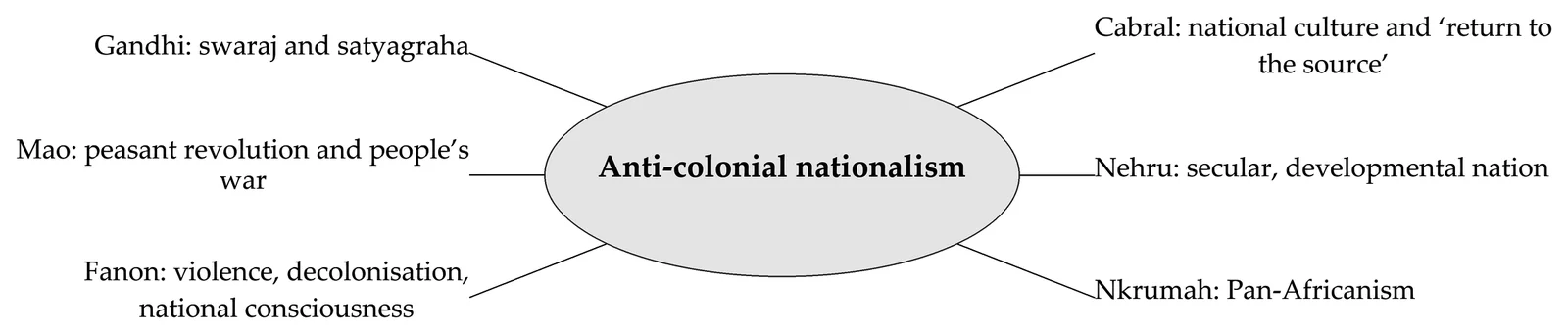
A. M.K. Gandhi: swaraj and satyagraha
Gandhi’s Hind Swaraj (1909) argued that India was enslaved not merely by the British but by modern civilisation, with its railways, lawyers, doctors and machinery. Swaraj meant not just home rule but self-rule over one’s own desires, and a moral and civilisational regeneration. His method of satyagraha, ‘holding on to truth’ through non-violent resistance, was developed in South Africa and used in Champaran (1917), the Non-Cooperation Movement (1920–22), the Salt March and Civil Disobedience (1930) and Quit India (1942). Gandhi turned nationalism into a mass movement of peasants, artisans and women, built Hindu–Muslim unity, campaigned against untouchability and promoted the constructive programme of khadi, village industry and self-reliance. Chatterjee calls Gandhi the ‘moment of manoeuvre’ in Indian nationalism, which mobilised the masses while keeping them under the leadership of the national movement.
B. Mao Zedong: peasant revolution and people’s war
Mao adapted Marxism to a semi-colonial, peasant society. In his Report on an Investigation of the Peasant Movement in Hunan (1927) he argued that the peasantry, not the small urban proletariat, was the main force of the revolution. In On New Democracy (1940) he proposed a united front of workers, peasants, the petty bourgeoisie and the national bourgeoisie against imperialism and feudalism, led by the Communist Party. His strategy of protracted people’s war, building rural base areas and encircling the cities from the countryside, combined national liberation from Japanese occupation with social revolution, leading to the People’s Republic of China in 1949. He famously declared that political power grows out of the barrel of a gun.
2.5 Fanon and Cabral
A. Frantz Fanon: violence and national consciousness
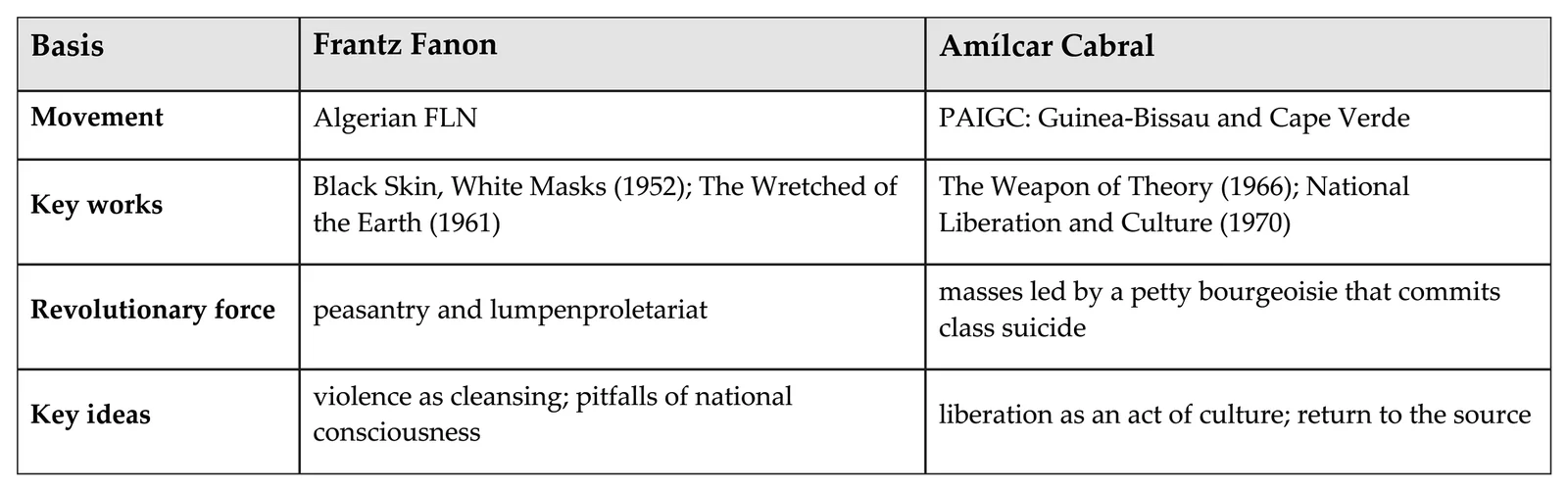
Frantz Fanon [फ़ानों] (1925–1961), a psychiatrist from Martinique who joined the Algerian liberation struggle, analysed the psychology of colonialism in Black Skin, White Masks (1952). In The Wretched of the Earth (1961) he described the colonial world as a Manichaean world cut in two, divided between settlers and natives. Decolonisation, he argued, is always a violent phenomenon, and violence by the colonised is a cleansing force that frees them from their inferiority complex and unites them as a people. Fanon saw the peasantry and the urban lumpenproletariat as revolutionary forces, and warned in ‘The Pitfalls of National Consciousness’ that the national bourgeoisie would simply replace the colonisers and act as intermediaries for foreign capital. National consciousness must therefore become social and political consciousness, leading to a new humanism.
B. Amílcar Cabral: culture and class suicide
Amílcar Cabral [काब्राल] (1924–1973), an agronomist who founded the PAIGC to free Guinea-Bissau and Cape Verde from Portuguese rule, based his strategy on a careful study of social structure. In ‘The Weapon of Theory’ (1966) he argued that national liberation is the recovery by a people of their own historical process, and that the revolutionary petty bourgeoisie must commit class suicide, giving up its class interests to identify with the workers and peasants. In ‘National Liberation and Culture’ (1970) he declared that national liberation is necessarily an act of culture, and called on the educated elite to ‘return to the source’ by reconnecting with the culture of the masses. In liberated areas the PAIGC built schools, clinics and people’s stores. Cabral was assassinated in January 1973, months before Guinea-Bissau declared independence.
2.6 Important Questions
- Question 1 Distinguish between civic and ethnic nationalism. Is the distinction tenable?
- Question 2 ‘The nation is an imagined community.’ Discuss with reference to Benedict Anderson and other theories of nationalism.
- Question 3 Discuss the ideological basis of anti-colonial nationalism with reference to Gandhi and Mao.
- Question 4 Examine the ideas of Frantz Fanon and Amílcar Cabral on anti-colonial nationalism.
DU asks the same idea in different words. So learn one broad answer for each question below; the same answer works for every question joined by OR.
Important Question 1
Distinguish between civic and ethnic nationalism. Is the distinction tenable?
OR
Critically examine Hans Kohn’s classification of Western and Eastern nationalism.
OR
‘Every nationalism is a mix of civic and ethnic elements.’ Discuss.
Model Answer
“The existence of a nation is a daily plebiscite, just as an individual’s existence is a perpetual affirmation of life.”
— Ernest Renan, ‘What is a Nation?’ (1882)
Introduction. Nationalism takes many forms, and one of the most influential ways of classifying them is the distinction between civic and ethnic nationalism. It asks a basic question: who belongs to the nation? Civic nationalism answers in terms of shared citizenship and political values, ethnic nationalism in terms of shared descent and culture. The distinction is widely used in comparative politics but has also been seriously criticised.
1. Meaning of Nation and Nationalism
A nation is a community of people who believe they share a common identity and destiny and who seek self-government. Nationalism is the sentiment and doctrine that the nation should be the basis of political loyalty and statehood. Gellner described it as the principle that the political and the national unit should be congruent. How membership of the nation is defined, by choice and citizenship or by birth and culture, is the core of the civic–ethnic distinction.
2. Kohn’s Classification
Hans Kohn, writing during the Second World War, distinguished a Western nationalism in Britain, France, the Netherlands, Switzerland and the United States from an Eastern nationalism in Germany, Central and Eastern Europe and Asia. Western nationalism grew in societies with a strong middle class and a state already in place; it was rational and liberal. Eastern nationalism arose where the state did not match the cultural nation, so intellectuals turned to language, folklore and history, producing a more emotional and authoritarian nationalism.
3. Civic Nationalism
In civic nationalism the nation is a political community of equal citizens bound by shared institutions, laws and values. Anyone who accepts the political creed can join, regardless of race, religion or language. Michael Ignatieff describes it as a nationalism that is democratic because it vests sovereignty in all the people. The French Declaration of the Rights of Man (1789) and the American Constitution are classic examples, and the US citizenship oath expresses allegiance to a constitution rather than to an ethnic group. Jürgen Habermas later described a similar idea as constitutional patriotism, loyalty to the principles of a democratic constitution rather than to a pre-political ethnic community.
4. Renan’s Idea
Ernest Renan rejected race, language, religion and geography as the basis of the nation. A nation, he argued, is a soul or spiritual principle made of two things: a rich legacy of shared memories and the present desire to live together. Its existence is therefore a daily plebiscite. Renan also noted that forgetting, including forgetting past violence, is essential to nation-building.
5. Ethnic Nationalism
In ethnic nationalism the nation is defined by common descent, language, culture or religion, and membership is inherited rather than chosen. Herder celebrated the distinct spirit of each people expressed in its language and folk culture, and Fichte appealed to the Germans as a people united by language under Napoleonic occupation. Ignatieff argues that ethnic nationalism holds that an individual’s deepest attachments are inherited, not chosen.
6. Consequences of the Two Types
Civic nationalism is associated with liberal democracy, equal citizenship and the integration of immigrants. Ethnic nationalism tends to treat minorities as outsiders, to demand cultural homogeneity and, in extreme cases, has justified expulsions and genocide, as in Nazi Germany or the wars in the former Yugoslavia in the 1990s, which Ignatieff witnessed.
7. Civic Nations Have Cultures
Critics such as Bernard Yack argue that civic nationalism is not purely political. Every civic nation has a common language, historical memories, symbols and myths that newcomers must learn. France’s civic nationalism required the assimilation of regional languages, and the USA long defined its nation in racial terms through slavery and restrictions on Asian immigration.
8. Ethnic Nations Have Politics
Equally, ethnic nations are not purely cultural; they are shaped by states, constitutions and political choices. Germany, often treated as the model of ethnic nationalism, reformed its citizenship law in 2000 to allow citizenship by birth in Germany, showing that the two types can change over time.
9. The Charge of Ethnocentrism
Rogers Brubaker and others argue that the dichotomy is normative as well as analytical: ‘civic’ is good and Western, ‘ethnic’ is bad and Eastern. This ignores the violence of Western colonial and racial history and the civic and inclusive character of many anti-colonial nationalisms, such as India’s, which defined the nation through common citizenship rather than one religion or language.
10. Indian Illustration
The Indian Constitution adopted a civic idea of nationhood based on equal citizenship and secularism, while debates over citizenship and religion show the continuing pull of cultural definitions. Most nationalisms combine civic and ethnic elements, and what matters is the balance between them and whether they include or exclude minorities.
Conclusion. Thus, the civic–ethnic distinction is useful for comparing how nations define membership, but it should be treated as a spectrum rather than a sharp dichotomy, since every nation mixes political and cultural elements.
Important Question 2
‘The nation is an imagined community.’ Discuss with reference to Benedict Anderson and other theories of nationalism.
OR
Critically examine modernist theories of nationalism.
OR
Discuss primordialist, modernist and ethno-symbolist approaches to nationalism.
Model Answer
“Nationalism is primarily a political principle, which holds that the political and the national unit should be congruent.”
— Ernest Gellner, Nations and Nationalism (1983)
Introduction. Why did nations and nationalism emerge, and why do people feel such intense loyalty to them? Scholars disagree whether nations are ancient and natural or modern and constructed. Benedict Anderson’s idea of the nation as an imagined community is one of the most influential answers. Umut Özkırımlı’s survey shows how it fits into a wider debate among primordialists, modernists, ethno-symbolists and newer approaches.
1. Primordialism
Primordialists see nations as natural and ancient communities rooted in kinship, language, religion and territory. Clifford Geertz spoke of primordial attachments that seem given and overpowering, and sociobiologists linked ethnic loyalty to kin selection. Primordialism explains the emotional power of nationalism, but critics say it cannot explain why national identities change, or why nationalism as a political doctrine appeared only in the late eighteenth century.
2. Modernism
Modernists argue that nations are products of modern conditions such as capitalism, industrialisation, the bureaucratic state and mass education. Nations did not create nationalism; nationalism created nations. Leading modernists include Gellner, Hobsbawm, John Breuilly, who saw nationalism as a form of politics aimed at state power, and Anderson. For modernists the key question is not how old a nation’s culture is, but why people began, in the modern era, to demand that culture and political power coincide.
3. Gellner
Gellner argued that agrarian societies had no need for national cultures, since elites and peasants lived in separate worlds. Industrial society requires a mobile, literate workforce sharing a standardised high culture, which only a state-run education system can provide. Nationalism is the demand that culture and polity coincide, and nations are created where it succeeds. Critics note that nationalism appeared in many agrarian societies, such as nineteenth-century Ireland or colonial India, before industrialisation, which weakens Gellner’s functional explanation.
4. Hobsbawm and Invented Traditions
Eric Hobsbawm and Terence Ranger, in The Invention of Tradition (1983), showed that many apparently ancient traditions, such as royal ceremonies or Scottish tartans, were recent inventions used by states and elites to create loyalty. In Nations and Nationalism since 1780 (1990), Hobsbawm argued that nations are dual phenomena, constructed from above but understood from below.
5. Anderson’s Definition
Anderson defined the nation as an imagined political community, imagined as both limited and sovereign. It is imagined because members will never meet most of their compatriots, yet feel communion with them; limited because it has finite boundaries; sovereign because it arose when dynastic and religious legitimacy was declining; and a community because it is felt as a deep, horizontal comradeship for which people are willing to die. Imagined does not mean false or fabricated: Anderson stressed that all communities larger than face-to-face villages are imagined, and they should be distinguished by the style in which they are imagined.

6. Cultural Roots and Print Capitalism
Anderson traced nationalism to the decline of sacred script communities and dynastic realms, and to a new sense of time as ‘homogeneous, empty time’. The key change was print capitalism: publishers seeking larger markets printed books and newspapers in vernacular languages, creating unified fields of communication. Reading the same newspaper at the same moment, people imagined themselves as members of a nation moving together through history.
7. Waves of Nationalism
Anderson argued that the first nations were in the Americas, where creole elites, born in the colonies and blocked from careers in Spain, imagined new nations. Linguistic nationalism followed in Europe, then official nationalism as dynasties adopted national identities, and finally the last wave in the colonies, where educated colonial subjects, moving through colonial schools and administrations, imagined their colonies as nations. The census, the map and the museum helped the colonial state shape these imaginings.
8. Criticisms of Anderson
Partha Chatterjee asked: if the colonised could only imagine nations in forms already supplied by Europe and the Americas, what was left for them to imagine? He showed that anti-colonial nationalism created its own sovereign inner domain of culture. Others criticise Anderson for neglecting the role of conflict, power and gender in shaping nations. Anthony D. Smith added that Anderson overstated the role of print and underestimated pre-modern religious and ethnic communities, which supplied much of the content of national imagination.
9. Ethno-symbolism
Anthony D. Smith argued that modernists ignore the older ethnic foundations of nations. Many nations were built on ethnies, communities with a common name, myths of descent, shared memories and attachment to a homeland. Nationalists selectively used these myths and symbols to mobilise people, which explains the emotional appeal that modernist theories struggle to account for.
10. Newer Approaches
Michael Billig’s Banal Nationalism (1995) showed how nationhood is reproduced daily through unnoticed symbols such as flags on public buildings and the use of ‘we’ in news. Feminist scholars such as Nira Yuval-Davis highlighted women’s role as symbolic bearers of the nation, while postcolonial scholars questioned Eurocentric theories.
Conclusion. Thus, Anderson’s idea of the imagined community shows that nations are historical and cultural creations, made possible by print capitalism and modern institutions. Combined with insights from Gellner, Smith and Chatterjee, it explains both the modernity of nations and the deep loyalties they inspire.
Important Question 3
Discuss the ideological basis of anti-colonial nationalism with reference to Gandhi and Mao.
OR
How did Gandhi transform Indian nationalism into a mass movement?
OR
Examine Mao’s ideas on peasant revolution and national liberation.
Model Answer
“Swaraj has to be experienced by each one for himself. What others get for me is not Home Rule but foreign rule.”
— M.K. Gandhi, Hind Swaraj (1909)
Introduction. Anti-colonial nationalism was the political response of colonised peoples to foreign domination. It drew on European ideas of nationhood and self-determination but gave them new meanings rooted in local culture and the experience of colonial exploitation. Gandhi in India and Mao in China offered two very different ideological bases for national liberation: one moral and non-violent, the other Marxist and revolutionary.
1. Nature of Anti-colonial Nationalism
Anti-colonial nationalism challenged the claim that colonised peoples were unfit to rule themselves. Partha Chatterjee argued that it was a derivative discourse, using European categories, yet it asserted its sovereignty first in the inner domain of culture, religion and family before contesting state power. It combined the demand for political independence with debates on social reform, economic development and the identity of the nation. Unlike European nationalism, which often grew within existing states, anti-colonial nationalism had to create a sense of nationhood among diverse peoples brought together only by colonial boundaries.
2. Gandhi’s Critique of Modern Civilisation
In Hind Swaraj (1909) Gandhi argued that India was enslaved not by British guns but by its own acceptance of modern civilisation, which he saw as materialistic, violent and driven by greed. Railways, lawyers and doctors, in his view, had weakened India. Expelling the British while keeping their civilisation would mean ‘English rule without the Englishman’.
3. Gandhi’s Idea of Swaraj
For Gandhi swaraj meant self-rule in the deepest sense: individual self-control over desires, moral regeneration, village self-sufficiency and decentralised political power, as well as freedom from British rule. National freedom had to be built from the bottom up through the self-discipline of each individual and the revival of village communities. He insisted on the unity of means and ends: a free and just India could not be won by violent or deceitful means, because the means would shape the society that followed.
4. Satyagraha and Mass Mobilisation
Gandhi’s method of satyagraha, non-violent resistance grounded in truth and self-suffering, allowed ordinary people to participate in the struggle. Through Champaran (1917), Non-Cooperation (1920–22), the Salt March (1930) and Quit India (1942), the Congress became a mass movement of peasants, workers, women and students. Simple symbols such as salt and khadi connected nationalism to everyday life.
5. Gandhi’s Social Vision
Gandhi linked nationalism to social reform: the abolition of untouchability, Hindu–Muslim unity, the uplift of women and the constructive programme of khadi, village industries and basic education. Chatterjee described Gandhi as the moment of manoeuvre, in which the peasantry was mobilised but kept within the bounds of the national movement, preparing the way for Nehru’s modern state.
6. Mao’s Adaptation of Marxism
Mao faced a country partly colonised by several powers and dominated by landlords. Classical Marxism expected revolution to be led by the industrial proletariat, but China’s working class was small. Mao adapted Marxism to Chinese conditions, a process later called the Sinification of Marxism, by placing the peasantry at the centre of the revolution.
7. Peasant Revolution
In his Report on an Investigation of the Peasant Movement in Hunan (1927), Mao predicted that hundreds of millions of peasants would rise like a mighty storm and sweep away imperialists, warlords and corrupt officials. After the Communists were driven from the cities, he built rural base areas, carried out land reform and created the Red Army, which survived the Long March (1934–35).
8. New Democracy and the United Front
In On New Democracy (1940) Mao argued that China first needed a new-democratic revolution against imperialism and feudalism, led by the Communist Party but based on a united front of four classes: workers, peasants, the petty bourgeoisie and the national bourgeoisie. During the war against Japan (1937–45) the Communists presented themselves as the most determined nationalists, combining national liberation with social revolution.
9. People’s War
Mao’s strategy of protracted people’s war relied on guerrilla warfare, the support of the rural population and the gradual encirclement of the cities from the countryside. He argued that political power grows out of the barrel of a gun and that the army must be under party control. This strategy brought victory in 1949 and inspired movements in Vietnam, Africa and Latin America.
10. Comparing Gandhi and Mao
Both mobilised peasants and fused nationalism with a vision of social change. But Gandhi rejected violence and modern industrial civilisation, seeking moral transformation and decentralisation, while Mao embraced armed struggle, class war and a centralised party-state committed to rapid industrialisation. Their contrast shows the range of ideological choices within anti-colonial nationalism.
Conclusion. Thus, Gandhi and Mao gave anti-colonial nationalism two powerful ideological bases: non-violent swaraj rooted in moral regeneration and Indian civilisation, and peasant revolution guided by Marxism. Both turned nationalism into a mass movement, though with very different means and outcomes.
Important Question 4
Examine the ideas of Frantz Fanon and Amílcar Cabral on anti-colonial nationalism.
OR
Discuss Fanon’s views on violence, the national bourgeoisie and national consciousness.
OR
‘National liberation is necessarily an act of culture.’ Discuss with reference to Cabral.
Model Answer
“Decolonization is always a violent phenomenon.”
— Frantz Fanon, The Wretched of the Earth (1961)
Introduction. The African liberation struggles of the 1950s–1970s produced two of the most original thinkers of anti-colonial nationalism. Frantz Fanon and Amílcar Cabral both analysed the social classes of colonised societies and asked who would lead national liberation and what kind of nation would emerge. H.B. Davis, in his study of Marxism and nationalism, treats them as theorists who adapted Marxism to African conditions.
1. Fanon’s Background
Frantz Fanon (1925–1961) was born in Martinique, fought for Free France in the Second World War and trained as a psychiatrist in France. Posted to a hospital in Algeria, he saw the psychological damage caused by colonial violence and joined the Algerian National Liberation Front (FLN). His works Black Skin, White Masks (1952) and The Wretched of the Earth (1961) became classics of decolonisation. Fanon resigned from his hospital post in 1956, saying that a psychiatrist could not help patients adjust to a society that was itself diseased by colonialism.
2. The Colonial World
Fanon described the colonial world as a Manichaean world cut in two: the settlers’ town, well-fed and lit, and the natives’ town, hungry and crowded. Colonialism dehumanised the colonised, treating them as the embodiment of evil, and was maintained by force. In Black Skin, White Masks he showed how colonial racism led black people to internalise a sense of inferiority.
3. Violence and Decolonisation
For Fanon, decolonisation is always a violent phenomenon because it replaces one species of men with another. Since colonialism was established and maintained by violence, it can only be overthrown by violence. At the individual level, violence is a cleansing force that frees the native from the inferiority complex and restores self-respect; at the collective level, it unites the people into a nation. Critics, including Hannah Arendt, objected to this glorification of violence. Jean-Paul Sartre’s preface to The Wretched of the Earth amplified this argument, while later readers stressed that Fanon also documented the psychological wounds that violence leaves on both sides.
4. Fanon on Social Classes
Fanon argued that in colonial Africa the urban working class was relatively privileged, while the peasantry had nothing to lose and was the truly revolutionary class. The lumpenproletariat of the shanty towns could also become a revolutionary force. Nationalist parties based in the towns often distrusted the peasants, which Fanon saw as a serious weakness.
5. The Pitfalls of National Consciousness
Fanon warned that the national bourgeoisie, lacking capital and productive capacity, would not develop the nation but would act as an intermediary for Western business, replacing the colonisers and enjoying their privileges. The single party and the cult of the leader would follow. To avoid this, national consciousness must be transformed into social and political consciousness, power must be decentralised and the people politically educated. Many post-independence African states, with their one-party regimes and military coups, seemed to confirm this warning.
6. National Culture and Humanism
Fanon traced the colonised intellectual’s path from assimilation to rediscovery of the past to active participation in the people’s struggle. National culture, he argued, is not a museum of traditions but the whole body of efforts made by a people to create and sustain itself in action. His goal was a new humanism, not a mere reversal of colonial hierarchies.
7. Cabral’s Background
Amílcar Cabral (1924–1973) was an agronomist from Guinea-Bissau and Cape Verde who studied in Lisbon. His agricultural survey of Guinea gave him detailed knowledge of rural society. In 1956 he founded the PAIGC, which waged an armed struggle against Portuguese rule from 1963. He was assassinated in Conakry in January 1973, and Guinea-Bissau declared independence later that year. Unlike Fanon, who wrote mainly as an analyst, Cabral was the leader of a liberation movement, so his ideas were tested directly in organising the struggle.
8. The Weapon of Theory and Class Suicide
In ‘The Weapon of Theory’ (1966), Cabral argued that imperialism had denied colonised peoples their own history, and that national liberation means the recovery of their own historical process by freeing their productive forces. Because the leadership of liberation movements comes from the petty bourgeoisie, it must commit class suicide, rejecting its class interests and identifying with the workers and peasants; otherwise it would betray the revolution.
9. National Liberation as an Act of Culture
In ‘National Liberation and Culture’ (1970), Cabral argued that culture is the basis of resistance, since colonial domination tries to suppress the culture of the dominated. National liberation is therefore necessarily an act of culture. The alienated educated elite must return to the source, reconnecting with the culture of the masses, while discarding negative elements of tradition. In liberated areas the PAIGC built schools, clinics and people’s stores.
10. Comparing Fanon and Cabral
Both rooted nationalism in the masses, distrusted the national bourgeoisie and saw culture as central to liberation. But Fanon emphasised violence and spontaneity, while Cabral stressed careful class analysis, disciplined political organisation and practical nation-building. Cabral was more cautious about the peasantry’s revolutionary spontaneity and insisted on concrete study of each society. Davis notes that both thinkers had to explain why the classical Marxist expectation of proletarian leadership did not fit African societies, and both answered by analysing the specific classes produced by colonialism.
Conclusion. Thus, Fanon and Cabral turned anti-colonial nationalism into a theory of social and cultural liberation, warning that independence would be hollow if new elites simply replaced the old colonisers. Their ideas remain relevant to debates on post-colonial states and the decolonisation of culture.
Short Notes
(a) Print capitalism
Benedict Anderson’s term for the combination of capitalism and printing technology that made national consciousness possible. Publishers seeking larger markets printed books and newspapers in vernacular languages, creating unified fields of communication and fixing languages. Readers of the same newspaper imagined themselves as part of a community of people they would never meet, which became the nation.
(b) Banal nationalism
Michael Billig’s concept (1995) for the everyday, unnoticed ways in which nationhood is reproduced in established nations: flags hanging on public buildings, national weather maps, sports coverage and the use of ‘we’ and ‘our country’ by politicians and newspapers. It shows that nationalism is not only found in extreme movements but in ordinary life.
(c) Class suicide
Amílcar Cabral’s idea that the petty bourgeoisie, which usually leads national liberation movements, must give up its own class interests and identify with the workers and peasants. Only by this ‘suicide’ as a class can it carry the revolution beyond the replacement of colonial rulers by a new privileged elite.
(d) Satyagraha
Gandhi’s method of non-violent resistance, literally ‘holding firmly to truth’. First used against racial laws in South Africa from 1906, it involves refusing to obey unjust laws, accepting punishment willingly and seeking to convert the opponent through self-suffering rather than to defeat or humiliate him. Its forms include non-cooperation, civil disobedience, fasting and boycott. Gandhi distinguished it from ‘passive resistance’, which he saw as a weapon of the weak, since satyagraha requires great courage and discipline.
(e) Ethno-symbolism
An approach associated with Anthony D. Smith and John Armstrong, which argues that modern nations are built on older ethnic communities, or ethnies, with shared myths of origin, memories, symbols and attachment to a homeland. It accepts that nationalism is modern but explains its emotional power by its roots in these pre-modern traditions.
More notes: DSC-11 Concepts in Comparative Political Analysis
These notes are prepared by PADHO TO AISE for study help. They are not an official University of Delhi publication.