
Generic Electives (GE) GE-9 Women and Politics in India: Concepts and Debates
Unit VI · 22 min read · Updated 27 Nov 2026
As per the University of Delhi (DU) Generic Elective (GE) syllabus offered by the Department of Political Science
Contents
- 6.1 Women and Work in India
- Features of Women’s Paid Work
- Why Is Women’s Participation Low
- 6.2 Unpaid Labour, Reproductive and Care Work
- Unpaid Work
- Swaminathan: Outside the Realm of Protective Legislation
- Recognise, Reduce, Redistribute
- Reproductive Work and Social Reproduction
- Tronto: Care as a Political Concept
- 6.3 Sex Work
- The Law in India
- Two Positions
- Voices of Sex Workers
- Courts and Rights
- 6.4 Important Questions
- Discuss the nature and problems of women’s work in India.
- Discuss the problem of women’s unpaid work in India.
- Discuss care as a political concept with reference to Joan Tronto.
- Examine the debate on sex work in India.
- Short Notes
वे कहते हैं यह प्रेम है। हम कहते हैं यह बिना मज़दूरी का काम है।
They say it is love. We say it is unwaged work.
— Silvia Federici, Wages against Housework (1975)
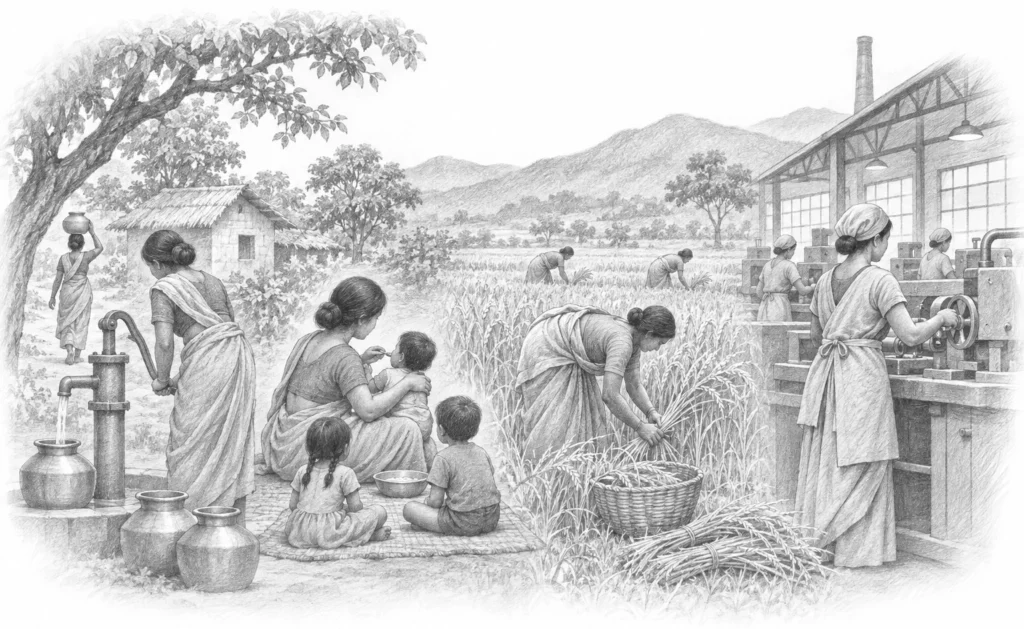
WWOMEN work long hours, in fields, factories, offices and above all in homes, cooking, cleaning, fetching water and caring for children, the sick and the elderly. Yet much of this work is unpaid, invisible in national statistics and outside the protection of labour laws. When women do paid work, they are concentrated in low-paid, insecure jobs. This chapter examines the nature of women’s work in India, the problem of unpaid labour, reproductive and care work and the idea of care as a political concept, and the contested debate on sex work.
6.1 Women and Work in India
Padmini Swaminathan, in her introduction to Women and Work (2012), argues that understanding women’s work requires looking beyond paid employment to the whole range of women’s activities, paid and unpaid, in the home and outside. Official statistics have long under-counted women’s work, since much of it takes place in households, family farms and informal enterprises.
Features of Women’s Paid Work
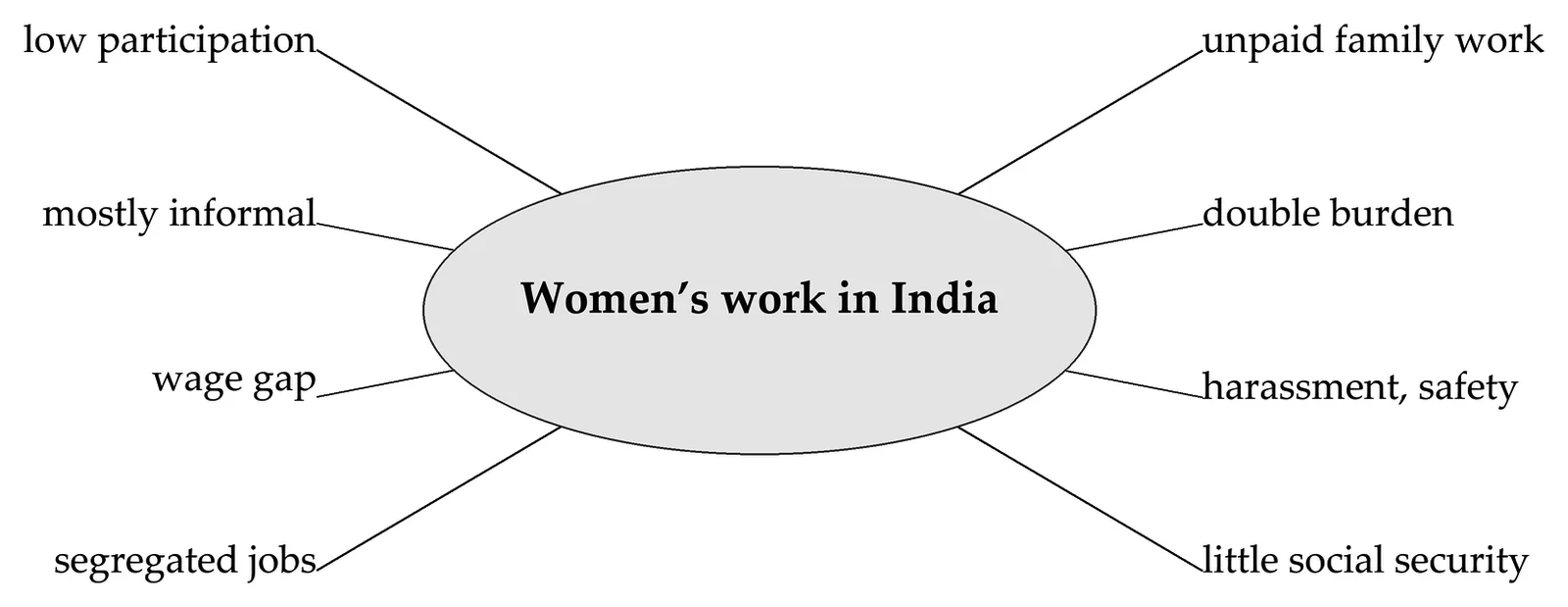
- Low participation. India’s female labour force participation has long been among the lowest in the world. According to the Periodic Labour Force Survey, it rose from about 23% in 2017–18 to around 40% by 2023–24, though much of the increase was in self-employment and unpaid work in family enterprises.
- Informality. The vast majority of working women are in the informal sector, in agriculture, home-based work, domestic service and construction, without contracts, minimum wages or social security.
- Wage gap. Women are paid less than men for similar work, despite Article 39(d) and the Equal Remuneration Act, 1976.
- Occupational segregation. Women are concentrated in jobs seen as extensions of domestic roles, such as teaching, nursing, care and domestic work, which are often low-paid.
- Feminisation of labour. Globalisation drew women into export industries such as garments and electronics, often on insecure terms, a process Jayati Ghosh describes in Never Done and Poorly Paid (2009).
- Double burden. Women who work outside the home still do most housework, carrying a double burden.
- Harassment and safety. Sexual harassment and lack of safe transport discourage women from paid work.
Why Is Women’s Participation Low
Explanations include social norms that see the home as women’s proper place and men as breadwinners, the burden of unpaid care, lack of suitable jobs near home, rising household incomes that allow women to withdraw from hard manual work, mechanisation of agriculture, and concerns about safety. Education has increased, but jobs for educated women have not kept pace. Feminist economists argue that the low participation rate also reflects the failure of statistics to count much of women’s work.
6.2 Unpaid Labour, Reproductive and Care Work
Unpaid Work
Unpaid work includes domestic work such as cooking, cleaning, washing, fetching water and fuel, and care work for children, the sick and the elderly. The System of National Accounts does not count household services produced for own use in GDP, so this work is economically invisible. India’s Time Use Survey of 2019 found that women spent nearly five hours a day on unpaid domestic services, compared with about an hour and a half for men.
Swaminathan: Outside the Realm of Protective Legislation
Padmini Swaminathan, in Outside the Realm of Protective Legislation: The Saga of Unpaid Work in India (2014), argues that labour laws in India protect only workers in paid employment, mainly in the organised sector, leaving unpaid workers entirely outside their protection. Women who do unpaid work at home or in family enterprises have no rights to wages, rest, safety or social security. She shows that unpaid work is not only a private family matter but a subsidy to the economy and the state, which rely on women to provide care that would otherwise have to be paid for. She argues that unpaid work must be recognised in law and policy.
Recognise, Reduce, Redistribute
The economist Diane Elson proposed a framework of three Rs: recognise unpaid work by measuring it and valuing it; reduce its drudgery through infrastructure such as piped water, clean cooking fuel, electricity and public services; and redistribute it, between women and men within households and between households and the state through childcare, elder care and paid leave. Indian schemes such as piped water connections and clean cooking gas have reduced some drudgery.
Reproductive Work and Social Reproduction
Reproductive work includes bearing and raising children and maintaining household members so that they can work. Marxist feminists argued that this work reproduces labour power and is essential for capitalism, though unpaid. In the 1970s, the Wages for Housework campaign, led by Selma James, Mariarosa Dalla Costa and Silvia Federici, demanded wages for housework to expose its value. Social reproduction theory today examines how the work of sustaining life, done mostly by women, underpins the whole economy. Issues such as surrogacy, regulated by the Surrogacy (Regulation) Act, 2021, which banned commercial surrogacy, show how reproduction itself can become a form of paid labour.
Tronto: Care as a Political Concept
Joan Tronto, in Care as a Political Concept (1996), and with Berenice Fisher, defined care broadly as a species activity that includes everything we do to maintain, continue and repair our world so that we can live in it as well as possible. She identified four phases of care: caring about (noticing a need), taking care of (assuming responsibility), care-giving (doing the work) and care-receiving (the response of the person cared for), linked to the moral qualities of attentiveness, responsibility, competence and responsiveness. Tronto argued that care has been devalued and assigned to women, the poor and racial minorities, while the powerful enjoy privileged irresponsibility, receiving care without recognising it. She argued that care should be a central political concept, since every person needs care, and that a just democracy must decide how care responsibilities are shared, a theme she developed in Caring Democracy (2013).

6.3 Sex Work
Sex work is one of the most contested issues in feminist politics. Feminists disagree on whether it is a form of exploitation and violence against women that should be abolished, or a form of work that should be decriminalised and protected by rights.
The Law in India
The Immoral Traffic (Prevention) Act, 1956 (originally the Suppression of Immoral Traffic Act, renamed in 1986) does not make sex work itself illegal, but criminalises related activities such as running a brothel, living on the earnings of sex work, soliciting in public places and procuring. In practice, sex workers face frequent police raids, extortion and violence, and rescue and rehabilitation operations often confine adult women against their will.
Two Positions
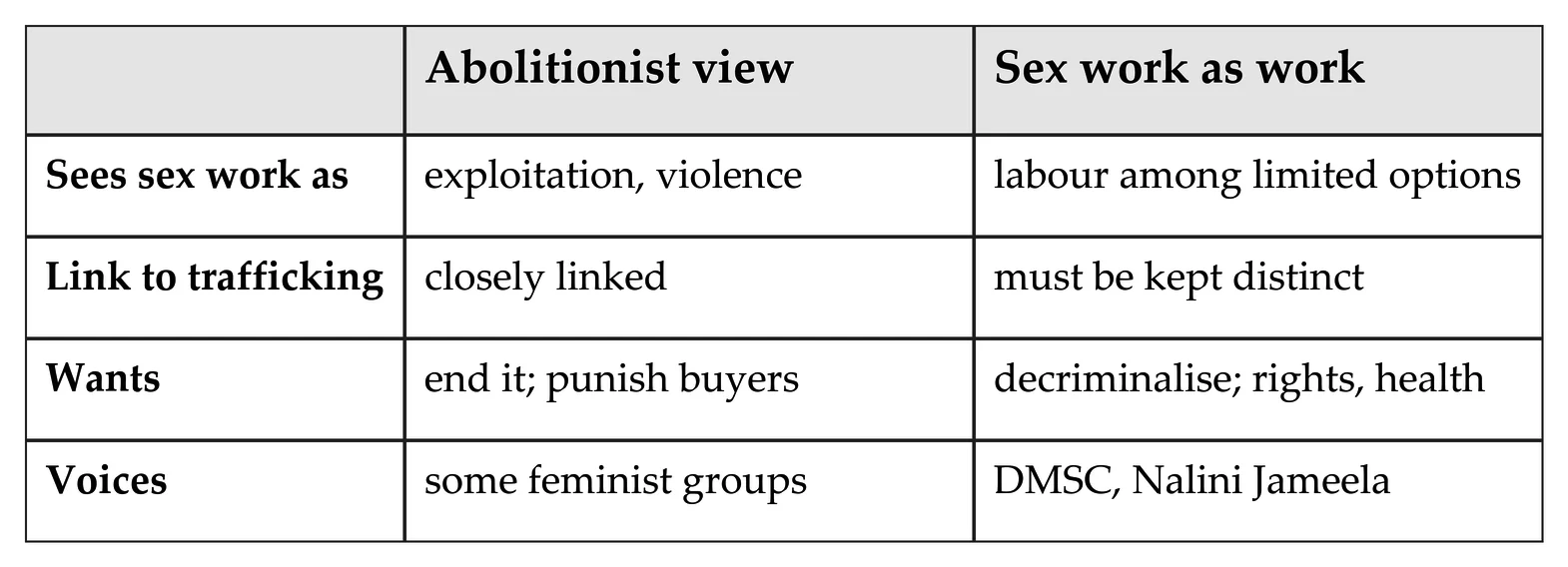
- Abolitionist view. It sees prostitution as inherently exploitative and a form of violence against women, closely linked to trafficking, poverty and patriarchy, and seeks to end it, sometimes through the Nordic model of criminalising buyers.
- Sex work as work. It sees sex work as a form of labour chosen by many adults among limited options, and argues that criminalisation increases violence and stigma. It calls for decriminalisation, labour rights, health services and a clear distinction between consensual adult sex work and trafficking.
Voices of Sex Workers
The Durbar Mahila Samanwaya Committee (DMSC), a collective of tens of thousands of sex workers based in Sonagachi, Kolkata, argues in Why the So-called Immoral Traffic (Prevention) Act of India Should Be Repealed (2011) that the Act harms sex workers by exposing them to police harassment, denying them rights and conflating sex work with trafficking. DMSC runs self-regulatory boards to prevent trafficking of minors and unwilling women, and its health programme against HIV/AIDS became an international model. Nalini Jameela, a sex worker from Kerala, in The Autobiography of a Sex Worker (Malayalam 2005, English 2007), describes her life with frankness, presenting sex work as a means of survival and independence, exposing the hypocrisy of society and the violence of the police, and demanding dignity rather than pity.
Courts and Rights
In Budhadev Karmaskar v. State of West Bengal, the Supreme Court directed measures for the rehabilitation of sex workers (2011) and, in 2022, held that sex workers are entitled to dignity under Article 21, directing that police should not harass or act against consenting adult sex workers. Debates continue over anti-trafficking bills, which sex workers’ groups criticise for treating all sex work as trafficking.
6.4 Important Questions
- Question 1 Discuss the nature and problems of women’s work in India.
- Question 2 Discuss the problem of women’s unpaid work in India.
- Question 3 Discuss care as a political concept with reference to Joan Tronto.
- Question 4 Examine the debate on sex work in India.
DU asks the same idea in different words. So learn one broad answer for each question below; the same answer works for every question joined by OR.
Important Question 1
Discuss the nature and problems of women’s work in India.
OR
Why is women’s labour force participation low in India? Discuss.
OR
Examine the feminisation of labour in India.
Model Answer
“That there is equal pay for equal work for both men and women.”
— Constitution of India, Article 39(d)
Introduction. Women in India work long hours, but much of their work is unpaid or under-counted, and their paid work is concentrated in low-paid, insecure jobs. Padmini Swaminathan and other feminist economists argue that understanding women’s work requires looking at the whole range of their activities and the structures that devalue them.
1. Swaminathan’s Approach
Swaminathan argues that women’s work must be understood beyond paid employment, including unpaid work in homes, family farms and informal enterprises.
2. Under-Counting
Official statistics have long under-counted women’s work, since much of it takes place in households and is not seen as economic activity.
3. Low Participation
India’s female labour force participation has been among the lowest in the world, though PLFS data show a rise from about 23% in 2017–18 to around 40% by 2023–24.
4. Quality of the Increase
Much of the recent rise has been in self-employment and unpaid work in family enterprises, rather than in secure, regular jobs.
5. Informality
The vast majority of working women are in the informal sector, without contracts, minimum wages, maternity benefits or social security.
6. Wage Gap
Women are paid less than men for similar work despite Article 39(d) and the Equal Remuneration Act, 1976, now part of the Code on Wages, 2019.
7. Occupational Segregation
Women are concentrated in jobs seen as extensions of domestic roles, such as teaching, nursing and domestic work, which are often undervalued and low-paid.
8. Feminisation of Labour
Globalisation drew women into export industries on insecure terms, and Jayati Ghosh describes women’s work as never done and poorly paid.
9. The Double Burden
Women who work outside the home still do most housework and care, carrying a double burden that limits their opportunities.
10. Social Norms
Norms that see the home as women’s place and men as breadwinners discourage women from paid work, especially in better-off families.
11. Safety and Harassment
Sexual harassment and unsafe public transport discourage women from working outside the home, despite the POSH Act of 2013.
12. Agriculture
Most rural women work in agriculture, but are rarely recognised as farmers since land is usually owned by men.
13. Maternity Benefits
The Maternity Benefit (Amendment) Act, 2017 extended paid leave to 26 weeks and required crèches, but it covers mainly the formal sector.
14. Education and Jobs
Women’s education has risen sharply, but suitable jobs for educated women have not kept pace, contributing to low participation.
15. Policy Needs
Feminist economists call for better statistics, social security for informal workers, public childcare, safe transport and equal pay enforcement.
16. Women and the Gig Economy
Women are increasingly employed through digital platforms in delivery, beauty and domestic services. Such work offers flexibility but little security, and the Code on Social Security, 2020 extended some protections to gig and platform workers for the first time.
17. Collective Organisation
Organisations such as SEWA, founded in 1972 by Ela Bhatt, organised self-employed women in the informal sector through unions and cooperatives, showing how women workers can gain bargaining power and social security through collective action.
18. Evaluation
Women’s work in India is extensive but undervalued, shaped by patriarchy, informality and the burden of unpaid care.
Conclusion. Thus, women’s work in India is marked by low and insecure participation, informality, wage gaps, occupational segregation and a double burden, as Swaminathan and Ghosh show. Realising Article 39(d)’s promise of equal pay requires recognising all of women’s work and addressing its structural causes.
Important Question 2
Discuss the problem of women’s unpaid work in India.
OR
Examine Padmini Swaminathan’s analysis of unpaid work.
OR
Discuss reproductive work and the idea of social reproduction.
Model Answer
“The conception that housemakers do not work or that they do not add economic value to the household is a problematic idea that has persisted for many years and must be overcome.”
— Supreme Court of India, Kirti v. Oriental Insurance Co. (2021)
Introduction. Women perform most of the unpaid domestic and care work that sustains families and the economy. This work is invisible in national accounts and outside the protection of labour laws. Feminists, including Padmini Swaminathan, argue that unpaid work must be recognised, reduced and redistributed.
1. Meaning of Unpaid Work
Unpaid work includes domestic chores such as cooking, cleaning and fetching water and fuel, and care for children, the sick and the elderly.
2. Invisibility in Statistics
The System of National Accounts excludes household services for own use from GDP, so women’s unpaid work is economically invisible.
3. Swaminathan’s Argument
Swaminathan argues that Indian labour laws protect only paid employment, leaving unpaid workers outside the realm of protective legislation.
4. Unpaid Work as Subsidy
She shows that unpaid work subsidises the economy and the state, which rely on women to provide care that would otherwise have to be paid for.
5. Contributing Family Workers
Many women work unpaid on family farms and enterprises; they are counted as workers but receive no income or rights.
6. Marxist Feminist View
Marxist feminists argued that domestic work reproduces labour power and is essential for capitalism, though it remains unpaid.
7. Wages for Housework
The Wages for Housework campaign of the 1970s, led by Selma James, Dalla Costa and Federici, demanded wages to expose the value of housework.
8. Social Reproduction
Social reproduction theory examines how the work of sustaining life, done mostly by women, underpins the whole economy.
9. Reproductive Labour and Surrogacy
Reproduction can itself become paid labour, as in commercial surrogacy, which India banned through the Surrogacy (Regulation) Act, 2021.
10. Recognise
Elson’s framework calls for recognising unpaid work through time use surveys and valuing it in policy and law.
11. Reduce
Drudgery can be reduced through piped water, clean cooking fuel, electricity and public services, as recent Indian schemes have attempted.
12. Redistribute
Unpaid work should be redistributed between women and men and between households and the state, through childcare, elder care and paid leave.
13. Courts on Homemakers
In Kirti v. Oriental Insurance (2021), the Supreme Court recognised the economic value of homemakers’ work in calculating compensation.
14. Consequences of Unpaid Work
The burden of unpaid work limits women’s education, paid employment, rest and political participation, reinforcing their dependence.
15. Debates
Some feminists worry that paying for housework could reinforce women’s confinement to the home, preferring public services and redistribution.
16. Time Use Survey Evidence
India’s first national Time Use Survey of 2019 found that women spent nearly five hours a day on unpaid domestic work, compared with under two hours for men, giving official evidence of the unequal burden of unpaid work.
17. Valuing Unpaid Work
Courts have recognised the economic value of homemakers’ work when calculating compensation in accident cases, as in Kirti v. Oriental Insurance (2021), where the Supreme Court said that the notion that homemakers do not work must be overcome.
18. Evaluation
Recognising unpaid work is essential to gender justice, since it reveals the hidden foundations of the economy and women’s subordination.
Conclusion. Thus, women’s unpaid domestic, care and reproductive work sustains families and the economy but remains invisible and outside labour laws, as Swaminathan shows. As the Supreme Court said in Kirti, the idea that homemakers do not work must be overcome, through recognising, reducing and redistributing unpaid work.
Important Question 3
Discuss care as a political concept with reference to Joan Tronto.
OR
Why should care be a political and not merely a private concern? Discuss.
OR
Examine the ethics of care.
Model Answer
“A species activity that includes everything that we do to maintain, continue, and repair our world so that we can live in it as well as possible.”
— Berenice Fisher and Joan Tronto, defining care (1990)
Introduction. Care, looking after children, the sick, the elderly and each other, is essential to human life, yet it is usually treated as a private, natural duty of women rather than as a public, political concern. Joan Tronto argues that care should be a central political concept, and that a just society must decide how care responsibilities are shared.
1. Care as Private Duty
Traditionally, care has been seen as a private matter of family and love, performed naturally by women, and therefore outside politics.
2. The Ethics of Care
Carol Gilligan’s In a Different Voice (1982) identified an ethics of care, based on relationships and responsibility, as distinct from an ethics of justice based on rules and rights.

3. Fisher and Tronto’s Definition
Fisher and Tronto defined care broadly as everything we do to maintain, continue and repair our world so that we can live in it as well as possible.
4. Caring About
The first phase, caring about, involves noticing that a need exists, which requires the moral quality of attentiveness.
5. Taking Care Of
The second phase, taking care of, involves assuming responsibility for meeting the need, requiring the quality of responsibility.
6. Care-Giving
The third phase, care-giving, is the actual work of meeting the need, which requires competence.
7. Care-Receiving
The fourth phase, care-receiving, is the response of the person cared for, which requires responsiveness to their needs and views.
8. Devaluation of Care
Tronto argues that care has been devalued and assigned to women, the poor and racial minorities, who receive little pay or recognition for it.
9. Privileged Irresponsibility
The powerful enjoy privileged irresponsibility: they receive care from others without recognising it or taking responsibility for it.
10. Care as Political
Tronto argues that since everyone needs care, care is a political issue, and democracy must decide how care responsibilities are allocated.
11. Caring Democracy
In Caring Democracy (2013), Tronto argued that democratic citizenship should include caring with others, sharing care responsibilities fairly.
12. Care Workers in India
In India, anganwadi workers, ASHAs and domestic workers, mostly women, provide much care for low pay, and their struggles show the politics of care.
13. Domestic Workers
Millions of domestic workers, mostly women from marginalised castes and migrant communities, lack legal protection, and the ILO Domestic Workers Convention of 2011 has not been ratified by India.
14. The Pandemic and Care
The Covid-19 pandemic revealed the importance of care work, as health workers, ASHAs and women at home carried enormous burdens.
15. Criticism
Critics warn that emphasising care may reinforce the association of women with caring, though Tronto insists that care must be shared by all.
16. Care and the Welfare State
The welfare state can socialise some care through public childcare, health services and pensions. Countries with strong public care services allow more women to work outside the home, showing that care is a matter of public policy, not only private duty.
17. Global Care Chains
Arlie Hochschild described global care chains, in which women from poorer countries migrate to care for children and the elderly in richer ones, while their own children are cared for by relatives at home. Indian nurses and domestic workers in the Gulf and the West form part of such chains, showing that care is organised globally along lines of gender, class and nationality.
18. Evaluation
Tronto’s argument transforms care from a private female duty into a public responsibility central to justice and democracy.
Conclusion. Thus, Tronto, with Fisher, defines care as everything we do to maintain and repair our world, identifies four phases of care, and criticises the privileged irresponsibility of the powerful. By making care a political concept, she argues that a just democracy must share care fairly among all.
Important Question 4
Examine the debate on sex work in India.
OR
Is sex work a form of work? Discuss with reference to the views of sex workers.
OR
Discuss the demand for the repeal of the Immoral Traffic (Prevention) Act.
Model Answer
“Notwithstanding the profession, every individual in this country has a right to a dignified life under Article 21 of the Constitution.”
— Supreme Court of India, Budhadev Karmaskar v. State of West Bengal (2022)
Introduction. Sex work divides feminists. Some see it as exploitation and violence against women that must be abolished; others, including sex workers’ own organisations, see it as work that should be decriminalised and protected by rights. In India, the Immoral Traffic (Prevention) Act and police practices shape sex workers’ lives, while collectives such as DMSC and writers such as Nalini Jameela have brought sex workers’ voices into the debate.
1. A Contested Issue
Sex work raises questions about choice, exploitation, sexuality, morality and labour, on which feminists hold sharply different views.
2. The Abolitionist View
Abolitionists see prostitution as inherently exploitative and a form of violence, linked to trafficking, poverty and patriarchy, and seek to end it.
3. Sex Work as Work
Others see sex work as labour chosen by many adults among limited options and argue for decriminalisation, rights and health services.
4. Sex Work and Trafficking
Sex workers’ groups insist on distinguishing consensual adult sex work from trafficking, which involves force, fraud or minors.
5. The ITPA
The Immoral Traffic (Prevention) Act, 1956 does not ban sex work itself but criminalises brothels, living on earnings, soliciting and procuring.
6. Effects of the Law
In practice, sex workers face police raids, extortion and violence, and rescue operations often confine adult women against their will.
7. DMSC
The Durbar Mahila Samanwaya Committee, a large collective of sex workers based in Sonagachi, Kolkata, demands the repeal of the ITPA.
8. DMSC’s Arguments
DMSC argues that the ITPA exposes sex workers to harassment, denies them rights and conflates sex work with trafficking.
9. Self-Regulatory Boards
DMSC runs self-regulatory boards to prevent the entry of minors and unwilling women, showing sex workers acting against trafficking themselves.
10. Health Programmes
DMSC’s HIV/AIDS programme in Sonagachi, which empowered sex workers to insist on condom use, became an international model of rights-based public health.
11. Nalini Jameela
Nalini Jameela’s Autobiography of a Sex Worker describes sex work as a means of survival and independence and exposes society’s hypocrisy.
12. Dignity, Not Pity
Jameela demands dignity rather than pity, criticising police violence and moral campaigns that treat sex workers as victims without agency.
13. The Supreme Court
In Budhadev Karmaskar, the Supreme Court held in 2022 that sex workers are entitled to dignity under Article 21 and that consenting adults should not be harassed by police.
14. Anti-Trafficking Bills
Sex workers’ groups have criticised anti-trafficking bills for treating all sex work as trafficking and expanding raids and rescues.
15. Middle Positions
Some feminists argue for decriminalising sex workers while fighting trafficking and expanding other livelihood options for poor women.
16. Health and Rights
Public health programmes against HIV/AIDS worked with sex workers’ collectives, such as the Sonagachi project begun in 1992, showing that empowering sex workers to negotiate condom use and organise was effective, and supporting a rights-based approach.
17. International Approaches
Countries follow different models: criminalisation of all parties, the Nordic model that criminalises buyers but not sellers, legalisation with regulation, and decriminalisation, as in New Zealand since 2003. Each model reflects a different view of sex work and agency.
18. Evaluation
The debate shows that listening to sex workers’ own voices is essential to policies that protect rights and dignity rather than increase harm.
Conclusion. Thus, abolitionists see sex work as exploitation, while sex workers’ collectives such as DMSC and writers such as Nalini Jameela see it as work deserving rights and dignity, and demand the repeal of the ITPA. The Supreme Court’s affirmation that every individual has a right to a dignified life supports a rights-based approach.
Short Notes
(a) Double burden
The situation of women who work outside the home but continue to do most of the unpaid domestic and care work at home.
(b) Privileged irresponsibility
Joan Tronto’s term for the way the powerful receive care from others without recognising it or taking responsibility for it.
(c) Durbar Mahila Samanwaya Committee
A collective of sex workers based in Sonagachi, Kolkata, that campaigns for sex workers’ rights and the repeal of the Immoral Traffic (Prevention) Act.
(d) Wages for Housework
A feminist campaign of the 1970s, led by Selma James, Mariarosa Dalla Costa and Silvia Federici, that demanded wages for housework in order to expose the economic value of women’s unpaid domestic labour.
More notes: GE-9 Women and Politics in India: Concepts and Debates
These notes are prepared by PADHO TO AISE for study help. They are not an official publication.