
Generic Electives (GE) GE-9 Women and Politics in India: Concepts and Debates
Unit I · 24 min read · Updated 27 Nov 2026
As per the University of Delhi (DU) Generic Elective (GE) syllabus offered by the Department of Political Science
Contents
- 1.1 Patriarchy and Feminism
- Patriarchy in India
- What Is Feminism
- Strands of Feminism
- Is Feminism about Women
- Tarabai Shinde
- 1.2 Sex-Gender Debates
- Why the Distinction Matters
- Questioning Sex Itself
- Gender Beyond the Binary in India
- 1.3 Public and Private Dichotomy, and Power
- The Public-Private Dichotomy
- The Personal Is Political
- Kosambi: Crossing the Threshold
- Feminist Understandings of Power
- 1.4 Important Questions
- What is patriarchy? How does feminism challenge it? Discuss with reference to India.
- Discuss the debates on the distinction between sex and gender.
- Examine the feminist critique of the public-private dichotomy.
- Discuss different conceptions of power and their significance for feminist politics.
- Short Notes
कोई स्त्री पैदा नहीं होती, बल्कि स्त्री बनती है।
One is not born, but rather becomes, a woman.
— Simone de Beauvoir, The Second Sex (1949)
WWHY do women in most societies earn less, own less property, hold fewer positions of power and do most of the unpaid work at home? Feminists answer that these are not natural facts but the result of patriarchy, a social system of male dominance. Feminism is both a body of ideas that explains this system and a movement that seeks to change it. This chapter explains the concepts of patriarchy and feminism, the sex-gender debates, the public-private dichotomy and the feminist understanding of power, drawing on Indian thinkers such as Nivedita Menon, V. Geetha, Uma Chakravarti and Tarabai Shinde.
1.1 Patriarchy and Feminism
Patriarchy literally means the rule of the father. In feminist theory it refers to a system of social structures and practices in which men dominate, oppress and exploit women. Kate Millett, in Sexual Politics (1970), argued that the relationship between the sexes is a political relationship of power, maintained through the family, ideology, education, religion, economy and force. Sylvia Walby, in Theorizing Patriarchy (1990), identified six structures of patriarchy: household production, paid work, the state, male violence, sexuality and cultural institutions, and distinguished private patriarchy, based in the household, from public patriarchy, based in employment and the state.
Patriarchy in India
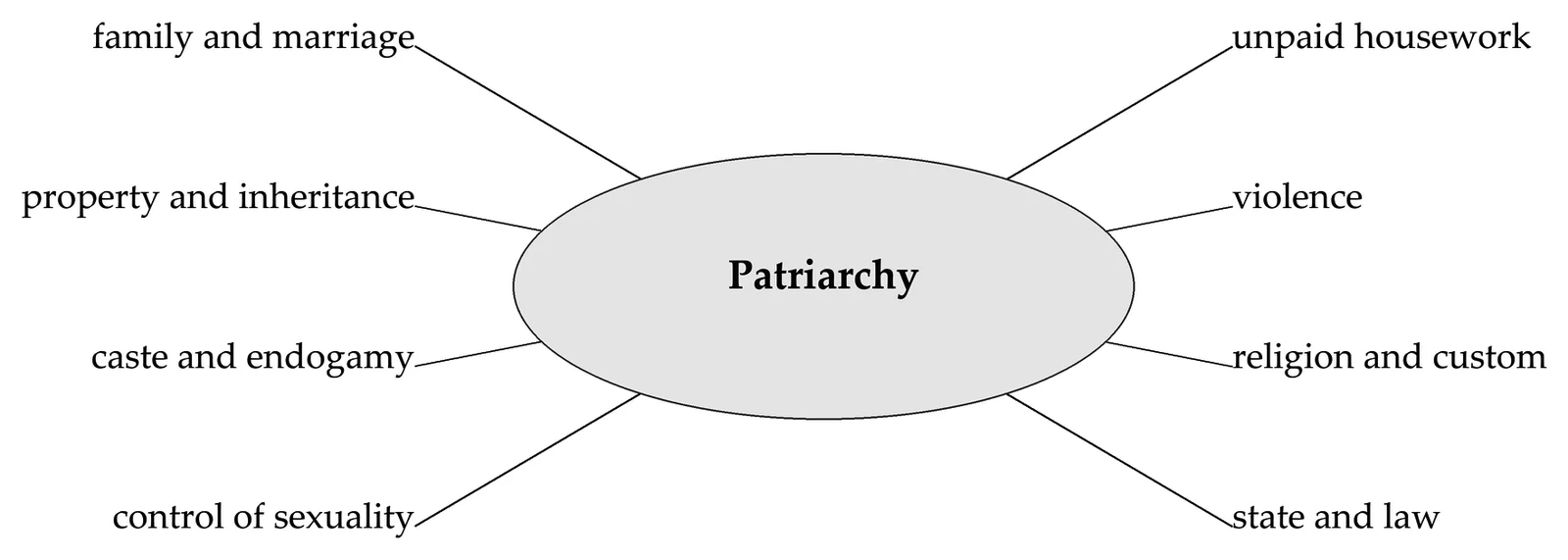
Uma Chakravarti, in her note on patriarchy (Pitrasatta par ek Note) and her work on brahmanical patriarchy, argues that in India patriarchy is closely tied to caste. Control over women’s sexuality, through early marriage, restrictions on widows and endogamy, was essential to maintaining the purity of caste and the transmission of property. Kumkum Sangari speaks of multiple patriarchies, since different religious communities, castes and classes have their own forms of patriarchal control, which often reinforce one another. Patriarchy thus operates through the family, marriage, property, religion, caste, the labour market and the state.
What Is Feminism
Rosalind Delmar, in What Is Feminism?, notes that feminism is hard to define because it includes many strands, but offers a broad starting point: a feminist is someone who holds that women suffer discrimination because of their sex, that they have specific needs which remain unsatisfied, and that meeting these needs requires a radical change in the social, economic and political order. bell hooks, in Feminism: A Movement to End Sexism, defines feminism as a movement to end sexist oppression, rather than a movement to make women equal to men, since men themselves are not equal across class and race. She argues that feminism must challenge the ideology of domination in all its forms and include women of all classes and races.
Strands of Feminism
- Liberal feminism. It seeks equal rights for women in law, education, employment and politics, as argued by Mary Wollstonecraft (1792) and J.S. Mill (1869).
- Radical feminism. It sees patriarchy as the root of women’s oppression, operating through sexuality, the body and the family.
- Socialist and Marxist feminism. It links women’s oppression to capitalism and class, and to the unpaid work women do in the home.
- Black and Dalit feminism. It insists that gender cannot be separated from race and caste, and that the experiences of the most marginalised women must be central.
Is Feminism about Women
Nivedita Menon, in Is Feminism about Women? (2015), argues that feminism is not simply about a fixed category called women. The idea of intersectionality, developed by Kimberlé Crenshaw (1989), shows that women experience oppression differently according to race, caste, class and sexuality. Menon argues that in India, identities such as caste and community were already politicised, so feminism had to engage with them from the start. For her, feminism is a way of looking at the world that questions how bodies, identities and hierarchies are produced, and it includes the struggles of Dalit women, Muslim women, queer and transgender people.
Tarabai Shinde
Tarabai Shinde’s Stree Purush Tulna (A Comparison between Women and Men, 1882) is one of the earliest feminist texts in India. Writing in Marathi after the case of a Brahmin widow sentenced for killing her child, she attacked the double standards by which men blamed women for every vice while excusing their own. She exposed patriarchal hypocrisy in religion, marriage and society, anticipating many later feminist arguments.
1.2 Sex-Gender Debates
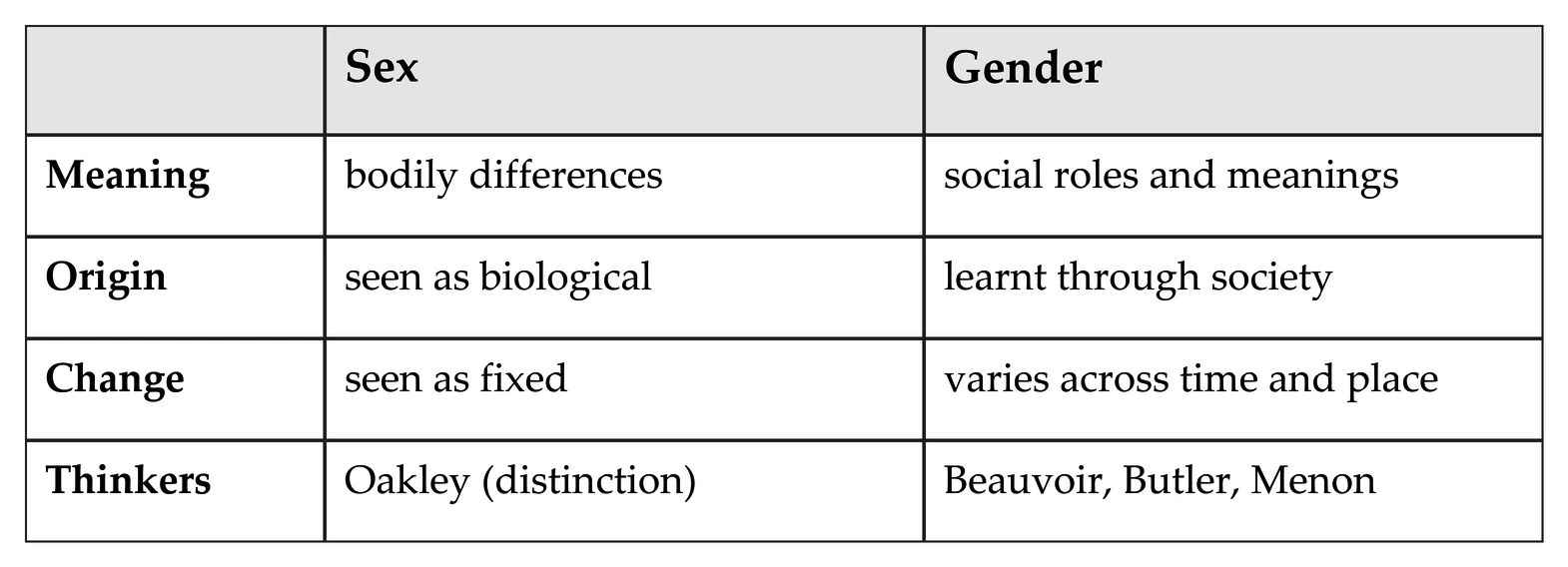
Feminists distinguish sex, the biological differences between male and female bodies, from gender, the social and cultural meanings, roles and expectations attached to being a man or a woman. Simone de Beauvoir, in The Second Sex (1949), wrote that one is not born, but rather becomes, a woman, meaning that womanhood is produced by society. Ann Oakley, in Sex, Gender and Society (1972), popularised the distinction, showing that gender roles vary across cultures and history and are therefore not determined by biology.
Why the Distinction Matters
- Against biological determinism. It challenges the claim that women’s inferior status is natural, since what is social can be changed.
- Variation across cultures. Tasks considered male in one society are female in another, showing that gender roles are learnt.
- Socialisation. Children learn gender through family, school, religion, media and games, from the toys they are given to the chores they are assigned.
- Gender as a social relation. V. Geetha, in Gender (2002), shows that gender is a relation of power that organises labour, property, sexuality and ritual, and in India is intertwined with caste.
Questioning Sex Itself
Later feminists questioned whether sex is purely natural. Judith Butler, in Gender Trouble (1990), argued that gender is performative: it is produced through the repeated performance of acts, gestures and styles, rather than expressing an inner essence. She also argued that our understanding of sex is itself shaped by gender norms. Nivedita Menon, in Gender (2008) and Seeing like a Feminist (2012), points to intersex people, born with bodies that do not fit typical male or female categories, to show that the two-sex model is a social classification imposed on human variety. She argues that the body is not simply a natural given but is shaped by medicine, law and culture.
Gender Beyond the Binary in India
In National Legal Services Authority v. Union of India (2014), the Supreme Court recognised transgender persons as a third gender with the right to self-identify their gender, and the Transgender Persons (Protection of Rights) Act was passed in 2019, though activists criticised its procedures. In Navtej Singh Johar (2018), the Court decriminalised consensual same-sex relations. These developments show how the sex-gender debates have entered law and politics.
1.3 Public and Private Dichotomy, and Power
The Public-Private Dichotomy
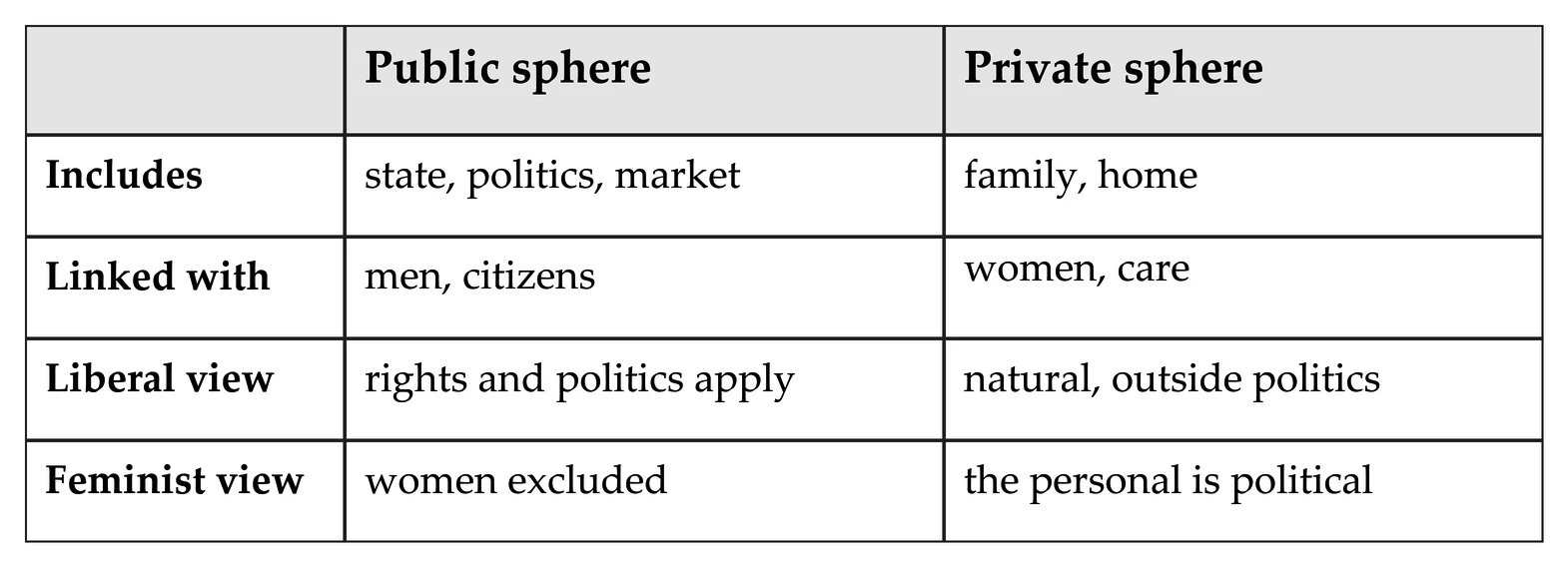
Liberal political theory, from John Locke onwards, separated the public sphere of the state, politics and the market, where citizens are equal and rights apply, from the private sphere of the family and home, seen as natural and outside politics. Feminists argue that this division is gendered: men are associated with the public sphere and women confined to the private, and by treating the family as private, liberal theory hides the power relations within it. Carole Pateman, in The Sexual Contract (1988), argued that the social contract of liberal theory rests on an earlier sexual contract that subordinates women to men.
The Personal Is Political
The slogan the personal is political, the title of an essay by Carol Hanisch (1970), expressed the radical feminist insight that problems women experience as personal, such as domestic violence, the division of housework, sexuality and reproduction, are in fact political, rooted in structures of power. This led feminists to demand laws on domestic violence, dowry and sexual harassment, and to question the idea that the state should not intervene in the family. In India, the exception for marital rape in the criminal law shows how the private sphere can shield violence.
Kosambi: Crossing the Threshold
Meera Kosambi, in Crossing the Threshold (2007), studies how women in colonial Maharashtra moved from the home into the public sphere in the late nineteenth century. Women such as Pandita Ramabai and Anandibai Joshi, who became one of the first Indian women to qualify as a doctor in 1886, crossed the threshold of the home through education, travel, writing and reform work, often facing fierce opposition. Kosambi shows that the boundary between public and private was historically constructed and contested, and that women’s entry into public life was itself a political struggle.
Feminist Understandings of Power
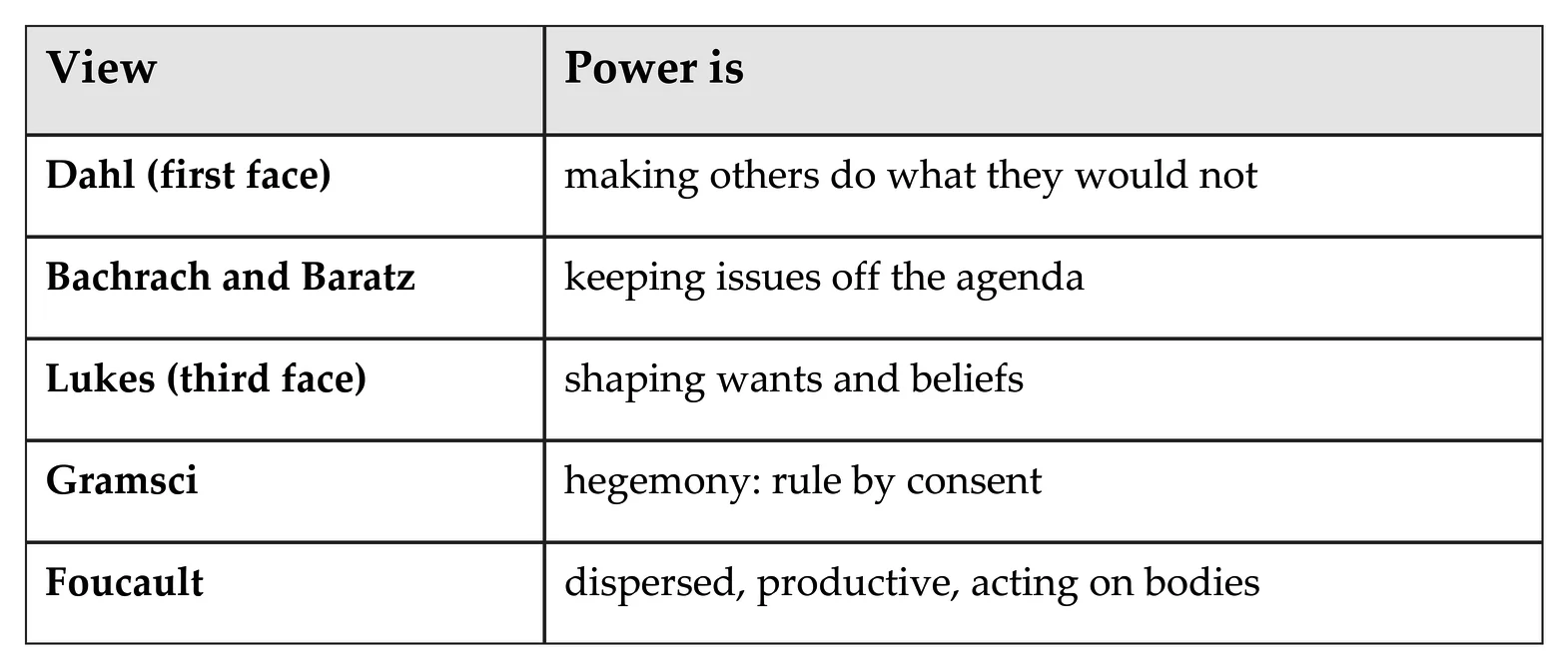
Nivedita Menon, in Power (2008), explains different ways of understanding power. Robert Dahl defined power as the ability of A to get B to do something B would not otherwise do, focusing on visible decisions. Bachrach and Baratz added a second face, the power to keep issues off the agenda through non-decision-making. Steven Lukes, in Power: A Radical View (1974), added a third dimension, the power to shape people’s very wants and beliefs so that they accept their subordination. Antonio Gramsci’s idea of hegemony describes rule through consent rather than force. Michel Foucault argued that power is not only repressive but productive, operating through everyday practices, institutions and knowledge, and that it is dispersed throughout society rather than held by one centre.
These ideas help feminists explain patriarchy. Women’s subordination is maintained not only by laws and force but by everyday practices, norms of beauty and modesty, the division of labour and beliefs that women themselves may accept, which Lukes and Gramsci help explain. Foucault’s idea of power acting on bodies helps explain the control of women’s sexuality and appearance. Feminists also stress power to, the capacity to act and change, and empowerment, through which women collectively challenge domination.
1.4 Important Questions
- Question 1 What is patriarchy? How does feminism challenge it? Discuss with reference to India.
- Question 2 Discuss the debates on the distinction between sex and gender.
- Question 3 Examine the feminist critique of the public-private dichotomy.
- Question 4 Discuss different conceptions of power and their significance for feminist politics.
DU asks the same idea in different words. So learn one broad answer for each question below; the same answer works for every question joined by OR.
Important Question 1
What is patriarchy? How does feminism challenge it? Discuss with reference to India.
OR
Explain the concept of patriarchy and its different forms.
OR
What is feminism? Discuss its main strands.
Model Answer
“Feminism is a movement to end sexist oppression.”
— bell hooks, Feminist Theory: From Margin to Center (1984)
Introduction. Patriarchy is the system of male dominance that shapes women’s lives in the family, the economy, religion and the state. Feminism is the body of thought and political movement that exposes patriarchy and seeks to end it. In India, patriarchy is closely bound up with caste and community, and Indian feminists have developed their own understandings of it.
1. Meaning of Patriarchy
Patriarchy literally means rule of the father. Feminists use it to describe a system of social structures and practices in which men dominate, oppress and exploit women.
2. Kate Millett
Millett argued in Sexual Politics (1970) that the relationship between the sexes is political, maintained through family, ideology, religion, economy and force.
3. Walby’s Six Structures
Walby identified six structures of patriarchy, household production, paid work, the state, male violence, sexuality and culture, and distinguished private from public patriarchy.
4. Brahmanical Patriarchy
Uma Chakravarti argued that in India patriarchy is tied to caste, as control over women’s sexuality through early marriage, endogamy and restrictions on widows preserved caste purity and property.
5. Multiple Patriarchies
Kumkum Sangari spoke of multiple patriarchies, since different communities, castes and classes have their own forms of patriarchal control, which often reinforce one another.
6. Patriarchy in Everyday Life
Patriarchy appears in son preference, dowry, unequal inheritance, the burden of housework, restrictions on mobility, violence and under-representation in politics.
7. Meaning of Feminism
Delmar suggests that a feminist holds that women suffer discrimination because of their sex and that ending it requires radical social, economic and political change.
8. bell hooks
bell hooks defined feminism as a movement to end sexist oppression, arguing that it must challenge all forms of domination and include women of every class and race.
9. Liberal Feminism
Liberal feminists such as Wollstonecraft and Mill sought equal rights for women in law, education, employment and politics.
10. Radical Feminism
Radical feminists see patriarchy as the root of women’s oppression, operating through sexuality, reproduction and the family, and coined the slogan the personal is political.
11. Socialist Feminism
Socialist feminists link women’s oppression to capitalism and class, and stress the unpaid domestic and care work that sustains the economy.
12. Dalit Feminism and Intersectionality
Dalit feminists such as Sharmila Rege argue that caste and gender must be analysed together, and Crenshaw’s intersectionality shows how oppressions combine.
13. Menon on Feminism
Menon argues that feminism is not only about a fixed category of women but a way of seeing how bodies, identities and hierarchies are produced.
14. Tarabai Shinde
Tarabai Shinde’s Stree Purush Tulna (1882) exposed the double standards of patriarchal morality, making her one of India’s earliest feminist writers.
15. Achievements of Feminism in India
Feminist movements have won laws on dowry, domestic violence, sexual harassment and inheritance, and reservation for women in local bodies and, from 2023, in legislatures.
16. Patriarchy and the State
The state has historically reinforced patriarchy through laws on marriage, property, citizenship and sexuality, such as colonial laws that treated wives as dependants. Feminists have therefore both used the state to win rights and criticised it, since law can also be used to police women in the name of protection.
17. Waves of Feminism
Feminism is often described in waves: a first wave in the nineteenth and early twentieth centuries for suffrage and legal rights, a second wave from the 1960s on sexuality, family and work, and a third wave from the 1990s stressing diversity and intersectionality. Indian feminism has its own history, from social reform to the autonomous movement of the 1970s.
18. Evaluation
Patriarchy is a resilient system that adapts to change, and feminism remains necessary to expose and challenge it in all its forms.
Conclusion. Thus, patriarchy is a system of male dominance operating through family, caste, religion, economy and the state, which in India takes the form of brahmanical and multiple patriarchies. Feminism, in bell hooks’ words a movement to end sexist oppression, challenges it through liberal, radical, socialist and Dalit perspectives.
Important Question 2
Discuss the debates on the distinction between sex and gender.
OR
One is not born, but rather becomes, a woman. Discuss.
OR
Is sex natural and gender social? Discuss with reference to Butler and Menon.
Model Answer
“There is no gender identity behind the expressions of gender; that identity is performatively constituted by the very expressions that are said to be its results.”
— Judith Butler, Gender Trouble (1990)
Introduction. One of the most important contributions of feminist theory is the distinction between sex and gender. It showed that many differences between men and women are not natural but social, and can therefore be changed. Later feminists went further and questioned whether sex itself is purely natural. These debates have important consequences for law and politics in India.
1. Sex and Gender Defined
Sex refers to biological differences between male and female bodies, while gender refers to the social meanings, roles and expectations attached to being a man or a woman.
2. Simone de Beauvoir
Beauvoir wrote in The Second Sex (1949) that one is not born, but rather becomes, a woman, meaning that womanhood is produced by society and treated as the other of man.
3. Ann Oakley
Oakley’s Sex, Gender and Society (1972) popularised the distinction, showing that gender roles vary across cultures and history and are not fixed by biology.
4. Against Biological Determinism
The distinction challenged the claim that women’s subordination is natural, since roles that are social can be changed through politics and law.
5. Gender Socialisation
Children learn gender through family, school, religion, media and games, from the toys they are given to the household tasks they are assigned.
6. V. Geetha on Gender
V. Geetha shows that gender is a relation of power organising labour, property, sexuality and ritual, and in India it is intertwined with caste.
7. Judith Butler
Butler argued in Gender Trouble (1990) that gender is performative, produced through repeated acts and styles rather than expressing an inner essence.
8. Sex as Gendered
Butler also argued that our understanding of sex is itself shaped by gender norms, so the line between natural sex and social gender is blurred.
9. Menon on the Body
Menon argues that the body is shaped by medicine, law and culture, and that the two-sex model is a social classification imposed on human variety.
10. Intersex Persons
Menon points to intersex people, whose bodies do not fit typical male or female categories, to show that sex is not a simple binary given by nature.
11. Transgender Rights
In NALSA (2014), the Supreme Court recognised transgender persons as a third gender with the right to self-identify, and Parliament passed a law on their rights in 2019.
12. Sexuality and Law
In Navtej Singh Johar (2018), the Supreme Court decriminalised consensual same-sex relations, recognising diverse sexualities.
13. Criticism of the Distinction
Some feminists warn that questioning the category of women may weaken the political movement for women’s rights, which needs a shared identity.
14. Strategic Use
Others argue that feminists can use the category of women strategically while recognising its diversity and constructed nature.
15. Indian Context
In India, gender intersects with caste, class and religion, so the experience of being a woman differs greatly between a Dalit labourer and an upper-caste professional.
16. Masculinities
The sex-gender distinction also applies to men. R.W. Connell’s idea of hegemonic masculinity shows that dominant forms of manhood, linked to strength, control and breadwinning, are socially produced and harm both women and men who do not conform to them.
17. Gender in Everyday Language
Language reflects and reproduces gender norms, as when words for professions assume men, or when insults target women’s sexuality. Feminist attention to language shows how ordinary speech makes gender roles seem natural, supporting the argument that gender is socially constructed.
18. Evaluation
The sex-gender debates show that much of what is seen as natural is social and political, opening possibilities for change and for recognising diverse identities.
Conclusion. Thus, the sex-gender distinction, from Beauvoir and Oakley, showed that gender is social and changeable, while Butler and Menon questioned whether sex itself is natural, arguing that gender is performative and the body socially shaped. These debates have shaped Indian law on transgender and sexual rights.
Important Question 3
Examine the feminist critique of the public-private dichotomy.
OR
The personal is political. Discuss.
OR
Discuss the public-private divide with reference to women in colonial India.
Model Answer
“The personal is political.”
— Carol Hanisch, title of her essay (1970)
Introduction. Liberal political theory divides social life into a public sphere of politics and the market and a private sphere of the family. Feminists argue that this division is gendered, confining women to the home and hiding the power relations within it. The slogan the personal is political captures their claim that the family and personal life are sites of power that politics must address.
1. The Liberal Division
From Locke onwards, liberal theory separated the public sphere of the state and market, where citizens are equal, from the private sphere of the family, seen as natural and outside politics.
2. A Gendered Division
Feminists argue that men are associated with the public sphere and women confined to the private, so the division reinforces male dominance.
3. Hiding Power
By treating the family as private, liberal theory hides relations of power within it, such as control over money, decisions and women’s bodies.
4. Pateman’s Sexual Contract
Carole Pateman argued that the liberal social contract rests on a prior sexual contract that subordinates women to men in marriage and the family.
5. The Personal Is Political
Carol Hanisch’s slogan expressed the radical feminist insight that problems experienced as personal, such as housework, sexuality and violence, are rooted in structures of power.
6. Domestic Violence
Treating the home as private allowed domestic violence to remain hidden. Feminist campaigns led to Section 498A of the Indian Penal Code (1983) and the Protection of Women from Domestic Violence Act, 2005.
7. Unpaid Work
The private sphere hides women’s unpaid domestic and care work, which sustains families and the economy but is not counted as work.
8. Marital Rape
The exception for marital rape in the criminal law shows how the private sphere can shield violence, and feminists have campaigned for its removal.
9. Kosambi’s Study
Meera Kosambi showed how women in colonial Maharashtra crossed the threshold of the home into the public sphere through education, writing and reform work.
10. Pandita Ramabai and Anandibai Joshi
Pandita Ramabai’s work for widows and Anandibai Joshi’s qualification as a doctor in 1886 show women entering public life against fierce opposition.
11. Nationalism and the Home
Partha Chatterjee showed that nationalists made the home an inner, spiritual domain to be preserved by women, giving the private sphere a nationalist meaning.
12. Historical Construction
Kosambi’s work shows that the boundary between public and private is historically constructed and changes through women’s struggles.
13. Value of Privacy
Some feminists note that privacy can also protect women, for example in decisions about their bodies, as recognised in Puttaswamy (2017).
14. Adultery Law
In Joseph Shine (2018), the Supreme Court struck down the adultery law, holding that it treated women as the property of their husbands.
15. Limits of State Intervention
Feminists also caution that state intervention in the family can be used to police women and communities, so it must be guided by women’s own voices.
16. Women in Public Life
Despite constitutional equality, women remain under-represented in public life. Their share in the Lok Sabha has been around one-seventh, and the 106th Amendment of 2023 reserving one-third of seats for women is an attempt to change this, though it takes effect only after delimitation.
17. Women and Public Spaces
Studies such as Why Loiter? (2011) by Shilpa Phadke, Sameera Khan and Shilpa Ranade show that women’s access to public spaces in Indian cities is restricted by fear and norms of respectability, and argue for women’s right to be in public for pleasure, not only for work.
18. Evaluation
The feminist critique has transformed political thinking by bringing the family and personal life within the scope of justice and politics.
Conclusion. Thus, feminists argue that the liberal public-private dichotomy is gendered and hides power in the family, as Pateman’s sexual contract shows. Hanisch’s slogan that the personal is political led to laws against domestic violence and dowry, and Kosambi shows how Indian women crossed the threshold into public life.
Important Question 4
Discuss different conceptions of power and their significance for feminist politics.
OR
Examine Nivedita Menon’s discussion of power.
OR
How does Foucault’s idea of power help us understand patriarchy?
Model Answer
“A has power over B to the extent that he can get B to do something that B would not otherwise do.”
— Robert A. Dahl, The Concept of Power (1957)
Introduction. Power is a central concept in politics, and feminists see patriarchy as a system of power. But how should power be understood: as visible coercion, as control of the agenda, as shaping of beliefs, or as a dispersed network of practices? Nivedita Menon’s discussion of these conceptions shows how each helps explain women’s subordination and resistance.
1. Power as a Political Concept
Power is commonly understood as the ability to influence others or to achieve outcomes, and politics is often defined as the struggle for power.
2. Dahl’s First Face
Dahl defined power as A getting B to do something B would not otherwise do, focusing on observable decisions and conflicts.
3. Bachrach and Baratz
Bachrach and Baratz identified a second face of power, the ability to keep issues off the agenda through non-decision-making, as when women’s concerns were ignored in politics.
4. Lukes’s Third Dimension
Lukes argued that the most effective power shapes people’s wants and beliefs so that they accept their subordination without conflict.
5. Gramsci’s Hegemony
Gramsci described hegemony as rule through consent, achieved through institutions such as family, religion, schools and media that make domination seem natural.
6. Foucault’s View
Foucault argued that power is not only repressive but productive, creating identities and knowledge, and that it is dispersed throughout society rather than held by one centre.
7. Disciplinary Power
Foucault showed how disciplinary power works through surveillance and norms that shape bodies and behaviour, in schools, prisons, hospitals and families.
8. Menon’s Discussion
Menon explains these conceptions and shows that feminist politics requires attention to power in its visible, hidden and everyday forms.
9. Patriarchy as Visible Power
Patriarchy operates through visible power, such as laws that discriminated against women and violence used to control them.
10. Patriarchy and the Agenda
It also works by keeping women’s issues off the political agenda, as when domestic violence was treated as a private matter.
11. Patriarchy and Consent
Women may accept norms of modesty, sacrifice and domestic duty as natural, illustrating Lukes’s third dimension and Gramsci’s hegemony.
12. Power over Bodies
Foucault’s ideas help explain how women’s bodies are disciplined through norms of beauty, dress and sexuality enforced by families, media and medicine.
13. Power To and Empowerment
Feminists distinguish power over others from power to act, and see empowerment as women’s collective capacity to challenge domination and change their lives.
14. Resistance
Foucault noted that where there is power there is resistance, and women resist through movements, everyday defiance and new forms of identity.
15. Indian Examples
Women’s self-help groups, the anti-arrack movement in Andhra Pradesh in the early 1990s and campaigns against dowry show women exercising collective power.
16. Power and Knowledge
Foucault argued that power and knowledge are linked: those who define what counts as true, as in medicine, law and science, exercise power. Feminists showed how medical and scientific knowledge long treated women’s bodies as abnormal or weak, justifying their exclusion.
17. Empowerment in Policy
The idea of women’s empowerment entered Indian policy with the National Policy for the Empowerment of Women (2001), and schemes such as self-help groups and reservation in panchayats. Feminists warn that empowerment can become a slogan if it ignores structural inequality and women’s collective power.
18. Evaluation
Different conceptions of power together explain how patriarchy works and how it can be challenged, making them essential for feminist politics.
Conclusion. Thus, power has been understood as Dahl’s ability to make others act, as control of the agenda, as Lukes’s shaping of beliefs, as Gramsci’s hegemony and as Foucault’s dispersed and productive power. Menon shows that all these help feminists understand patriarchy and build women’s power to resist and change it.
Short Notes
(a) Brahmanical patriarchy
Uma Chakravarti’s term for the form of patriarchy in India in which control over women’s sexuality is tied to maintaining caste purity and property.
(b) Intersectionality
Kimberlé Crenshaw’s concept (1989) that forms of oppression such as gender, race, caste and class intersect and shape each person’s experience differently.
(c) Performativity
Judith Butler’s idea that gender is produced through repeated acts and styles rather than expressing a natural inner identity.
(d) The personal is political
A slogan of second-wave feminism, from the title of Carol Hanisch’s essay of 1970, expressing the idea that problems women experience in personal life, such as housework, sexuality and domestic violence, are rooted in structures of power and are therefore political.
More notes: GE-9 Women and Politics in India: Concepts and Debates
These notes are prepared by PADHO TO AISE for study help. They are not an official publication.