
Generic Electives (GE) GE-9 Women and Politics in India: Concepts and Debates
Unit III · 23 min read · Updated 27 Nov 2026
As per the University of Delhi (DU) Generic Elective (GE) syllabus offered by the Department of Political Science
Contents
- 3.1 Feminist Perspectives on the State
- Liberal Feminism and the State
- MacKinnon: The Liberal State
- Other Perspectives
- The Women’s Movement and the State
- 3.2 Women, Equality and the Constitution
- Constitutional Provisions
- Kapur and Cossman: Through the Looking Glass of Feminism
- Cases
- 3.3 Criminal Law, Personal Laws and Women
- Ved Kumari: Gender Analysis of the Penal Code
- Personal Laws
- MacKinnon on Sex Equality in India
- Reforms and Debates
- 3.4 Important Questions
- Is the state patriarchal? Discuss feminist perspectives on the state with reference to MacKinnon.
- Discuss the constitutional provisions for women’s equality and the different approaches to equality adopted by Indian courts.
- Examine the gender assumptions of the Indian criminal law and the reforms demanded by the women’s movement.
- Discuss the debate on personal laws and sex equality in India.
- Short Notes
नारीवादी अर्थ में राज्य पुरुष है: क़ानून स्त्रियों को उसी तरह देखता और बरतता है जैसे पुरुष स्त्रियों को देखते और बरतते हैं।
The state is male in the feminist sense: the law sees and treats women the way men see and treat women.
— Catharine A. MacKinnon, Toward a Feminist Theory of the State (1989)
TTHE Indian Constitution promises equality to women, and Parliament has passed many laws against dowry, domestic violence and sexual harassment. Yet women’s experience of the law and the state is mixed. Laws can protect and empower, but they can also reflect male assumptions, treat women as dependants or as property, and be enforced by institutions that disbelieve women. This chapter examines feminist theories of the state, the meaning of equality in the Constitution, the gender assumptions of criminal law, and the debate on personal laws.
3.1 Feminist Perspectives on the State
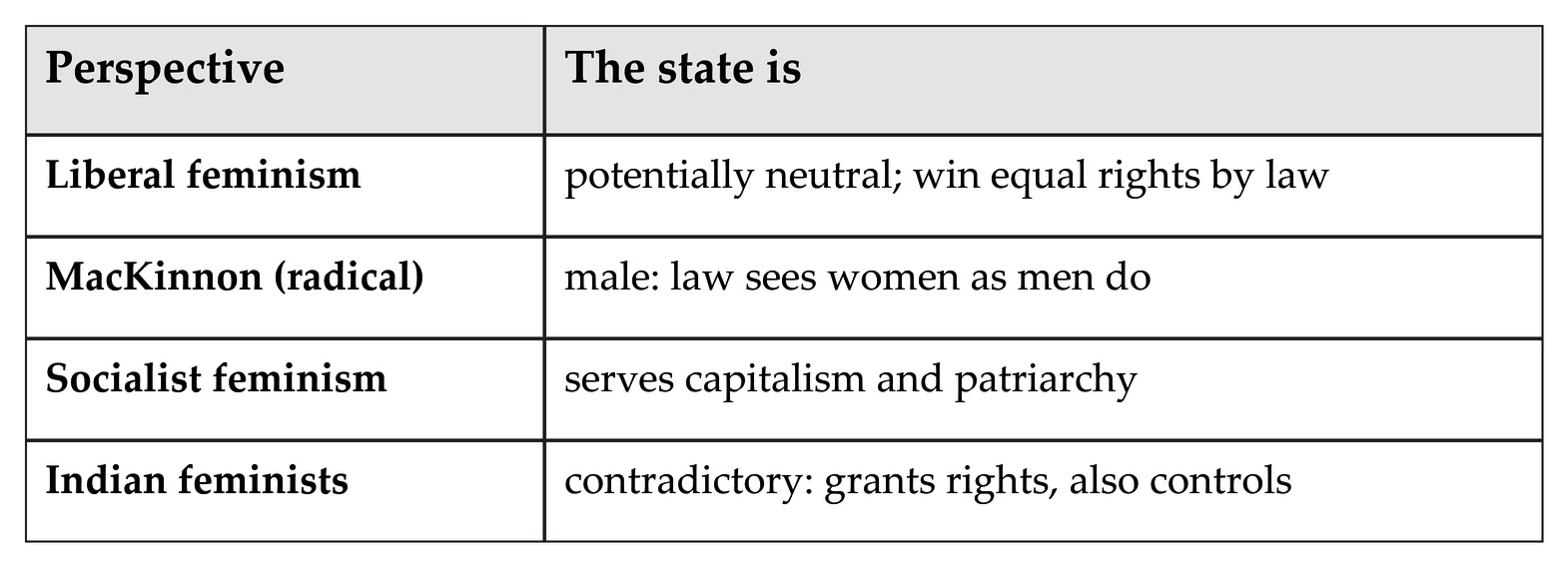
The state is the institution that makes and enforces laws. Feminists ask whether the state is a neutral arbiter that can deliver equality to women, or whether it is itself shaped by patriarchy. Different feminist traditions answer differently.
Liberal Feminism and the State
Liberal feminists see the state as potentially neutral. They seek equal rights for women through law: the vote, equal pay, access to education and employment, and the removal of discriminatory laws. The state is the main instrument of reform, and the problem is that it has not yet treated women equally.
MacKinnon: The Liberal State
Catharine MacKinnon, in the chapter The Liberal State of Toward a Feminist Theory of the State (1989), argues that the state is male in a feminist sense: the law sees and treats women the way men see and treat women. The liberal state claims to be neutral and objective, but its standards are based on men’s experience and point of view. For example, rape law has asked whether the woman consented as judged from the man’s perspective, and has treated the home as a private sphere beyond the law’s reach. Because the state’s point of view is male, its claim to objectivity hides male power. MacKinnon argues that equality requires not sameness of treatment but the end of sexual hierarchy, and that law should be judged by whether it challenges or reinforces women’s subordination.
Other Perspectives
- Marxist and socialist feminists see the state as serving both capitalism and patriarchy, for example by relying on women’s unpaid work in the family.
- Post-structuralist feminists, influenced by Foucault, see the state not as a single male entity but as a set of institutions and discourses that produce gendered subjects in different ways.
- Indian feminists such as Ratna Kapur and Nivedita Menon stress that the state is contradictory: it has passed progressive laws under pressure from the women’s movement, but it also acts through police, courts and bureaucracies that often disbelieve and harass women.
The Women’s Movement and the State
The Indian women’s movement has had an ambivalent relationship with the state. It has demanded laws and institutions, such as the National Commission for Women (1990), laws against dowry and domestic violence, and reservation in local bodies. But it has also learnt that laws are often poorly implemented, that the state can use protective laws to control women, and that it can itself be a perpetrator of violence, as in custodial rape. The challenge is to use the state while remaining critical of it.
3.2 Women, Equality and the Constitution
Constitutional Provisions
- Article 14 guarantees equality before the law and the equal protection of the laws.
- Article 15(1) prohibits discrimination on grounds of sex, and Article 15(3) allows the state to make special provisions for women and children.
- Article 16 guarantees equality of opportunity in public employment.
- Article 39(a) and (d) direct the state to secure an adequate means of livelihood for men and women equally and equal pay for equal work, and Article 42 provides for maternity relief.
- Article 51A(e) makes it a fundamental duty to renounce practices derogatory to the dignity of women.
- Articles 243D and 243T reserve one-third of seats in panchayats and municipalities for women, and the 106th Amendment (2023) provides for one-third reservation in the Lok Sabha and state assemblies.
Kapur and Cossman: Through the Looking Glass of Feminism
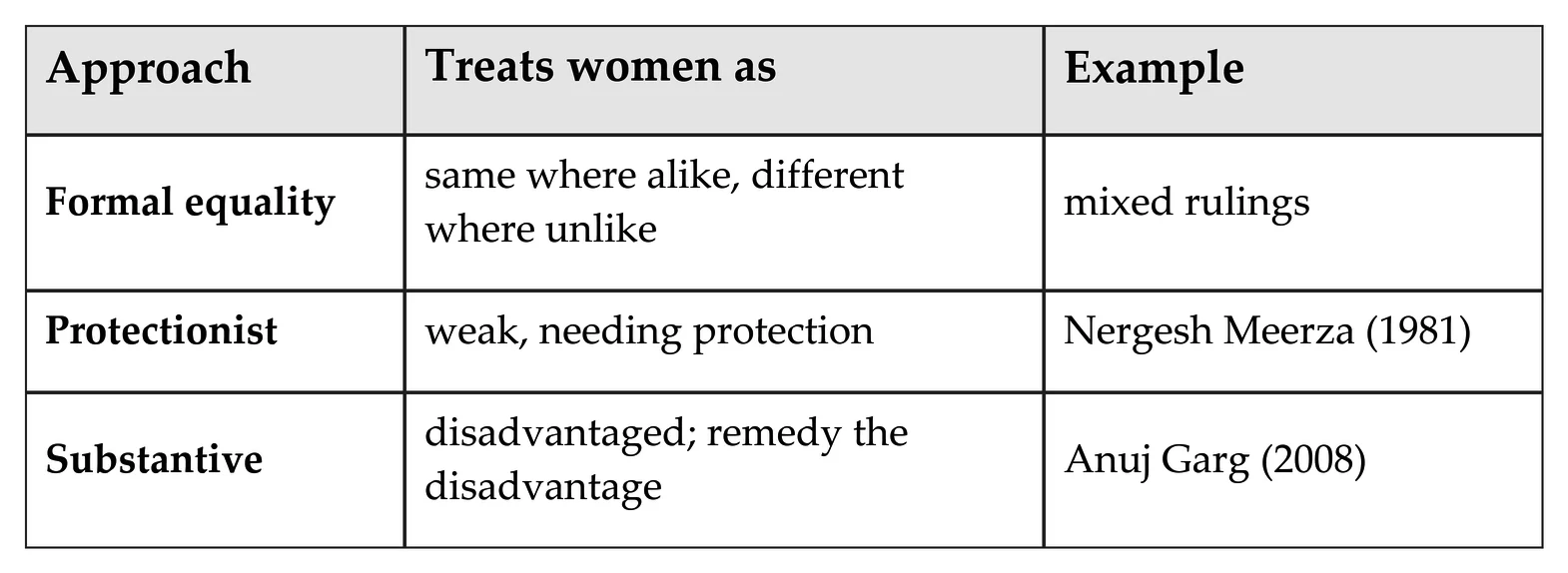
Ratna Kapur and Brenda Cossman, in On Women, Equality and the Constitution: Through the Looking Glass of Feminism (1993), examine how Indian courts have interpreted equality for women. They identify three approaches. The formal equality approach treats men and women the same where they are similarly situated, but accepts differential treatment where they are seen as different, without questioning how differences were produced. The protectionist approach treats women as weak and in need of protection, justifying restrictions on women’s work, movement and sexuality in the name of their welfare. The substantive equality approach, which they support, examines whether a law contributes to women’s actual disadvantage and seeks to remedy historical and social inequality.
Cases
- Air India v. Nergesh Meerza (1981). The Supreme Court struck down the rule ending air hostesses’ service on first pregnancy, but upheld rules on retirement on marriage within four years, reflecting protectionist assumptions.
- Githa Hariharan v. Reserve Bank of India (1999). The Court interpreted the Hindu Minority and Guardianship Act to allow the mother to act as natural guardian, moving towards equality.
- Anuj Garg v. Hotel Association of India (2008). The Court struck down a law barring women from working in establishments serving liquor, rejecting paternalistic protection.
- Joseph Shine v. Union of India (2018). The Court struck down the adultery law, which treated the wife as the husband’s property, as violating equality and dignity.
- Indian Young Lawyers Association (2018). The Court held that excluding women of menstruating age from the Sabarimala temple violated equality, though the matter was later referred to a larger bench.
- Babita Puniya (2020). The Court directed permanent commission for women officers in the Army, rejecting stereotypes about women’s physical abilities.
3.3 Criminal Law, Personal Laws and Women
Ved Kumari: Gender Analysis of the Penal Code
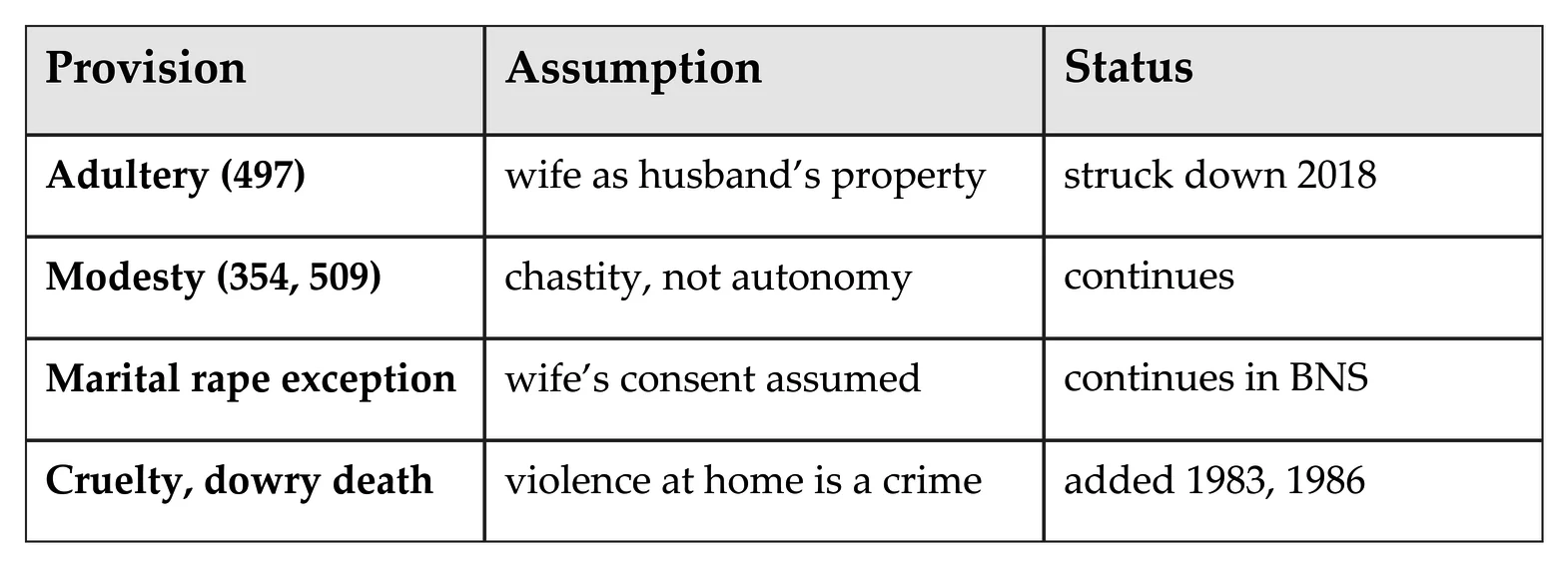
Ved Kumari, in Gender Analyses of Indian Penal Code (1999), examined how the colonial Indian Penal Code of 1860 reflected patriarchal assumptions. Many offences protected not women’s autonomy but men’s interests in women’s sexuality, or a vague idea of women’s modesty and chastity.
- Adultery (Section 497). Only a man could be punished for adultery with another man’s wife, and only if the husband did not consent, treating the wife as the husband’s property; the provision was struck down in 2018.
- Rape and marital rape. Rape law long focused on proof of resistance and the woman’s character, and Exception 2 to Section 375 exempted sexual intercourse by a man with his wife (above a certain age) from rape; the exception continues in the Bharatiya Nyaya Sanhita of 2023.
- Outraging modesty. Sections 354 and 509 punished acts outraging or insulting a woman’s modesty, a concept tied to ideas of female chastity rather than bodily integrity.
- Reforms. The movement won Section 498A (cruelty, 1983), Section 304B (dowry death, 1986), changes to rape law after the Mathura case (1983), and the Criminal Law (Amendment) Act, 2013 after the Justice Verma Committee, which widened the definition of rape and created offences of stalking, voyeurism and acid attack.
Personal Laws
India has no single family law. Hindus, Muslims, Christians, Parsis and others are governed by personal laws on marriage, divorce, maintenance, inheritance and guardianship, many of which discriminate against women. In State of Bombay v. Narasu Appa Mali (1951), the Bombay High Court held that uncodified personal laws are not laws in force subject to Fundamental Rights, shielding them from equality challenges. Article 44 directs the state to endeavour to secure a Uniform Civil Code, but this has remained contested.
MacKinnon on Sex Equality in India
Catharine MacKinnon, in Sex Equality under the Constitution of India: Problems, Prospects and Personal Laws (2006), praised the Indian Constitution for its substantive approach to equality, including Article 15(3), which allows special measures for women, and for the courts’ willingness in cases such as Vishaka to use international law to advance women’s rights. But she argued that the exemption of personal laws from equality scrutiny is a major problem, since it allows sex discrimination in the family to continue in the name of religious freedom. She suggested that sex equality should be applied to personal laws in ways that respect religious communities while ending discrimination, rather than through a uniform code imposed by the majority.
Reforms and Debates
Personal laws have been reformed piecemeal: the Hindu Code Bills (1955–56), the Hindu Succession (Amendment) Act (2005), the Supreme Court’s ruling against instant triple talaq in Shayara Bano (2017), and Uttarakhand’s Uniform Civil Code (2024). Feminists remain divided between those who favour a uniform, gender-just code and those who prefer reform within communities, wary that the Uniform Civil Code has been used to target minorities.
3.4 Important Questions
- Question 1 Is the state patriarchal? Discuss feminist perspectives on the state with reference to MacKinnon.
- Question 2 Discuss the constitutional provisions for women’s equality and the different approaches to equality adopted by Indian courts.
- Question 3 Examine the gender assumptions of the Indian criminal law and the reforms demanded by the women’s movement.
- Question 4 Discuss the debate on personal laws and sex equality in India.
DU asks the same idea in different words. So learn one broad answer for each question below; the same answer works for every question joined by OR.
Important Question 1
Is the state patriarchal? Discuss feminist perspectives on the state with reference to MacKinnon.
OR
Examine Catharine MacKinnon’s critique of the liberal state.
OR
Discuss the relationship between the women’s movement and the state in India.
Model Answer
“The state is male in the feminist sense: the law sees and treats women the way men see and treat women.”
— Catharine A. MacKinnon, Toward a Feminist Theory of the State (1989)
Introduction. The state makes and enforces the laws that govern women’s lives. Feminists ask whether it is a neutral institution that can deliver equality, or whether it reflects and reinforces male dominance. Catharine MacKinnon’s critique of the liberal state is the most powerful statement of the view that the state is male, while Indian feminists stress the contradictory nature of the state.
1. The Question
Feminists ask whether the state is neutral among the sexes or whether its laws, institutions and practices are shaped by patriarchy.
2. Liberal Feminism
Liberal feminists see the state as potentially neutral and seek equal rights for women through law, such as the vote, equal pay and access to education and jobs.
3. MacKinnon’s Critique
MacKinnon argues that the liberal state is male: its standards and point of view reflect men’s experience, while it claims to be neutral and objective.
4. Objectivity as Male Power
For MacKinnon, the state’s claim to objectivity hides male power, since what counts as reasonable, neutral or normal is defined from a male standpoint.
5. Rape Law Example
Rape law has judged consent from the man’s perspective and scrutinised the woman’s character, showing how law sees women as men see them.
6. The Private Sphere
By treating the home as private, the liberal state left women unprotected against violence and exploitation within the family.
7. Equality as Ending Hierarchy
MacKinnon argues that equality means ending sexual hierarchy, not treating women the same as men, so law must be judged by whether it challenges subordination.
8. Marxist and Socialist Views
Marxist and socialist feminists see the state as serving both capitalism and patriarchy, for example by relying on women’s unpaid domestic labour.
9. Post-Structuralist Views
Post-structuralist feminists see the state as a set of institutions and discourses that produce gendered subjects in varied and sometimes contradictory ways.
10. The Contradictory Indian State
Indian feminists stress that the state has passed progressive laws under pressure from the women’s movement but also acts through police and courts that often disbelieve women.
11. Gains from the State
The movement has won laws against dowry, domestic violence and sexual harassment, the National Commission for Women (1990) and reservation in local bodies.
12. The State as Perpetrator
Custodial rape, as in the Mathura case of 1979, and violence by security forces show that the state can itself be a perpetrator of violence against women.
13. Protection as Control
Protective laws can be used to restrict women’s mobility, work and sexuality, as Kapur warns, strengthening a paternalistic state.
14. Criticism of MacKinnon
Critics argue that MacKinnon treats the state as uniformly male, ignoring differences among women and the real gains won through law.
15. Using the State Critically
Many Indian feminists argue for engaging with the state to win rights while remaining critical of its patriarchal and coercive tendencies.
16. Women in State Institutions
Women remain under-represented in state institutions: few judges of the Supreme Court have been women, and women form a small share of the police. Feminists argue that greater representation, though not sufficient, can make institutions more responsive to women’s experiences.
17. The State and Reproductive Rights
The state shapes women’s lives through policies on population and reproduction. The forced sterilisations of the Emergency (1975–77) and deaths in sterilisation camps, as at Bilaspur in 2014, show how the state can treat women’s bodies as instruments of policy, while the Medical Termination of Pregnancy Act, amended in 2021, widened access to safe abortion.
18. Evaluation
The state is neither simply neutral nor simply male; it is a site of struggle where women’s movements can win gains but also face control.
Conclusion. Thus, liberal feminists see the state as a potential instrument of equality, while MacKinnon argues that the state is male, seeing and treating women as men do. Indian feminists show that the state is contradictory, both granting rights and acting as an agent of control, so the women’s movement must engage with it critically.
Important Question 2
Discuss the constitutional provisions for women’s equality and the different approaches to equality adopted by Indian courts.
OR
Examine Kapur and Cossman’s analysis of women, equality and the Constitution.
OR
Distinguish between formal, protectionist and substantive equality.
Model Answer
“The State shall not deny to any person equality before the law or the equal protection of the laws within the territory of India.”
— Constitution of India, Article 14
Introduction. The Indian Constitution guarantees equality to women and allows special measures to remedy their disadvantage. But the meaning of equality depends on how courts interpret it. Ratna Kapur and Brenda Cossman show that Indian courts have used different approaches, some of which reinforce rather than challenge women’s subordination.
1. Equality before Law
Article 14 guarantees equality before the law and the equal protection of the laws to all persons, including women.
2. Non-Discrimination
Article 15(1) prohibits discrimination on grounds of sex, and Article 16 guarantees equal opportunity in public employment.
3. Special Provisions
Article 15(3) allows the state to make special provisions for women and children, recognising that formal equality may not be enough.
4. Directive Principles
Articles 39(a) and (d) direct equal livelihood and equal pay for equal work, Article 42 provides for maternity relief, and Article 51A(e) asks citizens to renounce practices derogatory to women’s dignity.
5. Political Representation
Articles 243D and 243T reserve one-third of seats in local bodies for women, and the 106th Amendment of 2023 extends reservation to legislatures.
6. Kapur and Cossman’s Analysis
Kapur and Cossman examined how courts interpret equality and identified formal, protectionist and substantive approaches.
7. Formal Equality
Formal equality treats men and women the same where similarly situated but accepts differences in treatment where they differ, without asking how differences arose.
8. The Protectionist Approach
The protectionist approach treats women as weak and in need of protection, justifying restrictions on their work, movement and sexuality.
9. Substantive Equality
Substantive equality asks whether a law contributes to women’s actual disadvantage and seeks to remedy historical and social inequality, the approach Kapur and Cossman support.
10. Nergesh Meerza
In Air India v. Nergesh Meerza (1981), the Court struck down termination on first pregnancy but upheld restrictions linked to marriage, reflecting protectionism.
11. Githa Hariharan
In Githa Hariharan (1999), the Court allowed mothers to act as natural guardians, interpreting the law in favour of equality.
12. Anuj Garg
In Anuj Garg (2008), the Court struck down a law barring women from bar work, rejecting paternalistic protection in favour of autonomy.
13. Joseph Shine
In Joseph Shine (2018), the Court struck down the adultery law as treating wives as property, affirming women’s dignity and autonomy.
14. Babita Puniya
In Babita Puniya (2020), the Court ordered permanent commission for women Army officers, rejecting stereotypes about women’s capacities.
15. Continuing Gaps
Despite progressive judgments, gaps remain, such as the marital rape exception and discrimination in personal laws.
16. Reservation and Equality
Courts have upheld special measures for women under Article 15(3), such as reservation in local bodies and employment, as consistent with equality, accepting that treating unequals equally can perpetuate inequality. This reflects a substantive understanding of equality in Indian constitutional law.
17. International Commitments
India ratified the UN Convention on the Elimination of All Forms of Discrimination against Women (CEDAW) in 1993. In Vishaka (1997), the Supreme Court used CEDAW to fill a gap in domestic law, showing how international commitments can strengthen constitutional equality.
18. Evaluation
Constitutional equality for women depends on courts adopting a substantive approach that challenges disadvantage rather than protectionism that reinforces it.
Conclusion. Thus, Articles 14, 15, 16, 39, 42 and 51A(e) and reservation in local bodies provide a strong framework for women’s equality. Kapur and Cossman show that courts have moved between formal, protectionist and substantive approaches, and that substantive equality is needed to realise the promise of Article 14.
Important Question 3
Examine the gender assumptions of the Indian criminal law and the reforms demanded by the women’s movement.
OR
Discuss Ved Kumari’s gender analysis of the Indian Penal Code.
OR
Write a note on the debate on marital rape.
Model Answer
“A marital or other relationship between the perpetrator or victim is not a valid defence against the crimes of rape or sexual violation.”
— Justice J.S. Verma Committee Report (2013), recommendation
Introduction. The Indian Penal Code of 1860, drafted under colonial rule, reflected patriarchal assumptions about women, their sexuality and their place in the family. Ved Kumari’s gender analysis exposes these assumptions. Campaigns by the women’s movement have led to several reforms, though some provisions, such as the marital rape exception, remain.
1. The Colonial Penal Code
The Indian Penal Code, drafted under Macaulay and enacted in 1860, governed criminal law in India until the Bharatiya Nyaya Sanhita replaced it from 1 July 2024.
2. Ved Kumari’s Analysis
Ved Kumari showed that many offences protected men’s interests in women’s sexuality, or vague ideas of modesty and chastity, rather than women’s autonomy.
3. Adultery
Section 497 punished only the man who had sex with another man’s wife, and only without the husband’s consent, treating the wife as property; it was struck down in 2018.
4. Modesty
Sections 354 and 509 punished outraging or insulting a woman’s modesty, a concept tied to chastity rather than bodily integrity.
5. Rape Law
Rape law long focused on proof of resistance and the woman’s character, making it difficult for survivors to obtain justice.
6. The Mathura Case
After the Supreme Court acquitted policemen accused of raping a young tribal girl in 1979, protests led to the 1983 amendment on custodial rape and shifting the burden of proof.
7. Cruelty and Dowry Death
Campaigns against dowry violence led to Section 498A on cruelty (1983) and Section 304B on dowry death (1986).
8. Sexual Harassment
After the Bhanwari Devi case, the Vishaka guidelines (1997) and the Sexual Harassment of Women at Workplace Act, 2013 addressed workplace harassment.
9. The Verma Committee
After the Delhi gang rape of December 2012, the Justice Verma Committee recommended sweeping reforms, including removing the marital rape exception.
10. Criminal Law Amendment, 2013
The 2013 Act widened the definition of rape and created offences such as stalking, voyeurism, acid attack and sexual harassment.
11. The Marital Rape Exception
Exception 2 to Section 375 exempted forced sex by a husband with his adult wife from rape, an exception retained in the Bharatiya Nyaya Sanhita.
12. Debate on Marital Rape
Feminists argue that the exception denies married women bodily autonomy, while the government has argued it protects the institution of marriage; the issue is before the Supreme Court.
13. Protection or Autonomy
Feminists debate whether criminal law should protect women or affirm their autonomy, warning against laws that police women’s sexuality.
14. Carceral Feminism
Ratna Kapur and others caution against relying too heavily on criminal law and harsher punishments, which may strengthen state power without changing social attitudes.
15. Implementation
Laws are often poorly implemented because of police insensitivity, delays in courts and social stigma, limiting their effect.
16. The POCSO Act
The Protection of Children from Sexual Offences Act, 2012 created a gender-neutral law against sexual abuse of children, with child-friendly procedures and special courts, reflecting greater attention to the experience of survivors.
17. Two-Finger Test and Survivor Dignity
In Lillu v. State of Haryana (2013), the Supreme Court held that the two-finger test on rape survivors violates their privacy and dignity, and in 2022 it directed that the test should not be conducted, reflecting a shift towards respecting survivors.
18. Evaluation
Criminal law has been reformed in important ways, but it still contains patriarchal assumptions and depends on implementation to protect women.
Conclusion. Thus, Ved Kumari shows that the Penal Code protected male interests and ideas of modesty rather than women’s autonomy. The women’s movement won reforms on custodial rape, dowry and sexual harassment, but the marital rape exception, which the Verma Committee said cannot be a defence, remains a major gap.
Important Question 4
Discuss the debate on personal laws and sex equality in India.
OR
Examine MacKinnon’s analysis of sex equality and personal laws under the Indian Constitution.
OR
Should India adopt a Uniform Civil Code? Discuss from a feminist perspective.
Model Answer
“The State shall endeavour to secure for the citizens a uniform civil code throughout the territory of India.”
— Constitution of India, Article 44
Introduction. In India, matters of marriage, divorce, maintenance, inheritance and guardianship are governed by the personal laws of different religious communities, many of which discriminate against women. The tension between sex equality and religious freedom has made personal law reform one of the most contested issues in Indian politics. Catharine MacKinnon and Indian feminists have analysed this debate.
1. Plurality of Personal Laws
Hindus, Muslims, Christians, Parsis and others are governed by separate personal laws, some codified by Parliament and others based on religious texts and custom.
2. Discrimination in Personal Laws
Many personal laws have discriminated against women in inheritance, divorce, maintenance and guardianship, as in unequal shares in property and unilateral divorce.

3. Narasu Appa Mali
In 1951, the Bombay High Court held that uncodified personal laws are not laws in force subject to Fundamental Rights, shielding them from equality challenges.
4. Article 44
Article 44 directs the state to endeavour to secure a Uniform Civil Code, but as a Directive Principle it is not enforceable by courts.
5. The Hindu Code Bills
The Hindu Code Bills, passed in parts in 1955–56 after Ambedkar’s efforts, reformed Hindu marriage, succession and adoption, though they retained some inequalities.
6. Hindu Succession Amendment
The Hindu Succession (Amendment) Act, 2005 made daughters coparceners in joint family property, confirmed by the Supreme Court in Vineeta Sharma (2020).
7. Shah Bano
The Supreme Court granted maintenance to a divorced Muslim woman in 1985, but the Muslim Women Act of 1986 limited this, showing the power of community politics.
8. Danial Latifi
In Danial Latifi (2001), the Court interpreted the 1986 Act to require a fair and reasonable provision for divorced Muslim women, protecting their rights.
9. Triple Talaq
In Shayara Bano (2017), the Court declared instant triple talaq unconstitutional, and Parliament criminalised it in 2019.
10. MacKinnon’s Analysis
MacKinnon praised India’s substantive approach to equality but argued that exempting personal laws from equality scrutiny allows sex discrimination in the family to continue.
11. MacKinnon’s Proposal
She suggested applying sex equality to personal laws in ways that respect communities while ending discrimination, rather than a code imposed by the majority.
12. Arguments for a Uniform Code
Supporters argue that a Uniform Civil Code would give all women equal rights regardless of religion and promote national integration.
13. Arguments against
Critics argue that a uniform code may impose majority norms on minorities and has been used politically to target them, without guaranteeing gender justice.
14. Uttarakhand’s Code
Uttarakhand adopted a Uniform Civil Code in 2024, including registration of live-in relationships, which drew both support and criticism on grounds of privacy and autonomy.
15. Feminist Positions
Feminists are divided between those favouring a gender-just common code and those preferring reform within communities, guided by women’s own voices.
16. Christian and Parsi Law Reform
Personal laws of smaller communities have also been reformed through litigation: in Mary Roy (1986), the Supreme Court gave Syrian Christian women in Kerala equal inheritance rights, and the Indian Divorce Act was amended in 2001 to remove discrimination against Christian women seeking divorce.
17. Optional Civil Law
Some scholars propose an optional secular civil code, building on the Special Marriage Act, which couples of any community could choose, combined with reforms within each personal law, as a middle path between uniformity and community autonomy.
18. Evaluation
The goal should be gender justice in family law for all women, achieved in ways that respect diversity and do not become instruments of majoritarian politics.
Conclusion. Thus, personal laws have discriminated against women while being shielded from equality scrutiny since Narasu Appa Mali. Reforms from the Hindu Code to Shayara Bano have advanced equality, and MacKinnon argues that sex equality must reach personal laws, though how to realise Article 44 remains deeply contested.
Short Notes
(a) Substantive equality
An approach that judges laws by whether they remedy or reinforce the actual disadvantage of women, rather than simply treating men and women alike.
(b) Marital rape exception
The exception in rape law that excludes forced sex by a husband with his adult wife from the offence of rape, retained in the Bharatiya Nyaya Sanhita of 2023.
(c) Personal laws
The laws of different religious communities governing marriage, divorce, maintenance, inheritance and guardianship in India.
More notes: GE-9 Women and Politics in India: Concepts and Debates
These notes are prepared by PADHO TO AISE for study help. They are not an official publication.