
Semester I DSC-2 Ideas and Institutions in Indian Political Thought
Unit VI · 23 min read · Updated 24 Nov 2026
As per the University of Delhi (DU) BA (Hons) Political Science syllabus
Contents
- 6.1 Varna
- Features of the Varna Order
- 6.2 Jati
- 6.3 From Varna to Jati
- 6.4 Institutionalisation of the Caste Order
- 6.5 Theories of the Origin of Caste
- 6.6 Critiques of the Caste Order
- 6.7 Important Questions
- What do you mean by ‘Varna’ and ‘Jati’ Vyavastha? How was it institutionalised in ancient India? Give suitable examples from historic texts.
- Discuss the various theories of the origin of the caste system.
- Examine the critique of the caste system in Indian political thought.
- Short Notes
न जच्चा वसलो होति न जच्चा होति ब्राह्मणो।
Not by birth is one an outcaste, not by birth is one a Brahmin; by deeds one becomes an outcaste, by deeds one becomes a Brahmin.
— The Buddha, Vasala Sutta, Sutta Nipata
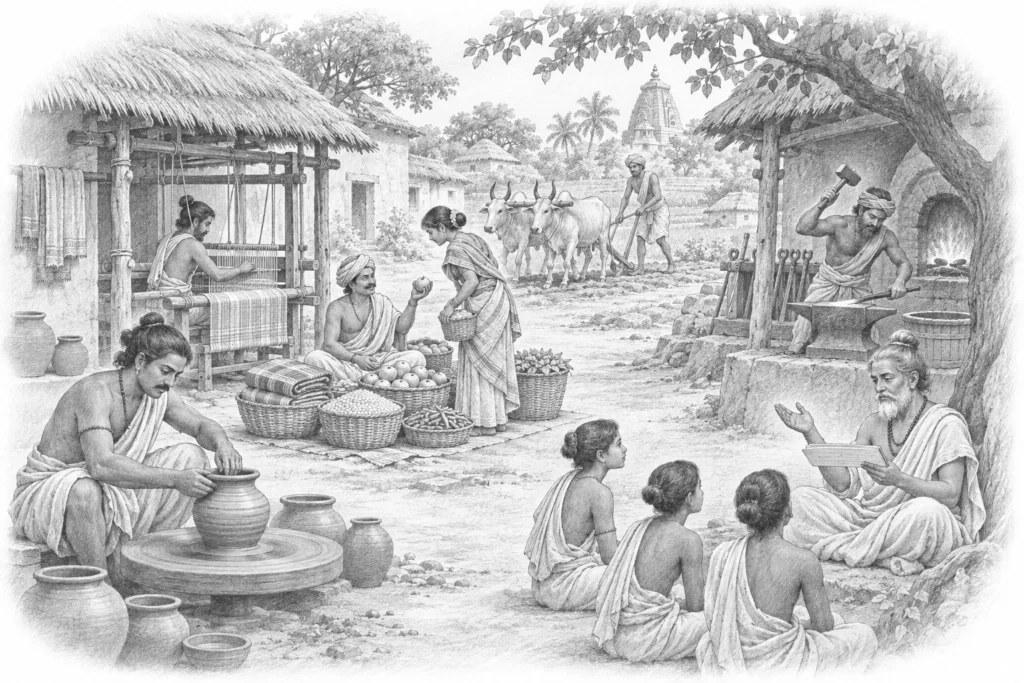
NO INSTITUTION has shaped Indian society as deeply as caste. Ancient texts describe society through two related ideas. Varna is the four-fold scheme of Brahmana, Kshatriya, Vaishya and Shudra found in the Vedas and the Dharmashastras. Jati refers to the thousands of actual birth-based groups, each with its own occupation, marriage rules and customs, into which people were born. The political thinkers we have studied in this paper, from Manu to Kautilya, expected the king to protect the varna order, so caste is not only a social question but also a question of political thought. In this chapter we study the meaning of varna and jati, how the system was institutionalised in ancient India, the theories of its origin, and the long tradition of criticism, from the Buddha to Ambedkar.
6.1 Varna
Varna literally means ‘colour’, and also ‘class’ or ‘type’. In the early Rigveda the word is used to distinguish the Aryans (arya varna) from the people they called dasas, which led some scholars to give caste a racial meaning. Later it came to mean the four orders of society. The Purusha Sukta (Rigveda X.90), a late hymn, describes the creation of society from the body of the cosmic being (Purusha): the Brahmana from his mouth, the Rajanya (Kshatriya) from his arms, the Vaishya from his thighs and the Shudra from his feet. The image presented society as one body with four unequal but interdependent parts.
Features of the Varna Order
- Four-fold division. Society is divided into four orders, as the Purusha Sukta first described.
- Division of functions. The Dharmashastras assigned duties: Brahmanas to study, teach and perform sacrifices; Kshatriyas to protect and rule; Vaishyas to farm, trade and keep cattle; Shudras to serve the other three. Manu (I.87–91) sets out these duties.
- Hierarchy. The varnas were ranked, with the Brahmana at the top; this hierarchy was justified by ideas of purity and sacred knowledge.
- Svadharma. Each varna had its own dharma; the Bhagavad Gita (3.35) urged people to follow their own duty rather than another’s.
- The ‘twice-born’. The first three varnas were dvija, entitled to the sacred thread and Vedic initiation; Shudras were excluded.
- Guna and karma. The Gita (4.13) says that the four varnas were created according to qualities and actions, which some later interpreters read as a basis in merit rather than birth.
6.2 Jati
Jati comes from the root jan, ‘to be born’. A jati is a group into which a person is born and within which he or she marries. Unlike the four varnas, jatis number in the thousands, each with its own name, traditional occupation, customs and place in the local hierarchy. When we speak of ‘caste’ in everyday life, we usually mean jati. The sociologist G.S. Ghurye, in Caste and Race in India (1932), identified six features of the caste system, which remain the standard description:
- Segmental division of society. Society is divided into groups whose membership is fixed by birth.
- Hierarchy. The groups are ranked from high to low.
- Restrictions on feeding and social intercourse. Rules govern who may eat with whom and accept food or water from whom.
- Civil and religious disabilities. Lower castes, and above all the ‘untouchables’, were denied access to temples, wells, schools and public places.
- Lack of free choice of occupation. Each caste had a hereditary occupation.
- Restrictions on marriage. Caste is endogamous: people must marry within their caste, though often outside their clan (gotra).
Other scholars added further ideas. The French sociologist Célestin Bouglé described caste through repulsion, hierarchy and hereditary specialisation; Louis Dumont, in Homo Hierarchicus (1966), argued that the whole system rests on the opposition of purity and pollution; and M.N. Srinivas introduced the concepts of the dominant caste and Sanskritisation, i.e. the process by which lower castes try to rise by adopting the customs of higher castes.
6.3 From Varna to Jati
How are varna and jati related? Varna is a broad, textual and ideal scheme of four orders, found in the Vedas and the Dharmashastras. Jati is the lived social reality of thousands of local, birth-based groups. M.N. Srinivas described varna as a frame of reference: a simple all-India model into which people tried to fit the confusing variety of local jatis (Figure 6.2).
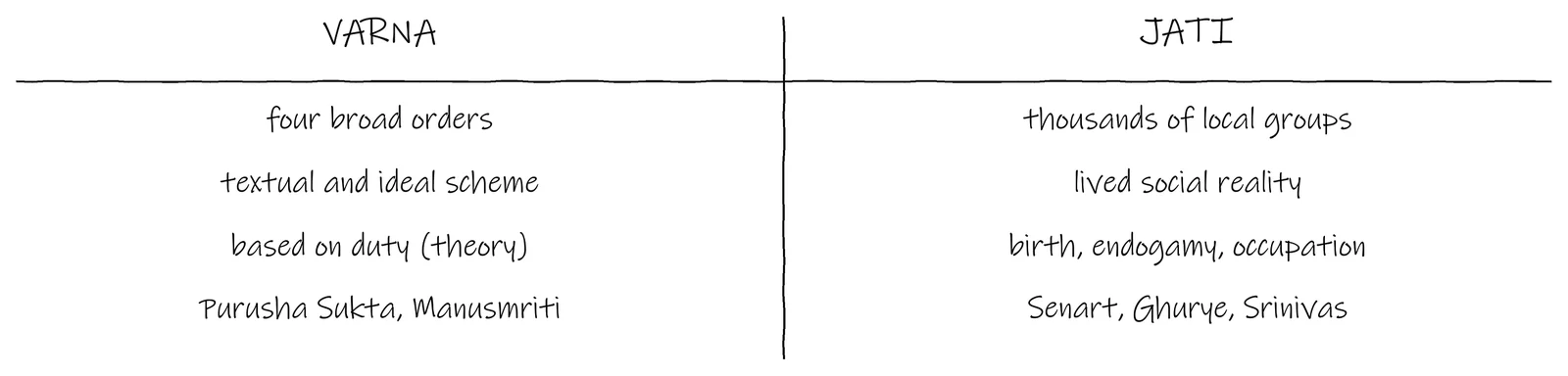
The Dharmashastras themselves tried to explain the existence of so many jatis. Manu (Chapter X) argued that new jatis arose from varna-sankara, i.e. mixed marriages between members of different varnas. Marriages in which a higher-varna man married a lower-varna woman (anuloma) were tolerated, while marriages in the opposite direction (pratiloma) were condemned; the offspring of the latter, such as the chandala, were given the lowest status. Modern historians regard this as an attempt to fit tribes, occupational groups and outsiders into the varna scheme rather than a real historical account.
The sociologist Dipankar Gupta, in ‘From Varna to Jati’, studied this transition historically. He linked the shift from the simple varna order to the complex jati system with changes in the mode of production, from an earlier order to a feudal economy in which land grants, local self-sufficiency and the hereditary attachment of groups to particular tasks multiplied jatis and fixed them in place. Sudhakar Chattopadhyaya, in Social Life in Ancient India (1965), similarly showed how the varna-jati order grew more complex over time.
6.4 Institutionalisation of the Caste Order
How was varna-jati turned into a lasting institution in ancient India? Several mechanisms worked together:
- Sacred sanction. The Purusha Sukta gave the varna order a divine origin, and the Bhagavad Gita linked it with svadharma.
- Law of the Dharmashastras. Manu and other lawgivers laid down the duties, rights and occupations of each varna, rules of marriage (anuloma and pratiloma) and differential punishments; for some offences, such as defamation, lower varnas were punished more harshly.
- Role of the king. Kautilya and the Dharmashastras made the protection of varnashrama dharma a duty of the king, so that the state enforced the caste order through danda.
- Untouchability. By the time of the Dharmashastras, groups such as the chandalas were placed outside the four varnas; Manu (X.51–56) required them to live outside the village and to use discarded vessels. The Chinese pilgrim Faxian (c. 400 CE) observed that chandalas had to strike a piece of wood to warn others of their approach.
- Occupational guilds. Jataka stories and inscriptions describe hereditary guilds (shrenis) of craftsmen and traders with their own rules, which strengthened occupational jatis.
- Land grants and feudalism. From the Gupta period, grants of land to Brahmins and temples and the growth of self-sufficient villages fixed groups in hereditary roles.
Foreign observers also noticed the system. Megasthenes, the Greek envoy at the Mauryan court, described Indian society as divided into seven ‘castes’, such as philosophers, farmers, herdsmen, artisans, soldiers, overseers and councillors, which shows that occupation and endogamy were already linked, though his classification does not match the four varnas.
6.5 Theories of the Origin of Caste
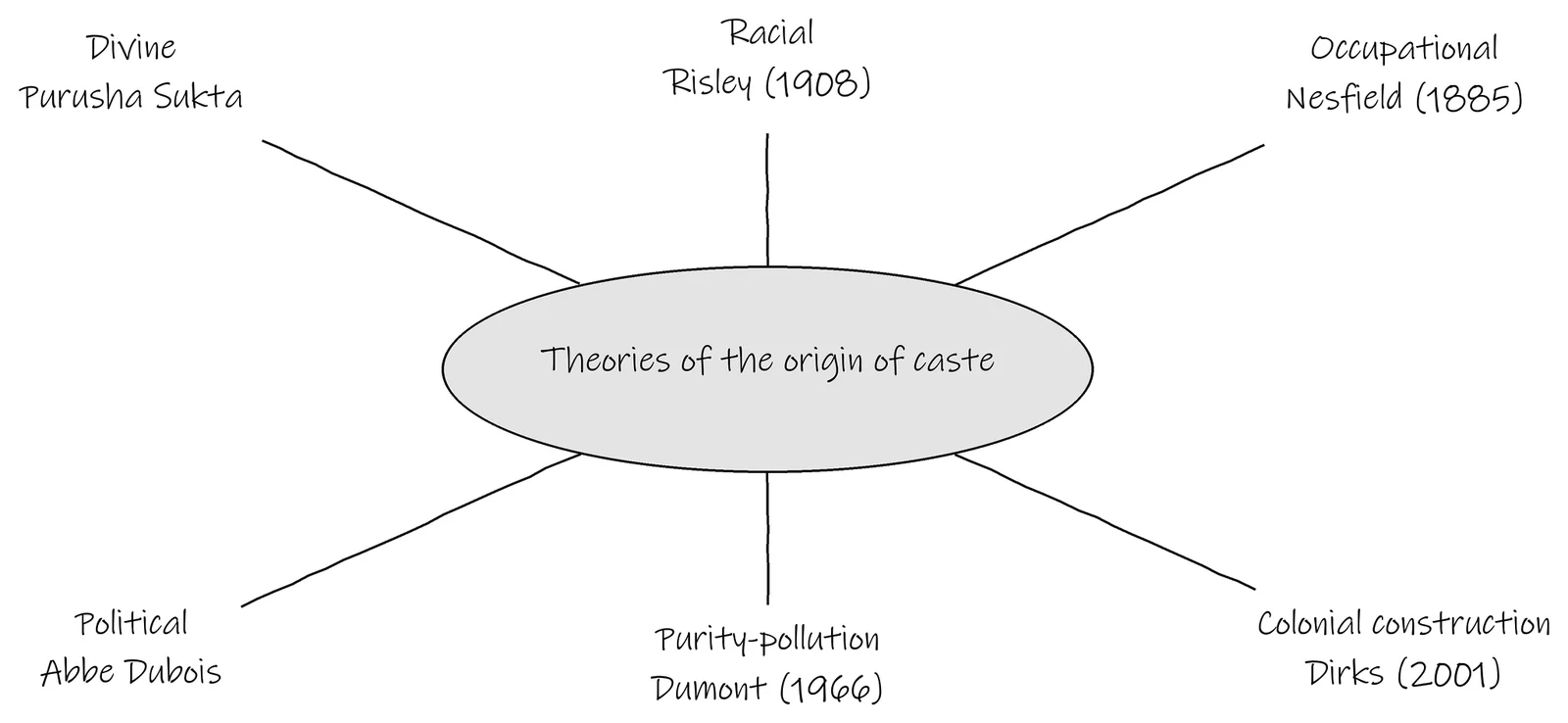
Scholars have offered many explanations of how caste began (Figure 6.3). Each reflects the context in which it was written:
- Divine theory. The Purusha Sukta and the Dharmashastras present the varnas as created by God; the Gita links them to qualities and actions.
- Racial theory. H.H. Risley, census commissioner of British India, argued in The People of India (1908) that caste arose from the encounter of fair-skinned Aryans and darker indigenous peoples, using body measurements to support his claim. The theory is now rejected as a product of colonial race science.
- Occupational theory. J.C. Nesfield (1885) argued that caste grew out of occupation, and that the rank of a caste depended on the status of its traditional work.
- Political (Brahmanical) theory. The French missionary Abbé Dubois, in Hindu Manners, Customs and Ceremonies (written in the early nineteenth century), saw caste as a device created by Brahmins to secure their own supremacy; Ghurye also stressed the role of the Brahmanical texts.
- Purity and pollution. Louis Dumont (1966) explained caste by the religious opposition of the pure and the impure, with the Brahmin at the top and the ‘untouchable’ at the bottom.
- Colonial construction. Nicholas Dirks, in Castes of Mind (2001), argued that caste as we know it, a single, rigid, all-India system, was made by colonial rule: the British census from 1871 and especially Risley’s 1901 census, which ranked castes, made caste the central category of Indian society.
No single theory is sufficient. Caste is best understood as the product of many forces over a long period: the Brahmanical texts, the division of labour, the absorption of tribes, feudal land relations and, later, colonial policy. Dirks’s argument has been criticised for underestimating the ancient roots of caste, but it rightly shows that colonial rule changed and hardened the system.
6.6 Critiques of the Caste Order
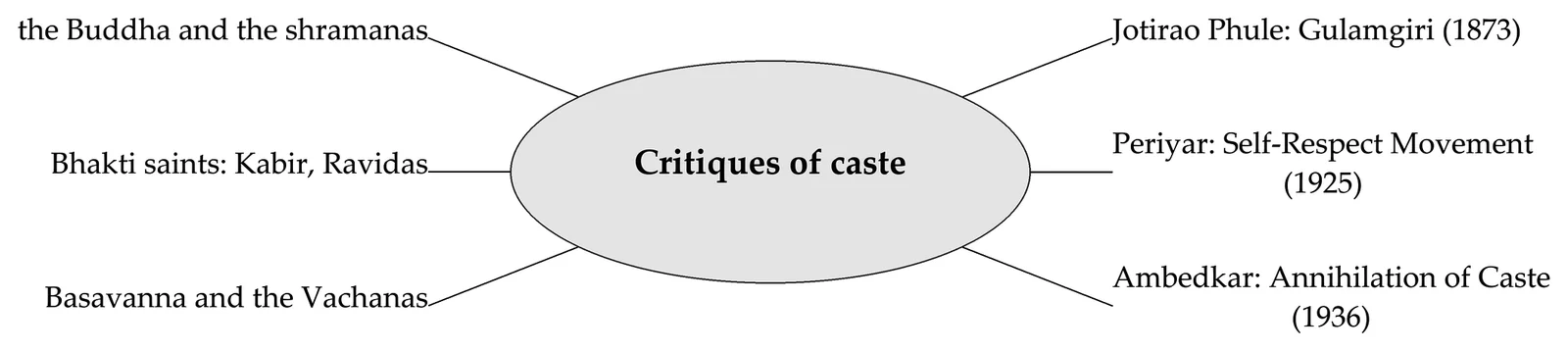
The caste order was criticised from early times. The Buddha rejected birth-based superiority: in the Vasala Sutta and the Assalayana Sutta he argued that one becomes noble or base by deeds, not by birth, and the Buddhist sangha admitted people of all varnas. Medieval bhakti saints such as Kabir and Ravidas condemned caste distinctions. In modern times, Jyotirao Phule, in Gulamgiri (1873), described caste as a form of slavery imposed by Brahmins, and B.R. Ambedkar, in Annihilation of Caste (1936), argued that caste is a ‘division of labourers’ rather than a division of labour, and that it cannot be reformed but must be destroyed. Gandhi defended an idealised varna as a division of duties while opposing untouchability, which led to a famous debate with Ambedkar. The Constitution of India, drafted under Ambedkar’s chairmanship, abolished untouchability (Article 17) and prohibited caste discrimination (Article 15).
6.7 Important Questions
- Question 1 What do you mean by ‘Varna’ and ‘Jati’ Vyavastha? How was it institutionalised in ancient India? Give suitable examples from historic texts.
- Question 2 Discuss the various theories of the origin of the caste system.
- Question 3 Examine the critique of the caste system in Indian political thought.
DU asks the same idea in different words. So learn one broad answer for each question below; the same answer works for every question joined by OR.
Important Question 1
What do you mean by ‘Varna’ and ‘Jati’ Vyavastha? How was it institutionalised in ancient India? Give suitable examples from historic texts.
OR
Distinguish between varna and jati.
OR
Trace the transition from varna to jati in ancient India.
Model Answer
“Caste is not just a division of labour. It is also a division of labourers.”
— B.R. Ambedkar, Annihilation of Caste (1936)
Introduction. Varna and jati are the two concepts through which ancient Indian thought described the organisation of society. Varna is the four-fold textual scheme; jati is the reality of thousands of birth-based groups. Together they formed the caste order, which the state was expected to protect.
1. Meaning of Varna
Varna means colour, class or type. The Purusha Sukta (Rigveda X.90) describes the Brahmana, Kshatriya, Vaishya and Shudra as born from the mouth, arms, thighs and feet of the cosmic being. The Gita (4.13) links the varnas to qualities and actions. The four varnas are compared to the mouth, arms, thighs and feet of the cosmic person, implying both unity and hierarchy.
2. Features of Varna
It was a four-fold, hierarchical order with a division of functions: Manu (I.87–91) assigned study, teaching and sacrifice to Brahmanas, protection and rule to Kshatriyas, agriculture, trade and cattle to Vaishyas, and service to Shudras. Each varna had its own svadharma, and the Gita (3.35) urged people to follow their own duty. The first three varnas were dvija (twice-born), entitled to Vedic initiation, while Shudras were excluded. In early times the order seems to have been more flexible: the Chandogya Upanishad tells how the teacher Gautama accepted Satyakama Jabala, who did not know his father, as a student because he spoke the truth. Only the first three varnas were dvija, twice-born, entitled to the sacred thread and the study of the Vedas.
3. Meaning and Features of Jati
Jati, from jan (birth), refers to endogamous, hereditary groups. Ghurye (1932) identified six features: segmental division, hierarchy, restrictions on food and social intercourse, civil and religious disabilities, hereditary occupation and endogamy. Dumont stressed purity and pollution. Ghurye’s six features were segmental division, hierarchy, restrictions on food and social intercourse, civil and religious disabilities, lack of free choice of occupation, and restrictions on marriage.
4. Varna and Jati Compared
Varna is an ideal, four-fold, all-India scheme; jati is a lived, local system of thousands of groups. Srinivas called varna a frame of reference for ranking jatis. M.N. Srinivas described Sanskritisation, the process by which lower jatis adopt the customs of higher castes to rise in status.
5. Caste and the Village Economy
The jajmani system linked service castes to landowning patrons through hereditary obligations and payments in kind, embedding caste in the village economy.
6. From Varna to Jati
Manu (X) explained new jatis by varna-sankara, distinguishing anuloma and pratiloma marriages. Dipankar Gupta linked the multiplication of jatis to the transition to a feudal economy, and Sudhakar Chattopadhyaya traced the growing complexity of the varna-jati order.
7. Regional Variation
Caste took different forms in different regions: in the south the Brahmin–non-Brahmin divide was sharper and the Kshatriya and Vaishya varnas were often absent, while in the north the four-fold scheme was more visible.
8. Institutionalisation in Ancient India
The order was institutionalised through several mechanisms: Kings enforced caste rules, and village and caste councils punished violations.
- Sacred sanction: the Purusha Sukta gave the varnas a divine origin, and the Gita linked them with svadharma.
- Law: Manu laid down the duties of each varna, rules of marriage (anuloma tolerated, pratiloma condemned) and differential punishments, with lower varnas punished more harshly for offences such as defamation.
- The state: Kautilya and the Dharmashastras made the protection of varnashrama dharma a duty of the king, enforced through danda.
- Untouchability: Manu (X.51–56) placed the chandalas outside the village; the Chinese pilgrim Faxian (c. 400 CE) saw them strike wood to warn others of their approach.
- Occupation and guilds: Jataka stories describe hereditary guilds (shrenis) of craftsmen and traders; Megasthenes described seven occupational ‘castes’ who married within their group.
- Land grants: from the Gupta period, grants to Brahmins and temples fixed groups in hereditary roles within self-sufficient villages.
9. Untouchability
Outside the four varnas were groups treated as untouchable, whose touch was considered polluting and who were assigned degrading work. Untouchability was the most extreme expression of the hierarchy and was abolished by Article 17 of the Constitution.
10. Caste beyond Hinduism
Caste-like divisions also appeared among Muslims, Christians and Sikhs in India, which shows how deeply caste shaped the wider society.
11. Critiques
The Buddha rejected birth-based status (Vasala Sutta); Phule (1873) and Ambedkar (1936) attacked caste as slavery and as a division of labourers; the Constitution abolished untouchability (Article 17). Caste persists in new forms, in politics, marriage and discrimination, despite constitutional equality.
Conclusion. Thus, varna provided the ideal scheme and jati the lived reality of caste. Sacred texts, law, the state and the economy together institutionalised it in ancient India, which is why its removal has required equally deep social and political change.
Important Question 2
Discuss the various theories of the origin of the caste system.
OR
Was caste a colonial construction? Examine with reference to Nicholas Dirks.
OR
Write a note on Louis Dumont’s theory of caste.
Model Answer
“Caste became a single term capable of expressing, organizing, and above all ‘systematizing’ India’s diverse forms of social identity, community, and organization.”
— Nicholas Dirks, Castes of Mind (2001)
Introduction. Caste is one of the oldest and most complex institutions of Indian society, and scholars have explained its origin in many ways: religious, racial, occupational, political, ideological and colonial.
1. Divine Theory
The Purusha Sukta (Rigveda X.90) and the Dharmashastras present the varnas as divinely created; the Gita (4.13) links them with guna and karma. Critics note that the Purusha Sukta is a late hymn and that the rest of the Rigveda shows a more fluid society. The Bhagavad Gita links varna with guna and karma, qualities and actions, which later reformers used to argue that varna should not depend on birth.
2. Varna-Sankara Theory
Manu (X) explained the many jatis as products of mixed marriages, anuloma and pratiloma, between the varnas.
3. Racial Theory
H.H. Risley (The People of India, 1908) linked caste to the meeting of Aryan and indigenous races, using body measurements; this colonial race science is now rejected. Later historical and genetic research has rejected any simple racial explanation.
4. Occupational Theory
J.C. Nesfield (1885) held that caste grew from occupation and that the status of a caste reflected the status of its work. Critics ask why occupation would harden into birth-based, endogamous groups if occupation alone explained caste.
5. Political Theory
Abbé Dubois saw caste as a Brahmin device to secure supremacy; Ghurye too emphasised the role of Brahmanical texts.
6. Priests and Kings
Some historians argue that caste was strengthened by an alliance between priests, who supplied religious legitimacy, and kings, who enforced the social order.
7. Purity and Pollution
Louis Dumont (Homo Hierarchicus, 1966) argued that caste rests on the religious opposition of pure and impure, which places the Brahmin above even the king. Dumont’s critics argued that he neglected power, land and economic relations.
8. Marxist and Historical Theories
Dipankar Gupta and D.D. Kosambi linked the growth of jatis to changes in the mode of production, the absorption of tribes and feudal land relations. Kosambi linked caste to the absorption of tribal groups into settled agrarian society.
9. Colonial Construction
Nicholas Dirks (Castes of Mind, 2001) argued that the colonial census, especially Risley’s 1901 ranking, turned caste into a rigid, all-India system and the central category of Indian society. Others reply that caste existed long before colonialism, though colonial rule rigidified it.
10. Sanskritisation and Mobility
M.N. Srinivas showed that castes could rise in the hierarchy through Sanskritisation, adopting the customs of higher castes, which suggests that the system was less rigid in practice than in theory.
11. Caste as Structure and Ideology
Sociologists such as André Béteille distinguish caste as a structure of groups from caste as an ideology of hierarchy, showing that the two can change at different rates.
12. Evaluation
Each theory explains part of the truth. Caste is best seen as a historical product of religion, economy, politics and, later, colonial administration. Caste must therefore be understood historically, not as an eternal or natural order.
13. Ambedkar’s Theory
In ‘Castes in India: Their Mechanism, Genesis and Development’ (1916), B.R. Ambedkar argued that the essence of caste is endogamy superimposed on exogamy. A group became a caste when it closed itself by forbidding marriage outside it; the Brahmins were the first to become an ‘enclosed class’, and others followed by imitation and exclusion. He also linked practices such as sati, enforced widowhood and child marriage to the need to maintain endogamy. He rejected racial theories, arguing that caste divides people of the same race. He saw endogamy as the essence of caste and argued that practices such as sati, enforced widowhood and child marriage arose to maintain it.
14. Ghurye’s Brahmanical Theory
G.S. Ghurye, in Caste and Race in India (1932), called caste ‘a Brahmanic child of the Indo-Aryan culture’, developed in the Ganga plain and spread to other regions, where it combined with local practices. He traced its spread to Brahmin influence across regions.
Conclusion. Thus, no single theory explains caste. It grew over centuries from many sources and was reshaped in modern times, which is why it must be studied historically rather than taken as natural or unchanging.
Important Question 3
Examine the critique of the caste system in Indian political thought.
OR
Discuss Ambedkar’s critique of caste.
OR
How did the Buddha challenge the varna order?
Model Answer
“Turn in any direction you like, caste is the monster that crosses your path.”
— B.R. Ambedkar, Annihilation of Caste (1936)
Introduction. The caste order was sanctified by the Dharmashastras, but it was also challenged repeatedly in Indian thought, from the Buddha to the modern reformers.
1. The Buddhist Critique
In the Vasala Sutta the Buddha declared that one becomes an outcaste or a Brahmin by deeds, not by birth, and in the Assalayana Sutta he rejected the Brahmin claim to be born from the mouth of Brahma. The Buddhist sangha admitted members of all varnas. The Buddha admitted people of all castes to the sangha, including the barber Upali, who became a leading monk.
2. The Bhakti Critique
Medieval saints such as Kabir, Ravidas and Namdev taught that devotion to God makes all equal and ridiculed the pride of birth. Ravidas, a leather-worker, imagined Begumpura, a city without sorrow, caste or taxes.
3. Jyotirao Phule
In Gulamgiri (1873), dedicated to the people who fought slavery in America, Phule described caste as a system of slavery imposed by Brahmins, and founded the Satyashodhak Samaj (1873) to spread education among lower castes and women. He founded the Satyashodhak Samaj in 1873 and, with Savitribai Phule, opened schools for girls and lower castes from 1848. He called the lower castes Shudra-atishudras and saw them as the original inhabitants subjugated by Brahmins.
4. B.R. Ambedkar
In Annihilation of Caste (1936) Ambedkar argued that caste is not a division of labour but a division of labourers, that it destroys public spirit and fraternity, and that it rests on the authority of the shastras, which must therefore be rejected. In Who Were the Shudras? (1946) he gave a historical account of the degradation of the Shudras. He called caste a system of graded inequality, argued that its religious foundations must be rejected, and led the Mahad satyagraha (1927) and the Kalaram temple entry movement (1930). In 1956 he embraced Buddhism at Nagpur with lakhs of his followers.
5. Gandhi’s Campaign against Untouchability
Gandhi called untouchability a sin, founded the Harijan Sevak Sangh in 1932 and campaigned for temple entry, but he defended varna as a division of duties and opposed separate electorates for the depressed classes.
6. The Gandhi–Ambedkar Debate
Gandhi opposed untouchability but defended an idealised varna as a division of duties; Ambedkar replied that varna and caste cannot be separated and that reform within Hinduism was not enough. Their conflict over separate electorates ended in the Poona Pact of 1932, which gave reserved seats within joint electorates.
7. Lohia and the Socialist Critique
Ram Manohar Lohia argued that caste and gender were the two great divisions of Indian society and called for special opportunities for backward castes and women, influencing the later politics of the backward classes.
8. Constitutional Response
The Constitution abolished untouchability (Article 17), prohibited caste discrimination (Article 15) and provided reservations for Scheduled Castes and Tribes to correct historical injustice. Laws such as the Protection of Civil Rights Act (1955) and the Scheduled Castes and Scheduled Tribes (Prevention of Atrocities) Act (1989) seek to enforce these guarantees. Article 46 also directs the state to promote the educational and economic interests of the weaker sections.
9. Reservations as a Remedy
Reservations in legislatures, education and public employment, extended to the backward classes after the Mandal Commission, have been the main constitutional remedy for caste disadvantage, though they remain controversial.
10. Ayyankali and Shahu Maharaj
In Kerala, Ayyankali fought for the right of Dalits to walk on public roads and send their children to school, and in Maharashtra, Shahu Maharaj introduced reservations in Kolhapur state in 1902.
11. Narayana Guru and Periyar
In Kerala, Sree Narayana Guru preached ‘one caste, one religion, one God for man’ and consecrated temples for those denied entry, founding the SNDP Yogam (1903). In Tamil Nadu, Periyar E.V. Ramasamy’s Self-Respect Movement (1925) attacked Brahmanical religion, caste and the subordination of women, and promoted self-respect marriages without priests. Periyar’s Self-Respect Movement (1925) attacked Brahmin dominance and promoted marriages without priests. Narayana Guru’s consecration of a Shiva idol at Aruvippuram in 1888 challenged the Brahmin monopoly of temple ritual.
12. Dalit Movements and Politics
From the Dalit Panthers of 1972 to Dalit literature and the rise of parties such as the Bahujan Samaj Party under Kanshi Ram and Mayawati, the critique of caste has become a powerful democratic force.
13. Caste and Economic Change
Urbanisation, education and reservations have weakened some caste practices, but caste has also adapted, appearing in politics, marriage and networks of opportunity, as scholars such as Surinder Jodhka show.
14. Women and Caste
Feminist scholars such as Uma Chakravarti show that caste is maintained by controlling women’s sexuality and marriage, so the critique of caste is also a critique of patriarchy.
15. Evaluation
The critics differed: some, like Gandhi, sought reform within Hinduism; others, like Phule, Periyar and Ambedkar, rejected the Brahmanical framework entirely. Together they turned caste from a religiously sanctioned order into a question of justice and rights. Caste discrimination persists, as continuing atrocities and the low representation of Dalits in many professions show, so the critique remains relevant.
Conclusion. Thus, Indian political thought contains not only the defence of the caste order but also a long and powerful tradition of resistance to it, which culminated in the egalitarian Constitution of India.
Short Notes
(a) Purusha Sukta
A hymn in the tenth book of the Rigveda (X.90), one of the later hymns, which describes the four varnas as emerging from the body of the cosmic being: the Brahmana from the mouth, the Rajanya from the arms, the Vaishya from the thighs and the Shudra from the feet. It became the main scriptural justification for the hierarchy of varna, and was strongly criticised by Ambedkar.
(b) Sanskritisation
A concept of the sociologist M.N. Srinivas, first set out in Religion and Society among the Coorgs of South India (1952). It refers to the process by which a lower caste or tribe adopts the customs, rituals and beliefs of higher castes, such as vegetarianism or Sanskritic rituals, to claim a higher position in the caste hierarchy. It shows mobility within the caste system rather than its abolition.
More notes: DSC-2 Ideas and Institutions in Indian Political Thought
These notes are prepared by PADHO TO AISE for study help. They are not an official University of Delhi publication.