
Semester I DSC-2 Ideas and Institutions in Indian Political Thought
Unit V · 22 min read · Updated 24 Nov 2026
As per the University of Delhi (DU) BA (Hons) Political Science syllabus
Contents
- 5.1 Rajya
- Growth of the State
- Types of States
- Features of Rajya
- 5.2 Rashtra
- Features of Rashtra
- 5.3 Rajya and Rashtra Compared
- 5.4 Bharatvarsha and the Idea of Cultural Unity
- 5.5 The Debate on the Nation’s Modernity
- 5.6 Important Questions
- Briefly explain the concepts of ‘Rajya’ and ‘Rashtra’ in the context of Indian political thought. Do you think the idea of the modern ‘nation-state’ has evolved from these concepts? Give reasons for your answer.
- Discuss the origin and types of the state in ancient India.
- Examine Partha Chatterjee’s argument that ‘all nations are modern’.
- Short Notes
माता भूमिः पुत्रो अहं पृथिव्याः।
The Earth is my mother, and I am her son.
— Atharvaveda, XII.1.12 (Prithvi Sukta)
THE WORDS RAJYA AND RASHTRA are used every day in modern India: rajya for a state of the Indian Union, rashtra for the nation, as in rashtrapati and rashtriya. But both words are very old. In ancient texts rajya meant the kingdom, the state or kingship itself, while rashtra meant the realm, the land and its people. This chapter asks what these words meant in ancient Indian political thought, how the ancient state developed from tribe to empire, and whether the modern nation-state grew out of these ancient ideas, a question set in the DU examination. The historian A.S. Altekar and the political theorist Partha Chatterjee give us two very different ways of answering it.
5.1 Rajya
Rajya means the kingdom, the state and the authority of the king. The word comes from raj, to rule or to shine; the Shanti Parva explains that the king is called raja because he delights (ranjayati) the people. In political theory, rajya is the organised state: in Kautilya’s words, the seven elements of king, ministers, territory and people, fort, treasury, army and ally together constitute the rajya. Rajya is therefore an institutional idea: it is about government, power and administration.
Growth of the State
A.S. Altekar, in State and Government in Ancient India (1949), traced how the state grew in ancient India. In the early Vedic period people lived in tribes (jana), led by a chief. As tribes settled on land, the territory came to be called by the tribe’s name, and the janapada (the land where a tribe has set its foot) appeared. By the sixth century BCE, sixteen large states, the mahajanapadas, such as Magadha, Kosala, Vatsa and Avanti, and the republic of the Vajjis, had emerged. Out of their wars arose the empire (samrajya) of the Mauryas. Altekar argued that the state arose from the family and the clan, and that it was preceded by a pre-political period in which order was kept by custom.
Types of States
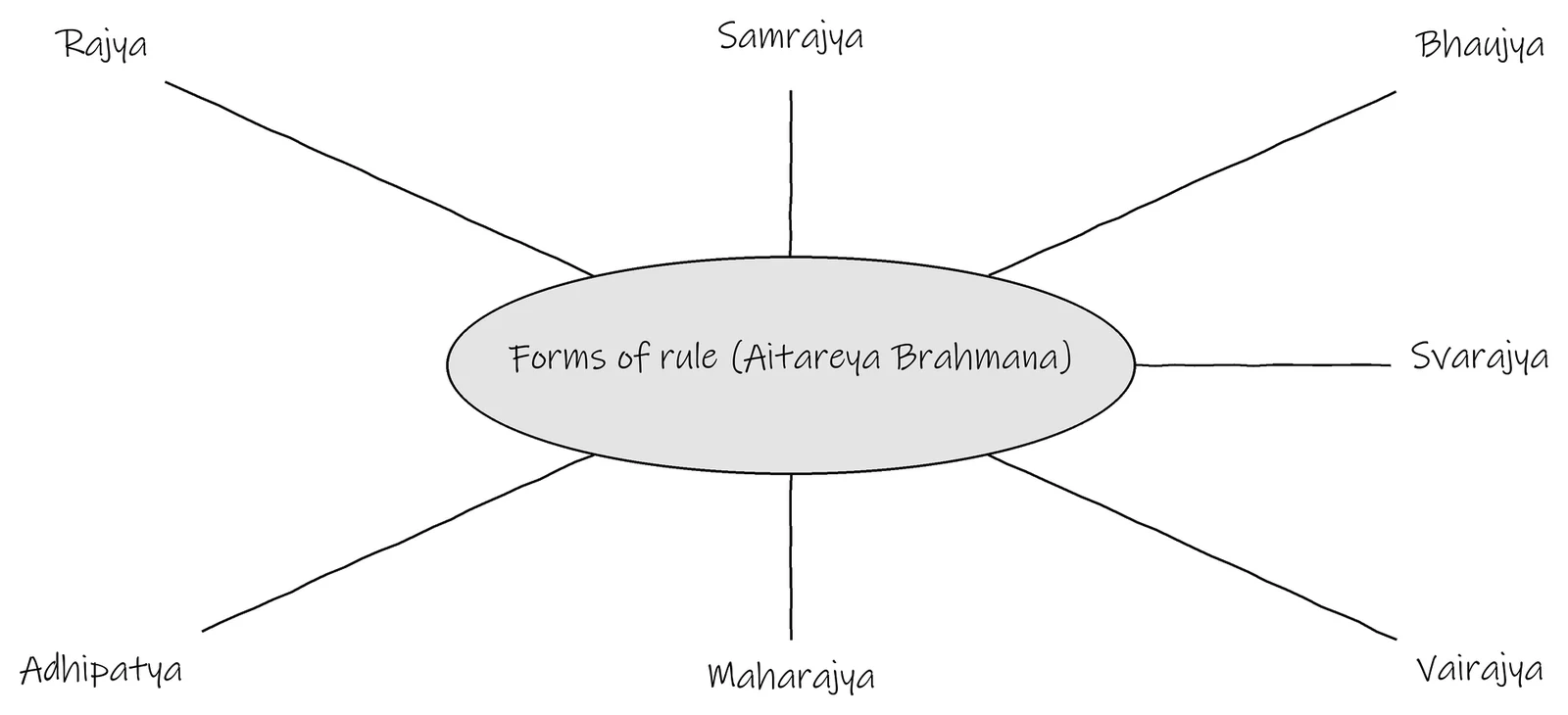
Ancient texts describe several forms of rule (Figure 5.2). The Aitareya Brahmana, describing the great consecration of Indra, links them with different regions: samrajya (empire) in the east, bhaujya in the south, svarajya (self-rule) in the west, vairajya in the north and rajya (kingship) in the middle region; it also mentions maharajya and adhipatya (overlordship). The exact meaning of some of these terms is disputed; Altekar and Jayaswal interpreted vairajya as a kingless form of government, and svarajya and bhaujya as forms of non-monarchical or limited rule. Kautilya and other texts also speak of dvairajya (rule by two) and of gana or sangha states (republics).
Features of Rajya
- Territory. Rajya is tied to a defined land (janapada); Kautilya’s Saptanga makes territory and population an essential limb.
- Sovereign authority. The king (swami) holds supreme power, consecrated through rituals such as the rajasuya and abhisheka described in the Brahmanas.
- Administration. Ministers, officials and a treasury make government possible, as the Arthashastra describes in detail.
- Coercive power. Danda and the army enforce the law and defend the realm.
- Purpose. Protection (raksha) and welfare (yogakshema) are the ends of the rajya in both Kautilya and the Shanti Parva.
- Bound by dharma. The rajya serves the moral order rather than the will of the king alone, as the Dharmashastras insist.
5.2 Rashtra
Rashtra is an equally old word, found in the Rigveda, where it means the realm, the dominion or the kingdom over which a ruler has authority. Later Vedic texts speak of the king as the bearer (rashtrabhrit) and protector of the rashtra, and a famous prayer in the Yajurveda (Vajasaneyi Samhita IX.23) says, ‘May we be watchful in the rashtra, placed in front.’ The Prithvi Sukta of the Atharvaveda (XII.1) praises the Earth as a mother who bears people of many languages and customs, and declares, ‘The Earth is my mother, and I am her son.’ In these texts rashtra carries a sense of attachment to the land and its people.
In the Arthashastra, Kautilya often uses rashtra for the countryside or territory of the kingdom as distinct from the fortified capital (durga), especially as the source of revenue; the officers of a district were later called rashtrikas, and one great dynasty took the name Rashtrakuta. In ancient usage, then, rashtra meant the realm, the land and the people under a ruler, rather than the modern ‘nation’ of equal citizens.
Features of Rashtra
- The realm. Rashtra is the land under a ruler’s authority, as in the Rigvedic usage.
- People and prosperity. It includes the people and the wealth of the land; Kautilya treats it as the source of revenue.
- Attachment to the land. The Prithvi Sukta expresses a feeling of belonging to a motherland.
- Protection by the ruler. The king is the rashtrabhrit, the one who bears and sustains the rashtra.
- Diversity. The Prithvi Sukta describes the Earth bearing people of different languages and customs, a recognition of plurality within the realm.
5.3 Rajya and Rashtra Compared
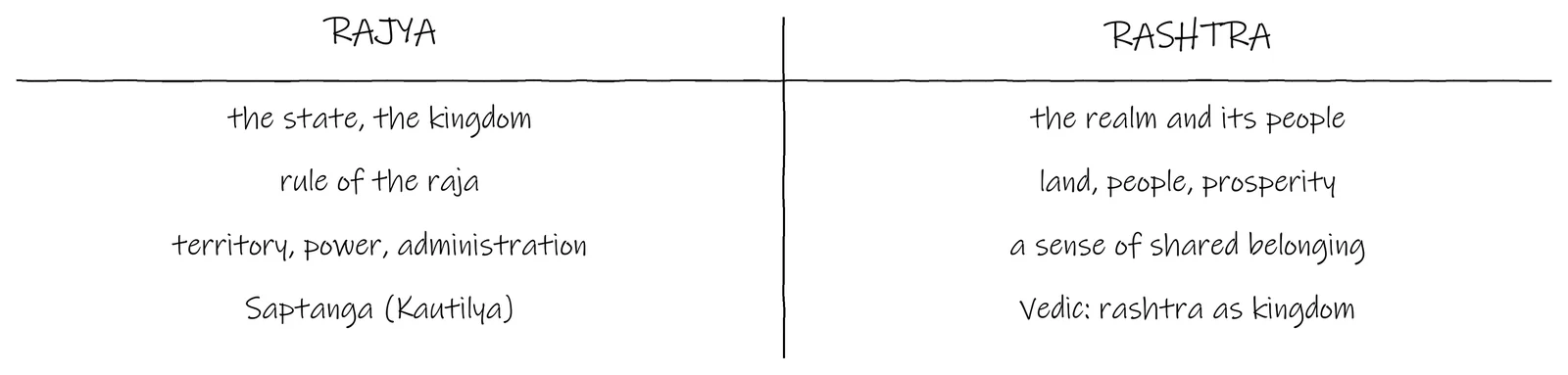
The two concepts are closely related but not identical (Figure 5.3). Rajya refers mainly to the state as an institution, i.e. government, sovereignty and administration. Rashtra refers mainly to the realm as a community, i.e. the land, its people and their prosperity. In simple words, rajya is the machinery of rule; rashtra is what is ruled and what people belong to. A rajya protects and governs the rashtra; a rashtra gives the rajya its territory, revenue and loyalty. This distinction is similar to the modern distinction between the state and the nation, which is why the DU examination asks whether the modern nation-state evolved from these concepts.
5.4 Bharatvarsha and the Idea of Cultural Unity
Ancient texts also have an idea of the whole subcontinent as a single land. The Vishnu Purana (II.3.1) describes ‘the country that lies north of the ocean and south of the snowy mountains’ as Bharata, where the descendants of Bharata dwell. The ideal of the chakravartin, the universal ruler whose authority extends over the whole land, and the network of pilgrimage centres from the Himalayas to Kanyakumari expressed a sense of shared culture. The historian Radha Kumud Mookerji, in The Fundamental Unity of India (1914), argued that this cultural and geographical unity was the basis of Indian nationhood. Critics reply that cultural unity is not the same as political nationhood: ancient India was politically divided among many kingdoms and republics, and loyalties were to king, caste, region and faith rather than to a nation.
5.5 The Debate on the Nation’s Modernity
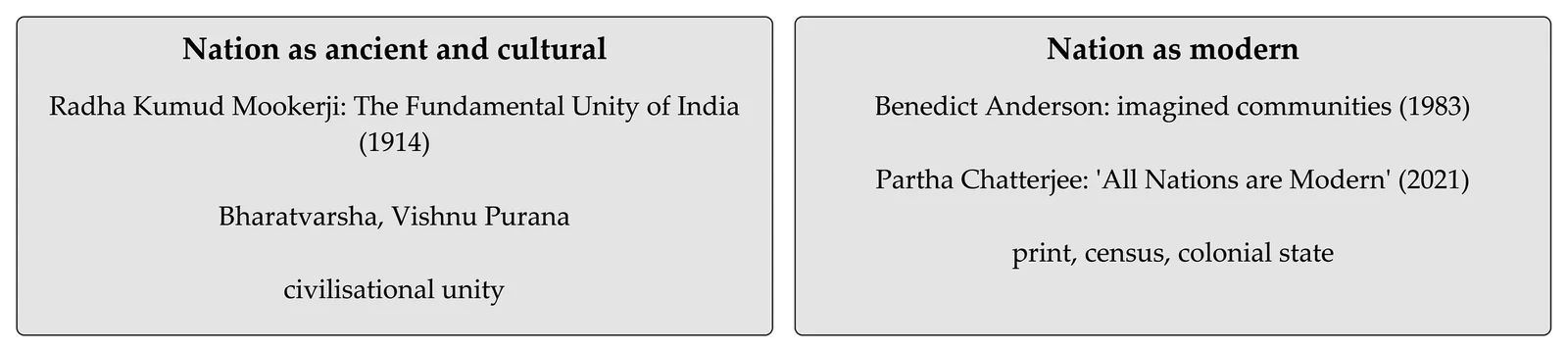
This brings us to the debate about the nation-state. A nation-state is a sovereign state whose legitimacy rests on a nation of citizens who see themselves as one people. Two broad views exist (Figure 5.4).
A. The nation as ancient (primordialist and cultural view)
Some thinkers see nations as old communities rooted in a shared land, culture and memory. Indian nationalists such as Mookerji and V.D. Savarkar, whose Hindutva (1923) defined the nation by a shared land, culture and heritage, traced the Indian nation to ancient times, pointing to the concepts of rashtra and Bharatvarsha. Anthony D. Smith, in The Ethnic Origins of Nations (1986), argued that modern nations are built on older ethnic communities (ethnies).
B. The nation as modern (modernist view)
Most modern scholars argue that nations are recent. Ernest Gellner, in Nations and Nationalism (1983), linked them to industrial society and mass education; Benedict Anderson, in Imagined Communities (1983), showed how print capitalism allowed millions who never meet to imagine themselves as one community. Partha Chatterjee, in ‘All Nations are Modern’ (2021), argues that the nation as a sovereign community of equal citizens is a product of modern history: earlier there were kingdoms, empires and religious communities, but not nations. In India, the colonial state, the census, print and the national movement created the nation, which then looked back to the past for its symbols. Rabindranath Tagore, in Nationalism (1917), even warned against the aggressive nation-state as a Western import.
The balanced conclusion is that the ancient concepts of rajya and rashtra provided a vocabulary and a sense of belonging to the land, but the modern nation-state, based on popular sovereignty, citizenship, defined borders and nationalism, is a modern creation. Independent India deliberately used the old words, rajya, rashtra, Bharat, for new institutions.
5.6 Important Questions
- Question 1 Briefly explain the concepts of ‘Rajya’ and ‘Rashtra’ in the context of Indian political thought. Do you think the idea of the modern ‘nation-state’ has evolved from these concepts? Give reasons for your answer.
- Question 2 Discuss the origin and types of the state in ancient India.
- Question 3 Examine Partha Chatterjee’s argument that ‘all nations are modern’.
DU asks the same idea in different words. So learn one broad answer for each question below; the same answer works for every question joined by OR.
Important Question 1
Briefly explain the concepts of ‘Rajya’ and ‘Rashtra’ in the context of Indian political thought. Do you think the idea of the modern ‘nation-state’ has evolved from these concepts? Give reasons for your answer.
OR
Distinguish between rajya and rashtra.
OR
Is the Indian nation ancient or modern? Discuss.
Model Answer
“All nations are modern.”
— Partha Chatterjee (2021)
Introduction. Rajya and rashtra are two of the oldest political concepts in India. Rajya meant the kingdom or state; rashtra meant the realm, its land and people. Today the words mean ‘state’ and ‘nation’, which raises the question whether the modern nation-state grew from them.
1. Meaning of Rajya
From raj, to rule or shine, rajya means the kingdom and kingship; the Shanti Parva explains that the king is called raja because he delights (ranjayati) the people. For Kautilya, the seven limbs, king, ministers, territory and people, fort, treasury, army and ally, constitute the rajya. It is therefore an institutional idea of government, sovereignty, administration and coercive power, aimed at protection (raksha) and welfare (yogakshema), and bound by dharma. Kautilya’s seven elements describe the rajya as a working organism of king, ministers, territory, fort, treasury, army and ally.
2. Types and Growth of Rajya
A.S. Altekar (1949) traced the growth from jana (tribe) to janapada, the sixteen mahajanapadas and the Mauryan samrajya. The Aitareya Brahmana names forms such as samrajya, bhaujya, svarajya, vairajya and rajya, and texts mention republics (ganas) and dvairajya. This growth reflected the spread of agriculture, iron and towns.
3. Meaning of Rashtra
In the Rigveda rashtra means the realm or dominion under a ruler, and the king is the rashtrabhrit, the one who sustains it. The Yajurveda (Vajasaneyi Samhita IX.23) prays, ‘May we be watchful in the rashtra’, and the Prithvi Sukta of the Atharvaveda (XII.1) calls the Earth ‘my mother’ and describes her bearing people of many languages and customs, a striking image of a shared land with diverse people. Kautilya uses rashtra for the territory and countryside that supply revenue, as distinct from the fortified capital, and district officers were later called rashtrikas. The Atharvaveda prays for a firm rashtra protected by the gods, which shows its sense of a secure realm.
4. Rajya and Rashtra Compared
Rajya is the state as institution; rashtra is the realm as land and community. The rajya governs and protects the rashtra; the rashtra gives the rajya its territory, wealth and loyalty. In modern Hindi, rashtra is used for the nation, while rajya refers to the states of the Union.
5. The Case for Evolution
Mookerji (The Fundamental Unity of India, 1914) and Savarkar (Hindutva, 1923) traced the Indian nation to Bharatvarsha and the idea of rashtra; Anthony D. Smith argued that nations rest on older ethnic communities. The Vishnu Purana describes Bharata as the land between the ocean and the Himalayas; the chakravartin ideal imagined a single sovereign over this land; and pilgrimage networks from Badrinath to Rameshwaram created shared sacred geography. The Prithvi Sukta’s motherland suggests an old sense of belonging to the land. Aurobindo spoke of India as a living mother and a spiritual unity, and the writings of Bankim Chandra gave the land deep emotional meaning.
6. Use of the Old Words in Modern India
Independent India deliberately used these ancient words for new institutions. Article 1 of the Constitution declares, ‘India, that is Bharat, shall be a Union of States’, the rajyas of today; the head of state is the Rashtrapati; and national symbols such as Ashoka’s lion capital link the modern state to an ancient past.
7. Old Words in the Constituent Assembly
When the Constituent Assembly chose ‘India, that is Bharat’ and titles such as Rashtrapati, Lok Sabha and Rajya Sabha, it deliberately linked the new republic with old words while giving them democratic meanings.
8. The Case against Evolution
Ernest Gellner (Nations and Nationalism, 1983) linked nations to industrial society and mass education, and Benedict Anderson (Imagined Communities, 1983) to print capitalism. Partha Chatterjee, in ‘All Nations are Modern’ (2021), argues that the nation as a sovereign community of equal citizens is a modern creation: ancient and medieval India had many kingdoms, empires and republics, and people’s loyalties were to king, caste, region and faith, not to a nation. The Indian nation was created by the colonial state, the census, print, modern education and the national movement, which then looked back to rajya, rashtra and Bharatvarsha for symbols. Rabindranath Tagore (Nationalism, 1917) even warned that the aggressive nation-state was a Western import. Benedict Anderson called nations imagined communities created by print capitalism.
9. Rashtra and Swaraj
During the freedom struggle, Tilak’s demand for swaraj and Gandhi’s idea of self-rule gave rashtra a new meaning: a nation of people who rule themselves, not merely a realm ruled by a king.
10. Evaluation
Rajya and rashtra gave Indians a political vocabulary and a sense of attachment to the land, which nationalism later used. But the modern nation-state differs fundamentally from them: its sovereignty belongs to the people, not the king; its members are equal citizens, not subjects ranked by varna; it has fixed borders recognised by other states; and it rests on nationalism, a modern ideology. The modern nation-state therefore did not evolve directly from rajya and rashtra, though it borrowed their names and memories. In short, the words are ancient but the modern nation-state of equal citizens is new.
Conclusion. Thus, rajya and rashtra are ancient concepts of state and realm. The modern Indian nation-state borrowed their names and drew on their cultural memory, but it is essentially a modern creation.
Important Question 2
Discuss the origin and types of the state in ancient India.
OR
Trace the growth of the state from jana to janapada and mahajanapada.
OR
Write a note on the forms of government in ancient India.
Model Answer
“The king is called raja because he delights the people.”
— Mahabharata, Shanti Parva
Introduction. The state in ancient India developed over many centuries, from tribal chiefdoms to territorial kingdoms and empires, and took several forms, monarchical and non-monarchical.
1. Theories of Origin
Ancient texts explain the state as a remedy for matsya nyaya: by divine creation (Manusmriti), by contract (Shanti Parva, Kautilya), by election (the Buddhist Mahasammata) or through war (Aitareya Brahmana). Altekar emphasised its growth from family and clan. The Aitareya Brahmana adds a theory of origin through war: the gods made Indra king to win against the demons.
2. Indian and Western Theories Compared
The Indian theories resemble Western ones: the divine theory parallels the divine right of kings, the contract story of Mahasammata parallels Hobbes and Locke, and the war theory parallels the view that conflict creates states.
3. From Jana to Janapada
Early Vedic society was organised in tribes (jana) under a chief. As tribes settled, territorial janapadas named after them emerged in the later Vedic period. The word janapada, ‘the foothold of a tribe’, shows the shift from people to territory.
4. Agriculture, Iron and the State
The spread of iron tools and rice cultivation in the Ganga valley from about 600 BCE produced surpluses that supported towns, armies and officials, making the transition from tribe to state possible.
5. The Mahajanapadas
By the sixth century BCE, sixteen mahajanapadas, such as Magadha, Kosala, Vatsa, Avanti and the Vajji republic, are listed in the Anguttara Nikaya; most were monarchies, some republics. Iron tools, agricultural surplus and the growth of towns made larger states possible.
6. Republican States
The ganas and sanghas, such as the Licchavis and Shakyas, were states governed by assemblies of clan heads; Panini and the Buddhist texts describe their procedures, and they show that monarchy was not the only form.
7. The Empire
Magadha’s expansion culminated in the Mauryan samrajya, a centralised empire with a bureaucracy, army and spies, as described in the Arthashastra. Ashoka’s empire stretched from Afghanistan to Karnataka.
8. The Gupta State
The Gupta empire (fourth to sixth centuries CE) was less centralised than the Mauryan, relying on feudatories and land grants, and its kings took grand titles such as maharajadhiraja and paramabhattaraka.
9. Types of State
The Aitareya Brahmana names samrajya, bhaujya, svarajya, vairajya and rajya, as well as maharajya and adhipatya; other texts mention dvairajya (rule by two) and the republics (ganas, sanghas). Altekar interpreted vairajya as kingless government, though meanings are debated. Kautilya also discusses rule by two kings (dvairajya) and rule by a foreign king (vairajya), which he regarded as unstable.
10. Sources of Revenue
States collected a share of the produce (bhaga), usually one-sixth, as well as taxes on trade and crafts; Kautilya describes the collector-general and the treasurer who managed revenue.
11. Features
All forms shared territory, authority, administration, coercive power and the aims of protection and welfare, bound by dharma. Every type rested on the idea that the state exists to protect people and property.
12. The Saptanga as Elements of the Rajya
Whatever its form, the ancient state was understood through Kautilya’s seven elements: king, ministers, territory and people, fort, treasury, army and ally. This organic view treated the state as a whole whose parts depend on one another, and it applied to monarchies and, with changes, to republics as well. The theory applied to kingdoms and, in modified form, to republics.
13. Monarchy and Its Limits
Monarchy became the dominant form from the later Vedic period, and kingship became hereditary, supported by rituals such as the rajasuya and ashvamedha. But the king was bound by dharma, advised by ministers and the mantriparishad, and limited by the autonomy of villages, guilds and castes. In the republics, power lay with assemblies of clan heads. Hereditary succession, usually by the eldest son, became normal, though councils and ministers still advised the king.
14. Evaluation
The variety of forms named in the texts, from samrajya to vairajya and the ganas, shows that ancient India had a rich and plural experience of government, not a single model of despotic kingship. This variety challenges the view that India knew only despotic monarchy.
Conclusion. Thus, the ancient Indian state grew from tribe to empire and took varied forms, showing a rich and plural political experience.
Important Question 3
Examine Partha Chatterjee’s argument that ‘all nations are modern’.
OR
Is nationalism a modern phenomenon? Discuss with reference to India.
OR
Write a note on the idea of Bharatvarsha.
Model Answer
“Imagined because the members of even the smallest nation will never know most of their fellow-members.”
— Benedict Anderson, Imagined Communities (1983)
Introduction. A central debate in the study of nationalism is whether nations are ancient communities or modern creations. Partha Chatterjee argues that all nations, including India, are modern.
1. The Primordialist View
Nations are seen as ancient, rooted in land, language and culture. Indian nationalists such as Mookerji and Savarkar pointed to Bharatvarsha and rashtra; Anthony D. Smith stressed ethnic roots. Anthony Smith’s ethno-symbolism takes a middle path, arguing that modern nations grow out of older ethnic communities and their myths and symbols.
2. The Modernist View
Gellner linked nations to industrialisation and mass education; Anderson to print capitalism and ‘imagined communities’. Eric Hobsbawm showed how traditions are often invented to give new nations a sense of antiquity.
3. Chatterjee’s Argument
In ‘All Nations are Modern’ (2021), Chatterjee argues that the nation as a sovereign community of equal citizens is modern. Pre-modern India had kingdoms, empires and religious communities, but not a nation; the colonial state, the census, print and the national movement created it, and nationalists then constructed an ancient past. In The Nation and Its Fragments (1993), he argued that Indian nationalism first claimed sovereignty in the inner, spiritual domain of culture and family before contesting the colonial state in the outer, material domain.
4. Popular Sovereignty as the Test
For Chatterjee the decisive feature of the modern nation is popular sovereignty: the people, not a king or a god, are the source of authority. This idea entered India with the national movement and was embodied in the Constitution’s opening words, ‘We, the People of India’.
5. Bharatvarsha and Cultural Unity
The Vishnu Purana describes Bharata between the ocean and the Himalayas, and pilgrimage networks expressed shared culture. Chatterjee accepts such cultural memory but denies that it amounted to political nationhood. This cultural unity was real, but it did not imply a single political community of equal citizens.
6. Gandhi and Nehru on the Nation
Gandhi, in Hind Swaraj, claimed that India was one nation before the British came, united by pilgrimage and culture, while Nehru, in The Discovery of India, described a unity in diversity built over millennia; both used history to imagine a modern, inclusive nation.
7. Nations in Comparative Perspective
European nations such as France and Germany were also built in the modern period through revolutions, wars, schools and national languages, which supports the view that nations are made rather than simply inherited.
8. The Constitution and the Modern Nation
The Constitution created a nation of equal citizens with universal franchise, Fundamental Rights and a secular state, an idea of nationhood without precedent in ancient India.
9. Critics of Chatterjee
Critics argue that Chatterjee underestimates older forms of collective identity, such as the shared culture of Bharatvarsha or regional patriotism, which nationalists could build upon.
10. Evaluation
The modernist view explains the novelty of popular sovereignty and citizenship; the primordialist view explains the emotional power of nationalism. Tagore’s critique (1917) reminds us of the dangers of aggressive nationalism. Chatterjee reminds us that the Indian nation was built through politics in the modern era, by the freedom movement and the Constitution. The best view combines both: old cultural materials, new political forms.
11. Anderson’s Imagined Communities
Benedict Anderson argued that the nation is ‘an imagined political community, imagined as both inherently limited and sovereign’. Print capitalism, newspapers and novels in vernacular languages allowed people who would never meet to imagine themselves as members of one community living in the same time. In Asia and Africa, he added, colonial schools, maps and censuses helped create the outline of future nations. Indian newspapers, novels and printed vernaculars in the nineteenth century helped people imagine the nation.
12. Nationalist Claims to an Ancient Nation
Indian nationalists drew on ancient symbols to argue that the nation was old: the idea of Bharatvarsha, the image of Bharat Mata and Bankim Chandra’s song Vande Mataram (1875, published in Anandamath, 1882), and the memory of the Mauryan and Gupta empires. Chatterjee does not deny these memories; he argues that they were selected and reinterpreted by modern nationalism, which needed a past to legitimise its claim to sovereignty. Such claims gave the nation emotional power but could exclude those whose history did not fit the ancient narrative.
13. Tagore’s Critique
Rabindranath Tagore, in Nationalism (1917), argued that the nation-state was a Western organisation of power and commerce that suppressed the moral and social life of people, and he warned India against imitating it. His critique supports the view that the nation-state was a new and foreign form, not a continuation of India’s ancient traditions. He feared that nationalism would make Indians imitate the aggressive Western nation-state rather than their own tradition of social cooperation.
14. Implications Today
The debate matters for contemporary politics, because ideas of an ancient nation can be used either to build an inclusive civic nationalism or to define the nation by one religion or culture.
Conclusion. Thus, Chatterjee persuasively shows that the nation-state is modern, though nations draw on older cultural memories such as rashtra and Bharatvarsha to give themselves meaning.
Short Notes
(a) Bhumi Sukta
The hymn to the earth in the Atharvaveda (Book 12), which contains the line ‘mata bhumih putro aham prithivyah’, the earth is my mother and I am her son. It expresses an attachment to land and a sense of belonging that later writers have read as an early idea of rashtra, though scholars caution that it is not modern nationalism.
(b) Chakravartin
The ideal of a universal ruler whose wheel of authority rolls everywhere without obstruction, found in Buddhist, Jain and Brahmanical texts. It expressed the aspiration to unify the land between the Himalayas and the sea under righteous rule, and was associated with rulers such as Ashoka. It combined political power with moral leadership.
More notes: DSC-2 Ideas and Institutions in Indian Political Thought
These notes are prepared by PADHO TO AISE for study help. They are not an official University of Delhi publication.