
Semester I DSC-2 Ideas and Institutions in Indian Political Thought
Unit III · 24 min read · Updated 24 Nov 2026
As per the University of Delhi (DU) BA (Hons) Political Science syllabus
Contents
- 3.1 Nyaya
- The Administration of Justice
- 3.2 Niti
- 3.3 The Nitisara: Origin, Growth and Significance
- Origin and Content
- Features of the Nitisara
- Growth and Significance
- 3.4 Amartya Sen on Niti and Nyaya
- 3.5 Relevance of Nyaya and Niti Today
- 3.6 Important Questions
- Analyse the significance of ‘Nyaya’ and ‘Niti’ in Indian tradition. Give suitable examples from relevant texts in support of your answer.
- Elaborate the origin, growth and significance of ‘Nitisara’ in Indian tradition.
- Discuss the administration of justice in ancient India.
- Short Notes
न्याय्यात् पथः प्रविचलन्ति पदं न धीराः।
The steadfast never step away from the path of justice.
— Bhartrihari, Nitishataka
IN CHAPTER 2 we saw that the king used danda to protect dharma. But how should the king decide what is just in a particular case, and how should he conduct himself in government? Two Sanskrit words answer these questions: nyaya and niti. In classical Sanskrit both can be translated as ‘justice’, but they point to different things. The economist and philosopher Amartya Sen, in The Idea of Justice (2009), revived this old distinction: niti means correct rules, institutions and conduct, while nyaya means justice actually realised in people’s lives. In this chapter we study both ideas in the Indian tradition: the meaning of nyaya and the administration of justice, the long tradition of Niti-shastra and its classic text, the Nitisara, and finally Sen’s modern use of the two concepts.
3.1 Nyaya
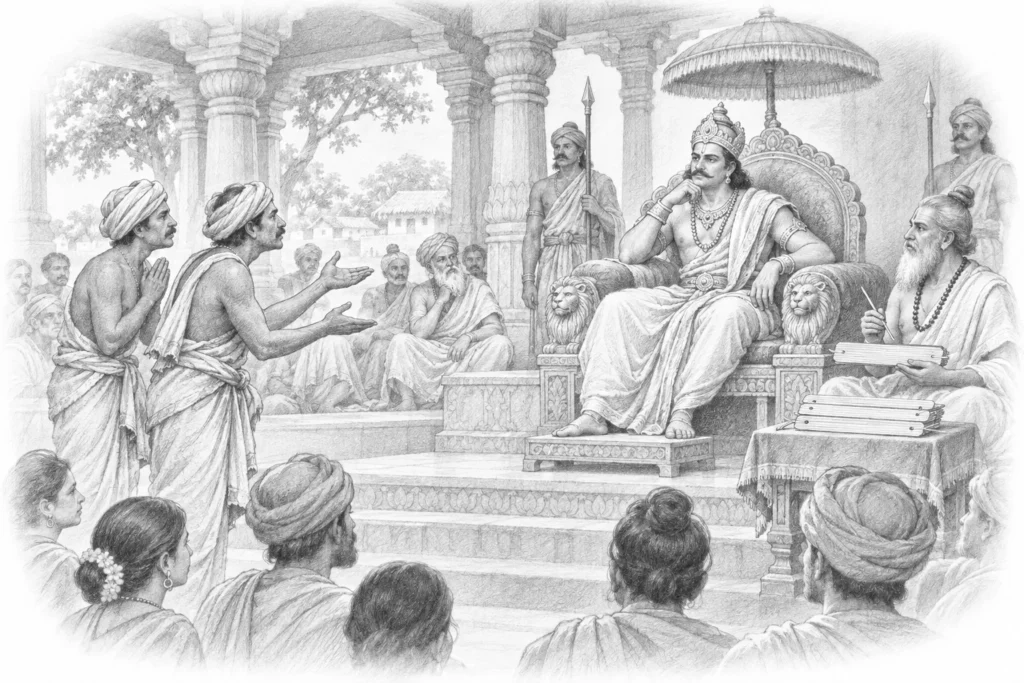
The word nyaya comes from a root meaning ‘to lead’ or ‘to go back to’, and has several meanings: justice, a right rule, a logical method and a guiding maxim. This last meaning explains the famous phrase matsya nyaya, the ‘maxim of the fishes’, i.e. the condition in which the big fish swallow the small. In political thought, nyaya above all means justice: giving each person what is due and protecting the weak against the strong. Ending matsya nyaya was the very reason for the existence of the king (Figure 3.2).

The Administration of Justice
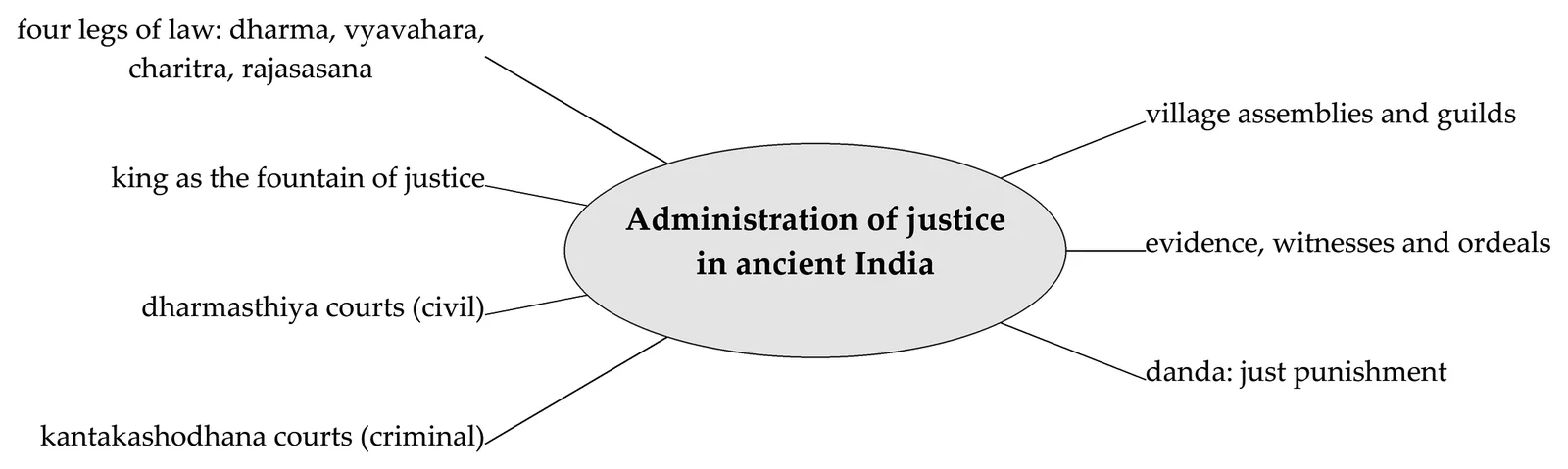
Ancient Indian texts gave great importance to the courts. The king was the fountain of justice, and hearing disputes was among his most important duties. The Dharmashastras and the Arthashastra describe the system in detail:
- The king and his court. Manu (VIII.1–10) says that the king should enter the court with learned Brahmins and counsellors; when he cannot attend, a learned judge (pradvivaka) with three assessors (sabhyas) should hear cases.
- Kinds of courts. Kautilya (Arthashastra Books 3 and 4) describes dharmasthiya courts for civil disputes, each with three judges and three ministers, and kantakashodhana courts for criminal matters, which ‘removed the thorns’ of society.
- Titles of law. Manu lists eighteen titles of law, including debts, deposits, sale without ownership, partnership, wages, contracts, boundary disputes, assault, defamation, theft, violence, adultery, the duties of husband and wife, inheritance and gambling.
- Procedure. A trial had four stages: the plaint (purvapaksha), the reply (uttara), the proof (kriya) and the decision (nirnaya).
- Evidence. Proof could be by documents, witnesses and possession, and in doubtful cases by divya, i.e. ordeals of fire, water, poison or the balance, as described in the Yajnavalkya Smriti.
- Sources of law. Kautilya named four: dharma, vyavahara (evidence and transactions), charitra (custom) and rajashasana (royal edict); local customs of guilds, villages and families were also respected.
- Impartiality. Judges were to be honest and fearless; Kautilya prescribed fines for judges who threatened, obstructed or wrongly decided cases.
Notice that nyaya in this sense is close to law and judicial procedure, i.e. justice as administered by the state. But Indian tradition also had a wider idea of good governance and right conduct, which it called niti.
3.2 Niti
Niti comes from the root nī, ‘to lead’ or ‘to guide’. It means guidance, policy, prudence and right conduct; in politics it means the wise conduct of government. The science of government itself was called Dandaniti [दण्डनीति], the niti of danda, and kings and ministers were trained in niti from childhood. Unlike the Dharmashastras, which are concerned with sacred duty, the niti texts are practical: they teach how to govern successfully and ethically in a world of rivals, flatterers and dangers. Over many centuries a whole literature of Niti-shastra developed (Figure 3.3).
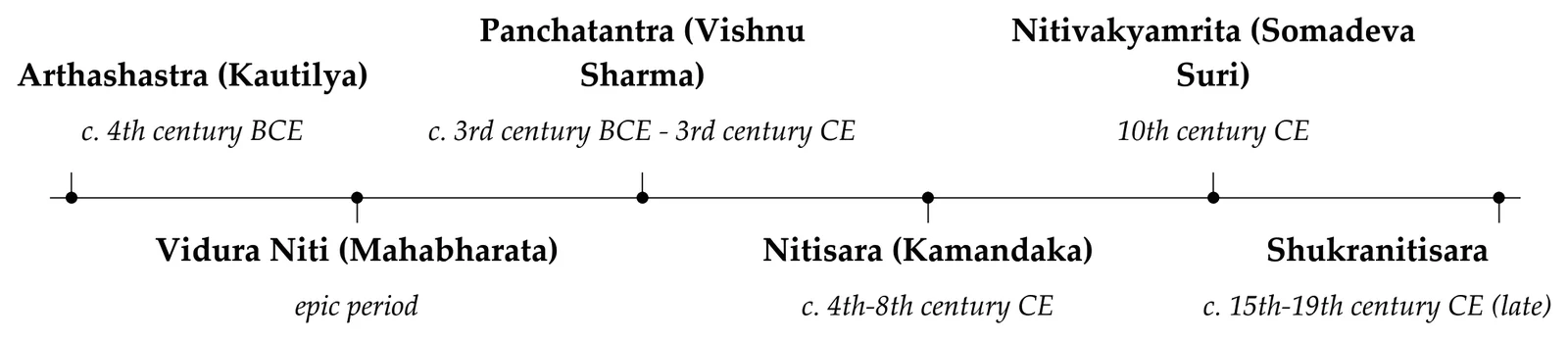
- *Kautilya’s Arthashastra.* The foundation of the tradition (Chapter 1), combining realist statecraft with the welfare of the people.
- Vidura Niti. In the Udyoga Parva of the Mahabharata, the wise Vidura advises the anxious king Dhritarashtra on the eve of the war, teaching truthfulness, self-control and fairness to the Pandavas.
- *The Panchatantra.* According to its frame story, Vishnu Sharma composed these animal fables to teach niti to three dull princes of King Amarashakti within six months; they teach friendship, alliance, war and prudence.
- *Kamandaka’s Nitisara.* A verse summary of Kautilyan statecraft (Section 3.3).
- *Somadeva Suri’s Nitivakyamrita.* A tenth-century Jain work of aphorisms on government, written at the court of a Rashtrakuta feudatory.
- *The Shukranitisara.* A late text attributed to Shukracharya, the preceptor of the asuras; it mentions firearms, which is why many scholars date it to the medieval or even early modern period.
- *Bhartrihari’s Nitishataka and Chanakya Niti.* Collections of verses and maxims on wise conduct that made niti popular wisdom.
3.3 The Nitisara: Origin, Growth and Significance
The Nitisara (the ‘essence of niti’) of Kamandaka, also called the Kamandakiya Nitisara, is the most important niti text after the Arthashastra. It was probably composed between the fourth and eighth centuries CE, in the Gupta or post-Gupta period. In its opening verses Kamandaka pays homage to Vishnugupta, i.e. Kautilya, and presents his work as a summary of Kautilya’s teaching for kings.
Origin and Content
Written in about twenty cantos (sargas) of verse, the Nitisara condenses the prose of the Arthashastra into a form that could be memorised. It covers the training and self-discipline of the king, the seven limbs of the state (Saptanga), the circle of states (Mandala), the six-fold policy, the four upayas, espionage, ambassadors, war and the conduct of ministers. It accepts Kautilya’s framework almost entirely.
Features of the Nitisara
- Self-control of the king. Kamandaka begins with indriya-jaya, i.e. conquest of the senses: a king who cannot govern himself cannot govern others.
- Moral emphasis. Compared with Kautilya, Kamandaka places more stress on righteousness and less on deceit, softening the harsher features of Kautilyan statecraft.
- Organic state. The seven limbs are mutually dependent, and the king must care for all of them.
- Balance of power. The mandala and the six-fold policy guide relations with other states.
- Welfare. The king must protect his people as a father protects his children, and his prosperity depends on theirs.
- Popular form. Its verse form made Kautilyan ideas accessible to later generations of princes and ministers.
Growth and Significance
The Nitisara shows that the Kautilyan tradition did not disappear after the Mauryas but continued to be studied for centuries. It influenced later works such as the Nitivakyamrita and the Shukranitisara, and versions of it reached Java and Bali, showing the spread of Indian political ideas across South-East Asia. The Shukranitisara carried the tradition further, comparing the state to a body and describing the king as a servant of the people who receives his revenue as wages. Together these texts form a continuous Indian tradition of political prudence from the Mauryas to the medieval period.
3.4 Amartya Sen on Niti and Nyaya
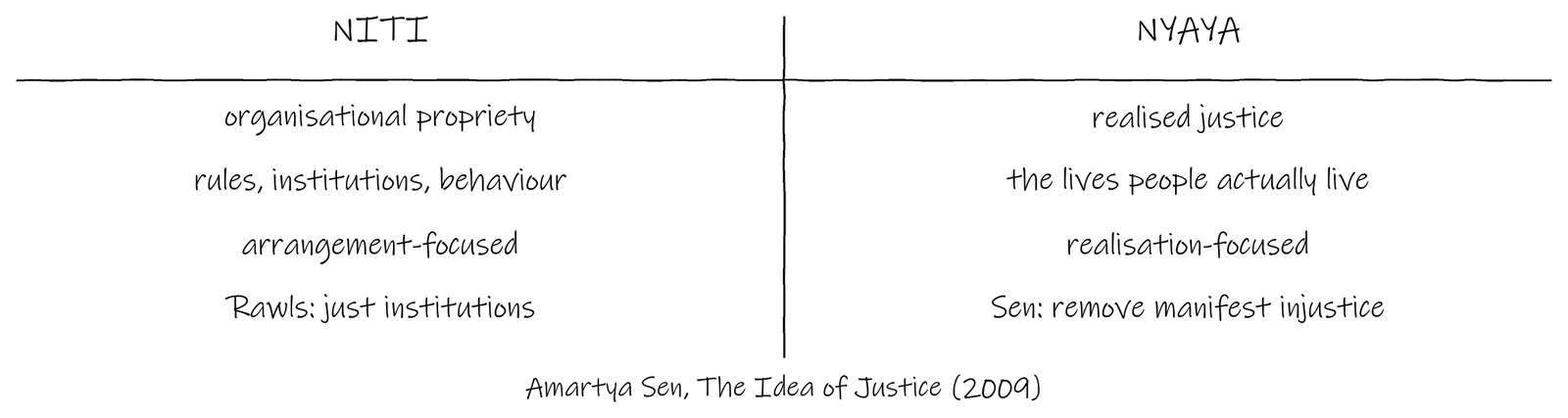
In the Introduction to The Idea of Justice (2009), Amartya Sen used the two Sanskrit words to explain his own theory of justice (Figure 3.4). Niti refers to organisational propriety and behavioural correctness, i.e. the right rules and just institutions. Nyaya refers to a comprehensive idea of realised justice, i.e. what kind of lives people are actually able to live. Institutions and rules matter, Sen argued, but only as means: what finally counts is the world that actually emerges.
Sen used the old idea of matsya nyaya to make his point. The central task of justice, he wrote, is to prevent the big fish from devouring the small fish, and this is a matter of nyaya, of what actually happens to people, not just of having correct rules. He gave the example of the Holy Roman Emperor Ferdinand I, who declared, ‘Let justice be done, though the world perish.’ Such strict niti, Sen argued, could hardly be called justice in the sense of nyaya if the world really did perish.
This distinction underlies Sen’s criticism of transcendental institutionalism, the approach of social contract thinkers from Hobbes to Rawls, which seeks to design perfectly just institutions. Sen preferred a realisation-focused comparison, found in thinkers such as Adam Smith, Condorcet, Mary Wollstonecraft, Marx and J.S. Mill, which asks how to remove clear injustices, such as famine, slavery or the subjection of women, even without agreement on a perfect theory. In simple words, we do not need to know what a perfect world looks like in order to know that ending a famine makes the world more just.
3.5 Relevance of Nyaya and Niti Today
The two ideas remain useful. Niti reminds us that good institutions, fair procedures and honest conduct by rulers are essential; nyaya reminds us that institutions must be judged by their results in people’s lives. The Preamble of the Indian Constitution promises justice, social, economic and political, and Article 39A directs the state to provide equal justice and free legal aid, so that justice is not denied to anyone because of poverty. Both reflect the old principle that the state exists to end matsya nyaya and protect the weak.
3.6 Important Questions
- Question 1 Analyse the significance of ‘Nyaya’ and ‘Niti’ in Indian tradition. Give suitable examples from relevant texts in support of your answer.
- Question 2 Elaborate the origin, growth and significance of ‘Nitisara’ in Indian tradition.
- Question 3 Discuss the administration of justice in ancient India.
DU asks the same idea in different words. So learn one broad answer for each question below; the same answer works for every question joined by OR.
Important Question 1
Analyse the significance of ‘Nyaya’ and ‘Niti’ in Indian tradition. Give suitable examples from relevant texts in support of your answer.
OR
Distinguish between niti and nyaya with reference to Amartya Sen.
OR
Explain the concept of nyaya in ancient Indian political thought.
Model Answer
“Let justice be done, though the world perish.”
— Ferdinand I, quoted by Amartya Sen as an example of niti without nyaya
Introduction. In classical Sanskrit, both niti and nyaya mean justice, but they point to different aspects of it. Niti refers to correct rules, institutions and conduct; nyaya refers to justice actually realised in people’s lives. Both ideas run through Indian political thought, from the Dharmashastras and the Arthashastra to Amartya Sen.
1. Meaning of Nyaya
Nyaya means justice, right rule and guiding principle; the word also names the school of logic founded on Gautama’s Nyaya Sutras, which shows how closely justice and right reasoning were linked. Its opposite is matsya nyaya, the law of the fishes, in which the strong swallow the weak. Kautilya (Arthashastra 1.4) and the Shanti Parva both say that the king exists to end this condition, so that the weak can live securely beside the strong. The Nyaya school developed rules of valid reasoning, and the link suggests that justice requires careful reasoning about evidence.
2. Nyaya in the Administration of Justice
The king was the fountain of justice. Manu (VIII) describes a court of the king or a learned judge (pradvivaka) with three assessors, and eighteen titles of law, from debts and deposits to inheritance and gambling. Kautilya describes dharmasthiya (civil) and kantakashodhana (criminal) courts, each with three judges and three ministers, and four sources of law: dharma, vyavahara, charitra and rajashasana. Trials had four parts, plaint, reply, proof and decision, and evidence included documents, witnesses, possession and, in doubtful cases, ordeals. Kautilya even fined judges who threatened or misled litigants, which shows a concern for fair procedure. Courts were expected to hear both sides, examine witnesses and documents and decide according to law and custom.
3. Nyaya in Ashoka’s Edicts
Ashoka’s Pillar Edict IV directed his officers, the rajukas, to ensure uniformity in judicial procedure and in punishment (vyavahara-samata and danda-samata), and granted three days’ respite to those sentenced to death. This is an early example of the idea that justice requires equal treatment and humane procedure. He also appointed officers to prevent unjust imprisonment and torture.
4. Meaning of Niti
Niti, from the root nī (to lead), means guidance, policy and right conduct. The science of government was Dandaniti, and a large literature of Niti-shastra taught rulers how to govern wisely. Niti thus includes both statecraft and ethics.
5. Niti in the Texts
Kautilya’s Arthashastra teaches that the king’s happiness lies in the happiness of his subjects (1.19) and that he must master his senses. Vidura Niti, in the Udyoga Parva of the Mahabharata, has the wise Vidura urge the blind king Dhritarashtra on the eve of war to be truthful and to give the Pandavas their due, warning that injustice destroys a dynasty. The Panchatantra, written to teach princes, uses animal fables to explain alliance, the loss of friends and the dangers of trusting enemies. Kamandaka’s Nitisara puts self-control first, and the late Shukranitisara calls the king a servant of the people paid by taxes. Together they show niti as practical wisdom joined to ethics.
6. Amartya Sen’s Distinction
In The Idea of Justice (2009), Sen defined niti as organisational propriety and behavioural correctness, and nyaya as a comprehensive concept of realised justice. Using matsya nyaya, he argued that justice must prevent the big fish from devouring the small, and that Ferdinand I’s ‘let justice be done though the world perish’ shows niti without nyaya. Sen used the example of matsyanyaya: preventing the ‘justice of the fish’, in which big fish freely devour small ones, is central to nyaya.
7. Nyaya and Niti in Practice
In government, niti appears in rules, procedures and institutions such as courts and ministries, while nyaya is judged by whether people actually receive justice, for example whether the poor can obtain timely remedies.
8. Significance
Niti gives importance to institutions, rules and the character of rulers; nyaya judges them by their actual results. Sen used the distinction to criticise transcendental institutionalism, the approach of Hobbes, Locke, Rousseau, Kant and Rawls, which seeks to design perfectly just institutions. He defended a realisation-focused comparison, found in Adam Smith, Condorcet, Mary Wollstonecraft, Marx and J.S. Mill, which asks how to remove manifest injustices such as famine, slavery and the subjection of women, even when people disagree about a perfect theory. In simple words, nyaya asks whether people’s lives are actually becoming more just. Together they show that good institutions and just outcomes must go together.
9. Relevance Today
The Preamble of the Indian Constitution promises social, economic and political justice, and Article 39A requires equal justice and free legal aid. Both reflect the nyaya concern that justice must reach the weak, while the constitutional design of courts and rights reflects niti. Legal aid and public interest litigation aim to make nyaya available to the poor.
10. Evaluation
The ancient idea of nyaya was limited by the varna order, which gave unequal treatment to different groups, and ordeals were irrational. Yet the tradition recognised the duty of the state to protect the weak, and Sen’s modern use of the concepts shows their continuing value. Modern India seeks nyaya through the Constitution, the courts and welfare policies, while long judicial delays show that institutions still often fail to deliver justice.
Conclusion. Thus, niti and nyaya together express a mature Indian understanding of justice: right rules and wise conduct are necessary, but justice is finally measured by the lives people are able to live.
Important Question 2
Elaborate the origin, growth and significance of ‘Nitisara’ in Indian tradition.
OR
Write a note on the Niti-shastra tradition in ancient India.
OR
Compare Kamandaka’s Nitisara with Kautilya’s Arthashastra.
Model Answer
“Whosoever is of reverse character, whoever has not his organs of sense under his control, will soon perish, though possessed of the whole earth bounded by four quarters.”
— Kautilya, Arthashastra 1.6 (translated by R. Shamasastry)
Introduction. The Nitisara of Kamandaka is the most important work of Niti-shastra after the Arthashastra. It summarised Kautilya’s statecraft in verse and carried the Kautilyan tradition into later centuries.
1. Meaning of Niti and Nitisara
Niti means guidance, policy and right conduct; Nitisara means ‘the essence of niti’, i.e. the core principles of good government. It is the best-known work of the niti tradition after the Arthashastra.
2. Origin
The Nitisara was probably composed between the fourth and eighth centuries CE, in the Gupta or post-Gupta period. Kamandaka opens by paying homage to Vishnugupta (Kautilya) and presents his work as a summary of the Arthashastra for kings. Kamandaka acknowledges his debt to Vishnugupta (Kautilya), whom he praises at the start of the work.
3. Content
In about twenty cantos of verse it covers the training and daily discipline of the king, the qualities of ministers, the seven limbs of the state, the mandala, the six-fold policy, the four upayas, spies, envoys (dutas), the conduct of war and the defence of forts. It accepts Kautilya’s classification of war into open war, concealed war and silent war (subversion), but advises the king to prefer conciliation and diplomacy wherever possible. It discusses the six-fold policy, the circle of kings, envoys and spies, and the conduct of war, including the arrangement of troops.
4. Features
It stresses self-control (indriya-jaya) as the first quality of the king; it is more moral than the Arthashastra, reducing the role of deceit; it treats the state as an organic whole; it accepts balance of power in foreign policy; it insists on the welfare of the people; and its verse form made it easy to memorise. It warns kings against the seven vices: hunting, gambling, women, drink, harsh speech, harsh punishment and wasting wealth. Kamandaka also stresses that the king must be energetic, since a lazy king ruins the kingdom.
5. Self-Control and the King
For Kamandaka, a king who cannot control his senses cannot control his kingdom; discipline (vinaya) is the root of good government, and humility, learning and respect for elders are its marks.
6. Kamandaka on Ministers
Kamandaka advises the king to choose ministers who are loyal, learned, brave and honest, to consult them in secret and to weigh their advice carefully, since a king who decides alone or follows flatterers falls.
7. Comparison with the Arthashastra
Kamandaka accepts Kautilya’s framework, but where Kautilya is a realist ready to use any means, Kamandaka gives more weight to righteousness and the moral character of the king. The Nitisara is a summary and a moral restatement rather than a new theory. Kamandaka also leaves out much of Kautilya’s economic administration and concentrates on the king and foreign policy.
8. Kamandaka on War
Kamandaka advises that war should be the last resort, undertaken only after peaceful means fail, because war brings loss of life, wealth and stability even to the victor.
9. Growth of the Tradition
The tradition grew through Vidura Niti, the Panchatantra, Somadeva Suri’s Nitivakyamrita (10th century), written for a Jain readership and stressing righteous rule, and the late Shukranitisara. The Shukranitisara compared the state to a body, recommended a council of ministers, and described the king as a servant of the people who receives his revenue as wages, a striking idea of accountable kingship. Versions of the Nitisara reached Java and Bali, where Indian ideas of kingship shaped local courts. Medieval writers, including the author of the Shukraniti, continued to adapt niti to new conditions.
10. Kamandaka on the Mandala
Like Kautilya, Kamandaka describes the circle of states and the six policies, but he advises the king to prefer alliances and diplomacy and to use force only when it is sure to succeed.
11. Limitations
Like the Arthashastra, the Nitisara assumes monarchy and the varna order, and it was written for kings rather than for the people. It adds little that is new to Kautilya, so its originality is limited. It offers practical advice rather than a theory of the foundations of the state.
12. Significance
The Nitisara shows the continuity of Indian political thought after the Mauryas, joins realism with ethics, and was used for centuries in training princes. It made Kautilya’s difficult prose accessible, preserved his ideas when the Arthashastra itself was little read, and proves that ancient India had a practical science of politics, not merely religious speculation. It shows that Indian political thought valued ethical restraint as well as realism.
13. Key Teachings of the Nitisara
The Nitisara restates the Saptanga theory and stresses that the king must care for all seven limbs; it explains the Mandala of twelve kings and the six-fold policy; it accepts the four upayas but advises conciliation and gifts before force; it describes the duties and qualities of ambassadors (dutas) and spies; and it insists that the king must study the four sciences and control the six enemies of the mind: lust, anger, greed, pride, infatuation and envy. It describes the good king as one who protects his people as a father protects his children.
14. Relevance Today
Its emphasis on the character of leaders, prudent policy and the avoidance of unnecessary war remains relevant to modern ideas of good governance and ethical leadership.
Conclusion. Thus, the Nitisara preserved and moralised Kautilyan statecraft, making it part of a long and living tradition of Indian political wisdom.
Important Question 3
Discuss the administration of justice in ancient India.
OR
Explain the judicial system described in the Arthashastra and the Dharmashastras.
OR
“The king is the fountain of justice.” Discuss with reference to ancient India.
Model Answer
“Sacred law (dharma), evidence (vyavahara), history (charitra) and edicts of kings (rajasasana) are the four legs of law.”
— Kautilya, Arthashastra 3.1 (translated by R. Shamasastry)
Introduction. Justice was one of the chief duties of the ancient Indian king. The Dharmashastras and the Arthashastra describe an organised judicial system with courts, judges, laws, procedures and rules of evidence.
1. The King as Fountain of Justice
The king was the highest judge. Manu says that he should hear cases daily with learned Brahmins and counsellors; failing that, he should appoint a judge (pradvivaka) with three assessors. He was to be impartial, free from anger and greed, and was himself liable to punishment for wrongful judgments.
2. Courts
Kautilya describes dharmasthiya courts for civil disputes and kantakashodhana courts for criminal cases, each with three judges and three ministers. Village, guild (shreni) and family councils settled local disputes, with appeal to higher courts. Each dharmasthiya court had three judges learned in law and three ministers; the kantakashodhana courts, ‘removing thorns’, dealt with crimes, fraud by artisans and merchants, and anti-social activities. Kautilya placed courts at administrative centres serving groups of ten, four hundred and eight hundred villages, and at the frontiers of the kingdom.
3. Sources and Titles of Law
Law came from dharma, vyavahara, charitra (custom) and rajashasana (royal edict). Manu’s eighteen titles of law covered debts, deposits, sales, partnerships, wages, contracts, boundaries, assault, defamation, theft, violence, marriage, inheritance and gambling. The eighteen titles covered debts, deposits, sales, partnership, gifts, wages, contracts, boundaries, defamation, assault, theft, violence and family law. Custom often prevailed in matters of family and caste.
4. Procedure
A trial had four stages: plaint, reply, proof and decision. Judges were to examine the parties carefully and decide according to evidence. A plaint had to state the time, place, matter and parties, and the defendant could deny, admit, plead special circumstances or cite a previous judgment.
5. Evidence
Proof included documents, witnesses and possession; when these failed, ordeals (divya) of fire, water, poison or the balance were used. Witnesses had to be of good character, and those with an interest in the case or enmity with a party were disqualified. Kautilya and Yajnavalkya discuss documents in detail, distinguishing royal grants, private deeds and debt bonds.
6. Punishment
Punishments followed Manu’s four kinds of danda: warning, censure, fine and physical punishment, rising with the gravity of the offence. Kautilya prescribed graded fines for most offences, keeping corporal and capital punishment for grave crimes.
7. Impartiality and Its Limits
Judges were expected to be honest and were fined for misconduct, and the king himself could be fined more heavily than a commoner. But punishment varied by varna, and ordeals were irrational. Punishments and the value of testimony varied by varna, which conflicts with the modern idea of equality before law.
8. Hierarchy of Courts
The Yajnavalkya Smriti and the Narada Smriti describe a hierarchy of courts. At the bottom were the kula (family or kin councils), above them the shreni (guild courts of artisans and traders) and the puga (assemblies of a locality), and above all the courts appointed by the king and the king’s own court. A case could be taken from a lower to a higher body, an early idea of appeal. This allowed appeals from lower to higher courts, a principle of the modern judicial system.
9. Justice in Villages and Guilds
Most disputes were settled locally by family, guild and village bodies according to custom, and only serious or unresolved cases reached royal courts, which made justice accessible but uneven.
10. Judges and Assessors
The chief judge (pradvivaka) was to be learned in law, impartial and of good character; he sat with three or more assessors (sabhyas) who were expected to speak the truth fearlessly. The Mahabharata and Manu warned that a judge who decides unjustly shares the sin of the wrongdoer, and Kautilya prescribed fines for judges who threatened, delayed or wrongly decided cases. The assessors (sabhyas) were expected to speak the truth fearlessly, even against the king.
11. Ashoka’s Reforms
Ashoka’s Pillar Edict IV asked his officers (rajukas) to ensure uniformity in judicial procedure and punishment, and granted condemned prisoners three days’ respite, showing a concern for fair and humane justice.
12. Comparison with Modern Courts
Like modern courts, ancient courts distinguished civil from criminal cases, valued evidence and allowed appeals; unlike them, they relied on ordeals in doubtful cases and accepted inequality by varna.
13. Lessons for Today
The ancient emphasis on reasoned judgment, local justice and speedy decisions speaks to modern concerns about judicial delays; Lok Adalats and Gram Nyayalayas (2008) try to bring justice closer to the people.
14. Women and Justice
Women’s property (stridhana) was protected, but women generally could not be witnesses in many matters and depended on male guardians in law.
15. Evaluation
The system shows a developed concern with procedure, evidence and appeal. Its limitations were the use of ordeals, unequal treatment by varna, and the dependence of courts on the king. The system was an important stage in the development of Indian law and later shaped Hindu law under colonial rule.
Conclusion. Thus, ancient India had a developed system of justice that reflected the ideal of nyaya, ending matsya nyaya and protecting the weak, though within the limits of a hierarchical society.
Short Notes
(a) Matsya nyaya
The law of the fish, a recurring idea in ancient Indian thought: in the absence of a king and punishment, the strong devour the weak, as big fish swallow small ones. Kautilya and the Mahabharata use it to justify kingship and danda, the coercive power that maintains order. It resembles Hobbes’s later description of the state of nature.
(b) Sen on niti and nyaya
In The Idea of Justice (2009), Amartya Sen used niti to mean organisational propriety and correct rules and institutions, and nyaya to mean realised justice, how people’s lives actually go. He argued that theories focused only on perfect institutions, like Rawls’s, neglect nyaya, and he proposed a comparative approach aimed at removing manifest injustices.
More notes: DSC-2 Ideas and Institutions in Indian Political Thought
These notes are prepared by PADHO TO AISE for study help. They are not an official University of Delhi publication.