
Generic Electives (GE) GE-1 Ideas in Indian Political Thought
Unit IV · 25 min read · Updated 27 Nov 2026
As per the University of Delhi (DU) Generic Elective (GE) syllabus offered by the Department of Political Science
Contents
- 4.1 Gandhi: Life, Influences and Hind Swaraj
- Influences on Gandhi
- Hind Swaraj
- 4.2 The Meaning of Swaraj and the Critique of Modern Civilisation
- Swaraj as Self-Rule
- Levels of Swaraj
- The Critique of Modern Civilisation
- Debates on Gandhi’s Critique
- 4.3 The Means of Swaraj: Satyagraha, Constructive Work and Gram Swaraj
- Satyagraha
- The Constructive Programme
- Gram Swaraj and the Oceanic Circle
- Trusteeship and Sarvodaya
- Legacy and Criticism
- 4.4 Important Questions
- Discuss Gandhi’s concept of swaraj.
- Examine Gandhi’s critique of modern civilisation in Hind Swaraj.
- Discuss satyagraha as Gandhi’s method of attaining swaraj.
- Discuss Gandhi’s idea of gram swaraj and the oceanic circle.
- Short Notes
जब हम स्वयं पर शासन करना सीख लेते हैं, वही स्वराज है।
It is Swaraj when we learn to rule ourselves.
— M.K. Gandhi, Hind Swaraj (1909), Chapter 14
FFOR most nationalists, swaraj meant self-government, i.e. freedom from British rule. Mohandas Karamchand Gandhi (1869–1948) gave the word a far deeper meaning. In his small book Hind Swaraj (1909), he argued that real swaraj is self-rule in the sense of self-control, and that India could not be free merely by replacing British rulers with Indian ones while keeping modern Western civilisation. This chapter studies Gandhi’s life and influences, his idea of swaraj at the individual, political, economic and social levels, his critique of modern civilisation, and the means he proposed for achieving swaraj: satyagraha, the constructive programme and gram swaraj.

4.1 Gandhi: Life, Influences and Hind Swaraj
Gandhi was born in Porbandar in 1869, studied law in London and went to South Africa in 1893, where he experienced racial discrimination and developed the method of satyagraha in the struggle of Indian settlers between 1906 and 1914. He returned to India in 1915 and led the Champaran (1917), Kheda (1918) and Ahmedabad (1918) struggles, and then the great national movements: Non-Cooperation (1920–22), Civil Disobedience with the Salt March (1930–34) and Quit India (1942). He was assassinated on 30 January 1948.
Influences on Gandhi
- Indian traditions. The Bhagavad Gita, which he called his mother, taught him selfless action; Jain and Vaishnava traditions in Gujarat taught non-violence and tolerance; the Jain thinker Raychandbhai guided his spiritual search.
- Leo Tolstoy. Tolstoy’s The Kingdom of God Is Within You (1894) convinced Gandhi of the power of non-violent resistance; he named his settlement near Johannesburg Tolstoy Farm (1910).
- John Ruskin. Unto This Last (1860) taught him the dignity of manual labour and the idea that the good of the individual lies in the good of all, which he called Sarvodaya.
- Henry David Thoreau. Thoreau’s essay on civil disobedience (1849) supported Gandhi’s idea of refusing to obey unjust laws.
- The Sermon on the Mount. Christ’s teaching of loving one’s enemies reinforced his commitment to non-violence.
Hind Swaraj
Gandhi wrote Hind Swaraj in Gujarati in ten days in November 1909, on board the ship Kildonan Castle while returning from London to South Africa. He was responding to Indian revolutionaries in London who believed that violence and modern industry would win India’s freedom. The book is written as a dialogue between a Reader, who represents the impatient young nationalist, and an Editor, who represents Gandhi. The Bombay government banned it in 1910, and Gandhi published an English translation the same year. Despite later changes in his views, Gandhi stood by its central ideas throughout his life. Anthony Parel’s edition (1997) and Bhikhu Parekh’s Gandhi’s Political Philosophy (1989) have made it a central text of Indian political thought.
4.2 The Meaning of Swaraj and the Critique of Modern Civilisation
Swaraj as Self-Rule
The word swaraj combines swa, self, and raj, rule. For Gandhi it had two meanings: rule of the self, i.e. self-control and self-discipline, and self-government of the nation. He insisted that the first was the foundation of the second. In Hind Swaraj, he told the Reader who wanted to expel the British while keeping their institutions that he wanted English rule without the Englishman, i.e. the tiger’s nature but not the tiger. Real swaraj would come only when Indians freed themselves from the domination of modern civilisation and learnt to rule themselves.
Levels of Swaraj
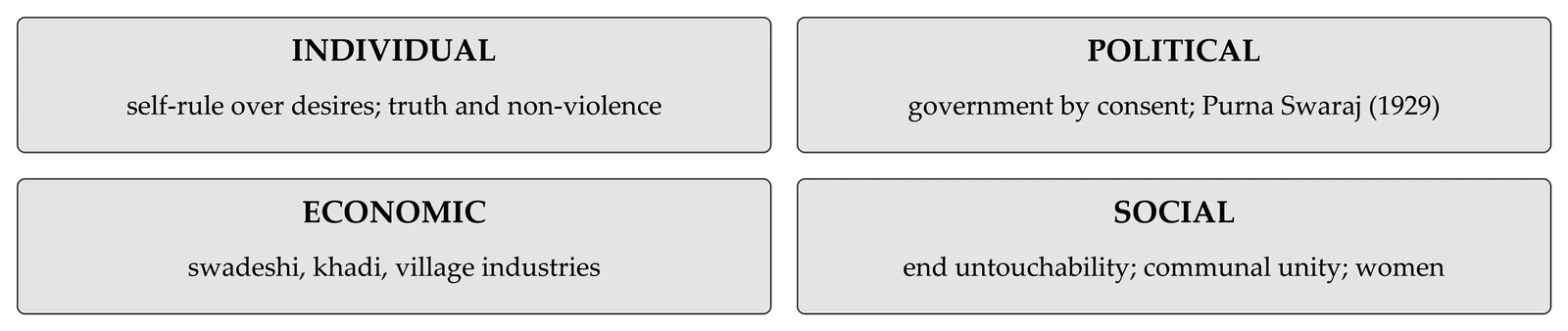
- Individual swaraj. Self-rule begins with the individual’s control over desires and passions through truth, non-violence, simplicity and self-discipline.
- Political swaraj. Freedom from foreign rule and government by the consent of the people; at Lahore in 1929 the Congress adopted Purna Swaraj, complete independence, as its goal.
- Economic swaraj. Self-reliance through swadeshi, the use of goods made locally, khadi, village industries and freedom from exploitation by industrial capitalism.
- Social swaraj. The removal of untouchability, Hindu–Muslim unity, the equality of women and the uplift of the poorest, for whom Gandhi used the term Daridranarayan.
- Moral and spiritual swaraj. Ultimately, swaraj meant a society in which people lived by truth and non-violence, so it was never fully achieved even after political independence.
The Critique of Modern Civilisation
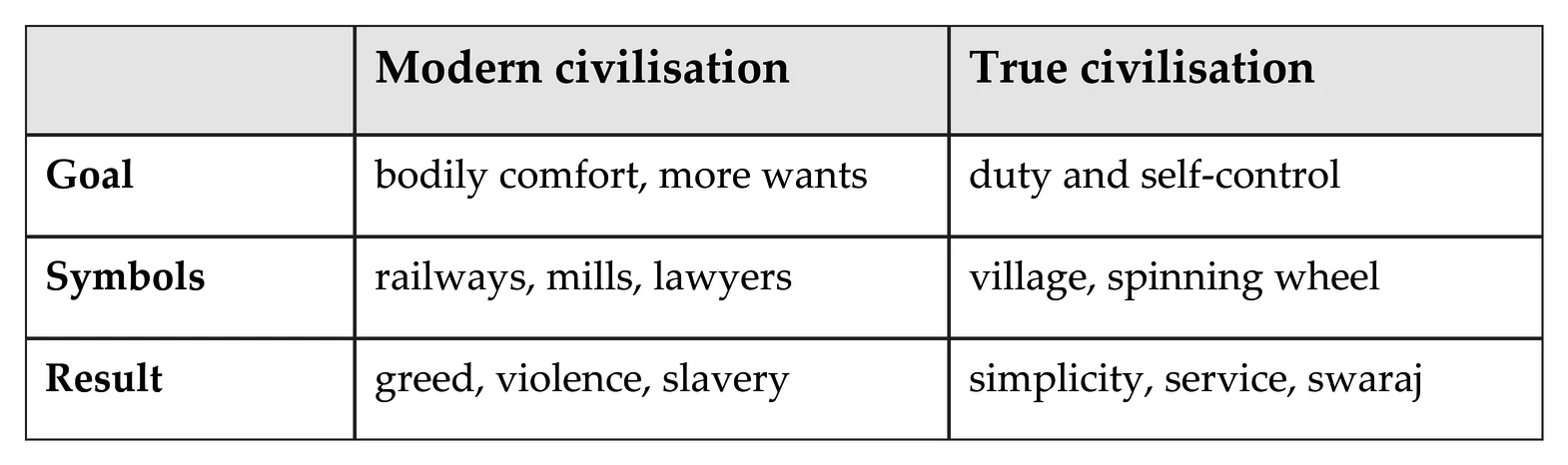
At the heart of Hind Swaraj is a radical critique of modern Western civilisation. Gandhi argued that modern civilisation measures progress by bodily comfort and the multiplication of wants, not by moral growth, so it is a civilisation only in name. He called it a disease, and argued that India was ruled by the British because Indians had accepted modern civilisation and its values.
- Railways. They spread disease and famine, increased the speed of evil and helped the British control India.
- Lawyers. They profit from quarrels, divide people and support British rule through the courts.
- Doctors. Modern medicine encourages indulgence by curing the effects of bad habits rather than encouraging self-control.
- Machinery. Machines, especially textile mills, destroyed Indian handicrafts and led to the exploitation of workers; in later years Gandhi accepted machines that served people without displacing them.
- Parliamentary democracy. He criticised the British Parliament as a talking shop controlled by parties and the press, though he later accepted representative institutions for India.
- True civilisation. Gandhi defined true civilisation as the mode of conduct that points out to man the path of duty, and believed that Indian civilisation, with its simplicity and moral restraint, was superior.
Debates on Gandhi’s Critique
Gandhi’s critique has been read in different ways. Jawaharlal Nehru, in letters of 1945, told Gandhi that he did not accept the idealisation of village life, which he saw as backward intellectually and culturally. Partha Chatterjee, in Nationalist Thought and the Colonial World (1986), described Gandhi as representing the moment of manoeuvre, a critique of the very framework of modern civil society that nationalism otherwise accepted. Lloyd and Susanne Rudolph, in The Modernity of Tradition (1967), showed how Gandhi used traditional symbols for modern mass politics. Today, environmentalists and critics of consumerism find in Hind Swaraj an early warning about unlimited growth.
4.3 The Means of Swaraj: Satyagraha, Constructive Work and Gram Swaraj
Satyagraha
Satyagraha, literally holding firmly to truth, is the method of resisting injustice through non-violence and self-suffering rather than violence. Gandhi preferred it to the term passive resistance, which he thought implied weakness. Its main elements are:
- Truth (satya). Gandhi said that God is truth, and later that truth is God; the satyagrahi seeks truth and appeals to the opponent’s conscience.
- Non-violence (ahimsa). Ahimsa means not only avoiding physical harm but also love towards the opponent, whom the satyagrahi seeks to convert rather than defeat.
- Self-suffering. The satyagrahi accepts suffering, such as imprisonment or beatings, rather than inflicting it, to touch the opponent’s heart.
- Purity of means. Gandhi argued that means and ends are inseparable, comparing them to a seed and a tree: good ends cannot be achieved by bad means.
- Forms of action. Satyagraha includes non-cooperation, civil disobedience, fasting, hartal and peaceful picketing, used according to the situation.
- Discipline. Gandhi withdrew the Non-Cooperation Movement after the violence at Chauri Chaura in 1922, showing his insistence that satyagraha must remain non-violent.

The Constructive Programme
Gandhi believed that swaraj had to be built from below through constructive work, not only won through protest. In Constructive Programme: Its Meaning and Place (1941), he listed items such as communal unity, removal of untouchability, prohibition, khadi, village industries, village sanitation, basic education (nai talim), adult education, uplift of women, health, the use of Indian languages, economic equality, and work among peasants, labourers, Adivasis and students. He called this the truthful and non-violent way to Purna Swaraj.
Gram Swaraj and the Oceanic Circle
Gandhi’s ideal political order was gram swaraj, a federation of self-governing, self-sufficient villages. In Harijan in 1942, he wrote that independence must begin at the bottom, so that every village would be a republic or panchayat with full powers, able to manage its own affairs. In Harijan of 28 July 1946, he described this order as an oceanic circle rather than a pyramid: the individual is at the centre, ready to sacrifice for the village, the village for the circle of villages, and so on, with the outer circles not crushing the inner ones but giving strength to all.
Trusteeship and Sarvodaya
Gandhi’s economic ideas included trusteeship, the idea that the rich should hold their wealth in trust for society, using only what they need and the rest for the common good, and sarvodaya, the welfare of all, inspired by Ruskin. After independence, Vinoba Bhave’s Bhoodan movement (1951) and Jayaprakash Narayan carried these ideas forward.
Legacy and Criticism
Gandhi’s idea of swaraj influenced the Directive Principles, especially Article 40 on village panchayats, and the 73rd Amendment of 1992. His method of satyagraha inspired Martin Luther King Jr. in the American civil rights movement and Nelson Mandela in South Africa. Critics, however, argue that his village ideal ignored caste oppression in villages, as B.R. Ambedkar pointed out, that his rejection of modern industry was unrealistic, and that his religious language sometimes alienated minorities and Dalits. Despite these criticisms, Gandhi’s swaraj remains one of the most original contributions of Indian political thought.
4.4 Important Questions
- Question 1 Discuss Gandhi’s concept of swaraj.
- Question 2 Examine Gandhi’s critique of modern civilisation in Hind Swaraj.
- Question 3 Discuss satyagraha as Gandhi’s method of attaining swaraj.
- Question 4 Discuss Gandhi’s idea of gram swaraj and the oceanic circle.
DU asks the same idea in different words. So learn one broad answer for each question below; the same answer works for every question joined by OR.
Important Question 1
Discuss Gandhi’s concept of swaraj.
OR
‘Swaraj means more than political independence.’ Discuss with reference to Gandhi.
OR
Explain the different dimensions of Gandhi’s idea of swaraj.
Model Answer
“You want English rule without the Englishman.”
— M.K. Gandhi, Hind Swaraj (1909), Chapter 4
Introduction. Swaraj, meaning self-rule, was the central goal of the Indian national movement. For many nationalists it meant political independence from Britain, but Mahatma Gandhi gave it a much wider meaning. In Hind Swaraj (1909), he argued that swaraj means rule over oneself as well as self-government of the nation, and that it must include economic self-reliance, social justice and moral regeneration. His concept made swaraj a complete vision of a free society.
1. Meaning of Swaraj
Swaraj combines swa, self, and raj, rule. Gandhi gave it two connected meanings: individual self-rule, i.e. control over one’s desires and passions, and national self-government. He insisted that national freedom built on individuals without self-control would not be real freedom, because people would remain slaves to their own greed and to modern civilisation.
2. Context of Hind Swaraj
Gandhi wrote Hind Swaraj in 1909 in reply to Indian revolutionaries in London who believed in violence and Western-style modernisation. Written as a dialogue between a Reader and an Editor, it argued that India’s problem was not only British rule but the acceptance of modern civilisation, and that freedom required a different path.
3. English Rule without the Englishman
Gandhi criticised nationalists who wanted to expel the British but keep British institutions, laws, industry and values. He said they wanted English rule without the Englishman, the tiger’s nature without the tiger. Such independence would leave Indians still ruled by the logic of modern civilisation, exploitation and violence.
4. Individual Swaraj
For Gandhi, swaraj begins with the individual. It is swaraj when we learn to rule ourselves. Self-rule requires truth, non-violence, simplicity, celibacy, fearlessness and the control of desires, which he practised through vows in his ashrams and expected of satyagrahis.
5. Political Swaraj
Politically, swaraj meant government by the consent of the people and freedom from foreign rule. Gandhi led the Congress in mass movements, and in 1929 the Congress at Lahore adopted Purna Swaraj, complete independence, as its goal. For Gandhi, political power was a means to serve the people, not an end.
6. Economic Swaraj
Economic swaraj meant self-reliance through swadeshi, khadi and village industries, so that villages could meet their basic needs without exploitation by distant markets and factories. The spinning wheel became the symbol of this economic freedom and of solidarity with the poor.
7. Social Swaraj
Swaraj also required social justice: the removal of untouchability, which Gandhi called a sin, Hindu–Muslim unity, equality for women and the welfare of the poorest. He said that swaraj would be meaningless if it did not benefit the lowliest Indian, Daridranarayan.
8. Moral Swaraj
Ultimately, swaraj was a moral order based on truth and non-violence. Gandhi believed that a society of self-disciplined individuals cooperating in village communities would need little coercion from the state, approaching what he called enlightened anarchy.
9. Swaraj and Satyagraha
Because means and ends are connected like a seed and a tree, swaraj could be achieved only through non-violent satyagraha. Violent revolution would create a violent state, while satyagraha would build the self-discipline and courage on which real swaraj depends.
10. Swaraj and the Constructive Programme
Gandhi insisted that swaraj must be built from below through constructive work: khadi, village industries, basic education, sanitation, removal of untouchability and communal unity. Protest without constructive work, he believed, would bring power to an elite but not freedom to the people.
11. Gram Swaraj
Gandhi’s political ideal was gram swaraj, a federation of self-governing villages organised as an oceanic circle with the individual at the centre. Power would flow from the bottom upwards, so swaraj meant decentralised democracy rather than a powerful central state.
12. Criticisms
Nehru found Gandhi’s idealisation of villages backward, Ambedkar saw villages as centres of caste oppression, and economists argued that rejecting modern industry would keep India poor. Critics also note that Gandhi’s demand for strict self-discipline was too high for most people.
13. Relevance
Gandhi’s swaraj remains relevant to debates on decentralisation, sustainable development, consumerism and non-violent protest. Article 40 and the 73rd Amendment reflect his idea of village self-government, and movements worldwide have drawn on satyagraha.
14. Evaluation
Gandhi’s concept of swaraj was a holistic vision combining individual self-rule, national independence, economic self-reliance and social justice. Though not fully realised, it challenged narrow ideas of freedom and remains one of the most original ideas in Indian political thought.
Conclusion. Thus, for Gandhi swaraj meant much more than political independence. It meant self-rule over one’s desires, government by consent, economic self-reliance through swadeshi, social justice and a moral order based on truth and non-violence. Achieved through satyagraha and constructive work and organised as gram swaraj, it offered a complete vision of a free society.
Important Question 2
Examine Gandhi’s critique of modern civilisation in Hind Swaraj.
OR
Why did Gandhi reject modern Western civilisation? Discuss.
OR
Discuss Gandhi’s idea of true civilisation.
Model Answer
“Civilization is that mode of conduct which points out to man the path of duty.”
— M.K. Gandhi, Hind Swaraj (1909), Chapter 13
Introduction. Hind Swaraj (1909) is famous for its radical critique of modern Western civilisation. Gandhi argued that modern civilisation, which measures progress by material comfort and machines, is a civilisation only in name and a cause of India’s enslavement. He contrasted it with true civilisation, which teaches duty and moral restraint. His critique remains one of the most powerful challenges to the idea of modern progress.
1. Context of the Critique
Gandhi wrote in 1909, when many educated Indians admired Western science, industry and institutions and wanted India to follow the same path. Indian revolutionaries in London saw violence and modern industry as the route to freedom. Gandhi challenged both, arguing that the problem lay deeper, in the values of modern civilisation itself.
2. Meaning of Modern Civilisation
Gandhi defined modern civilisation as one that takes bodily welfare and the multiplication of wants as the goal of life. It values comfort, speed, machines and wealth, and it judges progress by material achievement rather than by moral growth. Such a civilisation, he argued, makes people restless and selfish.
3. A Disease, Not Progress
Gandhi called modern civilisation a disease and said it was only nominally a civilisation. He believed it would destroy itself, because a way of life built on endless desires cannot bring peace or happiness. The English, he said, were themselves victims of this civilisation.
4. India Enslaved by Civilisation
Gandhi argued that the British did not take India by force alone; Indians gave it to them by accepting their trade, institutions and values. Hence India would be free only when it rejected modern civilisation, not merely British rulers.
5. Critique of Railways
Gandhi argued that railways spread plague and famine, encouraged greed and helped the British control India. They also increased the speed of evil, since good spreads slowly while evil travels quickly. This critique shocked readers who saw railways as symbols of progress.
6. Critique of Lawyers
Himself a lawyer, Gandhi argued that lawyers profit from quarrels, encourage disputes, divide Hindus and Muslims and strengthen British rule by making Indians depend on British courts. He favoured settling disputes through panchayats and arbitration.
7. Critique of Doctors and Medicine
Gandhi claimed that modern medicine encourages people to indulge their appetites and then cure the effects, rather than practising self-control. He preferred nature cure and simple living, ideas he practised in his ashrams.
8. Critique of Machinery
Machinery, especially the textile mills of Manchester and Bombay, destroyed Indian handicrafts and impoverished artisans. Gandhi saw machines as instruments of exploitation, though later he accepted machines that helped people without displacing labour.
9. Critique of Parliament
Gandhi described the British Parliament as a sterile talking shop controlled by parties and the press, and argued that representative institutions modelled on Britain would not bring real swaraj. His later acceptance of representative democracy for India shows that this was a moral critique rather than a fixed rejection.
10. True Civilisation
True civilisation, for Gandhi, is the mode of conduct which points out to man the path of duty. It means mastery over the mind and passions, simplicity and service. He believed that Indian civilisation, with its villages, self-restraint and spiritual values, came closer to this ideal.
11. Influence of Tolstoy and Ruskin
Gandhi’s critique drew on Western critics of modernity, especially Tolstoy and Ruskin, who condemned industrial civilisation and praised simple, moral living. His critique was therefore not simply anti-Western but part of a wider critique of modernity.
12. Nehru’s Disagreement
In letters of 1945, Nehru told Gandhi that he did not share his idealisation of the village and believed that India needed modern science, industry and education. Independent India largely followed Nehru’s path of modern development.
13. Contemporary Relevance
Today, environmentalists, critics of consumerism and advocates of sustainable development find Gandhi’s critique prophetic. His warning against unlimited wants anticipates concerns about climate change and resource depletion.
14. Evaluation
Gandhi’s critique was exaggerated in parts, such as his views on railways and medicine, but it raised profound questions about the meaning of progress and the relationship between material growth and moral life.
Conclusion. Thus, in Hind Swaraj Gandhi condemned modern civilisation as a disease that multiplied wants, enslaved India and corrupted moral life, criticising railways, lawyers, doctors, machinery and Parliament. He contrasted it with true civilisation, the path of duty and self-control. Though criticised as impractical, his critique remains a powerful challenge to the idea of progress.
Important Question 3
Discuss satyagraha as Gandhi’s method of attaining swaraj.
OR
Explain Gandhi’s views on the relationship between ends and means.
OR
What is satyagraha? How is it different from passive resistance?
Model Answer
“The means may be likened to a seed, the end to a tree; and there is just the same inviolable connection between the means and the end as there is between the seed and the tree.”
— M.K. Gandhi, Hind Swaraj (1909), Chapter 16
Introduction. Satyagraha, literally holding firmly to truth, was Gandhi’s method of resisting injustice through non-violence and self-suffering. He developed it in South Africa and used it in India’s freedom struggle. For Gandhi, satyagraha was not only a technique but a way of life, based on the belief that means and ends are inseparable, so non-violent means alone could lead to real swaraj.
1. Origin of Satyagraha
Gandhi developed satyagraha in South Africa in 1906, when Indians resisted the Asiatic Registration Act in the Transvaal. He invited suggestions for a name and coined satyagraha, combining satya, truth, and agraha, firmness, to describe a force born of truth and love.
2. Truth
Truth is the foundation of satyagraha. Gandhi first said that God is truth and later that truth is God. The satyagrahi seeks truth, recognises that no one possesses the whole truth and therefore refuses to impose his views by violence, appealing instead to the conscience of the opponent.
3. Non-Violence
Ahimsa, non-violence, means not only avoiding physical harm but also active love towards the opponent. The satyagrahi hates the evil, not the evildoer, and seeks to convert the opponent rather than defeat or humiliate him.
4. Self-Suffering
The satyagrahi accepts suffering, such as imprisonment, beatings and loss of property, without retaliation. Gandhi believed that voluntary suffering touches the heart of the opponent and the public, turning moral force into political power.
5. Satyagraha and Passive Resistance
Gandhi distinguished satyagraha from passive resistance. Passive resistance can be a weapon of the weak and may allow violence when possible, while satyagraha is a weapon of the strong, based on love and requiring complete non-violence in thought, word and deed.
6. Forms of Satyagraha
Satyagraha includes non-cooperation, i.e. withdrawing support from an unjust system, civil disobedience, i.e. deliberately breaking unjust laws, fasting, hartal, picketing and boycott. The form depends on the situation, but each must remain non-violent and open.
7. Ends and Means
Gandhi rejected the idea that the end justifies the means. In Hind Swaraj, he compared means and ends to a seed and a tree: good ends cannot grow from bad means. Violence would produce a violent state, so swaraj must be won by non-violent means.
8. Discipline of the Satyagrahi
The satyagrahi must be disciplined, truthful, fearless and willing to suffer. Gandhi trained volunteers in his ashrams and imposed vows, because he believed that only disciplined people could practise non-violence under provocation.
9. Chauri Chaura
When a crowd burnt a police station at Chauri Chaura in February 1922, killing twenty-two policemen, Gandhi withdrew the Non-Cooperation Movement, showing that he would not compromise non-violence even at the cost of political momentum.
10. Satyagraha in Practice
Gandhi used satyagraha in Champaran (1917), Kheda (1918) and Ahmedabad (1918), in the Non-Cooperation Movement (1920–22), the Salt March and Civil Disobedience (1930–34) and the Quit India Movement (1942), mobilising millions of ordinary Indians.
11. Satyagraha and Swaraj
Satyagraha was not only a means of removing British rule but also a training in self-rule. By practising courage, discipline and non-violence, Indians would develop the self-control that Gandhi saw as the essence of swaraj.
12. Global Influence
Satyagraha inspired Martin Luther King Jr. in the American civil rights movement, Nelson Mandela in South Africa and many later movements for non-violent change across the world.
13. Criticisms
Critics argue that satyagraha worked against the British because of their liberal traditions and would fail against ruthless regimes, that it sometimes led to violence, and that Gandhi’s withdrawals of movements frustrated many nationalists. Ambedkar criticised Gandhi’s fasts as coercive, especially during the Poona Pact of 1932.
14. Evaluation
Satyagraha was a creative political method that turned moral force into mass action, linked means with ends and gave ordinary people a role in the freedom struggle, though its success depended on circumstances and discipline.
Conclusion. Thus, satyagraha, based on truth, non-violence and self-suffering, was Gandhi’s method of attaining swaraj. Insisting that means and ends are like seed and tree, he used non-cooperation, civil disobedience and fasting to mobilise millions, making satyagraha both a path to independence and a training in self-rule.
Important Question 4
Discuss Gandhi’s idea of gram swaraj and the oceanic circle.
OR
Examine Gandhi’s vision of a decentralised political and economic order.
OR
Discuss the relevance of Gandhi’s gram swaraj for local self-government in India.
Model Answer
“Life will not be a pyramid with the apex sustained by the bottom. But it will be an oceanic circle whose centre will be the individual.”
— M.K. Gandhi, Harijan (28 July 1946)
Introduction. Gandhi’s idea of swaraj led to a vision of a decentralised society in which self-governing, self-sufficient villages would be the basic units. He called this gram swaraj and described the political order it would create as an oceanic circle rather than a pyramid. This vision was his alternative to both the centralised modern state and industrial capitalism.
1. Meaning of Gram Swaraj
Gram swaraj means village self-rule. Each village would be a republic or panchayat, managing its own affairs, meeting its basic needs and settling its disputes, so that power and production would be located close to the people rather than in distant capitals and factories.
2. Independence Begins at the Bottom
In Harijan in 1942, Gandhi wrote that independence must begin at the bottom and that every village should be a republic with full powers. Political authority would flow upwards from the villages rather than downwards from the centre.

3. The Oceanic Circle
In 1946, Gandhi described the ideal order as an oceanic circle with the individual at the centre. The individual is ready to sacrifice for the village, the village for the circle of villages, and so on, with outer circles strengthening rather than crushing inner ones, unlike a pyramid with power at the apex.
4. Economic Self-Sufficiency
Villages would produce their own food and cloth through agriculture, khadi and village industries, exchanging only surplus with others. This would end exploitation by distant markets and give dignity to manual labour.
5. Panchayats
Village affairs would be managed by a panchayat of five persons elected annually by adult villagers, with legislative, executive and judicial functions, settling disputes locally without lawyers and courts.
6. Education and Health
Gandhi’s scheme of basic education, nai talim, proposed in 1937, linked learning with productive crafts, while village sanitation and nature cure would keep villages healthy and self-reliant.
7. Equality and Social Justice
Gram swaraj required the removal of untouchability, equality between men and women and communal harmony, so that every villager could take part in village life with dignity.
8. Trusteeship
Gandhi proposed that landlords and capitalists act as trustees of their wealth for the community, using it for the common good, so that economic inequality could be reduced without violent class struggle.
9. A Minimal State
Gandhi was suspicious of the state, which he saw as violence in a concentrated form. In gram swaraj, most functions would be performed by self-governing communities, and the state would have a limited role, approaching enlightened anarchy.
10. The Constituent Assembly
Gandhian members wanted the Constitution to be based on village republics, but Ambedkar criticised the village as a den of localism and ignorance. As a compromise, Article 40 directed the state to organise village panchayats.
11. Panchayati Raj
Gandhi’s vision influenced the Balwantrai Mehta Committee (1957), the panchayati raj system begun in 1959 and the 73rd Amendment of 1992, which gave panchayats constitutional status and made the gram sabha a constitutional body.
12. Criticisms
Critics argue that villages were sites of caste hierarchy and landlord domination, that self-sufficiency was unrealistic in a modern economy and that gram swaraj neglected national defence and planning. Nehru and Ambedkar both preferred a modern state.
13. Contemporary Relevance
Gram swaraj inspires debates on decentralisation, participatory democracy, local economies and sustainable development. Movements for community control of forests and water and the gram sabhas of the PESA Act of 1996 reflect its spirit.
14. Gram Swaraj and the Environment
Gram swaraj’s emphasis on local production, limited wants and harmony with nature has inspired environmental movements such as Chipko. Thinkers of sustainable development see in Gandhi’s village republics an early model of an economy that meets needs without exhausting natural resources.
15. Evaluation
Gandhi’s gram swaraj offered a radical alternative to centralised power and industrial capitalism. Though not adopted as the basis of the Indian state, it shaped panchayati raj and remains a powerful ideal of participatory democracy.
Conclusion. Thus, Gandhi’s gram swaraj imagined self-governing, self-sufficient village republics organised as an oceanic circle with the individual at the centre. Combining panchayats, village industries, basic education, trusteeship and social equality, it challenged the centralised state, and its influence can be seen in Article 40 and the 73rd Amendment.
Short Notes
(a) Hind Swaraj
Gandhi’s book written in Gujarati in 1909 as a dialogue between a Reader and an Editor, presenting his idea of swaraj and his critique of modern civilisation.
(b) Constructive Programme
Gandhi’s programme of social and economic work, set out in 1941, including communal unity, removal of untouchability, khadi, village industries, basic education and the uplift of women.
(c) Trusteeship
Gandhi’s idea that the rich should hold their wealth in trust for society, using only what they need and the rest for the common good.
More notes: GE-1 Ideas in Indian Political Thought
These notes are prepared by PADHO TO AISE for study help. They are not an official publication.