
Generic Electives (GE) GE-1 Ideas in Indian Political Thought
Unit VI · 24 min read · Updated 27 Nov 2026
As per the University of Delhi (DU) Generic Elective (GE) syllabus offered by the Department of Political Science
Contents
- 6.1 Savarkar: Life and Context
- The Context of Hindutva
- 6.2 The Concept of Hindutva
- The Essentials of Hindutva
- Pitribhu and Punyabhu
- Hindutva and Hinduism
- Hindutva and Caste
- 6.3 Hindu Nationalism, the State and Debates on Savarkar
- Features of Savarkar’s Nationalism
- Savarkar and the National Movement
- Interpretations of Savarkar
- Hindutva and the Constitution
- 6.4 Important Questions
- Discuss Savarkar’s concept of Hindutva.
- Distinguish between Hindutva and Hinduism in Savarkar’s thought.
- Examine Savarkar’s idea of nationalism and the Hindu Rashtra.
- Critically assess Savarkar as a revolutionary, social reformer and political thinker.
- Short Notes
आसिन्धुसिन्धुपर्यन्ता यस्य भारतभूमिका। पितृभूः पुण्यभूश्चैव स वै हिन्दुरिति स्मृतः॥
A Hindu is one who regards the land of Bharatavarsha, from the Indus to the seas, as his fatherland as well as his holy land.
— V.D. Savarkar, Essentials of Hindutva (1923), defining verse
VVINAYAK DAMODAR SAVARKAR (1883–1966) was a revolutionary, a prisoner in the Cellular Jail of the Andaman Islands, a writer, a social reformer and the president of the Hindu Mahasabha. In Essentials of Hindutva (1923), he gave the word Hindutva its modern political meaning: an identity of the Hindus as a nation, based on a common territory, a common descent and a common culture, distinct from Hinduism as a religion. His ideas became the foundation of Hindu nationalism and remain among the most debated in Indian politics. This chapter studies his life and context, the concept of Hindutva, his idea of the nation and the main interpretations and criticisms of his thought.

6.1 Savarkar: Life and Context
Savarkar was born in 1883 at Bhagur near Nashik in a Chitpavan Brahmin family. As a student he founded a revolutionary group, the Mitra Mela (1899), which became Abhinav Bharat in 1904. In 1906 he went to London to study law and lived at India House, a centre of Indian revolutionaries, where he wrote The Indian War of Independence of 1857, presenting the revolt as a national war of liberation; it was banned before its publication in 1909. Arrested in 1910 in connection with the murder of a British official in Nashik, he made a famous attempt to escape at Marseilles, but was recaptured, convicted and sentenced to transportation for life twice over.
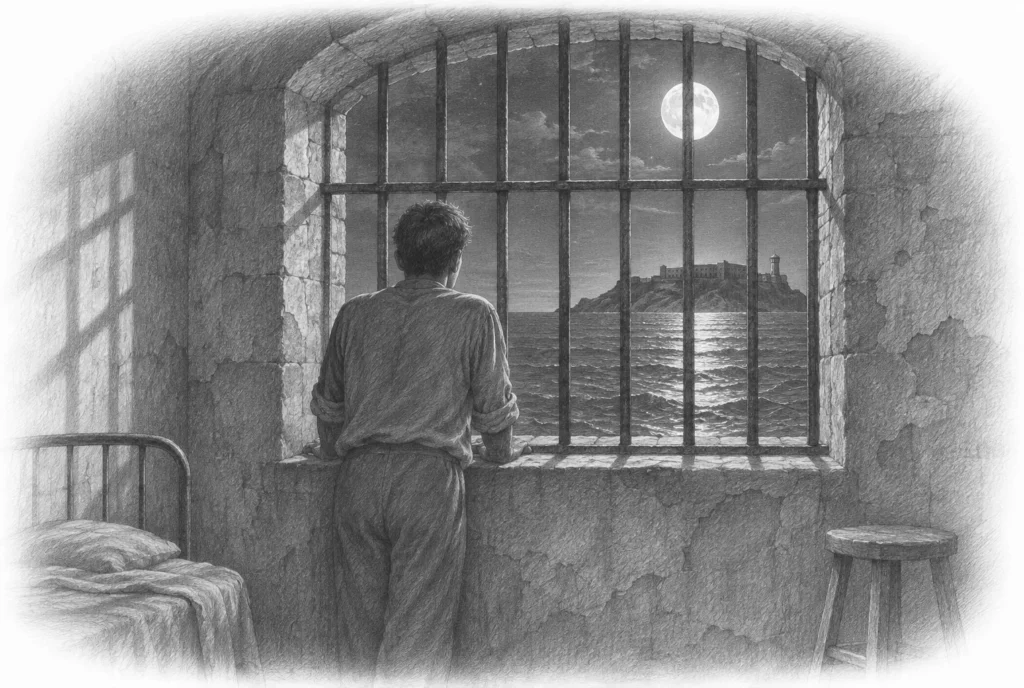
He was imprisoned in the Cellular Jail in the Andaman Islands from 1911 to 1921, during which he submitted several petitions to the government for release. Transferred to Indian jails, he was released in 1924 on condition that he stay within Ratnagiri district and keep away from politics, restrictions that lasted until 1937. In Ratnagiri he worked for social reform, opposing untouchability and opening the Patit Pavan temple (1931) to all castes. He became president of the Hindu Mahasabha in 1937 and led it until 1943. After Gandhi’s assassination in 1948, he was tried in the case but acquitted in 1949 for lack of evidence. He died in 1966.
The Context of Hindutva
- Communal politics. The Khilafat movement (1919–24), the Moplah rebellion (1921) and Hindu–Muslim riots of the early 1920s led some Hindu leaders to fear that Hindus were divided and weak.
- Colonial categories. Censuses that counted religious communities, and separate electorates from 1909, encouraged politics based on religious numbers.
- Hindu revivalism. The Arya Samaj’s shuddhi campaign and the formation of the Hindu Mahasabha (1915) sought to strengthen and unite Hindus.
- Revolutionary nationalism. Savarkar’s own background in armed revolutionary struggle shaped his emphasis on strength and militancy.
Savarkar wrote Essentials of Hindutva in Ratnagiri jail around 1921–22, and it was published in 1923 under the pseudonym A Maratha; later editions were titled Hindutva: Who Is a Hindu?. The Rashtriya Swayamsevak Sangh, founded by K.B. Hedgewar in 1925, drew on its ideas, though Savarkar himself led the Hindu Mahasabha rather than the RSS.
6.2 The Concept of Hindutva
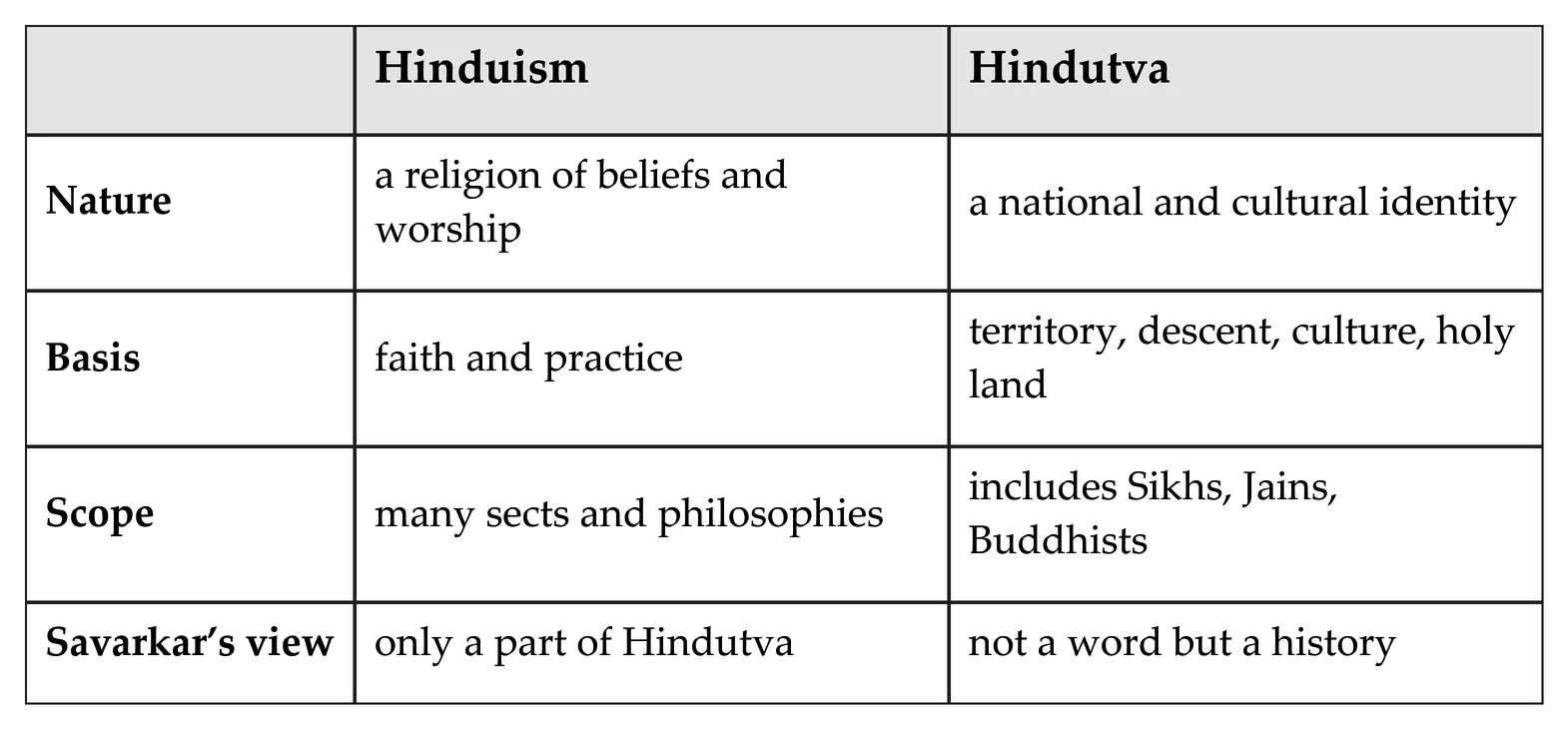
Savarkar used Hindutva, i.e. Hinduness, to mean the qualities that make a person a Hindu in a national and cultural sense. He insisted that Hindutva is not identical with Hinduism, the religious beliefs and practices of Hindus. Hindutva, he wrote, is not a word but a history, covering the whole of the Hindu people’s political, cultural and religious past.
The Essentials of Hindutva
- A common nation (rashtra). Hindus are bound by attachment to a common territory, the land of Bharatavarsha or Sindhusthan, stretching from the Indus to the seas.
- A common race (jati). Hindus share a common descent, the blood of the ancient Vedic people and of those who were assimilated into them over centuries, so they form a single jati, despite caste divisions.
- A common culture (sanskriti). Hindus share a common civilisation, expressed in a common history, heroes, literature, art, law, festivals and the Sanskrit language.

Pitribhu and Punyabhu
Savarkar’s definition of a Hindu combined territory, descent and culture with a religious criterion. A Hindu is one who regards Bharatavarsha both as his pitribhu, the fatherland, the land of his ancestors, and as his punyabhu, the holy land, the land where his religion was born. By this definition, followers of religions born in India, Hinduism, Buddhism, Jainism and Sikhism, are Hindus in the sense of Hindutva. Muslims and Christians in India, though they share the fatherland, are not included, because their holy lands lie outside India, in Arabia and Palestine; Savarkar argued that their loyalty would therefore be divided.

Hindutva and Hinduism
- Hinduism is a religion, a set of beliefs and practices concerning God, worship and salvation, and it contains many sects and philosophies.
- Hindutva is a broader cultural and political identity; Savarkar wrote that Hinduism is only a derivative, a fraction, a part of Hindutva.
- Rationalism. Savarkar himself was an atheist or rationalist in religious matters; he criticised superstition, called for a scientific outlook and even said that the cow is a useful animal, not a deity to be worshipped.
- Inclusion of Indic religions. Hindutva includes Sikhs, Jains and Buddhists as part of the Hindu nation, which some of these communities rejected.
Hindutva and Caste
Savarkar opposed untouchability and caste discrimination, arguing that caste divisions weakened Hindu unity and strength. He supported inter-caste dining and marriage and the opening of temples to all castes. His motive was partly to unite Hindus as a nation. Critics argue that his idea of a common Hindu jati, based on blood and descent, sat uneasily with the realities of caste and ignored the voices of Dalits such as Ambedkar, who rejected Hinduism.
6.3 Hindu Nationalism, the State and Debates on Savarkar
Features of Savarkar’s Nationalism
- Cultural nationalism. The nation is defined by culture, territory and descent, i.e. by Hindutva, rather than only by citizenship or common political institutions.
- Hindu Rashtra. India is the land of the Hindus, who form the national community; Savarkar sought a Hindu Rashtra in which Hindu culture would be the national culture.
- Strength and militarisation. He called on Hindus to become physically and militarily strong, and as Mahasabha president he urged them to join the armed forces during the Second World War; a slogan associated with him was Hinduise all politics and militarise Hindudom.
- Equal rights for minorities as citizens. He said that minorities would have equal rights as citizens in a free India, with one person one vote, but no special privileges such as separate electorates or weightage.
- Opposition to appeasement. He criticised the Congress for making concessions to Muslim leaders, as in the Khilafat movement and the Lucknow Pact of 1916.
- Two nations. In his Hindu Mahasabha presidential address at Ahmedabad in 1937, he said that India could not be assumed to be a homogeneous nation and that there were two nations in the main, the Hindus and the Muslims, though he opposed the partition of India.
Savarkar and the National Movement
Savarkar’s relationship with the Congress-led national movement was critical. He rejected Gandhi’s non-violence and his approach to Hindu–Muslim unity. The Hindu Mahasabha did not support the Quit India Movement of 1942, and in some provinces it shared power with the Muslim League. Admirers point to his revolutionary activity before 1910, his long imprisonment and his book on 1857, which inspired later revolutionaries such as Bhagat Singh. Critics point to his petitions from prison and his later politics, which they see as dividing the anti-colonial struggle along religious lines.
Interpretations of Savarkar
- Admirers. Biographers such as Vikram Sampath (2019 and 2021) and Hindu nationalist organisations portray Savarkar as a patriot, revolutionary, rationalist and social reformer whose ideas were misunderstood.
- Critics. Scholars such as Jyotirmaya Sharma, in Hindutva: Exploring the Idea of Hindu Nationalism (2003), and Christophe Jaffrelot, in The Hindu Nationalist Movement and Indian Politics (1996), argue that Hindutva defines the nation in exclusive terms that make religious minorities second-class members.
- Historians of ideas. Vinayak Chaturvedi, in Hindutva and Violence (2022), and Janaki Bakhle have examined how Savarkar’s writing of history justified the use of violence in politics.
- Constitutional debates. In Ramesh Yeshwant Prabhoo (1995), the Supreme Court remarked that Hindutva may be understood as a way of life of the people of the subcontinent, a view that has itself been debated.
Hindutva and the Constitution
The Constituent Assembly rejected a definition of the nation based on religion. The Constitution adopted a civic idea of citizenship, equal for all regardless of religion (Articles 5 to 11 and 14 to 15), and guaranteed freedom of religion (Article 25) and minority rights (Articles 29 and 30). Debates over the relationship between Hindutva and this constitutional nationalism remain central to Indian politics today, which is why students must study Savarkar’s ideas carefully and critically.
6.4 Important Questions
- Question 1 Discuss Savarkar’s concept of Hindutva.
- Question 2 Distinguish between Hindutva and Hinduism in Savarkar’s thought.
- Question 3 Examine Savarkar’s idea of nationalism and the Hindu Rashtra.
- Question 4 Critically assess Savarkar as a revolutionary, social reformer and political thinker.
DU asks the same idea in different words. So learn one broad answer for each question below; the same answer works for every question joined by OR.
Important Question 1
Discuss Savarkar’s concept of Hindutva.
OR
‘Hindutva is not a word but a history.’ Explain Savarkar’s idea of Hindutva.
OR
Who is a Hindu according to Savarkar? Discuss.
Model Answer
“Hindutva is not a word but a history.”
— V.D. Savarkar, Essentials of Hindutva (1923)
Introduction. Hindutva, meaning Hinduness, was given its modern political meaning by V.D. Savarkar in Essentials of Hindutva, written in Ratnagiri jail and published in 1923. Savarkar defined Hindutva as the identity of the Hindus as a nation, based on a common territory, a common descent and a common culture, and distinguished it from Hinduism as a religion. His concept became the ideological foundation of Hindu nationalism.
1. Context
Savarkar wrote after the Khilafat movement, the Moplah rebellion of 1921 and the riots of the early 1920s, when he believed that Hindus were divided by caste, sect and region and therefore weak. He sought to define an identity that would unite all Hindus as a political community.
2. Meaning of Hindutva
Savarkar wrote that Hindutva is not a word but a history, embracing not only the religious but the whole cultural, political and historical life of the Hindu people. Hindutva is thus a national identity, broader than any particular set of religious beliefs.
3. Common Territory
The first essential is attachment to a common territory, Bharatavarsha or Sindhusthan, extending from the Indus to the seas. The word Hindu itself, Savarkar argued, came from Sindhu, the Indus, so the identity of the Hindus is rooted in the land.
4. Common Descent
The second essential is jati, common blood or descent from the ancient Vedic people and those assimilated into them over centuries. Despite caste divisions, Savarkar argued, all Hindus share a common racial and family bond.
5. Common Culture
The third essential is sanskriti, a common civilisation expressed in history, heroes, literature, art, law, rites and festivals, and in Sanskrit as the common language of culture. Shared culture binds Hindus across regions and sects.
6. Fatherland and Holy Land
Savarkar defined a Hindu as one who regards Bharatavarsha as both pitribhu, fatherland, and punyabhu, holy land. This criterion combines territory and descent with religion, since the holy land is where one’s religion originated.
7. Who Is Included
By this definition, followers of religions born in India, Hindus, Sikhs, Jains and Buddhists, belong to the Hindu nation, since India is both their fatherland and their holy land. Savarkar saw this as a broad, inclusive definition of the national community.
8. Who Is Excluded
Muslims and Christians in India share the fatherland but not the holy land, since their religions arose in Arabia and Palestine. Savarkar argued that their loyalties were therefore divided, so they did not fully belong to the Hindu nation, though they could be citizens.
9. Hindutva and Hinduism
Savarkar distinguished Hindutva from Hinduism, writing that Hinduism is only a derivative, a part of Hindutva. A person could be a Hindu by Hindutva without being religious; Savarkar himself was a rationalist.
10. Hindutva and Caste
Savarkar opposed untouchability and supported inter-caste dining and temple entry, believing that caste divisions weakened Hindu unity. His aim was to forge a strong, united Hindu nation.
11. Influence
Hindutva shaped the Hindu Mahasabha, which Savarkar led from 1937 to 1943, and the Rashtriya Swayamsevak Sangh founded in 1925, and it remains the ideological basis of Hindu nationalism in India today.
12. Criticisms
Critics argue that the holy-land criterion excludes Muslims and Christians from full membership of the nation, contradicting the equal citizenship of the Constitution, and that the idea of common blood ignores India’s diversity and the realities of caste.
13. Defence
Supporters argue that Hindutva is a cultural rather than religious identity, that Savarkar promised equal citizenship to minorities and that he was a social reformer and rationalist who opposed caste discrimination.
14. Hindutva and the Idea of Sindhusthan
Savarkar traced the word Hindu to Sindhu, the Indus, and the land of the Sapta Sindhu, the seven rivers of the Rig Veda. He argued that the name itself showed that Hindu identity was territorial and civilisational from the beginning, rooted in the land rather than in any single scripture or sect.
15. Evaluation
Savarkar’s Hindutva was a powerful attempt to define a unified national identity for Hindus, but its exclusion of non-Indic religions from the core of the nation makes it one of the most contested ideas in Indian political thought.
Conclusion. Thus, Savarkar defined Hindutva as a national identity based on a common territory, common descent and common culture, and defined a Hindu as one who regards India as both fatherland and holy land. Distinct from Hinduism as a religion, Hindutva became the foundation of Hindu nationalism, though its exclusion of Muslims and Christians from the core of the nation remains deeply contested.
Important Question 2
Distinguish between Hindutva and Hinduism in Savarkar’s thought.
OR
‘Hinduism is only a derivative, a fraction, a part of Hindutva.’ Discuss.
OR
Is Hindutva a religious or a cultural and political concept? Discuss with reference to Savarkar.
Model Answer
“Hinduism is only a derivative, a fraction, a part of Hindutva.”
— V.D. Savarkar, Essentials of Hindutva (1923)
Introduction. A central feature of Savarkar’s thought is his distinction between Hindutva and Hinduism. Hinduism is a religion with many sects, beliefs and practices; Hindutva, as Savarkar defined it, is the national identity of the Hindu people, based on territory, descent and culture. This distinction allowed Savarkar to present Hindutva as a political and cultural rather than purely religious concept, though critics question how far religion can be separated from it.
1. Meaning of Hinduism
Hinduism refers to the religious beliefs and practices of Hindus: worship of various deities, philosophies such as Vedanta, rituals, pilgrimages and moral codes. It is diverse, without a single founder, church or creed.
2. Meaning of Hindutva
Hindutva, as Savarkar used it, means the qualities that make a person a member of the Hindu nation. It includes common territory, common blood and common culture, as well as regarding India as the holy land, and thus covers the whole historical life of the people.
3. Hinduism as a Part of Hindutva
Savarkar wrote that Hinduism is only a derivative, a fraction, a part of Hindutva. Religion is one element of the larger national identity, which also includes history, language, culture and territory.
4. Why Savarkar Made the Distinction
By separating Hindutva from Hinduism, Savarkar could unite people of different sects and beliefs, including atheists, Sikhs, Jains and Buddhists, into one national community, overcoming religious divisions within Hindu society.
5. Savarkar’s Rationalism
Savarkar himself was a rationalist who criticised superstition, ritualism and caste. He argued that the cow should be valued as a useful animal rather than worshipped as a goddess, showing that his Hindutva did not depend on religious orthodoxy.
6. Inclusion of Indic Religions
Because Sikhs, Jains and Buddhists regard India as both fatherland and holy land, Savarkar included them within Hindutva. Many members of these communities, however, rejected being classified as Hindus.
7. The Religious Element
Although Savarkar presented Hindutva as cultural, the holy-land criterion introduces religion into the definition of the nation, since it depends on where one’s religion originated. Critics argue that this makes Hindutva a religious nationalism after all.
8. Consequences for Minorities
The distinction has important consequences: Muslims and Christians may share Indian culture and ancestry but are excluded from Hindutva because of their religion, so the cultural nation remains defined by religious origin.
9. Gandhi’s Hinduism Compared
Gandhi’s Hinduism was a personal, ethical faith emphasising truth and non-violence, and he saw India as a nation of all religions. Savarkar’s Hindutva, by contrast, was a political identity, separate from personal faith, defining the nation in Hindu terms.
10. The Supreme Court’s View
In Ramesh Yeshwant Prabhoo (1995), the Supreme Court remarked that Hindutva could be understood as a way of life of the people of the subcontinent rather than a narrow religion. Critics argued that this overlooked its political meaning.
11. Scholarly Views
Jyotirmaya Sharma argues that Hindutva transformed a diverse religious tradition into a political ideology, while supporters argue that it expresses a civilisational identity shared by all who belong to Indian culture.
12. Relevance Today
The distinction between Hindutva and Hinduism is central to contemporary debates, with some arguing that one can be a devout Hindu without accepting Hindutva as a political ideology, and others seeing them as inseparable.
13. Assessment of the Distinction
The distinction helps explain how Savarkar could combine personal rationalism with religious nationalism, but its reliance on the holy-land criterion shows that religion remains central to Hindutva’s definition of the nation.
14. Evaluation
Savarkar’s distinction made Hindutva a flexible political identity capable of uniting diverse Hindus, while its religious criterion for full membership of the nation remains the main point of controversy.
Conclusion. Thus, Savarkar distinguished Hinduism, a religion, from Hindutva, a national identity based on territory, descent, culture and regard for India as the holy land, describing Hinduism as only a part of Hindutva. The distinction allowed him to unite diverse Hindus while remaining a rationalist, but the holy-land criterion keeps religion at the heart of his nationalism.
Important Question 3
Examine Savarkar’s idea of nationalism and the Hindu Rashtra.
OR
Discuss Savarkar’s views on the two nations and the position of minorities.
OR
How did Savarkar’s nationalism differ from the nationalism of the Congress?
Model Answer
“India cannot be assumed today to be a unitarian and homogeneous nation, but on the contrary there are two nations in the main: the Hindus and the Moslems, in India.”
— V.D. Savarkar, presidential address to the Hindu Mahasabha, Ahmedabad (1937)
Introduction. Savarkar’s nationalism was a cultural nationalism built on Hindutva. He believed that the Hindus formed the Indian nation by virtue of their common territory, descent and culture, and he sought a Hindu Rashtra in which Hindu culture would be the national culture. His nationalism differed sharply from the composite, territorial nationalism of the Congress and raised difficult questions about the position of religious minorities.
1. Cultural Nationalism
For Savarkar, the nation is not merely a group of people living in one territory under one government but a community bound by common culture, history and descent. This cultural nationalism contrasts with civic nationalism based on equal citizenship and shared political institutions.
2. The Hindu Nation
Savarkar argued that the Hindus, who regard India as both fatherland and holy land, constitute the Indian nation. Hindu history, heroes and culture form the core of national identity, and other communities are seen in relation to this core.
3. Hindu Rashtra
Savarkar sought a Hindu Rashtra, a state in which the Hindu majority’s culture would define national life. He argued that this was natural, since in every nation the majority community shapes the national culture.
4. The Two Nations Statement
In his Ahmedabad address of 1937, Savarkar said that India could not be assumed to be a homogeneous nation and that there were two nations in the main, Hindus and Muslims. This statement is often compared with Jinnah’s two-nation theory, though Savarkar opposed partition.
5. Rights of Minorities
Savarkar said that in a free India, minorities would enjoy equal rights as citizens, with one person one vote and freedom of religion, but no special privileges such as separate electorates, weightage or reservations based on religion.
6. Opposition to Appeasement
He criticised the Congress for what he called appeasement of Muslims, pointing to the Lucknow Pact of 1916, the support for the Khilafat movement and later negotiations with the Muslim League as concessions that encouraged separatism.
7. Strength and Militarisation
Savarkar believed that Hindus had been defeated in history because they were divided and weak. He called on them to become physically and militarily strong, a view expressed in the slogan Hinduise all politics and militarise Hindudom.
8. Rejection of Non-Violence
Unlike Gandhi, Savarkar rejected absolute non-violence as a political creed, arguing that force was sometimes necessary to defend the nation, a view rooted in his revolutionary past.
9. The Second World War
As Hindu Mahasabha president, Savarkar urged Hindus to join the British Indian armed forces during the Second World War to gain military training, while the Congress opposed participation in the war without independence.
10. Contrast with Congress Nationalism
The Congress, under Gandhi and Nehru, adopted a composite nationalism, seeing India as a nation of all religions united by territory, shared history and the anti-colonial struggle. Savarkar’s nationalism placed Hindu culture at the centre.
11. Influence
Savarkar’s ideas influenced the Hindu Mahasabha and later Hindu nationalist organisations and parties, and continue to shape debates about national identity in India.
12. Criticisms
Critics argue that Savarkar’s nationalism makes religious minorities second-class members of the nation, contradicts the Constitution’s secular citizenship and contributed to communal polarisation before Partition.
13. Defence
Supporters argue that Savarkar promised equal citizenship, opposed caste discrimination and sought a strong, united India, and that his criticism of special privileges for minorities was a demand for equal treatment.
14. Evaluation
Savarkar’s nationalism was a coherent alternative to the Congress’s composite nationalism, but its definition of the nation in terms of Hindu culture remains in tension with the equal and secular citizenship adopted by the Constitution.
Conclusion. Thus, Savarkar’s nationalism was a cultural nationalism that saw the Hindus as the core of the Indian nation and sought a Hindu Rashtra, granting minorities equal citizenship but no special privileges. His two-nation statement of 1937, emphasis on strength and opposition to appeasement set his nationalism apart from the composite nationalism of the Congress.
Important Question 4
Critically assess Savarkar as a revolutionary, social reformer and political thinker.
OR
Evaluate the legacy of V.D. Savarkar in Indian political thought.
OR
Discuss the different interpretations of Savarkar’s life and ideas.
Model Answer
“Hinduise all politics and militarise Hindudom.”
— Slogan associated with V.D. Savarkar as president of the Hindu Mahasabha (1937–43)
Introduction. V.D. Savarkar remains one of the most debated figures in modern Indian history. To admirers, he was a fearless revolutionary, a patriot who suffered long imprisonment, a rationalist and a social reformer. To critics, he was the ideologue of an exclusive Hindu nationalism that divided the anti-colonial struggle. A balanced assessment must consider his different roles and the evidence for each interpretation.
1. The Revolutionary
As a young man, Savarkar founded Abhinav Bharat (1904) and, in London, inspired revolutionaries at India House. His dramatic escape attempt at Marseilles in 1910 and his conviction made him a symbol of armed resistance to British rule.
2. The Historian of 1857
His book The Indian War of Independence of 1857 (1909) presented the revolt as a national war of liberation in which Hindus and Muslims fought together. Banned by the British, it inspired later revolutionaries such as Bhagat Singh.
3. The Prisoner
Savarkar spent ten years in the Cellular Jail of the Andaman Islands (1911–21) in harsh conditions. His petitions for release from prison are cited by critics as compromises, while supporters see them as tactics to regain freedom for further work.
4. The Social Reformer
In Ratnagiri, Savarkar campaigned against untouchability, supported inter-caste dining and marriage and opened the Patit Pavan temple (1931) to all castes, earning praise for his social reform.
5. The Rationalist
Savarkar criticised superstition and ritualism, called for a scientific outlook and argued that the cow should be valued for its usefulness, not worshipped, showing an unusual rationalism for a nationalist leader.
6. The Thinker of Hindutva
In Essentials of Hindutva (1923), Savarkar defined Hindu identity in terms of territory, descent, culture and holy land, providing the ideological basis of Hindu nationalism that continues to influence Indian politics.
7. The Hindu Mahasabha Leader
As Hindu Mahasabha president (1937–43), Savarkar opposed the Congress, did not support the Quit India Movement and urged Hindus to join the army, while speaking of two nations in 1937.
8. The Gandhi Murder Trial
After Gandhi’s assassination in 1948, Savarkar was tried in the case but acquitted in 1949 for lack of corroborating evidence. The Kapur Commission, which reported in 1969, revisited the conspiracy, and the matter remains controversial.
9. The Admirers’ View
Admirers, including biographer Vikram Sampath and Hindu nationalist organisations, see Savarkar as a great patriot, revolutionary and visionary whose emphasis on strength and unity was necessary for a weak and divided society.
10. The Critics’ View
Critics, such as Jyotirmaya Sharma and Christophe Jaffrelot, argue that his Hindutva defined the nation in exclusive terms, that his politics deepened communal divisions and that his later career departed from the anti-colonial struggle.
11. Historians of Ideas
Scholars such as Vinayak Chaturvedi and Janaki Bakhle analyse how Savarkar’s writing of history combined nationalism with justifications of violence, placing him within wider currents of twentieth-century nationalism.
12. Savarkar and the Constitution
The Constitution rejected Savarkar’s idea of a nation defined by religion and adopted secular, equal citizenship, but his ideas continue to shape debates about national identity and secularism.
13. Contemporary Relevance
With the rise of Hindu nationalist politics, Savarkar’s ideas have gained new prominence, making a careful, evidence-based study of his life and thought important for students of Indian politics.
14. Savarkar and Ambedkar
Savarkar’s opposition to untouchability was praised by some Dalit leaders, and Ambedkar acknowledged his work for temple entry and inter-caste dining in Ratnagiri. Yet Ambedkar rejected Hinduism and the idea of a common Hindu jati, showing the limits of Savarkar’s reform as seen from below.
15. Savarkar in Memory and Politics
Savarkar’s portrait was unveiled in Parliament’s Central Hall in 2003, and his memory remains a subject of fierce political dispute, with some parties celebrating him as a hero and others criticising his ideology. Students should study the historical evidence rather than adopt either political image uncritically.
16. Evaluation
Savarkar was a complex figure: a revolutionary and reformer who also developed an exclusive cultural nationalism. His legacy cannot be reduced to either hero-worship or simple condemnation.
Conclusion. Thus, Savarkar was at different times a revolutionary, a historian of 1857, a long-term prisoner, a social reformer, a rationalist and the theorist of Hindutva. Admirers celebrate his patriotism and reform, while critics stress the exclusive and divisive character of his nationalism, making him one of the most contested thinkers in modern India.
Short Notes
(a) Pitribhu and punyabhu
Savarkar’s criteria for being a Hindu: regarding India as the pitribhu, the fatherland of one’s ancestors, and as the punyabhu, the holy land where one’s religion was born.
(b) Essentials of Hindutva
The book written by Savarkar in Ratnagiri jail and published in 1923, later titled Hindutva: Who Is a Hindu?, which defined Hindutva as a national identity based on territory, descent and culture.
(c) Hindu Mahasabha
A Hindu nationalist organisation founded in 1915, led by Savarkar from 1937 to 1943, which sought to unite and strengthen Hindus as a political community.
More notes: GE-1 Ideas in Indian Political Thought
These notes are prepared by PADHO TO AISE for study help. They are not an official publication.