
Generic Electives (GE) GE-1 Ideas in Indian Political Thought
Unit VII · 25 min read · Updated 27 Nov 2026
As per the University of Delhi (DU) Generic Elective (GE) syllabus offered by the Department of Political Science
Contents
- 7.1 Deendayal Upadhyaya: Life and Context
- The Context of Integral Humanism
- 7.2 Integral Humanism: Man, Society and the Critique of Western Ideologies
- The Critique of Western Ideologies
- The Integral View of the Human Being
- Features of Integral Humanism
- Integral Humanism Compared
- Key Terms of Integral Humanism
- 7.3 Nation, Dharma Rajya and Antyodaya
- Chiti and Virat
- Dharma Rajya
- Antyodaya and Economic Thought
- Legacy and Debates
- Upadhyaya and Other Indian Thinkers
- 7.4 Important Questions
- Discuss Deendayal Upadhyaya’s concept of Integral Humanism.
- Examine Upadhyaya’s critique of Western ideologies and his alternative of Integral Humanism.
- Discuss the concepts of chiti, virat and dharma rajya in Upadhyaya’s thought.
- Discuss Upadhyaya’s idea of Antyodaya and his economic thought.
- Short Notes
सर्वे भवन्तु सुखिनः, सर्वे सन्तु निरामयाः।
May all be happy; may all be free from illness.
— A traditional Sanskrit prayer, often cited as the spirit of integral humanism
DDEENDAYAL UPADHYAYA (1916–1968) was a thinker and organiser of the Bharatiya Jana Sangh who tried to give Indian politics a philosophy of its own. In four lectures delivered in Bombay in April 1965, he presented Integral Humanism (Ekatma Manavvad), a view of human beings as integrated wholes of body, mind, intellect and soul, and of society as an organic unity rather than a field of conflict. He offered it as an Indian alternative to both Western capitalism and communism. This chapter studies his life and context, the main ideas of integral humanism, his concepts of the nation, dharma rajya and Antyodaya, and the debates about his thought.
7.1 Deendayal Upadhyaya: Life and Context
Upadhyaya was born in 1916 at Nagla Chandrabhan near Mathura and lost both parents in childhood, being raised by relatives. A brilliant student, he joined the Rashtriya Swayamsevak Sangh in 1937 and became a full-time worker (pracharak) in 1942. When Syama Prasad Mookerjee founded the Bharatiya Jana Sangh in 1951, Upadhyaya was deputed to it and became its general secretary in 1952, building its organisation over fifteen years. He founded the monthly Rashtra Dharma and the weekly Panchjanya, and wrote books and essays on politics and economics. He became president of the Jana Sangh in December 1967, but was found dead near Mughalsarai railway station on 11 February 1968, in circumstances that remain debated.
The Context of Integral Humanism
- The ideological contest of the Cold War. The world was divided between American capitalism and Soviet communism, and many newly independent countries were choosing between them.
- Nehruvian planning. India under Nehru followed planned development with a large public sector and a socialist pattern of society, which Upadhyaya thought was borrowed from the West.
- The search for an Indian path. Like Gandhi, Upadhyaya believed that India should develop according to its own culture rather than imitate foreign models.
- Party ideology. The Jana Sangh needed a coherent philosophy to distinguish itself from the Congress, the socialists and the communists; it adopted integral humanism as its doctrine in 1965.
7.2 Integral Humanism: Man, Society and the Critique of Western Ideologies
The Critique of Western Ideologies
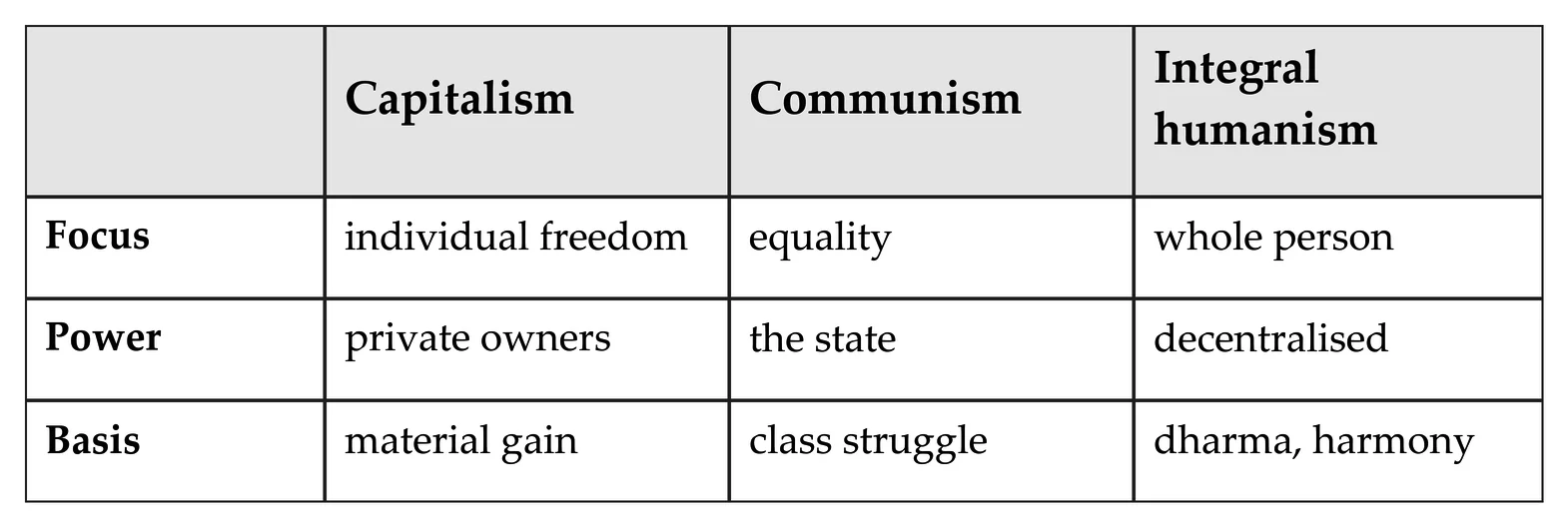
Upadhyaya argued that Western political thought had produced a series of partial ideas, nationalism, democracy, socialism, capitalism and individual freedom, each of which emphasised one aspect of human life and came into conflict with the others. Capitalism stressed individual freedom but produced exploitation and inequality; communism stressed equality but crushed individual freedom and concentrated power in the state. Both, he said, were materialist, treating human beings as economic beings whose happiness lay in consumption. He distinguished Western science, which India should absorb, from the Western way of life, which India need not copy.
The Integral View of the Human Being
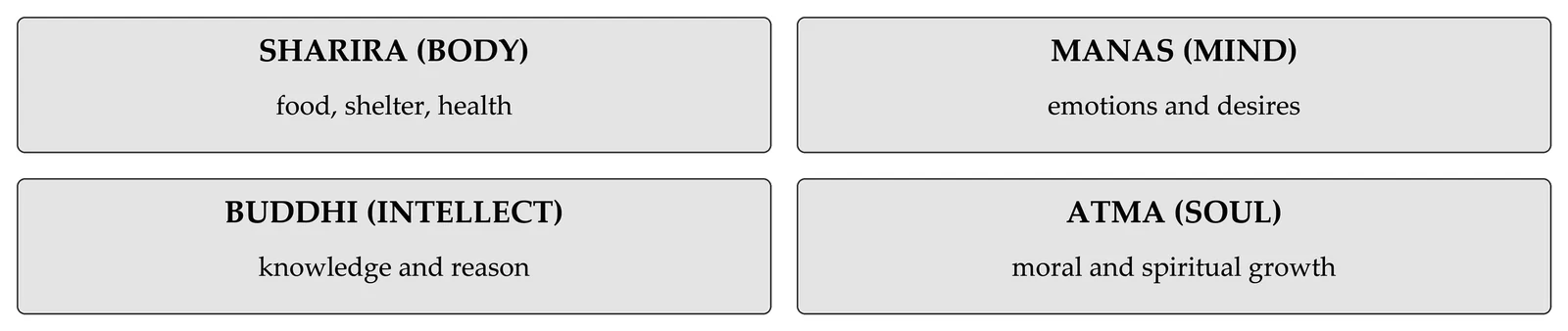
Against these partial views, Upadhyaya presented an integral view drawn from Indian tradition. A human being has four aspects: sharira (body), manas (mind), buddhi (intellect) and atma (soul). Happiness requires the satisfaction of all four, not only the body’s needs. Correspondingly, human life has four aims, the purusharthas: dharma (moral order and duty), artha (wealth and power), kama (desire and pleasure) and moksha (liberation). Artha and kama must be regulated by dharma, so that wealth and pleasure serve a moral purpose.
Features of Integral Humanism
- Integration, not fragmentation. The individual, family, society, nation, humanity and the universe are connected parts of one whole, like concentric circles, not separate or opposed units.
- Harmony, not conflict. Unlike the Marxist view of class struggle or the liberal view of competing interests, society is seen as naturally cooperative, with conflict a sign of disorder.
- Organic society. Society is not created by a social contract among individuals but is a living organism with its own soul, which grows naturally.
- Primacy of dharma. Dharma, the moral law that sustains society, is supreme over the state, the economy and individual desire.
- Balance of the purusharthas. Economic and material goals must be balanced with moral and spiritual goals.
- Decentralisation. Political and economic power should be decentralised to avoid concentration in either the state or private capitalists.
- Indian roots. The philosophy claims to draw on India’s cultural traditions rather than imported ideologies.

Integral Humanism Compared
Upadhyaya’s ideas have similarities with Gandhi’s critique of modern civilisation, his emphasis on villages, swadeshi and moral restraint, and his idea of Sarvodaya. They can also be compared with M.N. Roy’s Radical Humanism of the 1940s, which, from a very different, rationalist starting point, also criticised both capitalism and communism and placed the individual at the centre. Unlike Roy, Upadhyaya grounded his humanism in Indian spiritual tradition and the idea of the nation’s soul.
Key Terms of Integral Humanism
- Ekatma Manavvad: the Hindi name of integral humanism, meaning the philosophy of the integrated human being.
- Purusharthas: the four aims of life, dharma, artha, kama and moksha, which must be pursued in balance.
- Chiti: the soul or innate nature of a nation.
- Virat: the vital energy of the nation that sustains it.
- Antyodaya: the rise of the last person, the measure of a just economy.
7.3 Nation, Dharma Rajya and Antyodaya
Chiti and Virat
Upadhyaya described the nation as a living entity with a soul, which he called chiti, i.e. the innate nature or consciousness of a people that determines its direction and character. A nation’s institutions, culture and policies are good when they express its chiti and bad when they go against it. He used the term virat for the vital energy of the nation, which sustains it when its institutions follow its chiti. In his view, India’s chiti was shaped by its ancient culture, and national renewal required recovering it. Critics argue that identifying a single national soul with ancient Hindu culture can marginalise minorities, while supporters see chiti as a cultural rather than religious idea.
Dharma Rajya
Upadhyaya’s ideal state was dharma rajya, the rule of dharma. He emphasised that this was not a theocracy, since dharma does not mean religion or sect but the moral law that sustains society. In a dharma rajya, the state is not supreme; it is bound by dharma, just as rulers in ancient India were expected to follow rajadharma. Dharma rajya would protect the rights of all citizens and be secular in the sense of not favouring any sect, while being guided by moral values. He also favoured decentralisation, with a large role for local bodies and voluntary associations, and a limited, non-totalitarian state.

Antyodaya and Economic Thought
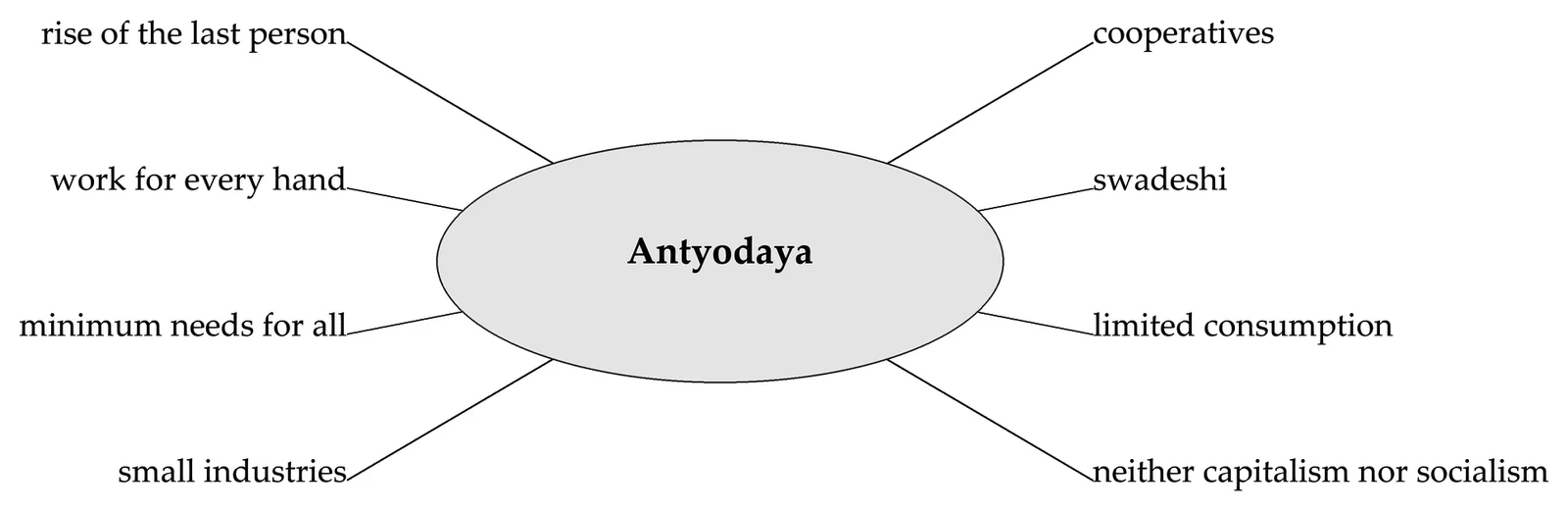
- Antyodaya. The rise of the last person, i.e. the economic system should be judged by its effect on the poorest; development must reach the person at the bottom first.
- Neither capitalism nor socialism. He rejected both the concentration of wealth in private hands and its concentration in the state, favouring a decentralised economy of small and medium enterprises and cooperatives.
- Work for every hand. Every able person must have work; technology should suit Indian conditions of abundant labour rather than displace workers.
- Swadeshi. India should rely on its own resources and enterprise, while welcoming useful foreign technology.
- Limited consumption. Following the balance of the purusharthas, he criticised unlimited consumption and the multiplication of wants, anticipating later concerns about sustainability.
- Minimum standard of living. The state should guarantee basic needs such as food, clothing, housing, education and health to all.
Legacy and Debates
Integral humanism became the official philosophy of the Bharatiya Jana Sangh and, in 1985, of the Bharatiya Janata Party, whose constitution names it as the party’s basic philosophy. Since 2014, several government programmes have been named after Upadhyaya, such as the Deendayal Antyodaya Yojana for livelihoods and the Deen Dayal Upadhyaya Grameen Kaushalya Yojana for rural skills, and the Mughalsarai junction was renamed after him in 2018. Supporters see integral humanism as an authentic Indian philosophy that balances material and spiritual life. Critics argue that its concepts are vague and idealised, that its economic ideas were not developed into concrete policy, and that its idea of a national soul rooted in Hindu culture may conflict with the constitutional ideal of a plural, secular nation.
Upadhyaya and Other Indian Thinkers
Upadhyaya’s thought can be placed alongside other attempts to formulate an Indian political philosophy. Like Vivekananda, he drew on Vedanta and the idea of the nation as a spiritual entity; like Gandhi, he criticised modern materialism and favoured decentralisation; and like M.S. Golwalkar of the RSS, he saw Indian culture as the basis of national identity, though he presented his ideas in more philosophical and economic terms. Comparing these thinkers helps students understand the different strands of cultural nationalism in modern India.
7.4 Important Questions
- Question 1 Discuss Deendayal Upadhyaya’s concept of Integral Humanism.
- Question 2 Examine Upadhyaya’s critique of Western ideologies and his alternative of Integral Humanism.
- Question 3 Discuss the concepts of chiti, virat and dharma rajya in Upadhyaya’s thought.
- Question 4 Discuss Upadhyaya’s idea of Antyodaya and his economic thought.
DU asks the same idea in different words. So learn one broad answer for each question below; the same answer works for every question joined by OR.
Important Question 1
Discuss Deendayal Upadhyaya’s concept of Integral Humanism.
OR
Explain the main features of Integral Humanism.
OR
How does Integral Humanism view the relationship between the individual and society?
Model Answer
“Integral Humanism shall be the basic philosophy of the Party.”
— Constitution of the Bharatiya Janata Party, Article III
Introduction. Integral Humanism (Ekatma Manavvad) is the political philosophy that Deendayal Upadhyaya presented in four lectures in Bombay in April 1965. It views the human being as an integrated whole of body, mind, intellect and soul, and society as an organic unity based on harmony rather than conflict. Offered as an Indian alternative to capitalism and communism, it became the basic philosophy of the Bharatiya Jana Sangh and later of the Bharatiya Janata Party.
1. Context
Upadhyaya developed integral humanism during the Cold War, when India was following Nehruvian planning and the world was divided between capitalism and communism. He sought an Indian philosophy based on Indian culture rather than imported Western ideologies, and the Jana Sangh adopted it as its doctrine in 1965.
2. Meaning of Integral Humanism
Integral humanism means a humanism that sees the person as a whole, integrated being and sees the individual, society, nation and universe as integrated with one another. It places the human being at the centre but understands human needs as moral and spiritual as well as material.
3. The Four Aspects of Man
Upadhyaya held that a human being consists of body (sharira), mind (manas), intellect (buddhi) and soul (atma). Western ideologies, he argued, attend mainly to bodily and material needs, while true happiness requires satisfying all four aspects together.
4. The Four Purusharthas
Human life has four aims: dharma, artha, kama and moksha. Artha (wealth) and kama (desire) are legitimate, but they must be regulated by dharma, the moral order, so that the pursuit of wealth and pleasure does not destroy social harmony or personal well-being.
5. Integration of Individual and Society
The individual, family, society, nation, humanity and the universe are like concentric circles, each part of the next. The individual is not opposed to society, and society is not opposed to the individual; each develops through the other.
6. Harmony Rather than Conflict
Unlike the Marxist view of history as class struggle, or the liberal view of society as a market of competing interests, integral humanism holds that cooperation and harmony are natural, and that conflict arises when society departs from dharma.
7. Society as an Organism
Upadhyaya rejected the social contract theory, arguing that society is not created by agreement among individuals but is a living organism with its own soul that grows naturally over time.
8. Critique of Capitalism
Capitalism, he argued, values individual freedom but treats people as economic beings, leads to concentration of wealth, exploitation and consumerism, and neglects moral and spiritual needs.
9. Critique of Communism
Communism, he argued, values equality but crushes individual freedom, concentrates power in the state and is equally materialist, so it cannot satisfy the whole human being.
10. Decentralisation
To avoid concentration of power in either private capitalists or the state, Upadhyaya favoured a decentralised political and economic order, with strong local bodies, small industries and cooperatives.
11. Indian Roots
Integral humanism draws on Indian concepts such as dharma, the purusharthas and the idea of an integrated cosmos, and claims to express Indian culture rather than a borrowed ideology, similar in spirit to Gandhi’s rejection of Western models.
12. Influence
Integral humanism became the official philosophy of the Jana Sangh and, from 1985, of the BJP, and its concept of Antyodaya has inspired government programmes for the poor.
13. Criticisms
Critics argue that integral humanism is vague and idealised, that it romanticises Indian tradition, that it offers few concrete policies and that its emphasis on a national culture can marginalise minorities.
14. Integral Humanism and Gandhi
Upadhyaya acknowledged Gandhi as an earlier thinker who sought an Indian path. Both criticised materialism, valued the village and self-reliance and wanted morality to guide politics and economics, though Upadhyaya gave greater emphasis to the nation and its culture, while Gandhi emphasised non-violence and individual conscience.
15. Integral Humanism and Sustainability
Supporters argue that integral humanism’s call for moderate consumption and harmony between human beings and nature anticipates modern concerns about sustainable development and climate change, since it rejects the idea that happiness lies in limitless material growth.
16. Evaluation
Integral humanism is a significant attempt to formulate an Indian political philosophy that integrates material and spiritual life, though its abstract character and its political uses continue to be debated.
Conclusion. Thus, Upadhyaya’s Integral Humanism views the human being as an integrated whole of body, mind, intellect and soul pursuing the four purusharthas under the guidance of dharma, and sees individual, society, nation and universe as harmoniously connected. Offered as an Indian alternative to capitalism and communism, it became the philosophy of the Jana Sangh and the BJP.
Important Question 2
Examine Upadhyaya’s critique of Western ideologies and his alternative of Integral Humanism.
OR
Why did Deendayal Upadhyaya reject both capitalism and communism?
OR
‘Integral Humanism is an Indian alternative to Western ideologies.’ Discuss.
Model Answer
“The earth provides enough to satisfy every man’s needs, but not every man’s greed.”
— Saying attributed to M.K. Gandhi, recorded by Pyarelal
Introduction. Deendayal Upadhyaya argued that the political ideologies developed in the West, such as capitalism, communism, liberal democracy and nationalism, were partial and materialist, and that India should not borrow them uncritically. In their place he proposed Integral Humanism, which he presented as an indigenous philosophy based on Indian culture. His critique shares some features with Gandhi’s critique of modern civilisation.
1. Western Ideologies as Partial
Upadhyaya argued that Western thought had produced a series of ideas, nationalism, democracy, socialism and individual liberty, each emphasising one aspect of life. These ideas came into conflict with one another, showing that none offered a complete view of human beings and society.
2. Materialism
He held that both capitalism and communism were materialist, treating human beings mainly as producers and consumers whose happiness lay in material goods. They neglected the mind, intellect and soul, and so could not bring true happiness.
3. Critique of Capitalism
Capitalism protects individual freedom and enterprise but leads to the concentration of wealth, the exploitation of workers, monopolies and consumerism. It makes the market supreme and reduces human relationships to economic exchange.
4. Critique of Communism
Communism aims at equality but concentrates all economic and political power in the state, destroying individual freedom and initiative. Its doctrine of class struggle divides society and justifies violence.
5. Critique of Individualism and Collectivism
Liberal individualism sees society as a contract among self-interested individuals, while collectivism subordinates the individual to the state. Upadhyaya rejected both, arguing that individual and society are integrated parts of one whole.
6. Science and Way of Life
Upadhyaya distinguished Western science, which is universal and should be absorbed by India, from the Western way of life and values, which India need not copy. India should modernise without abandoning its own culture.
7. The Integral Alternative
Integral humanism views the human being as a whole of body, mind, intellect and soul, pursuing dharma, artha, kama and moksha in balance. It seeks to satisfy material needs while respecting moral and spiritual goals.
8. Dharma as Regulator
In place of the market or the state, Upadhyaya made dharma, the moral law, the regulator of economic and political life. Artha and kama are legitimate but must be pursued within the limits of dharma.
9. Decentralised Economy
Against both private monopoly and state monopoly, he proposed a decentralised economy of small and medium enterprises, cooperatives and village industries, giving work to every hand.
10. Harmony Not Conflict
Where Marxism sees class struggle and liberalism sees competing interests, integral humanism sees society as an organism in which cooperation is natural and conflict is a sign of disorder.
11. Comparison with Gandhi
Like Gandhi, Upadhyaya criticised materialism, emphasised moral limits on wants, favoured decentralisation and sought an Indian path of development, though he placed greater emphasis on the nation and its culture.
12. Comparison with M.N. Roy
M.N. Roy’s Radical Humanism also rejected both capitalism and communism, but from a rationalist and scientific standpoint, whereas Upadhyaya grounded his humanism in Indian spiritual tradition.
13. Criticisms
Critics argue that Upadhyaya simplified Western thought, which itself contains many critiques of materialism, and that his alternative remained abstract, offering little guidance on concrete economic policy.
14. Evaluation
Upadhyaya’s critique raised important questions about materialism and the borrowing of foreign models, and his integral alternative appealed to many as an indigenous philosophy, though its practical implications remain debated.
Conclusion. Thus, Upadhyaya rejected capitalism and communism as partial and materialist ideologies that neglect the whole human being, and distinguished Western science from the Western way of life. His alternative, Integral Humanism, based on the purusharthas, dharma, harmony and decentralisation, was presented as an Indian path between individualism and collectivism.
Important Question 3
Discuss the concepts of chiti, virat and dharma rajya in Upadhyaya’s thought.
OR
Examine Deendayal Upadhyaya’s idea of the nation.
OR
‘Dharma rajya is not a theocratic state.’ Discuss with reference to Upadhyaya.
Model Answer
“Dharma protects those who protect it.”
— Dharmo rakshati rakshitah, Manusmriti 8.15
Introduction. Upadhyaya’s political thought rests on a particular idea of the nation as a living entity with its own soul and energy, and of the ideal state as one governed by dharma. He used the concepts of chiti, the soul of the nation, virat, its vital energy, and dharma rajya, the rule of moral law, to explain how a nation should be organised and governed.
1. The Nation as an Organism
Upadhyaya rejected the view that a nation is merely a collection of individuals or a territory under a government. A nation, he argued, is a living organism, a people bound by a common ideal and a common way of life developed over history.
2. Meaning of Chiti
Chiti is the soul or innate nature of a nation, which determines its character and direction. Just as an individual has a soul, a nation has a chiti that is revealed through its culture, history and values.
3. Chiti as a Standard
Upadhyaya argued that a nation’s institutions and policies should be judged by whether they express its chiti. Those that conform to it strengthen the nation, while those borrowed from others against its nature weaken it.
4. Meaning of Virat
Virat is the vital energy or collective strength of the nation that arises when its institutions follow its chiti. Virat sustains the nation, much as life force sustains the body, and gives it the power to face challenges.
5. India’s Chiti
Upadhyaya believed that India’s chiti was shaped by its ancient culture, which emphasised the integration of material and spiritual life, harmony and dharma. National renewal required recovering this chiti after centuries of foreign rule.
6. Meaning of Dharma
Upadhyaya used dharma not to mean religion or sect but the moral law that sustains individuals and society. Dharma includes duty, justice and the principles that hold society together.
7. Dharma Rajya
Dharma rajya means the rule of dharma. The state is not supreme; it is bound by dharma and must serve the welfare of all. Even rulers are subject to dharma, as rajadharma in ancient India required.
8. Not a Theocracy
Upadhyaya stressed that dharma rajya is not a theocratic state, since it does not favour any religion or sect, and that it guarantees freedom of worship and the rights of all citizens. In this sense he presented it as compatible with secularism.
9. Limited and Decentralised State
Dharma rajya would be a limited state, preventing the concentration of power, with a strong role for local bodies, families and voluntary associations, in contrast to totalitarian states.
10. Rights and Duties
Upadhyaya emphasised duties alongside rights, arguing that dharma defines the duties of individuals, groups and the state, and that rights flow from the performance of duties.
11. Comparison with Rajadharma
His idea of dharma rajya echoes ancient Indian ideas of rajadharma, in which the king’s authority was justified and limited by his duty to protect and promote the welfare of the people.
12. Criticisms
Critics argue that the concept of a single national soul is mystical and difficult to verify, and that identifying India’s chiti with ancient Hindu culture may marginalise religious minorities and conflict with the Constitution’s civic idea of the nation.
13. Defence
Supporters argue that chiti refers to a shared civilisational culture rather than a religion, and that dharma rajya, as a rule of moral law protecting all, is consistent with constitutional values.
14. Chiti and Culture
Upadhyaya illustrated chiti with examples from Indian history, arguing that whenever India’s rulers and institutions acted in harmony with its cultural nature, the nation flourished, and whenever they departed from it, decline followed. He saw the colonial period as a time when India’s chiti was suppressed by foreign institutions.
15. Dharma and Law
In dharma rajya, laws made by the legislature must conform to dharma, just as in modern constitutionalism ordinary laws must conform to the constitution. Upadhyaya suggested that dharma functions like a higher law that limits even a democratic majority.
16. Dharma Rajya and Democracy
Upadhyaya accepted democracy but argued that majority rule alone was not enough; democracy must be guided by dharma so that the majority does not oppress minorities or individuals. He thus sought to combine popular government with moral limits on power.
17. Evaluation
The concepts of chiti, virat and dharma rajya give Upadhyaya’s thought a distinctive cultural theory of the nation and the state, though their abstract and contested meanings continue to be debated.
Conclusion. Thus, Upadhyaya saw the nation as a living organism with a soul, chiti, and a vital energy, virat, which flourish when institutions follow the nation’s nature. His ideal of dharma rajya, the rule of moral law rather than of any religion, sought a limited, decentralised state, though critics question its implications for a plural society.
Important Question 4
Discuss Upadhyaya’s idea of Antyodaya and his economic thought.
OR
Compare Upadhyaya’s Antyodaya with Gandhi’s Sarvodaya.
OR
Examine the relevance of Antyodaya to development in India.
Model Answer
“Recall the face of the poorest and the weakest man whom you may have seen, and ask yourself, if the step you contemplate is going to be of any use to him.”
— M.K. Gandhi, the talisman (1947)
Introduction. Antyodaya, meaning the rise of the last person, is a central idea in Deendayal Upadhyaya’s economic thought. He argued that an economic system should be judged by its effect on the poorest person, and that development must begin with those at the bottom. His economic thought, rejecting both capitalism and state socialism, aimed at a decentralised, self-reliant economy that would satisfy basic needs and give work to all.
1. Meaning of Antyodaya
Antyodaya combines antya, the last, and udaya, rise. It means that the progress of society should be measured by the progress of its poorest member, and that policies must be designed to reach the last person first.
2. The Gandhian Inspiration
The idea echoes Gandhi’s talisman of 1947, which asked decision-makers to recall the face of the poorest person and ask whether their action would help him, and Gandhi’s concept of Sarvodaya, the welfare of all.
3. Neither Capitalism nor Socialism
Upadhyaya rejected capitalism because it concentrated wealth and exploited workers, and state socialism because it concentrated economic power in the state and suppressed freedom. He sought a middle path based on Indian conditions.
4. Decentralised Economy
He favoured small and medium enterprises, cottage industries and cooperatives, which would spread ownership and employment widely and prevent the domination of either big business or the bureaucracy.
5. Work for Every Hand
Upadhyaya held that every able person must have work. Since India had abundant labour and scarce capital, technology should be chosen to create employment rather than to replace workers.
6. Minimum Needs
The economy must guarantee every person the basic necessities of life, food, clothing, housing, education and health care, as a matter of national duty.
7. Swadeshi
He supported economic self-reliance based on India’s own resources and enterprise, while accepting useful foreign technology, so that the economy would serve national needs.
8. Limits on Consumption
Following the balance of the purusharthas, he criticised the endless multiplication of wants and consumerism, arguing for moderate consumption that respects nature and moral values.
9. Antyodaya and Sarvodaya Compared
Gandhi’s Sarvodaya aimed at the welfare of all through village self-reliance and trusteeship, while Upadhyaya’s Antyodaya emphasised beginning with the poorest. Both rejected materialism and centralisation, but Upadhyaya placed his economics within a philosophy of the nation.
10. Antyodaya in Policy
The Antyodaya Anna Yojana of 2000 provided highly subsidised grain to the poorest families, and the Deendayal Antyodaya Yojana launched in 2014–16 supports livelihoods of the urban and rural poor, showing the idea’s influence on policy.
11. Relevance Today
Antyodaya is relevant to debates on inclusive growth, targeting of welfare and the Sustainable Development Goals’ promise to leave no one behind, which also emphasises reaching the most disadvantaged first.
12. Comparison with Rawls
Antyodaya can be compared with John Rawls’s difference principle in A Theory of Justice (1971), which permits inequalities only if they benefit the least advantaged, though Upadhyaya grounded his idea in Indian tradition rather than contract theory.
13. Criticisms
Critics argue that Upadhyaya’s economic ideas remained general principles without detailed policy, that decentralised small-scale production may limit growth and that the idea of limited consumption is hard to reconcile with a modern market economy.
14. Antyodaya and Planning
Upadhyaya criticised the Five-Year Plans of the Nehru era for favouring heavy industry and big cities over villages and the poor. He argued that planning should begin from the needs of the poorest villager and from India’s own resources, rather than imitating Soviet or Western models.
15. Evaluation
Antyodaya offers a powerful moral criterion for judging development, placing the poorest at the centre, and it has shaped welfare schemes, though translating it into effective economic policy remains a challenge.
Conclusion. Thus, Upadhyaya’s Antyodaya, the rise of the last person, holds that development must be judged by its benefit to the poorest. Within a decentralised economy of small enterprises and cooperatives, guaranteeing work and basic needs and limiting consumption, it offered an alternative to capitalism and socialism, echoing Gandhi’s Sarvodaya and influencing welfare policies today.
Short Notes
(a) Antyodaya
Upadhyaya’s principle of the rise of the last person, according to which development should be judged by its effect on the poorest member of society.
(b) Chiti
Upadhyaya’s term for the soul or innate nature of a nation, which determines its character and should guide its institutions.
(c) Dharma rajya
The rule of dharma, i.e. a state bound by moral law that serves the welfare of all; Upadhyaya insisted that it is not a theocracy.
More notes: GE-1 Ideas in Indian Political Thought
These notes are prepared by PADHO TO AISE for study help. They are not an official publication.