
Generic Electives (GE) GE-10 Digital Social Sciences
Unit V · 21 min read · Updated 27 Nov 2026
As per the University of Delhi (DU) Generic Elective (GE) syllabus offered by the Department of Political Science
Contents
- 5.1 The Public Sphere and Social Media
- Critiques of Habermas
- Social Media as a Public Sphere
- Media Concentration and Platform Power
- 5.2 Echo Chambers and Networked Movements
- Sunstein: #Republic
- Castells: Networks of Outrage and Hope
- Limits of Networked Movements
- 5.3 Social Media, Politics and Regulation in India
- Social Media and Political Communication
- Sinha: The Networked Public
- Movements and Counterpublics in India
- Regulation
- Digital Public Sphere and Elections
- 5.4 Important Questions
- Can social media be seen as a new public sphere? Discuss with reference to Habermas.
- Discuss Cass Sunstein’s argument on echo chambers and its implications for democracy.
- Examine Manuel Castells’s analysis of networked social movements.
- Discuss the role of social media in Indian politics and the challenges of regulating online speech.
- Short Notes
सार्वजनिक क्षेत्र से हमारा अभिप्राय सबसे पहले हमारे सामाजिक जीवन के उस क्षेत्र से है जिसमें जनमत जैसा कुछ बन सकता है।
By the public sphere we mean first of all a realm of our social life in which something approaching public opinion can be formed.
— Jürgen Habermas, The Public Sphere: An Encyclopedia Article (1964)
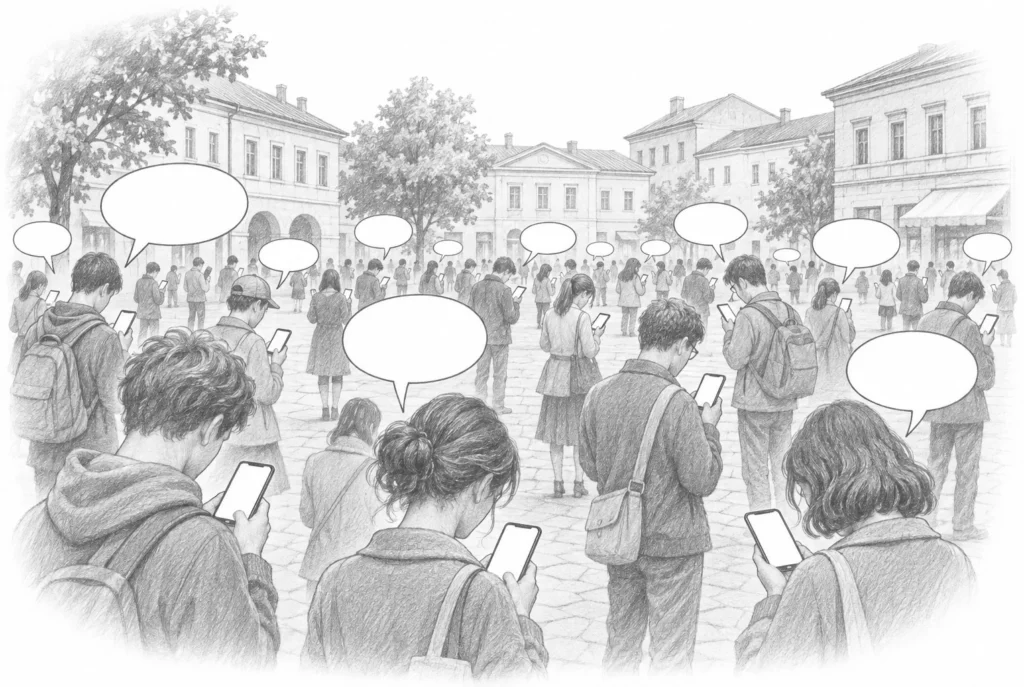
WWHERE do citizens debate public affairs today? Increasingly, on social media: on Twitter (now X), Facebook, YouTube, Instagram and WhatsApp groups. These platforms have given millions a voice, enabled protest movements and transformed political campaigns. But they have also spread misinformation and hate, divided citizens into echo chambers and given great power to a few companies. This chapter uses the idea of the public sphere to examine how social media are changing democracy, discussing Habermas, Sunstein’s warnings about echo chambers, Castells’s networked social movements, and political communication and regulation in India.

5.1 The Public Sphere and Social Media
The German philosopher Jürgen Habermas, in The Structural Transformation of the Public Sphere (1962), described the public sphere as a realm of social life, between the private sphere and the state, where private individuals come together to discuss matters of common concern and form public opinion through rational-critical debate. He traced its emergence in eighteenth-century Europe in coffee houses, salons, newspapers and reading societies, where arguments were judged on their merits rather than the status of speakers. The public sphere served as a check on state power. Habermas argued that in the twentieth century it declined, or was refeudalised, as commercial mass media and public relations turned citizens into passive consumers of opinion.
Critiques of Habermas
Nancy Fraser, in Rethinking the Public Sphere (1990), argued that the bourgeois public sphere excluded women, workers and minorities, and that subordinated groups formed their own subaltern counterpublics, parallel arenas in which they developed counter-discourses. Others noted that public debate is never purely rational, involving emotion, identity and power. In India, scholars have pointed to the vernacular press, caste associations and movements as diverse public spheres.
Social Media as a Public Sphere
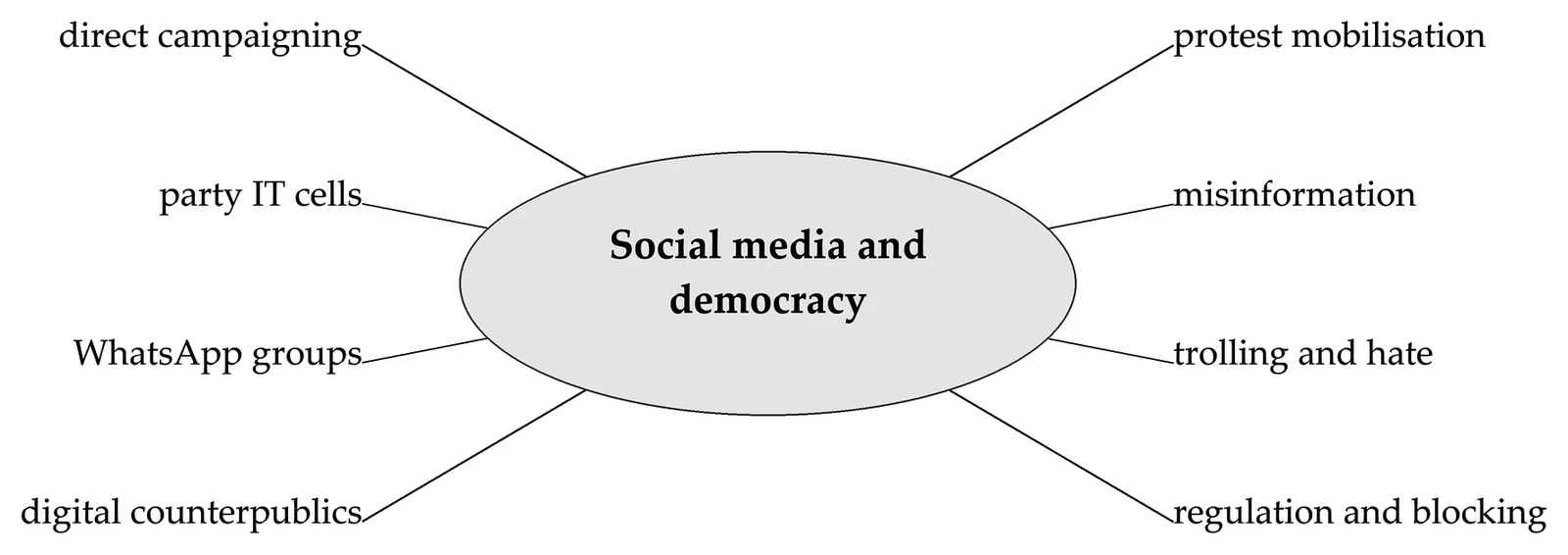
Social media seemed to promise a revival of the public sphere. They allow anyone to publish, comment and debate, bypassing the gatekeepers of traditional media. They give voice to marginalised groups, such as Dalit activists, feminists and regional communities, forming new digital counterpublics. They enable citizens to question leaders directly and to organise collective action. But critics argue that social media also undermine the public sphere: debate is shaped by algorithms designed to maximise engagement; outrage and misinformation spread faster than reasoned argument; trolling and harassment silence many, especially women; and a few corporations control the infrastructure of public debate.
Media Concentration and Platform Power
The infrastructure of the digital public sphere is owned by a handful of global companies. Their decisions about content moderation, account suspensions and ranking can shape public debate in many countries at once. In India, disputes between the government and platforms over blocking orders and the IT Rules show how both state and corporate power shape what citizens can see and say online.
5.2 Echo Chambers and Networked Movements
Sunstein: #Republic
Cass Sunstein, in #Republic: Divided Democracy in the Age of Social Media (2017), argues that in a well-functioning democracy people do not live in echo chambers or information cocoons; they encounter a wide range of topics and views, including those they did not choose. Social media, however, allow people to personalise what they see, creating what Nicholas Negroponte called the Daily Me. Algorithms reinforce this by showing users content similar to what they already like, producing filter bubbles, a term coined by Eli Pariser (2011). Sunstein warns that echo chambers lead to group polarisation, as like-minded people push one another towards more extreme positions, and to the spread of falsehoods within closed groups. He argues that democracy needs unplanned encounters with different views and shared experiences that bind citizens together, and suggests design changes and public forums to promote them.
Castells: Networks of Outrage and Hope
Manuel Castells, in Networks of Outrage and Hope: Social Movements in the Internet Age (2012, revised 2015), studied the wave of movements from Tunisia and Iceland in 2010 to Egypt, Spain’s Indignadas and Occupy Wall Street in 2011. He argued that these networked social movements were born from outrage at injustice and corruption and sustained by hope for change. They used the internet for mass self-communication, spreading images and messages horizontally without central control, and then occupied urban spaces such as Tahrir Square, combining online networks with physical presence. They were leaderless, horizontal and self-reflective, and aimed more at changing minds than seizing power. Castells argued that whoever controls communication holds power, and that these movements challenged the communication power of states and corporations.
Limits of Networked Movements
Critics note that many networked movements struggled to turn mobilisation into lasting political change; Egypt’s revolution was followed by military rule. Governments also learned to use social media for surveillance, propaganda and repression. Zeynep Tufekci, in Twitter and Tear Gas (2017), argued that the internet allowed movements to grow quickly without building the organisational capacity needed to negotiate and survive.

5.3 Social Media, Politics and Regulation in India
Social Media and Political Communication
Usha Rodrigues, in Political Communication on Social Media Platforms (2020), shows how Indian parties have made social media central to political communication. The 2014 general election is often called India’s first social media election, as the BJP and Narendra Modi used Twitter, Facebook and later WhatsApp to communicate directly with voters, bypassing traditional media. Parties built IT cells with thousands of volunteers to spread messages, counter opponents and shape trends. Other parties soon followed. P.R. Biju, in Political Internet (2016), and Pamela Philipose, in Media’s Shifting Terrain (2019), describe how the internet changed the relationship between the state, parties, journalists and citizens in India, including the rise of digital news outlets and the pressures on press freedom.
Sinha: The Networked Public
Amber Sinha, in The Networked Public: How Social Media Changed Democracy (2019), examines how social media changed Indian democracy. He shows how platforms enabled new forms of participation and movements, such as the anti-corruption movement of 2011 and protests after the Nirbhaya case in 2012, but also became channels for misinformation, hate speech and organised propaganda. WhatsApp’s closed, encrypted groups made false rumours hard to track; in 2018, rumours of child kidnappers led to lynchings in several states. Sinha argues that democracy requires addressing the business models and design of platforms, not only individual misinformation.
Movements and Counterpublics in India
- #MeToo in 2018 brought women’s accounts of sexual harassment into public debate.
- Dalit activists used social media to document caste atrocities and build counterpublics, as after the Una flogging in Gujarat in 2016.
- Shaheen Bagh (2019–20) and the farmers’ protest (2020–21) used social media to counter mainstream narratives and build support.
- Trolling and harassment of journalists, women and minorities show the dark side of the digital public sphere.
Regulation
India’s regulation of online speech involves several laws. In Shreya Singhal v. Union of India (2015), the Supreme Court struck down Section 66A of the IT Act, which criminalised offensive online messages, as vague and violating free speech, while upholding blocking powers under Section 69A with safeguards. The IT Rules, 2021 require large platforms to appoint grievance officers, remove unlawful content quickly and, for messaging services, enable identification of the first originator of certain messages, which critics say threatens encryption and privacy. In 2024, the Bombay High Court struck down an amendment allowing a government fact-check unit to label content about the government as false. Balancing free speech with the need to curb hate speech and misinformation remains a central challenge.
Digital Public Sphere and Elections
Elections are moments when the digital public sphere is most intense. Parties run large online campaigns, citizens debate candidates and issues, and false claims spread rapidly. Independent fact-checkers, journalists and the Election Commission try to counter misinformation, but the speed and scale of social media make this difficult, especially in many languages.
5.4 Important Questions
- Question 1 Can social media be seen as a new public sphere? Discuss with reference to Habermas.
- Question 2 Discuss Cass Sunstein’s argument on echo chambers and its implications for democracy.
- Question 3 Examine Manuel Castells’s analysis of networked social movements.
- Question 4 Discuss the role of social media in Indian politics and the challenges of regulating online speech.
DU asks the same idea in different words. So learn one broad answer for each question below; the same answer works for every question joined by OR.
Important Question 1
Can social media be seen as a new public sphere? Discuss with reference to Habermas.
OR
Examine Habermas’s concept of the public sphere and its relevance in the digital age.
OR
Discuss the idea of digital counterpublics.
Model Answer
“Parallel discursive arenas where members of subordinated social groups invent and circulate counterdiscourses.”
— Nancy Fraser, Rethinking the Public Sphere (1990), on subaltern counterpublics
Introduction. Jürgen Habermas’s idea of the public sphere describes the space where citizens debate public affairs and form public opinion. Social media seem to offer a new public sphere open to all. But whether they revive or undermine democratic debate depends on how they work, who controls them and who is included or excluded.
1. Habermas’s Public Sphere
Habermas described the public sphere as a realm between private life and the state where private persons debate matters of common concern and form public opinion.
2. Rational-Critical Debate
In the ideal public sphere, arguments are judged on their merits, not the status of speakers, and public opinion acts as a check on state power.
3. Historical Emergence
Habermas traced the public sphere to eighteenth-century Europe’s coffee houses, salons, newspapers and reading societies, where a reading public debated politics.
4. Refeudalisation
He argued that the public sphere declined in the twentieth century as commercial mass media and public relations turned citizens into passive consumers.
5. Fraser’s Critique
Nancy Fraser argued that the bourgeois public sphere excluded women, workers and minorities, who formed subaltern counterpublics with their own discourses.
6. Multiple Publics in India
In India, the vernacular press, caste associations and movements formed diverse public spheres, shaped by language, caste and region.
7. The Promise of Social Media
Social media allow anyone to publish and debate, bypassing gatekeepers of traditional media and enabling direct questioning of leaders.
8. Digital Counterpublics
Dalit activists, feminists, queer communities and regional groups use social media to form digital counterpublics and challenge dominant narratives.
9. Collective Action
Social media help citizens organise protests and campaigns, as in the anti-corruption movement of 2011 and #MeToo in 2018.
10. Algorithms and Engagement
Debate on social media is shaped by algorithms designed to maximise engagement, which favour sensational and emotional content over reasoned argument.
11. Misinformation
False information spreads faster than corrections, undermining the shared factual basis needed for public debate.
12. Trolling and Harassment
Organised trolling and harassment, especially of women, journalists and minorities, silence many voices and narrow the public sphere.
13. Corporate Control
A few corporations own the platforms where public debate takes place, giving them power over what is seen and heard, a new form of refeudalisation.
14. State Power
States can also shape the digital public sphere through blocking, takedown orders, surveillance and internet shutdowns.
15. A Fragmented Sphere
Rather than a single public sphere, social media create many fragmented publics, some open and deliberative, others closed and polarised.
16. Visual and Vernacular Publics
Much political talk on Indian social media now takes the form of short videos, memes and voice notes in Indian languages, reaching people who rarely read newspapers. This widens the public sphere but also favours emotional and simplified messages over long arguments.
17. Habermas on Digital Media
In his later work on a new structural transformation of the public sphere (2022), Habermas argued that digital platforms dissolve the boundaries of a shared public, as users form self-enclosed groups and the editorial filters that once checked falsehoods weaken.
18. Evaluation
Social media are a new, contested public sphere that both widens participation and threatens rational debate, so their design and governance matter for democracy.
Conclusion. Thus, Habermas’s public sphere of rational-critical debate finds both a revival and a threat in social media. Fraser’s subaltern counterpublics flourish online, but algorithms, misinformation, trolling and corporate and state control show that the digital public sphere is fragmented and contested.
Important Question 2
Discuss Cass Sunstein’s argument on echo chambers and its implications for democracy.
OR
What are filter bubbles and echo chambers? How do they affect democracy?
OR
Social media divide democracy. Discuss.
Model Answer
“In a well-functioning democracy, people do not live in echo chambers or information cocoons.”
— Cass R. Sunstein, #Republic (2017)
Introduction. Social media allow people to choose what they read and whom they follow, and algorithms tailor content to their preferences. Cass Sunstein argues that this personalisation threatens democracy by creating echo chambers that divide citizens and push them towards extreme views. His analysis has shaped debates on polarisation and platform design.
1. Personalisation
Social media and news apps let users personalise what they see, creating what Negroponte called the Daily Me, a news diet tailored to individual tastes.
2. Echo Chambers
Echo chambers are spaces where people hear mainly views that echo their own, as they follow like-minded people and avoid opposing views.
3. Filter Bubbles
Eli Pariser coined filter bubbles in 2011 for the way algorithms show users content similar to what they already like, hiding other perspectives.
4. Sunstein’s Argument
Sunstein argues that in a healthy democracy people encounter a wide range of views, including those they did not choose, but social media weaken this.
5. Group Polarisation
When like-minded people discuss among themselves, they tend to move towards more extreme positions, a process Sunstein calls group polarisation.
6. Spread of Falsehoods
Within closed groups, false information spreads easily because members trust each other and rarely encounter corrections.
7. Fragmentation
Echo chambers fragment the public into separate groups with different facts, making shared debate and compromise difficult.
8. Unplanned Encounters
Sunstein argues that democracy needs unplanned encounters with different topics and views, which broaden understanding and tolerance.
9. Shared Experiences
He also stresses shared experiences, such as common news events, which give citizens a sense of belonging to one political community.
10. Proposed Remedies
Sunstein suggests design changes, such as features that expose users to opposing views, and public forums that promote diverse encounters.
11. Indian Context
In India, closed WhatsApp groups organised by caste, religion or party have spread partisan messages and rumours, illustrating echo chamber dynamics.
12. Polarisation in India
Studies suggest that political and religious polarisation has intensified online, with hostile rhetoric against opponents and minorities.
13. Evidence and Debate
Some researchers find that many users encounter diverse views online, and that polarisation also has offline causes, so echo chambers are not the only factor.
14. Role of Platforms
Platforms’ algorithms and business models, which reward engagement, play a key role, so responsibility lies with companies as well as users.
15. Digital Literacy
Critical digital literacy helps citizens recognise echo chambers and seek out diverse sources, reducing their effects.
16. Recommendation Algorithms
Video platforms recommend content based on viewing history, which can lead some users towards increasingly extreme material, sometimes called a rabbit hole effect. Platforms have changed their recommendation systems in response, but their workings remain largely opaque.
17. Public Service Media
Sunstein and others value public service broadcasters and general-interest news organisations, which expose citizens to shared information and diverse views. In India, public broadcasters such as Doordarshan and All India Radio once played this role, though they faced criticism for government influence.
18. Evaluation
Sunstein’s warning highlights real dangers of personalisation, though the extent of echo chambers is debated and solutions require platform, policy and citizen action.
Conclusion. Thus, Sunstein argues that personalisation, filter bubbles and echo chambers lead to group polarisation and the spread of falsehoods, threatening a democracy in which people should not live in information cocoons. Unplanned encounters, shared experiences and better platform design are needed to sustain democratic debate.
Important Question 3
Examine Manuel Castells’s analysis of networked social movements.
OR
Discuss the role of social media in protest movements.
OR
Networks of outrage and hope. Discuss.
Model Answer
“If you want to liberate a society, just give them the Internet.”
— Wael Ghonim, Egyptian activist, interview (February 2011)
Introduction. From 2010, a wave of protest movements swept the world, from Tunisia and Egypt to Spain, the United States and India. Manuel Castells argued that these were networked social movements, born from outrage and sustained by hope, and organised through the internet and occupied urban spaces. Their successes and failures reveal both the power and the limits of social media in politics.
1. The Wave of Protest
Movements arose in Tunisia and Iceland in 2010 and in Egypt, Spain and the United States in 2011, challenging governments and economic elites.
2. Castells’s Study
In Networks of Outrage and Hope (2012), Castells analysed these movements as networked social movements of the internet age.

3. Outrage
Castells argued that movements were born from outrage at injustice, corruption and humiliation, often triggered by a single event shared online.
4. Hope
They were sustained by hope, the belief that change was possible, which spread through networks of communication and shared experience.
5. Mass Self-Communication
The internet enabled mass self-communication, allowing individuals to send messages to many people without passing through traditional media.
6. Online and Offline Space
Movements combined online networks with occupation of urban spaces such as Tahrir Square in Cairo and Zuccotti Park in New York.
7. Leaderless and Horizontal
The movements were often leaderless and horizontal, making decisions through assemblies and avoiding formal organisations.
8. Changing Minds
Castells argued that they aimed more at changing values and minds than at seizing state power, though many demanded political reforms.
9. Communication Power
Castells argued that power is exercised through communication, and these movements challenged the communication power of states and corporations.
10. Ghonim and Egypt
Wael Ghonim, whose Facebook page helped mobilise Egyptians in 2011, claimed that giving people the internet would liberate them.
11. Indian Examples
The anti-corruption movement of 2011, protests after Nirbhaya in 2012, #MeToo in 2018 and the farmers’ protest of 2020–21 used social media to mobilise and spread their message.
12. Limits: Weak Organisation
Zeynep Tufekci argued that the internet let movements grow quickly without building the organisational capacity to negotiate and survive.
13. Limits: Repression and Reversal
Egypt’s revolution was followed by military rule, showing that online mobilisation does not guarantee lasting democratic change.
14. State Counter-Strategies
Governments learned to use social media for surveillance, propaganda and trolling, and to impose internet shutdowns during protests.
15. Right-Wing Mobilisation
Social media also enabled right-wing and populist mobilisation, showing that networked politics is not inherently progressive.
16. Hashtag Activism
Hashtags allow causes to trend globally within hours, as with #BlackLivesMatter and #MeToo. Critics call some online activism slacktivism, involving little effort or risk, but supporters argue that hashtags can raise awareness and lead to offline action.
17. Movements and Media Ecology
Networked movements depend not only on social media but on a wider media ecology, including television coverage, independent journalism and diaspora networks, which amplify online messages and give them credibility.
18. Indian Movements and Networks
The anti-corruption movement of 2011 used text messages, missed-call campaigns and social media to mobilise support for Anna Hazare’s fast, while combining them with television coverage and gatherings at Jantar Mantar and the Ramlila Maidan, illustrating Castells’s combination of online networks and occupied space.
19. Evaluation
Networked social movements show the power of digital communication to mobilise outrage and hope, but lasting change requires organisation and institutions.
Conclusion. Thus, Castells shows that networked social movements, born from outrage and sustained by hope, used mass self-communication and occupied spaces to challenge power. Ghonim’s optimism was tempered by repression and weak organisation, showing that the internet is a necessary but not sufficient tool for change.
Important Question 4
Discuss the role of social media in Indian politics and the challenges of regulating online speech.
OR
Examine political communication on social media in India.
OR
Discuss the Shreya Singhal judgment and the IT Rules, 2021.
Model Answer
“Liberty of thought and expression is a cardinal value that is of paramount significance under our constitutional scheme.”
— Supreme Court of India, Shreya Singhal v. Union of India (2015)
Introduction. Social media have become central to Indian politics, transforming campaigns, protests and public debate. Parties use them to communicate directly with voters, while citizens use them to express views and mobilise. At the same time, misinformation, hate speech and harassment have led to growing regulation, raising questions about the balance between free speech and public order.
1. India’s First Social Media Election
The 2014 general election is often called India’s first social media election, as the BJP and Narendra Modi used Twitter, Facebook and later WhatsApp extensively.
2. Rodrigues on Political Communication
Usha Rodrigues shows how parties made social media central to political communication, bypassing traditional media to reach voters directly.
3. IT Cells
Parties built IT cells with thousands of volunteers to spread messages, counter opponents and create trending topics, professionalising online campaigns.
4. WhatsApp Politics
WhatsApp groups became powerful channels of political messaging, especially in rural areas, but their encryption makes misinformation hard to track.
5. Changing Media Landscape
Philipose and Biju describe how the internet changed relations between the state, parties, journalists and citizens, including the rise of digital news outlets.
6. Sinha’s Networked Public
Amber Sinha shows that social media enabled new participation but also became channels for misinformation, hate speech and organised propaganda.
7. Lynchings and Rumours
In 2018, false rumours of child kidnappers spread through WhatsApp led to lynchings, prompting the platform to limit message forwarding.
8. Hate Speech
Online hate speech against minorities and opponents has contributed to tension and violence, raising demands for action by platforms and the state.
9. Shreya Singhal
In 2015, the Supreme Court struck down Section 66A of the IT Act, which criminalised offensive online messages, as vague and violating free speech.
10. Blocking Powers
The Court upheld blocking powers under Section 69A with procedural safeguards, which the government has used to block content and accounts.
11. The IT Rules, 2021
The IT Rules require large platforms to appoint grievance officers, remove unlawful content quickly and, for messaging services, identify the first originator of certain messages.
12. Criticism of the Rules
Critics argue that the traceability requirement threatens encryption and privacy, and that the rules give the executive too much power over online speech.
13. Fact-Check Unit
In 2024, the Bombay High Court struck down an amendment allowing a government fact-check unit to label content about the government as false.
14. Platform Responsibility
Platforms are criticised for inconsistent content moderation, slow action against hate and opaque algorithms, raising demands for transparency.
15. Balancing Rights
Regulation must balance free speech with protection against hate, misinformation and harassment, without giving governments unchecked censorship powers.
16. The Election Commission and Social Media
The Election Commission requires candidates to disclose their social media accounts and spending, applies the Model Code of Conduct to online campaigning and, since 2019, works with platforms under a voluntary code to remove violating content during elections.
17. Deepfakes and AI
AI-generated deepfake videos and voice clones of politicians appeared in Indian elections in 2024, prompting advisories to platforms and debates on labelling synthetic content, a new challenge for regulating political speech.
18. Evaluation
Social media have transformed Indian politics, and their regulation is one of the central challenges for protecting both free speech and democratic debate.
Conclusion. Thus, social media have become central to Indian political communication, from IT cells to WhatsApp, while also spreading misinformation and hate. Shreya Singhal affirmed that liberty of expression is a cardinal value, and the IT Rules and fact-check debates show the continuing struggle to regulate online speech without censorship.
Short Notes
(a) Public sphere
Habermas’s term for the realm between private life and the state where citizens debate common concerns and form public opinion through rational argument.
(b) Filter bubble
Eli Pariser’s term (2011) for the way algorithms show users content matching their existing preferences, hiding other views.
(c) Networked social movement
Manuel Castells’s term for movements that combine internet-based communication with occupation of urban space, born from outrage and sustained by hope.
(d) Counterpublic
Nancy Fraser’s term for parallel arenas in which subordinated groups, such as women, workers or Dalits, develop their own discourses and challenge dominant views; social media have enabled many digital counterpublics.
More notes: GE-10 Digital Social Sciences
These notes are prepared by PADHO TO AISE for study help. They are not an official publication.