
Generic Electives (GE) GE-10 Digital Social Sciences
Unit II · 22 min read · Updated 27 Nov 2026
As per the University of Delhi (DU) Generic Elective (GE) syllabus offered by the Department of Political Science
Contents
- 2.1 Information and Society
- From Data to Wisdom
- The Information Society
- Information, Power and the Science of Society
- 2.2 Data, Big Data and Datafication
- What Is Big Data
- Uses of Big Data
- Datafication
- Limitations and Dangers
- 2.3 Lives of Data in India and the Politics of Data Protection
- Mertia: Lives of Data
- Data and the Indian State
- Sinha: The Politics of Data Protection
- The Digital Personal Data Protection Act, 2023
- 2.4 Important Questions
- What is information? Discuss the relationship between information and society.
- What is big data? Discuss its uses, limitations and the process of datafication.
- Discuss the history and politics of data in India with reference to Sandeep Mertia’s Lives of Data.
- Examine the politics of data protection in India with reference to the Digital Personal Data Protection Act, 2023.
- Short Notes
किसी के भी एकांत, परिवार, घर या पत्राचार में मनमाना हस्तक्षेप नहीं किया जाएगा।
No one shall be subjected to arbitrary interference with his privacy, family, home or correspondence.
— United Nations, Universal Declaration of Human Rights (1948), Article 12
EEVERY click, payment, phone call and form filled online produces data. Governments use data to plan, count and govern; companies use it to sell; and social scientists use it to understand society. But what is information, how does data become knowledge, and who controls it? This chapter examines the concept of information and the information society, the rise of big data and datafication, the history and lives of data in India, and the politics of data protection after the Supreme Court recognised privacy as a fundamental right.

2.1 Information and Society
Information is one of the most used and least defined words of our time. Michael Buckland, in Information and Society (2017), explains that the word is used in three main senses. Information-as-process is the act of informing, of becoming informed. Information-as-knowledge is what is communicated and understood, the knowledge gained. Information-as-thing refers to objects that are informative, such as documents, books, data, images and records. Buckland stresses that societies rely increasingly on documents and records, physical and digital, to know, prove and govern, from birth certificates and land records to databases.
From Data to Wisdom
Information scientists often describe a hierarchy, associated with Russell Ackoff (1989), from data (raw facts and figures), to information (data organised and given meaning), to knowledge (information understood and applied), to wisdom (judgement about what is right and important). The hierarchy reminds us that more data does not automatically mean more knowledge or better decisions; data must be interpreted, and interpretation depends on concepts, values and context.
The Information Society
- Knowledge industries. The economist Fritz Machlup (1962) measured the growing share of the economy devoted to producing and distributing knowledge.
- Post-industrial society. Daniel Bell, in The Coming of Post-Industrial Society (1973), argued that theoretical knowledge and services were replacing manufacturing as the centre of the economy.
- Network society. Manuel Castells, in The Rise of the Network Society (1996), argued that in the informational mode of development the source of productivity lies in knowledge generation, information processing and communication, organised through networks.
- Information inequality. Access to information and the ability to use it are unequally distributed, creating new divides between information-rich and information-poor groups and countries.
Information, Power and the Science of Society
Information has always been linked to power. States collect information to tax, conscript, plan and control; James C. Scott, in Seeing like a State (1998), described how states make societies legible through maps, censuses and standard measures. The social sciences themselves grew with the collection of statistics on populations, economies and crime in the nineteenth century. Today, digital information gives governments and corporations unprecedented ability to observe and predict behaviour, making questions about who collects, owns and uses information central to politics.
2.2 Data, Big Data and Datafication
What Is Big Data
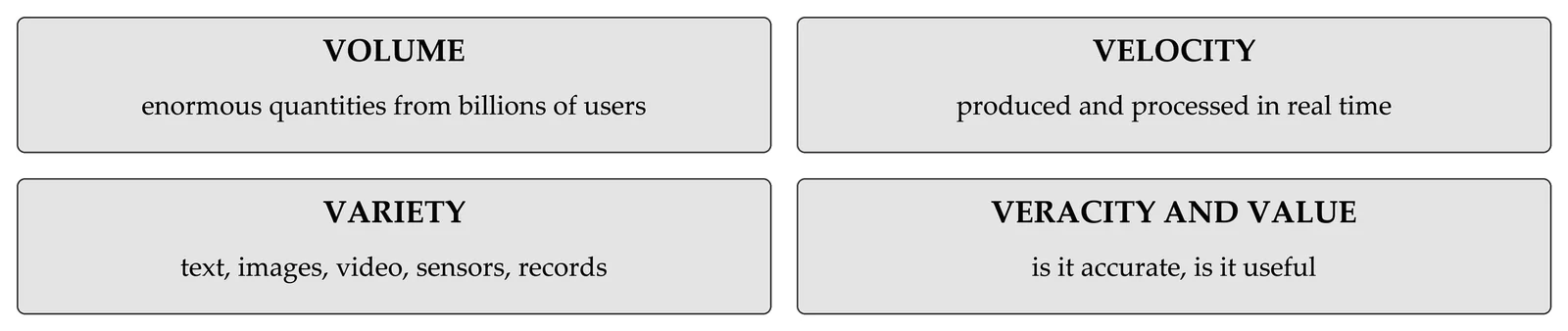
Dawn Holmes, in Big Data: A Very Short Introduction (2017), explains that big data refers to datasets so large and complex that traditional methods cannot handle them. The analyst Doug Laney (2001) described big data through three Vs: volume (enormous quantities of data), velocity (data produced and processed at high speed, often in real time) and variety (many forms, such as text, images, video, sensor readings and transactions). Later writers added veracity (uncertainty about accuracy) and value (the usefulness of insights). Sources include social media, mobile phones, online purchases, sensors and the internet of things, satellites and government records.
Uses of Big Data
- Business. Companies analyse customer data to target advertising, recommend products and set prices.
- Governance. Governments use data to target welfare, detect fraud, plan cities and monitor schemes through dashboards.
- Health. Data help track epidemics, as during Covid-19, and improve diagnosis and research.
- Science and social science. Researchers study mobility, opinion, networks and economic activity, for example using night-time satellite images to estimate development.
- Security. Intelligence agencies analyse communications and travel data, raising concerns about mass surveillance.
Datafication
Viktor Mayer-Schönberger and Kenneth Cukier, in Big Data (2013), used the term datafication for the process of turning aspects of life, such as location, friendships, moods and movements, into quantified data that can be tabulated and analysed. Datafication allows new insights, but it also changes how people are seen and treated, since decisions are increasingly made on the basis of data profiles. Shoshana Zuboff, in The Age of Surveillance Capitalism (2019), argued that technology companies treat human experience as raw material, extracting behavioural data to predict and influence what people do.
Limitations and Dangers
Holmes and others warn that big data has limits. Correlation is not causation: patterns in data do not explain why things happen. Data can be biased, representing some groups more than others; errors and missing data can mislead; and large datasets can create a false sense of objectivity. Big data also raises serious concerns about privacy, consent, security and the concentration of power in those who control data.
2.3 Lives of Data in India and the Politics of Data Protection
Mertia: Lives of Data
Sandeep Mertia, in his introduction to Lives of Data: Essays on Computational Cultures from India (2020), argues that data in India has a long and particular history, and that data are not just technical objects but have lives, shaped by institutions, practices and politics. The colonial state counted and classified Indians through censuses from 1872, the first synchronous one in 1881, which made caste and religion official categories and shaped identities. After independence, P.C. Mahalanobis and the Indian Statistical Institute (1931) made India a pioneer in statistics, with the National Sample Survey (1950) providing data for planning. In recent decades, computerisation, Aadhaar and digital public infrastructure have created vast new databases. Mertia shows that data is produced, contested and lived by people, from census enumerators and data entry workers to citizens whose welfare depends on databases.
Data and the Indian State
Data now shapes the relationship between citizen and state in India. Welfare depends on being correctly recorded in databases such as ration card and Aadhaar systems; errors can mean exclusion from food or pensions. Debates over the caste census, delays in the decennial census after 2021, and concerns about the quality of official statistics show that data is political: what is counted, how, and who decides affects recognition, resources and policy.
Sinha: The Politics of Data Protection
Amber Sinha, in The Politics of India’s Data Protection Ecosystem (2019), traced India’s path towards a data protection law. In Justice K.S. Puttaswamy v. Union of India (2017), a nine-judge bench held that privacy, including informational privacy, is a fundamental right. The Justice B.N. Srikrishna Committee (2018) proposed a draft law based on consent, purpose limitation and a strong regulator. The Personal Data Protection Bill, 2019, however, gave the government broad powers to exempt its own agencies. Sinha argued that India’s data protection debates were shaped by the competing interests of the state, which wanted access to data for governance and security, industry, which wanted freedom to use data, and citizens, whose privacy was at stake. He warned that a law with wide state exemptions would fail to protect citizens against state surveillance.
The Digital Personal Data Protection Act, 2023
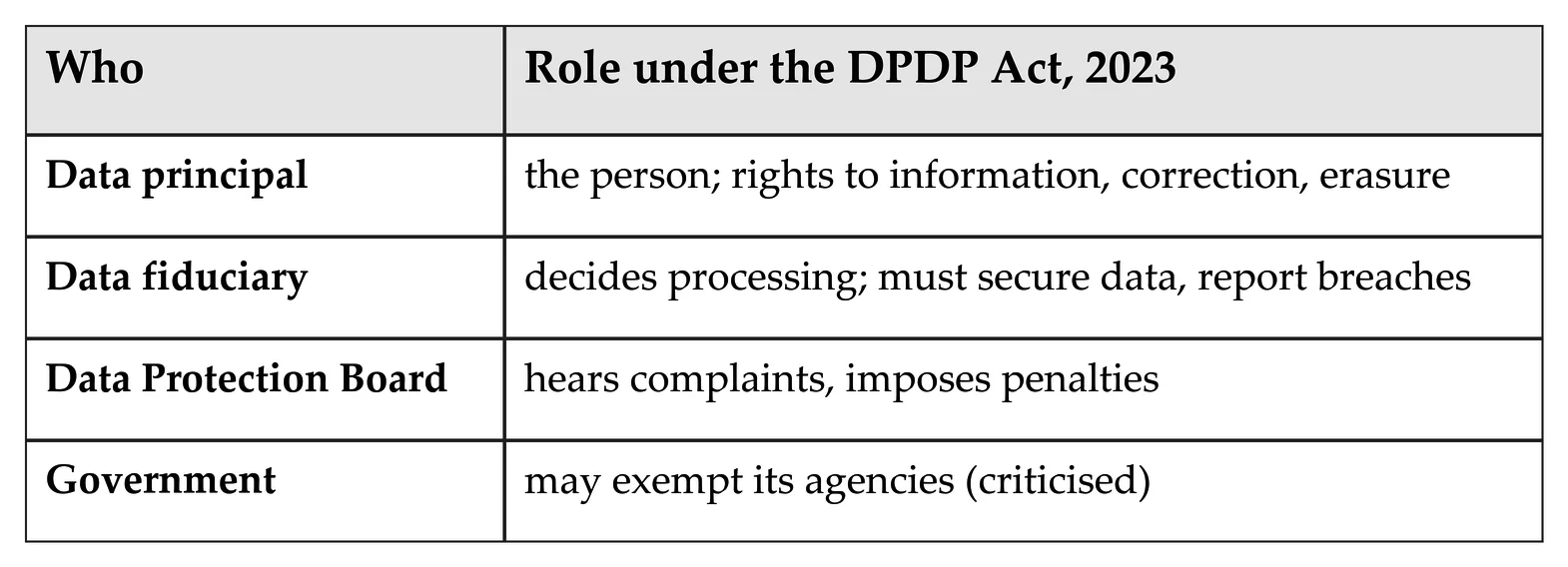
- Scope. It governs the processing of digital personal data by data fiduciaries (those who decide how data is processed).
- Consent. Data may be processed for lawful purposes with the consent of the data principal (the person to whom data relates), or for certain legitimate uses.
- Rights. Data principals have rights to information, correction and erasure, and grievance redressal.
- Duties of fiduciaries. Fiduciaries must ensure security, notify breaches and erase data when no longer needed.
- Regulator. A Data Protection Board of India adjudicates breaches and can impose large penalties.
- Criticism. Critics note broad exemptions for government agencies, the Board’s dependence on the executive, and an amendment to the RTI Act that widens the exemption for personal information, weakening transparency.

2.4 Important Questions
- Question 1 What is information? Discuss the relationship between information and society.
- Question 2 What is big data? Discuss its uses, limitations and the process of datafication.
- Question 3 Discuss the history and politics of data in India with reference to Sandeep Mertia’s Lives of Data.
- Question 4 Examine the politics of data protection in India with reference to the Digital Personal Data Protection Act, 2023.
DU asks the same idea in different words. So learn one broad answer for each question below; the same answer works for every question joined by OR.
Important Question 1
What is information? Discuss the relationship between information and society.
OR
Examine Michael Buckland’s understanding of information.
OR
Write a note on the information society.
Model Answer
“In the new, informational mode of development the source of productivity lies in the technology of knowledge generation, information processing, and symbol communication.”
— Manuel Castells, The Rise of the Network Society (1996)
Introduction. Information has become central to economy, politics and everyday life, giving rise to the idea of an information society. Yet the meaning of information is complex. Michael Buckland’s analysis of its different senses, and the theories of Machlup, Bell and Castells, help us understand how information shapes society and power.
1. A Complex Concept
Information is used in many ways, for facts, messages, knowledge and data, so clarity about its meaning is essential for studying its social role and its links with power and knowledge.
2. Information-as-Process
Buckland describes information-as-process as the act of informing or becoming informed, the change in what a person knows when they read a document or hear a message.

3. Information-as-Knowledge
Information-as-knowledge refers to what is communicated and understood, the knowledge that results from being informed, which exists in people’s minds.
4. Information-as-Thing
Information-as-thing refers to informative objects such as documents, books, data and images, which can be stored, retrieved and used as evidence in law, science and administration.
5. The Importance of Documents
Buckland stresses that societies rely on documents and records, such as birth certificates, land records and databases, to know, prove and govern, and that digital records now dominate.
6. Data to Wisdom
The hierarchy of data, information, knowledge and wisdom shows that raw data must be organised, interpreted and judged before it becomes useful knowledge.
7. Machlup’s Knowledge Industries
Fritz Machlup measured in 1962 the growing share of the American economy devoted to producing and distributing knowledge, such as education, research and media.
8. Bell’s Post-Industrial Society
Daniel Bell argued in 1973 that theoretical knowledge and services were replacing manufacturing at the centre of the economy and that professionals and experts were gaining importance.
9. Castells’s Network Society
Castells argued that in the informational mode of development, productivity comes from knowledge generation and information processing, organised through global networks.
10. Information and the State
States have always collected information to tax, conscript and govern. James Scott described how states make societies legible through maps, censuses and standard measures.
11. Information and the Market
Information has become a key commodity and source of profit, as technology companies build business models on collecting and analysing data about users.
12. Information Inequality
Access to information and the skills to use it are unequally distributed, creating divides between information-rich and information-poor groups and countries.
13. Information and Democracy
Free flow of information supports democratic debate and accountability, as recognised by the right to information, while control of information can be used to manipulate citizens.
14. The Science of Society
The social sciences grew with the collection of statistics in the nineteenth century, and digital information now offers new ways to study society scientifically.
15. India as an Information Society
India’s IT industry, digital public infrastructure and growing internet use make it an emerging information society, though large divides in access remain.
16. Misinformation and Society
The abundance of information has also produced information overload and misinformation, making it harder for people to distinguish reliable knowledge from rumour. The capacity to evaluate information is therefore as important as access to it in an information society.
17. Libraries and Archives
Libraries, archives and museums have long organised information for public use. Their digitisation, as in the National Digital Library of India and the Digital Library of India, extends access, while raising questions about preservation, selection and who decides what is kept.
18. Evaluation
Information is a social and political phenomenon, not only a technical one, and understanding its forms helps us analyse power in the digital age.
Conclusion. Thus, Buckland distinguishes information as process, knowledge and thing, stressing the role of documents and records. Theories of Machlup, Bell and Castells show the rise of an information society in which, as Castells says, productivity lies in knowledge and information processing, making information central to power.
Important Question 2
What is big data? Discuss its uses, limitations and the process of datafication.
OR
Explain the Vs of big data.
OR
Examine the social and political implications of datafication.
Model Answer
“To datafy a phenomenon is to put it in a quantified format so it can be tabulated and analyzed.”
— Viktor Mayer-Schönberger and Kenneth Cukier, Big Data (2013)
Introduction. The digital age produces data on an unprecedented scale. Big data, vast and complex datasets generated by digital activity, promises new insights for business, government and science. But it also raises questions about accuracy, bias, privacy and power, especially as more and more of life is turned into data through datafication.
1. Meaning of Big Data
Dawn Holmes explains that big data refers to datasets so large and complex that traditional methods of storage and analysis cannot handle them.
2. Volume
Big data involves enormous quantities of data, produced by billions of users, devices and transactions every day.
3. Velocity
Data is produced and processed at high speed, often in real time, as with financial transactions, social media posts and traffic sensors.
4. Variety
Big data comes in many forms, structured and unstructured, such as text, images, video, sensor readings and records.
5. Veracity and Value
Later writers added veracity, the uncertainty about the accuracy of data, and value, the usefulness of insights drawn from it.
6. Sources
Sources include social media, mobile phones, online purchases, the internet of things, satellites and government administrative records.
7. Business Uses
Companies analyse customer data to target advertising, recommend products and set prices, making data a key source of profit.
8. Governance Uses
Governments use data to target welfare, detect fraud, plan cities and monitor schemes, as in India’s dashboards for development programmes.
9. Health and Research
Data helped track the spread of Covid-19, and researchers use big data to study mobility, opinion and economic activity.
10. Datafication
Mayer-Schönberger and Cukier described datafication as putting phenomena into quantified form, turning location, friendships and behaviour into analysable data.
11. Surveillance Capitalism
Shoshana Zuboff argued that technology companies extract behavioural data from human experience to predict and influence behaviour, a new form of capitalism.
12. Correlation and Causation
Big data reveals correlations but not causes, so conclusions drawn from patterns alone can mislead policy and research.
13. Bias
Data may over-represent some groups and under-represent others, such as those without smartphones, producing biased results and unfair decisions.
14. Privacy and Security
Collecting and combining vast amounts of personal data threatens privacy and creates risks of breaches and misuse.
15. Concentration of Power
Control over data gives great power to large corporations and governments, raising concerns about accountability and competition.
16. Big Data in Elections
Political parties use voter data, social media analytics and targeted messaging in campaigns. The Cambridge Analytica scandal of 2018 showed how harvested personal data could be used for political profiling, raising concerns about manipulation of voters.
17. Algorithmic Decisions
Big data increasingly feeds automated decisions on credit, insurance, hiring and welfare eligibility. When such decisions are opaque, people may be denied opportunities without knowing why or being able to challenge the decision.
18. Data Ownership
Debates continue over who owns data generated by users: the individual, the platform or society. Some propose treating data as a collective resource, managed through data trusts or cooperatives, so that its benefits are shared more widely.
19. Evaluation
Big data offers powerful tools for understanding and governing society, but it must be used with attention to its limits and its effects on rights and power.
Conclusion. Thus, big data, defined by volume, velocity, variety, veracity and value, has wide uses in business, governance, health and research. Datafication, as Mayer-Schönberger and Cukier describe, turns life into quantified data, but bias, privacy and the concentration of power show the need for critical and regulated use.
Important Question 3
Discuss the history and politics of data in India with reference to Sandeep Mertia’s Lives of Data.
OR
Examine the role of statistics and data in the Indian state.
OR
Data is political. Discuss with reference to India.
Model Answer
“I began to see legibility as a central problem in statecraft.”
— James C. Scott, Seeing like a State (1998)
Introduction. Data in India has a long history, from colonial censuses to post-independence planning statistics and today’s digital databases. Sandeep Mertia’s Lives of Data argues that data is not merely technical but has lives shaped by institutions, practices and politics. Understanding this history shows that what is counted and how it is counted are political questions.
1. States and Legibility
James Scott argued that states make societies legible through maps, censuses and standard measures, so that they can tax, plan and control populations.
2. Mertia’s Argument
Mertia argues that data in India has particular histories and lives, produced, used and contested by institutions, workers and citizens.
3. The Colonial Census
The colonial state conducted censuses from 1872, the first synchronous one in 1881, classifying Indians by caste, religion and occupation.
4. Census and Identity
By making caste and religion official categories, the census shaped identities and politics, as groups mobilised to claim higher status or recognition.
5. Mahalanobis and the ISI
P.C. Mahalanobis founded the Indian Statistical Institute in 1931 and made India a pioneer in sample surveys and statistical planning.
6. Statistics for Planning
The National Sample Survey, begun in 1950, and the Central Statistical Organisation provided data for the Five-Year Plans and policy.
7. Computerisation
From the 1970s, the National Informatics Centre and later e-governance projects computerised government records, creating digital databases.
8. Aadhaar and Digital Infrastructure
Aadhaar, begun in 2009, and digital public infrastructure created vast databases linking identity, bank accounts and welfare.
9. Data as Lived
Mertia stresses that data is lived by census enumerators, data entry workers and citizens whose access to welfare depends on correct records.
10. Exclusion through Data Errors
Errors in databases, such as mismatches in names or failed authentication, have excluded people from rations and pensions, showing data’s real effects.
11. The Caste Census Debate
Debates over enumerating caste in the census, last done fully in 1931, show how counting shapes recognition, reservation and resources.
12. Census Delays
The decennial census due in 2021 was postponed, raising concerns about the use of outdated data for policy and welfare allocation.
13. Quality of Official Statistics
Controversies over GDP estimates and withheld survey reports have raised concerns about the independence and credibility of official statistics.
14. Data and Federalism
Data collected by the Union and states shape the allocation of funds, making data a subject of political bargaining in a federal system.
15. Data and Democracy
Open, reliable and independent data is essential for democratic accountability, as citizens and researchers use it to evaluate governments.
16. Data Workers
Behind digital databases are millions of data workers, census enumerators, anganwadi workers entering records, and data entry operators, often poorly paid. Mertia’s idea of the lives of data draws attention to their labour and to the pressures they face to meet targets.
17. Open Government Data
India’s Open Government Data Platform (data.gov.in), launched under the National Data Sharing and Accessibility Policy of 2012, makes many government datasets public, allowing researchers and citizens to analyse public policy.
18. Caste Surveys by States
Bihar’s caste survey, whose results were released in 2023, showed that states can collect caste data on their own, reviving national debates on caste enumeration and its implications for reservation and welfare.
19. Evaluation
The history of data in India shows that counting is never neutral; it shapes identities, policies and the relationship between citizen and state.
Conclusion. Thus, from colonial censuses to Mahalanobis’s statistics and Aadhaar, data in India has had lives shaped by power, as Mertia shows. As Scott’s idea of legibility suggests, what the state counts and how it counts are political choices with real effects on citizens.
Important Question 4
Examine the politics of data protection in India with reference to the Digital Personal Data Protection Act, 2023.
OR
Discuss Amber Sinha’s analysis of India’s data protection ecosystem.
OR
What is informational privacy? Discuss its significance.
Model Answer
“Informational privacy is a facet of the right to privacy.”
— Supreme Court of India, Justice K.S. Puttaswamy v. Union of India (2017)
Introduction. As more of life becomes data, the protection of personal data has become a major political issue. India’s path to a data protection law began with the Supreme Court’s recognition of privacy as a fundamental right in 2017 and culminated in the Digital Personal Data Protection Act, 2023. Amber Sinha shows that this path was shaped by the competing interests of the state, industry and citizens.
1. Why Data Protection Matters
Personal data reveals people’s identities, movements, health, finances and opinions, so its misuse can lead to discrimination, fraud, manipulation and surveillance.
2. The Puttaswamy Judgment
In 2017, a nine-judge bench held that privacy is a fundamental right under Article 21, and that informational privacy is a facet of it.
3. The Srikrishna Committee
The Justice B.N. Srikrishna Committee of 2018 proposed a draft law based on consent, purpose limitation, data minimisation and a strong, independent regulator.
4. The 2019 Bill
The Personal Data Protection Bill, 2019 gave the government broad powers to exempt its agencies and was withdrawn in 2022 after a joint committee proposed many changes.
5. Sinha’s Analysis
Amber Sinha argued that India’s data protection debates were shaped by competing interests of the state, industry and citizens.
6. The State’s Interest
The state seeks access to data for welfare, governance and security, and resists strict limits on its own collection and use of data.
7. Industry’s Interest
Industry seeks freedom to collect and use data for business and innovation, and opposes costly compliance and data localisation rules.
8. Citizens’ Interest
Citizens need protection of their privacy against both corporate exploitation and state surveillance, but their voice was weaker in the policy process.
9. The DPDP Act, 2023
The Act governs processing of digital personal data by data fiduciaries, based mainly on the consent of data principals.
10. Rights of Data Principals
Data principals have rights to information about processing, correction and erasure of data, and grievance redressal.
11. Duties of Data Fiduciaries
Fiduciaries must secure data, notify breaches and erase data when no longer needed, with special care for children’s data.
12. The Data Protection Board
The Data Protection Board of India adjudicates breaches and can impose large penalties, though critics question its independence from the executive.
13. State Exemptions
The Act allows the government to exempt its agencies on grounds such as security and public order, which critics say weakens protection against surveillance.
14. RTI Amendment
The Act amended the RTI Act to widen the exemption for personal information, which transparency activists say may weaken accountability.
15. Implementation
The Act and its rules are being brought into force in phases, and their effectiveness will depend on enforcement and public awareness.
16. The European Model
The European Union’s General Data Protection Regulation (2018) set a global standard, with strong rights for individuals, strict limits on processing and an independent regulator. Indian critics compare the DPDP Act unfavourably with it on the independence of the regulator and exemptions for the state.
17. Children’s Data
The DPDP Act requires verifiable parental consent for processing the data of children below eighteen and bars tracking and targeted advertising directed at children, reflecting concern about the vulnerability of young users online.
18. Evaluation
The DPDP Act is an important step in protecting personal data, but wide state exemptions show the unresolved tension between privacy and state power.
Conclusion. Thus, after Puttaswamy recognised informational privacy as a facet of the right to privacy, India moved through the Srikrishna draft and the 2019 Bill to the DPDP Act, 2023. Sinha shows that competing interests shaped this path, and wide state exemptions remain the Act’s most criticised feature.
Short Notes
(a) Datafication
The process of turning aspects of life, such as location, relationships and behaviour, into quantified data that can be analysed and used for decisions.
(b) Information-as-thing
Michael Buckland’s term for informative objects such as documents, records and data, which can be stored, retrieved and used as evidence.
(c) Data fiduciary
Under the DPDP Act, 2023, the person or organisation that decides the purpose and means of processing personal data and is responsible for protecting it.
More notes: GE-10 Digital Social Sciences
These notes are prepared by PADHO TO AISE for study help. They are not an official publication.