
Generic Electives (GE) GE-10 Digital Social Sciences
Unit III · 21 min read · Updated 27 Nov 2026
As per the University of Delhi (DU) Generic Elective (GE) syllabus offered by the Department of Political Science
Contents
- 3.1 What Biometrics Are and How They Work
- Types of Biometrics
- How Recognition Works
- Errors and Limits
- A Colonial History
- 3.2 The Body, Surveillance and Biological Citizenship
- Nayar: I Sing the Body Biometric
- Biological Citizenship
- Surveillance and Biopower
- Benefits Claimed
- 3.3 Aadhaar as a Platform and the Debates around It
- The Aadhaar Project
- Singh: Platform over Troubled Waters
- The Supreme Court Judgment, 2018
- Exclusion and Privacy
- 3.4 Important Questions
- What are biometrics? Explain how biometric identification works and discuss its limitations.
- Discuss Pramod Nayar’s argument on biometrics, surveillance and biological citizenship.
- Examine Aadhaar as a platform. Discuss the Supreme Court’s judgment on Aadhaar.
- Discuss the debates on privacy, exclusion and surveillance in biometric identification in India.
- Short Notes
संवैधानिक गारंटियाँ प्रौद्योगिकी के उतार-चढ़ाव के अधीन नहीं की जा सकतीं।
Constitutional guarantees cannot be subject to the vicissitudes of technology.
— Justice D.Y. Chandrachud, Puttaswamy (Aadhaar), dissent (2018)
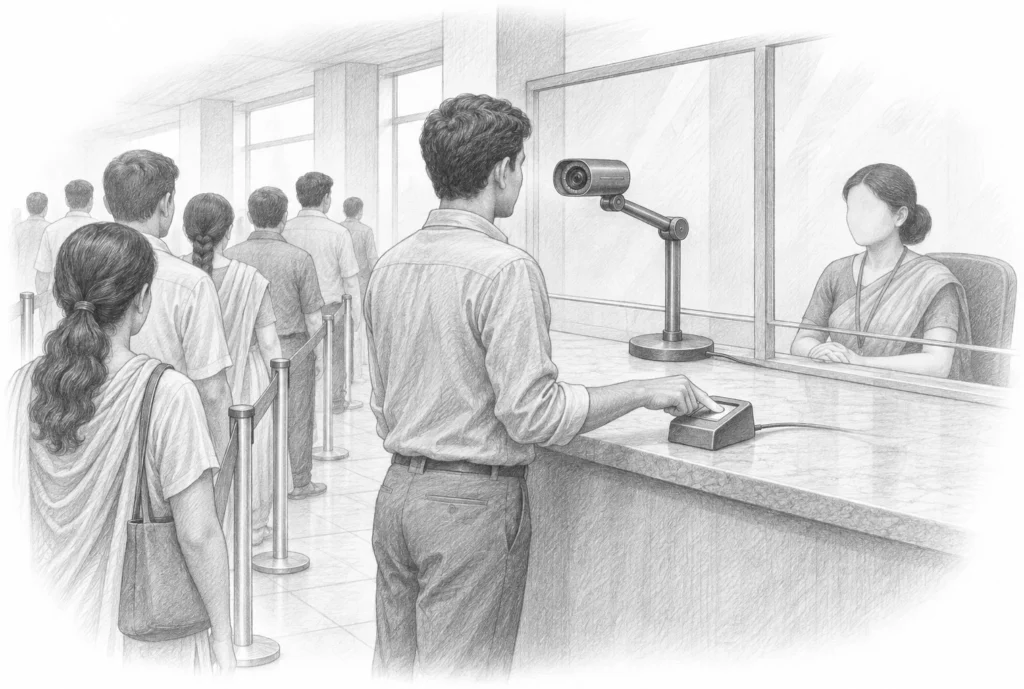
TTHE human body has become a password. We unlock phones with our faces, mark attendance with fingerprints and draw rations after scanning our irises. Biometrics, the automated recognition of people by their physical and behavioural characteristics, now underpins identity systems across the world, including India’s Aadhaar, the largest biometric identity programme ever built. This chapter explains how biometrics work and their history, the idea of biological citizenship and surveillance, and Aadhaar as a platform, along with the debates on privacy, exclusion and the Supreme Court’s judgment of 2018.

3.1 What Biometrics Are and How They Work
Michael Fairhurst, in Biometrics: A Very Short Introduction (2018), explains that biometrics is the automated recognition of individuals based on their biological and behavioural characteristics. Unlike passwords or cards, which can be forgotten or stolen, biometric traits are part of the person, so they are seen as a reliable way to establish identity. But they also cannot be changed if compromised, which creates special risks.
Types of Biometrics
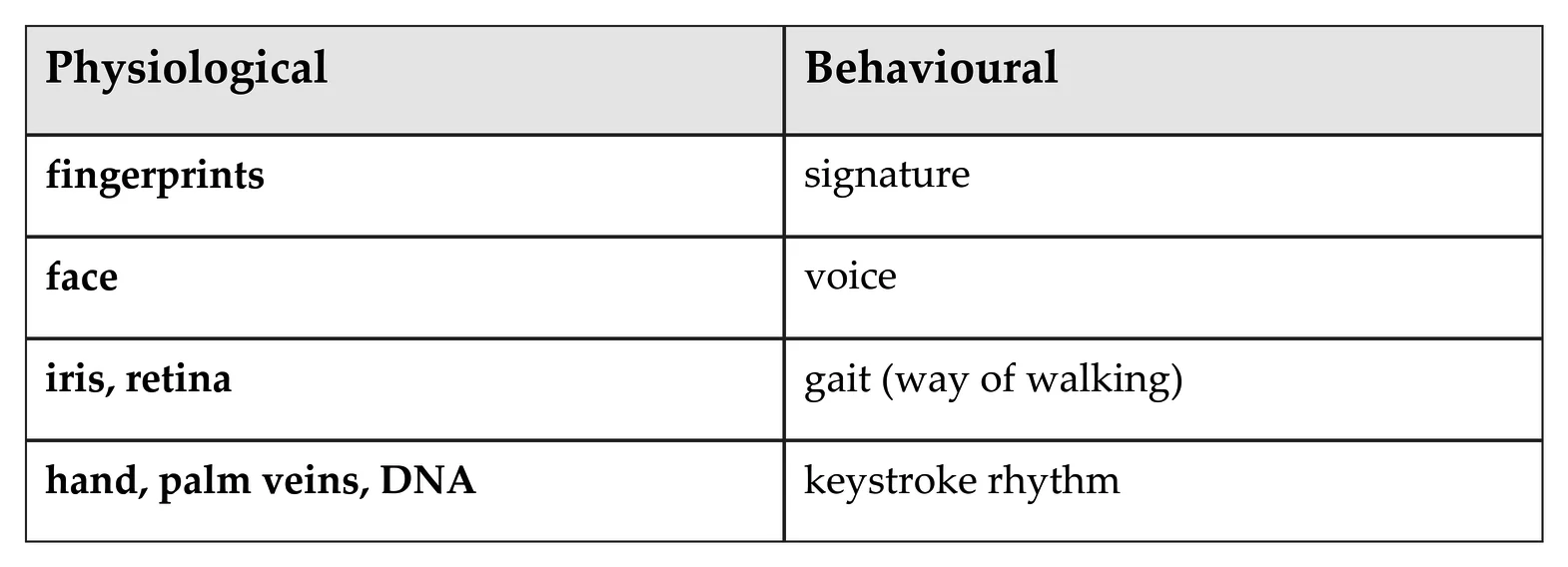
- Physiological biometrics are based on the body: fingerprints, face, iris, retina, hand geometry, palm veins and DNA.
- Behavioural biometrics are based on how people act: signature, voice, gait (way of walking) and keystroke patterns.
- Multimodal systems combine several traits, as Aadhaar uses fingerprints, iris scans and a photograph, to improve accuracy.
How Recognition Works
- Enrolment. The person’s trait is captured by a sensor, such as a fingerprint scanner or camera.
- Template creation. Software extracts key features and stores them as a digital template, not usually as the raw image.
- Matching. Later, a new sample is captured and compared with the stored template.
- Decision. If the match score passes a threshold, the person is accepted. Verification (one-to-one) checks whether a person is who they claim to be, while identification (one-to-many) searches a database to find who a person is.
Errors and Limits
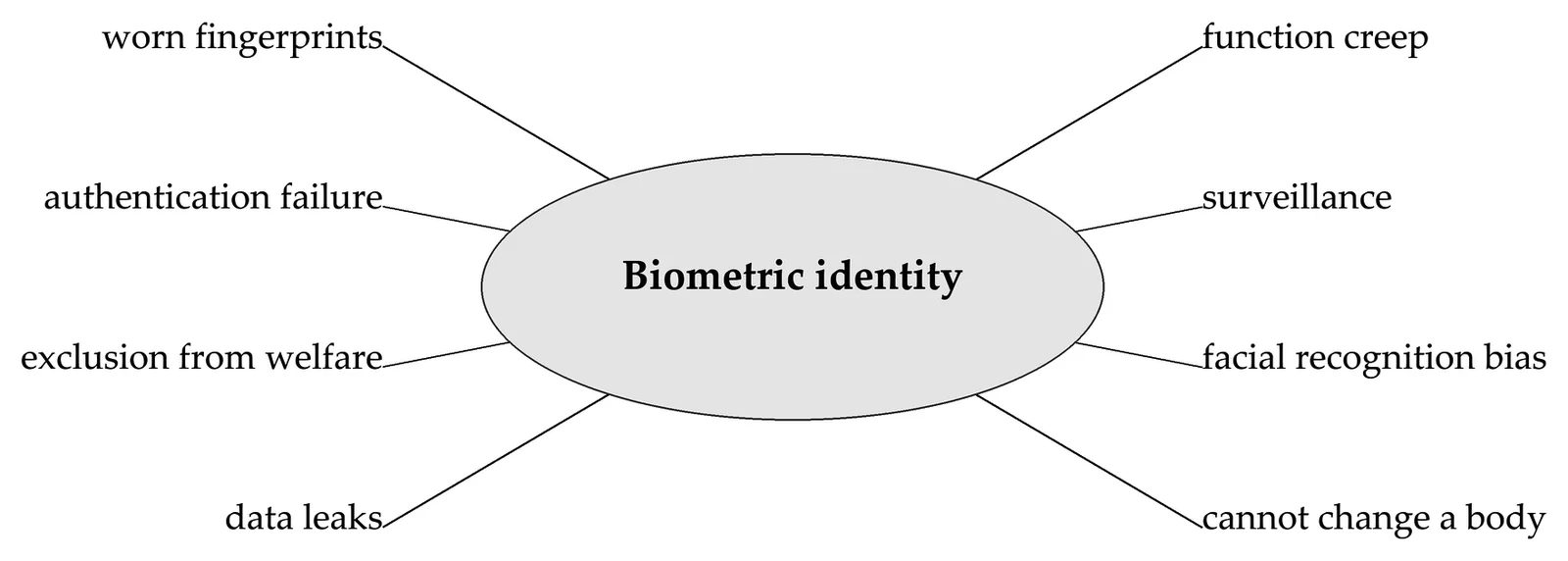
No biometric system is perfect. A false acceptance wrongly accepts an impostor, while a false rejection wrongly rejects a genuine person. Setting the threshold involves a trade-off between security and convenience. Fingerprints of manual labourers and the elderly may be worn and hard to read; faces change with age; and systems can be spoofed with fake fingers or photographs. Studies have found that some facial recognition systems are less accurate for women and darker-skinned people, raising concerns about bias.
A Colonial History
Biometric identification has deep roots in colonial India. William Herschel, a British official in Bengal, used fingerprints on contracts from 1858. Alphonse Bertillon in France developed a system of body measurements in the 1880s, and Francis Galton published Finger Prints in 1892. In Bengal, Azizul Haque and Hem Chandra Bose, working under Edward Henry, developed the fingerprint classification system that became known as the Henry system, and the world’s first fingerprint bureau was set up in Calcutta in 1897. The colonial state used fingerprints to control populations it regarded as untrustworthy, a history that informs critical views of biometrics today.
3.2 The Body, Surveillance and Biological Citizenship
Nayar: I Sing the Body Biometric
Pramod K. Nayar, in I Sing the Body Biometric: Surveillance and Biological Citizenship (2012), argues that biometric identity systems such as India’s UID transform the relationship between the body, identity and the state. In biometric regimes, the body becomes data: identity is no longer what a person says or the documents they carry, but what their fingerprints and irises reveal to a machine. The body is read, recorded and stored in databases, and citizenship comes to depend on the body’s data.
Biological Citizenship
The idea of biological citizenship, developed by scholars such as Adriana Petryna, Nikolas Rose and Carlos Novas, refers to forms of citizenship based on biological characteristics, in which people make claims on the state as biological beings and the state governs them through their bodies. Nayar argues that biometric identity creates a form of biological citizenship: access to rights, services and welfare depends on the body’s ability to be recognised by machines. Those whose bodies do not fit, because of worn fingerprints, disability or age, risk being excluded.
Surveillance and Biopower
Michel Foucault described biopower, the modern state’s power over life, exercised through the management of populations’ health, births and bodies. Biometric databases extend this power by making individuals permanently identifiable and traceable across services. Critics fear function creep, in which data collected for one purpose, such as welfare, is used for others, such as policing or profiling, and the creation of a surveillance state in which citizens’ movements and transactions can be tracked. David Lyon has described such systems as part of a growing surveillance society.
Benefits Claimed
Supporters argue that biometric identity gives millions of people, especially the poor who lacked documents, a recognised identity for the first time; reduces fraud and duplicate beneficiaries in welfare; enables direct benefit transfers and financial inclusion; and makes services more convenient. The tension between these benefits and the risks of exclusion and surveillance lies at the heart of debates on biometrics.
3.3 Aadhaar as a Platform and the Debates around It
The Aadhaar Project
The Unique Identification Authority of India (UIDAI) was set up in 2009 under the chairmanship of Nandan Nilekani, and the first Aadhaar numbers were issued in September 2010. Aadhaar is a twelve-digit number linked to a person’s demographic data (name, date of birth, gender, address) and biometric data (ten fingerprints, both irises and a photograph). Over 130 crore Aadhaar numbers have been generated. The Aadhaar Act, 2016 gave it statutory backing, passed as a money bill.
Singh: Platform over Troubled Waters
P. Singh, in Aadhaar: Platform over Troubled Waters (2020), analyses Aadhaar as a platform rather than just an identity card. Through application programming interfaces (APIs), Aadhaar provides authentication and electronic know-your-customer (e-KYC) services that other government departments and private companies can build upon. It forms the identity layer of India Stack, on which UPI payments, DigiLocker documents and consent-based data sharing are built. Singh shows how Aadhaar reflects the logic of platform capitalism, in which the state builds digital infrastructure that private firms use to expand markets, while the platform gathers data and shapes how citizens interact with state and market. He also shows the troubled waters it has faced: legal challenges, concerns about privacy and exclusion, and debates over private use.
The Supreme Court Judgment, 2018
- Upheld. A five-judge bench, by a majority of four to one, upheld the Aadhaar Act and its use for welfare benefits and subsidies under Section 7, and the linking of Aadhaar with PAN for income tax.
- Struck down. It struck down Section 57, which had allowed private companies to use Aadhaar for authentication, and ruled out mandatory linking with bank accounts and mobile numbers, and its requirement for school admission.
- Safeguards. It limited the retention of authentication records and required that no one be denied benefits for authentication failure.
- Dissent. Justice D.Y. Chandrachud dissented, holding that passing the Act as a money bill was a fraud on the Constitution and that Aadhaar enabled surveillance; he warned that constitutional guarantees cannot be subject to the vicissitudes of technology.
- After the judgment. The Aadhaar and Other Laws (Amendment) Act, 2019 allowed voluntary use of Aadhaar by banks and telecom companies.
Exclusion and Privacy
Field studies and reports documented exclusion when authentication failed because of worn fingerprints, poor connectivity or errors in records; deaths from hunger in Jharkhand in 2017 were linked by activists to denial of rations. Journalists reported data leaks and the sale of access to Aadhaar data. Supporters reply that Aadhaar has saved large sums by removing fake beneficiaries and has enabled financial inclusion. Newer biometric systems, such as facial recognition used by police and the DigiYatra airport system (2022), have extended these debates to public spaces.

3.4 Important Questions
- Question 1 What are biometrics? Explain how biometric identification works and discuss its limitations.
- Question 2 Discuss Pramod Nayar’s argument on biometrics, surveillance and biological citizenship.
- Question 3 Examine Aadhaar as a platform. Discuss the Supreme Court’s judgment on Aadhaar.
- Question 4 Discuss the debates on privacy, exclusion and surveillance in biometric identification in India.
DU asks the same idea in different words. So learn one broad answer for each question below; the same answer works for every question joined by OR.
Important Question 1
What are biometrics? Explain how biometric identification works and discuss its limitations.
OR
Distinguish between physiological and behavioural biometrics.
OR
Trace the history of biometric identification.
Model Answer
“Automated recognition of individuals based on their biological and behavioural characteristics.”
— ISO/IEC 2382-37, definition of biometrics
Introduction. Biometrics, the automated recognition of people by their physical and behavioural traits, has become a central technology of identification. It is used to unlock phones, control borders, record attendance and deliver welfare. Michael Fairhurst explains how biometrics work, while their history and limitations show why they are both powerful and controversial.
1. Definition
Biometrics is the automated recognition of individuals based on biological and behavioural characteristics, as defined by international standards and explained by Fairhurst.
2. Why Biometrics
Unlike passwords or cards, biometric traits are part of the person and cannot easily be forgotten or lent, so they are seen as reliable proof of identity.
3. Physiological Biometrics
Physiological biometrics use bodily features such as fingerprints, face, iris, retina, hand geometry, palm veins and DNA.
4. Behavioural Biometrics
Behavioural biometrics use patterns of action such as signature, voice, gait and keystroke rhythm, which are harder to measure consistently.
5. Multimodal Systems
Many systems combine several traits; Aadhaar uses fingerprints, iris scans and a photograph to improve accuracy and reduce duplication.
6. Enrolment and Templates
A sensor captures the trait, and software extracts key features to store a digital template that is used for later comparison.
7. Verification and Identification
Verification is a one-to-one check of a claimed identity, while identification is a one-to-many search of a database to find who a person is.
8. False Acceptance and Rejection
Systems make errors: false acceptance lets in impostors, while false rejection turns away genuine people, so thresholds involve a trade-off.
9. Worn and Changing Traits
Fingerprints of manual labourers and the elderly may be worn, and faces change with age, causing failures that fall hardest on the poor.
10. Spoofing and Security
Biometric systems can be spoofed with fake fingers or photographs, and stolen biometric data cannot be changed like a password.
11. Bias
Studies have found that some facial recognition systems are less accurate for women and darker-skinned people, raising concerns about discrimination.
12. Bertillon and Galton
Bertillon developed body measurements for identifying criminals in the 1880s, and Galton’s Finger Prints (1892) laid the scientific basis of fingerprinting.
13. Fingerprints in Colonial Bengal
Herschel used fingerprints on contracts in Bengal from 1858, and Azizul Haque and Hem Chandra Bose developed the Henry classification system, with the first bureau in Calcutta in 1897.
14. Colonial Control
The colonial state used fingerprints to control populations it distrusted, a history that informs critical views of biometric identification today.
15. Uses Today
Biometrics are used in passports, border control, banking, attendance, policing and welfare, as in India’s Aadhaar and DigiYatra systems.
16. DNA Profiling
DNA profiling is a powerful biometric used in criminal investigation and to identify disaster victims. India’s DNA Technology (Use and Application) Regulation Bill, introduced in 2019, was withdrawn in 2023 amid concerns about privacy and the creation of DNA databanks.
17. Biometrics in Everyday Life
Fingerprint and face unlocking on smartphones, biometric attendance in offices and schools, and biometric passports have made biometrics part of everyday life, often without users reflecting on how their data is stored and used.
18. Evaluation
Biometrics offer convenience and security, but their errors, biases and risks require safeguards so that technology does not exclude or oppress.
Conclusion. Thus, biometrics is the automated recognition of individuals by physiological and behavioural traits, working through enrolment, templates and matching. Its colonial origins in Bengal, its errors, spoofing and bias show that biometric identification must be used with care and accountability.
Important Question 2
Discuss Pramod Nayar’s argument on biometrics, surveillance and biological citizenship.
OR
What is biological citizenship? How does biometric identity transform citizenship?
OR
Examine the relationship between biometrics and surveillance.
Model Answer
“An explosion of numerous and diverse techniques for achieving the subjugation of bodies and the control of populations, marking the beginning of an era of bio-power.”
— Michel Foucault, The History of Sexuality, Volume 1 (1976)
Introduction. Biometric identity systems change not only how people are identified but how they relate to the state. Pramod Nayar argues that in biometric regimes the body becomes data and citizenship comes to depend on the body’s ability to be read by machines. Drawing on ideas of biological citizenship and biopower, his analysis highlights the risks of surveillance and exclusion.
1. Nayar’s Title
Nayar’s essay title, I Sing the Body Biometric, echoes Walt Whitman’s poem I Sing the Body Electric, suggesting a new relationship between the body and technology.
2. The Body as Data
In biometric regimes, identity is no longer what a person says or carries, but what fingerprints and irises reveal to a machine and a database.
3. Recorded and Stored Bodies
The body is read, recorded and stored, making individuals permanently identifiable across services and over time.
4. Biological Citizenship
Petryna, Rose and Novas describe biological citizenship as citizenship based on biological characteristics, through which people make claims and states govern.
5. Citizenship through the Body
Nayar argues that biometric identity creates a form of biological citizenship, where access to rights and welfare depends on biometric recognition.
6. Exclusion of Bodies that Do Not Fit
People with worn fingerprints, disabilities or age-related changes risk exclusion, since their bodies cannot be reliably read by machines.
7. Foucault’s Biopower
Foucault described biopower as the state’s power over life, exercised through the management of bodies and populations, which biometric databases extend.
8. Surveillance
Biometric databases make it possible to track individuals across services, transactions and movements, creating the potential for surveillance.
9. Function Creep
Data collected for one purpose, such as welfare, may be used for others, such as policing or profiling, without people’s knowledge or consent.
10. Surveillance Society
David Lyon describes a surveillance society in which monitoring is built into everyday institutions, and biometric identity is a key part of this trend.
11. Power Imbalance
Biometric systems give the state and corporations detailed knowledge of individuals, while individuals know little about how their data is used.
12. Claimed Benefits
Supporters argue that biometric identity gives the undocumented poor a recognised identity, reduces fraud and enables welfare and financial inclusion.
13. Facial Recognition
Police use of facial recognition in public places extends biometric surveillance from welfare to everyday movement, raising concerns about protest and privacy.
14. Legal Safeguards
The Supreme Court’s privacy judgment of 2017 and the data protection law of 2023 offer some safeguards, though critics find them inadequate against state surveillance.
15. Resistance and Debate
Civil liberties groups, researchers and citizens have challenged biometric projects in courts and public debate, shaping their limits.
16. Consent and Choice
Biometric enrolment is often presented as voluntary, but when access to food, pensions or bank accounts requires it, people have little real choice. This raises the question whether consent given under such pressure is meaningful.
17. Biometrics and Migrants
Biometric systems are used widely at borders and for refugees, as when UN agencies register refugees with iris scans. Critics argue that the most vulnerable people are subjected to the most intensive biometric control.
18. Evaluation
Nayar’s analysis shows that biometrics transform citizenship and power, requiring democratic control over how bodies are recorded and used.
Conclusion. Thus, Nayar argues that biometric identity turns the body into data and creates a biological citizenship in which rights depend on machine recognition. Foucault’s biopower and the risks of function creep and surveillance show why biometric systems require strong democratic safeguards.
Important Question 3
Examine Aadhaar as a platform. Discuss the Supreme Court’s judgment on Aadhaar.
OR
Discuss P. Singh’s analysis of Aadhaar as a platform over troubled waters.
OR
Critically evaluate the Aadhaar project.
Model Answer
“It is better to be unique than the best.”
— Justice A.K. Sikri, Puttaswamy (Aadhaar) judgment (2018)
Introduction. Aadhaar, India’s biometric identity system, is the largest of its kind in the world. P. Singh argues that it is best understood as a platform on which government and private services are built, reflecting the logic of platform capitalism. Its legality and limits were decided by the Supreme Court in 2018 after years of litigation.
1. Origins
The UIDAI was set up in 2009 under Nandan Nilekani, and the first Aadhaar numbers were issued in September 2010 in Maharashtra.
2. Data Collected
Aadhaar links a twelve-digit number to demographic data and biometric data, including ten fingerprints, both irises and a photograph.
3. Scale
Over 130 crore Aadhaar numbers have been generated, covering almost the entire population, making it the largest biometric identity system in the world.
4. The Aadhaar Act, 2016
The Aadhaar Act of 2016 gave the project statutory backing, but its passage as a money bill bypassed the Rajya Sabha and was challenged.
5. Aadhaar as a Platform
Singh argues that Aadhaar provides authentication and e-KYC through APIs that other departments and companies build upon, making it a platform.
6. India Stack
Aadhaar is the identity layer of India Stack, on which UPI payments, DigiLocker and consent-based data sharing are built.
7. Platform Capitalism
Singh shows that the state builds digital infrastructure that private firms use to expand markets, while the platform gathers data and shapes interactions.
8. Troubled Waters
The platform faced legal challenges, privacy concerns, exclusion errors and debates over private use, which Singh calls troubled waters.
9. The Judgment
In September 2018, a five-judge bench, by four to one, upheld the Aadhaar Act and its use for welfare under Section 7 and linking with PAN.
10. Limits Imposed
The Court struck down Section 57 allowing private use and ruled out mandatory linking with bank accounts, mobile numbers and school admissions.
11. The Majority’s Reasoning
Justice Sikri’s majority opinion held that Aadhaar empowers the marginalised by giving them a unique identity, and that it is better to be unique than the best.
12. The Dissent
Justice Chandrachud held that the money bill route was a fraud on the Constitution and that Aadhaar enabled surveillance and exclusion.
13. The 2019 Amendment
The Aadhaar and Other Laws (Amendment) Act, 2019 allowed voluntary use of Aadhaar by banks and telecom companies, partly restoring private use.
14. Exclusion
Authentication failures and errors excluded some people from rations and pensions, and hunger deaths in Jharkhand in 2017 were linked to such exclusion.
15. Benefits Claimed
The government claims large savings from removing fake beneficiaries and credits Aadhaar with enabling direct transfers and financial inclusion.
16. Aadhaar Abroad
India promotes its digital public infrastructure, including the open-source identity platform model, to other countries, and several countries have adopted identity systems inspired by it, showing the global influence of the Aadhaar model.
17. Virtual ID and Masked Aadhaar
In response to privacy concerns, UIDAI introduced the Virtual ID and masked Aadhaar in 2018, allowing people to authenticate without sharing their full Aadhaar number, though critics argue these features are not widely used.
18. Aadhaar-Enabled Payment System
The Aadhaar-enabled payment system allows people to withdraw cash and check balances at banking correspondents using only their Aadhaar number and fingerprint, bringing banking to villages, though failed authentication and fraud using cloned fingerprints have been reported.
19. Evaluation
Aadhaar has transformed identity and welfare delivery in India, but its platform logic and exclusion risks require continuing safeguards.
Conclusion. Thus, Singh shows that Aadhaar is a platform at the heart of India Stack, reflecting platform capitalism and facing troubled waters. The Supreme Court in 2018 upheld it for welfare, declaring it better to be unique than the best, while limiting private use, though exclusion and privacy concerns persist.
Important Question 4
Discuss the debates on privacy, exclusion and surveillance in biometric identification in India.
OR
Do biometric identity systems empower or exclude the poor? Discuss.
OR
Examine the use of facial recognition technology in India.
Model Answer
“Constitutional guarantees cannot be subject to the vicissitudes of technology.”
— Justice D.Y. Chandrachud, Puttaswamy (Aadhaar), dissent (2018)
Introduction. Biometric identification in India, led by Aadhaar and extended by facial recognition, has been hailed as a tool of empowerment and criticised as a source of exclusion and surveillance. The debates involve fundamental rights to privacy and dignity, the right to food and welfare, and the balance between efficiency and liberty.
1. The Promise
Biometric identity promised to give every resident a recognised identity, reduce fraud and deliver welfare directly to the intended beneficiaries.
2. Identity for the Undocumented
Many poor people, migrants and the homeless lacked documents, and Aadhaar gave them a portable identity accepted across services.
3. Efficiency Gains
Supporters credit biometric authentication with removing duplicate and fake beneficiaries and enabling direct benefit transfers.
4. Exclusion Errors
Authentication failed for people with worn fingerprints, in areas with poor connectivity and where records had errors, denying them rations and pensions.
5. Hunger Deaths
Activists linked hunger deaths in Jharkhand in 2017 to the denial of rations to families whose cards were not linked to Aadhaar.
6. Supreme Court Safeguards
The Supreme Court in 2018 held that no one should be denied benefits because of authentication failure, requiring alternative means of identification.
7. The Right to Privacy
The nine-judge bench in Puttaswamy (2017) recognised privacy as a fundamental right, framing biometric debates in terms of constitutional rights.
8. Data Security
Reports of data leaks and unauthorised access raised concerns about the security of biometric and demographic data held in large databases.
9. Surveillance Risks
Linking Aadhaar to many services could allow tracking of individuals’ transactions and movements, creating the risk of a surveillance state.
10. Chandrachud’s Dissent
Justice Chandrachud warned that constitutional guarantees cannot depend on the vicissitudes of technology and that Aadhaar enabled surveillance.
11. Facial Recognition
Police in several states and cities use facial recognition, and the NCRB has developed a national system, raising concerns in the absence of specific legal safeguards.
12. DigiYatra
DigiYatra, launched in 2022, uses facial recognition at airports for convenience, but critics question data retention and consent.
13. Voter ID Linking
The Election Laws (Amendment) Act, 2021 allowed voluntary linking of voter ID with Aadhaar, raising concerns about wrongful deletion of voters.
14. Data Protection Law
The DPDP Act, 2023 offers some protections, but wide exemptions for government agencies limit its safeguards against state surveillance.
15. Balancing Rights
The challenge is to use biometrics for inclusion and efficiency while protecting privacy, preventing exclusion and ensuring accountability.
16. Global Debates on Facial Recognition
Several cities in the United States, beginning with San Francisco in 2019, banned police use of facial recognition, and the European Union’s AI Act of 2024 strictly limits real-time biometric identification in public spaces, showing growing caution worldwide.
17. Alternatives and Fallbacks
Researchers recommend offline alternatives, such as one-time passwords, nominee systems and manual verification, so that those who fail biometric authentication are not denied essential services.
18. Evaluation
Biometric identity can empower or exclude depending on design, safeguards and accountability, so it must remain subject to constitutional rights.
Conclusion. Thus, biometric identification in India has given identity to many and improved welfare delivery, but has also caused exclusion, privacy risks and fears of surveillance, extended by facial recognition. As Justice Chandrachud warned, constitutional guarantees cannot be subject to the vicissitudes of technology.
Short Notes
(a) Biological citizenship
A form of citizenship based on biological characteristics, in which access to rights and services depends on the body and its data.
(b) Function creep
The use of data or technology for purposes beyond those for which it was originally collected, such as using welfare data for policing.
(c) India Stack
A set of digital public infrastructure layers built on Aadhaar, including UPI payments, DigiLocker and consent-based data sharing.
(d) Henry system
The fingerprint classification system developed in Bengal in the 1890s by Azizul Haque and Hem Chandra Bose under Edward Henry, which became the basis of fingerprint identification across the world.
More notes: GE-10 Digital Social Sciences
These notes are prepared by PADHO TO AISE for study help. They are not an official publication.