
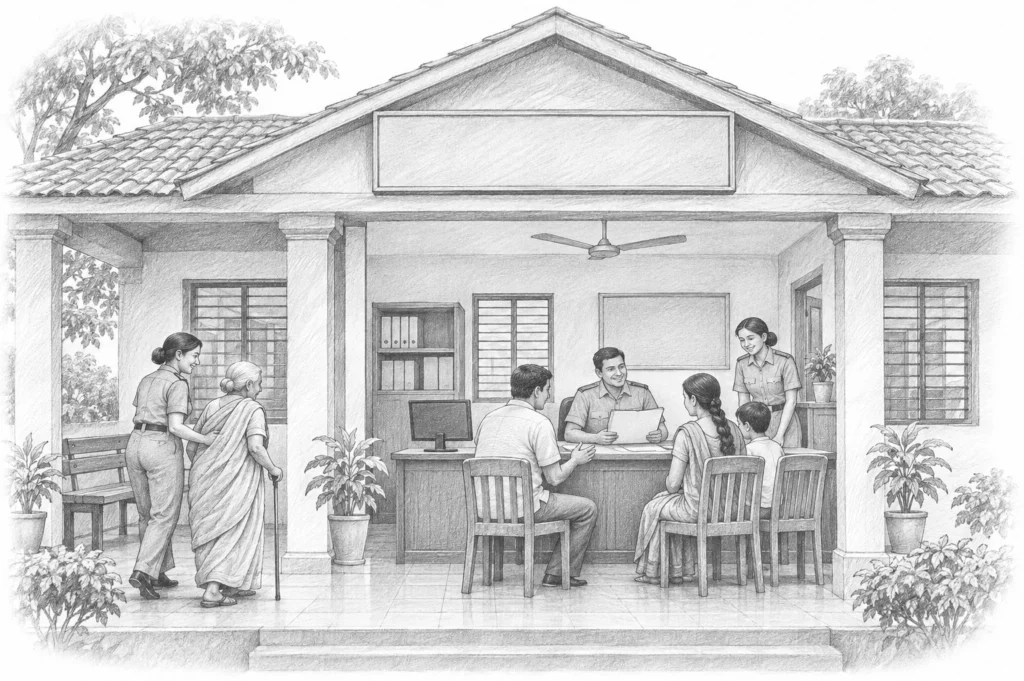
Semester IV MDSC-4B Public Institutions in India
Unit IV · 19 min read · Updated 24 Nov 2026
As per the University of Delhi (DU) BA (Hons) Political Science syllabus
Contents
- 4.1 The Police in a Democracy
- 4.2 Organisation of the Police in India
- 4.3 Problems of Policing
- 4.4 Police Reforms
- 4.5 Important Questions
- Discuss the role and organisation of the police in India. How has its colonial legacy shaped policing?
- Examine the major problems of policing in India.
- Critically examine the efforts at police reform in India.
- Short Notes
पुलिस ही जनता है और जनता ही पुलिस है।
The police are the public and the public are the police.
— Principles of policing associated with Sir Robert Peel, London (1829)
FOR most citizens, the police are the most visible face of the state. A family reporting a theft, a woman seeking protection, a shopkeeper facing threats and a protester on the street all encounter the police. In a democracy the police are meant to protect life, liberty and property, maintain order and uphold the law impartially. Yet in India the police are often feared rather than trusted, accused of corruption, custodial violence and political bias. This unit studies the organisation and role of the police, their colonial legacy, the problems analysed by Arvind Verma, R.K. Raghavan and Beatrice Jauregui, and the long story of police reform.
4.1 The Police in a Democracy
The police are the civil force of the state responsible for maintaining public order, preventing and investigating crime, enforcing laws and protecting the life, liberty and property of citizens. Max Weber defined the state by its monopoly of legitimate force, and the police are the main agency that exercises this force in everyday life. In a democracy, police power must be used according to law, impartially and with respect for rights, and the police must be accountable to citizens through the law, courts and elected institutions.
The principles of policing associated with Sir Robert Peel, who created London’s Metropolitan Police in 1829, held that the police depend on public approval and cooperation and should use force only as a last resort; hence the idea that the police are the public and the public are the police. R.K. Raghavan, a former director of the CBI, argues that a democratic polity expects the police to be impartial, professional, sensitive to the weak and accountable, rather than an instrument of the ruling party.
4.2 Organisation of the Police in India
- Constitutional position: police and public order are state subjects (entries 1 and 2 of the State List), so each state has its own police force, headed by a Director General of Police.
- Structure: states are divided into zones, ranges and districts; the Superintendent of Police heads the district police, and the police station, under a Station House Officer, is the basic unit. Large cities use a commissionerate system. The constabulary forms the great majority of the force.
- Union role: the Indian Police Service, an All India Service, provides senior officers; the Union has the Central Armed Police Forces such as the CRPF, BSF and CISF, and agencies such as the CBI, the Intelligence Bureau and the National Investigation Agency (2008).
- Colonial legacy: the Police Act of 1861, passed after the revolt of 1857, created a force designed to control the population and protect British rule, not to serve citizens. Arvind Verma argues that this colonial character, with its emphasis on control, hierarchy and loyalty to rulers, survived independence.
- Capacity: India has one of the lowest police-population ratios among major countries, around 150 police personnel per lakh people in practice, with many vacancies and only about one in eight personnel women.

4.3 Problems of Policing
- Politicisation: politicians control transfers and postings, so officers may serve the ruling party; Raghavan describes this as the central obstacle to professional policing.
- Coercion and custodial violence: Verma, in ‘Police Agencies and Coercive Power’ (2007), shows how the police use torture, illegal detention and fake encounters, especially against the poor, Dalits, Adivasis and minorities, and how special laws expand coercive powers.
- Corruption: petty bribery at police stations and collusion with criminals undermine public trust.
- Poor conditions: long working hours, inadequate housing, low pay for constables, weak training and outdated equipment.
- Weak investigation: lack of forensic capacity and separation of investigation from law-and-order duties lead to low conviction rates.
- Bias: commissions of inquiry into riots have documented partiality towards particular communities, and women often face hostility when reporting crimes.
Beatrice Jauregui, in Provisional Authority (2016), an ethnographic study of policing in Uttar Pradesh, shows that police authority in India is provisional: officers are constantly pulled by demands from politicians, superiors, influential citizens and the public, and must improvise, using jugaad, to get things done. The police are at once feared and needed; they are blamed for abuses yet are themselves overworked and vulnerable. Her study shows that police behaviour must be understood in the context of these social and political pressures, not only individual misconduct.
4.4 Police Reforms
The National Police Commission (1977–81) recommended a State Security Commission to insulate the police from political interference, a fixed tenure for the DGP, separation of investigation from law and order, and a new Police Act. Later bodies, including the Ribeiro Committee (1998), the Padmanabhaiah Committee (2000), the Malimath Committee (2003) on criminal justice and the Soli Sorabjee Committee, which drafted a Model Police Act (2006), made similar proposals. The Second Administrative Reforms Commission, in its fifth report Public Order (2007), called for repealing the 1861 Act, separating investigation, creating complaints authorities, strengthening community policing and improving the working conditions of the constabulary.
In Prakash Singh v. Union of India (2006), a case filed by a former DGP, the Supreme Court issued seven directives: State Security Commissions; transparent selection and a minimum two-year tenure for the DGP; minimum tenure for other key officers; separation of investigation from law and order; Police Establishment Boards for transfers; Police Complaints Authorities at state and district levels; and a National Security Commission for central forces. Most states have complied only partially. Other initiatives include community policing such as Kerala’s Janamaithri Suraksha (2008), the Crime and Criminal Tracking Network and Systems, women’s help desks and the new criminal laws of 2024.
4.5 Important Questions
- Question 1 Discuss the role and organisation of the police in India. How has its colonial legacy shaped policing?
- Question 2 Examine the major problems of policing in India.
- Question 3 Critically examine the efforts at police reform in India.
DU asks the same idea in different words. So learn one broad answer for each question below; the same answer works for every question joined by OR.
Important Question 1
Discuss the role and organisation of the police in India. How has its colonial legacy shaped policing?
OR
Examine the structure of the police system in India.
OR
‘The Indian police remain a colonial institution in a democratic state.’ Discuss.
Model Answer
“No person shall be deprived of his life or personal liberty except according to procedure established by law.”
— Article 21, Constitution of India
Introduction. The police are the institution through which the state exercises its coercive power in everyday life. In India they are responsible for maintaining order and enforcing the law among more than a billion people. Their organisation reflects both the federal Constitution and a colonial legacy that has shaped their culture and their relationship with citizens.
1. Role of the Police
The police maintain public order, prevent crime, investigate offences and bring offenders to justice, protect life, liberty and property, regulate traffic, gather intelligence and respond to emergencies. In a democracy they must also protect citizens’ rights, including the right to protest peacefully, and treat all citizens equally regardless of caste, religion, gender or class. They also perform many service functions, such as helping accident victims, finding missing children and managing crowds at festivals and elections.
2. Constitutional Position
Under the Seventh Schedule, police and public order are state subjects, so each state organises and controls its own police force. The Union can deploy central forces to assist states and has its own agencies. This division means that police reform depends largely on state governments, which explains the uneven implementation of reforms.
3. State Police Organisation
Each state police force is headed by a Director General of Police, assisted by Additional DGPs, Inspectors General and Deputy Inspectors General in charge of zones and ranges. The district is under a Superintendent of Police, and the police station, under a Station House Officer, is where citizens register complaints. Metropolitan cities use a commissionerate system that combines policing and some magisterial powers.
4. Union Police Organisations
The Indian Police Service provides senior officers to the states and Union. The Central Armed Police Forces, including the CRPF, BSF, CISF, ITBP and SSB, guard borders, protect installations and assist states in maintaining order. The CBI investigates corruption and major crimes, the Intelligence Bureau gathers intelligence and the National Investigation Agency, set up after the Mumbai attacks of 2008, investigates terrorism.
5. The Constabulary
Constables and head constables form the great majority of the police and are the officers citizens meet most often. Yet they receive limited training, low pay, poor housing and few chances of promotion, and they work long hours. Their conditions affect the quality of policing and their behaviour towards citizens. Constables are usually recruited with little education and often have no prospect of rising beyond a few ranks, which creates frustration.
6. Origins in Colonial Rule
The Police Act of 1861 was passed after the revolt of 1857 to create a force that would control the population, collect revenue and suppress dissent. The police were organised on military lines, answerable to the colonial executive and distant from the people. The Indian Police Commission of 1902–03 itself admitted that the police were widely regarded as corrupt and oppressive.
7. Continuity after Independence
Arvind Verma argues that independent India retained the colonial police system with few changes. The 1861 Act continued in many states, the hierarchical culture remained and the police continued to serve those in power rather than citizens. Political leaders found the colonial structure useful for controlling opponents.
8. Consequences of the Colonial Legacy
The colonial legacy appears in the reliance on force and intimidation, distance from the public, poor treatment of complainants, especially the poor and marginalised, and the subordination of the police to political executives. This contributes to low public trust, as surveys consistently show that citizens fear approaching police stations.
9. Democratic Expectations
R.K. Raghavan argues that a democratic polity expects the police to be impartial enforcers of law, protectors of rights and responsive to the community. The gap between these expectations and the colonial character of policing is at the heart of India’s police problem.
10. Police and the Magistracy
In the district, the colonial system placed the police under the general control of the District Magistrate, who was responsible for law and order. This dual control continues in many districts, while large cities have moved to the commissionerate system, in which the Police Commissioner exercises magisterial powers such as issuing prohibitory orders. Supporters say commissionerates allow quicker decisions; critics fear that they concentrate too much power in the police.
11. Changes and Continuities
Some states have passed new police acts, community policing programmes have been introduced and technology has improved record keeping. Yet the core structure of control by the political executive remains, which is why the Supreme Court and reform commissions have repeatedly called for a new democratic framework for policing.
Conclusion. Thus, the police in India are organised by the states within a federal framework, with central forces and agencies supporting them. Their colonial origins continue to shape their culture and their relationship with citizens, making democratic reform essential.
Important Question 2
Examine the major problems of policing in India.
OR
Discuss the relationship between the police and coercive power in Indian democracy.
OR
‘Police authority in India is provisional.’ Discuss with reference to Beatrice Jauregui.
Model Answer
“No person who is arrested shall be detained in custody without being informed, as soon as may be, of the grounds for such arrest nor shall he be denied the right to consult, and to be defended by, a legal practitioner of his choice.”
— Article 22(1), Constitution of India
Introduction. The Indian police face a crisis of performance and legitimacy. Citizens complain of corruption, harassment and violence, while police officers complain of political interference, overwork and inadequate resources. Arvind Verma, R.K. Raghavan and Beatrice Jauregui offer different but complementary analyses of these problems.
1. Political Interference
The political executive controls transfers, postings and promotions, and frequent transfers are used to reward loyal officers and punish those who act independently. Raghavan argues that this interference is the main obstacle to professional and impartial policing, since officers learn that their careers depend on pleasing politicians rather than enforcing the law fairly.
2. Coercive Power
Arvind Verma shows that the police in India often rely on coercion rather than consent. Illegal detention, torture in custody and extrajudicial killings described as encounters persist. Special laws, such as TADA (1985), POTA (2002), the UAPA and AFSPA, expand police and security powers and have been criticised for misuse against political opponents and marginalised groups.
3. Custodial Violence
The National Human Rights Commission receives many reports of custodial deaths each year. The Supreme Court in D.K. Basu v. State of West Bengal (1997) laid down guidelines for arrest and detention, such as informing relatives and medical examination, but violations continue. Victims are often poor, Dalit, Adivasi or from minority communities.
4. Corruption
Corruption ranges from petty bribes demanded for registering complaints or overlooking minor offences to collusion with criminals and the land and liquor mafias. Corruption reduces public trust and diverts police resources from protecting citizens.
5. Inadequate Resources
India has a low police-population ratio, many vacancies, outdated equipment, poor forensic facilities and inadequate vehicles and communication. Constables work very long hours, often without weekly rest, and live in poor housing. These conditions affect morale and behaviour.
6. Weak Investigation
Because the same officers handle law and order, VIP security and investigation, investigations are often hurried and rely on confessions rather than scientific evidence. This leads to low conviction rates and, sometimes, the use of torture to extract confessions.
7. Bias and Discrimination
Commissions of inquiry into communal riots, such as those in Delhi (1984) and Mumbai (1992–93), found evidence of police partiality. Women complainants often face insensitivity, and marginalised communities complain of harassment and false cases. The low representation of women and minorities in the police contributes to these problems.
8. Jauregui’s Provisional Authority
Beatrice Jauregui’s ethnography of police in Uttar Pradesh shows that police authority is provisional, contingent and constantly negotiated. Officers face demands from politicians, superiors, powerful local people and ordinary citizens, and they must improvise solutions through jugaad. The police are both feared and demanded: citizens criticise them yet constantly call on them to resolve disputes.
9. The Police as Victims
Jauregui and Raghavan also show that police personnel are themselves vulnerable: they face transfers, suspensions and blame for failures caused by political pressure and lack of resources. Understanding policing requires recognising these structural pressures, not only individual misconduct.
10. Policing and the Poor
Studies of urban and rural policing show that the poor experience the police very differently from the rich. Street vendors, migrant workers, slum residents and sex workers report frequent harassment and extortion, while influential people can use connections to register or block cases. Raghavan notes that a police force that treats citizens unequally violates the constitutional promise of equality before the law and alienates those who most need its protection.
11. Consequences for Democracy
Poor policing denies citizens equal protection of the law, erodes trust in the state, discourages reporting of crimes and allows powerful groups to use the police against the weak. Effective, fair policing is therefore essential for the rule of law and democratic citizenship.
Conclusion. Thus, the Indian police suffer from political interference, coercive practices, corruption, inadequate resources and bias. As Verma, Raghavan and Jauregui show, these problems arise from colonial legacies, political structures and working conditions, and require comprehensive reform.
Important Question 3
Critically examine the efforts at police reform in India.
OR
Discuss the directives of the Supreme Court in the Prakash Singh case.
OR
Examine the recommendations of the Second Administrative Reforms Commission on public order.
Model Answer
“No person accused of any offence shall be compelled to be a witness against himself.”
— Article 20(3), Constitution of India
Introduction. Police reform has been discussed in India for over four decades. Commissions, committees and the Supreme Court have recommended changes to insulate the police from political interference, make them accountable, improve investigation and working conditions, and replace the colonial Police Act of 1861. Implementation, however, has been slow and uneven, because police reform depends on state governments that benefit from controlling the police.
1. The Need for Reform
Reform is needed because the existing system, based on the 1861 Act, was designed for colonial control. The police suffer from political interference, lack of accountability, poor investigation, custodial violence and inadequate resources. A democratic police must be professional, impartial and answerable to the law and the people. Reform must also address the legitimacy of the police, so that citizens see them as protectors rather than oppressors.
2. The National Police Commission
The National Police Commission (1977–81), chaired by Dharma Vira, submitted eight reports. It recommended a State Security Commission to lay down policies and protect the police from illegitimate political pressure, a fixed tenure for the DGP and other officers, separation of investigation from law and order, better conditions for constables and a new Police Act. Most of its recommendations were not implemented.
3. Later Committees
The Ribeiro Committee (1998) and the Padmanabhaiah Committee (2000) reiterated many of these proposals. The Malimath Committee (2003) recommended reforms in the criminal justice system, including investigation. The Soli Sorabjee Committee drafted a Model Police Act in 2006 to replace the 1861 Act, providing for accountability bodies and professional autonomy. Each committee noted with frustration that the recommendations of earlier commissions had largely been ignored.
4. The Prakash Singh Judgment
In 1996 Prakash Singh, a former DGP, petitioned the Supreme Court, and in 2006 the Court issued seven directives: establish State Security Commissions; select the DGP from officers empanelled by the UPSC and give a minimum two-year tenure; provide minimum tenure for IGs, SPs and SHOs; separate investigation from law and order; set up Police Establishment Boards to decide transfers; set up Police Complaints Authorities at state and district levels; and create a National Security Commission for central police forces.
5. Compliance
Most states responded by passing new police acts or executive orders that diluted the directives, for example by giving governments majorities on Security Commissions or weakening complaints authorities. Studies by organisations such as the Commonwealth Human Rights Initiative have found widespread non-compliance. The Supreme Court has continued to monitor the issue, including through its 2018 orders on DGP appointments. In some states, Security Commissions were created on paper but rarely met, and complaints authorities were staffed by serving officials rather than independent members.
6. The Second ARC on Public Order
The Second Administrative Reforms Commission, in its fifth report Public Order (2007), recommended repealing the 1861 Act, separating investigation from law and order, creating specialised crime investigation units, establishing independent complaints authorities, improving training, delegating more powers to police stations, strengthening community policing and improving the working conditions of the constabulary.
7. Community Policing
Community policing seeks to build partnerships between the police and citizens. Kerala’s Janamaithri Suraksha project (2008), neighbourhood committees and women’s help desks aim to make police more approachable. Such initiatives show that trust can be built when police work with communities.
8. Technology and Modernisation
The Crime and Criminal Tracking Network and Systems connects police stations digitally, forensic science capacity is being expanded and the new criminal laws of 2024 require videography of searches and seizures and greater use of forensic evidence in serious crimes. Modernisation schemes provide funds for equipment, but technology alone cannot change police culture.
9. Obstacles to Reform
The main obstacle is political: governments benefit from controlling the police and resist measures that reduce their power. Bureaucratic resistance, lack of funds and the low priority given to policing in budgets also slow reform. As police are a state subject, reforms vary widely between states.
10. Evaluation
Despite decades of recommendations, India’s police remain largely unreformed. Real reform requires political will to insulate the police from partisan control, strong accountability mechanisms, investment in personnel and training, and a shift in culture from control to service, as Raghavan and the Second ARC emphasise.
Conclusion. Thus, police reform in India has been recommended by many commissions and ordered by the Supreme Court in Prakash Singh, but implementation remains weak. A democratic police requires autonomy from partisan politics, accountability to citizens and better resources and training.
Short Notes
(a) Prakash Singh judgment (2006)
A landmark Supreme Court judgment on police reform in a petition filed by a former DGP. The Court issued seven directives, including State Security Commissions, a two-year tenure for the DGP and other key officers, separation of investigation from law and order, Police Establishment Boards and Police Complaints Authorities. Compliance by states has been partial.
(b) Police Act, 1861
The colonial law, passed after the revolt of 1857, that organised the police as a force to maintain British control. It placed the police under the executive, emphasised order and obedience rather than service, and still governs policing in several states. Reform commissions have repeatedly recommended replacing it with a law suited to a democracy.
(c) Community policing
An approach in which the police work in partnership with local communities to prevent crime and solve problems, building trust through regular contact, beat officers and citizen committees. Examples in India include Kerala’s Janamaithri Suraksha project. It reflects the principle that the police depend on public cooperation.
(d) D.K. Basu guidelines
Guidelines laid down by the Supreme Court in D.K. Basu v. State of West Bengal (1997) to prevent custodial violence. Police officers making an arrest must wear clear identification, prepare an arrest memo attested by a witness, inform a relative or friend of the arrest and place of detention, allow the arrested person to meet a lawyer during interrogation, and arrange medical examination. Many of these safeguards were later written into the criminal procedure law.
(e) State Security Commission
A body recommended by the National Police Commission and ordered by the Supreme Court in Prakash Singh (2006) to lay down broad policies for the state police, evaluate their performance and prevent unwarranted political pressure, while leaving operational decisions to the police leadership.
More notes: MDSC-4B Public Institutions in India
- Studying Public Institutions
- Framing Public Policy: Niti Aayog
- Conducting Elections: Election Commission of India (ECI)
- Ensuring Rights: National Human Rights Commission of India (NHRC)
- Regulatory Institutions: Reserve Bank of India (RBI)
- Transparency and Accountability: Comptroller and Auditor General (CAG) and Central Vigilance Commissioner (CVC)
These notes are prepared by PADHO TO AISE for study help. They are not an official University of Delhi publication.