

Semester IV MDSC-4B Public Institutions in India
Unit II · 19 min read · Updated 24 Nov 2026
As per the University of Delhi (DU) BA (Hons) Political Science syllabus
Contents
- 2.1 Public Policy and Planning in India
- 2.2 The Planning Commission
- 2.3 NITI Aayog: Structure and Functions
- 2.4 Evaluating NITI Aayog
- 2.5 Important Questions
- Trace the transition from the Planning Commission to NITI Aayog. What were the reasons for this change?
- Discuss the structure and functions of NITI Aayog. How far has it promoted cooperative federalism?
- Does India need a central planning institution in the twenty-first century? Discuss.
- Short Notes
समुदाय के भौतिक संसाधनों का स्वामित्व और नियंत्रण इस प्रकार बँटा हो जिससे सामूहिक हित का सर्वोत्तम रूप से साधन हो।
That the ownership and control of the material resources of the community are so distributed as best to subserve the common good.
— Article 39(b), Constitution of India
FOR more than six decades, India’s economic development was guided by the Planning Commission and its Five-Year Plans. On 1 January 2015, the government replaced it with the NITI Aayog (National Institution for Transforming India), described as a policy think tank rather than a planning body. This change reflected a shift from state-led planning to a market economy, cooperative federalism and evidence-based policy. This unit studies the meaning of public policy, the history of the Planning Commission, the structure and functions of NITI Aayog, and the debate on whether India still needs a central planning institution, drawing on A. Rajan, Santosh Mehrotra, Sylvie Guichard and Pronab Sen.
2.1 Public Policy and Planning in India
Public policy is a course of action chosen by government to address a public problem, such as poverty, health or infrastructure. Making policy involves identifying problems, setting goals, choosing instruments, allocating resources, implementing programmes and evaluating results. In India, after independence, the main instrument of economic policy was planning: the state set targets for investment, production and social development over five-year periods and allocated resources to achieve them.
Planning reflected the ideas of the national movement and the Nehruvian consensus that the state must lead industrialisation and reduce poverty in a poor, newly independent country. Directive Principles such as Article 39(b) and (c) asked the state to distribute resources for the common good and prevent the concentration of wealth. The Bombay Plan (1944) of industrialists and the People’s Plan of M.N. Roy also showed wide support for planning. Sylvie Guichard and Santosh Mehrotra (2020) note that planning was not unique to socialist states but was used by many developing and even capitalist countries in the twentieth century.
2.2 The Planning Commission
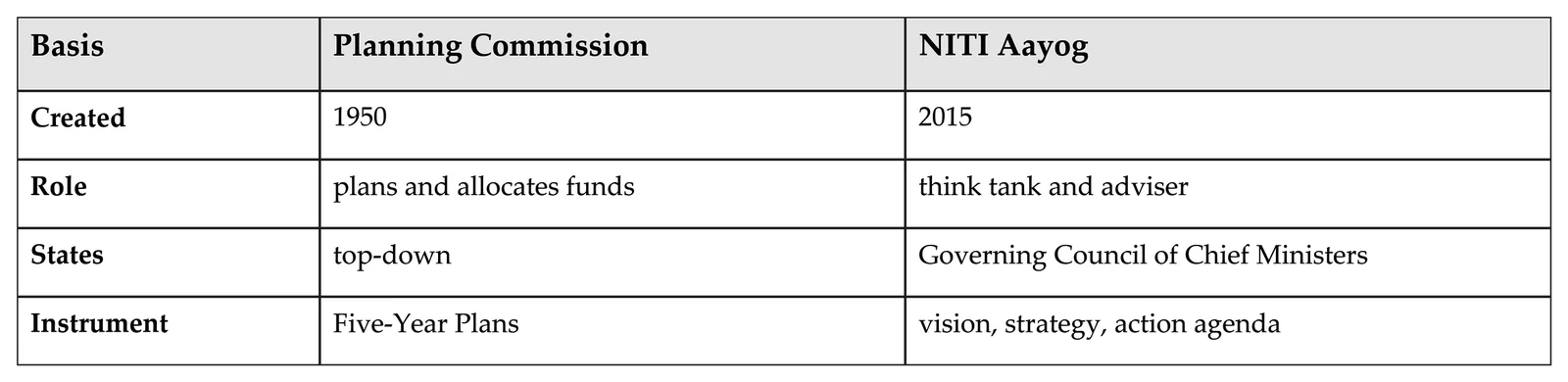
- Creation: set up by a cabinet resolution in March 1950, it was neither constitutional nor statutory. The Prime Minister was its chairperson, and a Deputy Chairperson led its work.
- Five-Year Plans: the First Plan (1951–56) focused on agriculture; the Second Plan (1956–61), based on the Mahalanobis model, emphasised heavy industry and the public sector; later plans addressed poverty, self-reliance and inclusive growth. Twelve plans were completed by 2017.
- National Development Council (1952): brought Chief Ministers together to approve plans, giving states a role.
- Allocation of funds: the Commission allocated plan grants to ministries and states, giving it great power over state budgets.
- Criticisms: it was criticised as a ‘super-cabinet’ dominating states, as top-down and bureaucratic, and, after the economic reforms of 1991, as irrelevant to a market economy. Its power to allocate funds overlapped with the constitutional role of the Finance Commission.
2.3 NITI Aayog: Structure and Functions
NITI Aayog was created by a cabinet resolution on 1 January 2015. Like the Planning Commission, it is neither constitutional nor statutory. Its structure consists of:
- the Prime Minister as Chairperson;
- a Governing Council of all Chief Ministers and Lieutenant Governors of Union Territories, symbolising cooperative federalism;
- Regional Councils for specific issues affecting more than one state;
- a full-time Vice-Chairperson, full-time members, part-time members from universities and research institutions, ex officio Union ministers and special invitees;
- a Chief Executive Officer and secretariat, along with bodies such as the Development Monitoring and Evaluation Office (DMEO) and the Atal Innovation Mission.
Its main functions are to act as the government’s think tank; promote cooperative federalism through structured engagement with states; encourage competitive federalism by ranking states on indices such as the SDG India Index, the Health Index and the School Education Quality Index; prepare long-term vision, medium-term strategy and short-term action agenda documents, such as the Three-Year Action Agenda (2017–20) and Strategy for New India @75 (2018); monitor and evaluate programmes; support innovation and entrepreneurship; and run the Aspirational Districts Programme (2018) to improve the most backward districts. Unlike the Planning Commission, it has no power to allocate funds, which now flow through the Finance Ministry and the Finance Commission.
2.4 Evaluating NITI Aayog
A. Rajan, in ‘The Institutional Identity of India’s NITI Aayog’ (2016), argues that NITI Aayog’s identity remained unclear in its early years. It is called a think tank, yet it is a government body headed by the Prime Minister; it is meant to serve both the Union and the states, yet its staff and agenda are set by the Union; and it lacks statutory status and financial powers, which limits its influence over ministries and states. Without clear authority, its role depends heavily on the support of the Prime Minister.
Pronab Sen, a former Chief Statistician, offers lessons for NITI Aayog in ‘Plan, but Do Not Over-plan’: India still needs coordination of public investment, long-term thinking and attention to sectors that markets neglect, but planning should be indicative and flexible rather than detailed and controlling. Santosh Mehrotra asks why India needs a central planning institution in the twenty-first century, arguing that the abolition of plans left a vacuum in medium-term investment planning, coordination across ministries and states, and long-term strategy for employment, infrastructure, industrial policy and climate change. Supporters of NITI Aayog point to its indices, innovation programmes and the Aspirational Districts Programme as useful contributions.
2.5 Important Questions
- Question 1 Trace the transition from the Planning Commission to NITI Aayog. What were the reasons for this change?
- Question 2 Discuss the structure and functions of NITI Aayog. How far has it promoted cooperative federalism?
- Question 3 Does India need a central planning institution in the twenty-first century? Discuss.
DU asks the same idea in different words. So learn one broad answer for each question below; the same answer works for every question joined by OR.
Important Question 1
Trace the transition from the Planning Commission to NITI Aayog. What were the reasons for this change?
OR
Compare the Planning Commission with NITI Aayog.
OR
Discuss the role of planning in India’s development after independence.
Model Answer
“The State shall strive to promote the welfare of the people by securing and protecting as effectively as it may a social order in which justice, social, economic and political, shall inform all the institutions of the national life.”
— Article 38(1), Constitution of India
Introduction. For more than six decades, India’s economic policy was shaped by the Planning Commission and its Five-Year Plans. In 2015 the government replaced it with NITI Aayog, a policy think tank. This transition reflected changes in India’s economy, politics and federal relations, and it remains a subject of debate about the role of the state in development.
1. The Idea of Planning
Planning means the deliberate use of state power to direct economic development towards chosen goals. After independence, Indian leaders believed that a poor, agrarian country needed the state to mobilise resources, build industries and reduce poverty. Guichard and Mehrotra note that planning was widely used in the twentieth century, from the Soviet Union to France and Japan, and was supported in India across the political spectrum, as the Bombay Plan of 1944 showed.
2. Creation of the Planning Commission
The Planning Commission was established by a cabinet resolution on 15 March 1950, with Jawaharlal Nehru as chairperson. It was an advisory body without constitutional or statutory status, but its chairmanship by the Prime Minister and its control over plan funds gave it enormous influence. The National Development Council, set up in 1952, brought Chief Ministers into the planning process.
3. The Five-Year Plans
The Planning Commission prepared twelve Five-Year Plans between 1951 and 2017. The First Plan focused on agriculture and irrigation; the Second Plan, based on P.C. Mahalanobis’s model, emphasised heavy industry and the public sector; later plans addressed self-reliance, poverty removal (Garibi Hatao in the Fifth Plan), and inclusive growth in the Eleventh and Twelfth Plans. Planning helped build India’s industrial base, dams, power plants and institutions of higher education.
4. Achievements of Planning
Planning created heavy industries, public sector enterprises, irrigation and power infrastructure, and institutions such as the IITs. It supported the Green Revolution and anti-poverty programmes. It also gave a long-term perspective to public investment and coordinated priorities across sectors and states.
5. Criticisms of the Planning Commission
Critics argued that planning became bureaucratic and rigid, with detailed targets that were often missed. The Commission was called a super-cabinet that interfered in ministries and dominated states, which depended on it for plan grants. Its role overlapped with the Finance Commission, the constitutional body for transfers to states. After the economic reforms of 1991, many argued that a market economy needed indicative guidance rather than central planning.
6. Reasons for Change
In August 2014, the Prime Minister announced that the Planning Commission would be replaced. Reasons included the shift to a market economy, the need for cooperative federalism that gave states a greater voice, the desire for a think tank to provide strategic and technical advice, and the view that a one-size-fits-all approach did not suit India’s diverse states.
7. Creation of NITI Aayog
NITI Aayog was established on 1 January 2015 by a cabinet resolution. It retained the Prime Minister as chairperson but added a Governing Council of all Chief Ministers and Lieutenant Governors, Regional Councils and a Chief Executive Officer. Its first Vice-Chairperson was the economist Arvind Panagariya.
8. Key Differences
The Planning Commission prepared Five-Year Plans and allocated funds; NITI Aayog prepares vision, strategy and action agenda documents and has no power to allocate funds. The Planning Commission followed a top-down approach, while NITI Aayog emphasises bottom-up, cooperative federalism. The Planning Commission had a large staff of sectoral experts; NITI Aayog is smaller and works more like a think tank, partnering with research institutions and experts.
9. Federal Implications
With the abolition of plan grants, a larger share of central taxes went to states after the Fourteenth Finance Commission (2015) raised states’ share to 42 per cent. This increased states’ fiscal autonomy, though centrally sponsored schemes still give the Union influence over state priorities. NITI Aayog’s Governing Council meetings provide a forum for dialogue between the Union and the states.
10. Evaluation
Supporters see the change as a modernisation suited to a market economy and federal democracy. Critics, such as Santosh Mehrotra, argue that the abolition of planning left a vacuum in medium-term coordination of public investment and that NITI Aayog lacks the authority to fill it. The debate concerns not whether the state should plan, but how planning should be done in the twenty-first century.
Conclusion. Thus, the transition from the Planning Commission to NITI Aayog reflected India’s shift from state-led planning to a market economy and cooperative federalism. While NITI Aayog has made new contributions, debates continue about whether India needs a stronger institution for long-term planning and coordination.
Important Question 2
Discuss the structure and functions of NITI Aayog. How far has it promoted cooperative federalism?
OR
‘NITI Aayog is a think tank without teeth.’ Discuss.
OR
Examine the institutional identity of NITI Aayog.
Model Answer
“That the operation of the economic system does not result in the concentration of wealth and means of production to the common detriment.”
— Article 39(c), Constitution of India
Introduction. NITI Aayog, the National Institution for Transforming India, is the government’s premier policy think tank. Created in 2015 to replace the Planning Commission, it was meant to promote cooperative and competitive federalism, provide strategic advice and foster innovation. Its structure and functions reflect these aims, but scholars such as A. Rajan have questioned its institutional identity and effectiveness.
1. Legal Status
NITI Aayog was set up by a cabinet resolution on 1 January 2015. Like the Planning Commission, it is neither a constitutional nor a statutory body. This means that its powers, structure and existence depend on the executive, and it can be changed without parliamentary approval. Some scholars and committees have suggested giving it statutory status to secure its role and independence.
2. Structure
The Prime Minister is the chairperson. The Governing Council comprises all Chief Ministers and Lieutenant Governors of Union Territories with legislatures. Regional Councils are formed for specific issues involving several states. The organisation includes a full-time Vice-Chairperson, full-time members, part-time members from universities and research bodies, four Union ministers as ex officio members, special invitees and a Chief Executive Officer who leads the secretariat.
3. Think Tank Functions
NITI Aayog provides strategic and technical advice to the Union and states on economic and social policy. It prepares long-term documents, such as a fifteen-year vision, a seven-year strategy and a three-year action agenda, and policy papers on topics such as artificial intelligence, electric mobility and agriculture. It partners with national and international think tanks and experts. It also hosts platforms such as the NITI Forum for North East and promotes the use of data through initiatives such as the National Data and Analytics Platform.
4. Cooperative Federalism
Cooperative federalism means that the Union and states work together as partners. The Governing Council meetings allow Chief Ministers to discuss national priorities with the Prime Minister. NITI Aayog has formed sub-groups of Chief Ministers on topics such as centrally sponsored schemes and skill development, and it supports states in preparing their own development strategies.
5. Competitive Federalism
NITI Aayog promotes competition among states by publishing rankings and indices, such as the SDG India Index (from 2018), the Health Index, the School Education Quality Index, the Composite Water Management Index and the Export Preparedness Index. These rankings are intended to encourage states to improve their performance through healthy competition. Critics argue that rankings may encourage states to manage indicators rather than outcomes, and that poorer states are penalised for disadvantages they did not create.
6. Monitoring, Evaluation and Innovation
The Development Monitoring and Evaluation Office assesses government programmes and schemes, promoting evidence-based policy. The Atal Innovation Mission (2016) supports Atal Tinkering Labs in schools and incubators for start-ups. The Aspirational Districts Programme (2018) ranks and supports more than a hundred of the country’s most backward districts to improve health, education, agriculture and infrastructure.
7. No Financial Powers
Unlike the Planning Commission, NITI Aayog has no power to allocate funds to ministries or states. Financial transfers are made through the Finance Commission and the Finance Ministry. This reduces its leverage but avoids the criticism that it dominated states through plan grants.
8. Rajan on Institutional Identity
A. Rajan argues that NITI Aayog’s institutional identity is ambiguous. It is described as a think tank, but it is a government body chaired by the Prime Minister, so its independence is limited. It claims to serve both the Union and the states, but its agenda and staff are set by the Union. Without statutory status or financial powers, its influence depends on political backing, which makes its role uncertain.
9. Assessment of Cooperative Federalism
Critics note that Governing Council meetings are infrequent and some Chief Ministers from opposition parties have boycotted them, arguing that the forum is used to announce Union priorities rather than to negotiate. The Union retains major control through centrally sponsored schemes and cesses. Supporters argue that NITI Aayog has nonetheless created new channels for Union–state dialogue.
10. Overall Evaluation
NITI Aayog has contributed through indices, innovation programmes, policy research and the Aspirational Districts Programme. But its lack of statutory status, financial powers and independence limits its effectiveness as both a think tank and a coordinating body. Strengthening it may require clearer mandates, statutory backing and greater autonomy.
Conclusion. Thus, NITI Aayog is a think tank that seeks to promote cooperative and competitive federalism and evidence-based policy. It has made useful contributions, but its ambiguous institutional identity, lack of financial powers and dependence on the Union limit its role as an independent policy institution.
Important Question 3
Does India need a central planning institution in the twenty-first century? Discuss.
OR
‘Plan, but do not over-plan.’ Discuss with reference to the lessons for NITI Aayog.
OR
Critically examine the debate on planning after the abolition of the Planning Commission.
Model Answer
“The State shall, in particular, direct its policy towards securing that the citizens, men and women equally, have the right to an adequate means of livelihood.”
— Article 39(a), Constitution of India
Introduction. The abolition of the Planning Commission in 2015 raised a broader question: in a market economy, does the state still need to plan? Santosh Mehrotra, Sylvie Guichard, Pronab Sen and others, in Planning in the 20th Century and Beyond (2020), argue that while old-style central planning is outdated, India still needs a capable institution to plan public investment and coordinate long-term development.
1. Planning in the Twentieth Century
Guichard and Mehrotra show that planning was widely practised in the twentieth century, not only in communist states but in capitalist economies such as France, Japan and South Korea, where states guided investment, industrial policy and infrastructure. In India, planning was central to the developmental state from 1951 to 2017.
2. Why Planning Declined
From the 1980s, the failures of Soviet-type planning, the rise of neo-liberal ideas and India’s economic reforms of 1991 weakened faith in planning. Detailed targets and allocation of resources by a central body seemed inefficient in a market economy. The Planning Commission was increasingly seen as a bureaucratic relic, and its abolition in 2015 reflected this view. The growth of the private sector and of global markets meant that a large part of investment was no longer under direct state control.
3. Mehrotra’s Argument
Santosh Mehrotra argues that India still needs a central planning institution because markets alone cannot deliver long-term public investment in infrastructure, education, health, research and climate adaptation. Coordination is needed across ministries and between the Union and states, and a medium-term framework helps align budgets with national priorities. Since 2015, he argues, there has been a vacuum in medium-term planning.
4. Sen’s Lessons
Pronab Sen argues that NITI Aayog should plan but not over-plan. Planning should be indicative, setting directions and coordinating investment, rather than prescriptive, fixing detailed targets for every sector. It should focus on areas markets neglect, such as public goods, long-gestation infrastructure and regional balance, and on identifying constraints and bottlenecks.
5. Functions a Planning Body Should Perform
A modern planning institution would provide long-term vision, prepare medium-term frameworks for public investment, coordinate policies across ministries and levels of government, conduct independent monitoring and evaluation, and anticipate challenges such as employment, urbanisation, energy transition and demographic change.
6. Planning and Federalism
In a federal democracy, planning must involve states, which deliver most services. The National Development Council once played this role. NITI Aayog’s Governing Council offers a forum, but critics argue it lacks the institutional strength to negotiate joint plans. Effective planning requires genuine cooperation between the Union and the states. States such as Kerala and Tamil Nadu continue to prepare their own plans, showing that planning remains useful at the state level.
7. Planning without Plans
Since 2017 there have been no Five-Year Plans, but planning continues in other forms: long-term vision documents, sectoral missions such as the National Infrastructure Pipeline and the National Green Hydrogen Mission, and NITI Aayog’s work on a vision for a developed India by 2047. Some argue that this mission-based approach is a more flexible form of planning.
8. The Case against Central Planning
Critics of central planning argue that the state lacks the information to plan a complex economy, that planning bodies become bureaucratic and politicised, and that markets, combined with sound regulation and budget processes, can allocate resources more efficiently. They see NITI Aayog’s think tank role as more appropriate than a revived Planning Commission. Friedrich Hayek’s argument that no central authority can gather the dispersed knowledge held by millions of individuals is often cited in this debate.
9. Challenges Requiring Coordination
Yet India faces challenges that require long-term coordination: creating jobs for a large young population, building infrastructure, managing urbanisation, responding to climate change and reducing regional inequality. These involve many ministries and states and long time horizons, which annual budgets and markets may not handle well.
10. Evaluation
The debate suggests a middle path: India does not need the old Planning Commission with detailed targets and financial control, but it does need a strong institution for strategic, indicative planning, coordination and evaluation, with statutory backing and genuine participation of states. NITI Aayog could evolve in this direction.
Conclusion. Thus, while detailed central planning is no longer suited to India’s market economy, the need for long-term coordination of public investment and strategy remains. As Mehrotra and Sen argue, India should plan without over-planning, through an institution that combines expertise, coordination and federal partnership.
Short Notes
(a) Aspirational Districts Programme
Launched by NITI Aayog in January 2018 to transform more than a hundred of India’s most backward districts. It focuses on health and nutrition, education, agriculture and water resources, financial inclusion and skill development, and basic infrastructure. Districts are ranked monthly on these indicators, combining convergence of schemes, collaboration of officials and competition among districts.
(b) Indicative planning
A form of planning in which the state sets broad goals, priorities and forecasts to guide private and public investment, without detailed targets or direct control of resources. It was used in France after 1945 and is recommended by many economists as more suitable for a market economy than the detailed, imperative planning of the Soviet type.
(c) Governing Council of NITI Aayog
The body comprising the Prime Minister, all Chief Ministers of states and Union Territories with legislatures, Lieutenant Governors of other Union Territories, ex officio members and the Vice-Chairperson. It is the main forum for cooperative federalism within NITI Aayog, where national priorities and state concerns are discussed.
More notes: MDSC-4B Public Institutions in India
- Studying Public Institutions
- Conducting Elections: Election Commission of India (ECI)
- Securing Citizens: The Police
- Ensuring Rights: National Human Rights Commission of India (NHRC)
- Regulatory Institutions: Reserve Bank of India (RBI)
- Transparency and Accountability: Comptroller and Auditor General (CAG) and Central Vigilance Commissioner (CVC)
These notes are prepared by PADHO TO AISE for study help. They are not an official University of Delhi publication.