
Semester IV MDSC-4B Public Institutions in India
Unit III · 20 min read · Updated 24 Nov 2026
As per the University of Delhi (DU) BA (Hons) Political Science syllabus
Contents
- 3.1 Elections and the Election Commission
- 3.2 Composition and Independence
- 3.3 Powers and Functions
- 3.4 The ECI in Action: Evolution and Challenges
- 3.5 Important Questions
- Discuss the composition, powers and functions of the Election Commission of India.
- Examine the role of the Election Commission in ensuring free and fair elections in India.
- What are the major challenges before the Election Commission of India? Suggest reforms.
- Short Notes
निर्वाचक नामावली तैयार करने और सभी चुनावों के संचालन का अधीक्षण, निदेशन और नियंत्रण एक आयोग में निहित होगा।
The superintendence, direction and control of the preparation of the electoral rolls for, and the conduct of, all elections … shall be vested in a Commission.
— Article 324(1), Constitution of India
INDIA holds the largest elections in the world. In the 2024 Lok Sabha election, nearly a billion people were registered to vote, at about a million polling stations, from Himalayan villages to island communities. That these elections are broadly accepted as free and fair is largely due to the Election Commission of India (ECI), a constitutional body created under Article 324. Political scientists such as E. Sridharan, Milan Vaishnav, Ujjwal Kumar Singh and Anupama Roy regard it as one of India’s most respected institutions. This unit studies its composition, powers and functions, its role in conducting free and fair elections, and the challenges and reforms it faces.
3.1 Elections and the Election Commission
Elections are the foundation of representative democracy: they allow citizens to choose and remove their rulers, give legitimacy to governments and channel conflict into peaceful competition. For elections to be meaningful, they must be free and fair: all eligible citizens must be able to vote, candidates must compete on equal terms, and votes must be counted honestly. This requires an independent electoral management body that is not controlled by the government of the day.
The Constituent Assembly decided to create a single, central, independent Election Commission for elections to Parliament, state legislatures and the offices of President and Vice-President, rather than leaving elections to governments. Article 324 vests the superintendence, direction and control of elections in the Commission. Articles 325 and 326 provide for a single electoral roll for each constituency and universal adult suffrage, and Article 329 bars courts from interfering in electoral matters during elections except through election petitions. Elections to panchayats and municipalities are conducted by separate State Election Commissions.
3.2 Composition and Independence
- Composition: the Commission consisted of only the Chief Election Commissioner (CEC) until 1989. It became multi-member briefly in 1989–90 and permanently from 1993, with the CEC and two Election Commissioners deciding by majority.
- Appointment: they are appointed by the President. In Anoop Baranwal v. Union of India (2023) the Supreme Court directed that, until Parliament made a law, appointments be made on the advice of a committee of the Prime Minister, the Leader of the Opposition and the Chief Justice of India. Parliament then passed the Chief Election Commissioner and Other Election Commissioners Act, 2023, under which the committee consists of the Prime Minister, a Union Cabinet minister nominated by him and the Leader of the Opposition.
- Tenure: six years or until the age of 65, whichever is earlier.
- Security: the CEC can be removed only in the manner of a Supreme Court judge, and the conditions of service cannot be varied to the CEC’s disadvantage after appointment (Article 324(5)). Other Election Commissioners can be removed only on the recommendation of the CEC.
- Staff: the Commission has its own secretariat, but during elections it relies on state government officials, such as Chief Electoral Officers, District Election Officers and Returning Officers, who come under its control.
3.3 Powers and Functions
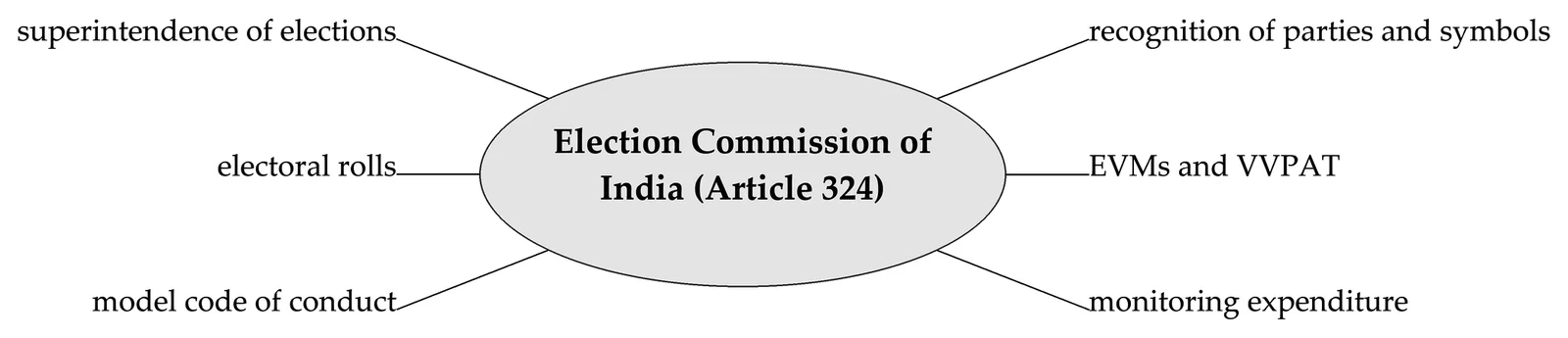
- Electoral rolls: preparing and revising voter lists and issuing Electors Photo Identity Cards (from 1993).
- Conduct of elections: scheduling elections, notifying them, supervising nominations, polling, counting and declaration of results, and deploying security forces.
- Model Code of Conduct: enforcing a code, first used in Kerala in 1960 and strengthened by the Commission, that governs parties, candidates and governments from the announcement of elections, banning new schemes and misuse of official machinery.
- Parties and symbols: registering political parties and recognising national and state parties, and allotting symbols under the Election Symbols Order of 1968; deciding disputes within parties over symbols.
- Technology: introducing EVMs and VVPAT, and digital services for voters and candidates.
- Expenditure and transparency: monitoring candidates’ election expenditure, requiring candidates to disclose criminal records, assets and education since 2003, and deploying observers.
- Quasi-judicial and advisory roles: advising the President and Governors on the disqualification of legislators and countermanding or re-ordering polls in case of irregularities.
3.4 The ECI in Action: Evolution and Challenges
Ujjwal Kumar Singh and Anupama Roy, in Election Commission of India: Institutionalising Democratic Uncertainties (2019), argue that the Commission’s task is to ensure that election outcomes are genuinely uncertain, that is, open to the free choice of voters, while the procedures are certain and trusted. They trace its evolution from the founding period under Sukumar Sen, who built the system for a largely illiterate electorate using symbols and separate ballot boxes; through a period of relative passivity; to the assertive phase under T.N. Seshan (1990–96), who strictly enforced the Model Code, insisted on voter identity cards and challenged governments; and to its role as a regulator of the electoral domain.
E. Sridharan and Milan Vaishnav (2017) describe the ECI as one of India’s most trusted institutions, whose strength comes from its constitutional mandate, assertive leadership, judicial support and public legitimacy. They also identify challenges: the influence of money power and opaque political finance; the criminalisation of politics; the absence of statutory backing for the Model Code; the Commission’s lack of power to deregister parties; questions about the appointment process and independence; disputes over EVMs; and maintaining accurate electoral rolls, as debates over the special intensive revision of rolls in Bihar in 2025 showed. Sanjay Kumar (2022) shows how rising turnout, especially among women and rural voters, reflects public faith in elections.
3.5 Important Questions
- Question 1 Discuss the composition, powers and functions of the Election Commission of India.
- Question 2 Examine the role of the Election Commission in ensuring free and fair elections in India.
- Question 3 What are the major challenges before the Election Commission of India? Suggest reforms.
DU asks the same idea in different words. So learn one broad answer for each question below; the same answer works for every question joined by OR.
Important Question 1
Discuss the composition, powers and functions of the Election Commission of India.
OR
Examine the constitutional position of the Election Commission of India.
OR
How does the Constitution ensure the independence of the Election Commission?
Model Answer
“The elections to the House of the People and to the Legislative Assembly of every State shall be on the basis of adult suffrage.”
— Article 326, Constitution of India
Introduction. The Election Commission of India is the constitutional body responsible for conducting elections to Parliament, state legislatures and the offices of President and Vice-President. Created on 25 January 1950 under Article 324, it has organised elections for the world’s largest electorate and is widely regarded as one of India’s most credible public institutions.
1. Constitutional Basis
Article 324 vests the superintendence, direction and control of the preparation of electoral rolls and the conduct of all elections to Parliament, state legislatures and the offices of President and Vice-President in the Election Commission. Articles 325 and 326 provide for a single electoral roll and universal adult suffrage, and Article 329 limits judicial interference during elections. The Representation of the People Acts of 1950 and 1951 provide detailed rules. The Supreme Court in Mohinder Singh Gill (1978) held that Article 324 is a reservoir of power, allowing the Commission to act where the law is silent, provided it acts fairly and does not violate any law.
2. Composition
The Commission consists of the Chief Election Commissioner and such number of Election Commissioners as the President may fix. It was a single-member body until 1989, briefly multi-member in 1989–90 and permanently three-member since 1993. In T.N. Seshan v. Union of India (1995), the Supreme Court upheld the multi-member Commission and held that decisions are taken by majority.
3. Appointment
The President appoints the CEC and Election Commissioners. For decades this was done on the advice of the government alone. In Anoop Baranwal (2023), the Supreme Court directed a committee including the Chief Justice until Parliament legislated. The 2023 Act then provided a selection committee of the Prime Minister, a Union Cabinet minister and the Leader of the Opposition, which critics argue gives the government a majority in appointments.
4. Tenure and Security
Commissioners hold office for six years or until the age of 65. The CEC can be removed only like a Supreme Court judge, by Parliament on grounds of proved misbehaviour or incapacity, and his conditions of service cannot be changed to his disadvantage. Other Commissioners can be removed only on the recommendation of the CEC. These provisions protect the Commission from political pressure.
5. Electoral Rolls
The Commission prepares and revises electoral rolls for every constituency, registers new voters and deletes the names of those who have died or moved. It introduced Electors Photo Identity Cards in 1993 to prevent impersonation. Accurate rolls are essential for free and fair elections and for ensuring that no eligible citizen is excluded.
6. Conduct of Elections
The Commission announces election schedules, supervises nominations and scrutiny, deploys polling staff and security forces, oversees voting and counting and declares results. During elections, state government officials work under its control, and it can transfer officials and order re-polls where irregularities occur. The 2024 Lok Sabha election, held in seven phases, involved about 1.5 crore polling and security personnel.
7. Model Code of Conduct
The Model Code of Conduct, which evolved from a code first used in Kerala in 1960, comes into force when elections are announced. It prohibits ruling parties from announcing new schemes, using official machinery for campaigning or making appeals on the basis of caste or religion. Although not a law, it has been enforced by the Commission through warnings, bans on campaigning and transfers of officials.
8. Parties, Symbols and Expenditure
The Commission registers political parties, recognises national and state parties, allots symbols under the Election Symbols Order of 1968 and decides symbol disputes between rival factions. It monitors candidates’ election expenditure, appoints expenditure and general observers and requires candidates to disclose assets, liabilities, education and criminal cases.
9. Technology
The Commission introduced electronic voting machines, first used in 1982 and nationwide from 2004, which speeded up counting and reduced booth capturing. Voter Verifiable Paper Audit Trail machines were introduced from 2013 and used in all constituencies from 2019, allowing voters to verify their votes.
10. State Election Commissions
Elections to panchayats and municipalities are not conducted by the ECI but by State Election Commissions created under Articles 243K and 243ZA by the 73rd and 74th Amendments. The State Election Commissioner is appointed by the Governor and can be removed only like a High Court judge. These bodies conduct elections for lakhs of local representatives, though critics note that many depend heavily on state governments and that local elections are sometimes delayed.
11. Advisory and Quasi-judicial Functions
The Commission advises the President and Governors on the disqualification of members of legislatures on certain grounds, decides disputes over party symbols, and may countermand elections in cases of booth capturing or the death of a candidate. These functions make it both an administrative and a quasi-judicial body.
Conclusion. Thus, the Election Commission of India, created under Article 324, has wide powers over electoral rolls, the conduct of elections, parties and symbols. Its constitutional status and security of tenure support its independence, though debates over appointments show the continuing need to protect it.
Important Question 2
Examine the role of the Election Commission in ensuring free and fair elections in India.
OR
‘The Election Commission institutionalises democratic uncertainty.’ Discuss.
OR
Discuss the evolution of the Election Commission as a regulator of the electoral domain.
Model Answer
“Democracy is a system in which parties lose elections.”
— Adam Przeworski, Democracy and the Market (1991)
Introduction. Free and fair elections require that every eligible citizen can vote, that candidates compete on a level playing field and that results reflect the choices of voters. In India, the Election Commission has made this possible in a vast, diverse and often turbulent society. Ujjwal Kumar Singh and Anupama Roy describe its role as institutionalising democratic uncertainty, while Sridharan and Vaishnav examine the sources of its strength.
1. Democratic Uncertainty
Adam Przeworski argued that democracy is a system in which parties lose elections: outcomes are uncertain, but procedures are certain. Singh and Roy apply this idea to the ECI, whose task is to ensure that no party can be sure of victory in advance, by guaranteeing fair rules and procedures that all parties accept. The Commission thus makes uncertainty of outcomes possible by ensuring certainty of process.
2. The Founding Phase
Under Sukumar Sen, the first CEC, the Commission organised the first general election of 1951–52 for about 173 million voters, most of them illiterate. It used party symbols and separate ballot boxes for each candidate so that people could vote without reading, and trained hundreds of thousands of officials. This founding effort established the credibility of elections in independent India. Women who were listed only as someone’s wife or mother rather than by name were a particular challenge, and the Commission insisted on registering women by their own names.
3. A Period of Low Visibility
For several decades the Commission was a relatively low-profile body that relied on governments and worked within the limits of the law. Electoral malpractices such as booth capturing, rigging and the misuse of government machinery grew in some regions in the 1970s and 1980s, raising doubts about the fairness of elections. The Commission also faced the challenge of elections in conflict areas such as Punjab and Jammu and Kashmir, where violence and boycotts affected participation.
4. The Seshan Era
T.N. Seshan, CEC from 1990 to 1996, transformed the Commission into an assertive institution. He strictly enforced the Model Code of Conduct, postponed elections where conditions were unfair, insisted on voter identity cards, curbed campaign excesses and confronted politicians. The Supreme Court’s support and public approval strengthened the Commission’s authority.
5. Regulating the Electoral Domain
Singh and Roy describe the Commission as a regulator of the electoral domain, setting and enforcing rules for parties, candidates, governments, media and voters. It regulates campaign conduct through the Model Code, expenditure through observers, the recognition of parties and allocation of symbols, and the use of technology, extending its role beyond administration to governance of elections.
6. Inclusion and Participation
The Commission has worked to include all citizens through voter registration drives, the Systematic Voters’ Education and Electoral Participation (SVEEP) programme, polling stations within easy reach, facilities for persons with disabilities and the elderly, and special arrangements in remote areas. Sanjay Kumar notes the rising turnout of women, who now vote at rates similar to or higher than men.
7. Technology and Integrity
EVMs reduced invalid votes and booth capturing and made counting faster, while VVPAT allowed verification. The Commission has defended EVMs against allegations of tampering, and the Supreme Court in 2024 rejected demands to return to paper ballots while upholding the VVPAT verification system.
8. Sources of Strength
Sridharan and Vaishnav attribute the Commission’s strength to its constitutional mandate under Article 324, which courts have interpreted as a reservoir of residual powers; security of tenure; assertive leadership; support from the judiciary; and high public trust, which makes it costly for governments to attack it openly.
9. Limits
The Commission depends on state officials during elections, lacks statutory power to deregister parties or punish violations of the Model Code directly, and cannot control spending by parties, as opposed to candidates. Its independence depends partly on the appointment process and on the conduct of individual commissioners.
10. Comparative Perspective
Compared with many other democracies, India’s centralised and constitutionally independent election body is unusual. In the United States, elections are run by state and county officials, often elected on party lines, which produces disputes over voting rules. Scholars of electoral management bodies regard the ECI as a model of an independent commission, and it has advised election authorities in other countries through its training institute, the India International Institute of Democracy and Election Management.
11. Evaluation
Despite challenges, the Election Commission has made Indian elections broadly free, fair and peaceful, with alternation of power at all levels. Its credibility is a key reason for India’s democratic stability, which is why debates about its independence and impartiality attract so much attention.
Conclusion. Thus, the Election Commission has ensured free and fair elections by guaranteeing trusted procedures that keep outcomes uncertain. From Sukumar Sen to the Seshan era and its role as regulator of the electoral domain, it has become central to Indian democracy, though its independence must be continually protected.
Important Question 3
What are the major challenges before the Election Commission of India? Suggest reforms.
OR
Discuss the problems of money power and criminalisation in Indian elections.
OR
Critically examine the debate on the independence of the Election Commission.
Model Answer
“It shall be the duty of every citizen of India to abide by the Constitution and respect its ideals and institutions.”
— Article 51A(a), Constitution of India
Introduction. The Election Commission has earned high trust, but Indian elections face serious challenges, including the influence of money, criminalisation of politics, misuse of state machinery, misinformation and disputes about the Commission’s own independence. E. Sridharan and Milan Vaishnav argue that sustaining the Commission’s credibility requires both institutional reforms and broader changes in political finance and party behaviour.
1. Money Power
Election campaigns in India are extremely expensive, and legal spending limits for candidates are often exceeded through unaccounted cash, while there is no limit on party spending. Opaque political funding allows corporate and illegal money to influence politics. The Supreme Court struck down the electoral bond scheme in February 2024 for violating voters’ right to information, but the broader problem of political finance remains.
2. Criminalisation of Politics
A significant share of elected legislators face criminal cases, some involving serious charges. Parties nominate such candidates because they can mobilise money and votes. The Supreme Court has required candidates and parties to publicise criminal records, and in Lily Thomas (2013) held that legislators convicted of certain offences lose their seats immediately, but the problem persists.
3. Limits on the Model Code
The Model Code of Conduct is not a law, so the Commission can enforce it only through moral authority, warnings, temporary campaign bans and transfers of officials. Critics argue that enforcement has sometimes appeared uneven between ruling and opposition parties, which affects the Commission’s credibility.
4. Appointment and Independence
The independence of the Commission depends on how its members are appointed. Critics long argued that appointments by the government alone threatened independence. The Anoop Baranwal judgment (2023) required a committee including the Chief Justice, but the 2023 Act replaced the Chief Justice with a Union minister, giving the government a majority in the selection committee. Many experts recommend a more balanced committee and constitutional protection for all commissioners.
5. Party Regulation
The Commission can register parties but has no power to deregister them for violating rules or failing to contest elections, except in limited cases. Many registered parties never contest elections and may be used for money laundering. Internal party democracy is also not regulated.
6. Electoral Rolls
Maintaining accurate rolls for nearly a billion voters is difficult, with problems of duplicate entries, deleted names and exclusion of migrants and the poor. Special intensive revisions of rolls, such as the one in Bihar in 2025, have raised concerns about the exclusion of eligible voters through documentary requirements, showing the need for transparent and inclusive procedures.
7. Technology and Trust
Some parties and activists have questioned the reliability of EVMs and demanded more VVPAT verification or a return to paper ballots. Although the Supreme Court has upheld EVMs, transparency about technology, audits and procedures is important for maintaining public trust.
8. Misinformation and Social Media
The spread of misinformation, hate speech and paid news through social media and messaging platforms challenges the Commission’s ability to regulate campaigns. It has issued guidelines for social media and worked with platforms, but regulating online campaigning remains difficult.
9. Reform Proposals
Reform proposals include statutory backing for the Model Code, power to deregister parties, a neutral appointment committee and equal protection for all commissioners, transparent political funding with limits on party spending, faster trials for politicians facing criminal charges, state funding of elections suggested by the Indrajit Gupta Committee (1998), and simultaneous elections, which remain contested.
10. Simultaneous Elections
The proposal of One Nation, One Election, recommended by a high-level committee chaired by former President Ram Nath Kovind in 2024, would hold Lok Sabha and state assembly elections together. Supporters argue that it would reduce costs and the frequent imposition of the Model Code; critics argue that it would weaken federalism, favour national parties and require major constitutional amendments, and that it would place enormous logistical demands on the Commission.
11. Evaluation
Sridharan and Vaishnav conclude that the Election Commission remains a strong institution, but its credibility cannot be taken for granted. Its independence and effectiveness depend on legal reforms, transparent procedures and a political culture that respects electoral rules.
Conclusion. Thus, the Election Commission faces challenges of money power, criminalisation, limited legal powers, disputed appointments and new technological threats. Reforms in political finance, party regulation and appointments are needed to protect the integrity of elections and public trust in the Commission.
Short Notes
(a) Model Code of Conduct
A set of guidelines for political parties, candidates and governments during elections, which evolved from a code first used in the Kerala assembly elections of 1960 and was later adopted and strengthened by the Election Commission. It comes into force when elections are announced and prohibits new government schemes, misuse of official machinery and appeals to caste or religion. It is not legally enforceable but carries strong moral authority.
(b) VVPAT
Voter Verifiable Paper Audit Trail: a device attached to the EVM that prints a slip showing the candidate and symbol chosen, visible to the voter for a few seconds before it drops into a sealed box. First used in 2013 and in all constituencies from 2019, it allows voters to verify their votes and permits audits of EVM counts.
(c) T.N. Seshan
Chief Election Commissioner from 1990 to 1996, who transformed the Election Commission into an assertive institution. He strictly enforced the Model Code of Conduct, pressed for voter identity cards, curbed campaign excesses and confronted governments over the conduct of elections, greatly increasing public awareness of the Commission’s powers.
More notes: MDSC-4B Public Institutions in India
- Studying Public Institutions
- Framing Public Policy: Niti Aayog
- Securing Citizens: The Police
- Ensuring Rights: National Human Rights Commission of India (NHRC)
- Regulatory Institutions: Reserve Bank of India (RBI)
- Transparency and Accountability: Comptroller and Auditor General (CAG) and Central Vigilance Commissioner (CVC)
These notes are prepared by PADHO TO AISE for study help. They are not an official University of Delhi publication.