
Semester VI MDSC-6B Comparative Political Systems
Unit IV · 20 min read · Updated 24 Nov 2026
As per the University of Delhi (DU) BA (Hons) Political Science syllabus
Contents
- 4.1 Political Traditions and Constitutional Development
- 4.2 Society and Economy: Nature of the State
- 4.3 Party and Electoral System
- 4.4 The Federal System
- 4.5 Important Questions
- Discuss the political traditions and constitutional development of Russia.
- Examine the relationship between society, economy and the nature of the state in post-Soviet Russia.
- Discuss the party and electoral system of Russia.
- Examine the nature of federalism in Russia.
- Short Notes
सोवियत संघ का पतन सदी की सबसे बड़ी भू-राजनीतिक तबाही था।
The collapse of the Soviet Union was the greatest geopolitical catastrophe of the century.
— Vladimir Putin, Annual Address to the Federal Assembly (2005)
RUSSIA is the largest country in the world, spanning Europe and Asia, with nearly two hundred ethnic groups. Its political history moved from the autocracy of the tsars to the communist one-party state of the Soviet Union, and after 1991 to a new Russian Federation. The 1993 Constitution promised democracy, federalism and the separation of powers, but it created a super-presidential system, and under Vladimir Putin Russia has become an increasingly authoritarian hybrid regime. This unit studies Russia’s political traditions and constitutional development, its society and economy and the nature of the state, its party and electoral system, and its federal system, drawing on Joan DeBardeleben, Eric Shiraev, and Graeme Gill and James Young.

4.1 Political Traditions and Constitutional Development
Eric Shiraev identifies enduring Russian political traditions: a strong, centralised state, personal rule by a powerful leader, a weak civil society and a sense of Russia as a great power. The tsars ruled as autocrats; the revolution of 1905 produced a limited parliament, the Duma, but in 1917 the monarchy collapsed and the Bolsheviks under Lenin seized power. The Soviet Union (1922–91) was a one-party state in which the Communist Party controlled the state, the economy and society, especially under Stalin.
Mikhail Gorbachev’s reforms from 1985, perestroika (restructuring) and glasnost (openness), loosened control but unleashed nationalist movements. After a failed coup in August 1991, the USSR dissolved in December 1991, and Boris Yeltsin led the new Russia. In October 1993, a conflict between Yeltsin and the parliament ended with tanks shelling the parliament building, and a new Constitution was approved by referendum in December 1993. It created a super-presidential system. Amendments in 2008 extended the presidential term to six years, and amendments of 2020 allowed Putin to seek two more terms, potentially to 2036.

4.2 Society and Economy: Nature of the State
The Soviet planned economy collapsed with the USSR. In 1992 the government launched shock therapy: prices were freed, and state enterprises were privatised through vouchers and, in 1995, a loans-for-shares scheme that transferred major firms to a small group of oligarchs. Output fell sharply, inequality and poverty rose, and in 1998 Russia defaulted on its debt. Under Putin, from 2000, high oil and gas prices brought growth, and the state reasserted control over the oligarchs, as in the arrest of Mikhail Khodorkovsky of Yukos in 2003, and over strategic sectors through state corporations.

Joan DeBardeleben describes Russia as a state that combines elections with tight control of media, courts and opposition. Scholars call it competitive authoritarianism or an electoral authoritarian regime; the Kremlin called it sovereign democracy. Repression increased after protests in 2011–12, the annexation of Crimea in 2014 and the full-scale invasion of Ukraine in 2022, which brought Western sanctions and a wartime economy.
4.3 Party and Electoral System
The 1993 Constitution recognises political diversity and a multiparty system, but Russia’s parties have been weak and dominated by the Kremlin. United Russia, formed in 2001, is the party of power, holding a large majority in the Duma. The Communist Party (KPRF), the LDPR, A Just Russia and New People form a systemic opposition that rarely challenges the President, while non-systemic opponents such as Alexei Navalny, who died in prison in 2024, were excluded and persecuted.
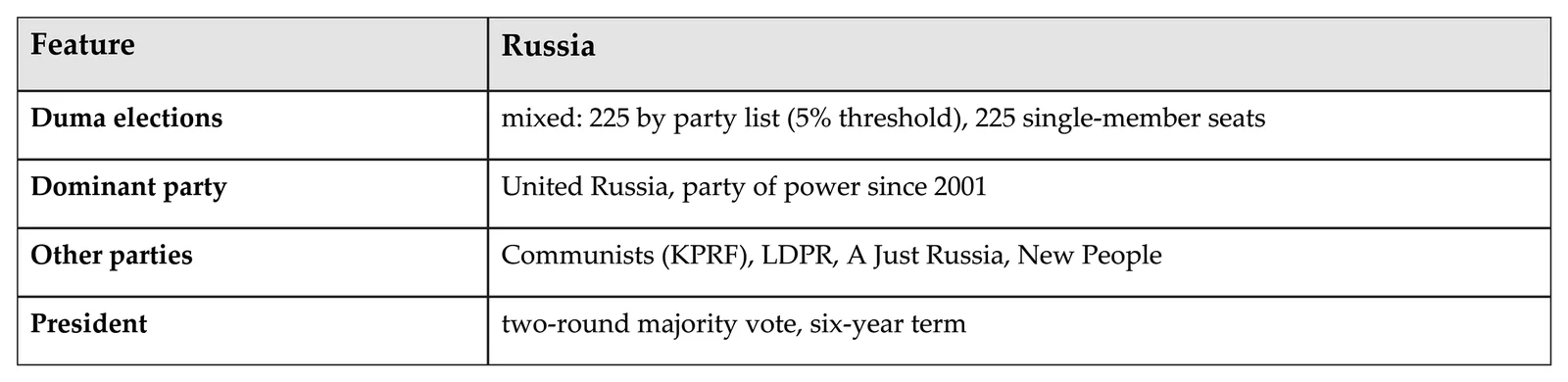
The Duma’s electoral system has changed repeatedly to suit the regime: a mixed system with half the seats by party list and half by single-member districts (1993–2003), a fully proportional system with a 7 per cent threshold (2007 and 2011), and a return to the mixed system with a 5 per cent threshold from 2016. In 2021 United Russia won 324 of 450 seats. The President is elected by a two-round majority system; Putin won about 87 per cent in 2024.
4.4 The Federal System
The Constitution describes Russia as a democratic federal state. It originally listed 89 federal subjects of different types: republics for major ethnic groups, krais, oblasts, federal cities, an autonomous oblast and autonomous okrugs. Mergers reduced them to 83; Russia now claims 89, including Crimea and Sevastopol, annexed in 2014, and four Ukrainian regions annexed in 2022, annexations not recognised internationally. The Federation Council, the upper house, represents the subjects.

In the 1990s Russian federalism was asymmetric, with Yeltsin signing bilateral treaties granting special powers to regions such as Tatarstan, while Chechnya fought for independence in two wars. Putin recentralised power: he created federal districts under presidential envoys in 2000, reformed the Federation Council, and from 2004 to 2012 appointed governors instead of allowing elections. Scholars describe Russia as federal in form but increasingly unitary in practice.
4.5 Important Questions
- Question 1 Discuss the political traditions and constitutional development of Russia.
- Question 2 Examine the relationship between society, economy and the nature of the state in post-Soviet Russia.
- Question 3 Discuss the party and electoral system of Russia.
- Question 4 Examine the nature of federalism in Russia.
DU asks the same idea in different words. So learn one broad answer for each question below; the same answer works for every question joined by OR.
Important Question 1
Discuss the political traditions and constitutional development of Russia.
OR
Examine the nature of super-presidentialism under the Russian Constitution of 1993.
OR
Discuss the powers and position of the Russian President.
Model Answer
“State power in the Russian Federation shall be exercised on the basis of its division into legislative, executive and judicial power.”
— Constitution of the Russian Federation (1993), Article 10
Introduction. Russia’s political development has been shaped by long traditions of centralised and personal rule, from the tsars to the Soviet leaders. After the collapse of the Soviet Union, the 1993 Constitution sought to establish democracy, but it concentrated power in the presidency. Eric Shiraev and Graeme Gill show how tradition and institutional design produced Russia’s super-presidential system.
1. Tsarist Autocracy
For centuries Russia was ruled by tsars who claimed absolute power, supported by the Orthodox Church and the nobility. Serfdom was abolished only in 1861. The revolution of 1905 forced Tsar Nicholas II to create an elected Duma, but he retained most power.
2. Revolution and Soviet Rule
In February 1917 the monarchy fell, and in October the Bolsheviks led by Lenin seized power. After a civil war, the Union of Soviet Socialist Republics was formed in 1922. The Communist Party monopolised power; under Stalin, the state collectivised agriculture, industrialised rapidly and carried out mass repression.
3. The Soviet Constitutional Order
Soviet constitutions of 1924, 1936 and 1977 described a federal state of soviets, but real power lay with the Communist Party, whose leading role was written into Article 6 of the 1977 Constitution. Elections were held but offered no choice.
4. Gorbachev’s Reforms
Mikhail Gorbachev, leader from 1985, introduced perestroika to reform the economy, glasnost to allow open discussion and democratisation, including competitive elections in 1989. Article 6 was abolished in 1990, ending the party’s legal monopoly.
5. Collapse of the USSR
Reforms weakened central control and encouraged nationalist movements in the republics. After hardliners attempted a coup in August 1991, which Boris Yeltsin resisted, the republics declared independence, and the USSR was dissolved in December 1991.
6. The 1993 Crisis
In 1993 Yeltsin clashed with the Supreme Soviet over economic reform and power. He dissolved parliament in September; deputies resisted, and in October troops shelled the parliament building. A new Constitution was then approved by referendum on 12 December 1993.
7. Super-presidentialism
The Constitution made the President head of state and guarantor of the Constitution, with powers to appoint the Prime Minister, issue decrees with the force of law, dissolve the Duma in certain circumstances, direct foreign and security policy and command the armed forces. Scholars call this super-presidentialism.
8. The Government and Prime Minister
The Prime Minister is appointed by the President with the Duma’s consent; if the Duma rejects the nominee three times, the President may dissolve it. The government is effectively responsible to the President rather than to parliament.
9. The Federal Assembly
The parliament, or Federal Assembly, consists of the State Duma with 450 members and the Federation Council representing the federal subjects. In practice, the Duma has been dominated by pro-presidential parties since the 2000s.
10. The Courts
The Constitution provides for a Constitutional Court and judicial independence, but courts have rarely challenged the executive, and politically sensitive cases are decided in the Kremlin’s favour.
11. The Putin Era
Vladimir Putin became President in 2000, served as Prime Minister from 2008 to 2012 while Dmitry Medvedev was President, and returned as President in 2012. A 2008 amendment extended the presidential term from four to six years.
12. The 2020 Amendments
Amendments approved in 2020 reset Putin’s previous terms, allowing him to run again in 2024 and 2030. They also gave the Constitution priority over international decisions, defined marriage as a union of a man and a woman, and strengthened presidential control over courts and regions.
13. Tradition and Personalism
Shiraev argues that Russia’s political culture, with its preference for a strong leader and order after the chaos of the 1990s, helps explain the acceptance of strong presidential power, though it was also produced by deliberate political choices.
14. Evaluation
Russia’s constitutional development shows how formal democratic institutions can coexist with concentrated, personal power. The 1993 Constitution’s strong presidency made it easier to build an authoritarian system under Putin.
Conclusion. Thus, Russia moved from tsarist autocracy and Soviet one-party rule to the 1993 Constitution, which promised democracy but created a super-presidential system. Under Putin, amendments and practice concentrated power further, continuing a tradition of strong centralised rule.
Important Question 2
Examine the relationship between society, economy and the nature of the state in post-Soviet Russia.
OR
Discuss the transition from a planned economy to a market economy in Russia.
OR
Is Russia a hybrid regime? Discuss.
Model Answer
“The Russian Federation is a social State whose policy is aimed at creating conditions for a worthy life and a free development of man.”
— Constitution of the Russian Federation (1993), Article 7
Introduction. The collapse of the Soviet Union required Russia to transform its economy and society at the same time as building new political institutions. The painful transition of the 1990s and the recovery under Putin shaped a distinctive kind of state, often described as a hybrid regime or competitive authoritarianism. Joan DeBardeleben examines these changes.
1. The Soviet Legacy
The Soviet Union had a centrally planned economy in which the state owned industry and set prices and output. It achieved industrialisation and full employment but suffered from inefficiency, shortages and stagnation by the 1980s.
2. Shock Therapy
In January 1992, the government of Yegor Gaidar freed most prices and cut subsidies. Prices soared, savings were wiped out, and output fell sharply. Supporters saw it as necessary; critics blamed it for impoverishing millions.
3. Privatisation and the Oligarchs
Voucher privatisation distributed shares to citizens, but many sold them cheaply. In the loans-for-shares scheme of 1995, major firms in oil and metals passed to a few businessmen, who became the oligarchs, gaining enormous wealth and political influence.
4. Social Costs
The 1990s saw falling life expectancy, rising poverty and inequality, unpaid wages and crime. The financial crisis of August 1998, when Russia defaulted on its debt, discredited liberal reform for many Russians.
5. Putin and Recovery
From 2000, rising oil and gas prices fuelled rapid growth and rising incomes. Putin promised stability and order, and many Russians credited him with ending the chaos of the 1990s.
6. Taming the Oligarchs
Putin reasserted state power over the oligarchs. Media owners who opposed him lost their channels, and the arrest of Mikhail Khodorkovsky of Yukos in 2003 signalled that business must stay out of opposition politics.
7. State Capitalism
The state took control of strategic sectors through companies such as Gazprom and Rosneft and state corporations. Energy exports became the backbone of the economy and the budget, making Russia vulnerable to oil prices.
8. Society
Russia is multi-ethnic, with a large Russian majority and nearly two hundred ethnic groups, as well as a revival of the Orthodox Church, which supports the government. Civil society organisations face restrictions under foreign agent laws introduced from 2012.
9. Sovereign Democracy
The Kremlin described its system as sovereign democracy, democracy adapted to Russian conditions and free from foreign influence. Critics saw this as a justification for controlling elections, media and opposition.
10. Competitive Authoritarianism
Steven Levitsky and Lucan Way classify Russia as competitive authoritarian: elections are held and opposition parties exist, but the playing field is heavily tilted through control of media, courts, resources and repression.
11. Increasing Authoritarianism
After mass protests in 2011–12, repression increased. After the annexation of Crimea in 2014 and the invasion of Ukraine in 2022, independent media were closed, protests banned and critics imprisoned or exiled. The human rights organisation Memorial was dissolved by court order.
12. Sanctions and War Economy
Western sanctions after 2014 and especially 2022 cut Russia off from many markets and technologies. Russia redirected trade towards China, India and others, and increased military spending.
13. Nature of the State
DeBardeleben describes Russia as a strong, centralised state with formal democratic institutions but authoritarian practices, a statist economy dependent on energy, and a leadership that defines itself in opposition to the West.
14. Demography and Regional Gaps
Russia faces long-term demographic decline, with low birth rates, relatively low male life expectancy and dependence on migrant workers from Central Asia. Wealth is concentrated in Moscow and energy-producing regions, while many industrial towns and rural areas have declined. These social pressures shape both the state’s welfare policies and its emphasis on national unity and traditional values.
15. Evaluation
Russia’s transition shows how economic collapse and inequality can undermine support for liberal democracy and pave the way for a strong leader. Its state combines market elements with state control and elections with authoritarian rule.
Conclusion. Thus, post-Soviet Russia moved from shock therapy and oligarchic capitalism in the 1990s to state capitalism and centralised power under Putin. Its state is best described as a hybrid or competitive authoritarian regime, dependent on energy and increasingly repressive.
Important Question 3
Discuss the party and electoral system of Russia.
OR
Examine the role of United Russia as a party of power.
OR
Discuss the changes in Russia’s electoral system since 1993.
Model Answer
“Political diversity and multi-party system shall be recognized in the Russian Federation.”
— Constitution of the Russian Federation (1993), Article 13(3)
Introduction. Russia’s Constitution recognises political diversity and a multiparty system, and regular elections are held for the President and the State Duma. Yet the party system has been dominated by a pro-Kremlin party of power, and electoral rules have repeatedly changed to benefit the authorities. Gill and Young examine Russia’s parties and Duma electoral system.
1. Weak Party Traditions
After seventy years of one-party rule, Russia lacked experienced independent parties. In the 1990s, many parties formed around leaders, and voters had weak party loyalties, making the party system unstable.
2. The 1990s Party System
In the 1990s the Communist Party of the Russian Federation was the largest party, and nationalist, liberal and centrist parties competed. Yeltsin did not build his own party, relying instead on presidential power.
3. Party of Power
A party of power is a party created by the ruling elite to support the executive. United Russia was formed in 2001 from the merger of Unity and Fatherland–All Russia. It controls the Duma and most regional legislatures and relies on state resources, officials and media.
4. Systemic Opposition
Parties such as the Communists, the LDPR founded by Vladimir Zhirinovsky, A Just Russia and New People sit in the Duma and criticise some policies, but they rarely challenge the President and usually support key decisions. They are called the systemic opposition.
5. Non-systemic Opposition
Independent opposition figures and parties, such as Alexei Navalny’s movement and the liberal Yabloko party, have been excluded from parliament, denied registration or persecuted. Navalny’s organisations were declared extremist in 2021, and he died in prison in 2024.
6. The Duma Electoral System, 1993–2003
From 1993 to 2003, half of the 450 Duma seats were elected by party lists with a 5 per cent threshold and half in single-member districts, where many independents won.
7. Fully Proportional, 2007–2011
For the 2007 and 2011 elections, the system was changed to full proportional representation with a 7 per cent threshold, eliminating independents and small parties and strengthening United Russia’s dominance.
8. Return to the Mixed System
After protests over the 2011 election, the mixed system with a 5 per cent threshold returned in 2016. United Russia benefited greatly from single-member districts, winning 324 of 450 seats in 2021.
9. Presidential Elections
The President is elected by direct vote; if no candidate wins a majority, a run-off is held. Putin won in 2000, 2004, 2012, 2018 and 2024, when he received about 87 per cent amid the absence of real opponents.
10. Electoral Manipulation
Observers have reported ballot stuffing, pressure on public employees to vote, restrictions on candidates and media bias. Electronic and multi-day voting introduced recently made monitoring harder.
11. Regional Elections
Governors and regional legislatures are elected, but candidates face filters such as the requirement to gather signatures from municipal deputies, mostly from United Russia, which keeps opposition candidates out.
12. Functions of Elections
In an authoritarian regime, elections serve to legitimise the government, demonstrate its strength, co-opt elites and gather information about public opinion, rather than to allow a change of government.
13. Comparison
Unlike the competitive two-party systems of the UK and USA, Russia has a dominant party system without genuine alternation in power, similar in some ways to other electoral authoritarian regimes.
14. Laws on Parties
The state shapes the party system through law. The 2001 Law on Political Parties required parties to have thousands of members and branches across many regions, a requirement raised in 2004, which eliminated many small parties. After the 2011–12 protests, the rule was relaxed to 500 members, producing many small parties that divided the opposition vote, while independent opponents still struggled to register.
15. Evaluation
Russia’s party and electoral system provides the form of multiparty democracy without its substance. Frequent rule changes and control of competition have kept the ruling elite in power.
Conclusion. Thus, Russia has a multiparty system in form but a dominant party of power, United Russia, in practice, with a systemic opposition that rarely challenges the Kremlin. The Duma’s electoral system has been repeatedly changed to benefit the regime, and elections serve mainly to legitimise it.
Important Question 4
Examine the nature of federalism in Russia.
OR
Discuss the asymmetric federalism of the 1990s and the recentralisation under Putin.
OR
‘Russia is federal in form but unitary in practice.’ Discuss.
Model Answer
“The Russian Federation – Russia is a democratic federal law-bound State with a republican form of government.”
— Constitution of the Russian Federation (1993), Article 1(1)
Introduction. Russia is a vast multinational state, and federalism was adopted to hold together its many regions and ethnic groups after the collapse of the Soviet Union. Russian federalism has been highly asymmetric and has shifted from extensive regional autonomy in the 1990s to strong centralisation under Putin.
1. Soviet Pseudo-federalism
The Soviet Union was formally a federation of republics, and Russia itself contained autonomous republics for ethnic groups. In practice, the Communist Party’s centralised control made this federalism largely nominal.
2. Federal Subjects
The 1993 Constitution listed 89 federal subjects: republics named after ethnic groups, such as Tatarstan and Chechnya; krais and oblasts, which are territorial regions; the federal cities of Moscow and St Petersburg; an autonomous oblast; and autonomous okrugs. Mergers reduced the number to 83 by 2008.
3. Asymmetric Federalism
The subjects have different statuses and powers. Republics have their own constitutions and languages, while other regions have charters. This asymmetry reflects the multinational character of the federation.
4. Yeltsin’s Bargaining
Yeltsin encouraged regions to take as much sovereignty as they could swallow and signed bilateral treaties with many regions, beginning with Tatarstan in 1994, granting them special rights over resources and taxes. Regional leaders became powerful.
5. Chechnya
Chechnya declared independence and fought two wars with Moscow, in 1994–96 and from 1999. The second war ended with Chechnya under a pro-Kremlin leadership, headed since 2007 by Ramzan Kadyrov.
6. Putin’s Recentralisation
From 2000, Putin sought to restore the power vertical. He created federal districts headed by presidential envoys to supervise regions, required regional laws to conform with federal law and ended the bilateral treaties.
7. Federation Council Reform
Governors and regional legislative leaders originally sat in the Federation Council. Putin replaced them with appointed representatives, reducing the regional leaders’ influence in national politics; amendments in 2020 also allow the President to appoint some senators.
8. Appointment of Governors
After the Beslan school siege in 2004, Putin abolished the direct election of governors and appointed them instead. Elections were restored in 2012 but with filters that ensure Kremlin-approved candidates.
9. Fiscal Centralisation
Taxes are mostly collected by the centre and redistributed to regions, many of which depend on federal transfers. This fiscal centralisation gives Moscow strong control over regional governments.
10. Ethnic Republics
Republics have been pressured to limit the teaching of their own languages and their autonomy. Requirements in 2017 made learning regional languages voluntary, which ethnic activists opposed.
11. Annexed Territories
Russia annexed Crimea and Sevastopol in 2014 and declared the annexation of four Ukrainian regions in 2022, counting them as federal subjects, though these annexations are not recognised by most of the world.
12. Federal in Form, Unitary in Practice
Scholars argue that Russia retains the formal structures of federalism, subjects, constitutions and a federal chamber, but that power is so centralised that it functions largely as a unitary state.
13. Comparison
Unlike the US or India, where courts and parties protect a federal balance, Russia’s federalism depends on the will of the President, illustrating how federalism requires democratic institutions to be meaningful.
14. Local Self-government
The 1993 Constitution recognised local self-government as separate from state power, giving municipalities their own sphere. The 2020 amendments placed local self-government within a unified system of public power, allowing higher authorities to intervene more easily, another step towards centralisation.
15. Evaluation
Russian federalism helped hold the country together after 1991, but its asymmetry and the centralisation under Putin show that federal forms can be emptied of substance in an authoritarian system.
Conclusion. Thus, Russia is a multinational asymmetric federation that moved from regional bargaining under Yeltsin to strong recentralisation under Putin, through federal districts, appointed governors and fiscal control. It is federal in form but increasingly unitary in practice.
Short Notes
(a) Super-presidentialism
A system in which the President holds very extensive powers over the government, legislation by decree, appointments and security, while parliament and courts are weak. Scholars use it to describe Russia under the 1993 Constitution and other post-Soviet states.
(b) Party of power
A political party created by and dependent on the ruling elite, rather than built from society, to support the executive and control parliament. United Russia, formed in 2001, is the leading example, relying on state resources, officials and media.
(c) Perestroika and glasnost
Mikhail Gorbachev’s policies from 1985. Perestroika meant restructuring the economy and political system; glasnost meant openness, allowing freer discussion and criticism. Together they weakened Communist control and contributed to the collapse of the Soviet Union.
(d) Power vertical
The hierarchy of executive authority built by Putin from 2000, running from the President through federal envoys to governors and local officials. It was designed to restore central control over regions after the decentralisation of the 1990s.
More notes: MDSC-6B Comparative Political Systems
These notes are prepared by PADHO TO AISE for study help. They are not an official University of Delhi publication.