
Semester VI MDSC-6B Comparative Political Systems
Unit V · 21 min read · Updated 24 Nov 2026
As per the University of Delhi (DU) BA (Hons) Political Science syllabus
Contents
- 5.1 Political Traditions and Constitutional Development
- 5.2 Society and Economy: Nature of the State
- 5.3 Party and Electoral System
- 5.4 A Unitary State: Centre and Regions
- 5.5 Important Questions
- Discuss the political traditions and constitutional development of China.
- Examine the relationship between society, economy and the nature of the state in China.
- Discuss the role of the Communist Party and the electoral system in China.
- Examine the nature of centre–local relations in China. Is China a unitary state?
- Short Notes
इससे कोई फर्क नहीं पड़ता कि बिल्ली काली है या सफ़ेद, जब तक वह चूहे पकड़ती है।
It doesn’t matter whether a cat is black or white, as long as it catches mice.
— Deng Xiaoping, a Sichuan saying he made famous (1962)
THE People’s Republic of China, home to about 1.4 billion people, is the world’s second-largest economy and its largest one-party state. Founded by the Communist Party in 1949 after a long revolution, it passed through the radical campaigns of Mao Zedong and then, from 1978, the market reforms of Deng Xiaoping that transformed it into an economic giant. China is a party-state: the Chinese Communist Party leads the state, the army and society, and the state is formally unitary, with autonomous regions and two special administrative regions. This unit studies China’s political traditions and constitutional development, its society and economy, its party and electoral system, and its unitary system, drawing on William Joseph, Michael Dillon and Elizabeth Larus.

5.1 Political Traditions and Constitutional Development
For two thousand years, China was ruled by imperial dynasties through a centralised bureaucracy recruited by examinations and guided by Confucian values of hierarchy, harmony and duty; emperors ruled by the mandate of heaven. In the nineteenth century, defeats in the Opium Wars began what Chinese nationalists call a century of humiliation. The Qing dynasty fell in 1911, and the Republic of China was weakened by warlords, civil war between the Nationalists (KMT) and the Communist Party (founded 1921), and Japanese invasion. The Communists under Mao Zedong won the civil war and founded the People’s Republic on 1 October 1949.
Mao’s era brought land reform and socialist planning, but also the disastrous Great Leap Forward (1958–62), which caused a terrible famine, and the Cultural Revolution (1966–76). After Mao’s death, Deng Xiaoping launched reform and opening in 1978. China has had four constitutions (1954, 1975, 1978 and 1982). The 1982 Constitution enshrines the Four Cardinal Principles, including the leadership of the Communist Party, and democratic centralism. Under Xi Jinping, leader since 2012, a 2018 amendment removed presidential term limits and added Xi Jinping Thought to the Constitution.

5.2 Society and Economy: Nature of the State
Under Mao, China had a planned economy with collective agriculture in communes and state-owned industry. Deng’s reforms introduced the household responsibility system in agriculture, special economic zones such as Shenzhen (1980), foreign investment and private enterprise. In 1993 the Constitution adopted the socialist market economy. China joined the WTO in 2001 and grew at about ten per cent a year for three decades, lifting hundreds of millions out of poverty and becoming the world’s factory.

Growth transformed society: rapid urbanisation, a large middle class and huge internal migration, regulated by the hukou household registration system that limits migrants’ access to urban services. Inequality, environmental damage, an ageing population after the one-child policy (1980–2015) and tension in minority regions such as Tibet and Xinjiang are major challenges. William Joseph describes the Chinese state as a Leninist party-state that combines authoritarian control with economic dynamism; others speak of resilient authoritarianism or fragmented authoritarianism.
5.3 Party and Electoral System
The Chinese Communist Party (CCP) is the ruling party, with about 99 million members. Its National Congress meets every five years and elects a Central Committee, which chooses the Politburo and its Standing Committee, the top leadership, headed by the General Secretary. The party controls appointments to all important posts through the nomenklatura system and has committees inside state bodies, enterprises and the army. Eight small democratic parties exist but accept CCP leadership and participate in consultation through the Chinese People’s Political Consultative Conference.
The National People’s Congress (NPC), with about 3,000 deputies, is constitutionally the highest organ of state power. Elections are direct only for people’s congresses at the county and township levels; higher congresses, including the NPC, are elected indirectly by the congresses below. Candidates are vetted by the party, so elections do not offer a real choice of government. Villagers have elected village committees since the late 1980s, though party secretaries remain dominant.
5.4 A Unitary State: Centre and Regions
China is a unitary state. The Constitution provides for a division of functions between central and local authorities under the unified leadership of the centre. China has 22 provinces (it also claims Taiwan as a province), 5 autonomous regions for minority nationalities (Tibet, Xinjiang, Inner Mongolia, Guangxi and Ningxia), 4 municipalities directly under the centre and 2 special administrative regions, Hong Kong (1997) and Macau (1999), governed under one country, two systems.
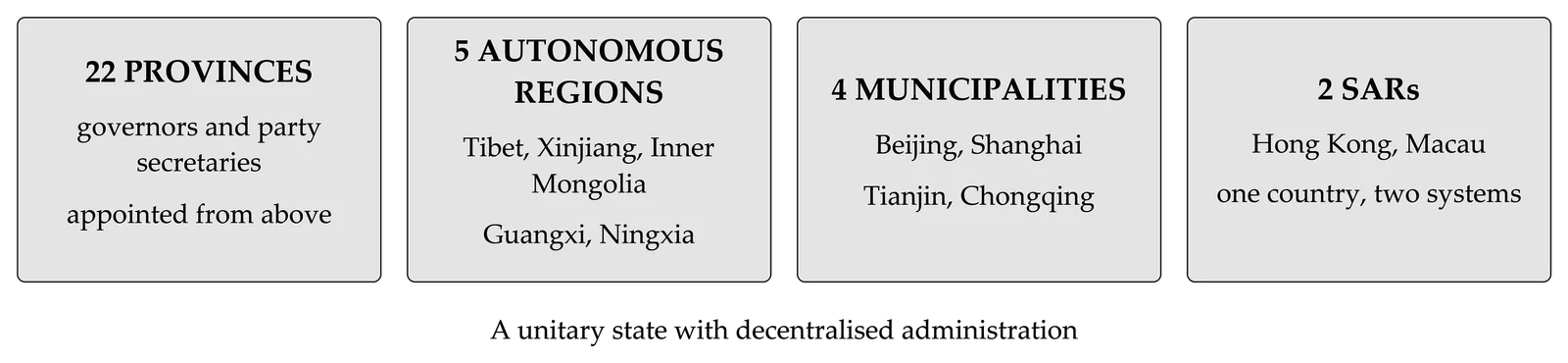
In practice, local governments have had wide discretion over economic development, and some scholars describe a de facto federalism in economic matters. But the centre controls appointments of provincial leaders through the party, and the 1994 tax-sharing reform recentralised revenues. Autonomy in Tibet and Xinjiang is limited, and the National Security Law of 2020 curtailed Hong Kong’s autonomy.
5.5 Important Questions
- Question 1 Discuss the political traditions and constitutional development of China.
- Question 2 Examine the relationship between society, economy and the nature of the state in China.
- Question 3 Discuss the role of the Communist Party and the electoral system in China.
- Question 4 Examine the nature of centre–local relations in China. Is China a unitary state?
DU asks the same idea in different words. So learn one broad answer for each question below; the same answer works for every question joined by OR.
Important Question 1
Discuss the political traditions and constitutional development of China.
OR
Examine the main features of the Chinese Constitution of 1982.
OR
Trace the evolution of the Chinese political system from Mao to Xi Jinping.
Model Answer
“Ours will no longer be a nation subject to insult and humiliation. We have stood up.”
— Mao Zedong, opening address to the Chinese People’s Political Consultative Conference (21 September 1949)
Introduction. China’s political system reflects both ancient traditions of centralised rule and the revolutionary history of the twentieth century. The Communist Party, which founded the People’s Republic in 1949, has adapted its rule through several constitutions and leaders, from Mao Zedong’s revolutionary campaigns to Deng Xiaoping’s reforms and Xi Jinping’s centralisation. William Joseph and Michael Dillon trace this development.
1. Imperial Traditions
Imperial China was governed by emperors who ruled by the mandate of heaven, which could be withdrawn if they failed. A scholar-official bureaucracy, recruited through examinations based on Confucian classics, administered the empire. Confucianism stressed hierarchy, order, family and the duty of rulers to govern virtuously.
2. The Century of Humiliation
From the Opium Wars (1839–42) to 1949, China suffered defeats, unequal treaties and foreign occupation. This memory of humiliation remains central to Chinese nationalism and the Communist Party’s claim to have restored China’s dignity.
3. Republic and Revolution
The Qing dynasty collapsed in the 1911 revolution, and the Republic of China was founded in 1912. It was divided by warlords, and the Nationalist Party (KMT) and the Communist Party, founded in 1921, fought a long civil war, interrupted by the Japanese invasion of 1937.
4. The People’s Republic
After the Long March (1934–35) and the war against Japan, the Communists won the civil war, and Mao Zedong proclaimed the People’s Republic on 1 October 1949. The Nationalists retreated to Taiwan.
5. The Mao Era
The new state carried out land reform, nationalised industry and adopted the 1954 Constitution. Mao launched mass campaigns: the Great Leap Forward (1958–62) caused a famine in which tens of millions died, and the Cultural Revolution (1966–76) persecuted officials and intellectuals and caused chaos.
6. Deng’s Reforms
After Mao’s death in 1976, Deng Xiaoping became paramount leader and launched reform and opening in December 1978. He emphasised economic development, pragmatism and collective leadership, while insisting on Communist Party rule.
7. The 1982 Constitution
The current Constitution was adopted in 1982 and amended in 1988, 1993, 1999, 2004 and 2018. Its Preamble includes the Four Cardinal Principles: the socialist road, the people’s democratic dictatorship, the leadership of the Communist Party and Marxism-Leninism-Mao Zedong Thought.
8. State Institutions
The Constitution makes the National People’s Congress the highest organ of state power, with a Standing Committee that acts between sessions. The President is head of state, the State Council led by the Premier is the government, and the Central Military Commission commands the armed forces. A National Supervisory Commission was added in 2018.
9. Democratic Centralism
Article 3 makes democratic centralism the organising principle of the state: discussion is allowed, but decisions of higher bodies bind lower ones and the minority must follow the majority. In practice, power flows from the top.
10. Leadership of the Party
A 2018 amendment added to Article 1 that the leadership of the Communist Party is the defining feature of socialism with Chinese characteristics. The party leads the state, the army and society.
11. Tiananmen and Political Limits
In 1989, student-led protests calling for political reform filled Tiananmen Square; the army suppressed them on 4 June. The leadership concluded that economic reform must not lead to political liberalisation.
12. Xi Jinping’s Centralisation
Xi Jinping became General Secretary in 2012 and President in 2013. He launched a sweeping anti-corruption campaign, concentrated power, removed presidential term limits in 2018 and began a third term in 2022–23, ending the pattern of regular leadership succession.
13. Constitution and Reality
The Constitution lists rights such as freedom of speech and religion, but courts cannot enforce them against the party, and they are limited by the four cardinal principles. The Constitution expresses the party’s programme more than it limits power.
14. Evaluation
China’s constitutional development shows the adaptability of the Communist party-state, which has shifted from revolution to reform while preserving one-party rule. Under Xi, the trend has been towards greater centralisation and personal leadership.
Conclusion. Thus, China’s political system draws on imperial traditions and the revolution of 1949. Through the Mao era, Deng’s reforms and Xi’s centralisation, the 1982 Constitution has preserved the leadership of the Communist Party, democratic centralism and a party-state in which the constitution expresses rather than limits power.
Important Question 2
Examine the relationship between society, economy and the nature of the state in China.
OR
Discuss China’s transition from a planned economy to a socialist market economy.
OR
What is the nature of the Chinese state? Discuss.
Model Answer
“The State practises socialist market economy.”
— Constitution of the People’s Republic of China, Article 15 (as amended in 1993)
Introduction. China’s economic transformation since 1978 is one of the most remarkable in history. A poor, largely rural country became the world’s second-largest economy and a manufacturing superpower. This transformation took place under one-party rule, raising questions about the nature of the Chinese state and the relationship between economic change and political control.
1. The Maoist Economy
Under Mao, China adopted Soviet-style planning: industry was nationalised and agriculture collectivised into communes. Heavy industry grew, but agriculture stagnated and campaigns such as the Great Leap Forward caused disaster.
2. Rural Reform
From 1978, the household responsibility system allowed farm families to lease land and sell surplus produce on the market. Agricultural output and rural incomes rose sharply, and township and village enterprises grew.
3. Opening to the World
Special economic zones such as Shenzhen, established in 1980, attracted foreign investment with low taxes and cheap labour. Coastal regions became export manufacturing centres, and China joined the World Trade Organization in 2001.
4. Socialist Market Economy
In 1992 the party adopted the goal of a socialist market economy, written into the Constitution in 1993. Markets allocate most goods, private firms produce much of output, but the state controls strategic sectors through state-owned enterprises and banks.
5. Rapid Growth
China grew at about ten per cent a year for three decades. Hundreds of millions were lifted out of poverty, and China became the world’s largest manufacturer and exporter.
6. Urbanisation and Migration
Hundreds of millions moved from villages to cities. The hukou system, which ties social services to place of registration, left many migrant workers without equal access to urban schools, health care and pensions.
7. Inequality and Environment
Growth increased inequality between coast and interior, cities and countryside, and within cities. Pollution and environmental damage became serious problems, leading to new policies on clean energy and environmental protection.
8. Social Change
A large middle class emerged, education expanded and the internet spread, but civil society and media remain controlled. The one-child policy (1980–2015) slowed population growth but contributed to an ageing society; it was replaced by two-child and then three-child policies.
9. Ethnic Minorities
China recognises 55 minority nationalities besides the Han majority. Policies in Tibet and Xinjiang emphasise stability and integration; mass detentions of Uyghurs in Xinjiang have drawn international criticism, which China rejects.
10. The Party-state
Joseph describes China as a Leninist party-state, in which the Communist Party controls the state, the economy and society through its organisation, appointments and propaganda. Private entrepreneurs were admitted to the party after Jiang Zemin’s Three Represents theory (2000).
11. Theories of the Chinese State
Kenneth Lieberthal and Michel Oksenberg described fragmented authoritarianism, in which bargaining among agencies and regions shapes policy. Andrew Nathan spoke of resilient authoritarianism, explaining the regime’s survival through institutionalisation, performance and adaptation.
12. Performance Legitimacy
The party’s legitimacy rests largely on economic growth, rising living standards, nationalism and order, rather than on elections. Slowing growth therefore poses a political challenge.
13. Xi’s Economic Turn
Under Xi Jinping, the state has reasserted control over private technology firms, pursued self-reliance in technology, promoted common prosperity to reduce inequality and launched the Belt and Road Initiative (2013) to expand influence abroad.
14. Poverty Reduction
China’s reduction of poverty is among the largest in history. Growth, rural reforms, infrastructure and targeted programmes raised incomes across the country, and in 2021 the government declared that extreme rural poverty, measured by its national line, had been eliminated. Critics note that the line is low and that rural–urban gaps remain, but the scale of change underpins the party’s claim to legitimacy.
15. Evaluation
China shows that rapid market-driven growth can occur under authoritarian rule. Its state combines market dynamism with party control, but faces challenges of inequality, ageing, environment and slowing growth.
Conclusion. Thus, China moved from a Maoist planned economy to a socialist market economy that produced rapid growth, urbanisation and a large middle class. The state remains a Leninist party-state whose legitimacy rests on performance and nationalism, with growing state control under Xi.
Important Question 3
Discuss the role of the Communist Party and the electoral system in China.
OR
Examine the organisation and role of the Chinese Communist Party.
OR
Is China a one-party state? Discuss the place of other parties and elections.
Model Answer
“The leadership of the Communist Party of China is the defining feature of socialism with Chinese characteristics.”
— Constitution of the People’s Republic of China, Article 1 (as amended in 2018)
Introduction. China is governed by the Chinese Communist Party, which has ruled since 1949 and whose leadership is written into the Constitution. China has other parties and holds elections, but they do not allow competition for power. Understanding the party’s organisation and the electoral system is essential to understanding Chinese politics.
1. A Leninist Party
The CCP is organised on Leninist principles of democratic centralism: members may discuss policy, but must obey decisions of higher bodies. The party claims to represent the interests of the whole people and to lead the nation towards socialism.
2. Membership
With about 99 million members in 2023, the CCP is one of the largest political organisations in the world. Members include workers, farmers, officials, professionals and, since 2001, private entrepreneurs.
3. Party Organisation
The National Party Congress meets every five years and elects the Central Committee. The Central Committee elects the Politburo, about two dozen members, and its Standing Committee, usually seven members, which is the top decision-making body. The General Secretary is the party’s leader.
4. Party Control of the State
Senior state officials are also senior party members. The General Secretary is usually also President and chairman of the Central Military Commission. Party committees operate in ministries, courts, universities and enterprises.
5. The Nomenklatura System
The party’s Organisation Department controls appointments to important posts in government, state enterprises and other institutions through the nomenklatura system, ensuring loyalty and party control.
6. Party Control of the Army
The People’s Liberation Army is the party’s army, not a neutral national army. Mao said that political power grows out of the barrel of a gun, and the party commands the gun through the Central Military Commission.
7. The Democratic Parties
Eight small parties, such as the China Democratic League and the Revolutionary Committee of the Kuomintang, are legal. They accept CCP leadership and participate in multiparty cooperation and political consultation, but do not compete for power.
8. The CPPCC
The Chinese People’s Political Consultative Conference brings together the democratic parties, mass organisations and prominent individuals to advise the government. It is part of the party’s united front strategy.
9. People’s Congresses
People’s congresses exist at every level from township to the national level. The National People’s Congress has about 3,000 deputies and meets annually to approve laws, budgets and appointments.
10. Electoral System
Voters directly elect deputies only to the people’s congresses of townships and counties. Higher congresses, including the NPC, are elected indirectly by the congresses below. Party committees control the nomination process, so elections confirm rather than choose leaders.
11. Village Elections
Since the late 1980s, villagers have elected village committees, and some elections have been competitive. However, village party secretaries usually hold more power, and the experiment has not spread to higher levels.
12. Intra-party Politics
Political competition takes place within the party, among factions and networks. After Deng, collective leadership and term limits made succession more regular, but Xi Jinping has concentrated power and ended term limits.
13. Comparison
Unlike the competitive party systems of Britain or Brazil, or even Russia’s managed multiparty system, China has an openly hegemonic one-party system in which the ruling party’s leadership is constitutionally entrenched.
14. Party Discipline
The party polices its own members through the Central Commission for Discipline Inspection. Under Xi Jinping’s anti-corruption campaign, very large numbers of officials were punished, from senior leaders called tigers to junior officials called flies. The campaign improved discipline and popular approval, but critics argue it was also used against political rivals and strengthened Xi’s personal control.
15. Evaluation
The CCP has proved adaptable, recruiting new social groups and using consultation and limited elections to gather information. But the absence of competitive elections means there is no peaceful way to change the ruling party.
Conclusion. Thus, the Chinese Communist Party leads the state, army and society through democratic centralism and the nomenklatura system. Eight democratic parties and elections to people’s congresses exist, but they operate under party leadership, making China a one-party state.
Important Question 4
Examine the nature of centre–local relations in China. Is China a unitary state?
OR
Discuss the autonomous regions and special administrative regions in China.
OR
‘China is a unitary state with elements of de facto federalism.’ Discuss.
Model Answer
“Regional autonomy is practised in areas where people of minority nationalities live in concentrated communities.”
— Constitution of the People’s Republic of China, Article 4
Introduction. China is a vast and diverse country governed as a unitary state. Power is formally concentrated at the centre, but provinces and localities have significant administrative and economic discretion. China also has autonomous regions for minority nationalities and special administrative regions under one country, two systems. Understanding centre–local relations is key to understanding how China is governed.
1. Unitary Constitution
The Constitution makes China a unitary multinational state. Article 3 provides that the division of functions between central and local state organs follows the principle of giving full scope to local initiative under the unified leadership of the central authorities.
2. Levels of Administration
China has four main levels below the centre: provinces, prefectures, counties and townships. Each level has a people’s congress, a government and, more importantly, a party committee.
3. Provinces and Municipalities
China has 22 provinces, plus Taiwan, which it claims as a province, and four municipalities directly under the centre: Beijing, Shanghai, Tianjin and Chongqing. Provincial leaders are appointed by the centre through the party.
4. Autonomous Regions
Five autonomous regions, Tibet, Xinjiang, Inner Mongolia, Guangxi and Ningxia, along with autonomous prefectures and counties, are designated for minority nationalities. The Law on Regional National Autonomy (1984) gives them some rights over language, culture and local regulations.
5. Limits of Autonomy
In practice, autonomy is limited: party secretaries, often Han, hold real power, and policies emphasise stability and integration. Unrest in Tibet (2008) and Xinjiang (2009) led to tighter control.
6. Special Administrative Regions
Hong Kong (returned by Britain in 1997) and Macau (returned by Portugal in 1999) are governed under one country, two systems, retaining their own legal, economic and administrative systems under their Basic Laws for fifty years.
7. Hong Kong’s Changing Autonomy
After large protests in 2019, the National Security Law of 2020 criminalised secession, subversion, terrorism and collusion with foreign forces, and electoral changes in 2021 ensured that only patriots govern Hong Kong. Critics argue that these changes undermined its autonomy.
8. Economic Decentralisation
During the reform era, local governments were given wide discretion over economic development, competing to attract investment. This decentralisation contributed to rapid growth.
9. De Facto Federalism
Scholars such as Zheng Yongnian argue that China practises de facto federalism: although formally unitary, provinces have substantial autonomy in economic policy, and central-local relations involve bargaining.
10. Fiscal Recentralisation
The 1994 tax-sharing reform increased the centre’s share of revenue, while leaving many spending responsibilities with local governments, which turned to land sales and borrowing, creating local debt problems.
11. Party Control
The decisive instrument of central control is the party’s power over appointments and promotion. Local officials are evaluated by their superiors on criteria such as growth, stability and, increasingly, environmental targets.
12. Taiwan
The People’s Republic claims Taiwan, governed separately since 1949, as part of China and has proposed one country, two systems for it. Taiwan has developed into a democracy, and relations remain tense.
13. Comparison
Unlike federations such as the US or Brazil, Chinese provinces have no constitutional guarantee of powers. Unlike Britain’s devolution, autonomy is not based on elected local legislatures but on administrative delegation within a party-state.
14. Local Discretion and Its Problems
An old Chinese saying holds that the mountains are high and the emperor is far away. Local officials often protect local firms, ignore central rules on land or pollution, or exaggerate statistics to win promotion. The centre responds with inspections, campaigns and new evaluation criteria, showing that even a centralised party-state must constantly struggle to control its localities.
15. Evaluation
China is constitutionally unitary and politically centralised through the party, but administratively and economically decentralised. Its autonomous regions and SARs show both the flexibility and the limits of autonomy within a party-state.
Conclusion. Thus, China is a unitary state in which the centre controls provinces through the party, while giving localities wide economic discretion, sometimes described as de facto federalism. Autonomous regions and the SARs of Hong Kong and Macau have special status, but their autonomy has been increasingly limited.
Short Notes
(a) Democratic centralism
The Leninist organising principle of the Communist Party and the Chinese state. Members and lower bodies may discuss policy, but once decisions are made, the minority must obey the majority and lower bodies must obey higher ones. In practice it concentrates power at the top.
(b) Socialist market economy
China’s economic system, adopted in 1992 and written into the Constitution in 1993. Markets allocate most resources and private enterprise is extensive, but the state controls strategic sectors through state-owned enterprises and banks, under the leadership of the Communist Party.
(c) One country, two systems
The principle, proposed by Deng Xiaoping, under which Hong Kong and Macau retain their own capitalist economic, legal and administrative systems after reunification with China, for fifty years. Its application in Hong Kong has been contested since the National Security Law of 2020.
(d) Hukou system
China’s household registration system, introduced in 1958, which records each person’s place of residence and determines access to public services. It has restricted rural migrants’ access to urban schools, health care and housing, creating a divide between urban and rural citizens.
(e) Mandate of heaven
The traditional Chinese idea that emperors ruled with heaven’s approval as long as they governed justly and kept order; natural disasters, rebellion or misrule were signs that the mandate had been lost and could pass to a new dynasty. Scholars see echoes of it in the Communist Party’s reliance on performance for legitimacy.
More notes: MDSC-6B Comparative Political Systems
These notes are prepared by PADHO TO AISE for study help. They are not an official University of Delhi publication.