
Semester VI MDSC-6B Comparative Political Systems
Unit VII · 21 min read · Updated 24 Nov 2026
As per the University of Delhi (DU) BA (Hons) Political Science syllabus
Contents
- 7.1 Political Traditions and Constitutional Development
- 7.2 Society and Economy: Nature of the State
- 7.3 Party and Electoral System
- 7.4 A Unitary State
- 7.5 Important Questions
- Discuss the political traditions and constitutional development of Israel.
- Examine the relationship between society, economy and the nature of the state in Israel.
- Discuss the party and electoral system of Israel.
- Examine the unitary nature of the Israeli state and the issue of territories.
- Short Notes
इज़राइल राज्य अपने सभी निवासियों को धर्म, नस्ल या लिंग की परवाह किए बिना सामाजिक और राजनीतिक अधिकारों की पूर्ण समानता सुनिश्चित करेगा।
The State of Israel … will ensure complete equality of social and political rights to all its inhabitants irrespective of religion, race or sex.
— Declaration of the Establishment of the State of Israel, 14 May 1948
ISRAEL, established in 1948, defines itself as a Jewish and democratic state. It is a parliamentary democracy without a single written constitution, governed instead by a series of Basic Laws, and it elects its parliament, the Knesset, by one of the most purely proportional systems in the world, so that every government is a coalition. Israeli politics is shaped by deep divisions, between religious and secular Jews, between Jewish and Arab citizens, and over the long conflict with the Palestinians and the territories occupied since 1967. This unit studies Israel’s political traditions and constitutional development, its society and economy, its party and electoral system, and its unitary system, drawing on Don Peretz, Gregory Mahler and Sunil K. Choudhary.

7.1 Political Traditions and Constitutional Development
Modern Zionism, the movement for a Jewish national home, was founded by Theodor Herzl, whose The Jewish State (1896) led to the First Zionist Congress in 1897. Jewish immigrants built communities in Ottoman and then British-ruled Palestine; the Balfour Declaration (1917) supported a Jewish national home, and Britain governed Palestine under a League of Nations Mandate. Arab opposition, violence between communities and, after the Holocaust, international support led the UN to recommend partition in 1947. Israel declared independence in 1948; in the war that followed, about 700,000 Palestinian Arabs fled or were expelled, an event Palestinians call the Nakba.
The Constituent Assembly elected in 1949 became the first Knesset and did not adopt a constitution, because of disagreements, especially over religion. The Harari Decision (1950) resolved that the constitution would be built chapter by chapter through Basic Laws. In 1992 the Basic Laws on Human Dignity and Liberty and Freedom of Occupation protected rights, and in the Mizrahi Bank case (1995) the Supreme Court, led by Aharon Barak, held that it could strike down laws that violate them, a constitutional revolution. The Nation-State Law (2018) and the government’s judicial overhaul plans of 2023, which provoked mass protests, show that the constitutional order remains contested.
7.2 Society and Economy: Nature of the State
Israel has about ten million people: roughly three-quarters Jewish and about a fifth Arab citizens, mostly Muslim, with Christian and Druze communities. Jewish society is itself diverse: secular and religious, Ashkenazi Jews of European origin and Mizrahi Jews from the Middle East and North Africa, immigrants from the former Soviet Union and Ethiopia, and a fast-growing Haredi (ultra-Orthodox) community. The Law of Return (1950) grants every Jew the right to immigrate.

Israel’s early economy was shaped by labour Zionism: collective farms (kibbutzim), cooperative villages and the trade union federation, the Histadrut, a major employer. After the stabilisation plan of 1985 ended hyperinflation, Israel liberalised and became a high-tech economy, joining the OECD in 2010. Scholars debate the nature of the state: Sammy Smooha described Israel as an ethnic democracy, democratic for all citizens but serving one national group, while critics call it an ethnocracy. The occupation of the West Bank since 1967 and the conflict with Palestinians, including the Hamas attack of 7 October 2023 and the war in Gaza, remain central to its politics.
7.3 Party and Electoral System
The 120-member Knesset is elected by closed-list proportional representation in a single nationwide constituency. The threshold has been raised from 1 per cent to 3.25 per cent (since 2015), but many parties still win seats, and no party has ever won a majority, so every government is a coalition. The Prime Minister must command the Knesset’s confidence. From 1996 to 2001 the Prime Minister was directly elected, but this was abolished because it further fragmented the Knesset.
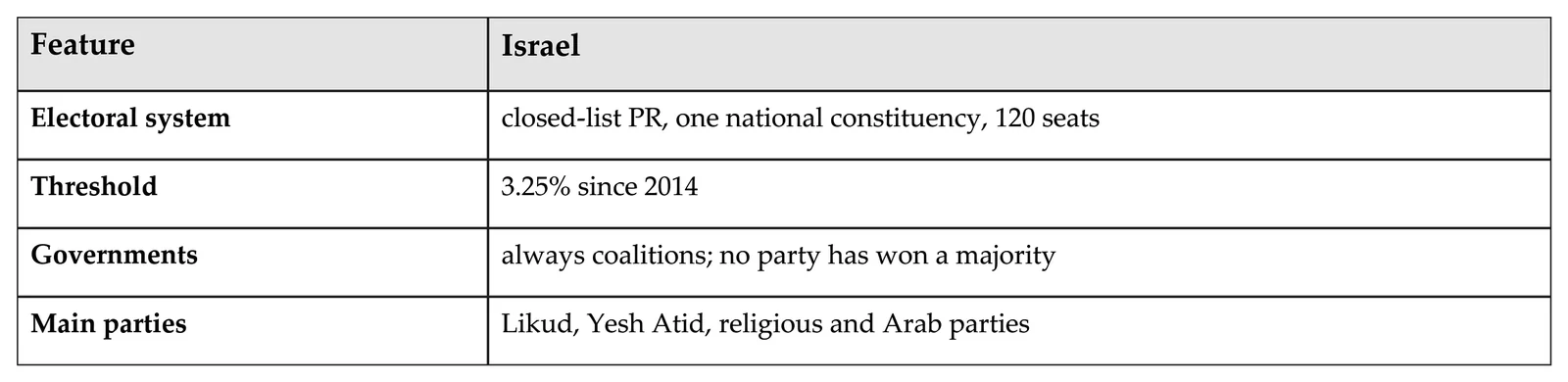
Sunil K. Choudhary traces the changing party system. From 1948 to 1977, Mapai, later Labour, led by David Ben-Gurion, was the dominant party. In 1977 the right-wing Likud under Menachem Begin won power, the mahapach (upheaval), creating competition between two blocs. Since the 1990s, fragmentation increased, with religious parties such as Shas and United Torah Judaism, centre parties such as Yesh Atid, nationalist parties and Arab parties. Between 2019 and 2022 Israel held five elections; in 2021 an Arab party, Ra’am, joined a governing coalition for the first time.
7.4 A Unitary State
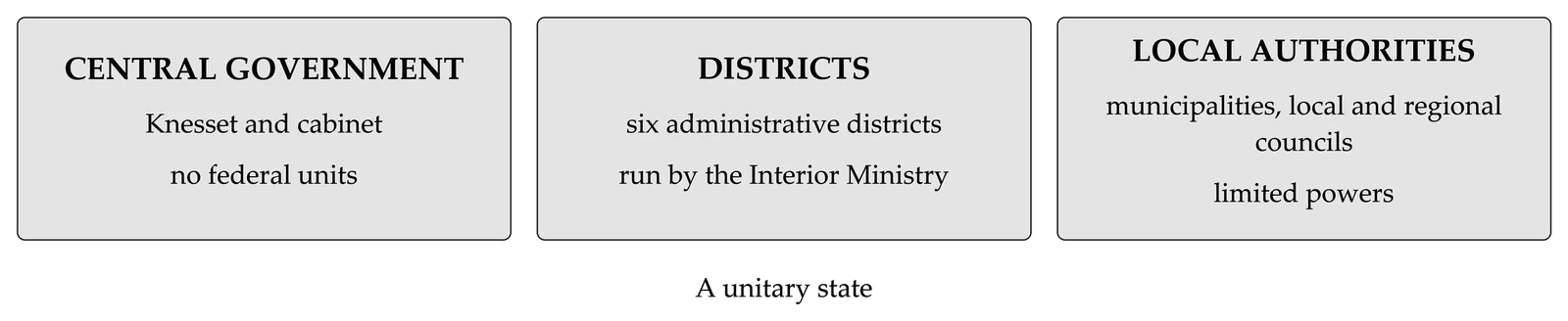
Israel is a unitary state with no federal units. The Knesset and the government hold sovereign authority, and the state is divided into six administrative districts run by the Ministry of the Interior. Local government consists of municipalities, local councils and regional councils, with directly elected mayors since 1978, but they depend heavily on central funding and control.
The territories captured in 1967 complicate this picture. Israel applied its law to East Jerusalem and the Golan Heights, annexations that most countries do not recognise. The West Bank is under military administration, with Israeli settlements and areas governed by the Palestinian Authority created under the Oslo Accords (1993–95). Israel withdrew from Gaza in 2005, and Hamas took control there in 2007. The future of these territories, and of a two-state solution, remains unresolved.
7.5 Important Questions
- Question 1 Discuss the political traditions and constitutional development of Israel.
- Question 2 Examine the relationship between society, economy and the nature of the state in Israel.
- Question 3 Discuss the party and electoral system of Israel.
- Question 4 Examine the unitary nature of the Israeli state and the issue of territories.
DU asks the same idea in different words. So learn one broad answer for each question below; the same answer works for every question joined by OR.
Important Question 1
Discuss the political traditions and constitutional development of Israel.
OR
Israel has no written constitution. Examine the role of the Basic Laws.
OR
Discuss the ‘constitutional revolution’ and the role of the Supreme Court in Israel.
Model Answer
“The purpose of this Basic Law is to protect human dignity and liberty, in order to establish in a Basic Law the values of the State of Israel as a Jewish and democratic state.”
— Basic Law: Human Dignity and Liberty (1992), Section 1A
Introduction. Israel is a parliamentary democracy founded in 1948 by the Zionist movement. Unlike most democracies, it has no single written constitution; its constitutional order has developed through Basic Laws and judicial decisions. Don Peretz and Gregory Mahler trace how this system emerged from Israel’s history and how it continues to be contested.
1. Zionism
Zionism emerged in nineteenth-century Europe as a response to antisemitism and the rise of nationalism. Theodor Herzl’s The Jewish State (1896) called for a Jewish state, and the First Zionist Congress at Basel (1897) organised the movement. Different streams, labour, religious and revisionist Zionism, shaped later Israeli politics.
2. The Yishuv
Jewish immigrants to Palestine built the Yishuv, a self-governing community with elected institutions, the Histadrut trade union federation (1920) and defence forces. These institutions, dominated by labour Zionists, became the basis of the state.
3. The British Mandate
Britain’s Balfour Declaration (1917) supported a Jewish national home, and Britain ruled Palestine under a League of Nations Mandate. Arab and Jewish communities clashed, and Britain limited Jewish immigration in 1939.
4. Partition and Independence
On 29 November 1947, the UN General Assembly recommended partition into Jewish and Arab states. Israel declared independence on 14 May 1948, promising equality of rights to all inhabitants. In the war that followed, about 700,000 Palestinian Arabs became refugees, an event Palestinians call the Nakba.
5. The Constitutional Question
The Constituent Assembly elected in 1949 failed to adopt a constitution, because religious parties opposed a secular constitution, Ben-Gurion preferred flexibility, and there were disagreements over the state’s identity.
6. The Harari Decision
On 13 June 1950 the Knesset adopted the Harari Decision, resolving that the constitution would be written in stages through Basic Laws, each a chapter of a future constitution.
7. The Basic Laws
Basic Laws have been enacted on the Knesset (1958), the President (1964), the Government (1968), the Judiciary (1984), Human Dignity and Liberty (1992), Freedom of Occupation (1992), and the Nation-State (2018), among others. Most can be amended by an ordinary majority.
8. Parliamentary Government
Israel is a parliamentary democracy. The President is a largely ceremonial head of state elected by the Knesset for a single seven-year term. The Prime Minister heads the government and must retain the Knesset’s confidence.
9. The Constitutional Revolution
The 1992 Basic Laws protected human dignity, liberty and freedom of occupation. In United Mizrahi Bank v. Migdal (1995), the Supreme Court, under Aharon Barak, held that Basic Laws have constitutional status and that courts may strike down conflicting laws. Barak called this a constitutional revolution.
10. An Activist Supreme Court
The Supreme Court, sitting as the High Court of Justice, became an active guardian of rights and the rule of law, hearing petitions from citizens, including Palestinians, and reviewing government action using standards such as reasonableness.
11. The Nation-State Law
The Basic Law: Israel as the Nation-State of the Jewish People (2018) declared that the right to national self-determination in Israel is unique to the Jewish people and gave Hebrew the status of the official language, with Arabic having a special status. Critics argued it weakened equality for Arab citizens.
12. The Judicial Overhaul Crisis
In 2023, the government led by Benjamin Netanyahu proposed reforms to limit the Supreme Court’s powers and give politicians more control over judicial appointments. Mass protests followed. In January 2024, the Supreme Court struck down a law abolishing the reasonableness standard.
13. Jewish and Democratic
The central constitutional question is how to reconcile Israel’s identity as a Jewish state with democratic equality for all citizens. Different Basic Laws and court decisions balance these values differently.
14. Evaluation
Israel’s constitutional order has developed flexibly through Basic Laws and judicial interpretation. Its lack of a fully entrenched constitution makes it vulnerable to political conflict over the role of courts and the identity of the state.
Conclusion. Thus, Israel emerged from the Zionist movement and the British Mandate as a parliamentary democracy without a single written constitution. Its constitution is being built through Basic Laws, strengthened by the constitutional revolution of the 1990s, but contested in the Nation-State Law and the judicial overhaul crisis.
Important Question 2
Examine the relationship between society, economy and the nature of the state in Israel.
OR
‘Israel is a Jewish and democratic state.’ Discuss the debates over this definition.
OR
Discuss the main social cleavages in Israeli politics.
Model Answer
“It will guarantee freedom of religion, conscience, language, education and culture.”
— Declaration of the Establishment of the State of Israel (1948)
Introduction. Israel is a diverse society of immigrants and natives, Jews and Arabs, religious and secular citizens. Its economy has changed from a labour-Zionist mixed economy to a high-tech market economy. These features shape debates about the nature of the Israeli state, described as Jewish and democratic, and its relationship with its Arab citizens and the Palestinians.
1. A Society of Immigrants
Israel’s Jewish population was built through waves of immigration: from Europe before and after the Holocaust, from Arab countries in the 1950s, from the former Soviet Union in the 1990s and from Ethiopia. The Law of Return (1950) grants every Jew the right to immigrate and become a citizen.
2. Ashkenazi and Mizrahi
Ashkenazi Jews of European origin dominated early institutions, while Mizrahi Jews from the Middle East and North Africa faced discrimination. Mizrahi grievances contributed to Likud’s victory in 1977 and the rise of the Shas party.
3. Religious and Secular
Jewish Israelis range from secular to traditional, religious Zionist and Haredi. Religious authorities control marriage and divorce for Jews, and debates over Sabbath laws and the exemption of Haredi men from military service are major political issues; in 2024 the Supreme Court ruled that Haredi students must be drafted.
4. Arab Citizens
Arab citizens, about a fifth of the population, have the vote and are represented in the Knesset, but they face inequalities in land, budgets, housing and services, and many identify as Palestinian. Druze citizens serve in the army, while most other Arab citizens do not.
5. Jewish and Democratic
Israel defines itself as a Jewish and democratic state. Supporters argue that, like other nation-states, it can express a national identity while protecting the rights of all citizens. Critics argue that the Jewish character of the state limits equality for non-Jewish citizens.
6. Ethnic Democracy
Sammy Smooha described Israel as an ethnic democracy, in which democratic rights are extended to all citizens but the state belongs to and serves one ethnic nation. Oren Yiftachel went further, calling it an ethnocracy, especially when the occupied territories are considered.
7. The Occupation
Since 1967, Israel has controlled the West Bank, where several hundred thousand Israeli settlers live alongside millions of Palestinians without Israeli citizenship. Most of the international community regards the settlements as contrary to international law; Israel disputes this. The issue shapes debates about Israel’s democracy.
8. Labour Zionism and the Mixed Economy
In the early decades, the economy was shaped by the labour movement: the Histadrut owned major enterprises and ran health services, and kibbutzim and moshavim organised agriculture. The state played a large role in development.
9. Liberalisation
High inflation in the early 1980s led to the Economic Stabilization Plan of 1985, which ended hyperinflation. Israel then privatised enterprises, reduced the Histadrut’s role and opened its economy.
10. The High-tech Economy
Israel became a centre of technology and start-ups, often linked to military research. It joined the OECD in 2010. Yet high living costs and inequality, especially among Haredi and Arab citizens, led to mass social protests in 2011.
11. Security and Society
Wars and conflict have made security central. Military service is compulsory for most Jewish citizens, and the army is a key institution. The Hamas attack of 7 October 2023, which killed about 1,200 people in Israel, and the ensuing war in Gaza, which caused very heavy Palestinian casualties and destruction, deepened divisions and international debate.
12. Nature of the State
Mahler describes Israel as a maturing democracy with strong institutions, a free press and competitive elections, facing tensions between its Jewish identity, its democratic values and the unresolved conflict with the Palestinians.
13. Comparison
Like India, Israel is a democracy with deep religious and ethnic divisions and debates about the relationship between national identity and minority rights, though its specific history of statehood and conflict is unique.
14. Evaluation
Israel’s society and economy have changed dramatically, producing a prosperous democracy. But its identity as a Jewish and democratic state, the status of Arab citizens and the occupation remain unresolved questions.
Conclusion. Thus, Israel is a diverse immigrant society divided by religion, ethnicity and nationality, with an economy that moved from labour Zionism to high-tech capitalism. Its nature as a Jewish and democratic state, described by some as an ethnic democracy, is shaped by the status of Arab citizens and the conflict with the Palestinians.
Important Question 3
Discuss the party and electoral system of Israel.
OR
Why are all governments in Israel coalition governments?
OR
Trace the changing nature of Israel’s party system with reference to Sunil K. Choudhary.
Model Answer
“The Knesset shall be elected by general, national, direct, equal, secret and proportional elections.”
— Basic Law: The Knesset (1958), Section 4
Introduction. Israel’s electoral system is one of the most proportional in the world, and its party system one of the most fragmented. Every government since 1948 has been a coalition. The party system has changed from the dominance of one party to bipolar competition and then to fragmentation. Sunil K. Choudhary’s study of party systems traces these changes.
1. The Electoral System
The 120 members of the Knesset are elected by closed-list proportional representation in a single national constituency. Voters choose a party list, and seats are distributed in proportion to votes among parties that pass the threshold.
2. The Threshold
The threshold was originally 1 per cent and was raised to 1.5 per cent in 1992, 2 per cent in 2006 and 3.25 per cent from 2015, in order to reduce fragmentation. Even so, ten or more parties usually win seats.
3. Coalition Governments
No party has ever won a majority of 61 seats. The President asks the leader most likely to form a government to try, and coalitions are built through negotiations over posts and policies. Small parties, especially religious ones, often hold the balance.
4. The Dominant-party Phase
From 1948 to 1977, Mapai, later the Labour Party, led every government under leaders such as David Ben-Gurion and Golda Meir. Its dominance rested on its role in building the state and its control of the Histadrut.
5. The 1977 Upheaval
In 1977 Likud, led by Menachem Begin, won the election, ending Labour’s dominance. Choudhary sees this mahapach as the beginning of a competitive two-bloc system of left and right.
6. Direct Election of the Prime Minister
From 1996 to 2001, Israel elected the Prime Minister directly while electing the Knesset separately. Voters split their votes, strengthening small parties and weakening the large ones, so the system was abolished in 2001.
7. Religious Parties
Religious parties such as the Sephardi Shas (1984), the Ashkenazi United Torah Judaism and religious Zionist parties play a key role in coalitions, securing funding for their institutions and influence on religious matters.
8. Centre Parties
New centre parties have repeatedly emerged, such as Kadima, founded by Ariel Sharon in 2005, Yesh Atid (2012) led by Yair Lapid, and Blue and White (2019). Many have been short-lived.
9. Arab Parties
Arab parties such as Hadash, Balad, Ta’al and Ra’am represent Arab citizens and sometimes run together as the Joint List. In 2021, Ra’am joined the governing coalition of Naftali Bennett and Yair Lapid, the first Arab party to do so.
10. The Era of Repeated Elections
Israel held five elections between 2019 and 2022, as neither the bloc supporting Benjamin Netanyahu nor his opponents could form a stable majority. In late 2022, Netanyahu formed a government with religious and far-right parties.
11. Personalisation
Choudhary notes that Israeli politics has become increasingly personalised, with parties built around leaders and elections becoming referendums on figures such as Netanyahu.
12. Merits and Problems
Proportional representation gives voice to Israel’s many social groups, but it produces fragmentation, unstable coalitions and disproportionate influence for small parties.
13. Comparison with India
Choudhary compares Israel and India, both of which moved from a dominant party, Mapai and Congress, to competitive and coalition-based party systems, though India uses first past the post and Israel extreme PR.
14. Evaluation
Israel’s electoral system ensures broad representation of a divided society but creates fragmentation and coalition instability. Its party system has moved from dominance to bipolar competition and then to personalised fragmentation.
Conclusion. Thus, Israel’s Knesset is elected by national closed-list PR with a 3.25 per cent threshold, producing a fragmented party system and permanent coalition governments. The party system has moved from Mapai’s dominance through the Likud upheaval of 1977 to fragmentation and personalisation.
Important Question 4
Examine the unitary nature of the Israeli state and the issue of territories.
OR
Discuss local government in Israel.
OR
Discuss the political status of the territories occupied by Israel in 1967.
Model Answer
“Independent Arab and Jewish States and the Special International Regime for the City of Jerusalem … shall come into existence in Palestine.”
— UN General Assembly Resolution 181 (II) (1947)
Introduction. Israel is a small unitary state with a centralised system of government. It has no federal units, and local authorities have limited powers. Yet the question of territory, borders and the status of the areas captured in 1967 makes the structure of the Israeli state more complex than its formal unitary character suggests.
1. A Unitary State
Israel has a single legislature, the Knesset, and a single government. There are no provinces or states with their own constitutions. National laws apply uniformly within Israel’s recognised territory.
2. Reasons for Centralisation
Israel’s small size, the need to absorb immigrants, security threats and the tradition of centralised Zionist institutions all encouraged a strong central government.
3. Administrative Districts
The country is divided into six districts, Jerusalem, Northern, Haifa, Central, Tel Aviv and Southern, administered by the Ministry of the Interior. They are administrative units, not self-governing regions.
4. Local Government
Local government includes municipalities for cities, local councils for towns and regional councils for rural areas. Mayors have been directly elected since 1978, and local elections are held every five years.
5. Central Control
Local authorities depend heavily on central grants and are supervised by the Ministry of the Interior, which can dismiss failing councils. Arab localities have historically received fewer resources, a source of complaint.
6. The 1967 War
In the Six-Day War of June 1967, Israel captured the West Bank and East Jerusalem from Jordan, Gaza and Sinai from Egypt, and the Golan Heights from Syria. Sinai was returned to Egypt after the peace treaty of 1979.
7. East Jerusalem and the Golan
Israel applied its law to East Jerusalem, confirmed by the Jerusalem Law of 1980, and to the Golan Heights in 1981. Most countries regard these as occupied territories and do not recognise the annexations.
8. The West Bank
The West Bank has been under Israeli military administration since 1967. Israel has built settlements there, now home to several hundred thousand Israelis, which most of the international community considers illegal under international law, a view Israel disputes.
9. The Oslo Accords
The Oslo Accords between Israel and the Palestine Liberation Organization (1993–95) created the Palestinian Authority, which governs Palestinian cities in parts of the West Bank, while Israel retains control over most of the territory.
10. Gaza
Israel withdrew its settlements and troops from Gaza in 2005. Hamas took control in 2007, and Israel and Egypt imposed a blockade. After the Hamas attack of 7 October 2023, Israel waged a long war in Gaza with very heavy loss of life.
11. Two States or One
The two-state solution envisages a Palestinian state alongside Israel. Settlement expansion, divisions among Palestinians and repeated wars have made it harder to achieve, and debates continue over alternatives.
12. Effect on Israeli Democracy
Scholars argue that control over millions of Palestinians without citizenship affects the character of Israeli democracy, while supporters of Israeli policy emphasise security needs and the failure of peace efforts.
13. Comparison
Like the UK and China, Israel is formally unitary, but unlike the UK it has no devolved national regions, and unlike China its central question concerns contested territories rather than internal administration.
14. Peace Agreements and Borders
Some of Israel’s borders have been settled by treaty: the peace treaty with Egypt (1979) fixed the southern border, and the treaty with Jordan (1994) the eastern border along the Jordan valley. The Abraham Accords of 2020 normalised relations with the United Arab Emirates, Bahrain and Morocco, without resolving the Palestinian question. Borders with Syria and Lebanon, and the final status of the West Bank and Jerusalem, remain disputed.
15. Evaluation
Israel’s internal structure is clearly unitary and centralised, but the unresolved status of the territories occupied in 1967 makes its borders and the reach of its democracy matters of continuing political and international dispute.
Conclusion. Thus, Israel is a centralised unitary state with administrative districts and dependent local authorities. The territories captured in 1967, East Jerusalem, the Golan, the West Bank and Gaza, complicate its structure and remain at the centre of the unresolved Israeli–Palestinian conflict.
Short Notes
(a) Basic Laws
Israel’s constitutional laws, enacted by the Knesset since 1958 under the Harari Decision of 1950 as chapters of a future constitution. They cover the Knesset, the government, the judiciary, human dignity and liberty, and Israel as the nation-state of the Jewish people. The Supreme Court treats them as having constitutional status.
(b) Law of Return
A law of 1950 granting every Jew the right to immigrate to Israel and receive citizenship, later extended to children and grandchildren of Jews. It expresses Israel’s identity as a homeland for the Jewish people; critics contrast it with the denial of return to Palestinian refugees.
(c) Mahapach
Hebrew for ‘upheaval’, the term for the 1977 election in which Menachem Begin’s Likud defeated the Labour Alignment, ending three decades of Labour dominance. It was driven in part by Mizrahi voters and transformed Israel into a competitive two-bloc party system.
(d) Ethnic democracy
Sammy Smooha’s term for a regime that grants democratic rights to all citizens but in which the state is owned by and serves one ethnic nation. He applied it to Israel; critics argue that it either understates or overstates the inequalities faced by Arab citizens.
More notes: MDSC-6B Comparative Political Systems
These notes are prepared by PADHO TO AISE for study help. They are not an official University of Delhi publication.