

Semester VI DSC-16 Public Policy
Unit III · 17 min read · Updated 24 Nov 2026
As per the University of Delhi (DU) BA (Hons) Political Science syllabus
Contents
- 3.1 Meaning and Types of Evaluation
- 3.2 Principles for Evaluation
- 3.3 Methods and Techniques of Evaluation
- 3.4 Evaluation in India
- 3.5 Important Questions
- What is policy evaluation? Discuss the principles for evaluation of public policy.
- Discuss the methods and techniques of policy evaluation.
- Examine the institutions and challenges of policy evaluation in India.
- Short Notes
जब रसोइया सूप चखता है, वह रचनात्मक मूल्यांकन है; जब मेहमान सूप चखते हैं, वह योगात्मक मूल्यांकन है।
When the cook tastes the soup, that’s formative; when the guests taste the soup, that’s summative.
— Robert Stake, as quoted by Michael Scriven
DOES a policy work? Did a school meal scheme raise attendance, did a road reduce poverty, did a subsidy reach the poor? Policy evaluation is the systematic assessment of the design, implementation and results of a policy, to judge its value and improve it. Evaluation rests on principles, standards by which policies are judged, and uses methods and techniques, from cost-benefit analysis to randomised trials and social audits. This unit studies the principles and methods of evaluation, drawing on Charles Anderson, Stephen Linder and B. Guy Peters, Malcolm Provus and S. Purdon and colleagues, and examines how evaluation is done in India.

3.1 Meaning and Types of Evaluation
Policy evaluation is the systematic assessment of the operation and outcomes of a policy against explicit or implicit standards, as Carol Weiss put it, in order to improve it. Michael Scriven distinguished formative evaluation, conducted during a programme to improve it, from summative evaluation, conducted at the end to judge its overall worth. Evaluators also distinguish process evaluation, which asks how a policy is delivered, from impact evaluation, which asks what difference it made compared with what would have happened without it, the counterfactual.
Malcolm Provus, in ‘Evaluation as Public Policy’ (1971), argued that evaluation should be built into public programmes as a continuous process. His discrepancy model compares a programme’s actual performance with its standards at each stage of design, installation, process and product, so that discrepancies can be corrected. Evaluation thus serves both accountability, showing whether public money was well spent, and learning, showing how to do better.
3.2 Principles for Evaluation
Charles Anderson, in ‘The Place of Principles in Policy Analysis’ (1979), argued that policy analysis is not a purely technical exercise. Judging a policy requires public principles that citizens and officials recognise as legitimate. He identified three basic standards of policy appraisal: authority, whether the policy is a legitimate use of public power; justice, whether it respects rights and fairness; and efficiency, whether it achieves its ends without waste. Stephen Linder and B. Guy Peters showed that the choice of policy instruments also involves such principles.
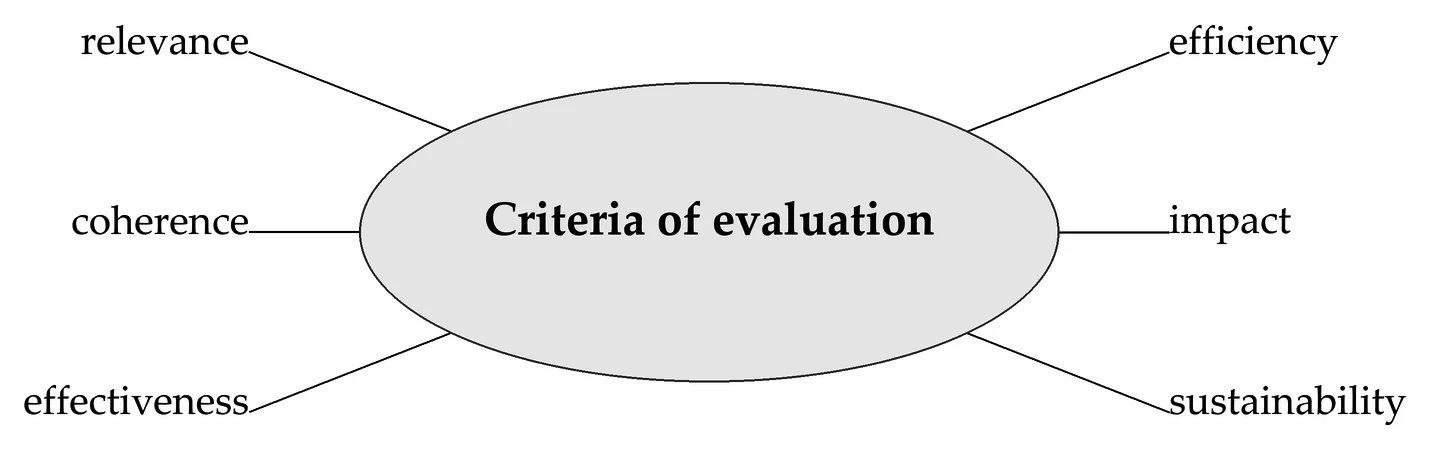
International practice uses the OECD Development Assistance Committee criteria: relevance (does the policy address real needs?), coherence (does it fit with other policies?), effectiveness (does it achieve its objectives?), efficiency (are resources used well?), impact (what wider changes did it cause?) and sustainability (will benefits last?). Evaluators also apply principles of independence, credibility, utility and ethics, protecting the people studied.
3.3 Methods and Techniques of Evaluation
S. Purdon and colleagues, in Research Methods for Policy Evaluation (2001), explain that impact evaluation must estimate the counterfactual. The strongest method is the randomised controlled trial, which randomly assigns people to receive a policy or not and compares outcomes. Where randomisation is impossible, evaluators use matched comparison groups, difference-in-differences, which compares changes over time between groups, and regression discontinuity. Weaker designs, such as simple before-and-after comparisons, cannot separate the effect of the policy from other changes.
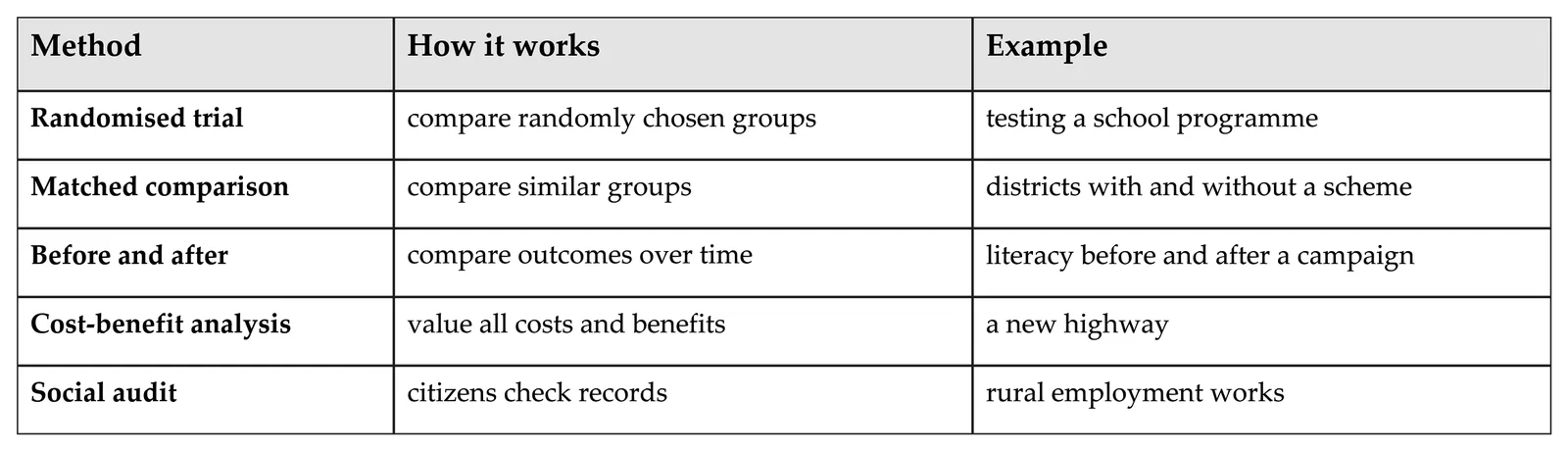
Other techniques include cost-benefit analysis, which values all costs and benefits in money; cost-effectiveness analysis, which compares the cost of achieving a given outcome; qualitative methods such as interviews, focus groups and case studies, which explain why a policy worked or failed; theory-based evaluation, which tests each link in a policy’s theory of change; and participatory methods such as social audits, in which beneficiaries themselves evaluate.
3.4 Evaluation in India
India established the Programme Evaluation Organisation under the Planning Commission in 1952 to evaluate the Community Development Programme. In 2015 it was merged with the Independent Evaluation Office into the Development Monitoring and Evaluation Office (DMEO) of NITI Aayog, which evaluates centrally sponsored schemes. The Comptroller and Auditor General conducts performance audits, parliamentary committees examine spending, and social audits involve citizens. Independent researchers, including J-PAL and other groups, have conducted rigorous evaluations, such as studies of teacher attendance and remedial teaching.

3.5 Important Questions
- Question 1 What is policy evaluation? Discuss the principles for evaluation of public policy.
- Question 2 Discuss the methods and techniques of policy evaluation.
- Question 3 Examine the institutions and challenges of policy evaluation in India.
DU asks the same idea in different words. So learn one broad answer for each question below; the same answer works for every question joined by OR.
Important Question 1
What is policy evaluation? Discuss the principles for evaluation of public policy.
OR
Examine Charles Anderson’s view on the place of principles in policy analysis.
OR
Discuss the criteria used to evaluate public policies.
Model Answer
“Evaluation is the systematic assessment of the operation and/or the outcomes of a program or policy, compared to a set of explicit or implicit standards, as a means of contributing to the improvement of the program or policy.”
— Carol H. Weiss, Evaluation (1998)
Introduction. Public policies use public money and power to change people’s lives, so they must be judged. Policy evaluation assesses whether policies are well designed, well implemented and effective. Evaluation is not merely technical: it rests on principles that define what counts as a good policy. Charles Anderson, the OECD criteria and Malcolm Provus offer important frameworks.
1. Meaning of Evaluation
Carol Weiss defined evaluation as the systematic assessment of the operation or outcomes of a programme or policy against explicit or implicit standards, as a means of improving it. Evaluation involves gathering evidence and making judgements of value.
2. Purposes of Evaluation
Evaluation serves accountability, by showing whether public resources achieved their aims; learning, by showing what works and why; decision-making, by informing whether to continue, expand, modify or end a policy; and public debate, by providing evidence to citizens.
3. Formative and Summative Evaluation
Michael Scriven distinguished formative evaluation, conducted during a programme to improve it, from summative evaluation, conducted at the end to judge its overall worth. Both are needed: one to correct, the other to decide.
4. Anderson’s Argument
Charles Anderson argued that policy analysis cannot rely only on technical calculations such as cost-benefit analysis. Policies must be judged by principles of public reason that are recognised as legitimate in a political community.
5. Authority, Justice and Efficiency
Anderson identified three basic standards. Authority asks whether a policy is a legitimate exercise of public power within the constitution. Justice asks whether it treats people fairly and respects rights. Efficiency asks whether it achieves its ends at reasonable cost. A good policy must satisfy all three.
6. Relevance and Coherence
The OECD criteria begin with relevance, whether the policy responds to real needs and priorities, and coherence, added in 2019, whether it fits with other policies and does not work against them.
7. Effectiveness and Efficiency
Effectiveness asks whether the policy achieved its stated objectives. Efficiency asks whether resources were converted into results economically and on time, and whether the same results could have been achieved at lower cost.
8. Impact and Sustainability
Impact refers to the wider, long-term effects of a policy, intended or unintended, positive or negative. Sustainability asks whether benefits will continue after funding or support ends.
9. Equity
Evaluation must also ask who benefits and who loses. A policy may be efficient on average but unfair to the poorest or to particular groups. Equity is especially important in India, given inequalities of caste, class, gender and region.
10. Provus’s Discrepancy Model
Malcolm Provus treated evaluation as an integral part of public policy. His discrepancy model compares a programme’s performance with its standards at each stage, so that differences can be identified and corrected continuously.
11. Principles of Good Evaluation
Good evaluation should be independent of those who run the programme, credible in method, useful to decision-makers, transparent and ethical, respecting the dignity and consent of the people studied.
12. Limits
Principles may conflict: an efficient policy may be unjust, or a just policy costly. Evaluators must make their value judgements explicit, as Anderson argued, rather than hiding them behind technical language.
13. Evaluation and Democracy
Evaluation is also a democratic practice. When findings are published and debated in legislatures, the media and civil society, citizens can hold governments accountable for results. But evaluation can also become technocratic, giving experts the final word on questions that involve value choices. Anderson’s emphasis on public principles reminds us that evaluation must remain open to democratic judgement.
14. Evaluation
Principles give evaluation its direction and legitimacy. Combining Anderson’s standards with the OECD criteria and attention to equity provides a comprehensive framework for judging public policies.
Conclusion. Thus, policy evaluation is the systematic assessment of a policy against standards. As Anderson argues, it rests on principles such as authority, justice and efficiency, supplemented by criteria of relevance, coherence, effectiveness, impact, sustainability and equity.
Important Question 2
Discuss the methods and techniques of policy evaluation.
OR
Examine the use of randomised controlled trials in policy evaluation.
OR
Distinguish between process evaluation and impact evaluation and discuss their methods.
Model Answer
“Evaluation refers to the process of determining the merit, worth, or value of something, or the product of that process.”
— Michael Scriven, Evaluation Thesaurus (1991)
Introduction. To know whether a policy works, evaluators must use sound methods. Purdon and colleagues, in Research Methods for Policy Evaluation, explain the main approaches. The central challenge of impact evaluation is to estimate what would have happened without the policy, the counterfactual. Different methods meet this challenge with different degrees of rigour.
1. Process Evaluation
Process evaluation examines how a policy is implemented: whether it reaches its target group, whether services are delivered as intended, and what problems arise. It uses administrative data, observation, interviews and surveys, and helps explain why a policy succeeds or fails.
2. Impact Evaluation
Impact evaluation measures the change caused by a policy. It requires comparing outcomes for those affected with an estimate of what their outcomes would have been without the policy.
3. The Counterfactual Problem
We cannot observe the same person both with and without a policy. Simply comparing participants with non-participants is misleading, because people who join a programme may differ in motivation or circumstances, a problem called selection bias.
4. Randomised Controlled Trials
In a randomised controlled trial, individuals or villages are randomly assigned to a treatment group that receives the policy and a control group that does not. Because assignment is random, differences in outcomes can be attributed to the policy. Banerjee, Duflo and Kremer won the 2019 Nobel Prize for using such experiments to study poverty.
5. Examples from India
Randomised studies in India have tested remedial teaching by Pratham, which led to the Teaching at the Right Level approach, and the use of cameras to monitor teacher attendance in schools run by Seva Mandir in Rajasthan, which increased attendance and learning.
6. Limits of Experiments
Randomised trials can be costly, raise ethical concerns about denying benefits, and may not generalise to other contexts or larger scales. Many national policies cannot be randomised at all. Angus Deaton and Nancy Cartwright argue that a trial shows what worked in one place, not why, so its results cannot simply be transferred to other settings.
7. Quasi-experimental Methods
Where randomisation is impossible, evaluators use matched comparison groups, which compare similar people; difference-in-differences, which compares changes over time between affected and unaffected groups; and regression discontinuity, which compares those just above and below an eligibility cut-off.
8. Before-and-after Comparison
Simple before-and-after comparisons are common but weak, because other factors, such as economic growth or weather, may cause changes over the same period. They should be used with caution.
9. Cost-benefit and Cost-effectiveness
Cost-benefit analysis values all costs and benefits in money and compares them, often over time using discounting. Cost-effectiveness analysis compares the cost of achieving a given outcome, such as one extra child in school, across alternatives. Such analysis is widely used to appraise large infrastructure projects, though valuing benefits such as health or environmental quality in money is difficult and contested.
10. Qualitative Methods
Interviews, focus groups, case studies and participant observation reveal how people experience a policy and why it works or fails. They complement quantitative methods, explaining the mechanisms behind the numbers.
11. Theory-based Evaluation
Theory-based evaluation, associated with Carol Weiss, sets out a policy’s theory of change, the chain from inputs to outcomes, and tests each link. It helps identify where a policy breaks down.
12. Participatory Methods
Participatory evaluation involves beneficiaries in assessing policies. Social audits, citizen report cards, pioneered in Bangalore by the Public Affairs Centre in the 1990s, and community scorecards give citizens a voice in evaluation.
13. Mixed Methods in Practice
A good evaluation of a welfare scheme might combine several methods: administrative data to track coverage, a household survey with a comparison group to estimate impact, interviews and focus groups to understand beneficiaries’ experience, and a cost analysis to judge value for money. Combining methods allows findings to be cross-checked and gives decision-makers both numbers and explanations.
14. Evaluation
No single method is sufficient. Rigorous impact methods establish whether a policy works, while process, qualitative and participatory methods explain how and why. Mixed methods provide the most complete picture.
Conclusion. Thus, policy evaluation uses process and impact methods. Randomised trials, quasi-experiments, cost-benefit analysis, qualitative and theory-based approaches and participatory techniques each have strengths and limits, and together they help estimate the counterfactual and explain results.
Important Question 3
Examine the institutions and challenges of policy evaluation in India.
OR
Discuss the role of the Development Monitoring and Evaluation Office and the CAG in policy evaluation.
OR
Why is policy evaluation weak in India? Suggest measures for improvement.
Model Answer
“The reports of the Comptroller and Auditor-General of India relating to the accounts of the Union shall be submitted to the President, who shall cause them to be laid before each House of Parliament.”
— Constitution of India, Article 151(1)
Introduction. India has a long history of policy evaluation, beginning soon after independence. Yet evaluation has often been weak, with findings rarely used to improve policies. In recent years, new institutions, data systems and research partnerships have strengthened evaluation, though serious challenges remain.
1. The Programme Evaluation Organisation
The Programme Evaluation Organisation was set up in October 1952 under the Planning Commission to evaluate the Community Development Programme. It went on to evaluate many plan schemes and built a tradition of independent field-based evaluation.
2. Development Monitoring and Evaluation Office
In 2015, the PEO and the Independent Evaluation Office were merged into the Development Monitoring and Evaluation Office in NITI Aayog. It evaluates centrally sponsored schemes, runs the Output-Outcome Monitoring Framework and promotes evidence-based policy.
3. The Comptroller and Auditor General
The CAG audits government accounts and conducts performance audits of schemes, examining whether they achieved their objectives economically and efficiently. Its reports, laid before Parliament under Article 151, have exposed failures in programmes and allocation of resources.
4. Parliamentary Committees
The Public Accounts Committee examines CAG reports, and the Estimates Committee and departmentally related standing committees scrutinise the working of ministries and schemes. They hold the executive accountable for policy performance.
5. Social Audits
Social audits, mandatory under the rural employment law, involve citizens in verifying records and works. States such as Andhra Pradesh and Telangana developed strong social audit units that have recovered misused funds.
6. Outcome Budgeting
India introduced the Outcome Budget in 2005 to link spending with results. Later reforms required ministries to set output and outcome targets and report on them, and the Finance Ministry has linked the continuation of schemes to their evaluation.
7. Independent Research
Universities, think tanks and research organisations such as J-PAL South Asia, the Centre for Policy Research and the Accountability Initiative conduct evaluations and track spending. Pratham’s Annual Status of Education Report, since 2005, measures children’s learning across rural India.
8. Lack of Data
Evaluation is hampered by weak baseline data, delays in surveys and doubts about official statistics. Without reliable data, it is hard to measure impact.
9. Weak Use of Findings
Evaluation reports are often ignored. Schemes continue regardless of findings, because of political commitments, bureaucratic inertia and the absence of clear mechanisms linking evaluation to budgets and decisions.
10. Independence and Capacity
Evaluation units often depend on the ministries they evaluate, and there is a shortage of trained evaluators, especially at state and district levels. Political sensitivity can discourage critical findings.
11. Attribution and Complexity
Many outcomes, such as health or learning, depend on multiple policies and social factors, making it difficult to attribute changes to a single scheme. Short evaluation periods may miss long-term effects.
12. Measures for Improvement
Improvements include building evaluation into policy design from the start, investing in data, ensuring independence, training evaluators, publishing findings, linking them to budgets and involving citizens through social audits and public hearings.
13. Learning from Evaluation
There are examples of evaluation changing policy in India. Evidence of leakages in the public distribution system encouraged states such as Chhattisgarh to computerise and reform it in the 2000s. ASER’s findings on poor learning shifted attention from enrolment to learning outcomes, contributing to the NIPUN Bharat mission for foundational literacy and numeracy (2021). Such cases show what evaluation can achieve when it is used.
14. Evaluation
India has a strong institutional base for evaluation, from the PEO to the DMEO and CAG, and a growing research community. The challenge is to make evaluation independent, rigorous and genuinely used to improve policy.
Conclusion. Thus, policy evaluation in India is carried out by the DMEO, the CAG, parliamentary committees, social audits and independent researchers. Weak data, limited independence and poor use of findings remain challenges, which require building evaluation into the policy process itself.
Short Notes
(a) Counterfactual
What would have happened in the absence of a policy. Impact evaluation must estimate the counterfactual in order to attribute changes to the policy. Randomised trials create it through a control group; other methods approximate it with comparison groups or statistical techniques.
(b) Formative and summative evaluation
Michael Scriven’s distinction (1967). Formative evaluation is conducted while a programme is being developed or implemented, in order to improve it. Summative evaluation is conducted at the end, in order to judge its overall merit and inform decisions about continuing it.
(c) Cost-benefit analysis
A technique that identifies and values in money all the costs and benefits of a policy, often over many years using a discount rate, and compares them. A policy is justified if benefits exceed costs. It is widely used for infrastructure but criticised for difficulty in valuing intangible benefits and for ignoring distribution.
(d) Citizen report card
A participatory evaluation tool pioneered by the Public Affairs Centre in Bangalore in the 1990s. Citizens rate the quality of public services such as water, electricity and transport through surveys, and the results are published and discussed with the service agencies to press them to improve performance.
More notes: DSC-16 Public Policy
These notes are prepared by PADHO TO AISE for study help. They are not an official University of Delhi publication.