
Semester VI DSC-16 Public Policy
Unit I · 19 min read · Updated 24 Nov 2026
As per the University of Delhi (DU) BA (Hons) Political Science syllabus
Contents
- 1.1 The Meaning of Public Policy
- 1.2 Formulation, Implementation and Evaluation
- 1.3 Elite and Group Theories
- 1.4 Incremental, Political System and Process Theories
- 1.5 Important Questions
- What is public policy? Discuss the process of policy formulation, implementation and evaluation.
- Critically examine the elite theory and group theory of public policy.
- Discuss the incremental, political system and process theories of public policy.
- Short Notes
सार्वजनिक नीति वह सब कुछ है जिसे सरकारें करने या न करने का चुनाव करती हैं।
Public policy is whatever governments choose to do or not to do.
— Thomas R. Dye, Understanding Public Policy
WHY does a government build roads in one district and not another, give free food grain to some families, ban single-use plastic, or decide to do nothing about a problem? Such choices are public policies. The study of public policy asks how policies are formulated, how they are implemented and how they are evaluated, and which forces, elites, interest groups, institutions or past decisions, shape them. This unit introduces the meaning of public policy, the stages of the policy process, and five classic theories of public policy: elite theory, group theory, incremental theory, political system theory and process theory. The readings include Michael Howlett and Benjamin Cashore, Herbert Kitschelt, Lawrence Mead and Henry Teune.

1.1 The Meaning of Public Policy
A public policy is a course of action, or inaction, chosen by public authorities to deal with a problem. Thomas Dye defined it simply as whatever governments choose to do or not to do, while David Easton saw politics as the authoritative allocation of values for a society. Policies take the form of laws, rules, programmes, budgets and decisions, such as India’s National Food Security Act (2013) or the Goods and Services Tax (2017). Michael Howlett and Benjamin Cashore explain that every policy combines goals (what government wants to achieve) and means (the instruments it uses), at different levels from broad aims to specific on-the-ground settings.
The study of policy began with Harold Lasswell, who in 1951 called for policy sciences that would use knowledge to solve public problems. Lawrence Mead argues that policy analysis must be linked to politics, since good policy must also be politically feasible. Peter Hall distinguished three orders of policy change: changes in the settings of instruments, in the instruments themselves, and in the overall goals or policy paradigm, such as India’s shift from planning to liberalisation in 1991.
1.2 Formulation, Implementation and Evaluation
Policy scholars describe a policy cycle. In agenda setting, a problem gains attention; John Kingdon described a policy window that opens when problems, proposals and politics come together. In formulation, officials, experts and interest groups design options. In decision-making, the executive or legislature adopts one. In implementation, agencies put it into practice, often with unexpected difficulties, as Jeffrey Pressman and Aaron Wildavsky showed in Implementation (1973). In evaluation, results are assessed and fed back into the next round of policy.
The cycle is a useful simplification, not an exact description: stages overlap, and policy often moves back and forth. In India, formulation involves ministries, the Cabinet, NITI Aayog, parliamentary committees and consultations with states and civil society; implementation depends heavily on state governments, district administrations and local bodies; and evaluation is carried out by bodies such as NITI Aayog’s Development Monitoring and Evaluation Office and the Comptroller and Auditor General.
1.3 Elite and Group Theories
Elite theory holds that public policy reflects the preferences of a small ruling elite rather than the demands of the masses. C. Wright Mills, in The Power Elite (1956), argued that leaders of the corporations, the military and the executive dominated American decisions. Thomas Dye and Harmon Zeigler, in The Irony of Democracy (1970), argued that policy flows downward from elites to masses, who are largely apathetic and poorly informed. Policy changes are therefore incremental and conservative, reflecting elite consensus.
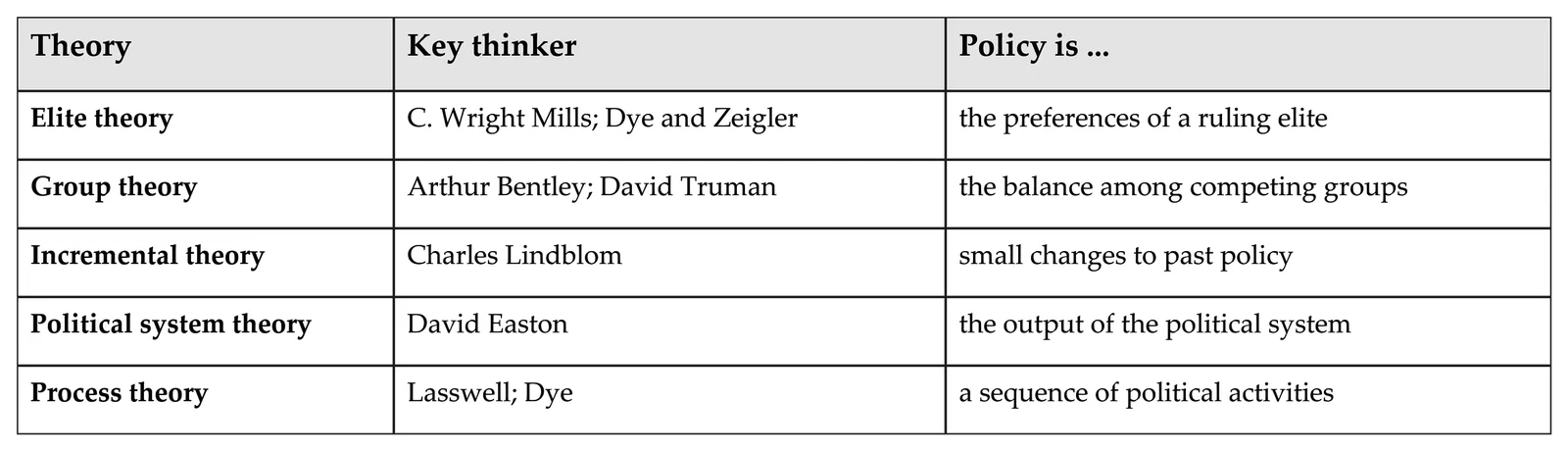
Group theory sees policy as the outcome of competition among interest groups. Arthur Bentley (1908) and David Truman, in The Governmental Process (1951), argued that politics is the struggle among groups to influence policy, and that public policy is the equilibrium reached at any moment. Government acts as a referee, setting rules and recording compromises. Critics note that groups are unequal in resources, so the poor and unorganised are often left out.
1.4 Incremental, Political System and Process Theories
Incremental theory, developed by Charles Lindblom, holds that policy-makers do not review all alternatives rationally. They make small changes to existing policies, comparing a few options and seeking agreement, a method he called muddling through. Aaron Wildavsky showed how budgets grow incrementally from the previous year’s base. Political system theory, drawn from David Easton, treats policy as the output of a political system that converts inputs, demands and supports from the environment, into decisions, with feedback shaping future demands.

Process theory treats policy-making as a sequence of political activities: problem identification, agenda setting, formulation, legitimation, implementation and evaluation. It focuses on how policy is made rather than on its content. Herbert Kitschelt, comparing fast breeder reactor programmes across industrial democracies, showed that different theories capture different parts of policy-making, and Henry Teune used broad macro-theoretical approaches to explain the fiscal crisis of American cities. Each theory illuminates one side of a complex reality.
1.5 Important Questions
- Question 1 What is public policy? Discuss the process of policy formulation, implementation and evaluation.
- Question 2 Critically examine the elite theory and group theory of public policy.
- Question 3 Discuss the incremental, political system and process theories of public policy.
DU asks the same idea in different words. So learn one broad answer for each question below; the same answer works for every question joined by OR.
Important Question 1
What is public policy? Discuss the process of policy formulation, implementation and evaluation.
OR
Explain the stages of the policy cycle.
OR
Discuss the meaning, nature and significance of public policy.
Model Answer
“Politics … is the authoritative allocation of values for a society.”
— David Easton, The Political System (1953)
Introduction. Governments constantly make choices about how to deal with public problems: poverty, health, education, pollution, security. These choices are public policies. Studying public policy means understanding what governments do, why they do it and with what effects. Scholars describe policy-making as a cycle of formulation, decision, implementation and evaluation.
1. Meaning of Public Policy
Thomas Dye defined public policy as whatever governments choose to do or not to do. James Anderson described it as a purposive course of action followed by an actor or set of actors in dealing with a problem. Policy includes both deliberate action and deliberate inaction, since deciding not to act is also a choice.
2. Nature of Public Policy
Public policy is made by public authorities, backed by the legitimate power of the state, and aimed at public goals. It is goal-oriented, involves choices among alternatives, and is expressed in laws, regulations, programmes and budgets. It is also political, reflecting conflicts and compromises among interests.
3. Goals and Means
Howlett and Cashore explain that every policy combines goals and means. At the most abstract level are broad aims, such as reducing hunger; at the programme level are specific objectives, such as providing subsidised grain; and at the most concrete level are settings, such as five kilograms per person per month. Policies can change at any of these levels.
4. Agenda Setting
A problem must first reach the government’s agenda. John Kingdon’s multiple streams model shows that this happens when a recognised problem, an available policy solution and favourable politics come together, opening a policy window. Media, crises, elections and social movements often open such windows. In India, the outrage after the Delhi gang rape of December 2012 opened such a window, leading quickly to the Criminal Law (Amendment) Act, 2013.
5. Policy Formulation
Formulation means developing options to address the problem. In India this involves ministries, expert committees, NITI Aayog, consultations with states and stakeholders, and sometimes public comments on draft policies. Analysts compare options for cost, effectiveness, equity and feasibility.
6. Decision-making and Legitimation
Authorised decision-makers, such as the Cabinet or Parliament, adopt a policy. Legislation, executive orders or budget allocations give it legal authority. This stage involves bargaining among parties, ministries and interest groups.
7. Implementation
Implementation turns decisions into action through agencies, officials, funds and procedures. Pressman and Wildavsky’s study of a federal programme in Oakland showed how a policy can fail when it depends on many agencies and approvals. In India, implementation relies heavily on states, districts and local bodies, and on frontline workers.
8. Monitoring
While a policy is being implemented, governments monitor inputs, outputs and progress through indicators, reports, inspections and data systems, so that problems can be corrected in time.
9. An Example: Food Security
India’s National Food Security Act shows the cycle at work. Starvation deaths and the Right to Food case brought hunger onto the agenda from 2001; the National Advisory Council and the food ministry formulated proposals; Parliament passed the Act in September 2013; states implemented it by reforming their public distribution systems; and studies and audits evaluated its reach, feeding into later changes such as free grain from 2024.
10. Evaluation
Evaluation assesses whether the policy achieved its goals, at what cost and with what side effects. It may be done by government bodies, auditors, independent researchers or citizens through social audits. Findings lead to continuation, modification or termination of the policy.
11. Feedback
The results of a policy create new demands and problems, which feed back into the agenda. The policy process is therefore continuous, as policies are made and remade over time.
12. Policy and Politics
Lawrence Mead argues that policy analysis must be linked to politics. A technically sound policy may fail if it lacks political support, while political leaders need analysis to choose wisely. Students of policy must understand both.
13. Limits of the Cycle Model
The cycle is a simplification. Stages overlap, some policies are adopted in crisis without careful formulation, and implementers often reshape policy. Critics argue that it underplays power and conflict, which theories such as elite and group theory emphasise.
14. Evaluation
Public policy is central to modern governance, shaping the lives of citizens in countless ways. Understanding the policy process helps citizens and officials improve policies, hold governments accountable and see why good intentions sometimes fail.
Conclusion. Thus, public policy is what governments choose to do or not to do. It passes through agenda setting, formulation, decision, implementation, monitoring and evaluation, with feedback into future policy, though in reality these stages overlap and are shaped by politics.
Important Question 2
Critically examine the elite theory and group theory of public policy.
OR
‘Public policy reflects the preferences of the elite.’ Discuss.
OR
Discuss the group theory of public policy and its limitations.
Model Answer
“The power elite is composed of men whose positions enable them to transcend the ordinary environments of ordinary men and women; they are in positions to make decisions having major consequences.”
— C. Wright Mills, The Power Elite (1956)
Introduction. Who really makes public policy? Elite theory answers that a small minority with power and resources shapes policy, while group theory answers that policy results from competition among many organised groups. These two theories offer contrasting pictures of power in democracies and have been widely applied and criticised.
1. Classical Elite Theory
Elite theory grew from the work of Vilfredo Pareto, Gaetano Mosca and Robert Michels in the early twentieth century. They argued that every society is ruled by a minority. Michels’s iron law of oligarchy (1911) held that even democratic organisations come to be controlled by a few leaders.
2. Mills’s Power Elite
C. Wright Mills argued that in the United States after 1945, power was concentrated in a power elite of corporate executives, military leaders and top political officials, who moved between these institutions and shared interests and outlooks. Major decisions, such as on war and the economy, were made by them.
3. Dye and Zeigler
Thomas Dye and Harmon Zeigler argued that policy reflects elite values. Elites share a consensus on basic values, such as private property and limited government; policy flows downward from elites to masses; and changes are incremental because elites wish to preserve the system.
4. Elite Theory and Policy
In elite theory, the masses are largely passive and poorly informed, and elections give them only limited influence. Public officials and administrators carry out policies decided by elites. New members may enter the elite, but only if they accept its basic values.
5. Elite Theory in India
Scholars have applied elite ideas to India, pointing to the influence of senior bureaucrats, business houses and political families on policy. Kuldeep Mathur and James Bjorkman found that policy-making in India is dominated by a small circle of officials and ministers, with limited voice for others.
6. Criticism of Elite Theory
Critics argue that elite theory exaggerates elite unity and ignores competition among elites, the influence of elections, social movements and courts, and cases in which mass mobilisation changed policy, such as the Right to Information and rural employment laws in India.
7. Group Theory
Group theory, developed by Arthur Bentley’s The Process of Government (1908) and David Truman’s The Governmental Process (1951), holds that politics is the struggle among interest groups to influence policy. Individuals matter politically mainly as members of groups.
8. Policy as Equilibrium
In group theory, public policy is the equilibrium reached in the struggle among groups at any moment. When the relative influence of groups changes, policy shifts in favour of the stronger. Government acts as a referee, managing conflict, arranging compromises and enacting them as policy.
9. Checks in Group Theory
Truman argued that the system is kept in balance by overlapping memberships, since individuals belong to many groups, and by potential groups, which can form if a widely shared interest is threatened. This prevents any one group from dominating.
10. Group Theory in India
In India, farmers’ organisations, trade unions, business associations such as FICCI and CII, caste associations and professional bodies influence policy. The farmers’ protests of 2020–21, which led to the repeal of three farm laws, show the power of organised groups.
11. Criticism of Group Theory
Critics note that groups are unequal in money, organisation and access, so policy favours the well-organised, such as business, over the poor and unorganised. E.E. Schattschneider famously remarked that the flaw in the pluralist heaven is that the heavenly chorus sings with a strong upper-class accent.
12. Corporatism and Policy Networks
Later scholars refined group theory. Philippe Schmitter described corporatism, in which a few peak associations of business and labour negotiate policy directly with the state, as in parts of Europe. Others described iron triangles of bureaucrats, legislative committees and interest groups that control particular policy areas, and wider policy networks in which many actors exchange information and resources.
13. Comparison
Elite theory sees power concentrated in a few, group theory sees it dispersed among many. Elite theory stresses consensus and stability; group theory stresses competition and change. Both, however, treat policy as the result of power rather than of rational analysis alone.
14. Evaluation
Each theory captures part of reality. In some areas, such as defence or monetary policy, a small elite dominates; in others, such as agriculture, many groups compete. A balanced understanding uses both.
Conclusion. Thus, elite theory holds that policy reflects the preferences of a ruling minority, while group theory sees policy as the equilibrium of competing groups. Both explain important features of policy-making, but each neglects the factors the other emphasises.
Important Question 3
Discuss the incremental, political system and process theories of public policy.
OR
Explain Charles Lindblom’s incremental model of policy-making.
OR
Examine David Easton’s systems approach to public policy.
Model Answer
“Policy is not made once and for all; it is made and re-made endlessly.”
— Charles E. Lindblom, ‘The Science of “Muddling Through”’ (1959)
Introduction. Besides elite and group theories, three other theories explain public policy in different ways. Incremental theory explains why policies change slowly, political system theory places policy within the whole political system, and process theory explains how policy is made through a sequence of activities. Together they offer a fuller picture of policy-making.
1. The Rational Model
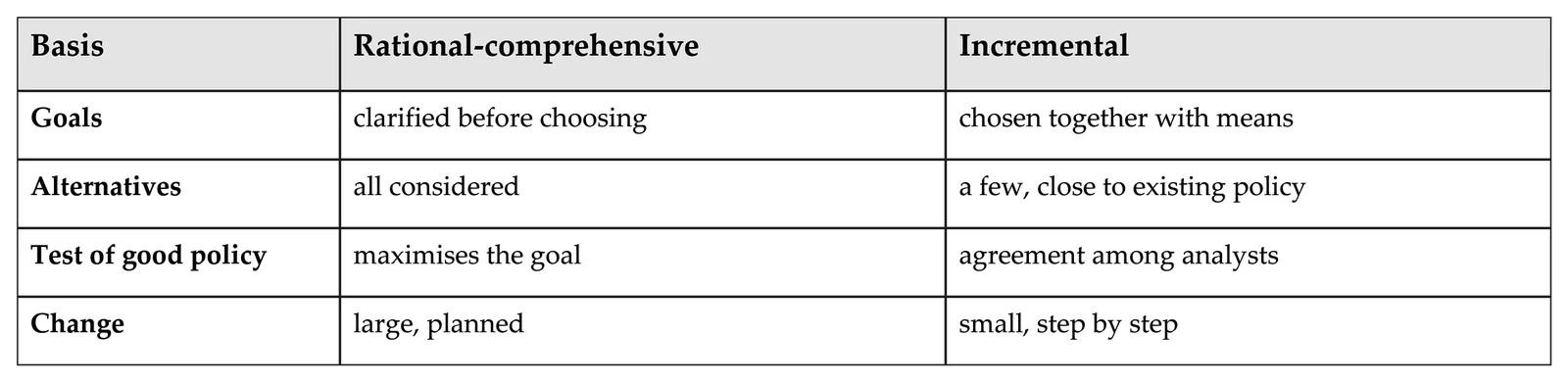
The rational-comprehensive model expects policy-makers to identify all goals, consider all alternatives, predict all consequences and choose the best. Herbert Simon showed that real decision-makers lack the information, time and capacity for this, and instead satisfice, choosing an option that is good enough.
2. Lindblom’s Incrementalism
Charles Lindblom argued that policy-makers actually muddle through. They consider only a few alternatives close to existing policy, compare them at the margin, mix ends and means, and judge a policy good if analysts agree on it. Policy changes through small, successive steps.
3. Why Incrementalism Works
Incrementalism reduces risk, since small mistakes can be corrected. It respects past commitments and existing programmes, reduces conflict by avoiding radical change and makes agreement easier in a plural society. Lindblom later called the bargaining among actors partisan mutual adjustment.
4. Incremental Budgeting
Aaron Wildavsky’s The Politics of the Budgetary Process (1964) showed that budgets are made incrementally: each agency’s budget starts from last year’s base, with small increases or cuts. Indian budgets largely follow the same pattern.
5. Criticism of Incrementalism
Critics argue that incrementalism is conservative, favouring existing interests, and unsuitable in crises that require bold change, such as economic reforms in 1991 or pandemic responses. Amitai Etzioni proposed mixed scanning, combining broad review of options with incremental steps.
6. Easton’s Political System
David Easton viewed the political system as a set of interactions through which values are authoritatively allocated. The system receives inputs from its environment, demands and supports, and converts them into outputs, decisions and policies.
7. Inputs, Outputs and Feedback
Demands come from citizens and groups; supports include obedience, taxes and votes. Outputs are policies and decisions, which affect the environment and generate new demands and supports through feedback. The system persists by responding to its environment.
8. Value of Systems Theory
Systems theory helps explain how environmental forces, such as economic change or social demands, shape policy, and how policies in turn affect society. Gabriel Almond extended it with functional categories such as interest articulation and rule-making.
9. Criticism of Systems Theory
Critics argue that systems theory treats the conversion process as a black box, telling us little about who decides and how. It also tends to assume stability and neglect conflict and power. It also neglects the state as an actor with interests of its own, which later state-centred and institutional theories emphasised.
10. Process Theory
Process theory treats policy-making as a series of political activities: identifying problems, setting the agenda, formulating proposals, legitimising policy, implementing it and evaluating it. It focuses on how decisions are made and who participates at each stage.
11. Value and Limits of Process Theory
Process theory is useful for organising the study of policy and identifying where problems arise. But it says little about the content of policy and can suggest a neat sequence that real policy-making rarely follows. Paul Sabatier criticised the stages approach for lacking a causal theory and proposed the advocacy coalition framework, in which coalitions of actors who share beliefs compete within a policy area over a decade or more.
12. Comparing Theories
Herbert Kitschelt showed, in his study of fast breeder reactor programmes, that different theories explain different parts of policy-making, and that a combination is often needed. Henry Teune similarly used broad macro-theoretical approaches to explain complex policy crises.
13. Evaluation
Incremental theory explains continuity, systems theory explains the relationship between policy and environment, and process theory explains the stages of policy-making. Used together, they complement elite and group theories.
Conclusion. Thus, incremental theory sees policy as small adjustments to past policy, political system theory sees it as the output of a system responding to inputs and feedback, and process theory sees it as a sequence of activities. Each illuminates a different side of policy-making.
Short Notes
(a) Policy window
John Kingdon’s term, from Agendas, Alternatives, and Public Policies (1984), for a short opportunity when a problem, a ready solution and favourable politics come together, allowing policy change. Crises, elections and focusing events open such windows, and policy entrepreneurs use them to push their proposals.
(b) Muddling through
Charles Lindblom’s description of incremental policy-making. Instead of comprehensive analysis, policy-makers compare a few options close to existing policy and make small changes, correcting mistakes as they go. Lindblom argued this was not a failure but a sensible method in a complex, plural society.
(c) Black box
A criticism of Easton’s systems model: it shows inputs entering and outputs leaving the political system but treats what happens inside, the actual process of decision-making, as a closed box. Later approaches, such as process and institutional theories, tried to open the box.
(d) Iron law of oligarchy
Robert Michels’s thesis in Political Parties (1911) that every organisation, even a democratic socialist party, becomes controlled by a small group of leaders, because of the need for expertise, organisation and continuity. It is a foundation of elite theory.
(e) Policy paradigm
Peter Hall’s term (1993) for the framework of ideas and standards that specifies the goals of policy, the instruments to be used and the nature of the problems to be addressed. Normal policy-making adjusts settings and instruments within a paradigm; a paradigm shift, such as the move from Keynesian to monetarist economic policy in Britain, changes the goals themselves.
More notes: DSC-16 Public Policy
These notes are prepared by PADHO TO AISE for study help. They are not an official University of Delhi publication.