
Semester VI DSC-16 Public Policy
Unit II · 21 min read · Updated 24 Nov 2026
As per the University of Delhi (DU) BA (Hons) Political Science syllabus
Contents
- 2.1 Policy Design: What, Who, How and Why
- 2.2 Herbert Simon and Bounded Rationality
- 2.3 Policy Monitoring: Tools and Techniques
- 2.4 Implementation, Decentralisation and Local Government
- 2.5 State Capacity Building
- 2.6 Important Questions
- What is policy design? Discuss Michael Howlett’s view and Herbert Simon’s contribution to policy-making.
- What is policy monitoring? Discuss its tools and techniques.
- Discuss the problems of policy implementation and the role of decentralisation and local government.
- Discuss Francis Fukuyama’s argument on state capacity building.
- Short Notes
स्वतंत्रता नीचे से शुरू होनी चाहिए। इस प्रकार हर गाँव एक गणराज्य या पूर्ण अधिकारों वाली पंचायत होगा।
Independence must begin at the bottom. Thus every village will be a republic or panchayat having full powers.
— M.K. Gandhi, Harijan (28 July 1946)
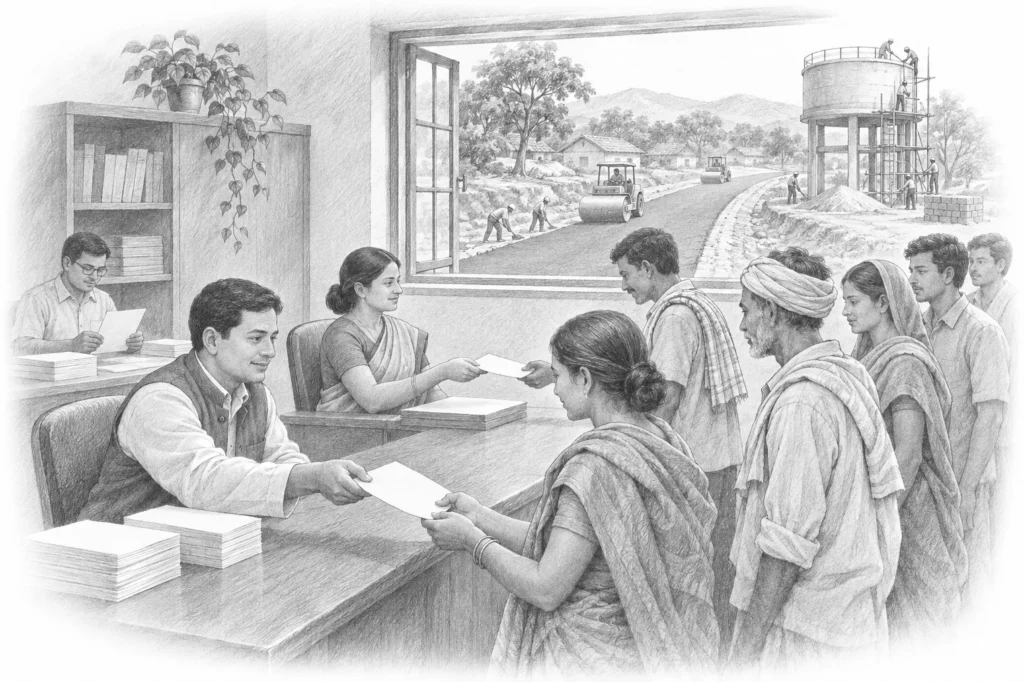
GOOD policy needs more than good intentions. It must be carefully designed, matching goals with the right instruments; it must be monitored while it is carried out; it must be implemented by officials and local governments close to the people; and it needs a capable state to deliver it. This unit studies Michael Howlett’s idea of policy design, Herbert Simon’s theory of bounded rationality, the tools and techniques of policy monitoring, the role of decentralisation and local government in implementation, and Francis Fukuyama’s argument about state capacity building.
2.1 Policy Design: What, Who, How and Why
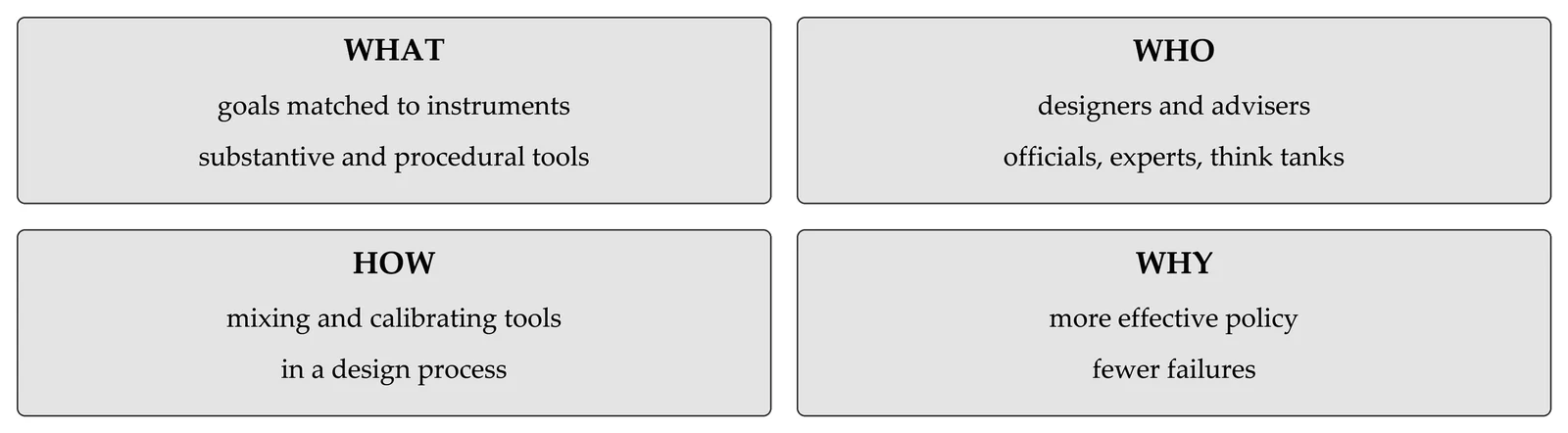
Michael Howlett, in ‘Policy Design: What, Who, How and Why?’ (2014), defines policy design as the deliberate and conscious attempt to define policy goals and connect them to the instruments expected to achieve them. What is designed are policy tools: substantive tools that affect goods and services, and procedural tools that affect the policy process. Who designs are policy advisers inside and outside government. How design happens involves combining and calibrating tools into policy mixes. Why design matters is that well-designed policies are more likely to succeed. Stephen Linder and B. Guy Peters showed how policy design emerged as a distinct way of thinking about instruments.
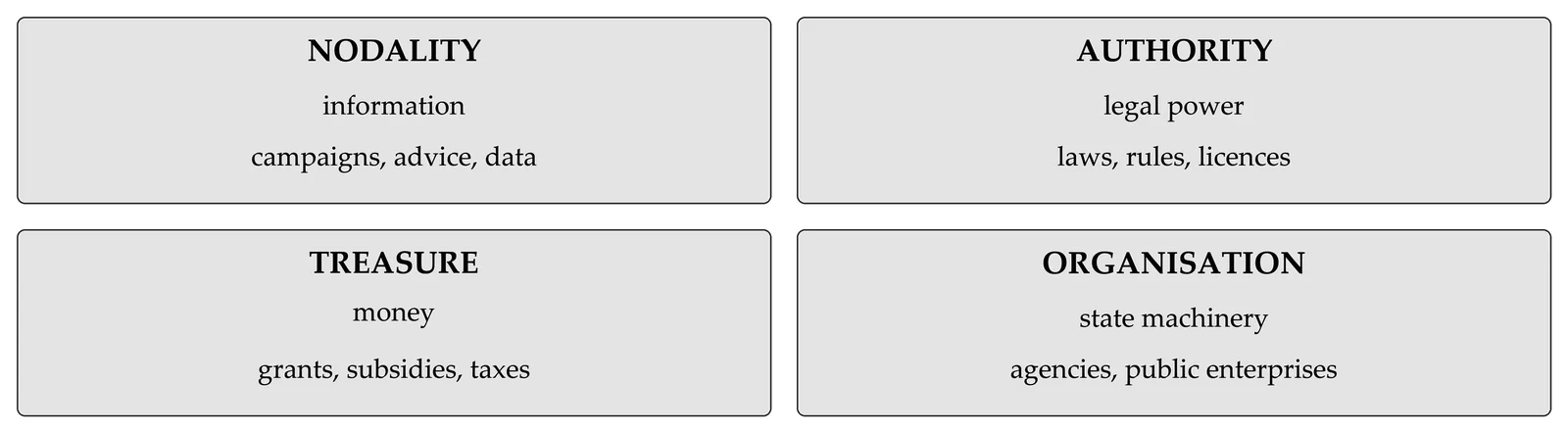
Christopher Hood classified government tools by the resources they use: nodality (information), authority (legal power), treasure (money) and organisation (the state’s own machinery). A policy to reduce smoking, for instance, may combine warnings on packets (nodality), bans in public places (authority), higher taxes (treasure) and public health clinics (organisation). Howlett warns that many policies are not designed at all but result from bargaining or from layering new elements on old ones.
2.2 Herbert Simon and Bounded Rationality
Herbert Simon, in Administrative Behavior (1947), rejected the idea that decision-makers are perfectly rational. Real people have limited information, limited time and limited capacity to calculate, so their rationality is bounded. Instead of maximising, they satisfice: they choose the first alternative that is good enough. Bryan Jones (2002) shows how Simon’s ideas explain policy: governments attend to only a few problems at a time, so policy remains stable for long periods and then changes suddenly when attention shifts, a pattern called punctuated equilibrium.

2.3 Policy Monitoring: Tools and Techniques
Policy monitoring is the continuous tracking of a policy while it is being implemented, to check whether inputs are used, activities completed and outputs delivered as planned. Richard Waterman and B. Dan Wood (1993) argued that monitoring bureaucratic outputs over time reveals how agencies respond to laws, political leaders and changing conditions, and that it complements evaluation. Monitoring uses indicators at different levels: inputs, activities, outputs, outcomes and impact.
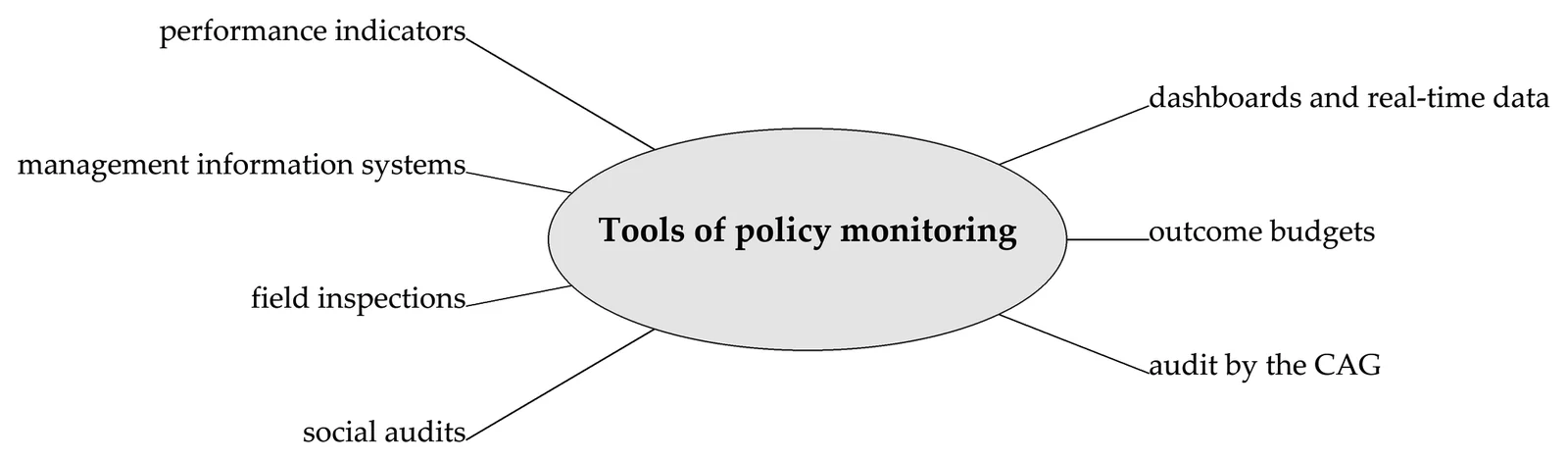
Tools include management information systems, field inspections, physical verification, geo-tagging and satellite imagery, real-time dashboards, third-party monitoring, social audits by citizens, the Right to Information, and audits by the Comptroller and Auditor General. In India, the Outcome Budget (2005), the PRAGATI platform for reviewing projects (2015), NITI Aayog’s Output-Outcome Monitoring Framework and the ranking of districts under the Aspirational Districts Programme (2018) are examples.
2.4 Implementation, Decentralisation and Local Government
Implementation is where policy meets reality. Jeffrey Pressman and Aaron Wildavsky, in Implementation (1973), showed that a programme in Oakland, California, failed because it required many agencies to agree at many decision points. Top-down approaches, such as those of Paul Sabatier and Daniel Mazmanian, list conditions for successful implementation: clear goals, adequate resources and committed officials. Bottom-up approaches, following Michael Lipsky, emphasise the discretion of frontline workers and local actors who actually deliver policy.
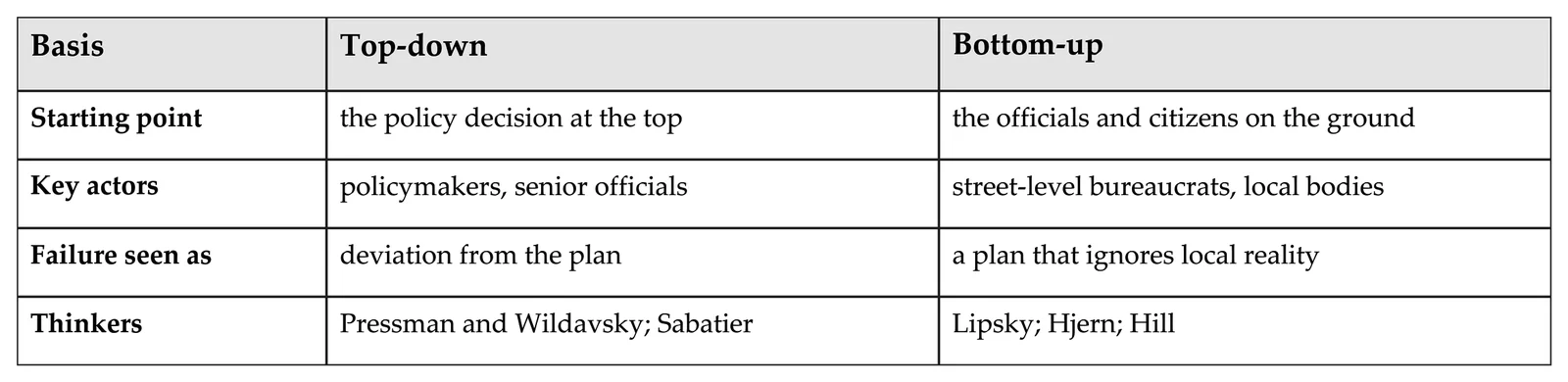
Decentralisation transfers power, functions and resources from central to local levels. Gordon Crawford and Christof Hartmann (2008) examine whether decentralisation in Africa reduces poverty and conflict, and find that results depend on central commitment, local capacity and the risk of capture by local elites. In India, the 73rd and 74th Amendments (1992) created a third tier of government. D. Bandyopadhyay (1996) argued that good governance requires genuine devolution of functions, funds and functionaries to panchayats, which states have often resisted. Kerala’s People’s Plan Campaign (1996) is a leading example of devolution.
2.5 State Capacity Building
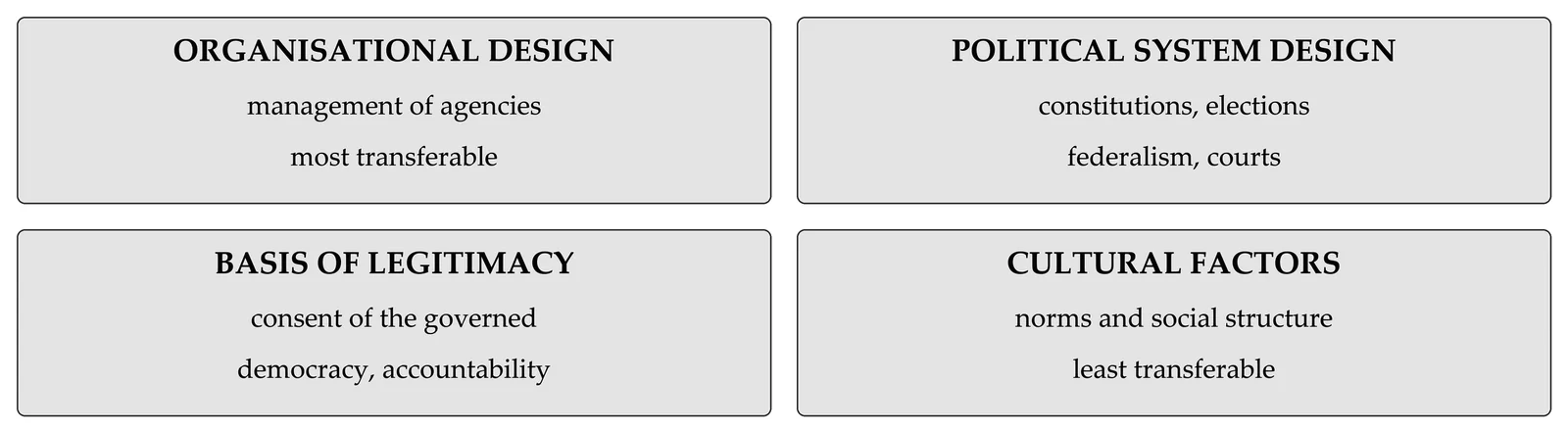
Francis Fukuyama, in State-Building: Governance and World Order in the 21st Century (2004) and ‘The Imperative of State-Building’, argues that weak and failed states are the source of many global problems. He distinguishes the scope of state functions from the strength of state capacity to carry them out. The market reforms of the 1990s reduced scope but often also weakened strength, which was a mistake. Building capacity involves four components: organisational design and management, political system design, the basis of legitimacy, and cultural and structural factors, which are progressively harder to transfer from outside.
In India, Lant Pritchett (2009) described a flailing state, whose head in Delhi makes sound policies but whose limbs at the local level often fail to carry them out. Capacity building therefore requires better recruitment, training, incentives, technology and accountability at every level, not only better policies at the top.
2.6 Important Questions
- Question 1 What is policy design? Discuss Michael Howlett’s view and Herbert Simon’s contribution to policy-making.
- Question 2 What is policy monitoring? Discuss its tools and techniques.
- Question 3 Discuss the problems of policy implementation and the role of decentralisation and local government.
- Question 4 Discuss Francis Fukuyama’s argument on state capacity building.
DU asks the same idea in different words. So learn one broad answer for each question below; the same answer works for every question joined by OR.
Important Question 1
What is policy design? Discuss Michael Howlett’s view and Herbert Simon’s contribution to policy-making.
OR
Discuss the what, who, how and why of policy design.
OR
Explain Herbert Simon’s idea of bounded rationality and its relevance to public policy.
Model Answer
“Whereas economic man maximizes … administrative man satisfices—looks for a course of action that is satisfactory or ‘good enough.’”
— Herbert A. Simon, Administrative Behavior (second edition, 1957)
Introduction. Policies succeed or fail partly because of how they are designed. Michael Howlett treats policy design as a deliberate effort to match goals with suitable instruments, and asks what is designed, who designs, how and why. Herbert Simon’s theory of bounded rationality explains the limits within which all designers and decision-makers work.
1. Meaning of Policy Design
Howlett defines policy design as the deliberate and conscious attempt to define policy goals and connect them to instruments or tools expected to realise those objectives. It applies knowledge about instruments to the solution of policy problems, rather than leaving policy to chance or pure bargaining.
2. What: Policy Tools
The objects of design are policy tools. Substantive tools directly affect the production and distribution of goods and services, such as subsidies, regulations or public enterprises. Procedural tools affect the policy process itself, such as consultations, advisory committees and access to information.
3. Hood’s NATO Scheme
Christopher Hood classified tools by the governing resource they use: nodality, government’s position at the centre of information networks; authority, its legal power; treasure, its money; and organisation, its own staff and agencies. Designers choose combinations of these.
4. Who: Designers
Designers include ministers, civil servants, expert committees, think tanks, consultants, academics and international agencies, together forming a policy advisory system. In India, NITI Aayog, ministries and expert committees play this role. Howlett stresses that the quality of this advisory system, including the analytical capacity of the civil service, strongly affects the quality of design.
5. How: Mixes and Calibration
Policies usually combine several tools into mixes. Good design requires that tools be consistent with each other and with goals, and that their settings be calibrated properly. Poor mixes, in which tools work against each other, cause failure.
6. Why: Better Outcomes
Design matters because careful matching of goals and tools increases the chances of success and reduces waste. Howlett notes that much policy is not designed but results from layering new measures on old ones, which produces incoherent mixes.
7. Linder and Peters
Stephen Linder and B. Guy Peters argued that policy design emerged as a distinct perspective linking social theory to practical choices about instruments. They stressed that instruments have different characteristics, such as cost, intrusiveness and visibility, which affect their suitability.
8. Simon’s Critique of Rationality
Herbert Simon argued that the ideal of perfect rationality is unrealistic. Decision-makers cannot know all alternatives or predict all consequences, because information is incomplete and human cognitive capacity is limited.
9. Bounded Rationality and Satisficing
Simon called this bounded rationality. Within these bounds, decision-makers satisfice: they search until they find an alternative that meets their minimum standards. Organisations help by setting routines and dividing decisions into manageable parts.
10. Fact and Value
Simon distinguished factual premises, which can be tested, from value premises, which reflect goals and preferences. Administrators work mainly on factual premises, while political leaders set the values.
11. Jones on Simon and Policy
Bryan Jones argues that Simon’s ideas provide the decisional foundation for understanding public policy. Because attention is limited, governments ignore many problems until they become urgent, producing long periods of stability broken by sudden change.
12. Implications for Design
Bounded rationality means designers should keep policies simple, use pilot projects, build in learning and feedback, and expect to correct mistakes. Behavioural approaches, such as nudges, build on Simon’s insights. Governments, including India’s, have increasingly used such behavioural insights, for example in messaging campaigns for sanitation and vaccination.
13. Evaluation
Howlett’s framework shows that policy design is a deliberate craft, while Simon reminds us that it always operates within cognitive and organisational limits. Together they explain both how good policies can be made and why they often fall short.
Conclusion. Thus, policy design means deliberately matching goals with tools, involving what tools, which designers, how they are mixed and why. Simon’s bounded rationality and satisficing show the limits of such design and the need for learning and adjustment.
Important Question 2
What is policy monitoring? Discuss its tools and techniques.
OR
Distinguish between policy monitoring and policy evaluation.
OR
Examine the tools of policy monitoring used in India.
Model Answer
“In order to promote transparency and accountability in the working of every public authority …”
— Right to Information Act, 2005, Preamble
Introduction. Once a policy is adopted, governments must ensure that it is carried out as planned. Policy monitoring is the continuous tracking of implementation to detect problems early and correct them. Richard Waterman and B. Dan Wood showed how monitoring can reveal the behaviour of agencies over time. Modern technology has greatly expanded the tools available.
1. Meaning of Monitoring
Monitoring is the systematic and continuous collection of information on the progress of a policy or programme: whether funds are released, activities carried out and outputs delivered on time and as intended. It is an ongoing management function.
2. Monitoring and Evaluation
Monitoring tracks progress during implementation; evaluation assesses results and impact, usually at a later stage. Monitoring asks whether things are being done right; evaluation asks whether the right things are being done and whether they work. The two are complementary.
3. Waterman and Wood
Waterman and Wood argued that policy monitoring, the tracking of bureaucratic outputs such as inspections or enforcement actions over time, helps analysts see how agencies respond to new laws, political appointees and budgets. It provides evidence for holding agencies accountable.
4. Levels of Indicators
Monitoring uses indicators at several levels: inputs, such as money and staff; activities, such as training sessions; outputs, such as schools built; outcomes, such as enrolment; and impact, such as improved learning. Good indicators are specific, measurable and timely.
5. Management Information Systems
Computerised management information systems record data from the field on beneficiaries, payments and works. The rural employment scheme’s system, for instance, records job cards, attendance and wage payments, making data publicly available.
6. Field Inspection and Verification
Officials visit sites, inspect works and verify records. Third-party monitors and independent agencies are sometimes engaged to reduce bias. Physical verification checks whether reported assets actually exist.
7. Technology and Real-time Data
Geo-tagging, satellite imagery and mobile applications allow real-time tracking of assets and services. Dashboards display progress for decision-makers. The PRAGATI platform (2015) lets the Prime Minister review major projects with states by video.
8. Social Audits
In a social audit, citizens examine records of a programme in public meetings and verify them against reality. Pioneered by the Mazdoor Kisan Shakti Sangathan in Rajasthan and institutionalised for the rural employment scheme, social audits expose corruption and empower beneficiaries.
9. RTI and Transparency
The Right to Information Act (2005) allows citizens to obtain records of government decisions and spending, enabling them to monitor policies themselves. Proactive disclosure under Section 4 requires agencies to publish key information.
10. Audit and Budget Tools
The Comptroller and Auditor General conducts financial and performance audits. The Outcome Budget (2005), later NITI Aayog’s Output-Outcome Monitoring Framework, links spending to measurable results. The Aspirational Districts Programme (2018) ranks districts monthly on key indicators.
11. Challenges
Monitoring faces problems of poor data quality, manipulation of figures, focus on easily measured outputs rather than outcomes, weak capacity at local levels and the burden of reporting on frontline workers.
12. Making Monitoring Effective
Effective monitoring requires reliable data, independent verification, use of findings in decision-making, participation of citizens and protection of whistle-blowers. Monitoring must lead to correction, not merely reporting.
13. Evaluation
Policy monitoring is essential for successful implementation and accountability. Combining official systems with technology and citizen participation offers the best chance of detecting and correcting problems in time.
Conclusion. Thus, policy monitoring is the continuous tracking of implementation through indicators, information systems, inspections, technology, social audits, RTI and audit. As Waterman and Wood show, it reveals how agencies behave and helps keep policy on course.
Important Question 3
Discuss the problems of policy implementation and the role of decentralisation and local government.
OR
Compare the top-down and bottom-up approaches to policy implementation.
OR
‘Decentralisation is a pathway to good governance.’ Discuss.
Model Answer
“The Legislature of a State may, by law, endow the Panchayats with such powers and authority as may be necessary to enable them to function as institutions of self-government.”
— Constitution of India, Article 243G
Introduction. Many good policies fail in implementation. Scholars have studied why, developing top-down and bottom-up approaches. Decentralisation, transferring power and resources to local governments, is widely seen as a way to improve implementation by bringing decisions closer to people. But its success depends on how it is designed and practised.
1. Meaning of Implementation
Implementation is the stage at which a policy decision is translated into action through organisations, officials, rules and resources. It includes issuing guidelines, releasing funds, recruiting staff and delivering services to citizens.
2. Pressman and Wildavsky
Pressman and Wildavsky’s Implementation (1973) studied an economic development programme in Oakland that achieved little despite funding and support. They showed that the complexity of joint action, the need for many agencies to agree at many decision points, makes failure likely.
3. The Top-down Approach
The top-down approach starts from the policy decision and asks how far it was carried out. Sabatier and Mazmanian identified conditions for success: clear and consistent objectives, a valid causal theory, adequate resources, skilled and committed officials, support from interest groups and stable conditions.
4. The Bottom-up Approach
The bottom-up approach starts from the people who deliver policy. Michael Lipsky showed that street-level bureaucrats, such as teachers, police and welfare workers, exercise discretion and effectively make policy. Benny Hjern and others studied local networks of implementers.
5. Causes of Implementation Failure
Failure may result from vague goals, inadequate funds, poor coordination, lack of trained staff, corruption, resistance from interests, weak monitoring and mismatch between policy design and local conditions.
6. Meaning of Decentralisation
Decentralisation transfers authority from central to lower levels. Dennis Rondinelli distinguished deconcentration, shifting work to field offices; delegation, giving responsibility to semi-autonomous bodies; and devolution, transferring power to elected local governments.
7. Benefits
Decentralisation can make policies more responsive to local needs, increase participation and accountability, use local knowledge, reduce burdens on central government and strengthen democracy.
8. Crawford and Hartmann
Crawford and Hartmann examine decentralisation in Africa and ask whether it reduces poverty and conflict. They find mixed results: decentralisation helps where central governments are committed and local institutions capable, but it can also empower local elites or be used by central rulers to extend control.
9. Decentralisation in India
The 73rd and 74th Amendments (1992) gave constitutional status to panchayats and municipalities, with regular elections, reservation for SCs, STs and women, State Finance Commissions and lists of functions in the Eleventh and Twelfth Schedules.
10. Bandyopadhyay’s Argument
D. Bandyopadhyay argued that good governance requires genuine devolution of functions, funds and functionaries to panchayats. He criticised states for keeping control through the bureaucracy and for treating panchayats as mere agents of state schemes.
11. Kerala’s Experience
Kerala’s People’s Plan Campaign of 1996 transferred over a third of the state’s plan funds to local bodies and involved citizens in planning through gram sabhas. It is widely cited as a successful example of devolution.
12. Limits of Decentralisation
Problems include limited financial autonomy, capture by local elites, low capacity, parallel bodies controlled by states, and bureaucratic dominance. Without real power and resources, local governments cannot implement policy effectively. Studies also find that elected women and Dalit leaders sometimes face resistance from local elites or rule by male relatives, which weakens the promise of local democracy.
13. Hogwood and Gunn’s Perfect Implementation
Brian Hogwood and Lewis Gunn (1984) listed the conditions for perfect implementation: no crippling external constraints, adequate time and resources, a valid theory of cause and effect, few intervening links, minimal dependence on other agencies, agreed objectives, fully specified tasks, perfect communication and coordination, and perfect compliance. Since these conditions are never fully met, some implementation gap is inevitable, and the task is to reduce it.
14. Evaluation
Implementation is often where policies fail, and decentralisation can help by bringing decisions closer to people. But it works only when local governments have real powers, funds and capacity, and when citizens participate actively.
Conclusion. Thus, implementation is shaped by complexity, resources and the discretion of frontline workers, as top-down and bottom-up approaches show. Decentralisation through local government can improve implementation, but as Crawford, Hartmann and Bandyopadhyay argue, only with genuine devolution and capacity.
Important Question 4
Discuss Francis Fukuyama’s argument on state capacity building.
OR
Distinguish between the scope and strength of the state with reference to Fukuyama.
OR
Why is state capacity important for public policy? Discuss.
Model Answer
“State-building is one of the most important issues for the world community because weak or failed states are the source of many of the world’s most serious problems.”
— Francis Fukuyama, State-Building (2004)
Introduction. Good policies require a capable state to implement them. Francis Fukuyama, in State-Building (2004) and ‘The Imperative of State-Building’, argues that strengthening state institutions is one of the most important tasks of our time. His distinction between the scope and strength of the state has become central to debates on governance and development.
1. Context
Fukuyama wrote after the 1990s, when market reforms under the Washington Consensus sought to shrink the state, and after the September 2001 attacks, which drew attention to failed states such as Afghanistan as sources of terrorism and instability.
2. Weak and Failed States
Fukuyama argues that weak or failed states are the source of many global problems, including poverty, disease, drug trafficking, refugee flows and terrorism. Building effective states is therefore a priority for the world community.
3. Scope and Strength
He distinguishes the scope of state activities, the range of functions government takes on, from the strength of state power, its ability to plan and carry out policies and enforce laws. A state may have wide scope but little strength, or limited scope but great strength.
4. The Mistake of the 1990s
Market reformers rightly reduced excessive state scope, but in doing so they often weakened state strength, cutting capacity to collect taxes, enforce laws and deliver services. Fukuyama argues that the priority should have been to reduce scope while increasing strength.
5. Organisational Design and Management
The first component of stateness is the design and management of public organisations. This is the most transferable component, since knowledge of public administration can be taught and borrowed.
6. Political System Design
The second is the design of political institutions, such as constitutions, electoral systems, federalism and courts. These shape how power is exercised and checked.
7. Legitimacy
The third is the basis of legitimisation. States are stronger when citizens accept their authority, which in modern times usually requires democracy and accountability.
8. Cultural and Structural Factors
The fourth comprises cultural and structural factors, such as social norms, trust and values. These are the hardest to change and least transferable from outside, which is why state-building by foreign powers often fails.
9. Supply and Demand for Institutions
Fukuyama argues that institution-building requires domestic demand: local leaders and societies must want reform. External actors can supply knowledge and resources but cannot create demand, which limits nation-building by outsiders.
10. State Capacity in India
Lant Pritchett described India as a flailing state, whose head makes good policies but whose limbs fail to implement them, as shown by teacher and health-worker absenteeism. Devesh Kapur and others note that India has too few officials per head of population for many tasks.
11. Building Capacity
Capacity can be built through merit-based recruitment, training, adequate staffing, technology, performance incentives, coordination and accountability. Approaches such as problem-driven iterative adaptation emphasise solving local problems step by step rather than copying foreign models. Matt Andrews, Lant Pritchett and Michael Woolcock warn against capability traps, in which states adopt the forms of modern institutions without their functions.
12. Criticisms
Critics argue that Fukuyama’s framework reflects Western experience, underplays the role of power and politics in state-building, and that strong states can also be repressive. Capacity must be combined with accountability.
13. Technology and Capacity in India
India has tried to build capacity through digital public infrastructure: Aadhaar identities, bank accounts for the poor and the UPI payments system (2016) allow benefits to be transferred directly to beneficiaries, reducing leakages. Mission Karmayogi (2020) aims to build the skills of civil servants. Technology can strengthen the state’s limbs, though it cannot replace accountable institutions on the ground.
14. Evaluation
Fukuyama rightly shows that policy success depends on state strength, not only on the right policies. Building capacity is slow and context-specific, but it is essential for development and good governance.
Conclusion. Thus, Fukuyama argues that state-building is a global imperative, distinguishing the scope of the state from its strength and identifying four components of stateness. Effective public policy requires strengthening state capacity, as India’s flailing-state problem illustrates.
Short Notes
(a) Satisficing
Herbert Simon’s term, combining satisfy and suffice, for choosing the first alternative that meets minimum standards rather than searching for the best. Because of bounded rationality, administrators and policy-makers satisfice in practice, relying on routines and rules of thumb.
(b) Social audit
A process in which citizens, especially beneficiaries, examine the records of a programme in a public meeting and verify them on the ground. Pioneered in Rajasthan by the Mazdoor Kisan Shakti Sangathan and made mandatory under the rural employment law, it strengthens transparency and accountability.
(c) Flailing state
Lant Pritchett’s description (2009) of the Indian state as one whose head, the central and state elite institutions, remains capable, while its limbs, the local agencies that deliver services, are not reliably connected to or controlled by the head, so that good policies fail in implementation.
(d) Policy mix
A combination of policy tools used together to achieve a goal, such as taxes, regulations, subsidies and information campaigns. Good design ensures that the tools in a mix are consistent and mutually supporting; poor mixes, often the result of layering, can work against each other.
More notes: DSC-16 Public Policy
These notes are prepared by PADHO TO AISE for study help. They are not an official University of Delhi publication.