
Semester V DSC-13 Western Political Philosophy - I
Unit IV · 26 min read · Updated 24 Nov 2026
As per the University of Delhi (DU) BA (Hons) Political Science syllabus
Contents
- 6.1 Locke and the Glorious Revolution
- 6.2 Laws of Nature and Natural Rights
- 6.3 The Justification of Property
- 6.4 Consent and Limited Government
- 6.5 The Right to Resist
- 6.6 Toleration
- 6.7 Important Questions
- Analyse Locke’s theory of the right to property.
- How is the social contract theory of Hobbes different from that of Locke?
- Discuss Locke’s ideas of natural rights, consent and the right to resist.
- Examine Locke’s theory of toleration.
- Short Notes
प्रत्येक मनुष्य का अपने व्यक्ति पर स्वामित्व है; उस पर किसी और का कोई अधिकार नहीं, सिवाय उसके स्वयं के।
Every man has a property in his own person: this nobody has any right to but himself.
— John Locke, Second Treatise of Government, §27 (1689)
JOHN Locke (1632–1704) is often called the father of liberalism. His Two Treatises of Government, published in 1689 after the Glorious Revolution that replaced James II with William and Mary, argued that individuals have natural rights to life, liberty and property that no government may violate; that legitimate government rests on consent; that its power is limited and held in trust; and that the people may resist a government that betrays its trust. His Letter Concerning Toleration (1689) argued for separating church and state. C.B. Macpherson read Locke, like Hobbes, as a theorist of possessive individualism, whose defence of property justified capitalist accumulation. This chapter studies Locke’s laws of nature, natural rights, consent, property, resistance and toleration, and compares his contract with Hobbes’s.
6.1 Locke and the Glorious Revolution
Locke was a physician, philosopher and adviser to the Earl of Shaftesbury, a leader of the opposition to the Catholic James, Duke of York. During the Exclusion Crisis (1679–81), when Shaftesbury’s party tried to exclude James from the throne, Locke wrote the Two Treatises. After Shaftesbury’s fall, Locke went into exile in Holland and returned after the Glorious Revolution of 1688. The Treatises were published in 1689 and came to be seen as a justification of the revolution and of parliamentary, constitutional government.
The First Treatise attacked Sir Robert Filmer, who argued that kings inherit absolute power from Adam through divine right and patriarchal authority. Locke replied that political power is different from a father’s power over children and a master’s over servants. The Second Treatise set out his positive theory: political power is the right of making laws for the regulation and preservation of property and of using the force of the community to execute them, all for the public good.
6.2 Laws of Nature and Natural Rights
Locke’s state of nature is a state of perfect freedom and equality, in which people order their actions and possessions as they think fit, within the bounds of the law of nature. It is a state of liberty but not of licence. The law of nature is reason, which teaches all who consult it that, being equal and independent creations of God, no one ought to harm another in his life, health, liberty or possessions. In the state of nature each person has the executive power of the law of nature: the right to punish offenders and seek reparation.
Unlike Hobbes, Locke distinguished the state of nature from the state of war, which arises when someone uses force without right. The state of nature has three inconveniences: there is no established, settled and known law; no known and indifferent judge; and no power to execute just sentences. Because people are judges in their own cases, partiality and revenge lead to disorder. People therefore agree to form a political society. Their natural rights to life, liberty and property, which Locke together called property in a broad sense, are prior to government, and the purpose of government is to preserve them.
6.3 The Justification of Property
Chapter 5 of the Second Treatise is Locke’s famous account of property. God gave the world to mankind in common, but individuals must appropriate things to use them. Every man has a property in his own person, and the labour of his body and the work of his hands are properly his. Whatever a person removes from the state of nature and mixes his labour with becomes his property, without needing the consent of others. Labour also creates most of the value of things: an acre of cultivated land is worth far more than one left wild. In the beginning, Locke wrote, all the world was America.

Locke set two limits on appropriation in the state of nature. The sufficiency proviso requires that enough and as good be left in common for others, and the spoilage proviso that a person take no more than he can use before it spoils. The invention of money, which does not spoil and is accepted by tacit consent, removed the spoilage limit and allowed people to accumulate large and unequal possessions. Macpherson argued that Locke thereby justified unlimited capitalist accumulation and wage labour, since the turf cut by one’s servant becomes one’s own property. Critics such as James Tully reply that Locke saw property as limited by duties to God and to others in need.
6.4 Consent and Limited Government
Political society is formed when individuals consent to give up their executive power of the law of nature to the community. Locke distinguished express consent, given by a declaration or oath, from tacit consent, given by anyone who enjoys the benefits of a government’s territory, even by travelling on its highways. Once a community is formed, it acts by majority rule, since a body must move one way. The community then entrusts power to a government, whose authority is a fiduciary trust for the public good.
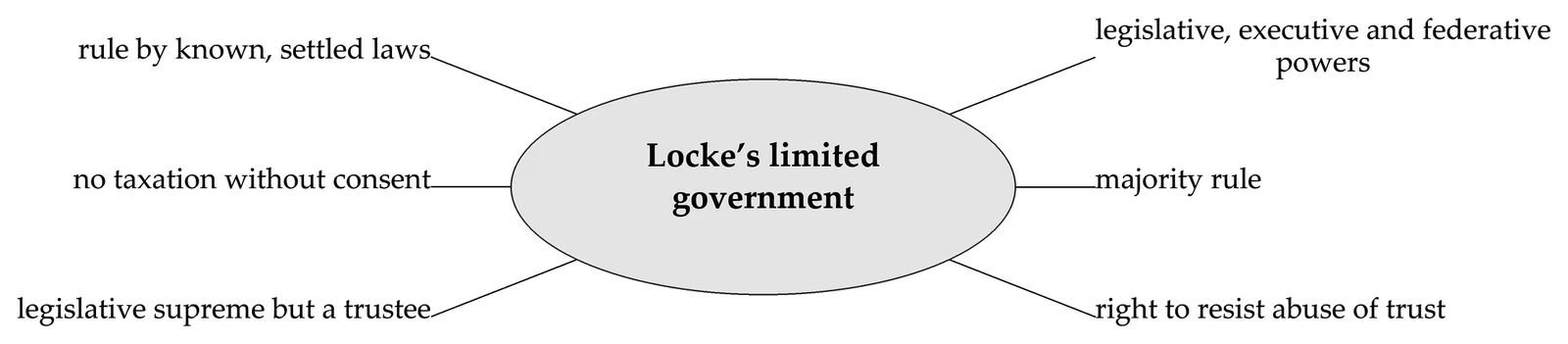
The legislative is the supreme power, but it is limited: it must govern by established, promulgated laws, not by arbitrary decrees; it cannot take anyone’s property without their consent, so there can be no taxation without consent of the people or their representatives; it cannot transfer its law-making power to others; and it must act for the public good. Locke also distinguished the executive power, which enforces laws, and the federative power, which conducts foreign relations, and allowed the executive a prerogative to act for the public good where the law is silent.
6.5 The Right to Resist
When the legislative or executive acts contrary to its trust, by invading the property of subjects, ruling arbitrarily, altering the legislature or betraying the people, the government is dissolved and power returns to the people, who may establish a new government. The people are the judge of whether their trustees have betrayed their trust, and if there is no judge on earth they may appeal to heaven, that is, resist by force.
Locke argued that this right would not lead to constant rebellion, since people bear great mistakes, many wrong laws and the slips of human frailty without mutiny. Only a long train of abuses, all tending the same way, will move them to resist. Indeed, he argued, the threat of resistance is the best fence against rebellion, because it discourages rulers from tyranny. The real rebels are rulers who use force without right. These ideas inspired the American Declaration of Independence (1776).
6.6 Toleration
In A Letter Concerning Toleration (1689), Locke argued for religious toleration by separating the business of civil government from that of religion. The commonwealth exists to protect civil interests: life, liberty, health and possessions. A church is a free and voluntary society for the worship of God and the salvation of souls. The magistrate’s power consists in outward force, but true religion consists in inward persuasion of the mind, which force cannot produce. Compelling belief is therefore both useless and wrong.

Locke’s toleration had limits. He would not tolerate opinions contrary to the moral rules necessary for civil society; churches whose members owe allegiance to a foreign prince, a reference to Catholics; or atheists, since promises and oaths, the bonds of society, can have no hold on them. Despite these limits, the Letter became a foundation of the liberal idea of freedom of conscience and the separation of church and state.
6.7 Important Questions
- Question 1 Analyse Locke’s theory of the right to property.
- Question 2 How is the social contract theory of Hobbes different from that of Locke?
- Question 3 Discuss Locke’s ideas of natural rights, consent and the right to resist.
- Question 4 Examine Locke’s theory of toleration.
DU asks the same idea in different words. So learn one broad answer for each question below; the same answer works for every question joined by OR.
Important Question 1
Analyse Locke’s theory of the right to property.
OR
Examine Locke’s labour theory of property and its limits.
OR
‘Locke was a theorist of possessive individualism.’ Discuss with reference to C.B. Macpherson.
Model Answer
“The labour of his body, and the work of his hands, we may say, are properly his.”
— John Locke, Second Treatise of Government, §27 (1689)
Introduction. Property is central to John Locke’s political philosophy. He declared that the great and chief end of people uniting into commonwealths is the preservation of their property. In Chapter 5 of the Second Treatise he explained how individuals can acquire private property in a world given by God to mankind in common, without the consent of others. His theory has been praised as a defence of individual rights and criticised as a justification of capitalist inequality.
1. The Context
Locke wrote against Sir Robert Filmer, who argued that God gave the world to Adam and his heirs, the kings, so that subjects had no property against the king. Locke needed to show that individuals have property rights independent of the monarch, which governments must respect. His argument also reflected the growth of commercial agriculture and colonisation in England.
2. Property in a Broad Sense
Locke used property in two senses. In the broad sense, it means a person’s life, liberty and estate, all of which are protected by natural law. In the narrow sense, it means material possessions such as land and goods. The purpose of government is to preserve property in the broad sense.
3. The World Given in Common
Locke began from the premise that God gave the earth and its fruits to mankind in common for the support and comfort of their being. The problem is to explain how individuals can come to own particular things privately, since if everyone’s consent were needed, people would starve amid plenty.
4. Self-ownership
Every man has a property in his own person, which nobody has any right to but himself. The labour of his body and the work of his hands are therefore properly his. Self-ownership is the foundation of Locke’s theory of property and of his individualism.
5. The Labour Theory
Whatever a person removes from the state of nature and mixes his labour with, he joins to something that is his own, and thereby makes it his property. The acorns a person gathers or the water he draws become his. Labour puts the difference of value on everything; Locke estimated that labour contributes nine-tenths or more of the value of useful products.
6. The Limits of Appropriation
Locke set limits on appropriation in the state of nature. A person may appropriate only as long as enough and as good is left in common for others, and only as much as he can use before it spoils; taking more is taking what belongs to others. These limits ensured that early appropriation harmed no one.
7. The Role of Money
The invention of money changed this. Gold and silver do not spoil, and people agreed by tacit consent to accept money in exchange for perishable goods. A person can therefore accumulate far more land and wealth than he can use without violating the spoilage limit. By consenting to money, people consented to unequal and disproportionate possession of the earth.
8. Property and Government
Because property exists before government, government cannot take it without the owner’s consent. Taxation requires the consent of the majority, given by themselves or their representatives. The protection of property is the main purpose of government and the test of its legitimacy.
9. Macpherson’s Critique
C.B. Macpherson argued that Locke’s theory justified unlimited capitalist accumulation. Through money, Locke removed the natural limits on appropriation, and by saying that the turfs my servant has cut become my property, he treated wage labour as the property of the employer. Locke assumed a class society in which the propertyless have less rationality and limited political rights, making him a theorist of possessive individualism.
10. Other Interpretations
James Tully argued that Locke’s property was limited by natural law duties, including charity to those in need, and was not capitalist in the modern sense. Jeremy Waldron emphasised Locke’s commitment to basic human equality grounded in theology. Robert Nozick later used Locke’s theory to defend libertarian property rights against redistribution.
11. Colonial Implications
Postcolonial scholars point out that Locke’s claim that uncultivated land is waste, and that in the beginning all the world was America, was used to justify the seizure of indigenous lands in North America, whose people were said not to labour on the land in the European way. Locke himself was involved in colonial administration.
12. Evaluation
Locke’s theory gave a powerful justification for individual property rights and limited government, influencing liberal constitutions and economic thought, including the labour theory of value of Smith and Marx. But it also legitimised inequality, wage labour and colonial dispossession, which is why it remains contested.
Conclusion. Thus, Locke grounded property in self-ownership and labour, limited at first by sufficiency and spoilage, but money allowed unlimited and unequal accumulation. His theory protects individual rights against arbitrary government, yet, as Macpherson argued, it also reflects and justifies the assumptions of possessive market society.
Important Question 2
How is the social contract theory of Hobbes different from that of Locke?
OR
Compare Hobbes and Locke on the state of nature, social contract and sovereignty.
OR
‘Hobbes was a theorist of absolutism and Locke of limited government.’ Discuss.
Model Answer
“This is to think that men are so foolish that they take care to avoid what mischiefs may be done them by polecats or foxes, but are content, nay, think it safety, to be devoured by lions.”
— John Locke on absolute monarchy, Second Treatise of Government, §93 (1689)
Introduction. Thomas Hobbes and John Locke were both English social contract theorists of the seventeenth century, and both derived political authority from the consent of free and equal individuals in a state of nature. Yet they reached opposite conclusions: Hobbes defended an absolute and undivided sovereign, while Locke defended limited, constitutional government and the right of resistance. Their differences arise from their different contexts and their different views of human nature and the state of nature.
1. Historical Context
Hobbes wrote Leviathan (1651) after the English Civil War, when the main danger seemed to be anarchy, so he stressed order and undivided sovereignty. Locke wrote the Two Treatises during the Exclusion Crisis and published them after the Glorious Revolution of 1688, when the main danger seemed to be royal tyranny, so he stressed rights and limits on power.
2. Human Nature
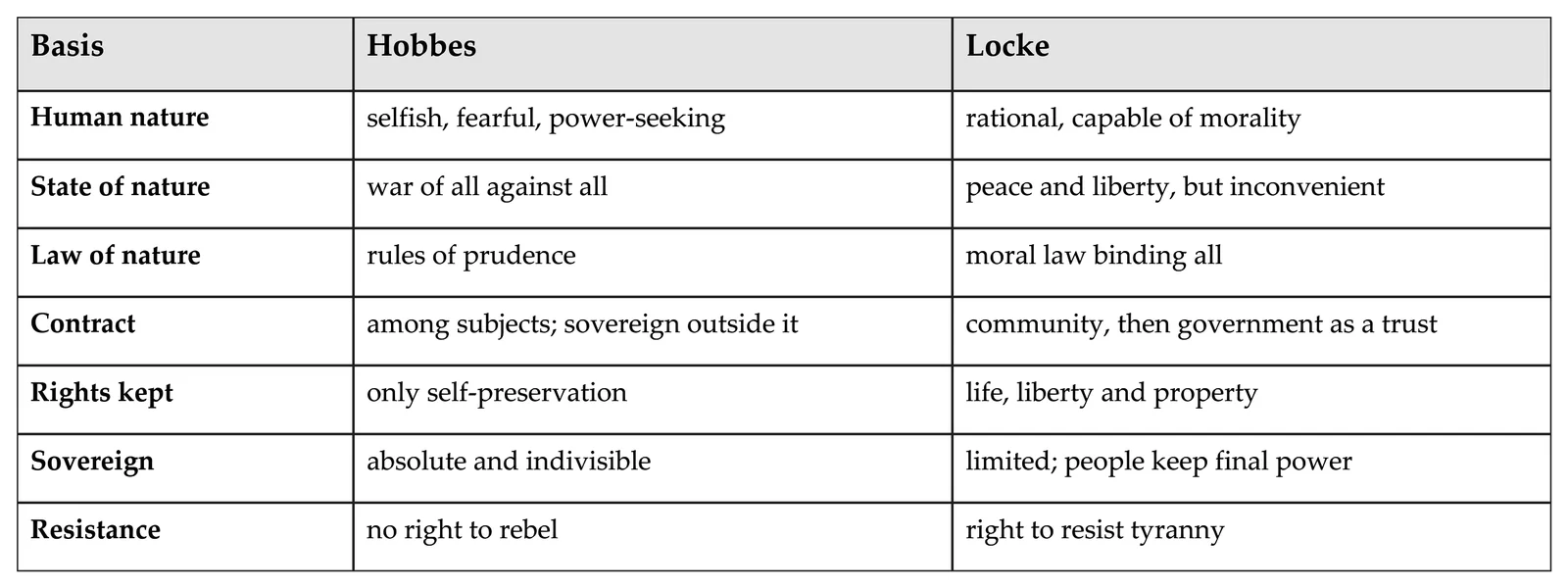
Hobbes saw humans as driven by a restless desire for power and fear of violent death, competitive, distrustful and vainglorious. Locke saw humans as rational beings capable of understanding and obeying the moral law of nature, more sociable and cooperative, though liable to be partial in their own cases.
3. State of Nature
For Hobbes, the state of nature is a war of every man against every man, in which life is solitary, poor, nasty, brutish and short. For Locke, it is a state of liberty and equality governed by the law of nature, a state of peace and goodwill, though with inconveniences. Locke distinguished it from the state of war, which arises only when someone uses force without right.
4. Law of Nature
For Hobbes, the laws of nature are rules of prudence discovered by reason, which oblige only in conscience until a sovereign enforces them. For Locke, the law of nature is a moral law, given by God and known through reason, which binds everyone even in the state of nature and protects life, liberty and property.
5. Rights before Government
In Hobbes’s state of nature there is no property or justice, only a right to everything. In Locke’s, people already have property, acquired through labour, and natural rights that exist before government. For Locke, government is created to protect these rights; for Hobbes, rights and property are largely created by the sovereign.
6. The Contract
For Hobbes, the contract is made among subjects who authorise a sovereign who is not a party to it and so cannot break it. For Locke, individuals first agree to form a community, which then entrusts power to a government; government is a fiduciary trust, bound by its purpose and revocable if betrayed.
7. What Is Surrendered
Hobbes’s subjects surrender all their rights except the right of self-preservation. Locke’s individuals surrender only their executive power to enforce the law of nature and punish offenders, while retaining their natural rights to life, liberty and property.
8. Nature of Sovereignty
Hobbes’s sovereign is absolute, indivisible and above the law, and he preferred monarchy. Locke made the legislative supreme but limited by the law of nature, by known laws, by the requirement of consent to taxation and by its trust, and he separated legislative, executive and federative powers. For Locke, ultimate power remains with the people.
9. Consent
Hobbes’s consent is a single irrevocable act, which may be given out of fear, even to a conqueror. Locke’s consent is ongoing, express or tacit, and government must continue to act for the public good; majority rule governs the community, and taxation requires the consent of the people or their representatives.
10. Resistance and Revolution
Hobbes denied any right of rebellion, except the right of individuals to resist being killed. Locke affirmed the right of the people to resist and replace a government that violates its trust, though only after a long train of abuses. Locke mocked Hobbes’s absolutism: it is foolish to protect oneself from polecats and foxes but be content to be devoured by lions.
11. Influence
Hobbes’s ideas influenced theories of sovereignty and the modern state, legal positivism and realism in international relations. Locke’s influenced liberal constitutionalism, the American Declaration of Independence, the separation of powers and the idea of human rights.
12. Common Ground
Despite their differences, both were individualists who began with free and equal individuals, made consent the source of authority and treated the state as an artificial creation serving individual purposes. Macpherson saw both as theorists of possessive individualism, reflecting the assumptions of an emerging market society.
Conclusion. Thus, Hobbes and Locke both grounded government in the consent of individuals, but Hobbes’s fearful view of human nature and the state of nature led him to absolute sovereignty, while Locke’s more optimistic view of reason and natural rights led him to limited government held in trust and a right of resistance.
Important Question 3
Discuss Locke’s ideas of natural rights, consent and the right to resist.
OR
Why is Locke called the father of liberalism?
OR
Examine Locke’s theory of limited government and the dissolution of government.
Model Answer
“Reason, which is that law, teaches all mankind, who will but consult it, that being all equal and independent, no one ought to harm another in his life, health, liberty, or possessions.”
— John Locke, Second Treatise of Government, §6 (1689)
Introduction. John Locke is widely regarded as the father of liberalism because he argued that individuals have natural rights that precede government, that legitimate government rests on consent, that its power is limited and held in trust, and that people may resist a government that abuses its power. These ideas shaped the Glorious Revolution, the American Revolution and modern constitutional democracy.
1. The State of Nature
Locke’s state of nature is a state of perfect freedom and equality, in which people are free to order their actions and dispose of their possessions within the bounds of the law of nature. It is a state of liberty, not licence, because the law of nature limits what people may do to themselves and others.
2. The Law of Nature
The law of nature is reason, which teaches that all people, being equal and independent creations of God, ought not to harm one another in their life, health, liberty or possessions. Everyone is bound to preserve himself and, when his own preservation is not at stake, to preserve the rest of mankind.
3. Natural Rights
From the law of nature flow natural rights to life, liberty and property, which Locke grouped together as property in the broad sense. These rights exist before government and do not depend on it. In the state of nature each person also has the executive power to enforce the law of nature and punish offenders.
4. Inconveniences of the State of Nature
The state of nature lacks an established and known law, an impartial judge and a power to enforce judgments. Since people are judges in their own cases, self-love and revenge lead to excess, and the enjoyment of rights is uncertain. These inconveniences give people reason to form political society.
5. Consent and the Formation of Society
No one can be subjected to the political power of another without his own consent. Individuals agree to form a community and give up their executive power to it. Locke distinguished express consent from tacit consent, given by enjoying property or even travelling on the highways within a government’s territory.
6. Majority Rule
Once a community is formed, it must act by the will of the majority, since a body must move one way and unanimity is impossible. Everyone who consents to form a community agrees to be bound by its majority decisions.
7. Government as a Trust
The community entrusts power to a government, whose authority is fiduciary: it holds power for the purpose of protecting the rights and good of the people. The legislative is supreme, but it may not rule arbitrarily, must govern by known laws, cannot take property or tax without consent and cannot delegate its power.
8. Separation of Powers
Locke distinguished the legislative power of making laws, the executive power of enforcing them and the federative power of war, peace and foreign relations. He argued that it is dangerous for the same persons who make laws also to execute them. He allowed the executive a prerogative to act for the public good where the law is silent, within limits.
9. Dissolution of Government
Government is dissolved when the legislature is altered without the people’s consent, when the executive neglects or abandons its duty, or when rulers act contrary to their trust by invading the property of subjects. In such cases power returns to the people, who may set up a new legislative.
10. The Right to Resist
The people are the judge of whether their trustees have betrayed their trust. Where there is no earthly judge, they may appeal to heaven, that is, resist by force. Locke argued that people will not rebel over minor mistakes but only after a long train of abuses, and that rulers who abuse power are the true rebels.
11. Influence
Locke’s ideas inspired the Declaration of Independence (1776), which declared that governments derive their just powers from the consent of the governed and that people may alter or abolish a government that becomes destructive of their rights. His ideas shaped liberal constitutionalism and human rights.
12. Evaluation
Locke’s theory provided a strong basis for limited government and individual rights. Critics argue that tacit consent is too weak to justify obligation, as Hume observed, that his rights were mainly for property owners, and that he did not extend equal rights to women, the propertyless or colonised peoples. Yet his principles became the foundation of liberal democracy.
Conclusion. Thus, Locke argued that individuals have natural rights to life, liberty and property, consent to form a society that entrusts limited power to government, and may resist when that trust is betrayed. These ideas make him the father of liberalism and a key source of constitutional democracy.
Important Question 4
Examine Locke’s theory of toleration.
OR
Discuss Locke’s argument for the separation of church and state.
OR
What are the limits of Locke’s idea of toleration?
Model Answer
“I esteem it above all things necessary to distinguish exactly the business of civil government from that of religion, and to settle the just bounds that lie between the one and the other.”
— John Locke, A Letter Concerning Toleration (1689)
Introduction. Seventeenth-century Europe was torn by religious wars and persecution. In England, conflicts among Anglicans, Catholics and Protestant dissenters shaped the Civil War and later politics. In A Letter Concerning Toleration (1689), written in exile in Holland, Locke argued that the state should not use force to impose religious belief, laying the foundations of the liberal principle of freedom of conscience and the separation of church and state.
1. The Context
After the Restoration of 1660, laws penalised dissenters who refused to conform to the Church of England, and fears of Catholic absolutism under James II were widespread. Locke, who had earlier held more authoritarian views, came to believe that religious persecution caused conflict rather than peace.
2. The Purpose of Civil Government
Locke defined the commonwealth as a society of people constituted only for procuring, preserving and advancing their civil interests: life, liberty, health and freedom from pain, and the possession of outward things such as money, land and houses. The magistrate’s duty is to protect these interests by impartial laws.
3. The Nature of a Church
A church is a free and voluntary society of people who join together to worship God in the way they believe acceptable to him for the salvation of their souls. No one is born a member of a church; people join and leave freely. A church may make its own rules and expel members, but it has no power to use force or to take away civil rights.
4. Separation of Church and State
Locke insisted on distinguishing exactly the business of civil government from that of religion. The care of souls is not committed to the civil magistrate, any more than to other people. Civil government deals with outward things and uses force; religion deals with the inward salvation of souls and uses persuasion.
5. The Argument from Belief
The central argument is that true religion consists in the inward persuasion of the mind, and belief cannot be compelled by force. The magistrate can force outward conformity, but this cannot make anyone believe or be saved. Persecution therefore cannot achieve its supposed purpose.
6. The Argument from Uncertainty
Locke also argued that rulers are no more likely than others to know the true religion; they differ from one another in religion, so if each forced his own belief, people would be compelled to follow different religions in different countries. Salvation cannot depend on the accident of where one is born.
7. Toleration among Churches and Individuals
Churches must tolerate one another and individuals must treat people of other faiths with charity and goodwill. No private person may harm another’s civil rights because of religion. Even the ruler’s own church has no special power over others.
8. Limits of Toleration
Locke did not extend toleration to opinions contrary to human society or to the moral rules necessary for civil society; to those who claim special privileges to break faith with heretics; to churches whose members owe allegiance to a foreign prince, a reference to Catholics who obeyed the Pope; or to atheists, since promises, covenants and oaths, the bonds of society, can have no hold on them.
9. Practical Effects
The Toleration Act of 1689 granted freedom of worship to Protestant dissenters, though not to Catholics or anti-Trinitarians. Locke’s Letter helped shift opinion towards the view that religious diversity can coexist with civil peace.
10. Influence
Locke’s arguments shaped the separation of church and state in the United States, enshrined in the First Amendment (1791), and the wider liberal commitment to freedom of conscience and religious liberty in modern constitutions, including India’s Articles 25 to 28.
11. Criticisms
Critics note that Locke’s toleration was limited and excluded atheists and Catholics. Others argue that his claim that belief cannot be compelled is not entirely true, since education and social pressure can shape belief, as Jeremy Waldron has argued. Modern liberals ground toleration more firmly in respect for persons and equal rights.
12. Evaluation
Despite its limits, Locke’s Letter was a decisive step towards religious freedom. By defining the state’s role as the protection of civil interests and religion as a matter of conscience, it laid the basis of secular, liberal government.
Conclusion. Thus, Locke argued for toleration by separating civil government, which protects civil interests through force, from religion, which concerns salvation through persuasion. Though limited by the exclusion of atheists and those owing foreign allegiance, his theory became a foundation of freedom of conscience and the secular state.
Short Notes
(a) Theory of consent (Locke)
Locke held that no one can be subjected to political power without his own consent. Express consent is given by an explicit promise or oath, making a person a full member of a commonwealth; tacit consent is given by anyone who enjoys the benefits of a government’s territory, such as owning land, lodging for a week or travelling on the highway, binding him to obey its laws while there. David Hume later objected that tacit consent is no real consent for those who cannot afford to leave.
(b) Spoilage limitation
Locke’s rule that in the state of nature a person may appropriate only as much as he can use before it spoils, since whatever spoils belongs to others. It, together with the sufficiency proviso, limited early property. The invention of money, which does not spoil, removed this limit and allowed large and unequal accumulation.
(c) Appeal to heaven
Locke’s phrase for the people’s right to resist a ruler who uses force without right when there is no judge on earth to decide between them. Like Jephthah in the Bible, the people must appeal to God and resist by force. It expresses the idea that the people are the final judge of whether their rulers have betrayed their trust.
More notes: DSC-13 Western Political Philosophy - I
These notes are prepared by PADHO TO AISE for study help. They are not an official University of Delhi publication.