
Semester V DSC-13 Western Political Philosophy - I
Unit IV · 23 min read · Updated 24 Nov 2026
As per the University of Delhi (DU) BA (Hons) Political Science syllabus
Contents
- 5.1 Hobbes, Science and the Civil War
- 5.2 Human Nature
- 5.3 The State of Nature and the Laws of Nature
- 5.4 Social Contract and the Role of Consent
- 5.5 State and Sovereignty
- 5.6 Possessive Individualism: Macpherson’s Reading
- 5.7 Important Questions
- Discuss Hobbes’s theory of sovereignty. Does that make him an absolutist or an individualist?
- Explain Hobbes’s views on human nature and the state of nature.
- Examine Hobbes’s theory of the social contract and the role of consent.
- Short Notes
और मनुष्य का जीवन एकाकी, दरिद्र, घृणित, पाशविक और अल्पकालिक होता है।
And the life of man, solitary, poor, nasty, brutish, and short.
— Thomas Hobbes, Leviathan, Chapter 13 (1651)
THOMAS Hobbes (1588–1679) wrote Leviathan (1651) as England emerged from a bloody civil war in which king and Parliament fought, the king was executed in 1649 and religious sects competed for power. Hobbes, who said that fear and he were born twins in the year of the Spanish Armada, sought a science of politics that would make peace possible. Starting from a mechanistic view of human nature, he imagined a state of nature without government, showed why it would be a war of all against all, and argued that rational individuals would consent to a social contract creating an absolute sovereign. This chapter studies these ideas and the debate about whether Hobbes is an absolutist or an individualist, including C.B. Macpherson’s thesis of possessive individualism.
5.1 Hobbes, Science and the Civil War
Hobbes admired the new sciences of Galileo and the method of geometry, which proceeds from definitions to certain conclusions. He believed that politics could become a science if it began from the basic elements of human nature and reasoned step by step to the conditions of peace. He used a resolutive–compositive method: resolving society into its parts, individuals and their passions, and then recomposing it in a form that would be stable. Everything, for Hobbes, is matter in motion, including human thoughts and feelings.
The context of the English Civil War shaped his concerns. Disputes over religion, taxation and the powers of king and Parliament had led to war, and every side claimed to act in the name of God, law or conscience. Hobbes concluded that peace requires a single, undivided sovereign power with the authority to decide disputes, including religious ones, and that divided sovereignty is the cause of civil war.
5.2 Human Nature
In the first chapters of Leviathan, Hobbes explained human thought as arising from sense: external objects press on our senses and produce images; imagination is decaying sense; and the train of thoughts links images together. Human beings are moved by appetites, desires towards things, and aversions, movements away from them. What we desire we call good, and what we hate we call evil, so there is no common good by nature. Reason is reckoning, adding and subtracting consequences, and helps us find the means to our ends.
Hobbes famously wrote that there is in all mankind a perpetual and restless desire of power after power, that ceases only in death, not because people always seek greater pleasure but because they cannot secure what they have without acquiring more. Above all, humans fear violent death. People are roughly equal in body and mind: the weakest can kill the strongest by cunning or alliance. This equality of ability produces equality of hope in attaining our ends, and hence conflict when two desire the same thing.
5.3 The State of Nature and the Laws of Nature
The state of nature is the condition of human beings without a common power to keep them in awe. Hobbes identified three principal causes of quarrel: competition, which makes people fight for gain; diffidence, or distrust, which makes them fight for safety and strike first; and glory, which makes them fight for reputation. The result is a condition of war of every man against every man, not necessarily constant fighting but a known disposition to fight.

In such a condition there is no industry, agriculture, navigation, arts or society, and the life of man is solitary, poor, nasty, brutish and short. There is no justice or injustice, since these require law, and no property, no mine and thine. Everyone has the right of nature, the liberty to use their own power to preserve their life, and therefore a right to everything. But reason discovers laws of nature, general rules forbidding people to do what destroys their life. The first is to seek peace if it can be had, and otherwise to defend ourselves by all means. The second is to be willing to lay down the right to all things when others do too. The third is to perform covenants made, which is the origin of justice.
5.4 Social Contract and the Role of Consent
Since covenants without a common power are unreliable, people need a sovereign to enforce them. Hobbes declared that covenants without the sword are but words. Each person therefore makes a covenant with every other person, saying in effect: I authorise and give up my right of governing myself to this man, or to this assembly of men, on condition that you give up your right to him and authorise all his actions in like manner. The multitude so united becomes a commonwealth, the great Leviathan, a mortal god.
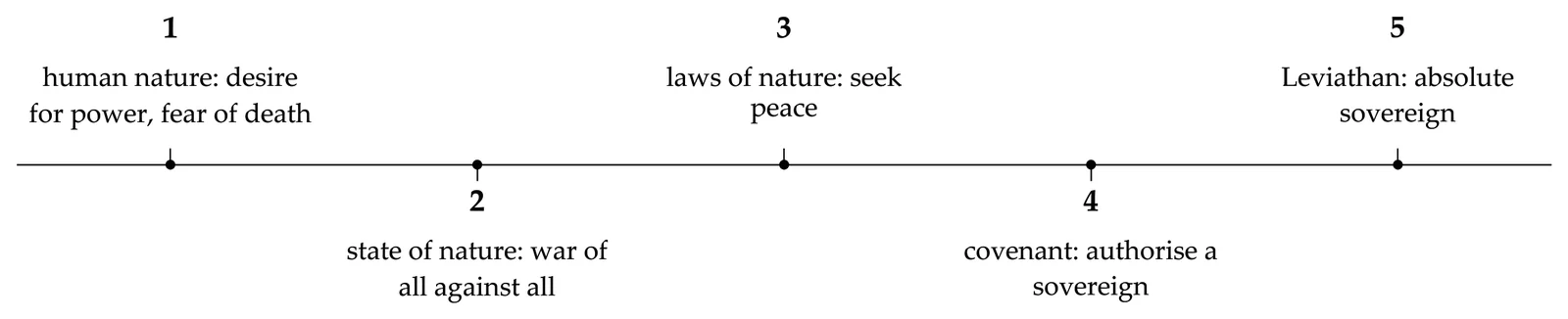
Three features of the contract are crucial. First, it is made among the subjects, not between subjects and sovereign, so the sovereign, not being a party, cannot break it. Second, it is a covenant of authorisation: the subjects become authors of all the sovereign’s actions, so they cannot complain of injustice. Third, consent grounds the sovereign’s authority whether the commonwealth is created by institution, through agreement, or by acquisition, through conquest, since in both cases people submit out of fear for their lives. Hobbes thus made consent, not divine right, the basis of political authority.
5.5 State and Sovereignty
The sovereign’s power is absolute. In Chapter 18 Hobbes listed the rights of the sovereign: subjects cannot change the form of government or transfer their allegiance; the sovereign cannot forfeit power; no subject can justly protest against the sovereign’s acts; the sovereign cannot be punished; he judges what doctrines may be taught, makes laws, decides disputes, makes war and peace, appoints ministers and distributes honours. Sovereignty is indivisible, since divided power, as between king and Parliament, leads to civil war. Hobbes preferred monarchy but accepted that sovereignty could belong to an assembly.
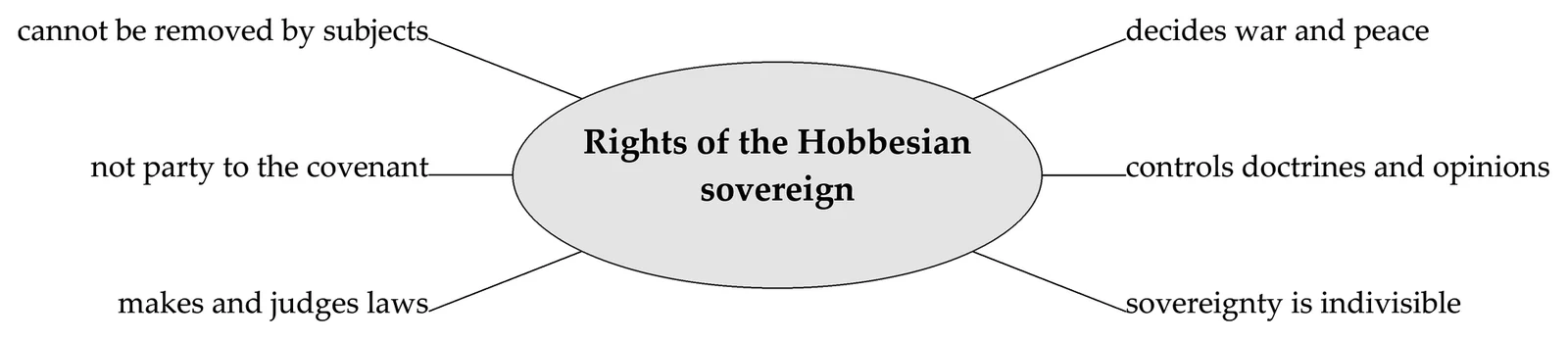
Yet subjects retain some liberty. The liberty of subjects lies in the silence of the law: whatever the law does not forbid, people may do. More importantly, the right of self-preservation cannot be surrendered. A subject may resist if the sovereign seeks to kill or injure him, may refuse to kill himself and need not accuse himself. The obligation of subjects lasts only as long as the sovereign is able to protect them. This shows that Hobbes’s absolutism rests on individualist foundations.
5.6 Possessive Individualism: Macpherson’s Reading
C.B. Macpherson, in The Political Theory of Possessive Individualism: Hobbes to Locke (1962), argued that Hobbes’s picture of human nature is not universal but reflects the emerging possessive market society of seventeenth-century England. In such a society, individuals are seen as proprietors of their own persons and capacities, owing nothing to society, and human relations become relations of exchange between proprietors. Hobbes himself wrote that the value or worth of a man is his price, what would be given for the use of his power.
For Macpherson, the competitive, power-seeking individuals of Hobbes’s state of nature are really the bourgeois individuals of market society, abstracted from their social setting. Hobbes’s strength was to see that such a society needs a strong sovereign to keep order; his weakness was to treat market behaviour as natural. Critics reply that Macpherson read too much into Hobbes, who was concerned with civil war and religious conflict rather than markets, but his thesis remains an influential reading of early liberalism. John Rawls read Hobbes differently, as offering a secular moral argument that rational individuals have reason to accept a sovereign to escape a collective trap.
5.7 Important Questions
- Question 1 Discuss Hobbes’s theory of sovereignty. Does that make him an absolutist or an individualist?
- Question 2 Explain Hobbes’s views on human nature and the state of nature.
- Question 3 Examine Hobbes’s theory of the social contract and the role of consent.
DU asks the same idea in different words. So learn one broad answer for each question below; the same answer works for every question joined by OR.
Important Question 1
Discuss Hobbes’s theory of sovereignty. Does that make him an absolutist or an individualist?
OR
‘Hobbes’s premises are individualist but his conclusions are absolutist.’ Discuss.
OR
Examine the nature and limits of sovereign power according to Hobbes.
Model Answer
“The obligation of subjects to the sovereign is understood to last as long, and no longer, than the power lasteth by which he is able to protect them.”
— Thomas Hobbes, Leviathan, Chapter 21 (1651)
Introduction. Thomas Hobbes’s Leviathan (1651) contains the most uncompromising defence of absolute sovereignty in Western political thought. Yet Hobbes built this absolutism on the foundations of individual equality, natural rights and consent. This apparent paradox has led to a long debate: is Hobbes an absolutist, an individualist or both? Answering it requires examining his theory of sovereignty and its foundations.
1. Context
Hobbes wrote during and after the English Civil War, when disputes between king and Parliament and among religious sects destroyed peace. He concluded that divided authority causes civil war and that only an undivided, absolute sovereign can guarantee order and security.
2. From the State of Nature to Sovereignty
In the state of nature, equal individuals driven by competition, diffidence and glory live in a war of all against all, where life is solitary, poor, nasty, brutish and short. To escape, they covenant with each other to authorise a sovereign who will keep them in awe and enforce the laws of nature.
3. Nature of the Covenant
The covenant is made among the subjects, each agreeing to authorise all the actions of the sovereign. The sovereign is not a party to the covenant and so cannot breach it. Since the subjects are authors of the sovereign’s actions, they cannot accuse him of injustice.
4. Absolute and Indivisible Sovereignty
The sovereign’s rights include making and interpreting laws, judging disputes, controlling doctrines and opinions, making war and peace, appointing officials, rewarding and punishing. Sovereignty cannot be divided among king, Lords and Commons, since divided power is the cause of civil war. The sovereign is above civil law and cannot be punished by subjects.
5. No Right of Rebellion
Subjects cannot change the form of government, transfer their allegiance or rebel on grounds of conscience or religion. Hobbes regarded claims of private judgement in politics, such as the belief that whatever a man does against his conscience is sin, as seditious doctrines that dissolve commonwealths.
6. The Case for Absolutism
These features make Hobbes the theorist of absolutism par excellence. His sovereign has unlimited power over subjects, controls religion and education, and is accountable to no earthly authority. He preferred monarchy because the private and public interests of a monarch coincide.
7. Individualist Foundations
Yet Hobbes’s premises are strongly individualist. He began with free and equal individuals in a state of nature, each with a natural right to preserve himself. The state is not natural, as Aristotle held, but an artificial creation made by individuals for their own security. Political authority rests on the consent of individuals, not on divine right or tradition.
8. Inalienable Rights
Hobbes held that the right of self-preservation cannot be surrendered. A subject may resist those who come to kill or wound him, even if they act for the sovereign, may refuse to kill himself or others in some cases and need not confess his crimes. The covenant itself exists to secure each individual’s life.

9. Liberty and the Limits of Obligation
The liberty of subjects lies in the silence of the law: people may do whatever the sovereign has not forbidden, such as buying and selling, choosing their homes and trades. The obligation to obey lasts only as long as the sovereign can protect them; if he fails, they are free to seek protection elsewhere. Sovereignty is thus conditional on its purpose.
10. Interpretations
Michael Oakeshott described Hobbes as an individualist whose sovereign exists to secure individual purposes. C.B. Macpherson saw him as a theorist of possessive individualism, whose individuals resemble competitive market actors needing a strong state. Others see him as a precursor of totalitarianism. Most scholars conclude that he combined individualist premises with absolutist conclusions.
11. Influence
Hobbes’s theory of sovereignty laid the foundations of the modern state as a secular, impersonal authority based on consent. Later liberals accepted his starting point but rejected his absolutism, arguing, like Locke, that individuals retain rights against the state and may resist tyranny.
12. Evaluation
Hobbes’s theory is logically powerful but leaves subjects with little protection against a sovereign who abuses power. Critics argue that he underestimated the dangers of absolute rule, as Locke observed: it is foolish to avoid polecats and foxes only to be devoured by lions. Yet his insight that peace requires an effective common authority remains central to political thought.
Conclusion. Thus, Hobbes is both an absolutist and an individualist. His sovereign is absolute, indivisible and beyond resistance, but this sovereign is created by the consent of free and equal individuals to secure their lives, and their inalienable right of self-preservation sets the limit of obligation. Individualist premises lead to absolutist conclusions.
Important Question 2
Explain Hobbes’s views on human nature and the state of nature.
OR
‘The life of man in the state of nature is solitary, poor, nasty, brutish and short.’ Discuss.
OR
Discuss Hobbes’s laws of nature and their role in his political theory.
Model Answer
“I put for a general inclination of all mankind a perpetual and restless desire of power after power, that ceaseth only in death.”
— Thomas Hobbes, Leviathan, Chapter 11 (1651)
Introduction. Hobbes built his political theory on an account of human nature and an imagined state of nature, the condition of human beings without government. His purpose was to show why people need an absolute sovereign. Writing during the English Civil War, he drew on the new science of his age to explain human behaviour in mechanical terms and to show how fear and reason lead people out of the state of nature.
1. A Mechanistic View
Hobbes was a materialist who believed that everything consists of matter in motion. Human beings are complex machines: sense arises from external objects pressing on our organs, imagination is decaying sense, and thought is a train of images. This scientific approach was meant to give politics the certainty of geometry.
2. Appetites and Aversions
Human actions are driven by appetites, movements towards things, and aversions, movements away from them. Whatever a person desires is called good and whatever he hates is called evil. There is therefore no common or objective good by nature; good and evil are relative to individual desire.
3. The Desire for Power
Power is a person’s present means to obtain some future apparent good. Hobbes held that all people have a perpetual and restless desire of power after power, ceasing only in death, because they cannot secure their present well-being without acquiring more. Reputation, wealth, friends and knowledge are all forms of power.
4. Equality
Nature has made people roughly equal in body and mind. Even the weakest can kill the strongest by secret means or by joining with others, and people are similar in prudence, which comes from experience. Equality of ability gives rise to equality of hope in attaining our ends, so when two people want the same thing they become enemies.
5. Three Causes of Quarrel
Hobbes identified three causes of conflict. Competition makes people invade for gain; diffidence, or distrust, makes them attack to protect themselves, since striking first is the best defence; and glory makes them fight over trifles such as a word, a smile or any sign of undervaluing.
6. War of All against All
Without a common power to keep them in awe, people are in a condition of war of every man against every man. War consists not only in actual fighting but in a known disposition to fight. In this condition there is no industry, agriculture, trade, arts, letters or society, and continual fear and danger of violent death; the life of man is solitary, poor, nasty, brutish and short.
7. No Justice and No Property
In the state of nature nothing can be unjust, since justice and injustice exist only where there is law, and there is no law without a common power. There is also no property, no dominion and no distinction between mine and thine, only what each person can get and keep for as long as he can keep it.
8. Evidence for the State of Nature
Hobbes admitted that there may never have been a general state of nature, but pointed to evidence: people lock their doors and chests, travel armed and distrust their neighbours; the native peoples of America, he claimed, lived without government; independent kings are in a posture of war; and civil war shows what life without a common power is like.
9. Right of Nature
The right of nature is the liberty each person has to use his own power to preserve his own life, and to do anything that he judges necessary for this. In the state of nature everyone has a right to everything, even to one another’s body, which makes security impossible.
10. Laws of Nature
Reason discovers laws of nature, rules forbidding a person to do what is destructive of his life. The first is to seek peace if it can be obtained and otherwise to defend oneself by all means. The second is to lay down one’s right to all things when others are willing to do the same. The third is to keep covenants, which is the source of justice. Others include gratitude, equity and the avoidance of pride.
11. From Nature to Commonwealth
The laws of nature oblige only in conscience, since without a common power keeping them would make a person prey to others. People therefore need a sovereign to enforce them, which leads to the social contract. Fear of death and reason together lead people out of the state of nature.
12. Evaluation
Critics argue that Hobbes’s picture of human nature is too pessimistic and ignores sociability and cooperation, as Aristotle and Rousseau stressed. Macpherson argued that it describes the competitive individuals of market society rather than human nature as such. Yet his analysis of insecurity, mistrust and the logic of conflict influences modern game theory and realist international relations.
Conclusion. Thus, Hobbes saw human beings as equal, self-interested and driven by a restless desire for power and fear of death. Without government their life would be a war of all against all, but reason discovers laws of nature that point towards peace through a covenant establishing a common power.
Important Question 3
Examine Hobbes’s theory of the social contract and the role of consent.
OR
‘Covenants without the sword are but words.’ Discuss.
OR
Discuss C.B. Macpherson’s interpretation of Hobbes as a theorist of possessive individualism.
Model Answer
“Covenants, without the sword, are but words, and of no strength to secure a man at all.”
— Thomas Hobbes, Leviathan, Chapter 17 (1651)
Introduction. Hobbes was one of the founders of social contract theory, which explains political authority as the product of an agreement among individuals. In Leviathan he argued that rational individuals, fearing death in the state of nature, would consent to create a sovereign with absolute power. His theory made consent rather than divine right or tradition the foundation of authority, though in a form that gave the sovereign almost unlimited power.
1. The Need for a Contract
In the state of nature, people know the laws of nature but cannot safely obey them, because others may not. Covenants made without a common power are unreliable, since the first to perform risks being betrayed. People therefore need a power that will compel everyone to keep their agreements.
2. The Terms of the Covenant
Each person covenants with every other: I authorise and give up my right of governing myself to this man, or to this assembly of men, on condition that you give up your right to him and authorise all his actions in like manner. The multitude so united in one person is called a commonwealth, the great Leviathan, that mortal god to which we owe our peace and defence.
3. Authorisation
The key idea is authorisation. The subjects become the authors of all the sovereign’s actions, and the sovereign is the actor who represents them. Since a person cannot injure himself, subjects cannot complain that the sovereign wrongs them. The sovereign represents the unity of the commonwealth, which otherwise would be a mere multitude.
4. The Sovereign Outside the Contract
The contract is among subjects, not between subjects and sovereign. The sovereign makes no promises and is bound by no conditions, so he cannot break the covenant or forfeit his power. This distinguishes Hobbes from later contract theorists such as Locke, for whom government is a trust that can be revoked.
5. Institution and Acquisition
A commonwealth may be created by institution, when people agree to appoint a sovereign, or by acquisition, when a conqueror obtains submission by force. In both cases, Hobbes argued, authority rests on consent, since people consent out of fear, whether of each other or of the conqueror. Covenants made out of fear are valid.
6. The Role of Consent
Consent is central to Hobbes’s theory: the sovereign’s right comes from the agreement of those he rules, not from God, nature or heredity. This was a revolutionary idea, because it made political authority a human creation justified by its benefits to individuals. Even absolute power must be traced back to the will of the subjects.
7. Limits of Consent
However, Hobbes’s consent is a single, irrevocable act. Once given, it cannot be withdrawn, and it may be extracted by fear. Critics argue that consent given under threat of death is not genuine, and that Hobbes’s theory leaves no room for ongoing consent or participation, unlike later democratic theories.
8. Inalienable Rights
Some rights cannot be transferred by the covenant, especially the right to defend one’s life. A covenant not to defend oneself from force is void. Hence the contract secures, rather than abolishes, the individual’s most basic right, and obligation ends if the sovereign can no longer protect the subject.
9. Macpherson’s Interpretation
C.B. Macpherson argued that Hobbes’s contracting individuals are possessive individuals, proprietors of their own capacities who relate to each other through market exchange. Hobbes wrote that a man’s value is his price. The contract reflects the assumptions of an emerging capitalist society, in which a strong state is needed to maintain order among competing individuals.
10. Rawls’s Interpretation
John Rawls read Hobbes’s argument as a secular moral and rational argument: each person, reasoning about his own good, has strong reasons to accept a sovereign to escape the collective trap of the state of nature, a situation similar to what game theorists call the prisoner’s dilemma, in which individually rational choices produce a bad outcome for all.
11. Influence
Hobbes’s contract theory inspired later contractarians, Locke, Rousseau, Kant and in the twentieth century Rawls and David Gauthier, who all used the idea of agreement to justify political principles, though most rejected his absolutism.
12. Evaluation
Hobbes’s theory is powerful in showing why rational individuals need government and why authority must rest on consent. But by making consent irrevocable and the sovereign unaccountable, it offers little protection against tyranny, a weakness Locke sought to correct.
Conclusion. Thus, Hobbes’s social contract is a covenant among individuals who authorise an absolute sovereign to secure peace. Consent is the source of authority, but it is given once and for all, limited only by the inalienable right of self-preservation, making Hobbes a founder of both contract theory and modern absolutism.
Short Notes
(a) Possessive individualism
C.B. Macpherson’s term (1962) for the assumptions of seventeenth-century English political theory from Hobbes to Locke. The individual is seen as essentially the proprietor of his own person and capacities, owing nothing to society for them; freedom means freedom from dependence on others; and society consists of relations of exchange between proprietors. Political society is a device for protecting property and maintaining orderly exchange.
(b) Right of nature and law of nature
Hobbes distinguished the right of nature, the liberty to use one’s own power to preserve one’s life, from a law of nature, a rule found by reason forbidding a person to do what destroys his life. Right is liberty to do or forbear; law binds. The first law of nature is to seek peace, and the second to lay down one’s right to all things when others do the same.
(c) Leviathan
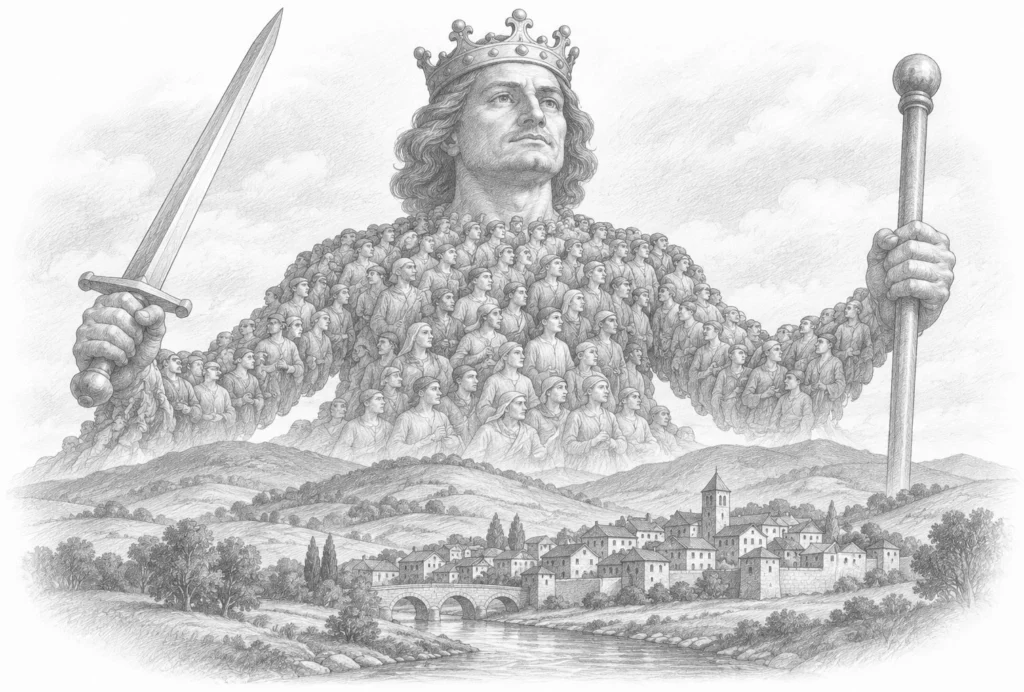
A sea monster in the Book of Job, used by Hobbes as the title of his 1651 work and the name of the commonwealth. The sovereign is the Leviathan, a mortal god and artificial person created by the covenant of the multitude. The famous frontispiece shows a crowned giant whose body is made of many small people, symbolising the unity of subjects in the sovereign.
(d) Liberty of subjects
In Chapter 21 of Leviathan, Hobbes defined liberty as the absence of external impediments to motion, and argued that freedom is compatible with fear and necessity: a man who throws his goods into the sea to save his ship acts freely. The liberty of subjects lies in the silence of the law, in all the matters the sovereign has not regulated. Subjects also keep the true liberty to refuse orders that threaten their lives, since the right of self-preservation cannot be surrendered.
More notes: DSC-13 Western Political Philosophy - I
These notes are prepared by PADHO TO AISE for study help. They are not an official University of Delhi publication.