
Semester V DSC-13 Western Political Philosophy - I
Unit II · 28 min read · Updated 24 Nov 2026
As per the University of Delhi (DU) BA (Hons) Political Science syllabus
Contents
- 2.1 Philosophy and Politics: The Theory of Forms
- 2.2 Virtues and the Theory of Justice
- 2.3 Philosopher Kings and Queens and Communism
- 2.4 Women and Guardianship
- 2.5 Philosophic Education and the Good
- 2.6 Plato on Democracy
- 2.7 Important Questions
- Analyse Plato’s theory of justice underlying its significance in the construction of the ideal state.
- ‘Plato’s Republic was more of a treatise on education than on government.’ (Rousseau) Describe Plato’s theory of education in the light of this statement.
- Discuss Plato’s concept of the philosopher king and his theory of communism.
- Examine Plato’s views on democracy and on women and guardianship.
- Short Notes
जब तक दार्शनिक राजा नहीं बनते, या जिन्हें आज राजा कहा जाता है वे सच्चे अर्थों में दर्शन नहीं करते, तब तक नगरों को बुराइयों से मुक्ति नहीं मिलेगी।
Until philosophers rule as kings or those who are now called kings and leading men genuinely and adequately philosophize, cities will have no rest from evils.
— Plato, Republic, 473c–d (trans. Grube and Reeve)
WESTERN political philosophy, it is often said, is a series of footnotes to Plato. Plato (c. 427–347 BCE) wrote in Athens after its defeat in the Peloponnesian War and after the democratic city put his teacher Socrates to death in 399 BCE. These experiences convinced him that politics must be guided by knowledge rather than opinion, and that only those who know the good are fit to rule. In the Republic he described an ideal city founded on justice, ruled by philosopher kings and queens, sustained by a demanding system of education and protected by the abolition of private property and family among its rulers. This chapter studies Plato’s ideas on philosophy and politics, virtue, justice, the philosopher ruler, communism, democracy, women and education.
2.1 Philosophy and Politics: The Theory of Forms
For Plato, politics is a craft (techne) like medicine or navigation, and it requires knowledge (episteme) rather than mere opinion (doxa). Most people, and most democratic assemblies, live by opinion, which is changeable and unreliable. True knowledge is knowledge of the Forms or Ideas: eternal, unchanging and perfect realities, such as justice itself, beauty itself and equality itself, of which the things of the sensible world are imperfect copies. The highest Form is the Form of the Good, which Plato compared to the sun: as the sun makes things visible and makes them grow, the Good makes things knowable and gives them being.
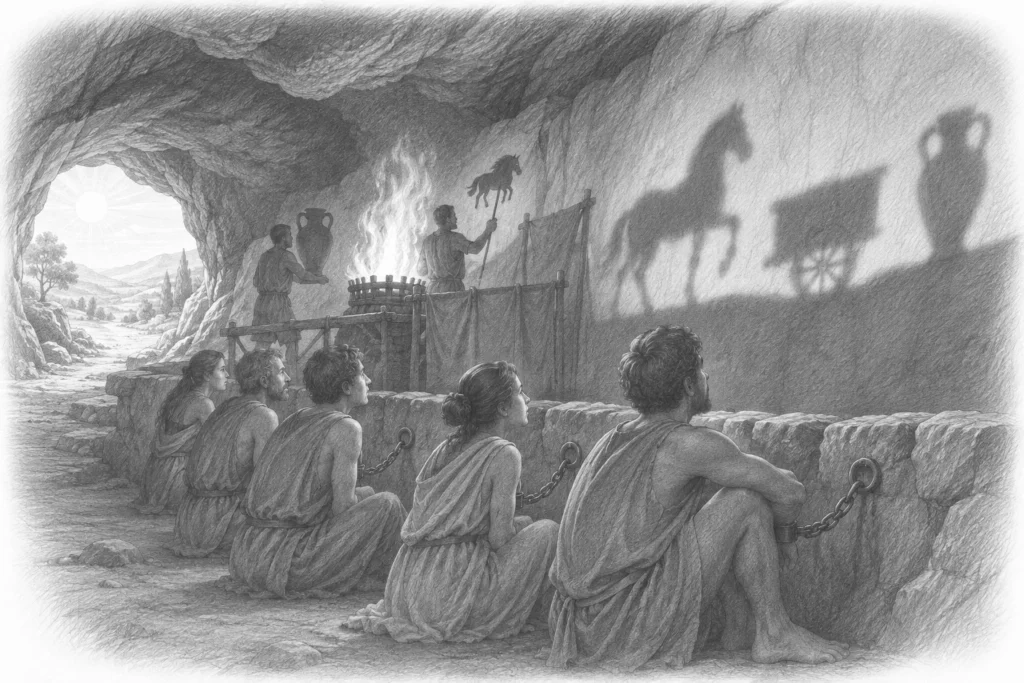
In the allegory of the cave (Book VII), prisoners chained in a cave see only shadows cast on a wall and take them for reality. A prisoner who is freed and dragged up into the sunlight at first is dazzled but finally sees the sun itself. If he returns to the cave, the others mock him and may even kill him, an allusion to Socrates. The allegory shows that philosophers, who have seen the Good, must return to the cave and rule, even if reluctantly, because only they can guide the city by knowledge. Philosophy and politics are thus united in Plato’s thought.
2.2 Virtues and the Theory of Justice
The Republic opens with the question what is justice. Cephalus suggests that justice is telling the truth and paying one’s debts; Polemarchus that it is helping friends and harming enemies; and Thrasymachus that justice is the advantage of the stronger, the rules made by rulers in their own interest. In Book II, Glaucon tells the story of the Ring of Gyges, which makes its wearer invisible, to argue that people are just only out of fear of punishment, and that justice is a social contract among the weak. Socrates sets out to show that justice is good in itself and for its consequences.
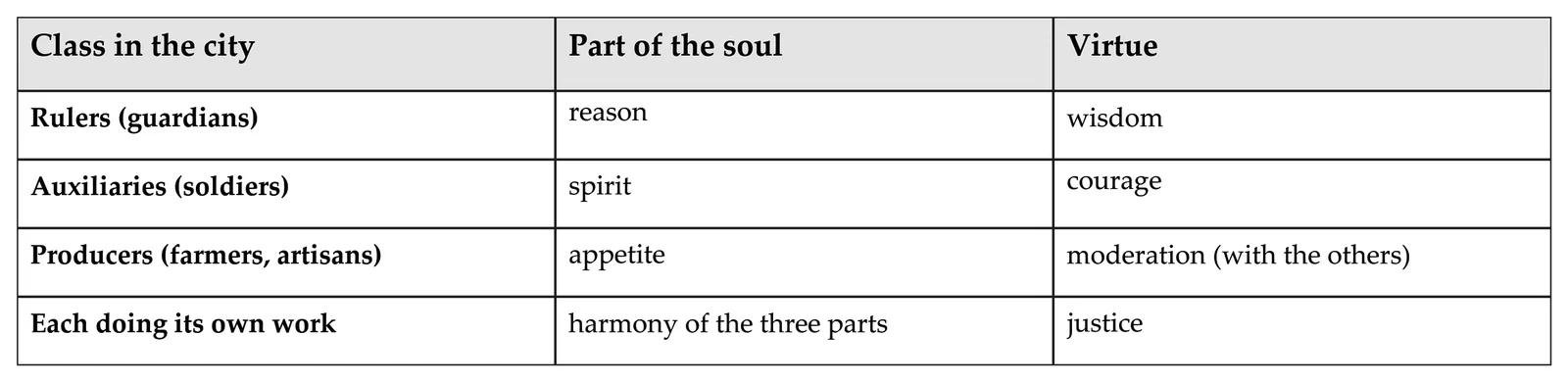
To find justice, Socrates constructs a city in speech with three classes: the rulers or guardians, the auxiliaries or soldiers, and the producers, farmers and artisans. The city has four virtues: wisdom in the rulers, courage in the auxiliaries, moderation, the agreement of all classes about who should rule, and justice, which is each class doing its own work and not meddling in the work of others. The individual soul has three parallel parts: reason, spirit and appetite. A just person is one whose reason rules, supported by spirit, over the appetites. Justice is thus a harmony, in the city and in the soul, and injustice is a kind of civil war.
2.3 Philosopher Kings and Queens and Communism
In Book V, Socrates faces three waves of objection to his ideal city. The third and greatest is the claim that philosophers should rule. Since only philosophers know the Good, only they can rule wisely and selflessly. They do not desire power; they must be compelled to rule out of duty. Plato compares the city to a ship whose sailors quarrel over who should steer, while ignoring the true navigator who studies the stars; democracy, he suggests, is such a ship.
To prevent the rulers from becoming corrupt, Plato proposed a system of communism for the guardian and auxiliary classes. They would have no private property, live and eat together, receive their needs from the producers and be forbidden to touch gold and silver. They would also have no private families: marriages would be arranged by the rulers through festivals and lotteries to produce the best children, who would be raised in common so that no one knew their own parents. The aim was unity: if the guardians had no private interests, they would say ‘mine’ and ‘not mine’ of the same things and devote themselves to the common good. This communism applied only to the ruling classes, not to the producers, and it was ascetic rather than economic.

2.4 Women and Guardianship
The first wave of Book V is Plato’s proposal that women should be guardians on equal terms with men. He argued that the difference between men and women, that women bear children, is not relevant to the work of ruling, just as the difference between bald and long-haired men is irrelevant to shoemaking. Women with the right nature should receive the same education in music, gymnastics and war, and could become philosopher queens. This was radical for Athens, where women were excluded from public life.
Susan Moller Okin, in ‘Philosopher Queens and Private Wives’ (1979), argued that Plato’s proposal depended on abolishing the private family: once guardians had no private households, women were freed from domestic roles. In the Laws, where Plato restored private property and the family, women returned to subordinate positions. Okin concluded that the family is the key institution for women’s equality. Critics also note that Plato still said women are weaker in all pursuits, and that his concern was the unity of the city, not women’s rights.
2.5 Philosophic Education and the Good
Rousseau said that the Republic is the finest treatise on education ever written. For Plato, education is the main instrument of politics: it shapes character, selects rulers and turns the soul towards the Good. Education is ‘turning around’ the soul from shadows to reality, not putting knowledge into empty minds. The curriculum for guardians begins with music, including poetry and stories, and gymnastics up to about eighteen, to form a balanced character; poetry is censored so that children hear only true and noble stories about gods and heroes. Two years of military training follow.
Those who show ability study mathematics, arithmetic, geometry, astronomy and harmonics, from about twenty to thirty, training the mind to think abstractly. The best then study dialectic, the highest form of reasoning, from thirty to thirty-five, leading to knowledge of the Forms and finally of the Good. After fifteen years of practical service in the city, those who pass every test become philosopher rulers at about fifty. Education is public, controlled by the state, open to women and lifelong. Its purpose is not individual success but justice in the soul and the city.

2.6 Plato on Democracy
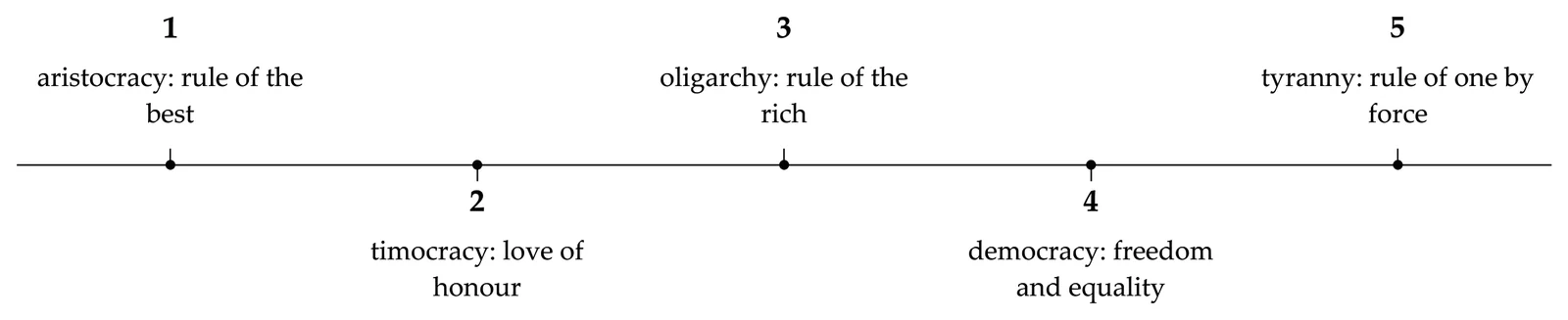
In Book VIII, Plato described how the ideal city would decline through a series of regimes: timocracy, ruled by lovers of honour; oligarchy, ruled by the rich; democracy, ruled by the many; and tyranny, the worst. Democracy arises when the poor overthrow the rich. It values freedom and equality above all, letting everyone live as they like and treating equals and unequals alike. Plato described the democratic person as following every passing desire, and democracy as a beautiful but disorderly regime that leads to tyranny, when a demagogue claiming to protect the people seizes power.
Plato’s hostility to democracy reflected the execution of Socrates and the failures of Athenian democracy in the war. In later works, the Statesman and the Laws, he accepted that philosopher rulers are rare and proposed a second-best state governed by laws and a mixed constitution. Karl Popper, in The Open Society and Its Enemies (1945), condemned Plato as an enemy of the open society and a forerunner of totalitarianism, while defenders reply that Plato sought rule by reason and the common good, not by force.
2.7 Important Questions
- Question 1 Analyse Plato’s theory of justice underlying its significance in the construction of the ideal state.
- Question 2 ‘Plato’s Republic was more of a treatise on education than on government.’ (Rousseau) Describe Plato’s theory of education in the light of this statement.
- Question 3 Discuss Plato’s concept of the philosopher king and his theory of communism.
- Question 4 Examine Plato’s views on democracy and on women and guardianship.
DU asks the same idea in different words. So learn one broad answer for each question below; the same answer works for every question joined by OR.
Important Question 1
Analyse Plato’s theory of justice underlying its significance in the construction of the ideal state.
OR
Examine Plato’s theory of justice. How is it related to his theory of the soul?
OR
‘Justice is doing one’s own work.’ Discuss with reference to Plato.
Model Answer
“Justice is doing one’s own work and not meddling with what isn’t one’s own.”
— Plato, Republic, 433a (trans. Grube and Reeve)
Introduction. Justice is the central theme of Plato’s Republic, whose subtitle in later tradition was ‘Concerning Justice’. Writing after Athens’s defeat in the Peloponnesian War and the execution of Socrates, Plato sought to show that justice is not merely a convention imposed by the powerful but a harmony that benefits both the individual and the city. His theory of justice is the foundation on which he builds his ideal state.
1. The Question of Justice
The Republic begins with an inquiry into what justice is and whether the just life is better than the unjust. Plato’s Socrates examines existing views and finds them inadequate before constructing a city in speech, believing that justice will be easier to see in the larger letters of the city than in the smaller letters of the individual.
2. Traditional Views
Cephalus, an old businessman, defines justice as telling the truth and paying one’s debts, but Socrates shows that returning a weapon to a madman would not be just. His son Polemarchus says justice is helping friends and harming enemies, but Socrates argues that a just person cannot harm anyone, since harming makes people worse.
3. Thrasymachus’s Challenge
The sophist Thrasymachus argues that justice is the advantage of the stronger: rulers make laws in their own interest and call obedience justice. He praises the unjust tyrant as happiest. This radical view reduces justice to power, and refuting it is one of Plato’s main purposes.
4. Glaucon and the Ring of Gyges
Glaucon restates the challenge by arguing that justice is a social contract: people agree not to harm each other because they fear being harmed. With the Ring of Gyges, which makes its wearer invisible, anyone would act unjustly. Socrates must show that justice is good in itself, not only for its rewards.
5. The City in Speech
Socrates builds an ideal city based on the principle of specialisation: each person should do the work for which nature has fitted them. The city has three classes: rulers who govern, auxiliaries who defend and producers who supply material needs. A noble lie, the myth of the metals, persuades citizens that rulers have gold in their souls, auxiliaries silver and producers bronze or iron.
6. The Four Virtues
The well-ordered city possesses four virtues. Wisdom belongs to the rulers, who know what is good for the whole city. Courage belongs to the auxiliaries, who hold right beliefs about what is to be feared. Moderation is the agreement of all classes about who should rule. Justice is the principle that each class performs its own function without interfering in the functions of others.
7. Justice in the Soul
The individual soul has three parts corresponding to the three classes: reason, which loves truth; spirit, which loves honour and anger at injustice; and appetite, which desires food, sex and money. A just person is one in whom reason rules with the help of spirit over the appetites. Justice is the health and harmony of the soul, and injustice is disease and civil war within it.
8. Justice and the Ideal State
Justice is the organising principle of the ideal state. It requires that philosophers, who know the Good, rule; that guardians and auxiliaries live without private property and families to avoid corruption; that education select and train each person for the right role; and that women capable of ruling be included among the guardians. All of Plato’s institutions serve to realise justice as harmony and specialisation.
9. Justice as Good in Itself
Plato’s final answer to Thrasymachus and Glaucon is that the just person is happier than the unjust, because justice is the health of the soul. The tyrant, who seems to have everything, is actually enslaved by his appetites, full of fear and without friends. In Book IX Plato even calculated, half playfully, that the philosopher-king lives seven hundred and twenty-nine times more pleasantly than the tyrant, to show that justice is good both in itself and for its consequences.
10. Significance
Plato’s theory showed that justice is not merely conventional but rooted in the nature of the soul and the needs of the community. It connected ethics and politics, personal virtue and social order, and influenced later thinkers from Aristotle to the natural law tradition. It also anticipated the idea of a functional division of labour.
11. Criticisms
Critics argue that Plato’s justice is not justice in the modern sense of rights and fairness but a principle of social hierarchy that fixes people in classes. Popper saw it as a justification for a closed, authoritarian society. Others note that Plato ignores individual freedom and the possibility of disagreement about the good. Yet his question, whether justice is good for those who practise it, remains central to political philosophy.
Conclusion. Thus, for Plato justice is each part, in the city and in the soul, doing its own work under the rule of reason. This idea of justice as harmony is the foundation of his ideal state, though its hierarchical and anti-democratic implications have been strongly criticised.
Important Question 2
‘Plato’s Republic was more of a treatise on education than on government.’ (Rousseau) Describe Plato’s theory of education in the light of this statement.
OR
Examine Plato’s scheme of education. How is it related to his ideal state?
OR
Discuss Plato’s idea of philosophic education and the Good.
Model Answer
“It is not at all a political work, as think those who judge books only by their titles. It is the most beautiful educational treatise ever written.”
— Jean-Jacques Rousseau on Plato’s Republic, Emile (1762), trans. Allan Bloom
Introduction. Rousseau, in Emile (1762), remarked that the Republic is not really a political book but the finest treatise on education ever written. For Plato, education is not one policy among others but the very foundation of the just city. It shapes the character of citizens, selects and trains the rulers and turns the soul from the world of shadows towards knowledge of the Good.
1. Why Education Matters
Plato believed that justice depends on each person doing the work for which they are naturally suited, and on rulers who possess knowledge. Education is the means by which natural abilities are discovered, developed and directed. A good education produces good citizens and rulers, while bad education corrupts both. In the Laws Plato called the minister of education the most important official in the state, a sign of how central education was to his political thought.
2. Education as Turning the Soul
In the allegory of the cave, education is not putting knowledge into empty minds, like putting sight into blind eyes, but turning the whole soul around from shadows towards the light. The capacity to learn is already present; education redirects it towards the truth and finally to the Form of the Good.
3. Influence of Athens and Sparta
Plato combined features of Athenian education, which emphasised music, poetry and intellectual culture, with Spartan education, which was controlled by the state, collective and focused on discipline and military training. Unlike Athens, where education was private, Plato made it public and compulsory for the guardian classes. Plato’s Academy itself was a model of the higher education he described, combining mathematics, dialectic and political training.
4. Elementary Education
Up to about eighteen, children study music, which includes poetry, stories and harmony, and gymnastics. Music shapes the soul and gymnastics the body, and a balance of the two produces a character that is neither harsh nor soft. Plato insisted that stories be censored so that gods and heroes are presented as good, and he would expel imitative poets who corrupt character.
5. Military Training
From about eighteen to twenty, young people undergo physical and military training. Those who perform well in tests of endurance and loyalty are selected for higher education, while others become auxiliaries.
6. Higher Education: Mathematics
From twenty to thirty, the selected students study arithmetic, plane and solid geometry, astronomy and harmonics. These subjects train the mind to move from visible things to abstract truths, preparing it for philosophy. Plato inscribed over the door of the Academy, according to tradition, that no one ignorant of geometry should enter.
7. Dialectic and the Good
From thirty to thirty-five, the best study dialectic, the art of reasoning through questions and answers to reach the first principles of reality. Dialectic leads to knowledge of the Forms and ultimately of the Form of the Good, which is the source of all value and knowledge. Only those who know the Good can rule wisely. Plato delayed dialectic until thirty because he feared that young people who learn to argue too early use it to contradict everything and lose respect for truth.
8. Practical Service and Rule
After dialectic, the students spend fifteen years in practical service, holding military and administrative posts to gain experience and prove their character. At about fifty, those who have passed every test become philosopher rulers, spending most of their time in philosophy but taking turns to govern out of duty.
9. Censorship of Poetry and Art
Plato insisted that the stories told to children must show gods as good and unchanging and heroes as brave and self-controlled, since early impressions shape character. In Book X he went further, banishing imitative poets such as Homer from the ideal city because poetry stirs the emotions and imitates appearances rather than truth. Critics see this as dangerous censorship; Plato saw it as protecting the soul’s education.
10. Features of Plato’s Education
Plato’s education is state-controlled, compulsory for the guardians, lifelong, selective and open to women equally with men. It combines moral, physical and intellectual training and aims at the good of the city rather than personal success. Its purpose is to produce justice in the soul and the city.
11. Evaluation
Plato’s theory was the first systematic philosophy of education and influenced thinkers from Aristotle to Rousseau and modern ideas of public education. But critics object to censorship, the neglect of the producers’ education, rigid selection and state control of thought. Rousseau’s remark is partly true: the Republic is about education because, for Plato, good government is impossible without it.
Conclusion. Thus, Plato’s Republic places education at the heart of politics. By turning souls towards the Good and selecting philosopher rulers through a long and demanding curriculum, education becomes the means of realising justice, which is why Rousseau could call the Republic the finest treatise on education ever written.
Important Question 3
Discuss Plato’s concept of the philosopher king and his theory of communism.
OR
Why did Plato advocate the abolition of private property and family for the guardians?
OR
Is Plato’s ideal state totalitarian? Discuss.
Model Answer
“I believe that Plato’s political programme, far from being morally superior to totalitarianism, is fundamentally identical with it.”
— Karl Popper, The Open Society and Its Enemies, Volume I (1945)
Introduction. The rule of philosopher kings and queens and the communism of property and family among the guardians are Plato’s most famous and controversial proposals. In Book V of the Republic, he presents them as the waves of objection his ideal city must survive. Both are designed to ensure that power is held by those who know the Good and that they use it for the common good rather than private interest.
1. The Problem of Rule
Plato saw politics in Athens as a contest of ignorant opinions and selfish interests that had led to war, faction and the death of Socrates. He believed that ruling is a craft requiring expert knowledge, and that the best city would be ruled by those who know what is truly good.
2. Why Philosophers Should Rule
Philosophers love truth and know the Forms, especially the Form of the Good. They can see what is good for the whole city and are not moved by greed or ambition. Plato declared that until philosophers rule as kings, or kings become philosophers, cities will have no rest from evils. Their long education, ending in knowledge of the Good, gives them a vision of the whole that no specialist, soldier or merchant possesses.
3. The Ship of State
Plato compared the city to a ship whose owner is strong but short-sighted, while the sailors quarrel over who should steer and flatter the owner, ignoring the true navigator who studies the stars and winds. Democracy, in his view, gives power to the persuasive rather than the knowledgeable.
4. Reluctant Rulers
Philosophers do not want to rule; they prefer contemplation. Plato argued that this reluctance makes them fit to rule, because those who desire power use it for themselves. The philosophers rule out of duty, repaying the city for their education. Plato remarked that the city in which those who are to rule are least eager to rule is necessarily governed best and most free from civil strife.
5. Communism of Property
To prevent corruption, the guardians and auxiliaries would own no private property, live in common barracks, eat together and receive a fixed allowance from the producers. They would not touch gold or silver. Plato believed that private property creates divided loyalties and turns guardians into masters rather than protectors of the citizens. Rulers who owned land and houses, he warned, would become enemies and masters of the other citizens instead of their allies.
6. Communism of Family
The guardians would also have no private families. Temporary unions would be arranged by the rulers at festivals to produce the best offspring, and children would be raised in common nurseries without knowing their parents. All guardians would regard each other as family, so the city would feel pleasure and pain as one body.
7. Nature of Plato’s Communism
Plato’s communism differs from modern communism. It applies only to the two ruling classes, not the producers, who keep property and families. It is political and ethical, aiming at unity and incorruptibility, not economic equality or the abolition of classes, and it is ascetic, requiring rulers to give up comforts.
8. Aristotle’s Criticism
Aristotle criticised Plato for seeking excessive unity, which would destroy the city as a plurality. He argued that what is owned in common is cared for least, that private property encourages generosity and responsibility, and that children belonging to everyone would belong to no one.
9. The Totalitarian Charge
Karl Popper accused Plato of designing a closed, totalitarian society ruled by an elite, using propaganda such as the noble lie, censorship and eugenic breeding. Defenders reply that Plato’s rulers serve the good of all, are bound by reason and possess no private power or wealth, and that his aim was justice, not domination. Popper also argued that Plato betrayed the open, critical spirit of Socrates.
10. Plato’s Later Revision
Plato himself recognised the difficulty of finding philosopher rulers. His visits to Syracuse, where he tried to educate the ruler Dionysius II, ended in failure. In the Laws, his last work, he proposed a second-best city ruled by laws, with private property and families restored but limited, and a mixed constitution combining elements of monarchy and democracy. This shift shows the practical limits of the philosopher-king ideal.
11. Relevance Today
Plato’s idea survives in debates about the role of experts in democracy. Independent central banks, election commissions and technocratic governments are justified by the claim that some decisions require specialised knowledge insulated from popular pressure. Critics echo Plato’s opponents, warning that rule by experts without accountability can become rule by an unaccountable elite. The tension between knowledge and consent that Plato identified remains unresolved.
12. Evaluation
Plato’s proposals raise lasting questions about expertise and democracy, the corrupting effect of power and wealth, and the relationship between private interest and public duty. Even critics recognise his insight that those who rule should not use power for private gain, though his solution sacrifices freedom and pluralism.
Conclusion. Thus, Plato’s philosopher kings rule by knowledge of the Good, and his communism of property and family keeps them selfless and united. These proposals express his ideal of rule by reason for the common good, but critics from Aristotle to Popper argue that they sacrifice individuality, freedom and democracy.
Important Question 4
Examine Plato’s views on democracy and on women and guardianship.
OR
Why was Plato critical of democracy?
OR
Discuss Plato’s views on women with reference to Susan Okin’s ‘philosopher queens and private wives’.
Model Answer
“It would seem to be a pleasant constitution, which lacks rulers but not variety and distributes a sort of equality to both equals and unequals alike.”
— Plato on democracy, Republic, 558c (trans. Grube and Reeve)
Introduction. Plato lived through the turbulent years of Athenian democracy, its defeat by Sparta, the rule of the Thirty Tyrants and the restored democracy that executed Socrates in 399 BCE. His criticism of democracy is among the most influential ever written. At the same time, his proposal that women could be guardians and even philosopher queens was remarkably radical for his time. Both views follow from his belief that rule should be based on knowledge and natural ability.
1. The Athenian Context
Athens was a direct democracy in which citizens debated and voted in the assembly and served in courts chosen by lot. Plato saw it make reckless decisions during the war, such as the disastrous Sicilian expedition, and finally condemn Socrates. These experiences shaped his distrust of popular rule. Plato’s relatives, Critias and Charmides, had been among the Thirty Tyrants, so he had seen both oligarchic and democratic violence at close quarters.
2. Democracy and Knowledge
Plato argued that ruling requires knowledge, as navigation does, but democracy gives power to the many who have only opinions. In the ship of state, the sailors ignore the true navigator. Politicians become flatterers who give the crowd what it wants rather than what is good for it. He compared the democratic politician to a keeper who learns the moods and appetites of a large, powerful beast and calls whatever pleases it good.
3. Freedom and Equality
In Book VIII, Plato described democracy as a regime that prizes freedom and equality. Everyone does as they please, and equality is given to equals and unequals alike, regardless of merit. Plato portrayed the democratic person as pursuing every desire without order, treating all pleasures as equal. In such a city, he joked, even horses and donkeys walk the streets with the freedom of citizens, bumping into anyone who does not give way.
4. From Democracy to Tyranny
Plato argued that excessive freedom leads to disorder, conflict between rich and poor and the rise of a demagogue who claims to defend the people. This leader becomes a tyrant, the most unjust ruler. Democracy is thus the last step before the worst regime in his sequence of decline.
5. Later Moderation
In the Statesman and the Laws, Plato accepted that philosopher rulers are rare and proposed rule by law and a mixed constitution combining monarchy and democracy as a second-best option. Even then, he remained critical of unrestrained democracy.
6. Women as Guardians
In Book V, Plato proposed that women with the right natures should be guardians, receiving the same education in music, gymnastics and war as men and sharing in ruling. He argued that the fact that women bear children does not make them unfit for ruling, just as baldness is irrelevant to shoemaking. He insisted that women guardians exercise naked with men in the gymnasium, a proposal he knew would provoke ridicule, and argued that only what is harmful should be shameful.
7. Philosopher Queens
Plato explicitly included women among the philosopher rulers, saying that what he had said about rulers applied equally to women with the necessary natures. This was revolutionary in Athens, where women were confined to the household and excluded from citizenship.
8. Okin’s Analysis
Susan Moller Okin argued that Plato’s inclusion of women depended on the abolition of the private family among the guardians. Once women were freed from private households, their abilities could be used for the city. In the Laws, where private families return, women are again subordinated as private wives. For Okin, this shows that the family is the key to women’s equality.
9. Limits of Plato’s Feminism
Critics note that Plato still claimed that women are weaker than men in all pursuits, that his motive was the unity and efficiency of the city rather than women’s rights, and that his proposals applied only to the guardian class. Some feminists therefore see Plato as a functionalist rather than a feminist.
10. Democracy’s Defenders
Democrats have replied to Plato in several ways. Aristotle argued that the many, deliberating together, may judge better than a single expert, just as a feast to which many contribute is better than one provided by one person. Modern democrats add that experts also have interests, that citizens can learn through participation, and that only democracy protects the freedom to criticise rulers, which Socrates himself exercised.
11. Evaluation
Plato’s critique of democracy raises enduring questions about expertise, demagoguery and the dangers of unlimited freedom, though democrats reply that citizens can deliberate and learn, and that experts also abuse power. His views on women challenged the assumptions of his age and still provoke debate about equality and the family.
Conclusion. Thus, Plato criticised democracy for giving power to opinion rather than knowledge and leading to tyranny, while proposing that women capable of ruling should share fully in guardianship. Both positions follow from his principle that rule should rest on knowledge and natural ability, and both remain provocative today.
Short Notes
(a) Theory of Ideas (Forms)
Plato’s theory that true reality consists of eternal, unchanging and perfect Forms or Ideas, such as justice, beauty and equality, which are grasped by reason, while the things we perceive with our senses are changing and imperfect copies. The highest Form is the Form of the Good, compared to the sun, which makes all things knowable. The theory grounds Plato’s claim that only philosophers, who know the Forms, are fit to rule.
(b) The noble lie
A myth that Plato’s rulers would tell the citizens: that they were born from the earth and that the god mixed gold into the rulers, silver into the auxiliaries and bronze or iron into the producers. It encourages citizens to accept their places and to love the city as their mother. Critics see it as political propaganda; defenders as a founding myth expressing natural differences.
(c) Allegory of the cave
Plato’s image in Book VII of the Republic: prisoners chained in a cave see only shadows on a wall and mistake them for reality. A freed prisoner climbs into the sunlight and sees the real world and the sun, symbolising the Good. When he returns to free the others, they mock him. It represents education and the duty of philosophers to rule.
More notes: DSC-13 Western Political Philosophy - I
These notes are prepared by PADHO TO AISE for study help. They are not an official University of Delhi publication.