
Generic Electives (GE) GE-5 Governance: Issues and Challenges
Unit 4 · 23 min read · Updated 27 Nov 2026
As per the University of Delhi (DU) Generic Elective (GE) syllabus offered by the Department of Political Science
Contents
- 4.1 Democratic Decentralisation: Concept and Evolution
- Arguments for Democratic Decentralisation
- Evolution of Local Governance in India
- 4.2 The 73rd and 74th Amendments and their Working
- The 73rd Amendment: Panchayats
- The 74th Amendment: Municipalities
- Achievements
- Problems
- 4.3 People’s Participation in Governance
- Arnstein’s Ladder of Participation
- Forms of Participation in India
- Barriers and Conditions
- 4.4 Important Questions
- What is democratic decentralisation? Discuss its significance and trace its evolution in India.
- Discuss the main features of the 73rd Constitutional Amendment and assess the working of Panchayati Raj institutions.
- What is meant by people’s participation in governance? Discuss its forms and significance in India.
- Discuss the provisions of the 74th Constitutional Amendment and the challenges of urban local governance in India.
- Short Notes
राज्य ग्राम पंचायतों का संगठन करने के लिए कदम उठाएगा और उनको ऐसी शक्तियाँ और प्राधिकार प्रदान करेगा जो उन्हें स्वायत्त शासन की इकाइयों के रूप में कार्य करने योग्य बनाने के लिए आवश्यक हों।
The State shall take steps to organise village panchayats and endow them with such powers and authority as may be necessary to enable them to function as units of self-government.
— Constitution of India, Article 40
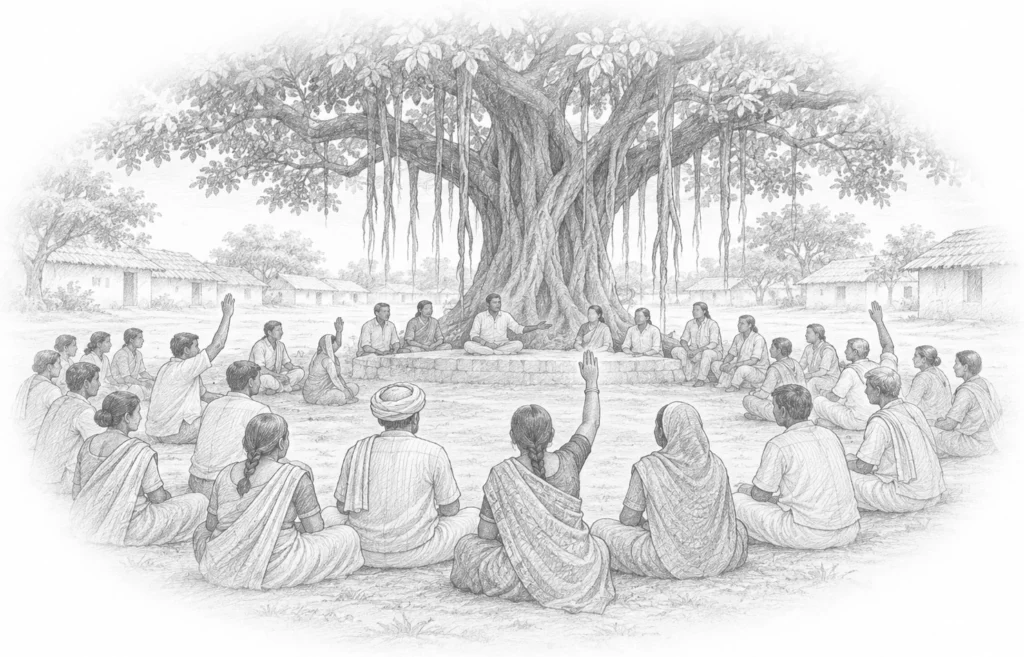
DDEMOCRACY is strongest when citizens can take part in decisions that affect their daily lives: the village road, the school, the water supply and the health centre. Local governance refers to the institutions and processes through which communities govern local affairs, including elected local bodies and the participation of citizens. In India, the 73rd and 74th Constitutional Amendments of 1992 created a third tier of democracy in panchayats and municipalities. This chapter examines democratic decentralisation, its evolution and working in India, and people’s participation in governance.
4.1 Democratic Decentralisation: Concept and Evolution
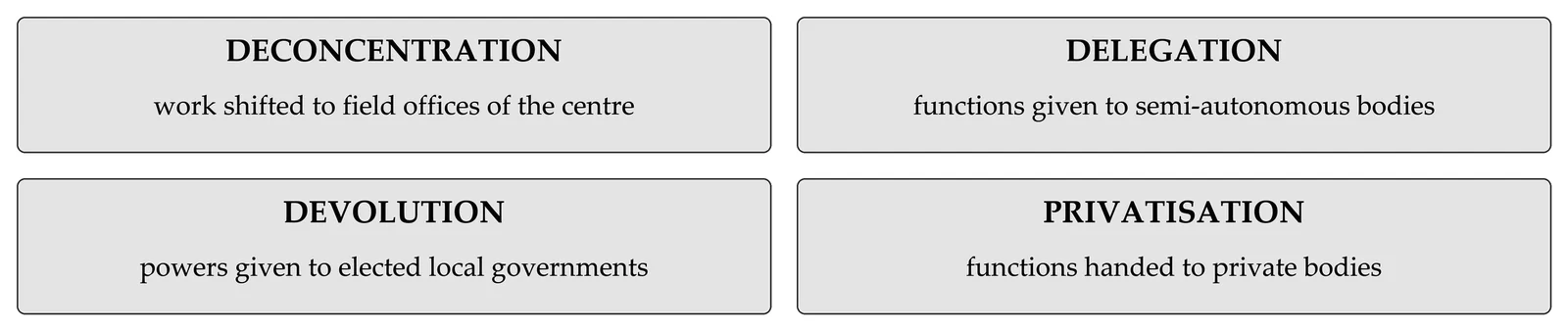
Decentralisation means the transfer of authority, responsibility and resources from the central government to lower levels of government or other bodies. Dennis Rondinelli distinguished four forms: deconcentration, the transfer of administrative work to field offices of the central government; delegation, the transfer of specific functions to semi-autonomous bodies; devolution, the transfer of powers to elected local governments with their own authority and resources; and privatisation, the transfer of functions to private bodies. Democratic decentralisation refers to devolution to elected local bodies accountable to local citizens.
Arguments for Democratic Decentralisation
- Participation. It brings government closer to the people and allows citizens to take part in decisions; Alexis de Tocqueville called local institutions the schools of liberty.
- Responsiveness. Local bodies know local needs and conditions better than distant governments.
- Accountability. Citizens can observe and question local representatives directly.
- Efficiency. Decisions can be taken faster and services matched to local preferences.
- Empowerment. Reservation in local bodies brings women, Dalits and Adivasis into leadership.
- Political training. Local bodies train leaders who later move to state and national politics.
- Reducing the burden on higher governments. Local bodies handle local matters, allowing state and central governments to focus on wider issues.
Critics warn of elite capture, in which local elites dominate local bodies, as studied by Pranab Bardhan and Dilip Mookherjee; weak capacity; corruption at the local level; and fragmentation. In the Constituent Assembly, B.R. Ambedkar was sceptical of village self-government, seeing the village as a site of caste domination, while Gandhi’s ideal of gram swaraj saw self-sufficient village republics as the foundation of Indian democracy. The compromise was Article 40, a Directive Principle asking the state to organise village panchayats.
Evolution of Local Governance in India
- Colonial period. Lord Mayo’s Resolution of 1870 and Lord Ripon’s Resolution of 1882 promoted local boards with elected members; Ripon is called the father of local self-government in India.
- Community Development Programme (1952). It aimed at rural development through people’s participation but became a bureaucratic programme.
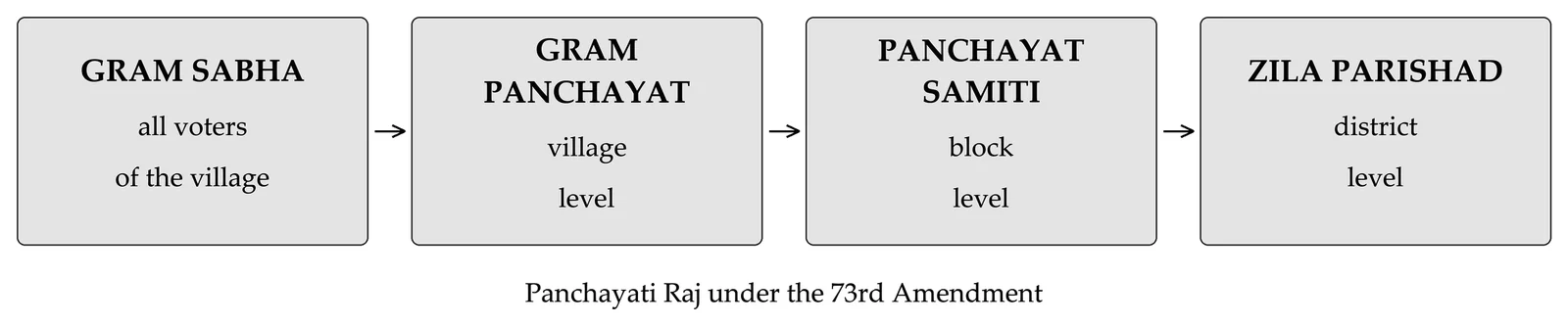
- Balwant Rai Mehta Committee (1957). It found that the programme lacked people’s participation and recommended democratic decentralisation through a three-tier system: gram panchayat at the village, panchayat samiti at the block and zila parishad at the district. Rajasthan was the first state to adopt it, at Nagaur on 2 October 1959.
- Decline. In the 1960s and 1970s, panchayats declined due to irregular elections, lack of funds, bureaucratic dominance and the centralisation of politics.
- Ashok Mehta Committee (1977). It recommended a two-tier system with the district as the main unit and the participation of political parties; West Bengal, Karnataka and Andhra Pradesh revitalised panchayats.
- G.V.K. Rao (1985) and L.M. Singhvi (1986) Committees. Singhvi recommended constitutional status for panchayats.
- 64th Amendment Bill (1989). Introduced by the Rajiv Gandhi government, it was defeated in the Rajya Sabha.
- 73rd and 74th Amendments (1992). Passed under the Narasimha Rao government, they came into force in 1993.

4.2 The 73rd and 74th Amendments and their Working
The 73rd Amendment: Panchayats
The 73rd Amendment added Part IX (Articles 243 to 243O) and the Eleventh Schedule, listing 29 subjects that may be devolved to panchayats, such as agriculture, minor irrigation, drinking water, rural housing, primary education, health and poverty alleviation.
- Gram Sabha (Article 243A). A body of all registered voters in a village, which exercises powers given by state law.
- Three tiers (Article 243B). Panchayats at the village, intermediate and district levels; states with a population below 20 lakh need not have the intermediate tier.
- Direct elections. Members at all levels are directly elected; chairpersons at the intermediate and district levels are elected indirectly.
- Reservation (Article 243D). Seats are reserved for SCs and STs in proportion to their population, and not less than one-third of seats and chairpersons’ posts for women; more than twenty states have raised women’s reservation to 50%.
- Five-year term (Article 243E). Elections must be held before the term ends, or within six months of dissolution.
- State Election Commission (Article 243K) conducts panchayat elections.
- State Finance Commission (Article 243I) is appointed every five years to review the finances of panchayats and recommend sharing of taxes and grants.
- PESA Act (1996). The Panchayats (Extension to Scheduled Areas) Act extended the system to Fifth Schedule areas, giving Gram Sabhas powers over natural resources, minor forest produce and consultation on land acquisition.
The 74th Amendment: Municipalities
The 74th Amendment added Part IXA (Articles 243P to 243ZG) and the Twelfth Schedule, listing 18 subjects, such as urban planning, water supply, public health, sanitation, slum improvement and urban poverty alleviation. It provides for three types of municipalities: nagar panchayats for areas in transition from rural to urban, municipal councils for smaller urban areas and municipal corporations for larger urban areas. It also provides for ward committees in municipalities with a population of three lakh or more, District Planning Committees (Article 243ZD) to consolidate rural and urban plans, and Metropolitan Planning Committees (Article 243ZE).
Achievements
The amendments have created more than 2.5 lakh panchayats and thousands of urban local bodies, with about 31 lakh elected representatives, of whom around 46% are women. Peter Ronald de Souza called decentralisation the second wind of democracy in India. Kerala’s People’s Plan Campaign (1996), which devolved a large share of state plan funds to local bodies and involved citizens in planning through Gram Sabhas, became a model. Reservation has brought lakhs of women, Dalits and Adivasis into public life, and studies have found that women leaders often give greater priority to drinking water and other needs voiced by women.
Problems
- Funds, functions and functionaries. Most states have not fully devolved the three Fs; panchayats depend on grants tied to schemes and raise little revenue of their own.
- Bureaucratic control. State governments and officials often control local bodies, and state laws allow their suspension or dissolution.
- Proxy representation. Some elected women act as proxies for male relatives, a practice known as sarpanch pati, though this has declined with experience.
- Elite capture and caste. Dominant castes and local elites often control local bodies and benefits.
- Weak Gram Sabhas. Gram Sabha meetings are irregular and poorly attended, with low participation of women and the poor.
- Urban governance gaps. Municipalities have weak finances and staff, and mayors in most states have little executive power; Mary John has shown how gender and caste shape urban local politics.
- Parallel bodies. Schemes run through parallel committees or MPLADS weaken elected local bodies.
4.3 People’s Participation in Governance
People’s participation means the involvement of citizens in decisions, implementation and monitoring of the policies and programmes that affect them. It goes beyond voting in elections to include taking part in planning, budgeting, service delivery and holding officials accountable. Participation is both an end in itself, as an expression of democratic citizenship, and a means to better governance.
Arnstein’s Ladder of Participation
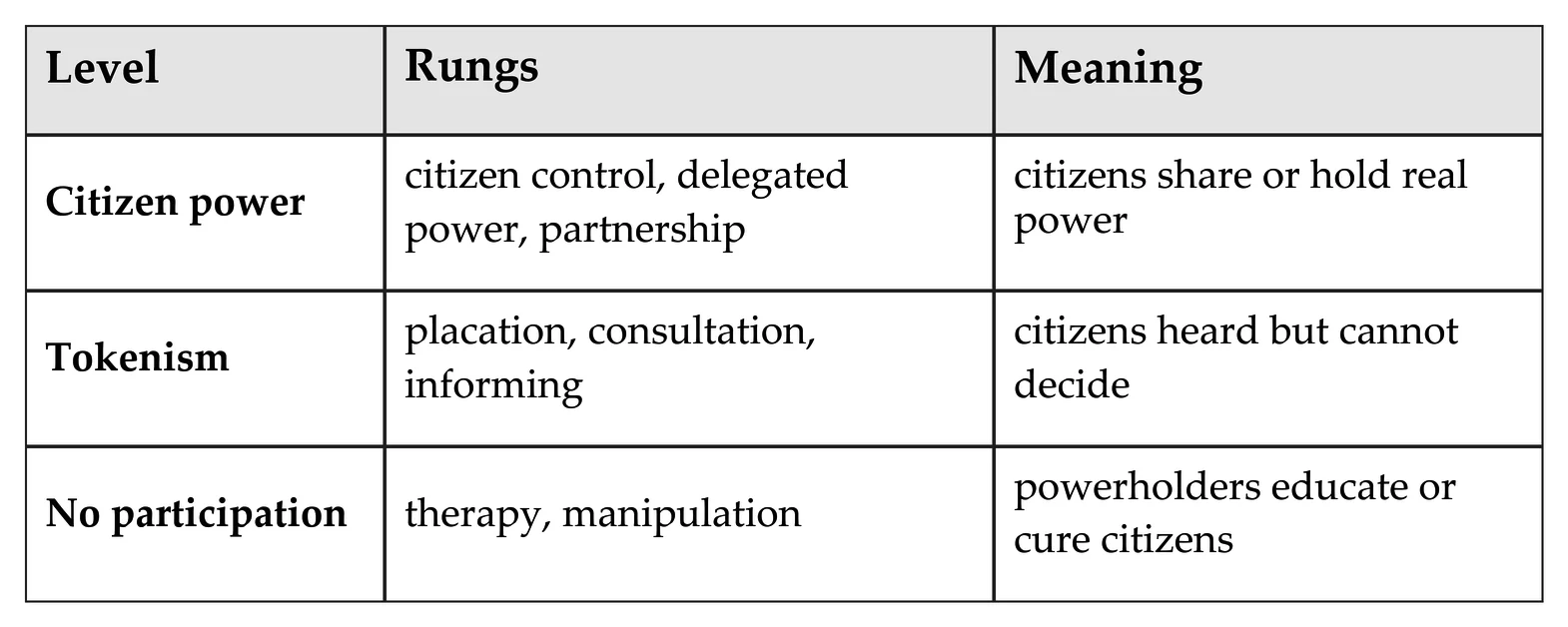
Sherry Arnstein, in A Ladder of Citizen Participation (1969), described eight rungs of participation grouped into three levels. At the bottom are manipulation and therapy, which are forms of non-participation. In the middle are informing, consultation and placation, which she called tokenism, since citizens may be heard but have no power to ensure their views are acted upon. At the top are partnership, delegated power and citizen control, which represent real citizen power. Her ladder reminds us that much so-called participation is only symbolic.
Forms of Participation in India
- Gram Sabha and ward sabhas. All voters in a village, and in some states in an urban ward or area, can discuss plans, select beneficiaries and review spending.
- Social audits. Under MGNREGA, the Gram Sabha audits works and payments; Andhra Pradesh (later Telangana) institutionalised social audits on a large scale.
- Public hearings. The Mazdoor Kisan Shakti Sangathan in Rajasthan held jan sunwais in the 1990s, reading out official records in public to expose corruption, which led to the RTI movement.
- Participatory planning and budgeting. Kerala’s People’s Plan Campaign and participatory budgeting in cities such as Pune, inspired by Porto Alegre in Brazil (1989), let citizens decide on local spending.
- User groups and committees. Joint Forest Management committees, water user associations and School Management Committees under the RTE Act involve users in managing services.
- Self-help groups. Women’s groups under the National Rural Livelihoods Mission and Kudumbashree in Kerala combine savings, credit and collective action.
- Citizen report cards. The Public Affairs Centre in Bengaluru, founded by Samuel Paul, pioneered report cards in 1993, in which citizens rate public services.
- Bhagidari. Delhi’s Bhagidari scheme (2000) brought resident welfare associations into partnership with the government.
Barriers and Conditions
Participation is limited by poverty, which leaves little time for meetings; caste and gender hierarchies, which silence the marginalised; low awareness of rights; elite capture of participatory spaces; and the reluctance of officials to share power. Participation succeeds when local bodies have real powers and funds, when information is freely available, when marginalised groups are organised and supported, and when participation leads to visible results. The Right to Information Act, decentralisation and social audits together provide the foundation for meaningful participation in India.
4.4 Important Questions
- Question 1 What is democratic decentralisation? Discuss its significance and trace its evolution in India.
- Question 2 Discuss the main features of the 73rd Constitutional Amendment and assess the working of Panchayati Raj institutions.
- Question 3 What is meant by people’s participation in governance? Discuss its forms and significance in India.
- Question 4 Discuss the provisions of the 74th Constitutional Amendment and the challenges of urban local governance in India.
DU asks the same idea in different words. So learn one broad answer for each question below; the same answer works for every question joined by OR.
Important Question 1
What is democratic decentralisation? Discuss its significance and trace its evolution in India.
OR
Discuss the arguments for and against democratic decentralisation.
OR
Trace the evolution of Panchayati Raj institutions in India.
Model Answer
“Town meetings are to liberty what primary schools are to science; they bring it within the people’s reach.”
— Alexis de Tocqueville, Democracy in America (1835)
Introduction. Democratic decentralisation means the transfer of powers and resources to elected local bodies accountable to local citizens. It deepens democracy by bringing government closer to people and allowing them to take part in decisions about their own lives. In India, the idea evolved from colonial local boards through the Balwant Rai Mehta Committee to the 73rd and 74th Amendments of 1992.
1. Meaning of Decentralisation
Decentralisation is the transfer of authority, responsibilities and resources from the central government to lower levels of government or other bodies, reversing the concentration of power at the top.
2. Forms of Decentralisation
Rondinelli distinguished deconcentration to field offices, delegation to semi-autonomous bodies, devolution to elected local governments and privatisation. Democratic decentralisation is devolution to elected local bodies.
3. Participation
Local bodies allow citizens to participate directly in governance. Tocqueville saw local institutions as schools of liberty that teach citizens the habits of self-government.
4. Responsiveness and Efficiency
Local bodies know local needs and conditions, so they can match services to local preferences and take decisions faster than distant governments.
5. Accountability and Empowerment
Citizens can observe and question local representatives directly, and reservation brings women, Dalits and Adivasis into leadership positions, empowering marginalised groups.
6. Arguments Against
Critics warn of elite capture, weak local capacity, corruption and fragmentation. Bardhan and Mookherjee showed that local elites can capture decentralised institutions where inequality is high.
7. Gandhi and Ambedkar
Gandhi saw self-reliant village republics as the basis of democracy, while Ambedkar feared that villages were sites of caste oppression. Article 40 was a compromise, directing the state to organise village panchayats.
8. Colonial Beginnings
Lord Mayo’s Resolution of 1870 and Lord Ripon’s Resolution of 1882 introduced local boards with elected members, though they had limited powers and served colonial purposes.
9. Community Development Programme
Launched in 1952, the programme aimed at rural development through people’s participation, but it became bureaucratic and failed to involve the people.
10. Balwant Rai Mehta Committee
In 1957, the committee recommended democratic decentralisation through a three-tier system of gram panchayats, panchayat samitis and zila parishads. Rajasthan inaugurated it at Nagaur on 2 October 1959.
11. Decline of Panchayats
In the 1960s and 1970s, irregular elections, lack of funds, bureaucratic control and political centralisation led to the decline of panchayats in most states.
12. Ashok Mehta Committee
In 1977, the committee recommended a two-tier system with the district as the main unit and party participation. West Bengal, Karnataka and Andhra Pradesh revitalised panchayats in the 1980s.
13. Towards Constitutional Status
The L.M. Singhvi Committee (1986) recommended constitutional status. The 64th Amendment Bill of 1989 was defeated in the Rajya Sabha, but the idea gained wide support.
14. The 73rd and 74th Amendments
Passed in 1992 and in force from 1993, the amendments gave constitutional status to panchayats and municipalities, with regular elections, reservations, finance commissions and devolution of subjects.
15. Achievements and Gaps
Lakhs of representatives, nearly half of them women, now serve in local bodies, but the incomplete devolution of funds, functions and functionaries limits their powers.
16. Evaluation
Democratic decentralisation has deepened Indian democracy, but its promise depends on real devolution and the empowerment of marginalised groups within local bodies.
Conclusion. Thus, democratic decentralisation transfers power to elected local bodies, promoting participation, responsiveness, accountability and empowerment, though it risks elite capture. In India, it evolved from Ripon’s Resolution through the Balwant Rai Mehta and Ashok Mehta Committees to the 73rd and 74th Amendments, bringing liberty, as Tocqueville said, within the people’s reach.
Important Question 2
Discuss the main features of the 73rd Constitutional Amendment and assess the working of Panchayati Raj institutions.
OR
Examine the achievements and problems of Panchayati Raj in India.
OR
Discuss the role of women in Panchayati Raj institutions.
Model Answer
“What is the village but a sink of localism, a den of ignorance, narrow-mindedness and communalism?”
— B.R. Ambedkar, Constituent Assembly Debates, 4 November 1948
Introduction. The 73rd Constitutional Amendment of 1992 gave constitutional status to Panchayati Raj institutions, creating a third tier of democracy in rural India. It answered the long debate between Gandhi’s vision of village republics and Ambedkar’s scepticism by building democratic panchayats with reservations for marginalised groups. Three decades later, panchayats have transformed rural politics, though they remain constrained.
1. Background
Earlier panchayats depended on state laws and declined due to irregular elections and lack of powers. The L.M. Singhvi Committee and the failed 64th Amendment Bill paved the way for the 73rd Amendment.
2. Part IX and the Eleventh Schedule
The amendment added Part IX (Articles 243 to 243O) and the Eleventh Schedule, listing 29 subjects, such as agriculture, drinking water, primary education and health, that states may devolve to panchayats.
3. Gram Sabha
Article 243A provides for a Gram Sabha of all registered voters in a village, the foundation of direct democracy at the grassroots, with powers given by state law.
4. Three-Tier Structure
Article 243B provides for panchayats at the village, intermediate and district levels, with states below 20 lakh population allowed to skip the intermediate tier.
5. Elections and Term
Members at all levels are directly elected for five years, and elections must be held within six months of dissolution. State Election Commissions conduct elections under Article 243K.
6. Reservation
Article 243D reserves seats for SCs and STs in proportion to population and not less than one-third of seats and chairpersons’ posts for women. More than twenty states have raised women’s reservation to 50%.
7. State Finance Commission
Article 243I requires a State Finance Commission every five years to recommend the sharing of taxes and grants between the state and panchayats.
8. PESA Act
The PESA Act of 1996 extended panchayats to Fifth Schedule areas, giving Gram Sabhas powers over natural resources and consultation on land acquisition, respecting tribal customs.
9. Achievements
There are more than 2.5 lakh panchayats with about 31 lakh elected representatives. Peter de Souza called decentralisation the second wind of Indian democracy.
10. Women’s Leadership
Around 46% of elected representatives are women. Studies show that women leaders often prioritise drinking water and other needs voiced by women, and their presence has changed attitudes to women in public life.
11. Kerala’s Model
Kerala’s People’s Plan Campaign of 1996 devolved a large share of plan funds to local bodies and involved citizens in planning, showing what real devolution can achieve.
12. Incomplete Devolution
Most states have not devolved the three Fs of funds, functions and functionaries. Panchayats depend on scheme-tied grants and raise little revenue of their own.
13. Bureaucratic and State Control
State governments and officials often control panchayats, and state laws allow their suspension, limiting their autonomy as institutions of self-government.
14. Proxy Representation and Elite Capture
Some elected women act as proxies for male relatives, and dominant castes often control panchayats, as Ambedkar feared, though reservation has gradually challenged these hierarchies.
15. Weak Gram Sabhas
Gram Sabha meetings are often irregular and poorly attended, with low participation of women and the poor, weakening direct democracy.
16. Evaluation
The 73rd Amendment has democratised rural India and empowered marginalised groups, but panchayats need real devolution and stronger Gram Sabhas to fulfil their promise.
Conclusion. Thus, the 73rd Amendment created Gram Sabhas, a three-tier structure, regular elections, reservations, State Election Commissions and State Finance Commissions. It has brought lakhs of women and marginalised people into governance, answering Ambedkar’s fears in part, though incomplete devolution, bureaucratic control and elite capture remain challenges.
Important Question 3
What is meant by people’s participation in governance? Discuss its forms and significance in India.
OR
Examine Arnstein’s ladder of citizen participation.
OR
Discuss the role of social audits and Gram Sabhas in promoting participatory governance.
Model Answer
“Citizen participation is a categorical term for citizen power.”
— Sherry R. Arnstein, A Ladder of Citizen Participation (1969)
Introduction. People’s participation means the involvement of citizens in making, implementing and monitoring the decisions that affect them. It goes beyond voting to include planning, budgeting, managing services and holding officials accountable. Participation is both a democratic value and a means of making governance more responsive and effective.
1. Meaning
Participation is the process through which citizens influence and share control over decisions, resources and institutions that affect their lives.
2. Significance
Participation makes governance more responsive to local needs, improves accountability, reduces corruption, builds citizenship and gives voice to marginalised groups.
3. Arnstein’s Ladder
Arnstein described eight rungs of participation: manipulation and therapy (non-participation); informing, consultation and placation (tokenism); and partnership, delegated power and citizen control (citizen power).
4. Tokenism and Real Power
Arnstein warned that much participation is tokenistic: citizens are heard but have no power to ensure their views are acted on. Real participation requires a redistribution of power.
5. Elections and Representation
Voting in elections is the most basic form of participation, and India’s high turnout, especially among the poor, shows the importance citizens attach to it.
6. Gram Sabha
The Gram Sabha, made up of all voters in a village, can discuss plans, select beneficiaries and review spending, providing a forum for direct democracy.
7. Social Audit
Under MGNREGA, the Gram Sabha audits works and payments. Andhra Pradesh institutionalised social audits on a large scale, exposing corruption and recovering misused funds.
8. Public Hearings and the RTI
The MKSS held jan sunwais in Rajasthan in the 1990s, reading official records in public to expose corruption, which led to the movement for the Right to Information Act of 2005.
9. Participatory Planning and Budgeting
Kerala’s People’s Plan Campaign and participatory budgeting in cities like Pune, inspired by Porto Alegre in Brazil, allow citizens to decide on local spending priorities.
10. User Groups
Joint Forest Management committees, water user associations and School Management Committees under the RTE Act involve users in managing local services and resources.
11. Self-Help Groups
Women’s self-help groups under the National Rural Livelihoods Mission and Kudumbashree in Kerala combine savings, credit and collective action, increasing women’s voice in local affairs.
12. Citizen Report Cards
The Public Affairs Centre in Bengaluru, founded by Samuel Paul, pioneered citizen report cards in 1993, in which citizens rate public services, pressing agencies to improve.
13. Barriers to Participation
Poverty, caste and gender hierarchies, low awareness and the reluctance of officials to share power limit participation, especially of the marginalised.
14. Elite Capture
Participatory spaces can be dominated by local elites, so that participation reinforces rather than challenges inequality, unless marginalised groups are organised.
15. Conditions for Success
Participation succeeds when local bodies have real powers and funds, information is freely available, marginalised groups are supported and participation leads to visible results.
16. Participation of Women and Dalits
Reservation in local bodies has increased the presence of women and Dalits, but their participation in Gram Sabhas often remains low because of social pressure and household burdens. Some states, such as Maharashtra and Kerala, require separate women’s Gram Sabhas or mahila sabhas before the main meeting so that women can voice their priorities.
17. Participation and Technology
Digital tools now support participation: the eGramSwaraj portal publishes panchayat plans and accounts, MyGov invites citizens’ suggestions on policies, and social media allows quick feedback. However, online participation can exclude those without internet access, so it must supplement rather than replace face-to-face forums.
18. Evaluation
People’s participation gives substance to democracy, but it must move up Arnstein’s ladder from tokenism to real citizen power to transform governance.
Conclusion. Thus, people’s participation through Gram Sabhas, social audits, public hearings, participatory planning, user groups, self-help groups and report cards makes governance more responsive and accountable. As Arnstein argued, participation is ultimately about citizen power, which requires overcoming barriers of poverty, caste, gender and elite capture.
Important Question 4
Discuss the provisions of the 74th Constitutional Amendment and the challenges of urban local governance in India.
OR
Examine the working of municipal governance in India.
OR
Write a note on urban local bodies and their problems.
Model Answer
“The Legislature of a State may, by law, endow the Municipalities with such powers and authority as may be necessary to enable them to function as institutions of self-government.”
— Constitution of India, Article 243W (abridged)
Introduction. India is urbanising rapidly, and cities face problems of housing, water, sanitation, transport and pollution. The 74th Constitutional Amendment of 1992 gave constitutional status to municipalities to make urban governance democratic and effective. However, urban local bodies remain weak in finances, powers and capacity.
1. Background
Before 1992, municipalities depended on state laws, were often superseded by state governments and had weak finances. The 74th Amendment sought to strengthen them as institutions of self-government.
2. Part IXA and the Twelfth Schedule
The amendment added Part IXA (Articles 243P to 243ZG) and the Twelfth Schedule, listing 18 subjects, such as urban planning, water supply, public health, sanitation and slum improvement.
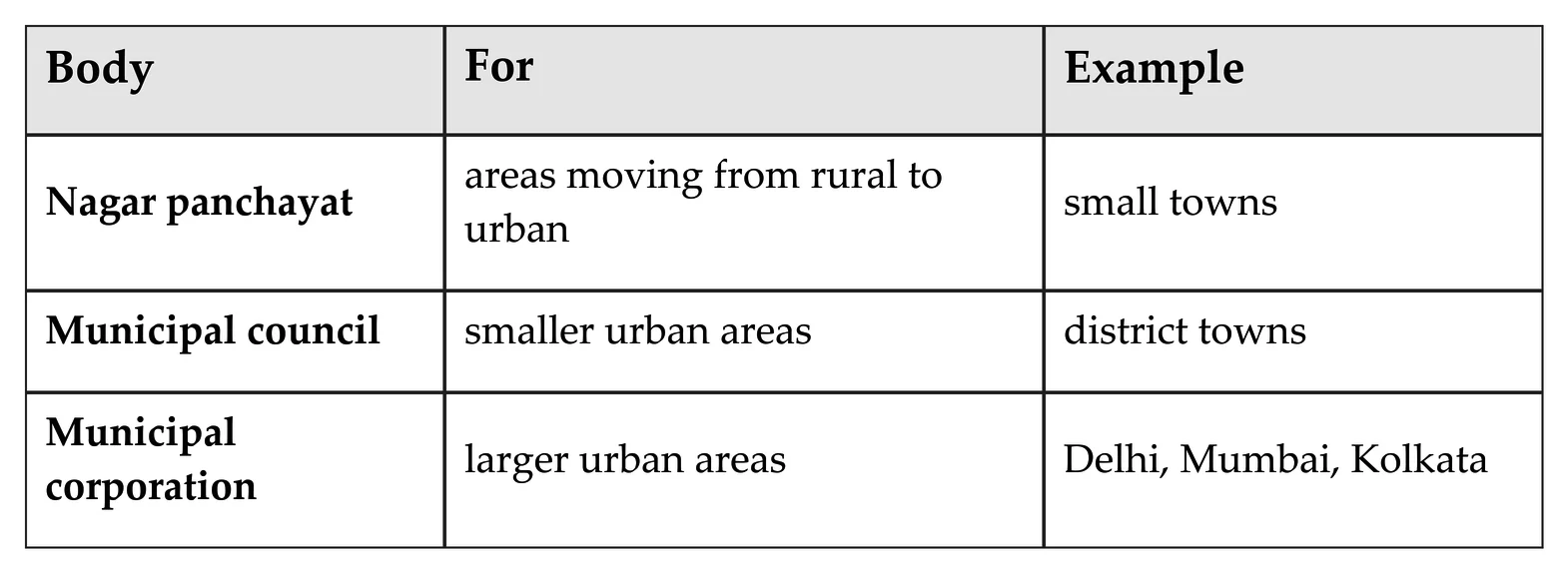
3. Types of Municipalities
It provides for nagar panchayats for areas in transition, municipal councils for smaller urban areas and municipal corporations for larger urban areas.
4. Elections and Reservation
Members are directly elected for five years, with reservation for SCs, STs and at least one-third of seats for women. State Election Commissions conduct the elections.
5. Ward Committees
Municipalities with a population of three lakh or more must have ward committees, intended to bring governance closer to citizens within large cities.
6. Finance Commissions
State Finance Commissions recommend the sharing of taxes and grants with municipalities, and the Union Finance Commission recommends grants to local bodies.
7. Planning Committees
District Planning Committees (Article 243ZD) consolidate rural and urban plans, while Metropolitan Planning Committees (Article 243ZE) plan for large metropolitan areas.
8. Urban Missions
Programmes such as JNNURM (2005), AMRUT, the Smart Cities Mission and the Swachh Bharat Mission (2015) have funded urban infrastructure and tied funds to governance reforms.
9. Weak Finances
Municipalities raise little revenue, mainly from property tax, which is poorly assessed and collected, and they depend heavily on state grants.
10. Incomplete Devolution
Many states have not transferred Twelfth Schedule functions, and parastatal bodies such as development authorities and water boards perform key urban functions outside municipal control.
11. Weak Mayors
In most states, mayors are indirectly elected for short terms and have little executive power, which rests with commissioners appointed by the state government.
12. Weak Participation
Ward committees and area sabhas exist only in some states, and citizen participation in urban governance is low, especially among the urban poor.
13. Gender and Caste in Urban Politics
Mary John has shown that reservation has brought women into urban local bodies, but gender, caste and party networks shape how they exercise power.
14. Capacity Gaps
Urban local bodies lack trained staff in planning, engineering and finance, which limits their ability to manage growing cities and complex projects.
15. Reforms
Suggested reforms include directly elected mayors with real powers, better property tax systems, municipal bonds, full devolution of functions and stronger ward committees.
16. Supreme Court on Local Elections
In Suresh Mahajan (2022), the Supreme Court directed states to hold overdue local body elections, holding that the constitutional mandate of elections every five years cannot be delayed, since prolonged rule by administrators violates the democratic spirit of the 73rd and 74th Amendments.
17. Evaluation
The 74th Amendment created a democratic framework for urban governance, but cities need real powers, finances and participation to meet the challenges of urbanisation.
Conclusion. Thus, the 74th Amendment created nagar panchayats, municipal councils and corporations, with elections, reservations, ward committees, finance commissions and planning committees, to make municipalities institutions of self-government under Article 243W. Weak finances, incomplete devolution and weak mayors remain major challenges.
Short Notes
(a) Gram Sabha
A body of all registered voters in a village under Article 243A, which discusses plans, selects beneficiaries and conducts social audits.
(b) PESA Act, 1996
The law extending Panchayati Raj to Fifth Schedule areas, giving Gram Sabhas powers over natural resources, minor forest produce and consultation on land acquisition.
(c) Elite capture
The domination of decentralised institutions and their benefits by local elites, such as dominant castes and wealthy families, at the expense of the poor.
More notes: GE-5 Governance: Issues and Challenges
These notes are prepared by PADHO TO AISE for study help. They are not an official publication.