
Generic Electives (GE) GE-5 Governance: Issues and Challenges
Unit 2 · 23 min read · Updated 27 Nov 2026
As per the University of Delhi (DU) Generic Elective (GE) syllabus offered by the Department of Political Science
Contents
- 2.1 Changing Dimensions of Development
- Development as Economic Growth
- Critiques and the Basic Needs Approach
- Human Development and Capabilities
- Sustainable, Rights-Based and Inclusive Development
- 2.2 Governance and Development
- Institutions Matter
- Channels Linking Governance and Development
- Governance and Development in India
- Critiques
- 2.3 Strengthening Democracy through Good Governance
- Accountability
- Transparency and the Right to Information
- Participation and Decentralisation
- Rule of Law and Citizen-Centric Administration
- Challenges
- 2.4 Important Questions
- Discuss the changing dimensions of the concept of development.
- How does good governance strengthen democracy? Discuss with reference to India.
- Examine Amartya Sen’s capability approach to development.
- Discuss the relationship between governance and development with special reference to India.
- Short Notes
विकास को लोगों द्वारा भोगी जाने वाली वास्तविक स्वतंत्रताओं के विस्तार की प्रक्रिया के रूप में देखा जा सकता है।
Development can be seen, it is argued here, as a process of expanding the real freedoms that people enjoy.
— Amartya Sen, Development as Freedom (1999)
WWHAT is development, and how does governance affect it? In the 1950s, development meant economic growth, measured by national income. Over the decades, the idea has widened to include basic needs, human development, capabilities, sustainability, rights and inclusion. At the same time, scholars and institutions came to see that the quality of governance, of institutions, accountability and participation, is central to development. This chapter examines the changing dimensions of development and how good governance strengthens democracy, with special reference to India.

2.1 Changing Dimensions of Development
The meaning of development has changed greatly since the Second World War. Each new understanding arose from the limitations of the earlier one, and together they show a shift from a focus on things (output and income) to a focus on people (their health, knowledge, freedom and dignity) and on the planet.
Development as Economic Growth
In the 1950s and 1960s, development was equated with economic growth, measured by the growth of gross national product (GNP) per head. Modernisation theory, expressed in W.W. Rostow’s The Stages of Economic Growth (1960), held that all societies pass through similar stages, from traditional society to high mass consumption, and that developing countries should follow the path of the West. It was assumed that the benefits of growth would trickle down to the poor. India’s early Five-Year Plans, especially the Mahalanobis strategy of the Second Plan (1956–61), emphasised rapid industrialisation through the public sector.
Critiques and the Basic Needs Approach
By the 1970s, it became clear that growth did not automatically reduce poverty, unemployment or inequality. Dependency theorists such as Andre Gunder Frank and Raúl Prebisch argued that underdevelopment was caused by the exploitative relationship between the industrial core and the periphery. The International Labour Organization proposed the basic needs approach in 1976, focusing on food, shelter, health, education and employment. India’s slogan of garibi hatao (1971) and the Minimum Needs Programme of the Fifth Plan reflected this shift.
Human Development and Capabilities
The human development approach, pioneered by Mahbub ul Haq and Amartya Sen, holds that the purpose of development is to enlarge people’s choices. The UNDP’s first Human Development Report (1990) introduced the Human Development Index (HDI), combining life expectancy, education and income. Sen’s capability approach argues that development should be judged by what people are able to do and be, their capabilities and functionings, rather than by income alone. In Development as Freedom (1999), Sen described development as the expansion of real freedoms and the removal of unfreedoms such as poverty, tyranny, lack of opportunity and social deprivation. Jean Drèze and Amartya Sen argued that India neglected education, health and social opportunity, and that Kerala’s achievements in literacy and health, despite low income, showed the value of public action.
Sustainable, Rights-Based and Inclusive Development
- Sustainable development. The Brundtland Report (1987) defined it as development that meets the needs of the present without compromising the ability of future generations to meet their own needs, linking development with environmental protection.
- Rights-based development. The UN Declaration on the Right to Development (1986) recognised development as an inalienable human right, and the rights-based approach treats people as rights-holders rather than beneficiaries; India’s rights to information, work, education and food reflect it.
- Gender and development. Feminist scholars showed that development often ignored women’s work and needs; the UNDP introduced gender-related indices, and empowerment of women became a development goal.
- Participatory development. Scholars such as Robert Chambers stressed putting the last first and involving people in planning their own development.
- Inclusive growth. India’s Eleventh Five-Year Plan (2007–12) adopted faster and more inclusive growth as its goal, recognising that growth must benefit all groups.
- Global goals. The Millennium Development Goals (2000–15) set eight targets on poverty, education, health and gender, followed by the 17 Sustainable Development Goals (2015–30), which integrate economic, social and environmental goals under the principle of leaving no one behind.

2.2 Governance and Development
Why do some countries develop while others with similar resources do not? From the late 1980s, a growing body of thought answered that institutions and governance matter. The World Bank’s 1992 report Governance and Development argued that sound development management requires good governance: efficient public sector management, accountability, a predictable legal framework, and transparency and information.
Institutions Matter
Douglass North, who won the Nobel Prize in Economics in 1993, argued that institutions, the rules of the game in society, shape economic performance by reducing uncertainty and transaction costs. Daron Acemoglu and James Robinson, in Why Nations Fail (2012), distinguished inclusive institutions, which protect property rights, enforce contracts and allow broad participation, from extractive institutions, which concentrate power and wealth in a narrow elite. They argued that inclusive political and economic institutions explain long-run prosperity. Acemoglu, Robinson and Simon Johnson won the Nobel Prize in Economics in 2024 for their work on institutions and prosperity.
Channels Linking Governance and Development
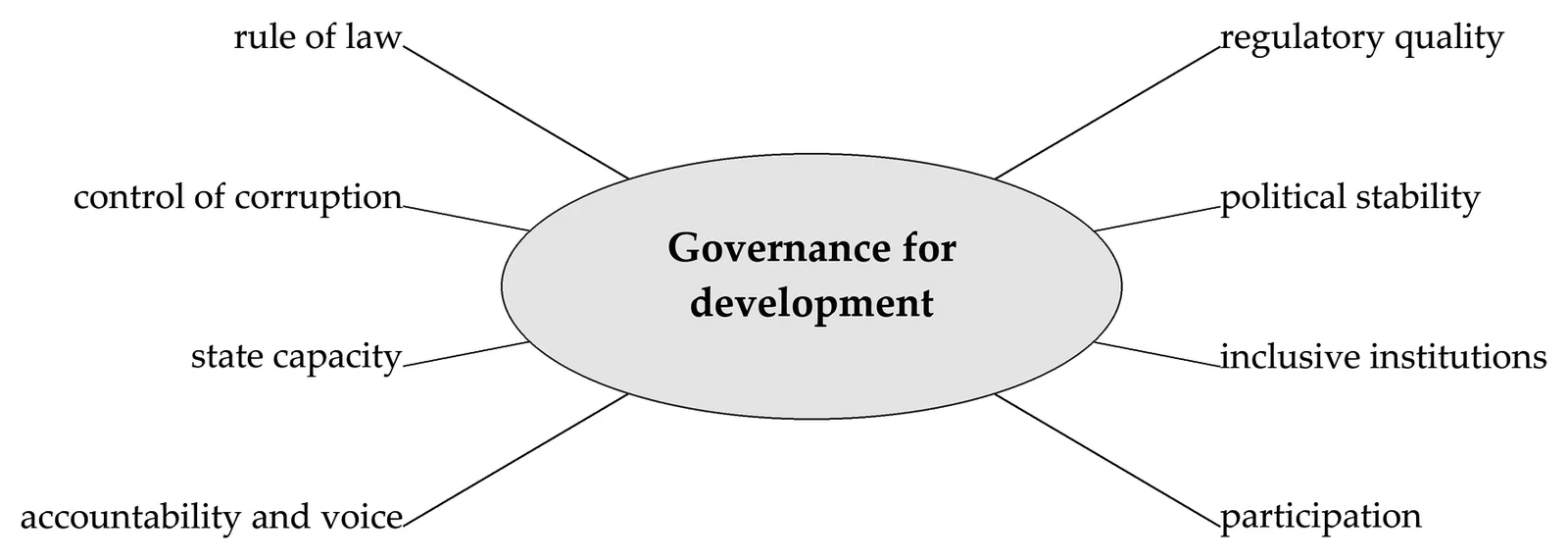
- Rule of law. Secure property rights and enforceable contracts encourage investment and enterprise.
- Control of corruption. Corruption raises costs, diverts resources from the poor and discourages investment.
- Government effectiveness. Capable bureaucracies deliver infrastructure, education and health, which are the foundations of development.
- Accountability and voice. Democratic accountability makes governments responsive to citizens’ needs; Sen noted that no substantial famine has occurred in a functioning democracy with a free press.
- Regulatory quality. Sound regulation allows markets to work while protecting consumers, workers and the environment.
- Political stability. Stability encourages long-term investment and planning.
Governance and Development in India
India’s development has been shaped by both strengths and weaknesses of governance. A stable democracy, an independent judiciary, a professional civil service and a free press have supported development. At the same time, corruption, weak state capacity at the local level, slow courts and red tape have held it back. Pranab Bardhan has analysed how competing interests of industrial capitalists, rich farmers and professionals shaped India’s political economy and slowed reform. Reforms since 1991, digital governance, direct benefit transfers and decentralisation have tried to improve governance, but large regional differences remain, with states like Kerala and Tamil Nadu performing much better on human development than others.
Critiques
Critics argue that the governance-development link is complex: China achieved rapid growth without democratic accountability, while some democracies have grown slowly. Others argue that development also improves governance, so causation runs both ways. Critics of the World Bank’s approach say that it emphasised market-friendly governance and neglected redistribution and social justice.
2.3 Strengthening Democracy through Good Governance
Democracy is not only about holding elections; it also requires that governments between elections act transparently, accountably, responsively and according to the rule of law. Good governance strengthens democracy by giving citizens real control over those who govern them. As Niraja Gopal Jayal and others have argued, the legitimacy of the democratic state in India depends on its ability to deliver welfare and justice to citizens.
Accountability
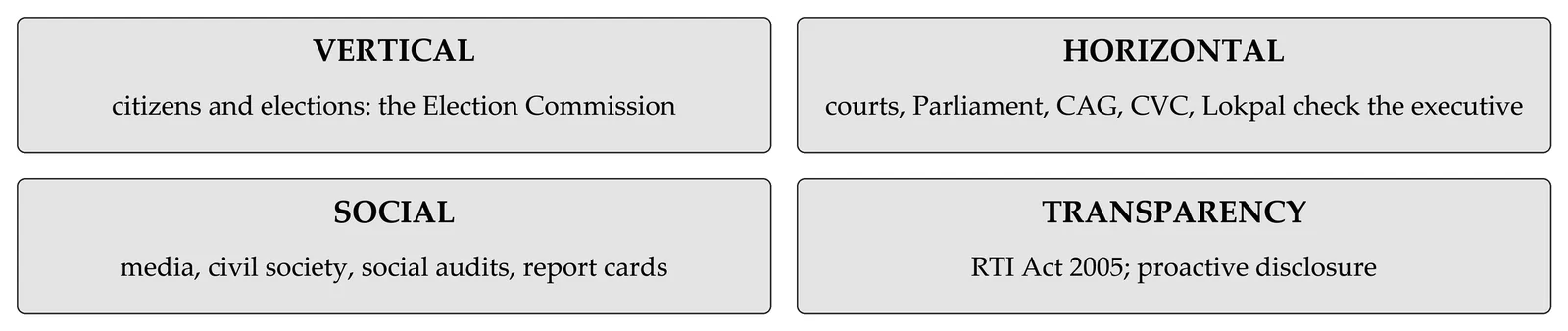
- Vertical accountability. Citizens hold governments accountable through regular, free and fair elections conducted by the Election Commission.
- Horizontal accountability. State institutions check one another: the judiciary through judicial review, Parliament through questions and committees, the CAG through audits, the Central Vigilance Commission and the Lokpal, set up under the Lokpal and Lokayuktas Act, 2013.
- Social or diagonal accountability. Citizens, civil society and the media monitor governments directly, through social audits, public hearings, citizen report cards and investigative journalism.
Transparency and the Right to Information
The Right to Information Act, 2005, which grew out of the campaign of the Mazdoor Kisan Shakti Sangathan in Rajasthan, gives every citizen the right to obtain information from public authorities within thirty days. It has exposed corruption, empowered the poor to claim entitlements and made officials more careful. Proactive disclosure under Section 4 requires authorities to publish information about their functioning. However, the RTI faces challenges such as pending appeals, attacks on activists and the 2019 amendment, which gave the Union government power to fix the tenure and salaries of information commissioners, raising concerns about their independence.
Participation and Decentralisation
The 73rd and 74th Constitutional Amendments (1992) created a third tier of democracy in panchayats and municipalities, with reservation for women, Scheduled Castes and Scheduled Tribes. The Gram Sabha allows villagers to participate directly in planning and social audits. Participation makes governance more responsive to local needs and builds democratic citizenship.
Rule of Law and Citizen-Centric Administration
Good governance requires that laws apply equally to all and that citizens can obtain justice quickly. The Second Administrative Reforms Commission (2005–09), chaired first by Veerappa Moily, submitted reports on ethics in governance, the RTI, citizen-centric administration, public order and local governance, recommending measures such as citizen’s charters, grievance redressal and simplification of procedures. The Supreme Court in Prakash Singh (2006) directed police reforms to insulate the police from political interference. Laws guaranteeing time-bound public services in many states, starting with Madhya Pradesh in 2010, give citizens enforceable rights to services.
Challenges
Corruption, the criminalisation of politics, delays in justice, weak local capacity, social inequality and the misuse of state power against critics remain challenges. Good governance reforms can also be used to centralise power or to treat citizens as customers rather than rights-bearing members of the political community. Strengthening democracy therefore requires good governance that is participatory and rights-based, not merely efficient.
2.4 Important Questions
- Question 1 Discuss the changing dimensions of the concept of development.
- Question 2 How does good governance strengthen democracy? Discuss with reference to India.
- Question 3 Examine Amartya Sen’s capability approach to development.
- Question 4 Discuss the relationship between governance and development with special reference to India.
DU asks the same idea in different words. So learn one broad answer for each question below; the same answer works for every question joined by OR.
Important Question 1
Discuss the changing dimensions of the concept of development.
OR
Trace the evolution of the concept of development from economic growth to human development.
OR
Development is more than economic growth. Discuss.
Model Answer
“People are the real wealth of a nation.”
— UNDP, Human Development Report 1990
Introduction. The meaning of development has changed considerably since 1945. It has moved from a narrow focus on economic growth to broader ideas of basic needs, human development, capabilities, sustainability, rights and inclusion. Each shift reflected the failure of earlier approaches to improve the lives of the poor, and together they show a movement from a focus on output to a focus on people and the planet.
1. Development as Growth
In the 1950s and 1960s, development meant economic growth, measured by GNP per head. It was assumed that growth would trickle down to the poor and solve problems of poverty and unemployment.
2. Modernisation Theory
Rostow’s The Stages of Economic Growth (1960) held that all societies pass through stages from traditional society to mass consumption, and that developing countries should follow the Western path of industrialisation.
3. Planning in India
India’s Second Five-Year Plan, based on the Mahalanobis model, emphasised rapid industrialisation through heavy industry and the public sector, reflecting the growth-centred understanding of development.
4. Failure of Trickle-Down
By the 1970s, it was clear that growth had not reduced poverty, unemployment or inequality in many countries, leading to a search for new approaches.
5. Dependency Theory
Dependency theorists such as Frank and Prebisch argued that underdevelopment resulted from the exploitative relationship between the developed core and the dependent periphery, not from internal backwardness.
6. Basic Needs Approach
The ILO’s basic needs approach of 1976 focused on meeting people’s needs for food, shelter, health, education and employment. India’s garibi hatao slogan and Minimum Needs Programme reflected this approach.
7. Human Development
Mahbub ul Haq and the UNDP’s first Human Development Report of 1990 defined development as enlarging people’s choices and introduced the HDI, combining life expectancy, education and income.
8. Sen’s Capability Approach
Amartya Sen argued that development should expand capabilities, what people are able to do and be. In Development as Freedom (1999), he described development as the expansion of real freedoms.
9. The Kerala Experience
Drèze and Sen showed that Kerala achieved high literacy and life expectancy despite low income, through public action in education and health, illustrating that human development need not wait for growth.
10. Sustainable Development
The Brundtland Report of 1987 defined sustainable development as meeting present needs without compromising the ability of future generations to meet theirs, linking development with environmental protection.
11. Rights-Based Development
The UN Declaration on the Right to Development (1986) recognised development as a human right. The rights-based approach treats people as rights-holders, as in India’s rights to information, work, education and food.
12. Gender and Development
Feminist scholars showed that development often ignored women’s unpaid work and needs. Empowerment of women and gender equality became central development goals.
13. Participatory Development
Robert Chambers and others stressed involving people, especially the poor, in planning their own development, through methods such as participatory rural appraisal.
14. Inclusive Growth
India’s Eleventh Plan (2007–12) adopted faster and more inclusive growth as its goal, recognising that growth must benefit marginalised groups and regions.
15. MDGs and SDGs
The eight Millennium Development Goals (2000–15) were followed by the 17 Sustainable Development Goals (2015–30), integrating economic, social and environmental goals with the promise to leave no one behind.
16. Evaluation
The changing dimensions of development show a growing recognition that development is multidimensional, concerning people’s well-being, freedom and dignity, and the sustainability of the planet.
Conclusion. Thus, development has evolved from economic growth to basic needs, human development, capabilities, sustainability, rights, gender equality and inclusion. As the first Human Development Report declared, people are the real wealth of a nation, and development must be judged by its effects on their lives.
Important Question 2
How does good governance strengthen democracy? Discuss with reference to India.
OR
Examine the role of transparency and accountability in strengthening democracy.
OR
Discuss the measures taken in India to promote good governance.
Model Answer
“Democracy requires an informed citizenry and transparency of information which are vital to its functioning and also to contain corruption and to hold Governments and their instrumentalities accountable to the governed.”
— Right to Information Act, 2005, Preamble
Introduction. Democracy requires more than periodic elections. Between elections, governments must act transparently, accountably and responsively, according to the rule of law and with the participation of citizens. Good governance gives substance to democracy by ensuring that power is exercised for the people and can be checked by them. India has taken many measures in this direction, though challenges remain.
1. Democracy and Governance
Democracy gives citizens the right to choose their rulers, while good governance ensures that rulers govern well between elections. The legitimacy of a democratic state depends on its ability to deliver welfare and justice.
2. Vertical Accountability
Citizens hold governments accountable through regular, free and fair elections, conducted in India by an independent Election Commission. Electoral defeat is the ultimate sanction against bad governance.
3. Horizontal Accountability
State institutions check one another: courts through judicial review, Parliament through questions and committees, the CAG through audits, and the Central Vigilance Commission and Lokpal through anti-corruption oversight.
4. Social Accountability
Civil society, the media and citizens monitor governments directly through social audits, public hearings, citizen report cards and investigative journalism, adding a third channel of accountability.
5. Right to Information
The RTI Act of 2005, inspired by the MKSS movement in Rajasthan, allows citizens to obtain information from public authorities within thirty days. It has exposed corruption and empowered the poor to claim entitlements.
6. Challenges to the RTI
Pending appeals, attacks on activists and the 2019 amendment giving the Union government power over information commissioners’ tenure and salaries have raised concerns about the RTI’s effectiveness.
7. Decentralisation
The 73rd and 74th Amendments of 1992 created elected panchayats and municipalities with reservations for women, SCs and STs, bringing governance closer to people and deepening democracy.
8. Gram Sabha and Participation
The Gram Sabha allows villagers to take part directly in planning, selecting beneficiaries and conducting social audits, as under MGNREGA, making local governance more transparent and responsive.
9. Rule of Law
Good governance requires that laws apply equally to all and are enforced impartially. Delays in courts, police misconduct and selective enforcement weaken the rule of law in India.
10. Police and Judicial Reforms
In Prakash Singh (2006), the Supreme Court directed police reforms to insulate the police from political interference, while e-courts and fast-track courts aim to reduce delays in justice.
11. Anti-Corruption Measures
The Prevention of Corruption Act, 1988, amended in 2018, the Lokpal and Lokayuktas Act, 2013, and the Central Vigilance Commission aim to curb corruption, which erodes trust in democracy.
12. Citizen-Centric Administration
The Second Administrative Reforms Commission recommended citizen’s charters, grievance redressal and simplified procedures. Public service guarantee laws, starting in Madhya Pradesh in 2010, give citizens enforceable rights to time-bound services.
13. E-Governance
Digital services, online grievance systems such as CPGRAMS and direct benefit transfers reduce discretion and corruption and make services more accessible.
14. Electoral Reforms
Disclosure of candidates’ criminal records and assets, ordered by the Supreme Court in 2002 and 2003, and the NOTA option introduced in 2013, aim to improve the quality of representation.
15. Continuing Challenges
Corruption, criminalisation of politics, weak local capacity, inequality and the misuse of state power against critics continue to limit good governance and democracy in India.
16. Evaluation
Good governance strengthens democracy when it is participatory and rights-based, empowering citizens rather than only making administration efficient.
Conclusion. Thus, good governance strengthens democracy through vertical, horizontal and social accountability, transparency through the RTI, decentralisation, rule of law, anti-corruption measures and citizen-centric administration. As the RTI Act’s Preamble states, an informed citizenry and transparency are vital to democracy and to holding governments accountable.
Important Question 3
Examine Amartya Sen’s capability approach to development.
OR
Development is the expansion of freedom. Discuss with reference to Amartya Sen.
OR
Discuss the human development approach and its significance.
Model Answer
“Development requires the removal of major sources of unfreedom: poverty as well as tyranny, poor economic opportunities as well as systematic social deprivation, neglect of public facilities as well as intolerance or overactivity of repressive states.”
— Amartya Sen, Development as Freedom (1999)
Introduction. Amartya Sen, who won the Nobel Prize in Economics in 1998, transformed the understanding of development. Rejecting the focus on income and growth, he argued that development should be judged by the expansion of people’s capabilities, their real freedoms to live the lives they value. His ideas shaped the human development approach of the UNDP and influenced policies across the world, including in India.
1. Critique of Income-Centred Development
Sen argued that income is only a means, not an end. People with the same income may have very different lives depending on health, gender, disability and social conditions, so income is a poor measure of well-being.
2. Functionings and Capabilities
Functionings are the things a person achieves, such as being well-nourished, healthy or educated. Capabilities are the set of functionings a person is able to achieve, their real freedom to choose among ways of living.
3. Development as Freedom
In Development as Freedom (1999), Sen described development as a process of expanding real freedoms. Freedom is both the primary end of development and its principal means.
4. Instrumental Freedoms
Sen identified five instrumental freedoms: political freedoms, economic facilities, social opportunities, transparency guarantees and protective security, which reinforce one another.
5. Removing Unfreedoms
Development requires removing major sources of unfreedom, such as poverty, tyranny, poor economic opportunities, social deprivation, neglect of public facilities and repressive states.
6. Democracy and Famines
Sen showed that no substantial famine has occurred in a functioning democracy with a free press, since governments must respond to public pressure. His study of the Bengal famine of 1943 showed that famines result from failures of entitlement rather than food shortage.
7. Human Development Index
With Mahbub ul Haq, Sen helped design the HDI, introduced in 1990, which combines life expectancy, education and income to measure development more broadly than GNP.
8. Gender and Missing Women
Sen drew attention to the millions of missing women in Asia due to discrimination in nutrition, health care and sex-selective practices, showing that development must address gender inequality.
9. Agency
Sen stressed people’s agency, their ability to act and bring about change. Women’s agency through education and employment, for example, reduces child mortality and fertility.
10. Application to India
Drèze and Sen argued that India neglected basic education and health, which limited its growth and human development, and urged greater public action in these areas.
11. Kerala and Public Action
Kerala’s high literacy and life expectancy despite modest income illustrated how public action can expand capabilities, a lesson Sen emphasised for other states.
12. Influence on Policy
The capability approach influenced the human development reports, rights-based policies such as the right to education and food, and the multidimensional poverty index.
13. Nussbaum’s Contribution
Martha Nussbaum developed the approach further by proposing a list of ten central capabilities, such as life, health, education and political participation, that every society should guarantee.
14. Criticism: Vagueness
Critics argue that Sen did not specify which capabilities matter most, making the approach difficult to apply and measure in practice.
15. Criticism: Individualism
Some argue that the approach is too individualistic and neglects social structures, power relations and collective goods, though Sen stressed the social conditions of freedom.
16. Multidimensional Poverty Index
The capability approach inspired the Multidimensional Poverty Index, developed by the Oxford Poverty and Human Development Initiative and the UNDP in 2010, which measures deprivations in health, education and living standards. NITI Aayog’s national MPI for India applies this method to show how poverty has changed across states.
17. Capabilities and Public Policy in India
Policies such as the midday meal scheme, the Right to Education Act and the National Food Security Act can be seen as efforts to expand basic capabilities of nourishment and knowledge. Sen and Drèze argued that such public provision is not a luxury to be postponed until a country becomes rich, but a foundation for growth itself.
18. Evaluation
Sen’s capability approach placed human beings at the centre of development and transformed the way development is measured and pursued around the world.
Conclusion. Thus, Sen’s capability approach judges development by the expansion of people’s real freedoms and capabilities rather than income, requiring the removal of unfreedoms such as poverty and tyranny. It shaped the HDI and rights-based policies, though critics find it vague and individualistic.
Important Question 4
Discuss the relationship between governance and development with special reference to India.
OR
Institutions matter for development. Discuss.
OR
Examine the role of governance in promoting development.
Model Answer
“Nations fail today because their extractive economic institutions do not create the incentives needed for people to save, invest, and innovate.”
— Daron Acemoglu and James A. Robinson, Why Nations Fail (2012)
Introduction. Since the late 1980s, scholars and international institutions have argued that the quality of governance is a key determinant of development. Countries with effective, accountable and law-governed institutions tend to develop faster than those with weak and corrupt ones. India’s experience shows both the contributions and the limitations of governance in development.
1. The World Bank’s Argument
The World Bank’s 1992 report Governance and Development argued that sound development management requires efficient public sector management, accountability, a legal framework and transparency.
2. Douglass North
North argued that institutions, the rules of the game in society, shape economic performance by reducing uncertainty and transaction costs, explaining why some societies prosper.
3. Inclusive and Extractive Institutions
Acemoglu and Robinson argued that inclusive institutions, which protect rights and allow broad participation, produce prosperity, while extractive institutions that serve narrow elites cause nations to fail.
4. Rule of Law
Secure property rights and enforceable contracts encourage investment and enterprise. Slow courts and uncertain laws discourage investment, as in India, where contract enforcement has been weak.
5. Corruption
Corruption raises costs, diverts resources meant for the poor and discourages investment. Leakages in welfare schemes in India illustrate its developmental costs.
6. State Capacity
Capable bureaucracies are needed to build infrastructure and deliver education and health. Weak capacity at the local level in many Indian states has limited development outcomes.
7. Democracy and Accountability
Democratic accountability makes governments responsive to citizens. Sen showed that democracies with a free press do not suffer famines, since governments must respond to public pressure.
8. India’s Governance Strengths
India’s stable democracy, independent judiciary, professional civil service, free press and federal structure have supported development and helped manage diversity.
9. India’s Governance Weaknesses
Corruption, red tape, slow justice, weak local administration and the criminalisation of politics have held back development and the delivery of public services.
10. Political Economy of Reform
Pranab Bardhan argued that competing demands of industrialists, rich farmers and professionals led to subsidies and slowed public investment, constraining India’s development before 1991.
11. Reforms since 1991
Economic liberalisation, regulatory institutions, digital governance and direct benefit transfers have improved governance and contributed to faster growth since 1991.
12. Regional Variations
States such as Kerala, Tamil Nadu and Himachal Pradesh, with better governance and public action, have achieved higher human development than states with weaker governance.
13. The Case of China
China’s rapid growth under an authoritarian system shows that the relationship between democracy and development is complex, though China has strong state capacity.
14. Two-Way Relationship
Development also improves governance, as education, income and urbanisation create citizens who demand accountability, so causation runs in both directions.
15. Criticism of the Governance Agenda
Critics argue that the World Bank’s focus on market-friendly governance neglected redistribution, social justice and the role of the state in leading development.
16. Evaluation
Good governance is essential for development, but it must include democratic accountability, social justice and state capacity, not only market-friendly rules.
Conclusion. Thus, governance shapes development through the rule of law, control of corruption, state capacity and accountability, as North and Acemoglu and Robinson show. India’s democratic institutions have supported development, but corruption and weak capacity have limited it, making governance reform central to India’s development.
Short Notes
(a) Human Development Index
A composite index introduced by the UNDP in 1990 that measures development by combining life expectancy, education and income per head.
(b) Sustainable development
Development that meets the needs of the present without compromising the ability of future generations to meet their own needs, as defined by the Brundtland Report of 1987.
(c) Social accountability
Accountability enforced directly by citizens, civil society and the media through social audits, public hearings and citizen report cards.
(d) Inclusive institutions
Acemoglu and Robinson’s term for political and economic institutions that protect property rights, enforce contracts and allow broad participation, as opposed to extractive institutions controlled by a narrow elite.
More notes: GE-5 Governance: Issues and Challenges
These notes are prepared by PADHO TO AISE for study help. They are not an official publication.