
Generic Electives (GE) GE-5 Governance: Issues and Challenges
Unit 3 · 24 min read · Updated 27 Nov 2026
As per the University of Delhi (DU) Generic Elective (GE) syllabus offered by the Department of Political Science
Contents
- 3.1 Human-Environment Interaction
- Anthropocentrism and Ecocentrism
- The Environmental Crisis
- The Commons
- Environmentalism of the Poor
- 3.2 Environmental Governance: Global and Indian
- Global Environmental Governance
- Environmental Governance in India
- 3.3 Green Governance: Sustainable Human Development
- Weston and Bollier: The Law of the Commons
- Bina Agarwal: Gender and Green Governance
- Sustainable Human Development
- Green Governance in India
- 3.4 Important Questions
- Discuss the nature of human-environment interaction and the problem of the commons.
- Examine the constitutional, legal and institutional framework of environmental governance in India.
- What is green governance? Discuss its relationship with sustainable human development.
- Discuss the evolution and challenges of global environmental governance.
- Short Notes
राज्य देश के पर्यावरण के संरक्षण तथा संवर्धन का और वन तथा वन्य जीवों की रक्षा करने का प्रयास करेगा।
The State shall endeavour to protect and improve the environment and to safeguard the forests and wild life of the country.
— Constitution of India, Article 48A
HHUMAN societies depend on nature for air, water, food and energy, but human activity has also caused pollution, deforestation, loss of biodiversity and climate change. Environmental governance refers to the rules, institutions and processes through which societies manage their relationship with the environment, involving states, international organisations, markets, communities and citizens. This chapter examines human-environment interaction, the institutions of environmental governance at the global and Indian levels, and the idea of green governance for sustainable human development.

3.1 Human-Environment Interaction
The relationship between human beings and the environment has been understood in different ways. Environmental determinism held that the physical environment shapes human societies and cultures, while possibilism argued that humans can shape and modify their environment within limits. Today, scholars study the two-way interaction: human societies use and change the environment, and environmental changes in turn affect human well-being. Emilio Moran and other environmental social scientists stress that this interaction is shaped by population, technology, institutions and culture.
Anthropocentrism and Ecocentrism
Anthropocentric views see nature as valuable mainly as a resource for human use. Ecocentric views, such as deep ecology associated with Arne Naess, hold that nature has intrinsic value apart from its usefulness to humans. Between these lie views that stress stewardship, the responsibility of humans to care for nature for present and future generations. Many Indian traditions, such as the protection of sacred groves, reflect a respect for nature.
The Environmental Crisis
Industrialisation, urbanisation and population growth have placed enormous pressure on the environment. Rachel Carson’s Silent Spring (1962) exposed the effects of pesticides. The Club of Rome’s The Limits to Growth (1972) warned that unlimited growth on a finite planet would lead to collapse. Today, climate change, caused by greenhouse gas emissions, threatens rising temperatures, extreme weather, sea-level rise and food insecurity. Scientists such as Paul Crutzen have proposed that we live in the Anthropocene, an age in which human activity is the dominant force shaping the planet. Ulrich Beck described modern societies as risk societies, facing hazards produced by modernisation itself, such as industrial disasters like the Bhopal gas tragedy of 1984.
The Commons
Many environmental resources, such as forests, pastures, fisheries, groundwater and the atmosphere, are common-pool resources, used by many people. Garrett Hardin, in The Tragedy of the Commons (1968), argued that individuals using a common resource will overuse it, since each gains the full benefit of use while sharing the cost, leading to ruin; he proposed either privatisation or state control. Elinor Ostrom, in Governing the Commons (1990), showed through studies across the world that communities often manage commons successfully through their own rules, monitoring and sanctions, without either privatisation or state control. She identified design principles for successful community institutions, such as clear boundaries, rules suited to local conditions, participation in rule-making, monitoring and graduated sanctions.
Environmentalism of the Poor
Ramachandra Guha and Joan Martínez-Alier distinguished the environmentalism of the poor in countries like India from the post-material environmentalism of rich countries. In India, environmental conflicts have often been struggles for livelihood and survival by communities dependent on forests, rivers and land. The Chipko movement (1973), in which villagers in the Garhwal Himalayas, many of them women, hugged trees to prevent felling; the Silent Valley campaign in Kerala against a hydroelectric project; the Narmada Bachao Andolan (from 1985) against displacement by large dams; and the struggle of the Dongria Kondh against bauxite mining in the Niyamgiri hills of Odisha, where the Supreme Court in 2013 required the consent of Gram Sabhas, are well-known examples.

3.2 Environmental Governance: Global and Indian
Environmental governance refers to the set of regulatory processes, mechanisms and organisations through which political actors influence environmental actions and outcomes. As J.P. Evans explains, it involves multiple actors, including states, international organisations, businesses, NGOs and communities, and operates at multiple levels, from local to global, since environmental problems such as climate change cross national borders.
Global Environmental Governance
- Stockholm Conference (1972). The UN Conference on the Human Environment led to the creation of the United Nations Environment Programme (UNEP); Indira Gandhi spoke there on the link between poverty and the environment.
- Brundtland Report (1987). The World Commission on Environment and Development defined sustainable development in Our Common Future.
- Montreal Protocol (1987). It phased out ozone-depleting substances and is regarded as the most successful environmental treaty.
- Rio Earth Summit (1992). The UN Conference on Environment and Development adopted the Rio Declaration, Agenda 21, the UN Framework Convention on Climate Change (UNFCCC) and the Convention on Biological Diversity. It recognised the principle of common but differentiated responsibilities.
- Kyoto Protocol (1997). It set binding emission reduction targets for developed countries, though the United States did not ratify it.
- Paris Agreement (2015). All countries agreed to limit warming to well below 2°C, and to pursue efforts to limit it to 1.5°C, through nationally determined contributions.
- Sustainable Development Goals (2015). Several goals concern the environment, including climate action, life below water and life on land.
Global environmental governance faces problems such as the lack of an enforcement mechanism, conflicts between developed and developing countries over responsibility and finance, the influence of fossil fuel interests, and free-riding, since states may benefit from others’ efforts without contributing.
Environmental Governance in India
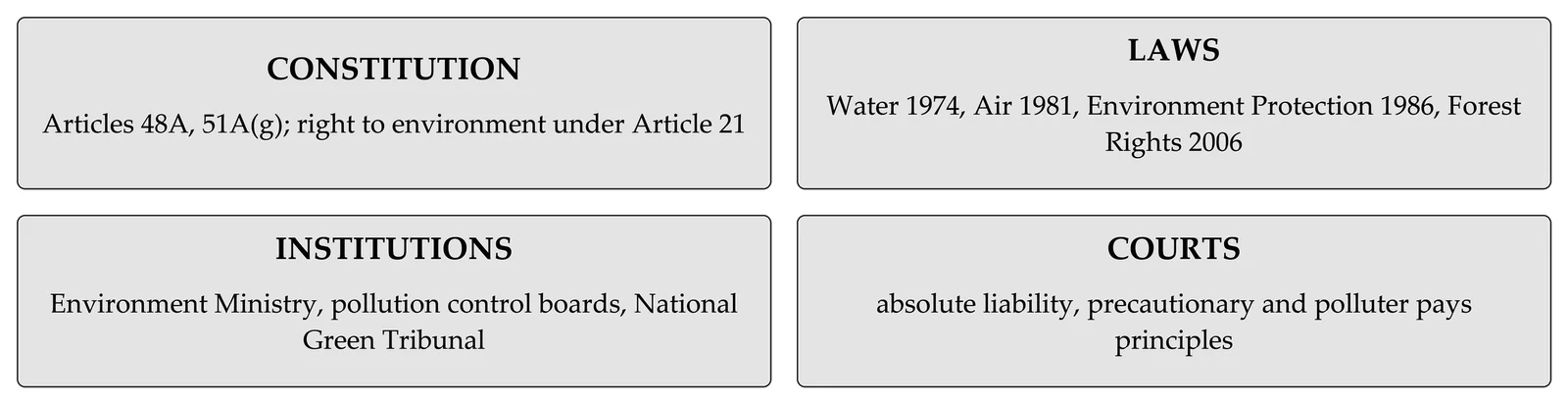
- Constitutional provisions. The 42nd Amendment (1976) added Article 48A, a Directive Principle on protecting the environment, and Article 51A(g), a Fundamental Duty to protect the natural environment. The Supreme Court has read the right to a healthy environment into the right to life under Article 21, as in Subhash Kumar (1991).
- Laws. Major laws include the Wildlife (Protection) Act, 1972; the Water Act, 1974; the Forest (Conservation) Act, 1980; the Air Act, 1981; the Environment (Protection) Act, 1986, enacted after the Bhopal disaster; the Biological Diversity Act, 2002; and the Forest Rights Act, 2006, which recognised the rights of forest-dwelling communities.
- Institutions. The Ministry of Environment, Forest and Climate Change, the Central and State Pollution Control Boards, and the National Green Tribunal, set up in 2010 to decide environmental cases quickly.
- Judicial activism. In the M.C. Mehta cases, the Supreme Court laid down the principle of absolute liability for hazardous industries (1986) and ordered measures against pollution of the Ganga and Delhi’s air. In Vellore Citizens’ Welfare Forum (1996), it adopted the precautionary principle and the polluter pays principle. In T.N. Godavarman (from 1995), it took over the supervision of forest conservation across India.
- Climate policy. The National Action Plan on Climate Change (2008) set up eight national missions, including on solar energy and energy efficiency. At COP26 in Glasgow (2021), India announced the Panchamrit commitments, including net zero emissions by 2070, and it launched the International Solar Alliance with France in 2015.
Despite these laws and institutions, India faces severe air and water pollution, groundwater depletion, forest degradation and climate vulnerability. Weak enforcement, conflicts between development projects and environmental protection, and the dilution of environmental impact assessment rules are major concerns.
3.3 Green Governance: Sustainable Human Development
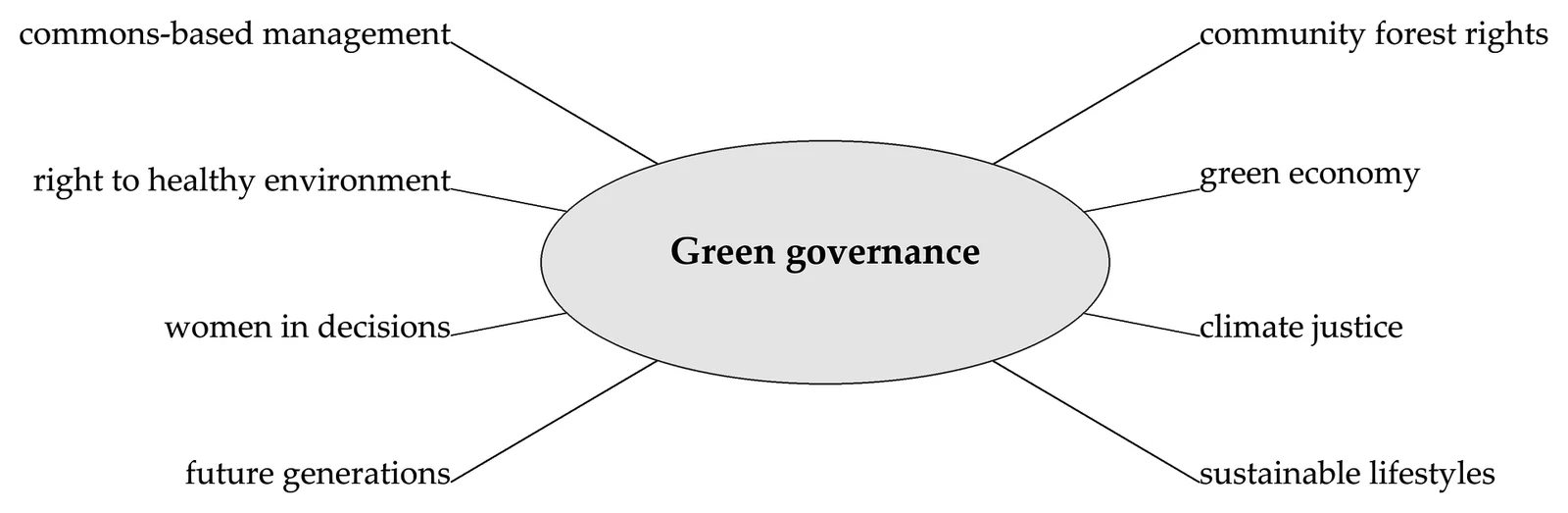
Green governance refers to governance that integrates ecological sustainability, human rights and the participation of communities into decision-making. It goes beyond environmental regulation by the state to recognise the role of communities, the commons and future generations.
Weston and Bollier: The Law of the Commons
Burns Weston and David Bollier, in Green Governance: Ecological Survival, Human Rights and the Law of the Commons (2013), argued that neither the state nor the market has protected the environment adequately. They proposed a commons-based approach, in which communities manage shared resources through their own rules, supported by law, and linked environmental protection to the human right to a clean and healthy environment. Their approach builds on Ostrom’s work and calls for a new partnership among the state, the market and the commons.
Bina Agarwal: Gender and Green Governance
Bina Agarwal, in Gender and Green Governance (2010), studied community forest groups in India and Nepal. She found that groups with a higher proportion of women on their executive committees achieved better forest conditions and less illegal felling. She argued that including women, who depend heavily on forests for fuel, fodder and food, improves both equity and conservation, showing that gender equality and green governance go together.
Sustainable Human Development
The UNDP linked the human development approach with sustainability in the idea of sustainable human development, which seeks development that is pro-poor, pro-nature, pro-jobs and pro-women. It aims to expand people’s capabilities today without reducing the capabilities of future generations. The Sustainable Development Goals integrate economic, social and environmental objectives. Related ideas include the green economy, which seeks growth with low carbon emissions and resource efficiency; the circular economy, which reduces waste through reuse and recycling; and climate justice, which holds that those least responsible for climate change, the poor and developing countries, should not bear its heaviest burden.
Green Governance in India
- Joint Forest Management (from 1990). Forest departments and village communities jointly protect and manage forests and share benefits.
- Forest Rights Act (2006). It recognises individual and community rights of forest dwellers and gives Gram Sabhas a role in managing community forest resources.
- PESA Act (1996). It gives Gram Sabhas in Scheduled Areas powers over natural resources and consultation on land acquisition.
- Community initiatives. Water harvesting in Rajasthan, led by organisations such as Tarun Bharat Sangh, revived rivers through community effort.
- Renewable energy. India has expanded solar and wind energy rapidly and set a target of 500 GW of non-fossil capacity by 2030.
- Mission LiFE. India launched Lifestyle for Environment in 2022 to promote sustainable consumption by individuals and communities.
3.4 Important Questions
- Question 1 Discuss the nature of human-environment interaction and the problem of the commons.
- Question 2 Examine the constitutional, legal and institutional framework of environmental governance in India.
- Question 3 What is green governance? Discuss its relationship with sustainable human development.
- Question 4 Discuss the evolution and challenges of global environmental governance.
DU asks the same idea in different words. So learn one broad answer for each question below; the same answer works for every question joined by OR.
Important Question 1
Discuss the nature of human-environment interaction and the problem of the commons.
OR
Examine Hardin’s tragedy of the commons and Ostrom’s response to it.
OR
What is meant by the environmentalism of the poor? Discuss with Indian examples.
Model Answer
“Freedom in a commons brings ruin to all.”
— Garrett Hardin, The Tragedy of the Commons (1968)
Introduction. Human societies both depend on and transform the environment. This interaction has produced great material progress but also an environmental crisis of pollution, resource depletion and climate change. Understanding how people use shared resources, the commons, is central to environmental governance, and debates between Hardin and Ostrom have shaped thinking on this question.
1. Determinism and Possibilism
Environmental determinism held that geography and climate shape human societies, while possibilism argued that humans can modify their environment within limits. Modern scholars stress a two-way interaction between society and nature.
2. Anthropocentrism and Ecocentrism
Anthropocentric views value nature as a resource for humans, while ecocentric views such as Arne Naess’s deep ecology assert the intrinsic value of nature. Stewardship views stress human responsibility to care for nature.
3. The Environmental Crisis
Industrialisation and population growth have caused pollution, deforestation and biodiversity loss. Carson’s Silent Spring (1962) and the Club of Rome’s The Limits to Growth (1972) awakened concern about environmental limits.
4. The Anthropocene and Risk Society
Paul Crutzen argued that human activity has become the dominant force shaping the planet, marking a new age called the Anthropocene. Ulrich Beck described modern societies as risk societies facing hazards produced by industry, such as the Bhopal disaster of 1984.
5. Meaning of the Commons
Common-pool resources, such as forests, pastures, fisheries, groundwater and the atmosphere, are used by many people, and it is difficult to exclude users, which makes them vulnerable to overuse.
6. Hardin’s Tragedy of the Commons
Hardin argued in 1968 that each herder on a common pasture gains the full benefit of adding an animal while sharing the cost of overgrazing, so all will overuse the pasture until it is ruined.
7. Hardin’s Solutions
Hardin proposed either privatisation, so that owners bear the costs of overuse, or state control through regulation, which he called mutual coercion, mutually agreed upon.
8. Ostrom’s Response
Elinor Ostrom, in Governing the Commons (1990), showed that many communities successfully manage commons through their own institutions, without privatisation or state control. She won the Nobel Prize in 2009.
9. Ostrom’s Design Principles
Successful community institutions have clear boundaries, rules suited to local conditions, participation of users in making rules, monitoring, graduated sanctions, conflict-resolution mechanisms and recognition by higher authorities.
10. Indian Examples of Community Management
Sacred groves, van panchayats in Uttarakhand, community forest management in Odisha and traditional water systems such as the johads of Rajasthan show community management of commons in India.
11. Environmentalism of the Poor
Guha and Martínez-Alier argued that environmentalism in poor countries is often a struggle for livelihood by communities dependent on natural resources, unlike the post-material environmentalism of rich countries.
12. Chipko
In the Chipko movement of 1973 in the Garhwal Himalayas, villagers, many of them women, hugged trees to prevent commercial felling, asserting local rights over forests.
13. Narmada and Niyamgiri
The Narmada Bachao Andolan opposed displacement by large dams from 1985, and the Dongria Kondh resisted bauxite mining in Niyamgiri, where the Supreme Court required Gram Sabha consent in 2013.
14. Climate Change
Climate change is the ultimate global commons problem, since the atmosphere is shared by all and each country is tempted to free-ride on the efforts of others.
15. Lessons for Governance
Human-environment interaction shows that environmental problems are also social and political problems, requiring institutions that combine state regulation, community management and global cooperation.
16. Evaluation
Hardin’s pessimism and Ostrom’s optimism together show that the fate of the commons depends on the quality of institutions, and that local communities can be effective guardians of nature.
Conclusion. Thus, human-environment interaction is a two-way relationship that has produced an environmental crisis. Hardin warned that freedom in a commons brings ruin to all, but Ostrom showed that communities can govern commons through their own institutions, as Indian movements and traditions also demonstrate.
Important Question 2
Examine the constitutional, legal and institutional framework of environmental governance in India.
OR
Discuss the role of the judiciary in environmental protection in India.
OR
Critically evaluate environmental governance in India.
Model Answer
“To protect and improve the natural environment including forests, lakes, rivers and wild life, and to have compassion for living creatures.”
— Constitution of India, Article 51A(g)
Introduction. India has built an extensive framework of environmental governance since the 1970s, including constitutional provisions, laws, institutions and an active judiciary. Yet the country faces severe environmental problems, showing the gap between law and practice and the tension between development and environmental protection.
1. The Stockholm Influence
India’s environmental framework began to take shape after the Stockholm Conference of 1972, where Indira Gandhi highlighted the link between poverty and environmental degradation.
2. Constitutional Provisions
The 42nd Amendment of 1976 added Article 48A, directing the state to protect the environment, and Article 51A(g), making environmental protection a fundamental duty of citizens.
3. Right to a Healthy Environment
The Supreme Court has read the right to a pollution-free environment into the right to life under Article 21, as in Subhash Kumar (1991), making environmental protection a fundamental right.
4. Early Laws
The Wildlife (Protection) Act of 1972, the Water Act of 1974, the Forest (Conservation) Act of 1980 and the Air Act of 1981 established the legal framework for protecting wildlife, forests, water and air.
5. Environment (Protection) Act, 1986
Enacted after the Bhopal gas disaster of 1984, this umbrella law empowers the Union government to set standards, regulate industries and require environmental impact assessments.
6. Biodiversity and Forest Rights
The Biological Diversity Act of 2002 protects biodiversity and traditional knowledge, while the Forest Rights Act of 2006 recognises the rights of forest dwellers and the role of Gram Sabhas in managing forests.
7. Institutions
The Ministry of Environment, Forest and Climate Change makes policy, while the Central and State Pollution Control Boards monitor and enforce pollution standards.
8. National Green Tribunal
The National Green Tribunal, set up in 2010, decides environmental cases quickly and has ordered measures on river pollution, waste management and illegal mining.
9. Absolute Liability
In the M.C. Mehta oleum gas leak case of 1986, the Supreme Court laid down the principle of absolute liability, holding hazardous industries fully liable for harm without exceptions.
10. Precautionary and Polluter Pays Principles
In Vellore Citizens’ Welfare Forum (1996), the Court adopted the precautionary principle and the polluter pays principle as part of Indian environmental law.
11. Continuing Mandamus
In T.N. Godavarman (from 1995), the Court supervised forest conservation across India for decades, and in the M.C. Mehta cases it ordered cleaner fuels for Delhi’s public transport.
12. Climate Policy
The National Action Plan on Climate Change of 2008 set up eight missions, and at COP26 in 2021 India pledged net zero emissions by 2070 and expanded renewable energy targets.
13. Weak Enforcement
Pollution control boards lack staff and independence, and fines are low, so laws are often poorly enforced. Indian cities rank among the most polluted in the world.
14. Development versus Environment
Development projects such as dams, mines and highways often conflict with environmental protection, and critics argue that environmental clearance procedures have been diluted to speed up projects.
15. Judicial Overreach Debate
Some argue that courts have taken over executive functions in environmental matters, while others see judicial activism as necessary because of executive failure.
16. Environmental Impact Assessment
The EIA Notification of 1994, revised in 2006, requires major projects to obtain environmental clearance after assessing their impact and holding public hearings with affected communities. The draft EIA Notification of 2020 was widely criticised for allowing post-facto clearances and reducing public consultation, showing the tension between ease of doing business and environmental protection.
17. Coastal and Wetland Protection
Coastal Regulation Zone notifications, first issued in 1991, restrict construction along the coast, and the Wetlands Rules protect lakes and marshes. The Supreme Court ordered the demolition of illegally built apartment towers at Maradu in Kerala in 2020 for violating coastal rules, showing the courts’ role in enforcement.
18. Evaluation
India has a strong legal framework for environmental governance, but effective protection requires better enforcement, independent regulators and the participation of affected communities.
Conclusion. Thus, India’s environmental governance rests on Articles 48A, 51A(g) and 21, laws such as the Environment Protection Act, institutions like the pollution control boards and the National Green Tribunal, and an active judiciary. Weak enforcement and conflicts with development remain the main challenges.
Important Question 3
What is green governance? Discuss its relationship with sustainable human development.
OR
Discuss the idea of green governance with reference to Weston, Bollier and Bina Agarwal.
OR
Examine the concept of sustainable human development.
Model Answer
“Sustainable development is development that meets the needs of the present without compromising the ability of future generations to meet their own needs.”
— World Commission on Environment and Development, Our Common Future (1987)
Introduction. Green governance refers to governance that places ecological sustainability, human rights and community participation at the centre of decision-making. It responds to the failure of both states and markets to protect the environment, and seeks development that improves human well-being without destroying the natural systems on which life depends.
1. Meaning of Green Governance
Green governance integrates environmental sustainability into all areas of governance and recognises the role of communities, the commons and future generations, beyond environmental regulation by the state.
2. Failure of State and Market
States often favour short-term growth and industrial interests, while markets ignore environmental costs. Green governance seeks new institutions that combine the strengths of the state, markets and communities.
3. Weston and Bollier
In Green Governance (2013), Weston and Bollier proposed a commons-based approach in which communities manage shared resources through their own rules, supported by law, as the basis of ecological survival.
4. Environment and Human Rights
They linked environmental protection to the human right to a clean and healthy environment, which the UN General Assembly recognised in 2022, and which India’s Supreme Court has read into Article 21.
5. Bina Agarwal’s Study
In Gender and Green Governance (2010), Bina Agarwal found that community forest groups in India and Nepal with more women on their executive committees achieved better forest conservation.
6. Gender and the Environment
Women depend heavily on forests and water for household needs and bear the burden of environmental degradation. Including them in decision-making improves both equity and sustainability.
7. Sustainable Development
The Brundtland Report of 1987 defined sustainable development as meeting present needs without compromising future generations, integrating economic growth, social equity and environmental protection.
8. Sustainable Human Development
The UNDP combined human development with sustainability, seeking development that is pro-poor, pro-nature, pro-jobs and pro-women, expanding capabilities today without reducing those of future generations.
9. Intergenerational Equity
Green governance recognises the rights of future generations, who cannot speak for themselves, and requires present decisions to consider long-term environmental effects.
10. Green Economy and Circular Economy
A green economy seeks growth with low carbon emissions and efficient use of resources, while a circular economy reduces waste by reusing and recycling materials.
11. Climate Justice
Climate justice holds that the poor and developing countries, least responsible for emissions, should not bear the heaviest burden of climate change, and that rich countries should provide finance and technology.
12. Joint Forest Management and Forest Rights
India’s Joint Forest Management from 1990 and the Forest Rights Act of 2006 give communities a role in managing forests, reflecting green governance principles.
13. PESA and Gram Sabhas
The PESA Act of 1996 gives Gram Sabhas in Scheduled Areas powers over natural resources, and the Niyamgiri case of 2013 affirmed their role in decisions on mining.
14. Renewable Energy and LiFE
India’s rapid expansion of solar and wind energy and the Mission LiFE launched in 2022 promote low-carbon development and sustainable lifestyles.
15. Challenges
Green governance faces resistance from powerful economic interests, weak community institutions, poverty that forces overuse of resources, and the pressure for rapid growth.
16. Evaluation
Green governance offers a path to development that respects both people and the planet, but it requires democratic participation, secure community rights and supportive state institutions.
Conclusion. Thus, green governance integrates sustainability, human rights and community participation into governance, as Weston and Bollier’s commons approach and Bina Agarwal’s work on gender show. It is closely linked to sustainable human development, which, following Brundtland, meets present needs without compromising future generations.
Important Question 4
Discuss the evolution and challenges of global environmental governance.
OR
Examine the role of international conferences and treaties in environmental governance.
OR
Discuss the principle of common but differentiated responsibilities in climate negotiations.
Model Answer
“In view of the different contributions to global environmental degradation, States have common but differentiated responsibilities.”
— Rio Declaration on Environment and Development (1992), Principle 7
Introduction. Many environmental problems, such as climate change, ozone depletion and biodiversity loss, cross national borders and cannot be solved by any state alone. Global environmental governance refers to the international institutions, treaties and processes through which states and other actors cooperate on these problems. It has grown since 1972, but faces serious challenges.
1. Need for Global Governance
The atmosphere, oceans and biodiversity are global commons. Without cooperation, states may free-ride on others’ efforts, so international agreements are needed to share responsibilities.
2. Stockholm Conference, 1972
The UN Conference on the Human Environment in Stockholm was the first major global environmental conference and led to the creation of the United Nations Environment Programme.
3. The Brundtland Report
The World Commission on Environment and Development’s 1987 report Our Common Future defined sustainable development and linked environment with development and poverty.
4. Montreal Protocol, 1987
The Montreal Protocol phased out ozone-depleting substances and is regarded as the most successful environmental treaty, showing that global cooperation can work.
5. Rio Earth Summit, 1992
The Rio Summit adopted the Rio Declaration, Agenda 21, the UN Framework Convention on Climate Change and the Convention on Biological Diversity, laying the foundation of modern environmental governance.
6. Common but Differentiated Responsibilities
The Rio Declaration recognised that all states share responsibility for the environment, but developed countries bear greater responsibility because of their historical emissions and greater resources.
7. Kyoto Protocol, 1997
The Kyoto Protocol set binding emission reduction targets for developed countries, but the United States did not ratify it, and emissions from developing countries were not limited.
8. Copenhagen, 2009
The Copenhagen conference failed to produce a binding agreement, showing the deep divisions between developed and developing countries over responsibility and finance.
9. Paris Agreement, 2015
Under the Paris Agreement, all countries agreed to limit warming to well below 2°C and to pursue 1.5°C through nationally determined contributions reviewed every five years.
10. Climate Finance
Developed countries promised to mobilise 100 billion dollars a year for developing countries by 2020, a goal that was met late, and a loss and damage fund was agreed at COP27 in 2022.
11. Role of Non-State Actors
NGOs, scientists, businesses, cities and indigenous peoples play growing roles. The Intergovernmental Panel on Climate Change, set up in 1988, provides scientific assessments.
12. India’s Role
India has defended common but differentiated responsibilities and climate justice, launched the International Solar Alliance with France in 2015 and pledged net zero by 2070 at COP26.
13. Lack of Enforcement
There is no global authority to enforce environmental agreements, so compliance depends on the willingness of states, and commitments are often not met.
14. North-South Divide
Developed and developing countries disagree over historical responsibility, finance and technology transfer, which has slowed negotiations.
15. Withdrawal and Free-Riding
States may withdraw from agreements, as the United States did from the Paris Agreement under President Trump, or fail to meet their pledges, undermining collective action.
16. Biodiversity Governance
The Convention on Biological Diversity of 1992 aims at conservation, sustainable use and fair sharing of the benefits of genetic resources; its Nagoya Protocol of 2010 deals with access and benefit-sharing, and the Kunming-Montreal Global Biodiversity Framework of 2022 set the target of protecting 30% of land and sea by 2030.
17. Trade and Environment
Environmental governance increasingly overlaps with trade. The European Union’s Carbon Border Adjustment Mechanism, which places a charge on carbon-intensive imports, has been criticised by India and other developing countries as a trade barrier that violates common but differentiated responsibilities.
18. Evaluation
Global environmental governance has achieved notable successes, such as the Montreal Protocol, but its weak enforcement and divisions make it inadequate to the scale of the climate crisis.
Conclusion. Thus, global environmental governance has evolved from Stockholm (1972) through Rio (1992) and Kyoto (1997) to Paris (2015), based on the principle of common but differentiated responsibilities. Lack of enforcement, North-South divisions and free-riding remain its central challenges.
Short Notes
(a) Tragedy of the commons
Garrett Hardin’s argument (1968) that individuals using a shared resource will overuse it, since each gains the full benefit while sharing the cost, leading to its ruin.
(b) Polluter pays principle
The principle that those who cause pollution should bear the cost of remedying it, adopted by the Supreme Court in Vellore Citizens’ Welfare Forum (1996).
(c) National Green Tribunal
A specialised tribunal set up in 2010 under the National Green Tribunal Act to decide cases on environmental protection and forest conservation quickly.
(d) Common but differentiated responsibilities
The principle in Principle 7 of the Rio Declaration (1992) that all states share responsibility for protecting the global environment, but developed countries bear greater responsibility because of their historical emissions and greater resources.
More notes: GE-5 Governance: Issues and Challenges
These notes are prepared by PADHO TO AISE for study help. They are not an official publication.