

Semester VII MDSE-11 Research Methods in Politics
Unit I · 18 min read · Updated 24 Nov 2026
As per the University of Delhi (DU) BA (Hons) Political Science syllabus
Contents
- 1.1 Human Enquiry and Social Science Research
- 1.2 Political Inquiry and Its Purpose
- 1.3 Objectivity and Interpretation
- 1.4 Quantitative and Qualitative Analysis
- 1.5 Important Questions
- How does social science research differ from ordinary human enquiry? Discuss.
- What is political inquiry? Why do we need it?
- Discuss the issues of objectivity and interpretation in political enquiry.
- Discuss the epistemological debate between quantitative and qualitative research.
- Short Notes
विज्ञान को मिथकों से, और मिथकों की आलोचना से, आरंभ करना चाहिए।
Science must begin with myths, and with the criticism of myths.
— Karl Popper, Conjectures and Refutations (1963)
EVERY day we make claims about politics: that voters choose by caste, that democracy reduces poverty, that a leader is popular. Research methods are the tools that let us test such claims systematically. This chapter introduces the foundations of political research: how social science research differs from everyday human enquiry, what political inquiry is and why we need it, how researchers deal with objectivity and interpretation, and the epistemological debate between quantitative and qualitative research. It draws on Earl Babbie, Gary King, Robert Keohane and Sidney Verba, Alasdair MacIntyre, Sandra Halperin and Oliver Heath, Alan Bryman, Lloyd and Susanne Rudolph, Sudipta Kaviraj and Divya Vaid.

1.1 Human Enquiry and Social Science Research
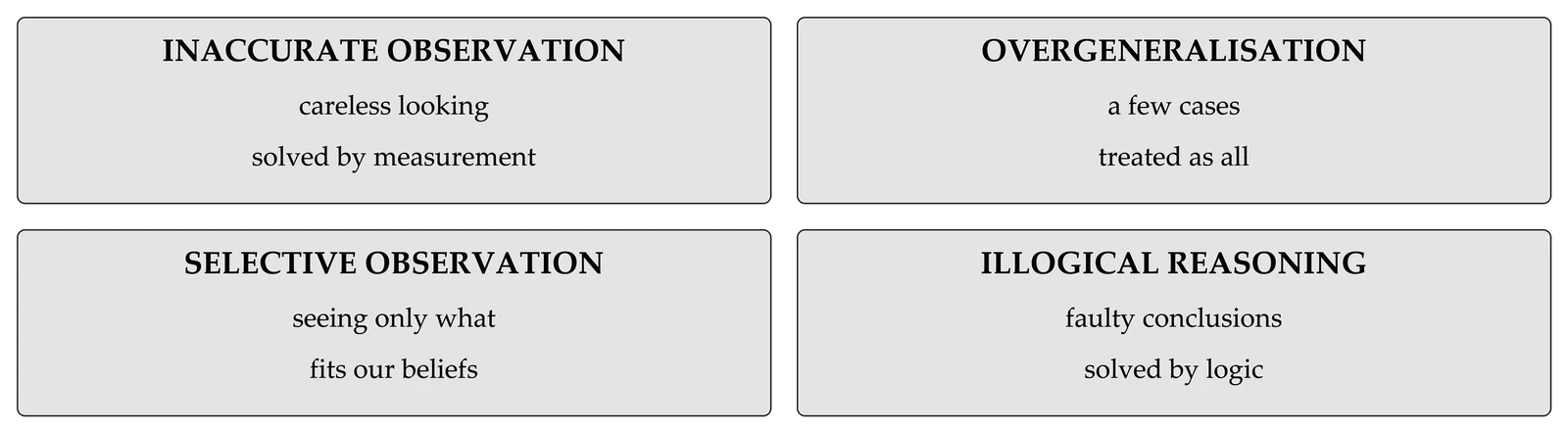
People learn about the world through tradition, authority and personal experience, but ordinary enquiry is prone to errors such as inaccurate observation, overgeneralisation, selective observation and illogical reasoning. Earl Babbie explains that science reduces these errors through systematic observation and logic. Social science research applies these methods to human behaviour and institutions. King, Keohane and Verba argue that its goal is inference: drawing conclusions about the world beyond the data collected, through public procedures that others can check.
1.2 Political Inquiry and Its Purpose
Political inquiry is the systematic study of power, the state, institutions, behaviour and ideas. It may be normative, asking what ought to be; empirical, describing and explaining what is; or interpretive, understanding meanings. We need it to understand and explain politics, to evaluate institutions and policies and to support informed citizenship. Lloyd and Susanne Rudolph trace how the study of Indian politics developed, while Sudipta Kaviraj warns against treating method as a neutral technique separated from theory.
1.3 Objectivity and Interpretation
Can political research be objective when researchers have their own values? Max Weber argued that research should be value-free in its conclusions, though values guide the choice of topics. Interpretive scholars argue that political action has meanings that must be understood from within. Halperin and Heath discuss how researchers can manage values through transparency and scrutiny, and Alasdair MacIntyre questioned whether a science of comparative politics is possible across cultures.

1.4 Quantitative and Qualitative Analysis
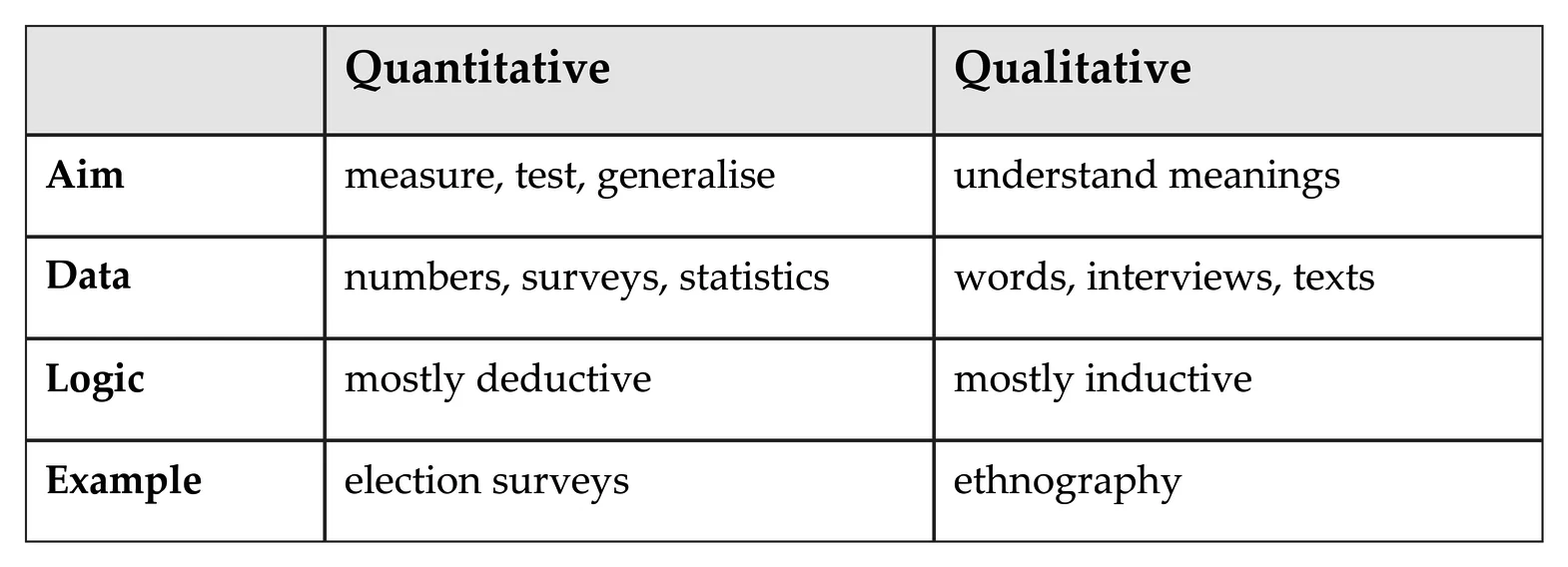
Quantitative research measures and counts, using surveys and statistics to test hypotheses and generalise. Qualitative research seeks to understand meanings through interviews, texts and observation. Alan Bryman asked whether their differences are a matter of method or of epistemology, the theory of knowledge, and King, Keohane and Verba argued that both share a common logic of inference.
1.5 Important Questions
- Question 1 How does social science research differ from ordinary human enquiry? Discuss.
- Question 2 What is political inquiry? Why do we need it?
- Question 3 Discuss the issues of objectivity and interpretation in political enquiry.
- Question 4 Discuss the epistemological debate between quantitative and qualitative research.
DU asks the same idea in different words. So learn one broad answer for each question below; the same answer works for every question joined by OR.
Important Question 1
How does social science research differ from ordinary human enquiry? Discuss.
OR
Discuss the nature of social science research with reference to Babbie and King, Keohane and Verba.
OR
Is a science of politics possible? Discuss.
Model Answer
“Scientific research is designed to make descriptive or explanatory inferences on the basis of empirical information about the world.”
— Gary King, Robert Keohane and Sidney Verba, Designing Social Inquiry (1994)
Introduction. Human beings constantly try to understand their world, but much everyday knowledge rests on tradition, authority and casual observation. Social science research is a more systematic form of enquiry that uses careful observation, logic and public procedures to reduce errors. Earl Babbie explains the difference between ordinary enquiry and science, and King, Keohane and Verba set out the features of scientific research in the social sciences.
1. Ordinary Human Enquiry
People acquire knowledge through tradition, inherited beliefs about how the world works, and authority, the claims of experts, elders or leaders. They also learn from personal experience. These sources are useful but often unreliable, because they are not systematically checked.
2. Errors in Ordinary Enquiry
Babbie identifies common errors: inaccurate observation, overgeneralisation from a few cases, selective observation of evidence that fits our beliefs and illogical reasoning. Science is designed to guard against each of them.
3. Science as a Method
Science is not a body of facts but a method of enquiry based on logic and observation. Scientific claims must make logical sense and agree with what we observe, and they remain open to revision when new evidence appears.
4. Social Science Research
Social science research applies scientific methods to human behaviour, societies and institutions. It looks for patterns in social life, explains why they occur and tests explanations against evidence.
5. King, Keohane and Verba
In Designing Social Inquiry (1994), King, Keohane and Verba identify four features of scientific research: its goal is inference; its procedures are public; its conclusions are uncertain; and its content is the method, so that science is defined by how it reaches conclusions, not by its subject.
6. Description and Explanation
Descriptive inference uses observed facts to learn about unobserved facts, such as estimating national opinion from a sample. Causal inference explains why something happens, such as why some groups vote more than others.
7. Theory, Hypothesis and Observation
Research moves between theory and observation. Deductive research derives hypotheses from theory and tests them, while inductive research builds generalisations from observations. Walter Wallace described this as a continuous wheel of science.
8. Concepts and Variables
Researchers turn abstract concepts, such as democracy or political participation, into measurable variables and state hypotheses about relationships between them, which can be tested with data.
9. Is a Science of Politics Possible
Alasdair MacIntyre, in ‘Is a Science of Comparative Politics Possible?’ (1971), argued that political institutions and actions have different meanings in different cultures, so law-like generalisations across societies are difficult. A party or a vote may not mean the same thing everywhere.
10. The Behavioural Revolution
In the 1950s and 1960s, the behavioural movement sought to make political science more scientific through observation, measurement and quantification, studying voting, attitudes and political culture.
11. Post-Behaviouralism
In 1969, David Easton announced a post-behavioural revolution, arguing that research must be relevant to urgent social problems and that substance must come before technique. In the same year, Sheldon Wolin defended political theory as a vocation against a narrow focus on method.
12. Research in India
Lloyd and Susanne Rudolph trace the intellectual history of the study of Indian politics, from institutional and constitutional studies to behavioural research led by the Centre for the Study of Developing Societies, founded in 1963, and later studies of political economy and social movements.
13. Limits of Social Science
Social science faces special difficulties: people change when studied, controlled experiments are often impossible, and values shape research. Its conclusions are therefore probabilistic and provisional.
14. Evaluation
Social science research improves on ordinary enquiry through system, logic and transparency, while recognising the special complexity of human behaviour.
Conclusion. Thus, ordinary human enquiry relies on tradition, authority and casual experience and is prone to errors that Babbie identifies. Social science research uses systematic observation and logic, with the goal of inference through public procedures, as King, Keohane and Verba explain, though MacIntyre reminds us that a science of politics must respect cultural meanings.
Important Question 2
What is political inquiry? Why do we need it?
OR
Discuss the nature and purpose of political inquiry.
OR
Examine the development of methods in the study of Indian politics.
Model Answer
“Substance must precede technique.”
— David Easton, ‘The New Revolution in Political Science’ (1969)
Introduction. Political inquiry is the systematic study of political phenomena: power, the state, government, institutions, behaviour, ideas and values. It seeks to describe, explain, understand and evaluate politics. Political inquiry is needed not only by scholars but by citizens, policy-makers and democracies, which depend on reliable knowledge about how political life works.
1. Meaning of Political Inquiry
Political inquiry asks questions about who has power, how decisions are made, why people vote as they do, how institutions work and what a just political order would be. It uses systematic methods to answer them.
2. Normative Inquiry
Normative inquiry asks what ought to be: what justice requires, what makes government legitimate, what rights people should have. Plato, Locke, Rousseau, Mill and Rawls are classic normative thinkers.
3. Empirical Inquiry
Empirical inquiry describes and explains what is. Aristotle’s study of 158 constitutions is an early example; modern examples include studies of voting behaviour and comparative studies of democracy.
4. Interpretive and Historical Inquiry
Interpretive inquiry seeks to understand the meanings that people attach to political action, and historical inquiry studies political ideas and institutions in their historical context.
5. Why We Need It: Understanding
Political inquiry helps us understand complex political phenomena that cannot be grasped through common sense, such as the causes of conflict, the sources of political stability or the effects of institutions.
6. Explanation and Prediction
By identifying patterns and causes, political inquiry helps explain past events and anticipate future trends, such as electoral outcomes or the likely effects of policies.
7. The Comparative Method
Comparison is one of the oldest tools of political inquiry. J.S. Mill, in 1843, described the method of agreement, which looks for a common factor among cases with the same outcome, and the method of difference, which looks for the factor that distinguishes cases with different outcomes. Comparative politics uses such logic to explain why democracy survives in some countries and fails in others.
8. New Sources of Data
Political inquiry now has access to large datasets on elections, legislators, parties and public opinion. Jensenius and Verniers describe large-scale data on Indian elections from 1961 to the present, which allow researchers to study patterns of candidates, turnout and representation over decades, making new kinds of questions answerable.
9. Ethics in Political Inquiry
Political inquiry often involves sensitive topics such as caste, religion, violence and voting. Researchers must protect respondents’ identities, obtain informed consent and avoid causing harm. Ethical conduct is part of what makes research trustworthy and is discussed further in the practical component of this course.
10. Evaluation and Policy
Political inquiry evaluates whether institutions and policies achieve their aims and what their consequences are, providing evidence for better decisions.
11. Democracy and Citizenship
Democracy depends on informed citizens. Political inquiry provides reliable knowledge that helps citizens judge leaders, policies and claims made in public debate.
12. The Behavioural Turn
Behaviouralists such as Robert Dahl and Gabriel Almond, with Sidney Verba in The Civic Culture (1963), made political inquiry more empirical, studying attitudes and behaviour through surveys.
13. Easton’s Post-Behaviouralism
David Easton argued in 1969 that political inquiry must be relevant to the crises of society and that substance must precede technique, combining scientific methods with concern for values and action.
14. Kaviraj on Method
Sudipta Kaviraj, in ‘How Not to Study Method?’ (1978), criticised the treatment of method as a neutral technique detached from theory. He argued that methods carry assumptions about society, so method cannot be separated from substantive theory.
15. Vaid on Methods
Divya Vaid argues that political science in India needs stronger training in research methods and greater methodological pluralism, combining quantitative and qualitative approaches.
16. The Rudolphs on Indian Politics
Lloyd and Susanne Rudolph show how the study of Indian politics moved from institutional description to behavioural, political economy and interpretive approaches, reflecting changes in methods and in Indian politics itself.
17. Evaluation
Political inquiry is essential for understanding and improving political life. It combines normative, empirical and interpretive approaches, and its methods must serve meaningful questions.
Conclusion. Thus, political inquiry is the systematic study of power, institutions, behaviour and ideas, through normative, empirical and interpretive approaches. We need it to understand, explain, evaluate and improve politics and to support democratic citizenship. As Easton and Kaviraj remind us, method must serve substance and theory.
Important Question 3
Discuss the issues of objectivity and interpretation in political enquiry.
OR
Can political research be value-free? Discuss.
OR
Examine Halperin and Heath’s discussion of objectivity and values.
Model Answer
“The prophet and the demagogue do not belong on the academic platform.”
— Max Weber, ‘Science as a Vocation’ (1917)
Introduction. Political researchers study a world in which they are themselves participants, with their own values, identities and interests. This raises the question of objectivity: can political research be free of bias? Some argue for value-free science, others for interpretation of meanings from within. Halperin and Heath discuss how researchers can manage values while producing reliable knowledge.
1. Meaning of Objectivity
Objectivity means that research findings should reflect the evidence rather than the researcher’s personal preferences, and that other researchers using the same methods should reach similar conclusions.
2. Positivism
Positivism, associated with Auguste Comte, holds that social science should follow the methods of natural science, observing facts and discovering laws, and separating facts from values.
3. Weber: Value Freedom and Value Relevance
Max Weber argued that scholars should not use the lecture hall to promote political views. Research should be value-free in its conclusions, but values legitimately guide the choice of topics, a principle he called value relevance.
4. Halperin and Heath
Sandra Halperin and Oliver Heath distinguish normative questions about values from empirical questions about facts. They argue that values inevitably influence research but that transparency about methods and assumptions, and openness to scrutiny, allow research to be reliable.
5. The Interpretive Approach
Interpretive scholars argue that human action is meaningful and must be understood from the actors’ perspective, a method Weber called Verstehen. Charles Taylor argued that the social sciences are inherently interpretive.
6. Hermeneutics
Hermeneutics, the theory of interpretation, holds that understanding always involves the interpreter’s own background. Researchers interpret texts and actions through a dialogue between their own understanding and that of others.
7. Critical Theory
Jürgen Habermas argued that knowledge is shaped by human interests, including technical control, mutual understanding and emancipation. Critical theorists see research as part of the struggle for a freer society.
8. Feminist Standpoint
Feminist standpoint theorists, such as Sandra Harding, argue that research from the standpoint of marginalised groups can reveal aspects of social reality hidden from dominant perspectives, producing a stronger form of objectivity.
9. Reflexivity
Reflexivity means that researchers reflect on how their own position, such as class, caste, gender and nationality, shapes their research, and make this explicit.
10. MacIntyre on Meaning
Alasdair MacIntyre argued that political concepts and institutions have different meanings across cultures, so researchers must interpret them in context rather than apply universal categories mechanically.
11. The Indian Debate
Gopal Guru argued in 2002 that Indian social science divided intellectual labour between theoretical brahmins and empirical shudras, raising questions about whose experience counts and who gets to theorise.
12. Intersubjectivity
Many scholars now see objectivity as intersubjectivity: knowledge is reliable when it survives criticism from a community of researchers with different perspectives.
13. Balancing Objectivity and Interpretation
Good political research combines rigour in evidence with sensitivity to meaning, acknowledging values while subjecting claims to critical scrutiny.
14. Ideal Types
Weber proposed ideal types as tools of objective analysis: simplified models that highlight the key features of a phenomenon, such as bureaucracy or charismatic authority. They are not descriptions of reality or moral ideals, but yardsticks against which real cases can be compared, helping researchers analyse complex reality systematically.
15. Neutrality or Commitment
Some researchers argue that political research should be committed to social change. Participatory action research involves the people studied as partners in identifying problems and seeking solutions. Critics warn that commitment may compromise objectivity, while supporters argue that openly acknowledged commitments are more honest than claims of neutrality.
16. Evaluation
Complete value freedom is impossible, but objectivity remains an important ideal, pursued through transparency, reflexivity and critical debate.
Conclusion. Thus, political enquiry faces the problem of objectivity because researchers have values. Weber sought value-free conclusions with value-relevant topics, interpretive scholars stress understanding meanings, and Halperin and Heath show how transparency and scrutiny make research reliable. Objectivity is best understood as an ideal pursued through reflexivity and critical debate.
Important Question 4
Discuss the epistemological debate between quantitative and qualitative research.
OR
Is the debate between quantitative and qualitative research a question of method or epistemology? Discuss with reference to Bryman.
OR
Compare the strengths and limitations of quantitative and qualitative research.
Model Answer
“All good research can be understood, indeed is best understood, to derive from the same underlying logic of inference.”
— Gary King, Robert Keohane and Sidney Verba, Designing Social Inquiry (1994)
Introduction. Political research uses two broad traditions. Quantitative research measures and counts, while qualitative research seeks to understand meanings and contexts. Their differences are sometimes seen as merely technical and sometimes as reflecting deeper epistemological differences about the nature of knowledge. Alan Bryman and King, Keohane and Verba offer influential perspectives on this debate.
1. Quantitative Research
Quantitative research uses numerical data, such as surveys, election results and statistics, to measure variables, test hypotheses and generalise to larger populations. It values precision, replicability and statistical analysis.
2. Qualitative Research
Qualitative research uses interviews, observation, documents and texts to understand meanings, experiences and processes in depth, often studying a small number of cases intensively.
3. Epistemology
Epistemology is the theory of knowledge: how we know what we know. Positivism, linked to quantitative research, holds that social reality can be observed and measured objectively. Interpretivism, linked to qualitative research, holds that social reality is constructed through meanings that must be interpreted.
4. Bryman: Method or Epistemology
Alan Bryman, in 1984, examined whether the debate is about technique or epistemology. He found that it is often presented as a clash of philosophies, but researchers frequently choose methods for practical reasons, so the link between epistemology and method is looser than claimed.
5. King, Keohane and Verba
King, Keohane and Verba argued that quantitative and qualitative research share the same logic of inference, and that qualitative researchers should follow the same rules of research design, such as avoiding bias and increasing the number of observations.
6. The Critics of KKV
Henry Brady and David Collier, in Rethinking Social Inquiry (2004), argued that qualitative methods have their own strengths, such as process tracing and attention to context, which cannot be reduced to quantitative logic.
7. Strengths of Quantitative Research
Quantitative research allows generalisation, precise measurement, comparison across many cases and statistical testing of relationships, as in large election surveys.
8. Limits of Quantitative Research
It may miss meanings, context and processes, and its measures may not capture complex concepts. Survey answers may not reflect what people really think or do.
9. Strengths of Qualitative Research
Qualitative research reveals meanings, motivations and processes, generates new concepts and hypotheses and studies phenomena that are hard to measure.
10. Limits of Qualitative Research
It is often difficult to generalise from a few cases, and findings may depend on the researcher’s interpretation, raising questions about reliability.
11. Mixed Methods
Many researchers combine methods. Datta and Vaid argue that survey research in India benefits from combining quantitative and qualitative approaches to bridge the gap between numbers and meanings.
12. Indian Examples
The National Election Studies use large surveys to analyse voting, while ethnographies such as Mukulika Banerjee’s Why India Votes? (2014) explore what voting means to citizens, together giving a fuller picture.
13. Choosing Methods
The choice of method should depend on the research question: questions about how many and how much suit quantitative methods, while questions about how and why in particular contexts often suit qualitative ones.
14. Evaluation
The debate between quantitative and qualitative research reflects real epistemological differences but need not be a war. Combining methods often produces the best understanding.
Conclusion. Thus, quantitative research measures and generalises while qualitative research interprets meanings. Bryman showed that their differences are partly epistemological and partly practical, and King, Keohane and Verba argued for a shared logic of inference, though critics defend qualitative methods’ distinct strengths. Mixed methods often offer the best path.
Short Notes
(a) Inference
The process of using observed facts to learn about facts we have not observed, either descriptively or causally. King, Keohane and Verba see inference as the goal of scientific research.
(b) Verstehen
Max Weber’s term for interpretive understanding, the attempt to grasp the meanings that actors attach to their actions, from their own point of view.
(c) Post-behaviouralism
A movement announced by David Easton in 1969 that called for political science to be relevant to social problems and action-oriented, insisting that substance must precede technique.
More notes: MDSE-11 Research Methods in Politics
These notes are prepared by PADHO TO AISE for study help. They are not an official University of Delhi publication.