
Semester VII DSE-6 The Idea of the Political: Perspectives from the Indian Intellectual Tradition
Unit IV · 20 min read · Updated 24 Nov 2026
As per the University of Delhi (DU) BA (Hons) Political Science syllabus
Contents
- 4.1 Prakriti in Samkhya and Yoga
- 4.2 Prakriti as Nature
- 4.3 Lok-kalyan: The Welfare of All
- 4.4 Important Questions
- Discuss the concept of prakriti in Samkhya philosophy.
- Discuss the idea of prakriti as nature and its significance for ecological well-being in the Indian tradition.
- Discuss the idea of lok-kalyan (welfare of the people) in Indian political thought.
- Discuss the relationship between ethics, values and well-being in Indian philosophy.
- Short Notes
सर्वे भवन्तु सुखिनः, सर्वे सन्तु निरामयाः।
May all be happy, may all be free from illness.
— Traditional Sanskrit prayer, Shanti mantra
WHAT does it mean to live well, and what is the state’s role in securing well-being? Indian thought answers these questions at several levels. The Samkhya philosophy explains the world through prakriti, primal nature, and its three gunas, while Yoga teaches discipline of body and mind as the path to inner freedom. Prakriti also means nature, and the tradition contains a deep respect for the earth. At the level of the state, the ideal of lok-kalyan, the welfare of all, defined the ruler’s duty. This unit draws on the Source Book in Indian Philosophy of Sarvepalli Radhakrishnan and Charles Moore and on William Goodwin’s study of ethics and value in Indian philosophy.

4.1 Prakriti in Samkhya and Yoga
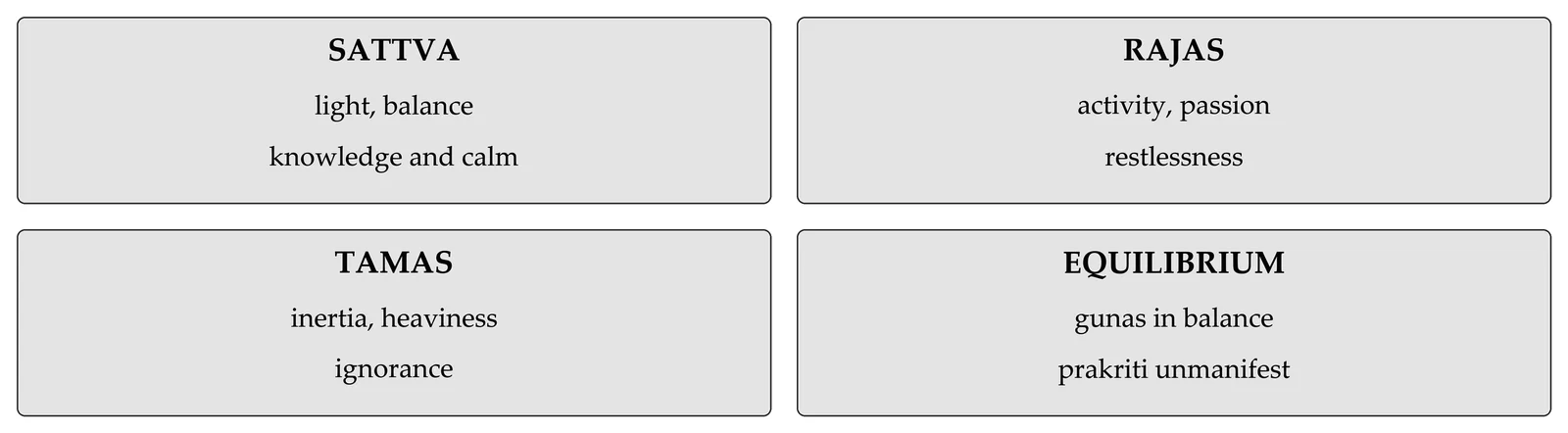
Samkhya is one of the oldest Indian philosophical systems. It holds that reality has two ultimate principles: purusha, pure consciousness, and prakriti, primal nature or matter. Prakriti is made of three gunas: sattva (lightness and balance), rajas (activity) and tamas (inertia). When the gunas lose their balance in the presence of purusha, prakriti evolves into intellect, ego, mind, the senses and the elements. Suffering arises because purusha wrongly identifies itself with prakriti, and liberation comes through discriminating knowledge. Yoga, systematised by Patanjali, accepts this framework and adds a practical discipline for calming the mind.
4.2 Prakriti as Nature
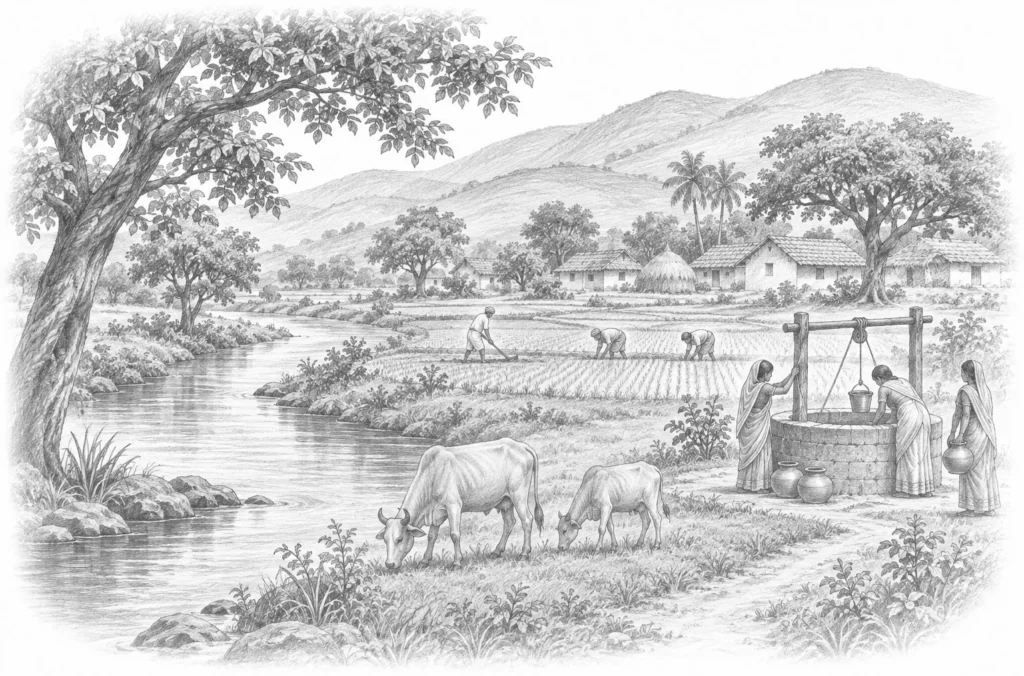
In everyday language, prakriti also means nature. Indian traditions contain deep respect for the earth: the Atharva Veda calls the earth our mother, sacred groves were protected by communities, and in 1730 members of the Bishnoi community gave their lives at Khejarli to protect trees. Modern movements such as Chipko drew on this heritage, and thinkers such as Vandana Shiva present prakriti as a living, creative principle. The Constitution now asks both the state and citizens to protect the environment.
4.3 Lok-kalyan: The Welfare of All
Lok-kalyan means the welfare of the people. Indian political thought made welfare the purpose of the state: Kautilya wrote that the king’s happiness lies in the happiness of his subjects, and Ashoka built wells, rest-houses and hospitals for people and animals. In modern India, Gandhi’s sarvodaya (the welfare of all) and the Directive Principles of State Policy continued this ideal. William Goodwin shows how Indian ethics links such values to the highest goal of liberation.

4.4 Important Questions
- Question 1 Discuss the concept of prakriti in Samkhya philosophy.
- Question 2 Discuss the idea of prakriti as nature and its significance for ecological well-being in the Indian tradition.
- Question 3 Discuss the idea of lok-kalyan (welfare of the people) in Indian political thought.
- Question 4 Discuss the relationship between ethics, values and well-being in Indian philosophy.
DU asks the same idea in different words. So learn one broad answer for each question below; the same answer works for every question joined by OR.
Important Question 1
Discuss the concept of prakriti in Samkhya philosophy.
OR
Examine the relationship between purusha and prakriti in Samkhya.
OR
Explain the theory of the three gunas and its significance for well-being.
Model Answer
“Know that prakriti and purusha are both without beginning.”
— Bhagavad Gita 13.19
Introduction. Samkhya is one of the six classical schools of Indian philosophy and one of the oldest. It explains the universe through two eternal principles, purusha and prakriti, and describes how the world evolves from prakriti. Its theory of the three gunas has influenced Indian ideas of personality, ethics and well-being. The classical statement of Samkhya is the Samkhya Karika of Ishvarakrishna, included in Radhakrishnan and Moore’s Source Book.
1. Samkhya as a System
The word samkhya means enumeration or discrimination. The system enumerates twenty-five principles of reality and teaches the discriminating knowledge that frees the self. It is traditionally traced to the sage Kapila, and its classical form is the Samkhya Karika, a short text of about seventy verses.
2. Dualism
Samkhya is dualist. It holds that there are two ultimate realities: purusha, pure consciousness, and prakriti, the material principle from which the entire world of mind and matter develops. Neither can be reduced to the other.
3. The Theory of Causation
Samkhya holds satkaryavada, the view that the effect already exists in its cause before it is produced, as oil exists in sesame seeds before they are pressed. The world therefore exists in an unmanifest form in prakriti and becomes manifest through evolution.
4. Nature of Prakriti
Prakriti is the uncaused, eternal, unconscious first cause of the world. Before creation it is unmanifest, avyakta. It is one, active and always changing. Samkhya argues for its existence from the fact that all finite things share common features and must come from a single source.
5. The Three Gunas
Prakriti is made of three gunas, or strands. Sattva is light, clarity and balance; rajas is energy, activity and passion; tamas is heaviness, inertia and ignorance. Everything in the world, including the human mind, is a mixture of these three in different proportions.
6. Evolution
When the balance of the gunas is disturbed by the presence of purusha, prakriti evolves. First comes mahat or buddhi, the intellect, then ahamkara, the sense of ‘I’, then the mind, the five sense organs, the five organs of action, the five subtle elements and the five gross elements, making twenty-three evolutes.
7. Nature of Purusha
Purusha is pure consciousness. It does not change or act; it is a witness. Samkhya holds that there are many purushas, one for each living being, because people are born, suffer and attain liberation separately.
8. The Lame and the Blind
Purusha is conscious but inactive, and prakriti is active but unconscious. The Samkhya Karika compares their association to that of a lame man who can see and a blind man who can walk, who cooperate to reach their goal. Their contact produces the world of experience.
9. Bondage
Bondage arises when purusha wrongly identifies itself with the body, mind and ego, which belong to prakriti. It then seems to suffer the pleasures and pains of the world, though in reality it remains untouched.
10. Liberation
Liberation, kaivalya or isolation, comes through viveka, the discriminating knowledge that purusha is distinct from prakriti. The Samkhya Karika compares prakriti to a dancer who stops dancing once she has shown herself to the audience.
11. Gunas and Human Character
The theory of the gunas became a way of understanding human character and conduct. The Bhagavad Gita classifies food, actions, knowledge and people as sattvic, rajasic or tamasic. Well-being lies in cultivating sattva, the quality of clarity and balance.
12. Samkhya and Yoga
The Yoga school of Patanjali accepts Samkhya’s metaphysics but adds a practical method of discipline and meditation, and it accepts a special purusha, Ishvara. Samkhya provides the theory and Yoga the practice of liberation.
13. Samkhya without God
Classical Samkhya explains the world without a creator God: prakriti evolves by its own nature. This made it one of the more rationalist systems of Indian philosophy, though later Samkhya thinkers became more theistic.
14. Criticism
Vedanta critics asked how an unconscious prakriti could evolve purposefully, and how purusha and prakriti, being entirely different, could interact at all. These questions led Advaita to posit a single reality instead.
15. Evaluation
Samkhya offers a systematic account of nature, mind and liberation. Its theory of the gunas links cosmic order with personal well-being, showing how balance within reflects balance in nature.
Conclusion. Thus, Samkhya explains reality through purusha, pure consciousness, and prakriti, primal nature made of three gunas. Prakriti evolves into the world in the presence of purusha, and suffering arises from their confusion. Liberation and well-being come through discriminating knowledge and the cultivation of sattva, as Samkhya and Yoga teach.
Important Question 2
Discuss the idea of prakriti as nature and its significance for ecological well-being in the Indian tradition.
OR
How does the Indian intellectual tradition view the relationship between human beings and nature?
OR
Examine the relevance of Indian ideas of nature for environmental ethics today.
Model Answer
“Mata bhumih putro aham prithivyah: the earth is my mother, and I am her son.”
— Atharva Veda 12.1.12
Introduction. Prakriti means not only the primal matter of Samkhya but also nature, the living world of earth, water, forests and animals. Indian traditions contain many expressions of respect for nature, from Vedic hymns to community practices of conservation. In an age of environmental crisis, these ideas offer resources for rethinking the relationship between human well-being and the well-being of nature.
1. Prakriti as Nature
In Indian languages, prakriti refers to nature in general, including the physical environment and the natural tendencies of beings. Human beings are seen as part of prakriti, not as its masters standing outside it.
2. The Earth as Mother
The Prithvi Sukta of the Atharva Veda praises the earth as a mother who supports all beings and calls human beings her children. It asks that what is dug from the earth should grow again quickly, expressing a sense of care and limits.
3. Sacred Nature
Rivers, mountains, trees and animals were often regarded as sacred. Rivers such as the Ganga are worshipped, trees such as the peepal and banyan are honoured, and many communities protect sacred groves where cutting trees is forbidden.
4. Non-Violence towards Living Beings
Jain and Buddhist ethics extended ahimsa, non-violence, to all living beings. Ashoka’s edicts restricted the killing of animals and provided medical care for them. These ideas imply that human well-being cannot be separated from the welfare of other beings.
5. The Bishnoi Example
The Bishnoi community of Rajasthan follows principles that include protecting trees and wildlife. In 1730, at Khejarli, Amrita Devi and more than three hundred Bishnois gave their lives trying to stop the felling of khejri trees for a ruler’s palace.
6. Chipko
In 1973, villagers in the Garhwal Himalaya, many of them women, hugged trees to stop commercial felling. Led by figures such as Chandi Prasad Bhatt and Sunderlal Bahuguna, the Chipko movement linked forest protection to the livelihoods of local communities.
7. Vandana Shiva: Prakriti as a Feminine Principle
The ecologist Vandana Shiva, in Staying Alive (1988), presents prakriti as a living, creative feminine principle, linked to shakti, energy. She argues that modern development treats nature as dead matter to be exploited, harming both the environment and the women who depend on it.
8. Gandhi and Simple Living
Gandhi criticised modern industrial civilisation for multiplying wants and argued for simple living and self-reliant village economies. His ideas inspired later environmental thinkers who see limits on consumption as essential for sustainability.
9. Constitutional Duties
The 42nd Amendment of 1976 added Article 48A, directing the state to protect and improve the environment, and Article 51A(g), making it a fundamental duty of citizens to protect the natural environment and have compassion for living creatures.
10. Courts and the Environment
The Supreme Court has read the right to a clean environment into the right to life under Article 21 and developed principles such as the polluter pays and sustainable development. Courts have also recognised the rights of forest-dwelling communities.
11. Well-being and Nature
Indian traditions see human well-being as dependent on harmony with nature. Health in Ayurveda depends on balance with the seasons and environment, and Yoga seeks harmony between body, mind and nature.
12. Ecology and Equity
Environmental damage hurts the poor most, especially Adivasis, fisherfolk and small farmers who depend directly on nature. Indian environmental movements have therefore combined ecology with justice, as in the Narmada Bachao Andolan.
13. Critique
Critics note that reverence for nature has not prevented severe pollution of sacred rivers and the destruction of forests. Traditional practices were also local and could coexist with inequality, so they cannot simply be revived as they were.
14. Relevance Today
Climate change, air pollution and water scarcity make the idea of living within the limits of prakriti urgent. Indian traditions offer cultural resources for sustainable living, alongside modern science and law.
15. Evaluation
The Indian idea of prakriti as a living mother links human well-being to the health of nature. It offers a valuable alternative to a purely exploitative view of the environment.
Conclusion. Thus, prakriti in the Indian tradition is also nature, honoured as the mother of all beings in the Atharva Veda and protected by communities such as the Bishnois and movements such as Chipko. Linking human well-being to harmony with nature, these ideas remain relevant to environmental ethics and sustainable development today.
Important Question 3
Discuss the idea of lok-kalyan (welfare of the people) in Indian political thought.
OR
Examine the welfare functions of the state in ancient Indian thought.
OR
‘In the happiness of his subjects lies the king’s happiness.’ Discuss.
Model Answer
“In the happiness of his subjects lies his happiness; in their welfare his welfare; whatever pleases himself he shall not consider as good, but whatever pleases his subjects he shall consider as good.”
— Kautilya, Arthashastra 1.19 (trans. R. Shamasastry)
Introduction. Lok-kalyan means the welfare of the people. In Indian political thought, the welfare of the subjects was the main purpose of the state and the measure of a good ruler. This ideal runs from Kautilya and Ashoka to Gandhi’s sarvodaya and the Directive Principles of the Constitution, giving the Indian tradition a strong conception of the welfare state.
1. Meaning of Lok-kalyan
Lok means the people and kalyan means welfare or good. Lok-kalyan therefore means the good of all the people, including their security, prosperity, health and moral well-being. It is closely related to the idea of yogakshema, the acquisition and security of the people’s well-being.
2. Rajadharma
The duties of the ruler, rajadharma, centred on protecting the people and promoting their welfare. The Shanti Parva of the Mahabharata compares the king to a pregnant mother who puts aside her own wishes for the good of her child.
3. Kautilya’s Welfare State
Although known for his realism, Kautilya made the welfare of the subjects the king’s highest duty. The state was to build irrigation works, roads and markets, regulate prices and weights, protect workers and consumers, support orphans, the aged and the sick, and provide relief during famines.
4. Yogakshema
Kautilya used the term yogakshema for the acquisition of what is not yet possessed and the protection of what is possessed. The state’s task was to secure both the prosperity and the safety of its people.
5. Ashoka’s Welfare Measures
Ashoka’s edicts record that he planted trees along roads, dug wells, built rest-houses and established medical treatment for people and animals. In one edict he declared that all people are his children, and he appointed dhamma officials to look after the welfare of different groups.
6. Welfare and Dharma
Welfare was not only material. The king was to promote dharma, moral conduct, so that people could pursue all the goals of life. Material security was seen as the foundation for ethical and spiritual well-being.
7. Taxation and Welfare
Indian texts justified taxes as the price of protection and welfare. The king was compared to a bee that collects honey without harming the flower, or a gardener who takes fruit without destroying the tree, warning against excessive taxation.
8. Gandhi’s Sarvodaya
Gandhi used the term sarvodaya, the rise or welfare of all, for his translation of John Ruskin’s Unto This Last in 1908. Sarvodaya meant that the good of the individual is contained in the good of all, and that society must be judged by the condition of the weakest.
9. Antyodaya
Deendayal Upadhyaya’s integral humanism, presented in 1965, emphasised antyodaya, the uplift of the last person. Government programmes such as the Antyodaya Anna Yojana, launched in 2000 to provide subsidised grain to the poorest families, take their name from this idea.
10. The Directive Principles
The Constitution’s Directive Principles direct the state to promote the welfare of the people by securing a social order of justice (Article 38), adequate livelihood, fair distribution of resources, public health and nutrition. They give lok-kalyan a constitutional form.
11. The Welfare State in Practice
Independent India built a welfare state through public education, health, food security, rural employment guarantees and social pensions. Schemes such as the National Food Security Act of 2013 and the rural employment guarantee of 2005 reflect this commitment.
12. Welfare and Rights
Modern democracy transforms welfare from the generosity of a ruler into the rights of citizens. Movements for the right to food, work and education have pushed the state to treat welfare as an entitlement.
13. Critique
Critics note that ancient welfare ideals coexisted with caste hierarchy and royal absolutism. Modern welfare schemes also suffer from leakages and exclusion, and some see welfarism as a form of patronage.
14. Lok-kalyan Today
The ideal of lok-kalyan remains part of Indian political language. In 2016, the road on which the Prime Minister’s residence stands in Delhi was renamed Lok Kalyan Marg, symbolising the continuing appeal of the idea.
15. Evaluation
Lok-kalyan gave Indian political thought a strong emphasis on the welfare of the people as the purpose of the state, an ideal that continues in the modern welfare state.
Conclusion. Thus, lok-kalyan, the welfare of the people, was the central aim of the state in Indian political thought, from Kautilya’s statement that the king’s happiness lies in his subjects’ happiness and Ashoka’s welfare measures to Gandhi’s sarvodaya and the Directive Principles. In a democracy, it becomes the citizens’ right to welfare.
Important Question 4
Discuss the relationship between ethics, values and well-being in Indian philosophy.
OR
Examine William Goodwin’s analysis of ethics and value in Indian philosophy.
OR
Discuss the purusharthas and Yoga ethics as paths to well-being.
Model Answer
“Yogas chitta-vritti-nirodhah: yoga is the restraint of the modifications of the mind.”
— Patanjali, Yoga Sutras 1.2
Introduction. Indian philosophy treats ethics not as a separate subject but as part of the path to the highest good. Ideas of duty, desire, wealth and liberation are organised into a hierarchy of values, and practices such as Yoga train the mind and body for ethical living. William Goodwin, in ‘Ethics and Value in Indian Philosophy’ (1955), examines how these ideas fit together.
1. Ethics and Liberation
Most Indian schools see moksha, liberation from suffering and rebirth, as the highest goal. Ethical conduct is valuable because it purifies the mind and leads towards this goal. Ethics is therefore part of a larger spiritual path.
2. Goodwin’s Analysis
William Goodwin argues that Indian ethics is largely teleological: actions are judged by how they contribute to the highest value, liberation. At the same time, dharma regulates social and worldly life. He also examines the common Western criticism that Indian ethics is otherworldly and indifferent to social welfare.
3. The Purusharthas
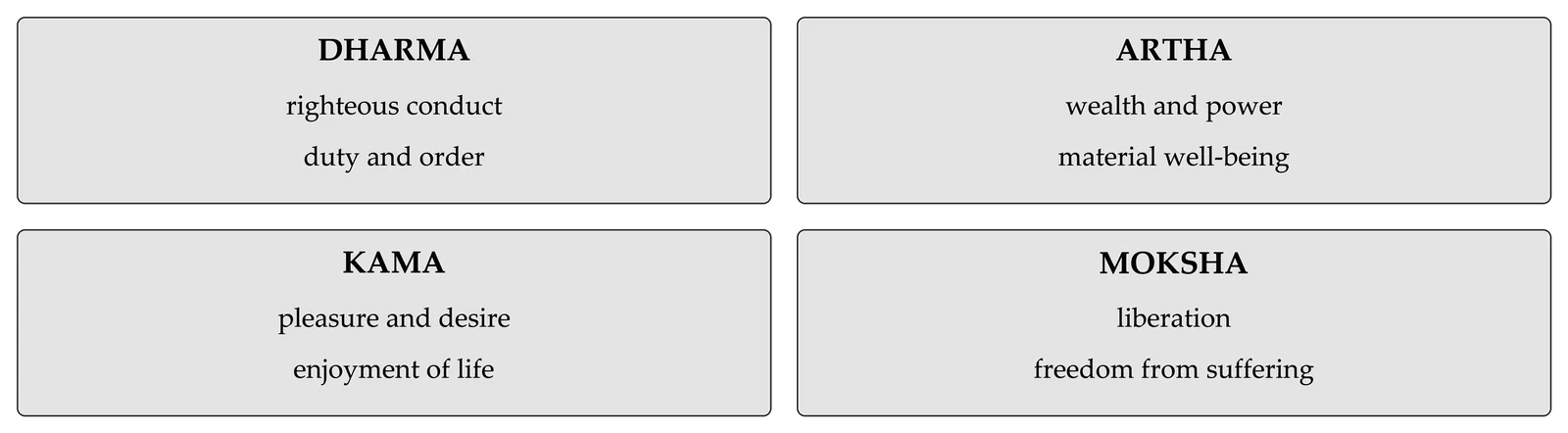
Indian thought recognises four goals of human life, the purusharthas: dharma (righteous conduct), artha (wealth and power), kama (pleasure and desire) and moksha (liberation). Well-being means pursuing all of them in proper balance and order.
4. Dharma as the Framework
Dharma regulates the pursuit of artha and kama. Wealth and pleasure are legitimate when pursued according to dharma, but harmful when they become ends in themselves. This hierarchy prevents greed and desire from destroying social order.
5. The Stages of Life
The ashrama system divided life into four stages: student, householder, forest-dweller and renouncer. Each stage had its own duties, so that a person could fulfil social responsibilities before turning to spiritual liberation.
6. Nishkama Karma
The Bhagavad Gita teaches nishkama karma, action without attachment to its fruits. One should do one’s duty for its own sake, without selfish desire. This reconciles active life in the world with the pursuit of liberation.
7. Yoga as Discipline
Patanjali defines yoga as the restraint of the modifications of the mind. A calm and disciplined mind is the basis of both inner peace and right conduct. Yoga thus links individual well-being with ethical life.
8. The Eight Limbs
Yoga’s eight limbs are yama (restraints), niyama (observances), asana (posture), pranayama (breath control), pratyahara (withdrawal of the senses), dharana (concentration), dhyana (meditation) and samadhi (absorption). The path begins with ethics and ends in liberation.
9. Yama and Niyama
The five yamas are non-violence, truthfulness, non-stealing, self-restraint and non-possessiveness. The niyamas include purity, contentment, austerity, self-study and devotion to Ishvara. Together they form a universal ethical foundation.
10. The Afflictions
Yoga identifies five afflictions, kleshas, that cause suffering: ignorance, egoism, attachment, aversion and clinging to life. Well-being requires overcoming them through discipline and knowledge.
11. Buddhist Ethics
Buddhism teaches that suffering arises from craving and can be ended through the Noble Eightfold Path of right view, intention, speech, action, livelihood, effort, mindfulness and concentration, a middle way between indulgence and extreme austerity.
12. Is Indian Ethics Otherworldly
Some Western critics argued that Indian ethics, focused on liberation, neglected social welfare. Defenders reply that dharma, ahimsa, compassion and lok-kalyan are deeply social values, and that thinkers from Ashoka to Gandhi applied them to public life.
13. Ethics and Politics
Gandhi drew on these traditions, especially ahimsa, truth and non-possessiveness, to create a politics based on ethics. For him, means and ends were inseparable, and personal discipline was the foundation of political freedom.
14. Modern Ideas of Well-being
Modern ideas such as Amartya Sen’s capability approach, which sees development as expanding people’s real freedoms, and the Human Development Index, introduced in 1990, share with Indian thought a view of well-being broader than income.
15. Evaluation
Indian philosophy integrates ethics, values and well-being into a single vision, from the purusharthas to Yoga. As Goodwin shows, its ethics is oriented to liberation but has strong social dimensions.
Conclusion. Thus, Indian philosophy links ethics and well-being through the purusharthas, the stages of life, nishkama karma and the disciplines of Yoga. As William Goodwin shows, its ethics is oriented to liberation as the highest value, yet values such as dharma, ahimsa and lok-kalyan give it a strong social and political meaning.
Short Notes
(a) Gunas
The three strands or qualities of prakriti in Samkhya: sattva (light and balance), rajas (activity and passion) and tamas (inertia and ignorance). Everything, including human character, is a mixture of the three, and well-being lies in cultivating sattva.
(b) Ashtanga Yoga
The eight-limbed path of Patanjali’s Yoga Sutras: yama, niyama, asana, pranayama, pratyahara, dharana, dhyana and samadhi. It leads from ethical discipline and bodily control to meditation and liberation.
(c) Sarvodaya
The welfare of all, a term Gandhi used for his 1908 translation of Ruskin’s Unto This Last. It holds that the good of the individual lies in the good of all, and that society must be judged by the welfare of its weakest members.
(d) Satkaryavada
The Samkhya theory that an effect already exists in its material cause before it is produced, as oil exists in sesame seeds or a pot in clay. It explains how the whole world can evolve out of prakriti, in which it lay unmanifest.
More notes: DSE-6 The Idea of the Political: Perspectives from the Indian Intellectual Tradition
These notes are prepared by PADHO TO AISE for study help. They are not an official University of Delhi publication.