
Semester VII DSE-6 The Idea of the Political: Perspectives from the Indian Intellectual Tradition
Unit III · 21 min read · Updated 24 Nov 2026
As per the University of Delhi (DU) BA (Hons) Political Science syllabus
Contents
- 3.1 Ganrajya: The Ancient Republics
- 3.2 Types of States in Ancient India
- 3.3 Swarajya: The Idea of Self-Rule
- 3.4 Important Questions
- Discuss the nature and working of the republics (ganrajya) of ancient India.
- Discuss the different types of states and the theory of the state in ancient India.
- Discuss the idea of swarajya in the Indian intellectual tradition.
- Examine the relationship between swaraj, democracy and the subaltern in contemporary India.
- Short Notes
स्वराज्य मेरा जन्मसिद्ध अधिकार है और मैं इसे लेकर रहूँगा।
Swaraj is my birthright and I shall have it.
— Bal Gangadhar Tilak, Slogan of the Home Rule movement (1916)
ANCIENT India is often imagined as a land of kings. Yet in the age of the Buddha, some of the most powerful states of north India, such as the Licchavis of Vaishali and the Shakyas of Kapilavastu, were ganas or sanghas, republics governed by assemblies. Indian thought also developed the idea of swarajya, self-rule, which moved from the self-mastery of the Upanishads to Shivaji’s kingdom, Gandhi’s Hind Swaraj and the demand for complete independence. This unit studies ganrajya and swarajya, drawing on A.S. Altekar, D.R. Bhandarkar, P.H. Prabhu and B.N. Prasad.
3.1 Ganrajya: The Ancient Republics
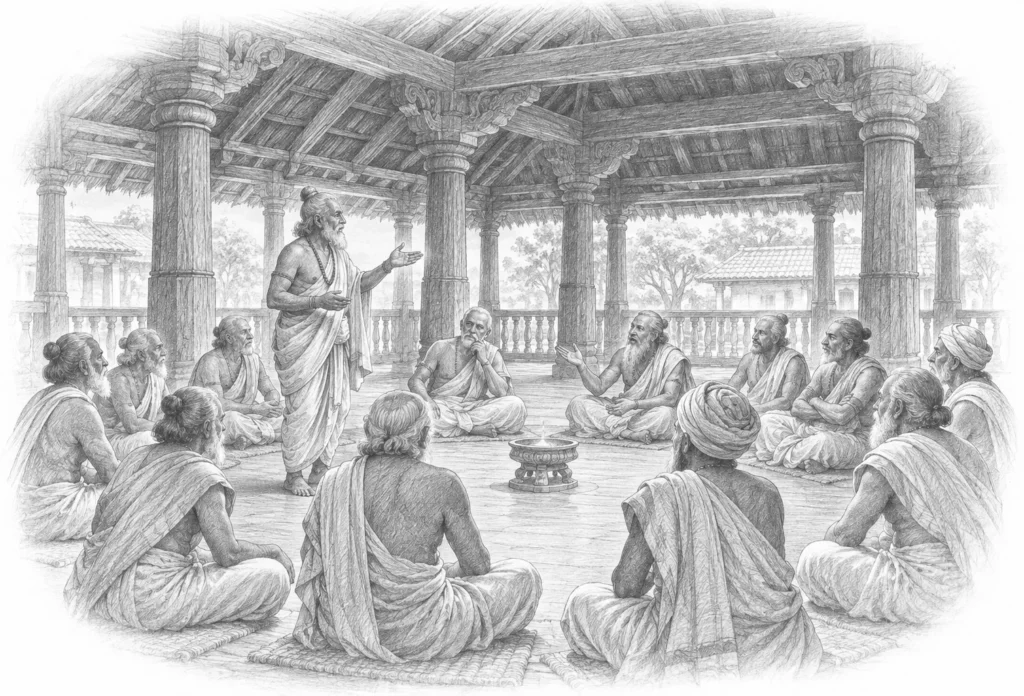
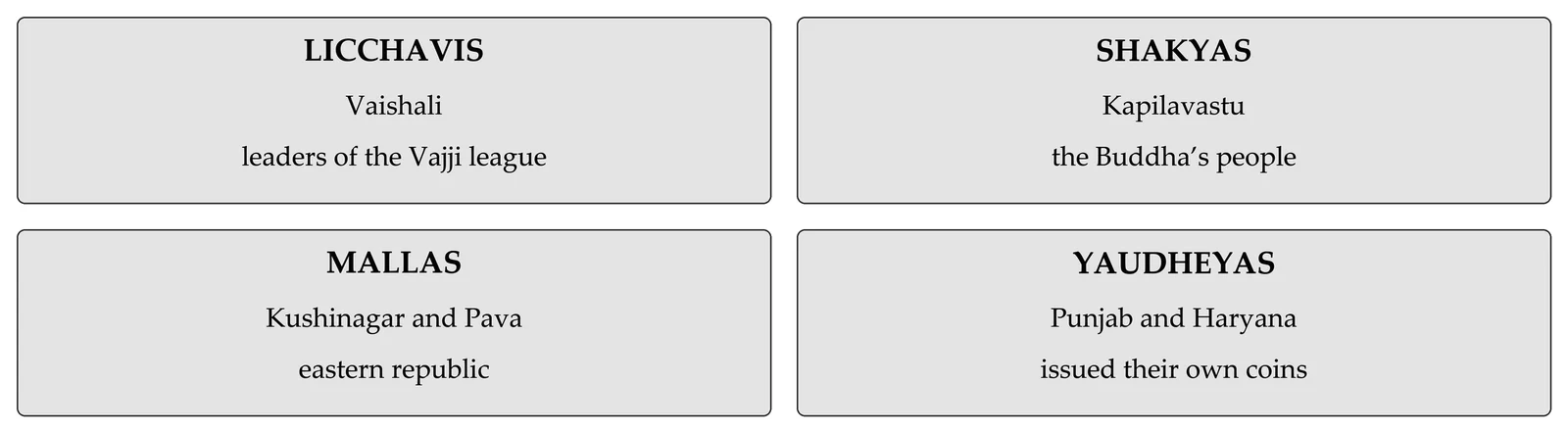
A gana or sangha was a state ruled not by a single king but by an assembly of the heads of leading families. The Licchavis, Shakyas and Mallas were such republics. Their assemblies met in a hall called the santhagara, discussed matters, and decided by consensus or by voting with wooden tokens. The Buddha praised the Vajjis for holding frequent assemblies and acting in harmony. A.S. Altekar shows that these were aristocratic republics, since power belonged to a ruling clan rather than to all inhabitants, but they show that collective, deliberative government had deep roots in India.

3.2 Types of States in Ancient India
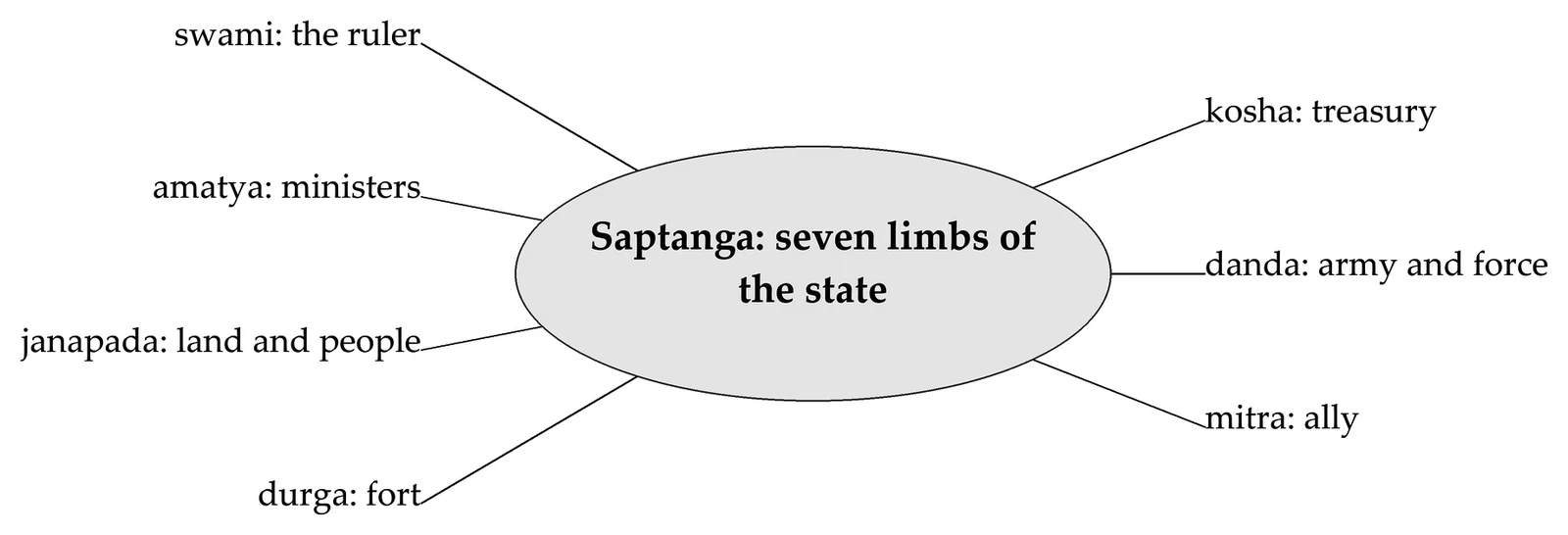
Ancient Indian texts recognised many forms of rule. The Aitareya Brahmana names samrajya, bhaujya, svarajya, vairajya and rajya, which D.R. Bhandarkar interpreted as different types of states, including kingless ones. Kautilya’s saptanga theory described the state as having seven limbs: ruler, ministers, territory and people, fort, treasury, army and ally. Altekar discusses the theories of the state’s origin, including the idea that the first king was elected by the people.
3.3 Swarajya: The Idea of Self-Rule
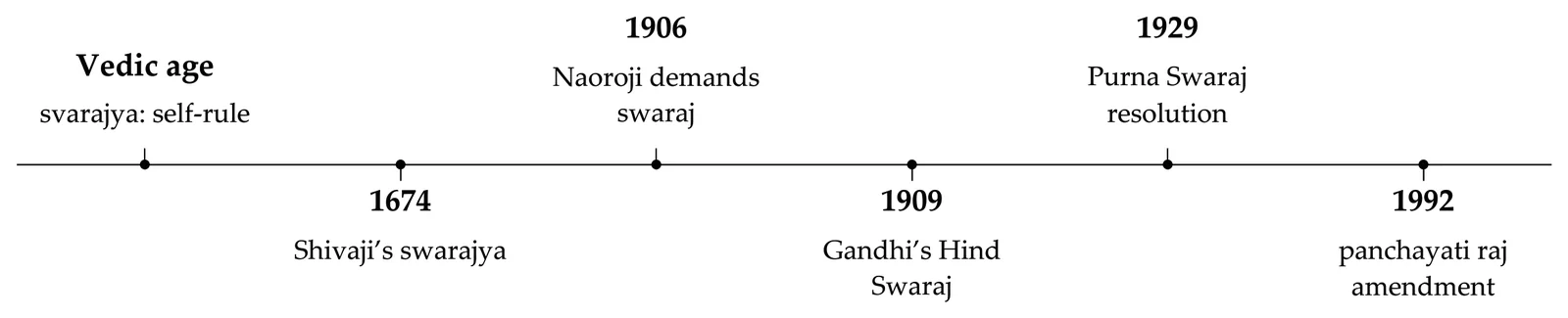
Swarajya means self-rule. In the Upanishads it meant self-mastery; in the seventeenth century, Shivaji’s swarajya meant a kingdom of the people’s own; and in the national movement it meant freedom from colonial rule. Dadabhai Naoroji demanded swaraj in 1906, and Gandhi’s Hind Swaraj (1909) argued that real swaraj means ruling ourselves. After Independence, gram swaraj inspired panchayati raj. B.N. Prasad asks whether swaraj has reached the subaltern classes of agrarian India.

3.4 Important Questions
- Question 1 Discuss the nature and working of the republics (ganrajya) of ancient India.
- Question 2 Discuss the different types of states and the theory of the state in ancient India.
- Question 3 Discuss the idea of swarajya in the Indian intellectual tradition.
- Question 4 Examine the relationship between swaraj, democracy and the subaltern in contemporary India.
DU asks the same idea in different words. So learn one broad answer for each question below; the same answer works for every question joined by OR.
Important Question 1
Discuss the nature and working of the republics (ganrajya) of ancient India.
OR
Examine A.S. Altekar’s account of ancient Indian republics.
OR
Were the ancient Indian republics democracies? Discuss.
Model Answer
“So long, Ananda, as the Vajjians hold these full and frequent public assemblies, so long may they be expected not to decline, but to prosper.”
— Mahaparinibbana Sutta (trans. T.W. Rhys Davids)
Introduction. Alongside the kingdoms of ancient India, there were states called ganas or sanghas, governed by assemblies rather than by hereditary kings. Buddhist, Jain and Sanskrit sources, as well as Greek accounts and coins, describe them. Scholars such as K.P. Jayaswal and A.S. Altekar studied these republics, debating whether they were democracies or aristocracies. They form an important part of the Indian idea of the political.
1. Meaning of Gana and Sangha
The words gana and sangha mean a group or collective. As political terms, they referred to states governed by a collective body of rulers. Panini’s grammar, composed around the fifth or fourth century BCE, already refers to sanghas, including some that lived by the profession of arms.
2. Republics of the Buddha’s Time
In the sixth and fifth centuries BCE, republics flourished in the foothills of the Himalayas and the plains of north Bihar and eastern Uttar Pradesh. They included the Shakyas of Kapilavastu, to whom the Buddha belonged, the Koliyas, the Mallas of Kushinagar and Pava, and the Vajji confederacy led by the Licchavis of Vaishali.
3. The Licchavis
The Licchavis were the leading members of the Vajji confederacy. Buddhist texts say that Vaishali had 7,707 rajas, meaning heads of leading families who formed the ruling assembly. They elected officers to manage affairs, and they were famous for their prosperity and unity.
4. The Assembly
The central institution was the assembly, which met in a hall called the santhagara. It discussed war and peace, alliances, justice and public works. Members were the heads of the ruling clan’s families, who were often called rajas.
5. Procedure
Buddhist monastic rules, which were probably modelled on republican practice, describe a formal procedure: a quorum, a motion placed before the assembly and repeated, discussion and, if needed, voting with wooden tokens called salaka, collected by an officer. Decisions were made by consensus or by majority.
6. The Buddha’s Seven Conditions
In the Mahaparinibbana Sutta, the Buddha said the Vajjis would prosper as long as they met frequently in assembly, met and acted in harmony, followed their established laws, respected their elders, protected women, honoured their shrines and protected holy men. These are among the earliest statements of the conditions of good republican government.
7. Kautilya on Sanghas
Kautilya distinguished sanghas whose members lived by agriculture, trade and arms from those whose members bore the title raja, such as the Licchavis, Vrijis and Mallas. He considered united sanghas invincible and advised kings to weaken them by sowing dissension among their members.
8. Altekar: Aristocratic Republics
A.S. Altekar argues that these states were republics because sovereignty lay with an assembly rather than a king, but they were not democracies in the modern sense. Power belonged to the members of a ruling Kshatriya clan, while artisans, labourers and slaves had no share in government. They were aristocratic or oligarchic republics.
9. Jayaswal’s Interpretation
K.P. Jayaswal, in Hindu Polity (1924), presented the ancient republics as evidence that India had democratic traditions comparable to those of Greece. Writing during the national movement, he used them to refute the colonial claim that Indians were fit only for despotic rule.
10. Later Republics
Greek historians of Alexander’s invasion described republican peoples in the Punjab. Later, republics such as the Yaudheyas, Malavas and Arjunayanas issued their own coins. Samudragupta’s Allahabad inscription in the fourth century CE lists them among peoples who paid tribute to him.
11. Decline of the Republics
The republics declined as large monarchies expanded. Magadha under Ajatashatru defeated the Vajjis, reportedly after his minister sowed discord among them. The Mauryas and later the Guptas absorbed the remaining republics, ending this form of government.
12. Strengths
The republics showed that government could rest on collective deliberation, rules of procedure and the consent of a body of citizens. Their emphasis on assembly, harmony and law offers an Indian source for ideas of deliberative government.
13. Limitations
Membership was narrow, based on birth in the ruling clan. Women, lower castes and the poor were excluded. The republics were also vulnerable to internal division and to conquest by more centralised monarchies.
14. Relevance
The memory of the ganas has been invoked in modern India as evidence of indigenous republican traditions. India’s Republic Day and the idea of a ganarajya draw symbolic strength from this heritage.
15. Evaluation
The ancient republics were real states governed by assemblies, but they were aristocratic rather than democratic. Their practices of deliberation and voting remain significant for the Indian idea of the republic.
Conclusion. Thus, the ganas and sanghas of ancient India, such as the Licchavis and Shakyas, were governed by assemblies that deliberated and voted according to rules. As Altekar shows, they were aristocratic republics rather than democracies, but they reveal a deep Indian tradition of collective, deliberative government.
Important Question 2
Discuss the different types of states and the theory of the state in ancient India.
OR
Examine D.R. Bhandarkar’s classification of ancient Indian states.
OR
Discuss the origin, nature and aims of the state in ancient Indian thought.
Model Answer
“The king, the minister, the country, the fort, the treasury, the army and the friend, and the enemy are the elements of sovereignty.”
— Kautilya, Arthashastra 6.1 (trans. R. Shamasastry)
Introduction. Ancient Indian political thought reflected on the origin of the state, its elements, its aims and its different forms. Vedic texts named several types of rule, the epics and Buddhist texts offered theories of the state’s origin, and Kautilya described the state as an organism with seven limbs. Scholars such as A.S. Altekar and D.R. Bhandarkar have interpreted these ideas.
1. The Problem of Anarchy
Indian texts often imagine a time before the state as one of matsya nyaya, the law of the fish, in which the big fish eat the small. The state arises to end this disorder by protecting the weak and enforcing law through danda, punishment.
2. Divine Origin
Some texts present the king as created by the gods. The Manusmriti says the Creator made the king from particles of the gods to protect the world. Yet even these texts insist that the king must rule according to dharma.
3. Contract and Election
The Shanti Parva of the Mahabharata describes people agreeing to accept a king to escape anarchy. The Buddhist Aggañña Sutta describes the first ruler, Mahasammata, the great elect, chosen by the people to punish wrongdoers in return for a share of the harvest. Altekar sees these as theories of contract.
4. Altekar on the State
A.S. Altekar argues that the ancient Indian state was not a theocracy. Its aims were protection, the promotion of dharma, artha and kama, and the welfare of the people. Kings were bound by dharma, custom and the advice of ministers, though there were few formal checks on their power.
5. The Saptanga Theory
Kautilya described the state as having seven elements: the ruler, ministers, territory and people, fort, treasury, army and ally. Like the limbs of a body, each element supports the others, and the strength of the state depends on all of them.
6. Types of Rule in the Vedic Texts
The Aitareya Brahmana mentions different forms of rule in different regions: samrajya in the east, bhaujya in the south, svarajya in the west, vairajya in the north and rajya in the middle country. Scholars have debated what each form meant.
7. Bhandarkar’s Classification
D.R. Bhandarkar, in lectures delivered in 1925, interpreted these terms as different types of states. Rajya was ordinary monarchy and samrajya an imperial state, while vairajya meant a kingless state and svarajya a form of self-rule. He argued that ancient India knew both monarchical and non-monarchical states.
8. Monarchies and Republics
Ancient India had both kingdoms, such as Magadha and Kosala, and republics, such as the Vajji confederacy. Over time, monarchy became dominant, but republican traditions survived in some regions until the Gupta period.
9. Rajadharma
The duties of the king, rajadharma, included protecting the people, punishing the wicked, collecting fair taxes and promoting welfare. The Mahabharata’s Shanti Parva and the Arthashastra describe these duties in detail.
10. Limits on Royal Power
The king was expected to follow dharma, respect the customs of castes, guilds and villages, consult ministers and avoid vices. A king who oppressed the people could, according to some texts, be resisted or removed.
11. Prabhu on Hindu Social Organisation
P.H. Prabhu explains how Hindu social organisation placed the individual within the framework of dharma, the stages of life and the goals of human life. The state was part of this wider order, responsible for maintaining it rather than creating it.
12. Local Self-Government
Alongside central rule, villages, guilds and assemblies governed many local matters. Inscriptions from the Chola period, such as those at Uttaramerur, describe village assemblies with elected committees.
13. Comparison with Western Thought
Like Hobbes, Indian texts justify the state as an escape from anarchy, and like Aristotle, they classify forms of rule. But Indian theories emphasise dharma, duty and the welfare of the people rather than individual rights.
14. Critique
Ancient theories of the state accepted social hierarchy and the varna order. Their ideals of welfare coexisted with inequality, which modern readers must recognise when drawing on them.
15. Evaluation
Ancient Indian thought developed rich theories of the state’s origin, elements, aims and forms. As Altekar and Bhandarkar show, it knew both monarchies and republics and bound rulers by dharma.
Conclusion. Thus, ancient Indian thought explained the state as a remedy for anarchy, created by divine will or by agreement, and described it through Kautilya’s seven limbs. Vedic texts named several forms of rule, which Bhandarkar interpreted as including kingless states, showing that the Indian tradition knew a variety of political forms.
Important Question 3
Discuss the idea of swarajya in the Indian intellectual tradition.
OR
Trace the evolution of the idea of swaraj from ancient times to the national movement.
OR
Examine Gandhi’s idea of swaraj.
Model Answer
“It is Swaraj when we learn to rule ourselves.”
— M.K. Gandhi, Hind Swaraj (1909)
Introduction. Swarajya, or swaraj, means self-rule. The idea has a long history in India, from the spiritual self-mastery of the Upanishads and the political self-rule of Vedic texts to Shivaji’s kingdom, the demand for national freedom and Gandhi’s vision of self-governing individuals and villages. Its many meanings show how Indian thought connected personal freedom with political freedom.
1. Swaraj as Self-Mastery
In the Upanishads, svaraj means mastery over oneself. The Chandogya Upanishad says that one who realises the self becomes self-ruled, sovereign over all worlds. Freedom here begins with control over desires and the knowledge of one’s true self.
2. Swaraj as a Form of State
The Aitareya Brahmana mentions svarajya as a form of rule practised in the western regions. D.R. Bhandarkar interpreted it as a kind of self-rule in which the ruler was one among equals. The idea thus had both spiritual and political meanings.
3. Shivaji’s Swarajya
In the seventeenth century, Shivaji built a Maratha kingdom, crowned in 1674, which he and his followers called swarajya, a kingdom of their own free from Mughal and Deccan sultanate rule. It became a powerful symbol for later nationalists.
4. Swaraj in the National Movement
Dadabhai Naoroji, presiding over the Congress in 1906, declared swaraj, self-government like that of the British colonies, to be the goal. Bal Gangadhar Tilak’s slogan, ‘Swaraj is my birthright and I shall have it’, made it a mass demand during the Home Rule movement.
5. Gandhi’s Hind Swaraj
In Hind Swaraj (1909), Gandhi argued that swaraj does not mean merely replacing British rulers with Indian ones while keeping the same modern civilisation. Real swaraj means ruling ourselves: mastering our desires, living simply and acting with truth and non-violence.
6. Critique of Modern Civilisation
Gandhi criticised modern civilisation for its machinery, railways, lawyers and doctors, which he believed made people dependent and greedy. Swaraj required freeing India from this civilisation, not just from British rule.
7. Swaraj and Swadeshi
Gandhi linked swaraj to swadeshi, reliance on one’s own community and its products, symbolised by the spinning wheel. Economic self-reliance was the basis of political freedom.
8. Gram Swaraj
Gandhi imagined India as a federation of self-governing villages, each meeting its own needs and governed by a panchayat. Power would flow from below, in what he described as an oceanic circle of villages rather than a pyramid.
9. Purna Swaraj
At its Lahore session in December 1929, the Congress adopted Purna Swaraj, complete independence, as its goal, and 26 January 1930 was celebrated as Independence Day. This date was later chosen for the Constitution’s commencement in 1950.
10. Other Voices
Ambedkar argued that political swaraj without social democracy would leave Dalits under the rule of the upper castes. For him, swaraj had to mean the end of caste oppression. Tagore warned against narrow nationalism and stressed the freedom of the mind.
11. Swaraj after Independence
The Constitution’s directive principle on village panchayats and the 73rd Amendment of 1992 gave constitutional status to panchayati raj. The Panchayats (Extension to Scheduled Areas) Act of 1996 gave gram sabhas in tribal areas powers over local resources.
12. Swaraj as Moral Freedom
The Indian idea of swaraj links political freedom with moral discipline. A people cannot be free if individuals are slaves to greed, fear and hatred. This makes swaraj both a personal and a collective project.
13. Critique
Critics argue that Gandhi’s rejection of modern civilisation was impractical and that idealised village self-rule ignores caste oppression. Nehru preferred a modern, industrial and democratic state.
14. Relevance Today
Swaraj remains a powerful idea for decentralisation, self-reliance, ecological living and citizens’ participation, inspiring movements for local democracy and the control of communities over their resources.
15. Swaraj and Extremist Nationalism
During the Swadeshi movement against the partition of Bengal, the Calcutta session of the Congress in 1906 adopted resolutions on swaraj, swadeshi, boycott and national education. Leaders such as Tilak, Bipin Chandra Pal, Lala Lajpat Rai and Aurobindo Ghosh argued that swaraj could not be begged for but had to be won through self-reliance, passive resistance and the awakening of national pride.
16. Evaluation
Swaraj is one of the richest ideas in Indian political thought, joining self-mastery, self-government and national freedom. Gandhi gave it its deepest moral meaning.
Conclusion. Thus, swarajya evolved from Upanishadic self-mastery and a Vedic form of rule to Shivaji’s kingdom, the national demand for self-government and Purna Swaraj. Gandhi, in Hind Swaraj, gave it its deepest meaning: swaraj is when we learn to rule ourselves, through moral discipline, self-reliance and village self-government.
Important Question 4
Examine the relationship between swaraj, democracy and the subaltern in contemporary India.
OR
Discuss B.N. Prasad’s argument about swaraj and the regional dynamics of agrarian India.
OR
How far has the promise of swaraj been realised for the subaltern classes?
Model Answer
“I shall work for an India in which the poorest shall feel that it is their country in whose making they have an effective voice.”
— M.K. Gandhi, Young India (10 September 1931)
Introduction. For Gandhi, swaraj would be real only when the poorest Indians felt that the country belonged to them. More than seven decades after Independence, scholars ask whether swaraj has reached the subaltern classes: landless labourers, small peasants, Dalits, Adivasis and women in agrarian India. B.N. Prasad, in a volume edited by K.B. Saxena titled Swaraj and the Reluctant State (2021), examines this question.
1. Who Are the Subalterns
The term subaltern, taken from the Italian thinker Antonio Gramsci and used by the Subaltern Studies historians, refers to groups subordinated by class, caste, gender or ethnicity. In agrarian India, they include landless labourers, tenants, small peasants, Dalits and Adivasis.
2. Swaraj as Promise
The freedom movement promised that swaraj would bring land to the tiller, an end to untouchability and a voice for the poor. The Constitution translated these promises into fundamental rights and directive principles.
3. The Reluctant State
The volume Swaraj and the Reluctant State argues that the Indian state has been reluctant to fulfil these promises. It passed laws on land reform, forest rights and decentralisation, but often failed to implement them, because powerful classes resisted and the bureaucracy was unwilling to share power.
4. Prasad: Regional Dynamics
B.N. Prasad shows that the realisation of swaraj for subalterns varies across the regions of agrarian India. Where land reforms and social movements were strong, as in Kerala and West Bengal, subalterns gained more land and voice; where landed castes remained dominant, democracy from below remained weak.
5. Land and Swaraj
Land is central to swaraj for the rural poor, because ownership of land gives security and freedom from dependence on landlords. The limited success of land reforms left many Dalits and landless labourers dependent, limiting their real freedom.
6. Democracy and the Subaltern
Democracy has given subaltern groups the vote, and their participation has increased since the 1990s, a process Yogendra Yadav called a second democratic upsurge. Parties based on backward castes and Dalits have gained power in several states.
7. Panchayati Raj
The 73rd Amendment reserved seats for Scheduled Castes, Scheduled Tribes and women in panchayats, bringing lakhs of subalterns into local government. But dominant castes often control panchayats, and many elected women and Dalits face pressure from local elites.
8. PESA and Forest Rights
The PESA Act of 1996 and the Forest Rights Act of 2006 promised self-rule to Adivasi gram sabhas over land and forests. Implementation has been weak, and many forest rights claims have been rejected, showing the state’s reluctance.
9. Movements from Below
Subaltern groups have pursued swaraj through movements: peasant struggles, Dalit movements, Adivasi movements against displacement and campaigns for the right to information, food and work. These movements expand democracy beyond elections.
10. Agrarian Crisis
The agrarian crisis since the 1990s, marked by debt, low prices and farmers’ suicides, has weakened the economic basis of swaraj for small peasants and labourers, pushing many to migrate to cities.
11. Gandhi and Ambedkar
Gandhi’s idea of swaraj for the poorest and Ambedkar’s demand for social democracy both point to the same test: freedom must be measured by the condition of the most marginalised. Political independence alone is not enough.
12. Swaraj as Unfinished
Many scholars describe swaraj as an unfinished project. The formal structures of democracy exist, but real self-rule requires land, livelihood, dignity and the power to shape decisions at every level.
13. Ways Forward
Strengthening gram sabhas, implementing land and forest rights, ensuring social justice in local institutions and supporting cooperatives and producer organisations can bring swaraj closer to the subaltern classes.
14. Critique
Some argue that the state has achieved significant progress through welfare programmes, reservations and rural development. Others argue that welfare without power keeps subalterns dependent rather than self-ruling.
15. Evaluation
Swaraj for the subaltern remains incomplete. As Prasad shows, its realisation depends on regional agrarian structures, social movements and the willingness of the state to share power.
Conclusion. Thus, the promise of swaraj, that the poorest would have an effective voice in their country, remains partly unfulfilled for the subaltern classes of agrarian India. As B.N. Prasad and Swaraj and the Reluctant State show, land reforms, decentralisation and social movements have advanced it unevenly across regions, while a reluctant state has slowed its realisation.
Short Notes
(a) Santhagara
The assembly hall of the ancient republics, such as that of the Shakyas at Kapilavastu, where the heads of ruling families met to deliberate on public affairs and make decisions by consensus or voting.
(b) Saptanga
Kautilya’s theory of the seven limbs of the state: ruler, ministers, territory and people, fort, treasury, army and ally. Each limb supports the others, and the health of the state depends on all of them.
(c) Purna Swaraj
Complete independence, adopted as the goal of the Indian National Congress at its Lahore session in December 1929. Independence Day was celebrated on 26 January 1930, the date later chosen for the commencement of the Constitution.
More notes: DSE-6 The Idea of the Political: Perspectives from the Indian Intellectual Tradition
These notes are prepared by PADHO TO AISE for study help. They are not an official University of Delhi publication.