
Semester VII DSE-6 The Idea of the Political: Perspectives from the Indian Intellectual Tradition
Unit II · 21 min read · Updated 24 Nov 2026
As per the University of Delhi (DU) BA (Hons) Political Science syllabus
Contents
- 2.1 Shrenis: Guilds and Corporate Life
- 2.2 Samaj: Society and the Collective
- 2.3 Individual and Collective Identities
- 2.4 Important Questions
- Discuss the role of shrenis (guilds) in the economic and political life of ancient India.
- Discuss the idea of samaj in the Indian intellectual tradition.
- Examine the debate between individualism and collectivism with reference to the Indian self.
- Discuss Amartya Sen’s idea of the argumentative Indian and its significance for collective life.
- Short Notes
संगच्छध्वं संवदध्वं सं वो मनांसि जानताम्।
Walk together, speak together, let your minds be of one accord.
— Rig Veda, 10.191.2
HUMAN beings live in groups: families, villages, occupations, communities and states. Modern Western political thought often begins with the individual and the state, leaving the groups in between in the background. The Indian tradition, by contrast, gave great importance to collectives: the shrenis, or guilds, which governed their own members and were recognised by kings, and the wider samaj, or society, held together by custom and dharma. This unit examines these ideas and the debate on whether the Indian self is individualist or collectivist, drawing on Pradeep Chakkarath, Cigdem Kagitçibasi, Harry Triandis, Michael Mascolo and Sunil Bhatia, and Amartya Sen.

2.1 Shrenis: Guilds and Corporate Life
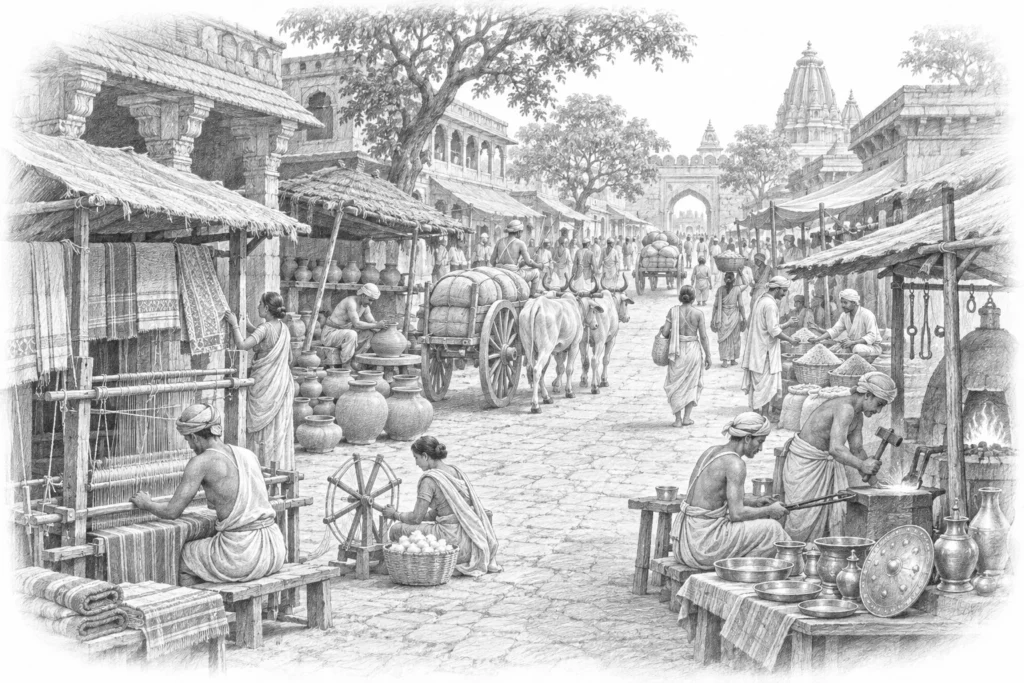
A shreni was a guild, an association of people following the same craft or trade, such as weavers, potters, ivory carvers, metalworkers or merchants. Guilds had a headman and executive officers, made rules for their members, fixed standards and prices, settled disputes and trained apprentices. They also acted as banks, accepting deposits and paying interest, and gave donations to temples and monasteries. Kings were expected to respect their customs, called shreni-dharma. The historian R.C. Majumdar described this as the corporate life of ancient India, a world of self-governing bodies between the family and the state.
2.2 Samaj: Society and the Collective
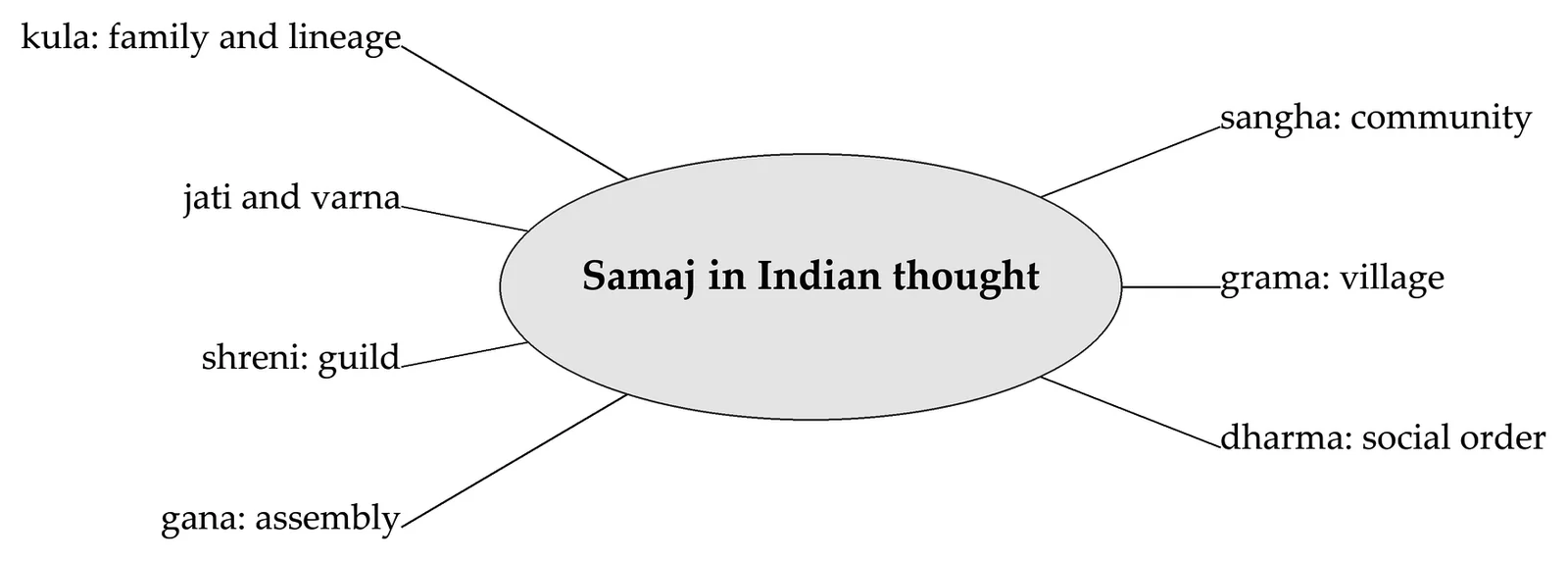
Samaj means society, the wider collective of families, castes, villages, guilds and religious communities. In Indian thought, society was largely self-regulating through dharma and customary law, while the king’s role was to protect this order. Rabindranath Tagore argued in his essay Swadeshi Samaj (1904) that India’s strength lay in its society rather than its state. Others celebrated the village community, while Ambedkar criticised it as a home of caste oppression and chose the individual as the unit of the Constitution.
2.3 Individual and Collective Identities
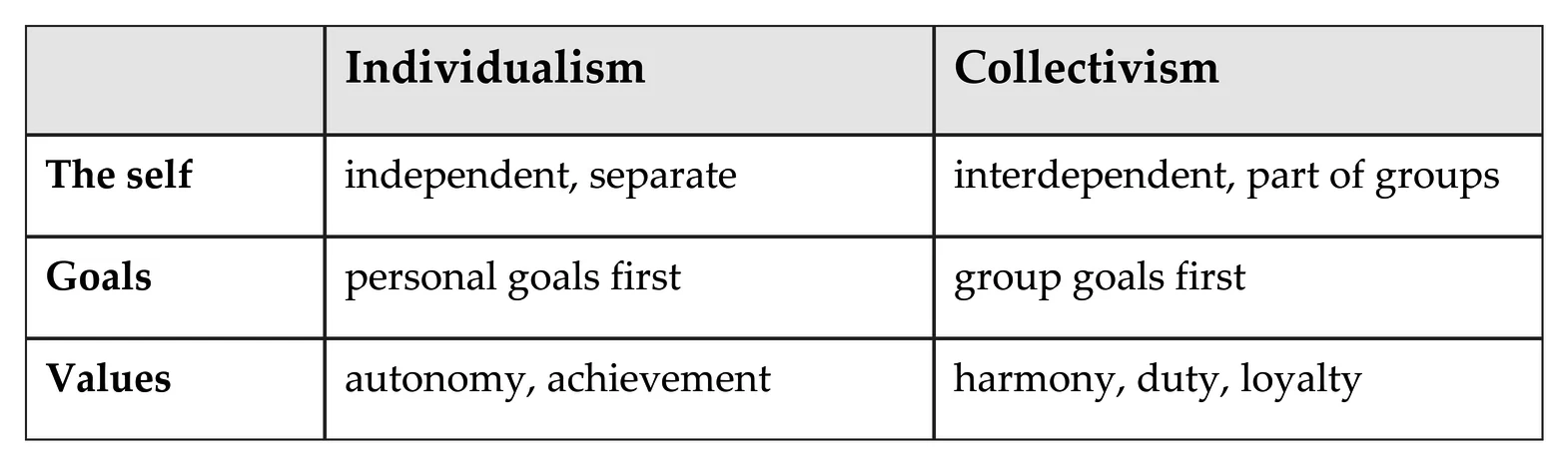
Psychologists distinguish individualist cultures, in which people see themselves as independent and give priority to personal goals, from collectivist cultures, in which people see themselves as part of groups and give priority to group goals. Harry Triandis developed this distinction, and India is often classed as collectivist. But Pradeep Chakkarath shows that the Indian self combines strong social embeddedness with an individual spiritual quest, Cigdem Kagitçibasi describes an autonomous-related self, and Mascolo and Bhatia argue that selves are constructed dynamically through relationships. Amartya Sen stresses India’s argumentative tradition and the plurality of identities.
2.4 Important Questions
- Question 1 Discuss the role of shrenis (guilds) in the economic and political life of ancient India.
- Question 2 Discuss the idea of samaj in the Indian intellectual tradition.
- Question 3 Examine the debate between individualism and collectivism with reference to the Indian self.
- Question 4 Discuss Amartya Sen’s idea of the argumentative Indian and its significance for collective life.
DU asks the same idea in different words. So learn one broad answer for each question below; the same answer works for every question joined by OR.
Important Question 1
Discuss the role of shrenis (guilds) in the economic and political life of ancient India.
OR
Examine shrenis as forms of collective organisation in ancient India.
OR
How did guilds reflect the idea of the collective in the Indian tradition?
Model Answer
“A king who knows the sacred law must inquire into the laws of castes, of districts, of guilds and of families, and thus settle the peculiar law of each.”
— Manusmriti 8.41 (trans. G. Bühler)
Introduction. Shrenis were guilds of artisans and merchants that played a central role in ancient Indian economic and social life. They were self-governing collective bodies with their own rules, leaders and assets, recognised and protected by kings. Studying them shows that ancient Indian political life was not simply a relationship between a ruler and individual subjects, but included powerful intermediate collectives.
1. Meaning of Shreni
A shreni was an association of people practising the same craft or trade. Ancient texts and inscriptions mention guilds of weavers, potters, oil-pressers, carpenters, goldsmiths, ivory carvers, bamboo workers and merchants. Membership was often hereditary, linking guilds closely with occupational castes.
2. Origins and Growth
Guilds grew with the expansion of crafts, trade and cities from about the sixth century BCE. The Jataka stories refer to eighteen guilds, and Buddhist and Jain texts describe the leaders of guilds as wealthy and influential figures in towns such as Rajagriha, Shravasti and Varanasi.
3. Organisation
Each guild had a headman, called jyeshthaka or shreshthin, assisted by executive officers. The guild assembly made rules for members, regulated working hours, quality and prices, admitted apprentices and punished those who broke its rules.
4. Economic Functions
Guilds organised production and trade, maintained standards and protected members from unfair competition. They also acted as banks. A Nasik cave inscription of the early second century CE records that money was deposited with weavers’ guilds, which paid regular interest to fund the needs of monks.
5. Social and Religious Functions
Guilds supported their members in hardship and made gifts to religious institutions. An inscription at Sanchi records that ivory workers of Vidisha carved part of a gateway, and the Mandasor inscription of the fifth century CE records a sun temple built by a guild of silk weavers who had migrated from Gujarat.
6. Legal Recognition
The Dharmashastras of Manu, Yajnavalkya and Narada asked kings to respect the customs and rules of guilds, called shreni-dharma, and to enforce agreements among their members. Guilds thus had a recognised sphere of self-government within the kingdom.
7. Guilds and the State
Kautilya’s Arthashastra treats guilds as important but potentially dangerous centres of power. It mentions shreni-bala, troops supplied by guilds, and advises the king to keep guilds under watch and to tax them. The relationship between guild and state combined cooperation with control.
8. Seals and Corporations
Seals found at Vaishali from the Gupta period bear the names of corporations of bankers, traders and artisans acting together. They show that guilds formed larger associations with legal and administrative functions, a form of corporate life in towns.
9. Other Collectives
Besides shrenis, ancient texts mention ganas (republican assemblies), pugas (associations of people of different castes in a locality), naigamas (merchant corporations) and the Buddhist sangha. Together they formed a rich world of collective bodies between the family and the state.
10. Majumdar: Corporate Life
The historian R.C. Majumdar, in Corporate Life in Ancient India (1918), argued that these associations show a strong tradition of self-governing corporate bodies in India, comparable to the guilds of medieval Europe, which challenges the stereotype of an Oriental despotism with nothing between the ruler and the ruled.
11. The Idea of the Collective
Shrenis show that in the Indian tradition, people were members of collectives with their own laws and identities. The political order was a structure of groups, each with its dharma, rather than a mass of individuals facing the state directly.
12. Limits of Guild Life
Guilds were also hierarchical and tied to caste. Membership was often hereditary, and those outside the guild, including lower castes and women, had little voice. Self-government for the guild did not mean equality within it.
13. Decline
From the early medieval period, changes in trade, the growth of land grants and the hardening of caste weakened guilds. Many merged into caste groups, and their autonomous economic and legal role declined.
14. Relevance Today
Shrenis anticipate modern ideas of cooperatives, trade associations and pluralism. They suggest that a healthy political order needs strong intermediate associations through which people manage their own affairs.
15. Evaluation
Shrenis were powerful self-governing collectives that organised production, banking and charity, and were recognised by kings. They show the importance of the collective in Indian political life, though they reflected the hierarchies of their time.
Conclusion. Thus, shrenis were guilds of artisans and merchants with their own leaders, rules and assets, recognised by kings through shreni-dharma. They functioned as producers, banks and patrons, and formed part of a rich corporate life, as R.C. Majumdar showed, revealing the central place of the collective in the Indian tradition.
Important Question 2
Discuss the idea of samaj in the Indian intellectual tradition.
OR
‘In India, society rather than the state has been the centre of collective life.’ Discuss.
OR
Examine the relationship between samaj and the state in Indian thought.
Model Answer
“The village communities are little republics, having nearly everything they can want within themselves, and almost independent of any foreign relations.”
— Charles Metcalfe, Minute of 1830
Introduction. Samaj means society, the collective life of families, castes, villages, guilds and religious communities. In the Indian tradition, society was often seen as a self-regulating order governed by dharma and custom, with the state, or rajya, as its protector rather than its creator. This idea was celebrated by thinkers such as Tagore and Gandhi and criticised by Ambedkar.
1. Meaning of Samaj
Samaj refers to the wider social collective. It includes the kula or family, the jati, the village, the guild and the religious community. Each had its own customs and duties, and together they formed a complex social order in which individuals found their place.
2. Dharma as Social Order
In Indian thought, dharma means the duties appropriate to each person according to their stage of life and social position. Society was held together by these duties and by custom, so that much of social life was regulated without the direct intervention of the state.
3. The King as Protector
Classical texts describe the king’s duty as protecting the social order, punishing wrongdoers and upholding the dharma of different groups. The state did not make society but defended it, and kings were expected to respect the laws of castes, guilds and families.
4. Varna and Jati
The varna system divided society into four orders, while jatis were numerous hereditary occupational groups. Prabhu describes how Hindu social organisation placed individuals within these groups and within stages of life. This gave social order but also created deep hierarchy and exclusion.
5. The Village Community
Colonial officials such as Charles Metcalfe described Indian villages as little republics, nearly self-sufficient and surviving the rise and fall of dynasties. This image, though idealised, influenced later thinkers who saw the village as the basic unit of Indian collective life.
6. Tagore’s Swadeshi Samaj
In his essay Swadeshi Samaj (1904), Rabindranath Tagore argued that in Europe the state was the centre of collective life, but in India society was. Indians had traditionally provided schools, water and welfare through their own social institutions, and should rebuild this self-reliant society rather than depend on the colonial state.
7. Gandhi’s Vision
Gandhi, in Hind Swaraj (1909) and later writings, imagined India as a federation of self-governing villages in which people met their needs through their own effort and cooperation. Society, not the centralised state, would be the main site of collective life.
8. Ambedkar’s Critique
Ambedkar rejected the romantic image of the village. In the Constituent Assembly in 1948, he called the village a sink of localism and a den of ignorance, narrow-mindedness and communalism, and welcomed the Constitution’s choice of the individual as its unit, because village society oppressed Dalits.
9. Samaj and Reform
Many nineteenth-century reform movements took the form of samajs: the Brahmo Samaj (1828), the Prarthana Samaj (1867), the Arya Samaj (1875) and Phule’s Satyashodhak Samaj (1873). They sought to reform society from within through new collective organisations.
10. Samaj and Rajya
The distinction between samaj and rajya suggests a limited view of the state: the state should protect and serve society, not dominate it. This idea parallels the Western idea of civil society, but it is rooted in custom, community and dharma rather than in individual rights.
11. Plurality of Collectives
Indian society contained many overlapping collectives, so people belonged to a family, a caste, a village, a guild and a religious tradition at once. This plurality allowed diversity to coexist, but also kept people within inherited identities.
12. Modern Transformations
Colonial rule, the modern state, markets and democracy have transformed samaj. Castes have become political interest groups, voluntary associations and movements have grown, and the Constitution has given individuals rights against oppressive communities.
13. Samaj in Democratic India
Civil society organisations, panchayats, cooperatives and self-help groups continue the tradition of collective self-help. The challenge is to combine the strength of collective life with the equality and freedom of individuals.
14. Critique
Critics argue that idealising samaj ignores its hierarchies of caste and gender. A self-regulating society can also be a society in which the powerful regulate the weak, which is why modern democracy relies on rights and the state as well.
15. Evaluation
The idea of samaj highlights the importance of society and collective self-government in Indian thought. It offers a corrective to state-centred politics, but must be reconciled with individual rights and social equality.
Conclusion. Thus, samaj in the Indian tradition refers to a self-regulating social order of families, castes, villages and guilds, governed by dharma and custom, with the state as its protector. Tagore and Gandhi celebrated this society-centred vision, while Ambedkar exposed its oppression and chose the individual as the unit of democratic India.
Important Question 3
Examine the debate between individualism and collectivism with reference to the Indian self.
OR
Discuss Pradeep Chakkarath’s analysis of individual and collective identities in India.
OR
Is the Indian self collectivist? Discuss with reference to Triandis and Kagitçibasi.
Model Answer
“I hold that these village republics have been the ruination of India. I am therefore surprised that those who condemn provincialism and communalism should come forward as champions of the village. What is the village but a sink of localism, a den of ignorance, narrow-mindedness and communalism?”
— B.R. Ambedkar, Constituent Assembly, 4 November 1948
Introduction. Are Indians individualist or collectivist? Social scientists have long described Western societies as individualist and Asian societies, including India, as collectivist. Recent scholarship questions this simple contrast. Pradeep Chakkarath, Cigdem Kagitçibasi, and Mascolo and Bhatia show that the Indian self combines independence and interdependence in complex ways, with important implications for understanding the political.
1. Individualism
Individualism sees the person as an independent, separate being whose own goals, rights and choices come first. It is associated with modern Western thought, from Locke’s natural rights to liberal ideas of autonomy, and with social practices that value self-reliance and personal achievement.
2. Collectivism
Collectivism sees the person as part of groups such as family, community and nation, whose goals and norms come first. Collectivist cultures value harmony, duty, loyalty and interdependence, and people define themselves through their relationships and roles.
3. Triandis’s Framework
The psychologist Harry Triandis, in Individualism and Collectivism (1995), developed this distinction systematically. He added a second dimension, horizontal and vertical, giving four types: horizontal individualism, vertical individualism, horizontal collectivism and vertical collectivism. India is often described as vertically collectivist, combining group loyalty with hierarchy.
4. Kagitçibasi: The Autonomous-Related Self
Cigdem Kagitçibasi argued that autonomy and relatedness are not opposites. In many developing societies, families move from material interdependence towards emotional interdependence, producing an autonomous-related self: a person who is capable of independent decisions while remaining closely connected to family and community.
5. Chakkarath: The Indian Self
Pradeep Chakkarath shows that the Indian self is shaped by ideas such as dharma, karma and the stages of life. People are deeply embedded in family and caste, yet the Indian tradition also values an individual spiritual quest for liberation. Indian identity therefore combines collective and individual orientations.
6. Mascolo and Bhatia: A Dynamic Self
Michael Mascolo and Sunil Bhatia argue that culture and self are not fixed categories but are constructed dynamically through social relationships. Indians, like others, negotiate between individual and collective orientations depending on context, so static labels such as collectivist are misleading.
7. The Renouncer and the Householder
Scholars of Indian society have noted that the tradition offered a powerful form of individualism in the renouncer, the sannyasi, who leaves social roles to seek liberation, alongside the householder who lives within social duties. Individualism existed, but often outside society rather than within it.
8. Caste and Collectivism
The collectivism of caste and kinship gave people identity and support, but also imposed hierarchy and restricted choice in occupation and marriage. This is why reformers such as Ambedkar saw liberation in the rights of the individual.
9. Ambedkar and the Individual
Ambedkar argued that village and caste collectivities had oppressed Dalits for centuries. He welcomed the Constitution’s choice of the individual, rather than the village or community, as its basic unit, so that every person could claim equal rights.
10. The Constitution’s Balance
The Indian Constitution combines individual fundamental rights with recognition of groups, through minority rights, reservations and personal laws. It reflects the Indian reality of individuals who are also members of communities.
11. Social Change
Urbanisation, education, migration and markets have expanded individual choices in occupation, marriage and lifestyle. At the same time, family, caste and religious identities remain strong, and many Indians combine modern individual aspirations with collective loyalties.
12. Political Implications
Whether the self is individualist or collectivist shapes politics: collective identities influence voting, mobilisation and demands for group rights, while individual identities underlie claims to rights and equal citizenship.
13. Critique of the Dichotomy
Critics argue that the individualism–collectivism contrast can repeat colonial stereotypes of a rational, individual West and a traditional, collective East. Western societies also have strong collective identities, and Indian thought has its own traditions of individuality.
14. Plural Identities
Amartya Sen argues that every person has many identities, of religion, language, profession, gender and nationality, and can choose which to emphasise. Reducing a person to a single collective identity, he warns, can fuel violence.
15. Evaluation
The Indian self cannot be reduced to collectivism. It combines embeddedness in groups with individual aspirations, as Chakkarath and Kagitçibasi show, and politics must respect both.
Conclusion. Thus, the debate between individualism and collectivism shows that the Indian self is neither simply individualist nor simply collectivist. As Chakkarath, Kagitçibasi and Mascolo and Bhatia argue, it combines strong relationships with autonomy, while Ambedkar’s defence of the individual shows why democracy must protect persons within communities.
Important Question 4
Discuss Amartya Sen’s idea of the argumentative Indian and its significance for collective life.
OR
How does the argumentative tradition shape Indian identity and democracy?
OR
Examine the plurality of identities in Indian collective life.
Model Answer
“Ekam sat vipra bahudha vadanti: truth is one, the wise call it by many names.”
— Rig Veda 1.164.46
Introduction. In The Argumentative Indian (2005), Amartya Sen argues that India has a long tradition of public argument, heterodoxy and tolerance of diverse views. This tradition, he suggests, shaped Indian identity and supports democracy and secularism. Sen’s account offers an important perspective on Indian collective life as plural and open, rather than uniform and closed.
1. The Argumentative Tradition
Sen argues that Indian intellectual history is full of debate and dissent: the Upanishadic dialogues, the arguments of Buddhists, Jains and Charvakas, and the long epics in which characters argue about duty and justice. Argument, he says, has been a central part of Indian culture.
2. Heterodoxy
Sen emphasises the heterodox schools, including materialists, sceptics and Buddhists, who questioned religious authority. He notes that even the Rig Veda’s creation hymn asks whether anyone really knows how the world began, showing doubt at the heart of tradition.
3. Ashoka and Tolerance
Sen highlights Ashoka, who in the third century BCE urged restraint in speech and respect for other sects, and held Buddhist councils to settle disputes through discussion. He sees Ashoka as an early champion of public reasoning and tolerance.
4. Akbar and Dialogue
Sen also highlights the Mughal emperor Akbar, who in the sixteenth century held discussions among Hindus, Muslims, Christians, Jains, Parsis and atheists, and promoted reason over blind tradition. Akbar’s policy of tolerance, Sen argues, anticipates secularism.
5. Public Reasoning and Democracy
For Sen, democracy is not only elections but government by discussion. India’s argumentative tradition provides cultural roots for democratic public reasoning, explaining why democracy took hold in India despite poverty and diversity.
6. Plural Identities
Sen argues that Indians have many identities, of language, region, religion, caste, profession and gender. Indian identity cannot be reduced to a single religion or tradition. The argumentative tradition supports this pluralism by recognising many views as legitimate.
7. Against a Single Identity
In Identity and Violence (2006), Sen warns against reducing people to a single identity, such as religion, which he calls a solitarist approach. Such reduction makes people easier to mobilise against others and fuels sectarian violence.
8. Secularism
Sen defends Indian secularism as equal respect for all religions and the state’s neutrality among them, rooted in traditions of tolerance from Ashoka to Akbar. He criticises attempts to define India as belonging to one religious community.
9. Women in the Tradition
Sen notes the role of women in arguments, from Gargi and Maitreyi in the Upanishads to women in public life today, though he recognises that gender inequality has been deep. The tradition of argument includes voices that questioned dominant views.
10. Science and Reason
Sen draws attention to India’s achievements in mathematics, astronomy and logic, such as the work of Aryabhata, as part of a reasoning tradition. Reason, not only spirituality, has been part of Indian intellectual history.
11. Collective Life as Conversation
Sen’s account suggests that Indian collective life is best understood as an ongoing conversation among diverse groups rather than a fixed set of shared beliefs. Collectivity is achieved through argument and accommodation, not uniformity.
12. Criticisms
Critics argue that Sen selects examples of tolerance and argument while underplaying the hierarchy of caste, which silenced many voices. Others say he presents a liberal reading of Indian tradition that suits modern secularism.
13. Relevance Today
In a period of polarisation, Sen’s emphasis on public reasoning, plural identities and tolerance offers resources for democratic dialogue across religious, linguistic and caste divides.
14. Argument and the Political
Sen’s account connects the Indian idea of the collective to the political: a community holds together not by suppressing difference but by arguing about it peacefully, which is the essence of democratic politics.
15. Evaluation
Sen’s argumentative Indian highlights pluralism and public reasoning as part of India’s heritage. Though selective, it offers a valuable foundation for democratic collective life.
Conclusion. Thus, Amartya Sen argues that India has a long argumentative tradition of debate, heterodoxy and tolerance, from the Upanishads and Ashoka to Akbar. This tradition supports plural identities, secularism and democracy as government by discussion, showing that Indian collective life is best understood as a continuing conversation among many voices.
Short Notes
(a) Shreni-dharma
The customs and rules of a guild, which classical law books asked kings to respect and enforce. It gave guilds a recognised sphere of self-government in matters such as work, prices, membership and disputes.
(b) Swadeshi Samaj
An essay by Rabindranath Tagore (1904) arguing that in India, society rather than the state was the centre of collective life. Tagore urged Indians to rebuild self-reliant social institutions instead of depending on the colonial state.
(c) Autonomous-related self
Cigdem Kagitçibasi’s concept of a self that is capable of independent decisions while remaining emotionally connected to family and community. It challenges the idea that autonomy and relatedness are opposites.
More notes: DSE-6 The Idea of the Political: Perspectives from the Indian Intellectual Tradition
These notes are prepared by PADHO TO AISE for study help. They are not an official University of Delhi publication.