
Semester VII MDSE-8 Understanding Globalisation
Unit I · 18 min read · Updated 24 Nov 2026
As per the University of Delhi (DU) BA (Hons) Political Science syllabus
Contents
- 1.1 The Meaning of Globalisation
- 1.2 The Globalisation Debate
- 1.3 Dimensions of Globalisation
- 1.4 Important Questions
- What is globalisation? Discuss the debate on globalisation.
- Discuss the economic and political dimensions of globalisation.
- Discuss the technological, cultural and language dimensions of globalisation.
- Does globalisation undermine the sovereignty of the nation-state? Discuss.
- Short Notes
वैश्वीकरण का अर्थ है विश्व-समय और विश्व-स्थान में सामाजिक संबंधों और चेतना का विस्तार और गहनता।
Globalization refers to the expansion and intensification of social relations and consciousness across world-time and world-space.
— Manfred Steger, Globalization: A Very Short Introduction
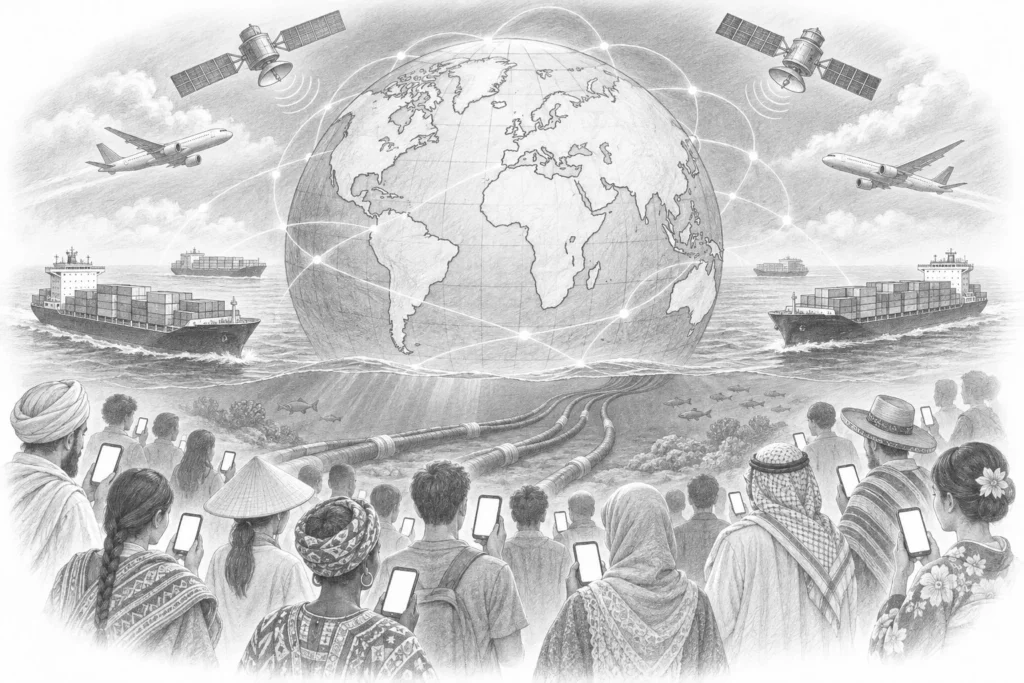
THE clothes we wear, the phones we use, the films we watch and the jobs many of us do are shaped by globalisation, the growing interconnection of the world. But what exactly is globalisation, is it really new, and does it weaken the nation-state? Scholars disagree sharply. This chapter explains the meaning of globalisation and the debate between hyperglobalists, sceptics and transformationalists, and examines its economic, political, technological, language and cultural dimensions. It draws on Paul Hirst and Grahame Thompson, David Held and Anthony McGrew, Andrew Heywood, John Baylis and Steve Smith, Manfred Steger and Arjun Appadurai.
1.1 The Meaning of Globalisation
Globalisation refers to the process by which the world becomes more interconnected, so that events, decisions and activities in one part of the world have significant consequences for people far away. David Held and his colleagues describe it as the widening, deepening and speeding up of worldwide interconnectedness. It involves flows of goods, capital, people, information and ideas across borders, driven by technology, liberalisation and the expansion of markets. Andrew Heywood notes that it has economic, cultural and political forms.
1.2 The Globalisation Debate
Held and McGrew identify three positions. Hyperglobalists, such as Kenichi Ohmae, argue that a borderless global economy has made the nation-state obsolete. Sceptics, such as Hirst and Thompson, argue that today’s economy is not much more open than before 1914, is concentrated in a few regions and remains governed by states. Transformationalists, such as Held, McGrew and Anthony Giddens, argue that globalisation is real and profound but uneven, reshaping states rather than ending them.

1.3 Dimensions of Globalisation
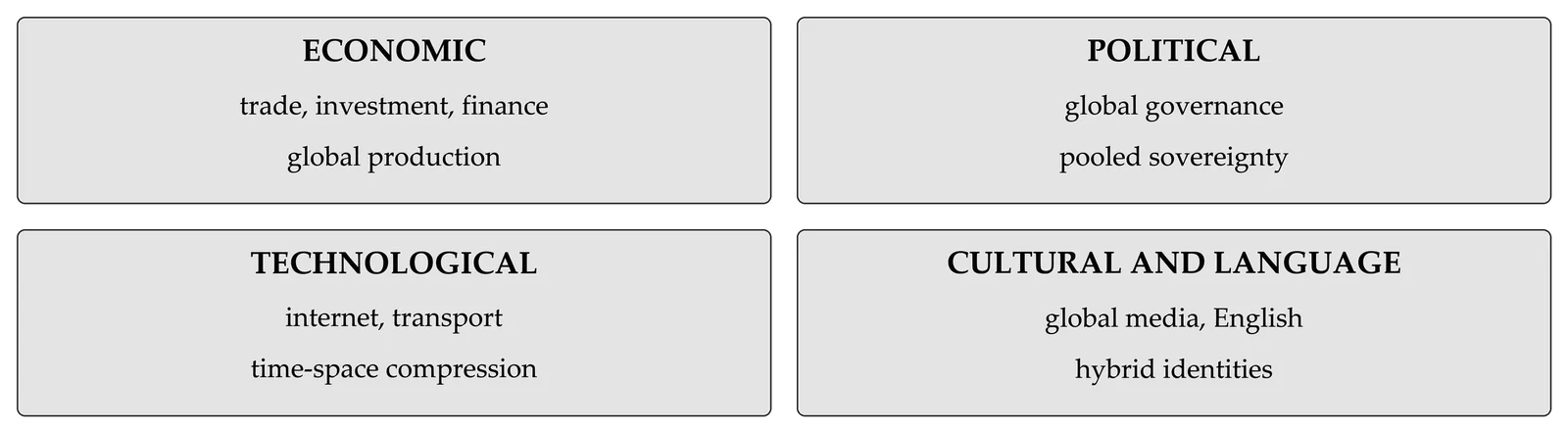
Globalisation has several dimensions. Economically, trade, investment and finance link national economies. Politically, international institutions and global governance shape decisions once made by states alone. Technologically, the internet and cheap transport compress time and space. Culturally, media, consumer goods and migration spread cultures and create hybrid identities, while English has become a global language, raising concerns about linguistic diversity.
1.4 Important Questions
- Question 1 What is globalisation? Discuss the debate on globalisation.
- Question 2 Discuss the economic and political dimensions of globalisation.
- Question 3 Discuss the technological, cultural and language dimensions of globalisation.
- Question 4 Does globalisation undermine the sovereignty of the nation-state? Discuss.
DU asks the same idea in different words. So learn one broad answer for each question below; the same answer works for every question joined by OR.
Important Question 1
What is globalisation? Discuss the debate on globalisation.
OR
Examine the views of hyperglobalists, sceptics and transformationalists on globalisation.
OR
Is globalisation a new phenomenon? Discuss with reference to Hirst and Thompson.
Model Answer
“Globalization, as conceived by the more extreme globalizers, is largely a myth.”
— Paul Hirst and Grahame Thompson, Globalization in Question
Introduction. Globalisation is one of the most widely used and debated concepts of our time. It refers to the growing interconnection of the world through economic, political, technological and cultural flows. But scholars disagree about how new it is, how far it has gone and what it means for the nation-state. These disagreements form the globalisation debate.
1. Definitions
Anthony Giddens defines globalisation as the intensification of worldwide social relations linking distant localities. Held and his colleagues describe it as the widening, deepening and speeding up of worldwide interconnectedness, and Manfred Steger as the expansion and intensification of social relations and consciousness across world-time and world-space.
2. Historical Waves
Many scholars identify waves of globalisation: an earlier wave of trade and migration from about 1870 to 1914, interrupted by wars and depression, a revival after 1945 and an intense wave from the 1980s, driven by liberalisation and new technology.
3. Drivers
Globalisation has been driven by advances in transport and communication, the liberalisation of trade and capital flows, the end of the Cold War, the strategies of multinational corporations and the policies of international institutions.
4. Hyperglobalists
Hyperglobalists, such as Kenichi Ohmae in The Borderless World (1990), argue that a single global market has emerged, that capital and corporations move freely and that the nation-state has lost much of its economic power and relevance.
5. Sceptics
Paul Hirst and Grahame Thompson, in Globalization in Question, argue that the world economy was in some ways as open before 1914, that most trade and investment are concentrated in a few regions, and that states remain powerful. Extreme claims about globalisation, they say, are largely a myth.
6. Transformationalists
Transformationalists, such as David Held, Anthony McGrew and Anthony Giddens, argue that globalisation is real and historically unprecedented in its extent, but uneven and open-ended. It transforms the role and power of states rather than ending them.
7. Heywood’s View
Andrew Heywood, in Global Politics, explains globalisation as a web of interconnectedness with economic, cultural and political forms, and notes that it has both integrating and fragmenting effects.
8. Baylis and Smith
John Baylis and Steve Smith, in The Globalization of World Politics, show that globalisation changes the nature of world politics by increasing the role of non-state actors, international institutions and transnational issues such as climate change and terrorism.
9. Lechner and Boli
Frank Lechner and John Boli’s Globalization Reader brings together debates on economic, political and cultural globalisation, including the idea of a world culture of shared models of the state, education and human rights.
10. Benefits
Supporters argue that globalisation has increased trade, investment and growth, spread technology and knowledge and helped lift hundreds of millions out of poverty, especially in Asia.
11. Critiques
Critics argue that globalisation has increased inequality within countries, weakened workers and the environment, and been governed by rules that favour rich countries and corporations.
12. Backlash and Slowdown
Since the financial crisis of 2008, globalisation has faced backlash, seen in Britain’s vote to leave the European Union in 2016, rising tariffs and supply-chain disruptions during COVID-19, leading some to speak of a slowdown or deglobalisation.
13. India and Globalisation
India opened its economy in 1991 and became deeply integrated through trade, services, investment and migration, while debating how to protect farmers, workers and policy autonomy.
14. Globalisation from Below
Globalisation is not only driven by governments and corporations. Social movements, trade unions, environmental groups and human rights organisations also connect across borders, forming what some call globalisation from below. The World Social Forum, first held in Porto Alegre in 2001 with the slogan ‘another world is possible’, brought such groups together to propose alternatives to corporate globalisation.
15. Measuring Globalisation
Scholars measure globalisation through indicators such as the share of trade in national income, flows of foreign investment, migration, internet use and participation in international organisations. Indices that combine economic, social and political measures show that globalisation rose rapidly from the 1990s and slowed after the financial crisis of 2008, though it did not reverse.
16. Evaluation
Globalisation is real and transformative but uneven and contested. The transformationalist view best captures its complexity.
Conclusion. Thus, globalisation is the widening, deepening and speeding up of worldwide interconnectedness. Hyperglobalists see a borderless world, sceptics such as Hirst and Thompson see continuity and strong states, and transformationalists such as Held and McGrew see profound but uneven change that reshapes states rather than ending them.
Important Question 2
Discuss the economic and political dimensions of globalisation.
OR
Examine the arguments of Jagdish Bhagwati and Joseph Stiglitz on globalisation.
OR
How has globalisation changed the role of the state?
Model Answer
“Globalization today is not working for many of the world’s poor. It is not working for much of the environment.”
— Joseph Stiglitz, Globalization and Its Discontents (2002)
Introduction. The economic and political dimensions of globalisation are closely connected. Economically, trade, investment, finance and production have become global. Politically, decisions are increasingly made through international institutions, regional organisations and transnational networks. Scholars such as Jagdish Bhagwati and Joseph Stiglitz disagree sharply about whether these changes benefit the world’s poor.
1. Trade
World trade has grown much faster than world output since the 1950s, especially after the creation of the WTO in 1995 and the entry of China in 2001. Trade now accounts for a large share of global income.
2. Global Production
Transnational corporations organise global value chains, in which design, components, assembly and services are spread across many countries, linking workers in different parts of the world.
3. Global Finance
Capital moves rapidly across borders through banks, investment funds and currency markets. Financial globalisation brings investment but also volatility, as the crises of 1997 and 2008 showed.
4. Migration and Remittances
Millions of people migrate for work, and their remittances are a major source of income for developing countries. India is the world’s largest recipient of remittances.
5. Bhagwati’s Defence
Jagdish Bhagwati, in In Defense of Globalization (2004), argues that trade and openness increase growth and reduce poverty, and that globalisation, properly managed, has a human face, benefiting women, workers and the poor.
6. Stiglitz’s Critique
Joseph Stiglitz argues that globalisation has been managed in the interest of rich countries and financial interests. He criticised IMF policies that forced rapid liberalisation on developing countries and, in a later work, examined the anti-globalisation backlash of the Trump era.
7. Global Governance
Politically, globalisation has increased the role of international institutions such as the UN, WTO and IMF, and of agreements on trade, climate and human rights, which shape national policies.
8. Pooled Sovereignty
In regional organisations such as the European Union, states pool sovereignty, sharing decision-making in areas such as trade and currency, which changes the traditional idea of sovereignty.
9. Transnational Civil Society
Sanjeev Khagram, James Riker and Kathryn Sikkink show in Restructuring World Politics (2002) how transnational social movements and advocacy networks influence international norms on human rights, environment and development.
10. Governance in a Globalising World
Joseph Nye and John Donahue, in Governance in a Globalizing World (2000), argue that governance now involves not only states but also private companies and non-governmental organisations, operating at local, national and global levels.
11. The Changing State
States now compete to attract investment and must work within international rules, but they remain central in regulating markets, providing security and responding to crises.
12. Inequality
Globalisation has reduced inequality between some countries, as China and India grew, but increased inequality within many countries, fuelling political discontent.
13. India’s Experience
India’s economic reforms since 1991 integrated it into global trade and investment, while it became an active player in global governance through the WTO, the G20 and BRICS.
14. Global Economic Institutions
The International Monetary Fund, the World Bank and the World Trade Organization, often called the pillars of global economic governance, set rules and provide finance that shape national economic policies. Critics argue that voting power in the IMF and World Bank is weighted towards rich countries, while developing countries have demanded reforms to give them a greater voice.
15. Regional Trade Agreements
Alongside global rules, countries have signed many regional and bilateral trade agreements. The Regional Comprehensive Economic Partnership, signed in 2020 by fifteen Asia-Pacific countries, is the largest such agreement. India withdrew from the negotiations in 2019, citing concerns about its farmers, dairy sector and trade deficit with China.
16. Labour and Globalisation
Economic globalisation has changed the world of work. Manufacturing moved to lower-wage countries, creating jobs in Asia but causing job losses in older industrial regions. Informal and flexible work has expanded, and many women have entered export industries, often in low-paid and insecure jobs, raising questions about labour rights in global supply chains.
17. Evaluation
The economic and political dimensions of globalisation have created new opportunities and new inequalities, and require better global governance.
Conclusion. Thus, economic globalisation has integrated trade, production, finance and migration, while political globalisation has strengthened international institutions, pooled sovereignty and transnational civil society. Bhagwati defends its benefits for the poor, while Stiglitz argues it has been managed unfairly, showing the need for fairer global governance.
Important Question 3
Discuss the technological, cultural and language dimensions of globalisation.
OR
Examine Arjun Appadurai’s idea of global cultural flows.
OR
Does globalisation lead to cultural homogenisation? Discuss.
Model Answer
“The new electronic interdependence recreates the world in the image of a global village.”
— Marshall McLuhan, The Gutenberg Galaxy (1962)
Introduction. Globalisation is not only economic and political. Advances in technology have compressed time and space, connecting people instantly across the world, while films, music, brands, food and languages travel across borders. These technological and cultural dimensions raise questions about whether the world is becoming culturally uniform or more diverse and hybrid.
1. Technology as a Driver
Container shipping, introduced in the 1950s, cheap air travel, satellites, the internet and mobile phones have made it faster and cheaper to move goods, people and information across the world.
2. Time-Space Compression
The geographer David Harvey described time-space compression, the way technology shrinks distances and speeds up social life, so that events anywhere can be known everywhere almost instantly.
3. The Digital Revolution
Billions of people now use the internet, and smartphones connect even remote areas. Social media allow ideas and movements to spread globally, while digital platforms reshape commerce and work.
4. The Network Society
Manuel Castells described a network society in which power and wealth flow through global information networks, connecting some places and people while excluding others.
5. The Digital Divide
Access to technology is unequal between and within countries, by income, gender and region, creating a digital divide that can deepen inequality.
6. Cultural Homogenisation
Some argue that globalisation spreads Western, especially American, culture and consumerism, producing a uniform global culture. George Ritzer called the spread of standardised fast-food methods McDonaldization.
7. Hybridisation
Others argue that cultures mix and adapt, producing new hybrid forms. Global products are localised, a process called glocalisation, and local cultures also spread globally.
8. Appadurai’s Scapes
Arjun Appadurai, in Modernity at Large (1996), described five dimensions of global cultural flows: ethnoscapes (people), mediascapes (media), technoscapes (technology), financescapes (money) and ideoscapes (ideas). These flows are disjunctive, moving in different directions and creating new imagined worlds.
9. Indian Culture Goes Global
Indian films, music, yoga, food and the diaspora have spread Indian culture worldwide, showing that cultural globalisation is not one-way.
10. Language
English has become the global language of business, science and the internet, giving advantages to its speakers. At the same time, many of the world’s languages are endangered, raising concerns about the loss of linguistic and cultural diversity.
11. Indian Languages Online
The growth of content in Hindi and other Indian languages online shows that technology can also support linguistic diversity, as new users access the internet in their own languages.
12. Steger on Ideologies
Manfred Steger identifies competing ideologies of globalisation: market globalism, which promotes free markets; justice globalism, which seeks a fairer globalisation; and religious globalisms that oppose Western influence.
13. Resistance and Identity
Cultural globalisation has provoked assertions of local, national and religious identity, as people seek to protect their traditions against perceived threats.
14. Global Media
Global television networks, streaming platforms and social media carry news and entertainment across the world. They allow events to be seen everywhere at once and give voice to people outside traditional media, but they also concentrate influence in a few large companies and spread misinformation rapidly across borders.
15. Diaspora and Culture
The Indian diaspora, numbering more than three crore people of Indian origin and Indian citizens living abroad, carries Indian languages, festivals, food and films to many countries, while also bringing new ideas back to India. Diasporas show how migration creates transnational communities that live between cultures.
16. Evaluation
Technological and cultural globalisation connect the world but also create divides and debates over identity. The outcome is more hybrid than homogeneous.
Conclusion. Thus, technology has compressed time and space, creating McLuhan’s global village and Castells’s network society, while cultural globalisation spreads media, goods and languages. As Appadurai shows, cultural flows are complex and disjunctive, producing hybridity as well as homogenisation, alongside concerns about English and the digital divide.
Important Question 4
Does globalisation undermine the sovereignty of the nation-state? Discuss.
OR
Examine the impact of globalisation on state sovereignty.
OR
‘The nation-state is in retreat.’ Discuss.
Model Answer
“Democracy, national sovereignty and global economic integration are mutually incompatible: we can combine any two of the three, but we can never have all three simultaneously and in full.”
— Dani Rodrik, The Globalization Paradox (2011)
Introduction. A central question in the globalisation debate is whether it undermines the sovereignty of the nation-state. Hyperglobalists argue that states have lost control over their economies and borders, sceptics that states remain powerful, and transformationalists that sovereignty is being reshaped. Recent events, from the financial crisis to the pandemic, have renewed the debate.
1. Sovereignty
Sovereignty means supreme authority within a territory and independence from external control. Since the Peace of Westphalia in 1648, the sovereign state has been the basic unit of world politics.
2. The Retreat of the State
Hyperglobalists argue that capital mobility, global markets and transnational corporations have reduced states’ ability to control their economies. The scholar Susan Strange wrote of the retreat of the state.
3. Economic Constraints
States compete to attract investment by lowering taxes and regulations, a process critics call a race to the bottom. Financial markets can punish governments whose policies they dislike.
4. International Institutions
States accept constraints from international institutions such as the WTO and IMF and from treaties on trade, human rights and climate, which limit their freedom of action.
5. Pooled Sovereignty
In the European Union, states pool sovereignty in areas such as trade and currency, accepting common rules and institutions.
6. The Sceptical View
Sceptics such as Hirst and Thompson argue that states remain the main actors, controlling borders, armed forces, taxation and the rules within which markets operate.
7. The Transformationalist View
Transformationalists argue that sovereignty is being transformed rather than lost: states share authority with other actors and exercise power through international cooperation.
8. The Return of the State
The financial crisis of 2008 and the COVID-19 pandemic showed the importance of states, which rescued banks, closed borders, organised vaccination and supported economies.
9. Rodrik’s Trilemma
Dani Rodrik argues that countries cannot have deep economic integration, full national sovereignty and democracy at once, and must choose which to limit.
10. Security
In security, states remain dominant, controlling military power and responding to threats such as terrorism, though they increasingly cooperate.
11. Nationalism
Globalisation has also provoked a resurgence of nationalism and demands to take back control from global institutions, showing the continuing appeal of national sovereignty.
12. India’s Experience
India has integrated into the global economy while asserting strategic autonomy, protecting key sectors and defending its policy space in negotiations such as those at the WTO.
13. Global Governance Gaps
Many global problems, such as climate change and pandemics, cannot be solved by states alone, but global institutions lack the authority to solve them, creating governance gaps.
14. Human Rights and Sovereignty
The globalisation of human rights norms has challenged the idea that states can treat their citizens as they wish. In 2005, the UN endorsed the Responsibility to Protect, under which the international community may act when a state fails to protect its people from genocide and other atrocities, though its use remains controversial.
15. Non-State Actors
Globalisation has empowered non-state actors such as multinational corporations, international non-governmental organisations, global media and transnational terrorist networks. These actors operate across borders and can challenge or influence states, which must now share the global stage with them.
16. Digital Sovereignty
The internet has created new debates about sovereignty over data and digital platforms. Governments, including India’s, have sought to control data flows, require data to be stored locally and regulate foreign platforms. In 2020, India banned dozens of Chinese mobile applications, citing threats to sovereignty and security.
17. Borders and Migration
Despite globalisation, states still control who may enter and settle in their territory. Migration has become a major political issue, and many countries have tightened border controls, showing that sovereignty over borders remains a central function of the state even in a globalised world.
18. Evaluation
Globalisation constrains states but has not made them obsolete. Sovereignty is being reshaped, and states remain central actors.
Conclusion. Thus, globalisation constrains state sovereignty through capital mobility, international institutions and pooled sovereignty, but states remain central, as the sceptics argue and recent crises show. Transformationalists capture the reality best: sovereignty is reshaped, and as Rodrik argues, states must balance integration, sovereignty and democracy.
Short Notes
(a) Hyperglobalists
Scholars, such as Kenichi Ohmae, who argue that globalisation has created a borderless world economy in which the nation-state has lost much of its power and relevance.
(b) Time-space compression
David Harvey’s term for the way technology shrinks distances and speeds up social life, so that events anywhere in the world can be known and felt almost instantly.
(c) Glocalisation
The adaptation of global products and ideas to local cultures and markets, showing that globalisation produces mixing and hybridity rather than simple uniformity.
More notes: MDSE-8 Understanding Globalisation
These notes are prepared by PADHO TO AISE for study help. They are not an official University of Delhi publication.