
Semester VII MDSE-8 Understanding Globalisation
Unit II · 18 min read · Updated 24 Nov 2026
As per the University of Delhi (DU) BA (Hons) Political Science syllabus
Contents
- 2.1 The United Nations
- 2.2 The WTO and the IMF
- 2.3 UNESCO
- 2.4 Important Questions
- Discuss the role of the United Nations in contemporary world politics.
- Discuss the role of the World Trade Organization in the global economy.
- Discuss the role of the International Monetary Fund in the global economy.
- Discuss the role of UNESCO in the contemporary world.
- Short Notes
हम संयुक्त राष्ट्र के लोग आने वाली पीढ़ियों को युद्ध की उस विभीषिका से बचाने के लिए दृढ़संकल्प हैं, जिसने हमारे जीवनकाल में दो बार मानवता को अकथनीय दुख दिया है।
We the peoples of the United Nations determined to save succeeding generations from the scourge of war, which twice in our lifetime has brought untold sorrow to mankind.
— Charter of the United Nations, Preamble (1945)
IN a globalised world, states are not the only actors. International organisations set rules, provide finance, keep peace and promote cooperation. This chapter studies four of the most important: the United Nations, created in 1945 to maintain peace and promote human rights and development; the World Trade Organization, which governs world trade; the International Monetary Fund, which oversees the international monetary system; and UNESCO, which promotes cooperation in education, science and culture. It draws on Joseph Nye and John Donahue, Sanjeev Khagram and his co-authors, A. Ghosh, D.K. Madaan, D.N. Ghosh, Devesh Kapur and S. Dutt.
2.1 The United Nations
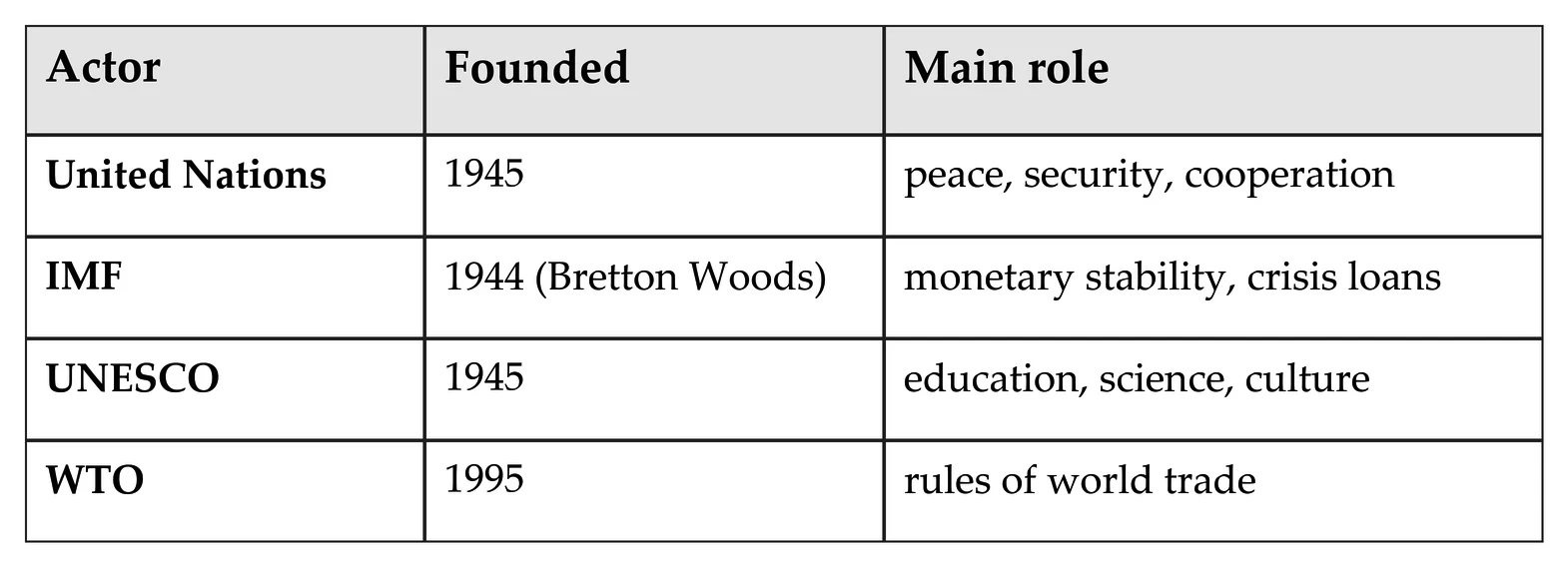
The United Nations was founded in 1945 to save succeeding generations from war. It has 193 member states. Its main organs are the General Assembly, where every state has one vote; the Security Council, with five permanent members holding a veto and ten elected members; the Secretariat, headed by the Secretary-General; the International Court of Justice; and the Economic and Social Council. The UN keeps peace, promotes human rights and development and coordinates specialised agencies, though it is often paralysed by great-power rivalry.
2.2 The WTO and the IMF
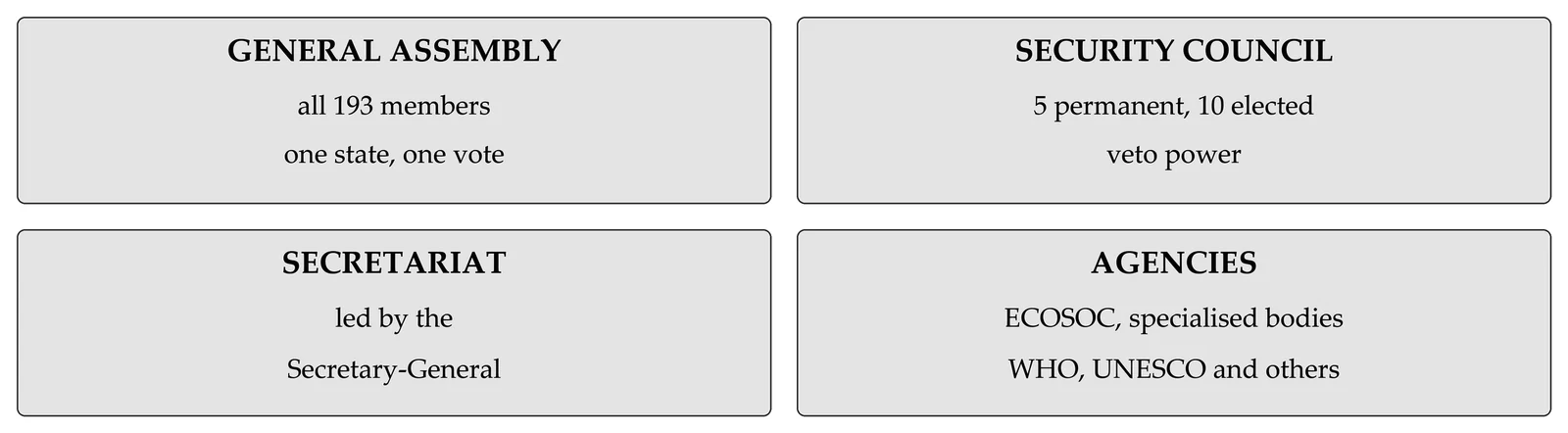
The World Trade Organization, which replaced the General Agreement on Tariffs and Trade in 1995, sets rules for international trade and settles trade disputes. The International Monetary Fund, created at Bretton Woods in 1944, promotes monetary cooperation, monitors economies and lends to countries in crisis, often with conditions. Both are central to economic globalisation and both have been criticised for favouring rich countries.
2.3 UNESCO
The United Nations Educational, Scientific and Cultural Organization, founded in 1945, seeks to build peace through cooperation in education, science, culture and communication. It is best known for the World Heritage list, its work on education for all and its protection of intangible cultural heritage, such as yoga and the Kumbh Mela. S. Dutt examines its efforts to promote shared values in a troubled world.
2.4 Important Questions
- Question 1 Discuss the role of the United Nations in contemporary world politics.
- Question 2 Discuss the role of the World Trade Organization in the global economy.
- Question 3 Discuss the role of the International Monetary Fund in the global economy.
- Question 4 Discuss the role of UNESCO in the contemporary world.
DU asks the same idea in different words. So learn one broad answer for each question below; the same answer works for every question joined by OR.
Important Question 1
Discuss the role of the United Nations in contemporary world politics.
OR
Examine the structure and functions of the United Nations.
OR
Discuss the need for reform of the United Nations Security Council.
Model Answer
“The UN was not created to take mankind to heaven, but to save humanity from hell.”
— Dag Hammarskjöld, UN Secretary-General (1954)
Introduction. The United Nations was created in 1945, after the failure of the League of Nations and the devastation of the Second World War, to maintain international peace and security, develop friendly relations among nations and promote cooperation on economic, social and humanitarian problems. With 193 members, it is the most important universal international organisation, though its effectiveness is often limited by the interests of powerful states.
1. Origins
The failure of the League of Nations to prevent the Second World War led the Allied powers to plan a stronger organisation. The UN Charter was signed by fifty countries in San Francisco in June 1945, with Poland signing soon after as the fifty-first founding member, and it came into force on 24 October 1945. India was one of the founding members, even before independence.
2. Purposes and Principles
The Charter lists the UN’s purposes as maintaining peace and security, developing friendly relations based on self-determination, achieving cooperation on economic and social problems and promoting human rights. Its principles include the sovereign equality of states, peaceful settlement of disputes, refraining from the use of force and non-intervention in domestic affairs.
3. The General Assembly
The General Assembly includes all members, each with one vote. It discusses any matter within the Charter, adopts the budget, elects non-permanent members of the Security Council and passes resolutions, which are recommendations rather than binding decisions on most matters.
4. The Security Council
The Security Council has primary responsibility for peace and security. It has five permanent members, the United States, Russia, China, Britain and France, each with a veto, and ten members elected for two-year terms. Under Chapter VII, it can impose sanctions and authorise the use of force, and its decisions bind all members.
5. The Secretariat and Other Organs
The Secretariat, headed by the Secretary-General, runs the UN’s work and can bring threats to peace to the Council’s attention. Other principal organs include the International Court of Justice and the Economic and Social Council, which coordinates the UN’s economic and social work and its specialised agencies.
6. Peacekeeping
Although not mentioned in the Charter, peacekeeping became a major UN activity from 1948, with lightly armed troops monitoring ceasefires and supporting peace processes. India has been one of the largest contributors of peacekeepers throughout the UN’s history.
7. Decolonisation and Human Rights
The UN supported decolonisation, adopting a declaration on independence for colonial peoples in 1960, and its membership grew from 51 to 193. It adopted the Universal Declaration of Human Rights in 1948 and many human rights treaties.
8. Development
Through agencies such as UNDP, UNICEF and WHO, the UN promotes development, health and education. It set the Millennium Development Goals in 2000 and the Sustainable Development Goals in 2015 to guide global efforts against poverty and inequality.
9. The Cold War and After
During the Cold War, rivalry between the superpowers and frequent vetoes paralysed the Security Council. After 1990, the Council became more active, authorising action in the Gulf War of 1991 and many peace operations.
10. Failures
The UN failed to prevent genocide in Rwanda in 1994 and the massacre at Srebrenica in 1995, could not stop the invasion of Iraq in 2003 and has been blocked by vetoes over conflicts such as Syria, Ukraine and Gaza, damaging its credibility.
11. Global Governance
Joseph Nye and John Donahue show that in a globalising world, the UN works alongside other actors, including states, corporations and civil society, in a complex system of global governance.
12. Security Council Reform
Many argue that the Security Council reflects the world of 1945, not today. The G4 countries, India, Brazil, Germany and Japan, seek permanent seats, and African countries demand representation, but reform requires agreement of the permanent members.
13. India and the UN
India has served eight terms as a non-permanent member of the Security Council, most recently in 2021–22, contributes heavily to peacekeeping and has long championed decolonisation, disarmament and development.
14. Achievements
Despite its limits, the UN has helped prevent a third world war, supported decolonisation, set global norms on human rights and coordinated humanitarian relief and development.
15. Evaluation
The UN is indispensable but imperfect. It reflects both the hopes of humanity and the power of states, and its effectiveness depends on the will of its members.
Conclusion. Thus, the United Nations, founded in 1945, works through the General Assembly, Security Council, Secretariat and other organs to maintain peace, promote human rights and support development. It has achieved much through peacekeeping, decolonisation and norm-setting, but the veto and outdated Security Council limit it, making reform, which India seeks, essential.
Important Question 2
Discuss the role of the World Trade Organization in the global economy.
OR
Examine the WTO and its implications for developing countries.
OR
Discuss the structure and functions of the WTO.
Model Answer
“Entering into reciprocal and mutually advantageous arrangements directed to the substantial reduction of tariffs and other barriers to trade and to the elimination of discriminatory treatment in international commerce.”
— General Agreement on Tariffs and Trade (1947), Preamble
Introduction. The World Trade Organization is the main international body governing world trade. It began work on 1 January 1995, succeeding the General Agreement on Tariffs and Trade of 1947. It sets rules for trade in goods, services and intellectual property and settles disputes among members. It is central to economic globalisation, but developing countries have raised serious concerns about its fairness, as A. Ghosh and D.K. Madaan show.
1. From GATT to the WTO
After the planned International Trade Organization failed, countries signed GATT in 1947. Successive rounds of negotiations reduced tariffs, and the Uruguay Round of 1986–94 created the WTO with a wider mandate and stronger institutions.
2. Structure
The highest body is the Ministerial Conference, which meets about every two years. The General Council conducts day-to-day work and also sits as the Dispute Settlement Body and the Trade Policy Review Body. Decisions are generally taken by consensus among its more than 160 members.
3. Principles
The WTO rests on non-discrimination: the most-favoured-nation principle, under which trade advantages given to one member must be given to all, and national treatment, under which imported goods must be treated like domestic goods once they enter a market.
4. Agreements
WTO agreements cover trade in goods, agriculture, services (GATS), intellectual property (TRIPS), investment measures and technical standards, together with a binding system for settling disputes.
5. Dispute Settlement
Members can bring disputes to panels, with appeals to an Appellate Body. This system made WTO rules enforceable, but the Appellate Body stopped functioning in December 2019, when the United States blocked the appointment of new members.
6. Ghosh on Globalisation and the WTO
A. Ghosh examines the WTO as a central institution of globalisation, analysing how its rules on trade, services and intellectual property affect national economic policies and what they mean for India.
7. Madaan on Developing Countries
D.K. Madaan discusses the concerns of developing countries: limited market access for their exports, high agricultural subsidies in rich countries, the costs of implementing agreements such as TRIPS and the weakness of special and differential treatment.
8. Agriculture
Agriculture is the most contentious issue. Developing countries, including India, defend their right to support farmers and hold public stocks for food security, while criticising the large subsidies paid by rich countries to their own farmers.
9. TRIPS and Medicines
The TRIPS agreement required strong patent protection. The Doha Declaration of 2001 affirmed that it should not prevent countries from protecting public health, which helped India’s generic medicine industry supply affordable drugs worldwide.
10. The Doha Round
Launched in 2001 as a development round, the Doha negotiations stalled over agriculture and market access. Members achieved smaller agreements, such as the Trade Facilitation Agreement of 2013, which entered into force in 2017.
11. India and the WTO
India has been an active WTO member, leading coalitions of developing countries on agriculture, food security and intellectual property, and resisting new rules that it believes would limit its policy space.
12. Criticisms
Critics argue that the WTO is dominated by rich countries, that its rules favour corporations, that it limits developing countries’ ability to protect industries and that its decision-making is not transparent.
13. Defence
Supporters argue that the WTO provides a rules-based system that protects small countries from the arbitrary power of large ones and has helped expand world trade and growth.
14. Current Crisis
The WTO faces a crisis of relevance due to the paralysis of its dispute system, the rise of protectionism and trade wars and the spread of regional agreements outside its framework.
15. Evaluation
The WTO is central to global trade governance but needs reform to restore its dispute system and address developing countries’ concerns.
Conclusion. Thus, the WTO, created in 1995 from GATT, sets rules for trade in goods, services and intellectual property based on non-discrimination, and settles disputes. As Ghosh and Madaan show, developing countries such as India have serious concerns about agriculture, TRIPS and market access, and the WTO now faces a crisis that requires reform.
Important Question 3
Discuss the role of the International Monetary Fund in the global economy.
OR
‘The IMF: a cure or a curse?’ Discuss.
OR
Examine the criticisms of IMF conditionality and governance.
Model Answer
“To promote international monetary cooperation through a permanent institution which provides the machinery for consultation and collaboration on international monetary problems.”
— IMF Articles of Agreement, Article I(i)
Introduction. The International Monetary Fund was created at the Bretton Woods conference in 1944 to promote international monetary cooperation and stability. It monitors the world economy, advises member countries and lends to those facing balance-of-payments crises. Its loans often come with conditions requiring policy changes, which has made it one of the most controversial institutions of globalisation.
1. Origins
At Bretton Woods in 1944, the Allied nations, led by the United States and Britain, created the IMF and the World Bank to prevent a return to the competitive devaluations and economic collapse of the 1930s. India was a founding member.
2. Purposes
The IMF aims to promote monetary cooperation, facilitate the growth of trade, promote exchange rate stability and help members correct balance-of-payments problems without harmful measures.
3. Quotas and Voting
Each member’s quota, based on its economic size, determines its contribution, its borrowing limits and its voting power. The United States holds the largest share of votes, enough to veto major decisions that require an eighty-five per cent majority.
4. Special Drawing Rights
In 1969, the IMF created Special Drawing Rights, an international reserve asset based on a basket of major currencies, which it allocates to members to supplement their reserves.
5. Surveillance
The IMF monitors the economies of member countries through regular consultations and publishes assessments of the world economy, warning of risks and recommending policies.
6. Lending and Conditionality
When countries face crises, the IMF lends money, usually on condition that they adopt policies such as reducing budget deficits, devaluing currencies, liberalising trade and privatising enterprises. These conditions are called conditionality.
7. The Debt Crisis and Adjustment
During the debt crisis of the 1980s, the IMF required many developing countries to adopt structural adjustment programmes. Critics argue that these cut social spending and increased poverty.
8. The Asian Crisis
During the Asian financial crisis of 1997, the IMF required countries such as Indonesia and South Korea to tighten budgets and raise interest rates. Joseph Stiglitz argued that these policies worsened the crisis.
9. Kapur: Cure or Curse
Devesh Kapur, in ‘The IMF: A Cure or a Curse?’ (1998), examined how the IMF expanded its role far beyond its original mission, raising problems of moral hazard, in which bailouts encourage risky behaviour, and of legitimacy, as it intervened deeply in countries’ domestic policies.
10. Ghosh on Governance
D.N. Ghosh argues that globalisation increased the IMF’s power over developing countries while its own governance remained dominated by rich countries, creating a democratic deficit in global economic governance.
11. India and the IMF
India borrowed from the IMF during its balance-of-payments crisis of 1991, which accompanied the start of economic reforms. India has since repaid its loans and become a creditor, and it seeks greater voice for developing countries.
12. Governance Reforms
Reforms agreed in 2010, which took effect in 2016, increased the quotas of emerging economies such as China and India, but the United States and Europe still dominate, and by convention a European heads the IMF.
13. Changing Approach
After the 2008 crisis, the IMF became more open to measures such as capital controls and social spending, and it played a large role in supporting countries during the COVID-19 pandemic.
14. Defence
Supporters argue that the IMF provides essential emergency finance and stability, preventing crises from spreading, and that its conditions address the causes of crises.
15. Evaluation
The IMF is a crucial institution of global finance, but its conditionality and governance have been widely criticised, and reforms remain incomplete.
Conclusion. Thus, the IMF, created at Bretton Woods in 1944, promotes monetary cooperation, monitors economies and lends to countries in crisis with conditions. As Kapur and D.N. Ghosh show, its expanded role, conditionality and rich-country dominance have raised questions of effectiveness and legitimacy, though it remains essential for global financial stability.
Important Question 4
Discuss the role of UNESCO in the contemporary world.
OR
Examine UNESCO’s contribution to education, science and culture.
OR
How does UNESCO seek to promote peace and shared values?
Model Answer
“Since wars begin in the minds of men, it is in the minds of men that the defences of peace must be constructed.”
— Constitution of UNESCO (1945), Preamble
Introduction. The United Nations Educational, Scientific and Cultural Organization was founded in November 1945, in the belief that lasting peace requires not only political and economic arrangements but also the intellectual and moral solidarity of humanity. It promotes cooperation in education, science, culture and communication. S. Dutt examines UNESCO’s efforts to promote shared values in a troubled twenty-first century.
1. Origins
UNESCO’s constitution was adopted in London in November 1945, and the organisation came into existence in 1946, with its headquarters in Paris. India was a founding member.
2. Purpose
Its constitution declares that since wars begin in the minds of men, the defences of peace must be built in the minds of men. UNESCO seeks to promote peace through education, science, culture and the free flow of ideas.
3. Education
UNESCO promotes literacy and education for all, leading global efforts such as the Education for All movement launched at Jomtien in 1990 and the Sustainable Development Goal on quality education adopted in 2015.
4. Science
UNESCO promotes scientific cooperation, including programmes on oceans, water, biosphere reserves and the ethics of science, and encourages science that serves sustainable development.
5. World Heritage
The World Heritage Convention of 1972 identifies and protects sites of outstanding universal value. India has more than forty World Heritage sites, including the Taj Mahal, the Western Ghats and the Ajanta and Ellora caves.
6. Intangible Heritage
The Convention for the Safeguarding of the Intangible Cultural Heritage of 2003 protects living traditions. India’s inscribed elements include yoga, the Kumbh Mela, Durga Puja in Kolkata and the Garba of Gujarat.
7. Cultural Diversity
UNESCO’s Universal Declaration on Cultural Diversity (2001) and its Convention of 2005 affirm the value of cultural diversity and countries’ right to support their cultures in a globalised world.
8. Communication and Information
UNESCO promotes freedom of expression, press freedom and access to information. The MacBride Report of 1980 called for a fairer world information order, reflecting developing countries’ concerns about Western media dominance.
9. Dutt on Shared Values
S. Dutt argues that UNESCO seeks to promote shared values of peace, tolerance and human dignity in a world troubled by conflict, extremism and inequality, though it faces challenges of politicisation and limited resources.
10. Politicisation
UNESCO has been drawn into political disputes. The United States withdrew in 1984, rejoined in 2003, left again in 2018, rejoined in 2023 and announced another withdrawal in 2025, often over disputes about Israel and Palestine and the organisation’s direction.
11. Funding Problems
The withdrawal of major contributors and budget constraints have limited UNESCO’s programmes, making it dependent on voluntary contributions.
12. Protecting Heritage in Conflict
The destruction of heritage by armed groups, such as the Bamiyan Buddhas in Afghanistan in 2001, has led UNESCO to campaign for the protection of cultural heritage during conflicts.
13. India and UNESCO
India has been an active member of UNESCO, using it to promote its heritage and education and to support cultural diversity and development.
14. Significance
UNESCO shows that globalisation has cultural and intellectual dimensions, and that international cooperation can protect heritage and promote education.
15. UNESCO and New Technologies
UNESCO has taken up the ethical challenges of new technologies. In 2021, its member states adopted a Recommendation on the Ethics of Artificial Intelligence, the first global standard on the subject, calling for AI that respects human rights, protects privacy, avoids discrimination and supports sustainable development. This shows UNESCO adapting its mission to the problems of a digital age.
16. Evaluation
UNESCO plays a valuable role in promoting peace through education, science and culture, though politicisation and funding problems limit its effectiveness.
Conclusion. Thus, UNESCO, founded in 1945 to build the defences of peace in the minds of men, promotes education for all, scientific cooperation, the protection of world and intangible heritage and cultural diversity. As Dutt shows, it seeks to promote shared values in a troubled world, though politicisation and funding problems constrain it.
Short Notes
(a) Veto power
The right of each of the five permanent members of the UN Security Council to block any substantive resolution by voting against it, which has often paralysed the Council.
(b) Conditionality
The policy conditions attached to IMF loans, such as reducing budget deficits, liberalising trade and privatising enterprises, which borrowing countries must accept to receive funds.
(c) World Heritage Convention
A UNESCO convention of 1972 for identifying and protecting cultural and natural sites of outstanding universal value, under which India has more than forty sites.
More notes: MDSE-8 Understanding Globalisation
These notes are prepared by PADHO TO AISE for study help. They are not an official University of Delhi publication.