
Semester VII MDSE-8 Understanding Globalisation
Unit III · 18 min read · Updated 24 Nov 2026
As per the University of Delhi (DU) BA (Hons) Political Science syllabus
Contents
- 3.1 Global Environmental Issues and UNEP
- 3.2 Global Justice
- 3.3 International Terrorism
- 3.4 Important Questions
- Discuss global warming as a global environmental issue and the role of UNEP.
- Discuss biodiversity loss and resource scarcities as global environmental issues.
- What is global justice? Discuss the debate between cosmopolitans and their critics.
- Discuss international terrorism as a contemporary world issue.
- Short Notes
ग्लोबल वार्मिंग का युग समाप्त हो गया है; अब ‘ग्लोबल बॉयलिंग’ का युग आ गया है।
The era of global warming has ended; the era of global boiling has arrived.
— António Guterres, UN Secretary-General, July 2023
SOME problems cross every border. Global environmental issues, such as global warming, the loss of biodiversity and resource scarcities, affect the whole planet and require cooperation through bodies such as the UN Environment Programme. Global justice asks whether rich countries and people owe duties to the world’s poor. International terrorism threatens security everywhere and challenges states to respond without violating rights. This chapter examines these contemporary world issues, drawing on David Held and Anthony McGrew, Joseph Stiglitz, Jagdish Bhagwati, Deepak Nayyar, John Clark, and Paul Viotti and Mark Kauppi.

3.1 Global Environmental Issues and UNEP
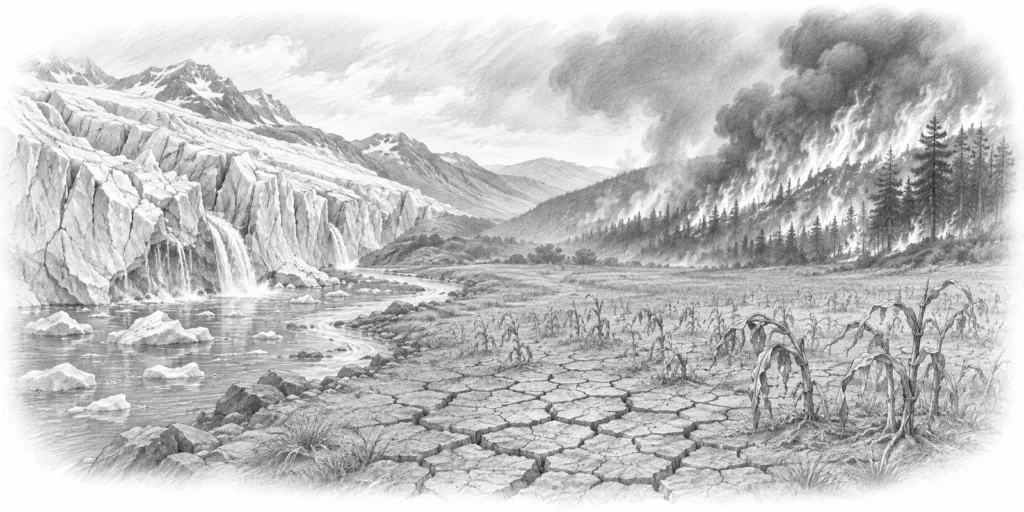
The UN Environment Programme (UNEP), created in 1972, assesses environmental conditions, coordinates international action and helps negotiate agreements. Global warming, caused mainly by greenhouse gases from burning fossil fuels, has raised global temperatures by more than 1°C since pre-industrial times, bringing heatwaves, floods, droughts and rising seas. The loss of biodiversity and resource scarcities of water, land and minerals add to the crisis. Agreements such as the climate convention (1992) and the Paris Agreement (2015) seek cooperation, but disputes between rich and poor countries over responsibility and finance persist.
3.2 Global Justice
Global justice asks what justice requires across borders, in a world of extreme inequality. Cosmopolitans, such as Peter Singer and Thomas Pogge, argue that we have strong duties to the global poor. Statists and nationalists, such as John Rawls and David Miller, argue that principles of distributive justice apply mainly within states. The capabilities approach of Amartya Sen and Martha Nussbaum focuses on what people are able to do and be. Deepak Nayyar argues for institutions to govern globalisation more fairly.

3.3 International Terrorism
International terrorism uses violence against civilians to achieve political aims across borders. The attacks of 11 September 2001 led to a global war on terror. The UN Security Council required states to act against terrorist financing and safe havens, and India, a long-standing victim of cross-border terrorism, has pressed for a comprehensive international convention. The challenge is to counter terrorism while respecting human rights.

3.4 Important Questions
- Question 1 Discuss global warming as a global environmental issue and the role of UNEP.
- Question 2 Discuss biodiversity loss and resource scarcities as global environmental issues.
- Question 3 What is global justice? Discuss the debate between cosmopolitans and their critics.
- Question 4 Discuss international terrorism as a contemporary world issue.
DU asks the same idea in different words. So learn one broad answer for each question below; the same answer works for every question joined by OR.
Important Question 1
Discuss global warming as a global environmental issue and the role of UNEP.
OR
Examine the international efforts to address climate change.
OR
Discuss the North–South debate on climate change.
Model Answer
“Stabilization of greenhouse gas concentrations in the atmosphere at a level that would prevent dangerous anthropogenic interference with the climate system.”
— UN Framework Convention on Climate Change (1992), Article 2
Introduction. Global warming is the most serious global environmental issue of our time. The burning of fossil fuels and deforestation have increased greenhouse gases in the atmosphere, raising global temperatures and changing the climate. Because emissions anywhere affect people everywhere, climate change can only be addressed through international cooperation, in which the UN Environment Programme and climate agreements play central roles.
1. A Global Problem
Environmental problems such as climate change cross national borders. No single country can solve them alone, and those who suffer most are often not those who caused the problem, which makes cooperation both necessary and difficult.
2. UNEP
The UN Environment Programme was created after the Stockholm Conference of 1972 and is based in Nairobi. It assesses the state of the environment, coordinates environmental activities within the UN and helps countries negotiate and implement agreements.
3. The Science
In 1988, UNEP and the World Meteorological Organization set up the Intergovernmental Panel on Climate Change. Its reports show that human activities have warmed the planet by more than 1°C since pre-industrial times.
4. Impacts
Climate change brings more intense heatwaves, floods, droughts and cyclones, rising sea levels, melting glaciers and threats to agriculture, water supplies and health, especially in poor countries such as those of South Asia and Africa.
5. The Climate Convention
The UN Framework Convention on Climate Change, adopted at Rio in 1992, aims to prevent dangerous interference with the climate system. It recognised common but differentiated responsibilities, accepting that developed countries should lead.
6. The Kyoto Protocol
The Kyoto Protocol of 1997 set binding emission reduction targets for developed countries only. The United States did not ratify it, and emissions from emerging economies grew, limiting its effectiveness.
7. Copenhagen and Paris
The Copenhagen conference of 2009 failed to produce a binding agreement. The Paris Agreement of 2015 asked all countries to set their own nationally determined contributions to keep warming well below 2°C, with efforts to limit it to 1.5°C.
8. Recent Developments
Later conferences agreed on a fund for loss and damage in 2022, called for a transition away from fossil fuels in 2023 and set a new climate finance goal in 2024. Yet current pledges remain insufficient to meet the Paris goals.
9. The North–South Divide
Developing countries argue that rich countries caused most historical emissions and must cut emissions faster and provide finance and technology. Rich countries argue that large emerging emitters such as China and India must also act.
10. Climate Finance
Developed countries promised in 2009 to mobilise 100 billion dollars a year for developing countries by 2020, a target met late. Disputes over finance remain central to climate negotiations.
11. India’s Position
India has low per capita emissions and defends its right to development, while pledging net-zero emissions by 2070, expanding renewable energy and launching the International Solar Alliance with France in 2015.
12. Held and McGrew on Environmental Governance
Held and McGrew show that environmental problems are a clear case of globalisation, creating shared risks that require new forms of global governance involving states, international organisations and civil society.
13. Climate Justice
The idea of climate justice holds that those least responsible for climate change, such as poor countries, small islands and future generations, suffer most, and that responses must be fair.
14. Limitations
Climate agreements rely on voluntary national pledges and lack strong enforcement, while short-term economic interests often outweigh long-term environmental concerns.
15. Evaluation
Global warming shows both the necessity and the difficulty of global cooperation. UNEP and climate agreements have made progress, but much more action and fairness are needed.
Conclusion. Thus, global warming is a global problem requiring cooperation. UNEP, the IPCC, the climate convention, the Kyoto Protocol and the Paris Agreement have shaped international action, but disputes between North and South over responsibility and finance, and weak enforcement, limit progress, making climate justice central.
Important Question 2
Discuss biodiversity loss and resource scarcities as global environmental issues.
OR
Examine international efforts to protect biodiversity.
OR
Do resource scarcities lead to conflict? Discuss.
Model Answer
“The conservation of biological diversity, the sustainable use of its components and the fair and equitable sharing of the benefits arising out of the utilization of genetic resources.”
— Convention on Biological Diversity (1992), Article 1
Introduction. Along with climate change, the loss of biodiversity and the scarcity of resources such as water, land, minerals and fish are major global environmental issues. They threaten ecosystems, livelihoods and peace. International agreements, coordinated partly through UNEP, seek to conserve biodiversity and manage resources fairly, but conflicts of interest between countries and groups make this difficult.
1. Meaning of Biodiversity
Biodiversity means the variety of life on earth: the diversity of genes, species and ecosystems. It provides food, medicine, clean water and other services on which human life depends.
2. Threats
Biodiversity is threatened by habitat destruction, overexploitation, pollution, invasive species and climate change. A global assessment in 2019 warned that around a million species face extinction.
3. The Convention on Biological Diversity
Adopted at Rio in 1992, the Convention on Biological Diversity has three objectives: conservation of biodiversity, sustainable use of its components and fair sharing of the benefits from genetic resources.
4. Protocols
The Cartagena Protocol of 2000 regulates the safe transfer of genetically modified organisms, and the Nagoya Protocol of 2010 sets rules for access to genetic resources and the sharing of benefits.
5. The 2022 Framework
The Kunming–Montreal Global Biodiversity Framework, adopted in 2022, set targets for 2030, including protecting 30 per cent of the world’s land and seas.
6. India’s Biodiversity
India is one of the world’s megadiverse countries, with parts of four biodiversity hotspots, including the Himalaya and the Western Ghats. It passed the Biological Diversity Act in 2002.
7. Biopiracy and Traditional Knowledge
Developing countries object to the patenting of their biological resources and traditional knowledge by foreign companies without consent or benefit sharing, which they call biopiracy.
8. Resource Scarcities
Growing populations and consumption increase pressure on water, fertile land, minerals, energy and fisheries. Billions of people lack safe drinking water, and groundwater is being depleted in many regions, including north India.
9. The Ozone Success
The Montreal Protocol of 1987, which phased out ozone-depleting chemicals, is often cited as the most successful environmental agreement, showing that global cooperation can work.
10. The Tragedy of the Commons
Garrett Hardin argued in 1968 that shared resources tend to be overused because each user gains from exploiting them while the costs are shared, a problem called the tragedy of the commons.
11. Governing the Commons
Elinor Ostrom showed that communities can manage shared resources sustainably through their own rules, offering alternatives to privatisation or state control.
12. Resources and Conflict
Some scholars warn that scarcities of water, land and minerals may cause conflict, while others argue that cooperation over shared resources, such as river treaties, is more common than war.
13. Scarcity Debates
Neo-Malthusians warn that population and consumption will exhaust resources, while optimists argue that technology and markets will find substitutes, as with past fears of resource exhaustion.
14. Justice Concerns
Rich countries consume far more resources per person, while the poor depend most directly on natural resources. Fair resource governance requires addressing these inequalities.
15. Evaluation
Biodiversity loss and resource scarcities threaten human well-being and peace. International agreements offer frameworks, but implementation and fairness remain challenges.
Conclusion. Thus, biodiversity is threatened by habitat loss, overexploitation and climate change, and resources such as water and land face growing scarcity. The Convention on Biological Diversity, its protocols and the 2022 framework seek conservation and fair sharing, while the tragedy of the commons and the success of the Montreal Protocol show both the difficulty and possibility of cooperation.
Important Question 3
What is global justice? Discuss the debate between cosmopolitans and their critics.
OR
Do rich countries have obligations to the global poor? Discuss.
OR
Examine Thomas Pogge’s argument about global poverty.
Model Answer
“If it is in our power to prevent something bad from happening, without thereby sacrificing anything of comparable moral importance, we ought, morally, to do it.”
— Peter Singer, ‘Famine, Affluence, and Morality’ (1972)
Introduction. In a world where some people live in great wealth while hundreds of millions live in extreme poverty, the question of global justice has become urgent. Global justice asks whether principles of justice apply beyond national borders, and what obligations rich countries and individuals have towards the global poor. Cosmopolitans and their critics give very different answers.
1. Meaning
Global justice concerns the fair distribution of wealth, opportunities, rights and burdens among all people in the world, not just within a single state.
2. Global Inequality
Global inequality is extreme. Hundreds of millions of people live in extreme poverty, lacking adequate food, clean water, health care and education, while a small share of the world’s population owns most of its wealth.
3. Singer’s Argument
Peter Singer argued in 1972 that if we can prevent something bad without sacrificing anything of comparable importance, we ought to do it. Just as we would save a drowning child at small cost, the affluent have a duty to help the global poor.
4. Cosmopolitanism
Cosmopolitans hold that every human being has equal moral worth, regardless of nationality. National borders are morally arbitrary, so principles of justice should apply globally.
5. Pogge on Global Poverty
Thomas Pogge, in World Poverty and Human Rights (2002), argues that rich countries are not merely failing to help the poor but actively harming them through a global institutional order, including trade rules and the recognition of corrupt rulers, which they impose. This violates negative duties not to harm.
6. Extending Rawls
Some cosmopolitans, such as Charles Beitz and Pogge, argue that John Rawls’s principles of justice, including the difference principle, should apply to the whole world, since the global economy is a system of cooperation.
7. Rawls’s Law of Peoples
Rawls himself, in The Law of Peoples (1999), rejected a global difference principle. He argued that well-ordered peoples have a duty of assistance to burdened societies to help them establish just institutions, but not a duty to equalise wealth.
8. Nationalist Views
David Miller argues that people have special obligations to their fellow nationals, with whom they share a political community, though they also owe basic human rights to all.
9. The Capabilities Approach
Amartya Sen and Martha Nussbaum focus on capabilities, what people are actually able to do and be, such as being healthy, educated and able to participate in political life, as the measure of justice everywhere.
10. Trade and Debt Justice
Campaigners argue for fairer trade rules, debt relief for poor countries, as in the Jubilee 2000 campaign, and for rich countries to meet the target of giving 0.7 per cent of their national income in aid, set in 1970.
11. Climate and Migration
Global justice also concerns climate change, whose burdens fall heavily on the poor, and migration, raising questions about whether rich countries may close their borders to people fleeing poverty.
12. Nayyar on Governing Globalisation
Deepak Nayyar argues that globalisation needs better governance, with international institutions that give developing countries a fair voice and rules that create space for development.
13. Civil Society
John Clark shows how global civil society campaigns, on debt, trade and aid, have made global justice part of international politics.
14. Criticisms
Critics of cosmopolitanism argue that it ignores the importance of national communities and is impractical without global institutions. Cosmopolitans reply that existing global institutions already shape people’s lives.
15. Bhagwati and Stiglitz on Poverty
Jagdish Bhagwati argues that globalisation has been the most powerful force for reducing poverty, as trade-led growth lifted hundreds of millions out of poverty in China and India. Joseph Stiglitz replies that the rules of globalisation have been unfair to poor countries and that growth has left many behind, so global justice requires reforming global institutions as well as encouraging growth.
16. Evaluation
Global justice is a central moral challenge of globalisation. Whether duties arise from humanity or from shared institutions, extreme global poverty demands action.
Conclusion. Thus, global justice asks what justice requires across borders. Cosmopolitans such as Singer and Pogge argue for strong duties to the global poor, while Rawls and Miller limit distributive justice to states, and the capabilities approach focuses on what people can do and be. Fairer global governance, as Nayyar argues, is essential.
Important Question 4
Discuss international terrorism as a contemporary world issue.
OR
Examine international efforts to combat terrorism.
OR
How has globalisation affected terrorism?
Model Answer
“Such acts, like any act of international terrorism, constitute a threat to international peace and security.”
— UN Security Council Resolution 1373 (2001)
Introduction. International terrorism, the use of violence against civilians to achieve political goals across borders, has become one of the most serious threats to global security. The attacks of 11 September 2001 made it a central issue of world politics. Terrorism is shaped by globalisation, which provides new means of communication, finance and travel, and its control requires international cooperation.
1. Meaning
Terrorism is generally understood as the use or threat of violence against civilians to create fear and achieve political, religious or ideological aims. There is no universally agreed definition.
2. Waves of Terrorism
David Rapoport described four waves of modern terrorism: anarchist terrorism from the 1880s, anti-colonial terrorism after the First World War, new left terrorism in the 1960s and religious terrorism from 1979.
3. The Attacks of 2001
The attacks of 11 September 2001 by Al-Qaeda on the United States killed nearly three thousand people and led to the global war on terror, including wars in Afghanistan and Iraq.
4. New Organisations
After Al-Qaeda, the Islamic State, which declared a so-called caliphate in Iraq and Syria in 2014, used social media to recruit fighters worldwide and inspired attacks in many countries.
5. Causes
Terrorism arises from many causes: political grievances, foreign occupation, ideological and religious extremism, state failure, discrimination and the strategic calculations of groups and sometimes states.
6. Globalisation and Terrorism
Globalisation has made it easier for terrorist networks to communicate, move money and people and spread propaganda across borders. Held and McGrew note that globalisation creates transnational networks of all kinds, including violent ones.
7. State-Sponsored and Cross-Border Terrorism
Some states have supported terrorist groups against rivals. India has long suffered cross-border terrorism, including the Mumbai attacks of 2008 and the attack at Pahalgam in 2025.
8. UN Responses
After 2001, Security Council Resolution 1373 required all states to act against terrorist financing and safe havens and created a Counter-Terrorism Committee. The UN adopted a Global Counter-Terrorism Strategy in 2006.
9. The Comprehensive Convention
India proposed a Comprehensive Convention on International Terrorism at the UN in 1996, but it remains stalled because states disagree on how to define terrorism.
10. Financial Measures
The Financial Action Task Force, set up in 1989, sets standards against money laundering and terrorist financing and can place countries on lists that affect their access to finance.
11. Regional Cooperation
Regional organisations such as the Shanghai Cooperation Organisation, with its regional anti-terrorist structure, and BRICS cooperate on counter-terrorism.
12. Counter-Terrorism and Human Rights
Counter-terrorism has raised concerns about human rights, such as detention without trial at Guantanamo Bay, torture, drone strikes and surveillance. The UN strategy insists that security and rights must go together.
13. Viotti and Kauppi
Paul Viotti and Mark Kauppi show how terrorism connects issues of security, economy and identity in international relations, requiring analysis beyond traditional state-centred security.
14. The Definitional Debate
The saying that one person’s terrorist is another’s freedom fighter reflects disagreement over whether violence for national liberation can be terrorism, which has blocked agreement on a definition.
15. Cyber Terrorism and Lone Attackers
New forms of terrorism have emerged with technology. Terrorist groups use encrypted communication and social media to recruit and inspire individuals, so-called lone-wolf attackers, who act without direct orders. There are also growing concerns about cyber attacks on critical infrastructure such as power grids, banks and hospitals, which could cause widespread harm.
16. India’s Approach
India has suffered terrorism in Jammu and Kashmir, Punjab, the North-East and its cities. It has strengthened its laws, created the National Investigation Agency in 2008 and pressed for international action against states that harbour terrorists, including through the Financial Action Task Force and the UN sanctions committees that list terrorists.
17. Evaluation
International terrorism is a major global threat shaped by globalisation. Countering it requires cooperation that respects human rights and addresses underlying causes.
Conclusion. Thus, international terrorism uses violence against civilians to achieve political aims and has been shaped by globalisation’s networks of communication, finance and travel. The UN, FATF and regional bodies have built a framework against it, and India has pressed for a comprehensive convention, but disagreements over definition and concerns about human rights remain.
Short Notes
(a) UNEP
The United Nations Environment Programme, set up after the Stockholm Conference of 1972 and based in Nairobi. It assesses the environment, coordinates UN environmental work and supports international environmental agreements.
(b) Cosmopolitanism
The view that all human beings have equal moral worth regardless of nationality, so that principles of justice and duties of assistance extend to people everywhere.
(c) Resolution 1373
A UN Security Council resolution adopted after the attacks of 11 September 2001, requiring all states to act against terrorist financing and safe havens and creating the Counter-Terrorism Committee.
More notes: MDSE-8 Understanding Globalisation
These notes are prepared by PADHO TO AISE for study help. They are not an official University of Delhi publication.