
Semester VII MDSE-10 Issues in Contemporary Politics
Unit I · 20 min read · Updated 24 Nov 2026
As per the University of Delhi (DU) BA (Hons) Political Science syllabus
Contents
- 1.1 Violence and Politics
- 1.2 Global Justice
- 1.3 Cosmopolitanism
- 1.4 Important Questions
- Discuss the relationship between violence and politics with reference to Hobbes and Arendt.
- Examine Charles Tilly’s analysis of collective violence.
- What is global justice? Discuss the debate between statist and cosmopolitan views.
- What is cosmopolitanism? Discuss David Held’s principles of cosmopolitan order.
- Short Notes
और मनुष्य का जीवन एकाकी, दरिद्र, घृणित, पाशविक और अल्प होता है।
And the life of man, solitary, poor, nasty, brutish, and short.
— Thomas Hobbes, Leviathan, Chapter 13 (1651)
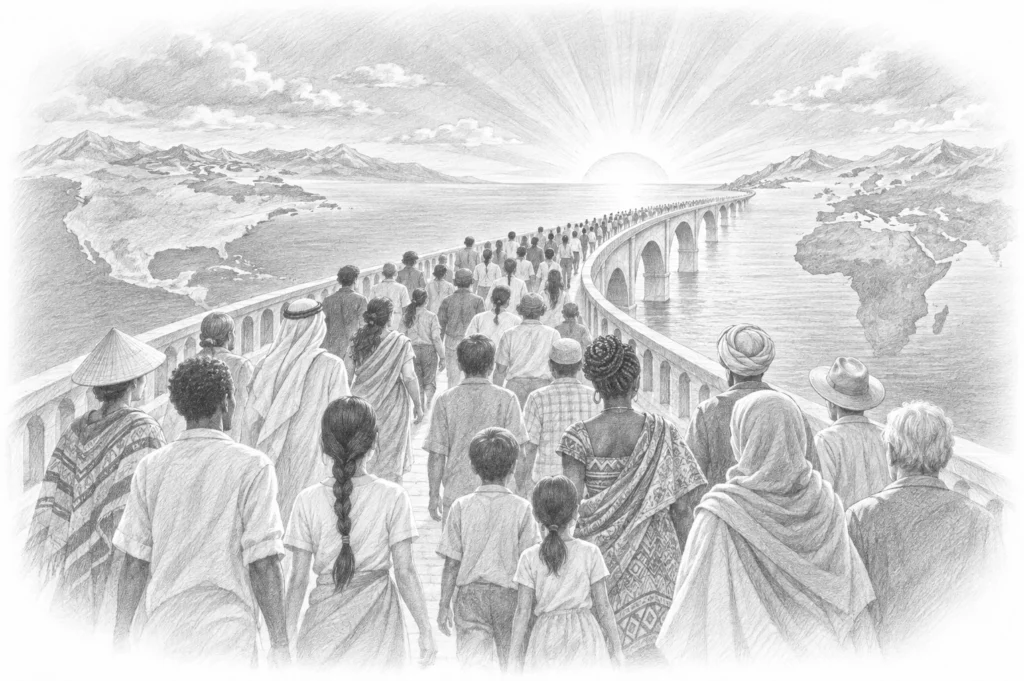
GLOBAL justice asks what we owe to people beyond our borders, and cosmopolitanism answers that every human being is a citizen of the world with equal moral worth. These questions begin with an older one: how can human beings escape violence and live in peace? Thomas Hobbes saw the state as the answer, Hannah Arendt separated power from violence, and Charles Tilly studied how collective violence arises. In a globalised world of poverty, war and migration, thinkers such as Peter Singer, Thomas Pogge, Cécile Fabre, David Held and Christine Sypnowich ask whether justice must also become global.

1.1 Violence and Politics
Political thought has long asked how violence can be controlled. For Hobbes, life without a common power is a war of all against all, so people create a sovereign to keep the peace. Max Weber defined the state as the body that successfully claims a monopoly of the legitimate use of force. Arendt argued that power, which comes from people acting together, is the opposite of violence, and Tilly showed that collective violence grows out of ordinary political interaction.
1.2 Global Justice
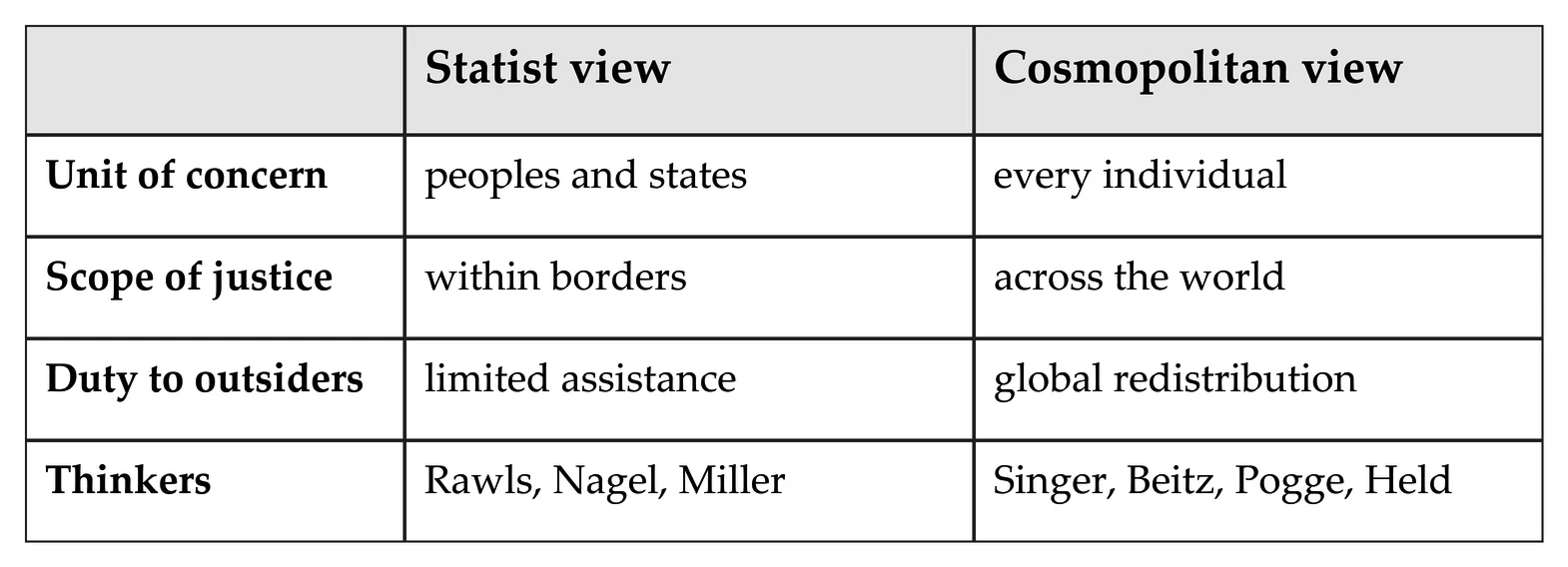
Global justice asks whether principles of justice, such as fair distribution of resources, apply to the whole world or only within states. Statists, such as John Rawls and Thomas Nagel, limit justice to political communities, with only a duty of assistance to outsiders. Cosmopolitans, such as Charles Beitz, Thomas Pogge and Peter Singer, argue that every person counts equally, so justice must cross borders.
1.3 Cosmopolitanism
Cosmopolitanism, from the Greek kosmopolitēs, citizen of the world, holds that all human beings belong to a single moral community. It goes back to the Cynics and Stoics and to Kant’s idea of perpetual peace. David Held set out principles for a cosmopolitan order and global democracy, while Christine Sypnowich links cosmopolitanism with human flourishing.
1.4 Important Questions
- Question 1 Discuss the relationship between violence and politics with reference to Hobbes and Arendt.
- Question 2 Examine Charles Tilly’s analysis of collective violence.
- Question 3 What is global justice? Discuss the debate between statist and cosmopolitan views.
- Question 4 What is cosmopolitanism? Discuss David Held’s principles of cosmopolitan order.
DU asks the same idea in different words. So learn one broad answer for each question below; the same answer works for every question joined by OR.
Important Question 1
Discuss the relationship between violence and politics with reference to Hobbes and Arendt.
OR
Examine Hannah Arendt’s distinction between power and violence.
OR
How does Hobbes explain the need for the state in the face of violence?
Model Answer
“Power and violence are opposites; where the one rules absolutely, the other is absent.”
— Hannah Arendt, On Violence (1969)
Introduction. Violence has always been part of political life, in war, revolution, repression and riots. Political theory asks whether violence is the basis of politics or its opposite. Thomas Hobbes saw the state as a remedy for violence, created by fear of death, while Hannah Arendt argued that real political power arises from people acting together and that violence destroys it.
1. Hobbes and the State of Nature
In chapter 13 of Leviathan (1651), Hobbes imagines human beings without a government. Because people are roughly equal in strength and mind, each hopes for the same things, and conflict follows. Without a common power to keep them in awe, they live in a condition of war of every man against every man.
2. Causes of Conflict
Hobbes names three principal causes of quarrel: competition, which makes people fight for gain; diffidence, or distrust, which makes them fight for safety; and glory, which makes them fight for reputation. War consists not only in actual fighting but in a known disposition to fight.
3. Life without the State
In the state of nature, Hobbes says, there is no place for industry, agriculture, trade, arts or letters, because the fruits of labour are uncertain. There is continual fear and danger of violent death, and the life of man is solitary, poor, nasty, brutish and short.
4. Laws of Nature and the Covenant
In chapter 14, Hobbes explains that reason discovers laws of nature. The first is to seek peace, and the second is to lay down one’s right to all things if others do the same. People therefore make a covenant to transfer their rights to a sovereign who can enforce peace.
5. The Sovereign’s Monopoly
For Hobbes, covenants without the sword are but words. The sovereign must hold overwhelming power to punish those who break the peace. Violence is thus removed from private hands and concentrated in the state, which becomes the guarantor of security.
6. Weber’s Definition
Max Weber, in Politics as a Vocation (1919), developed this idea, defining the state as a human community that successfully claims the monopoly of the legitimate use of physical force within a territory. Violence is the state’s special means, though not its only one.
7. Arendt’s Context
Hannah Arendt wrote On Violence in 1969, amid the Vietnam War, the nuclear arms race, student protests and the Black Power movement. She was troubled by thinkers, such as Sartre, Sorel and Fanon, who glorified violence as creative or liberating.
8. Power
Arendt defines power as the human ability not just to act but to act in concert. Power never belongs to an individual; it belongs to a group and lasts only as long as the group stays together. All governments, even tyrannies, rest ultimately on the support of people.
9. Violence
Violence, by contrast, is instrumental. It depends on implements, such as weapons, and can be used by a few against many. It may achieve short-term goals, but it can never be the essence of government, because it always needs guidance and justification from ends outside itself.
10. Power and Violence as Opposites
For Arendt, power and violence are opposites. When governments lose power, they turn to violence, but violence can destroy power and is utterly incapable of creating it. She rejected Mao’s claim that power grows out of the barrel of a gun.
11. Other Distinctions
Arendt also distinguished strength, the property of an individual; force, the energy of natural or social movements; and authority, unquestioning recognition by those asked to obey, as with respect for a teacher or parent. Confusing these terms, she argued, hides the real nature of politics.
12. Arendt on Non-Violence
Arendt noted that Gandhi’s non-violent resistance succeeded against Britain, but she warned that against a regime such as Stalin’s or Hitler’s it might have ended in massacre. Power can defeat violence only where the opponent still depends on some legitimacy.
13. Comparing Hobbes and Arendt
Hobbes sees the state’s concentrated force as the foundation of order, while Arendt sees order as resting on power, the consent and cooperation of citizens. For Hobbes, fear holds society together; for Arendt, shared action does.
14. Structural Violence
Later thinkers widened the idea of violence. Johan Galtung, in 1969, spoke of structural violence, the harm done by unjust social structures such as poverty and discrimination, even when no one strikes a blow. This links violence with questions of justice.
15. Evaluation
Hobbes explains why states claim a monopoly of force, while Arendt reminds us that lasting government depends on power rooted in citizens’ cooperation, not on violence.
Conclusion. Thus, Hobbes saw the state as a remedy for the violence of the state of nature, concentrating force in a sovereign, and Weber defined the state by its monopoly of legitimate force. Arendt argued that power, born of acting together, is the opposite of violence, which can destroy power but never create it.
Important Question 2
Examine Charles Tilly’s analysis of collective violence.
OR
Discuss the relationship between violence, politics and globalisation.
OR
Why does collective violence occur? Discuss with examples.
Model Answer
“A state is a human community that (successfully) claims the monopoly of the legitimate use of physical force within a given territory.”
— Max Weber, Politics as a Vocation (1919)
Introduction. Collective violence, such as wars, riots, genocide, terrorism and repression, has shaped the modern world. Charles Tilly, in The Politics of Collective Violence (2003), argued that such violence is not a sudden outburst of anger but grows out of ordinary political interaction. Mark Ungar and his co-authors show how globalisation has changed the forms and actors of political violence.
1. Meaning of Collective Violence
Tilly defines collective violence as episodic social interaction that immediately inflicts physical damage on persons or objects, involves at least two perpetrators of damage, and results at least in part from coordination among those who perform the damaging acts.
2. Violence as Interaction
Tilly rejects explanations based only on ideas, such as hateful beliefs, or on impulses, such as frustration. He argues that violence arises from relations between groups, and that the same mechanisms appear in very different kinds of violence.

3. Two Dimensions
Tilly classifies collective violence along two dimensions: the salience of short-run damage, meaning how central causing harm is to the interaction, and the extent of coordination among violent actors. Combining these produces different types of violence.
4. Types of Violence
His types include violent rituals, such as gang rivalries; coordinated destruction, such as war and genocide; opportunism, such as looting; brawls; individual aggression; scattered attacks, such as sabotage; and broken negotiations, where a demonstration turns violent.
5. Violent Specialists
Tilly stresses the role of specialists in violence, such as soldiers, police, militias, gangs and guerrillas, who control the means of force. Their relations with governments and political leaders shape when and how violence occurs.
6. Mechanisms
Key mechanisms include boundary activation, which sharpens the line between us and them; polarisation, which pushes groups apart; and brokerage, through which political entrepreneurs connect and mobilise people for violent action.
7. Regimes and Violence
Tilly argues that the type of regime affects violence. Governments with high capacity and little democracy often use large-scale repression, while weak states with low capacity are prone to civil wars and violence by private armed groups.
8. Riots in India
Paul Brass described an institutionalised riot system in Indian towns, in which political actors produce communal riots for electoral gain. Ashutosh Varshney found that cities with strong inter-community associations had fewer riots, supporting the view that violence depends on social relations.
9. Globalisation’s Paradox
Ungar, Bermanzohn and Worcester argue that globalisation creates a paradox. It spreads trade, communication and democracy, but it also produces new conflicts, as societies fragment and groups resist economic and cultural change.
10. New Actors
Globalisation has weakened the state’s monopoly of violence. Terrorist networks, organised crime, private military companies and armed militias operate across borders, often financed by global flows of money and arms.
11. Terrorism
The attacks of 11 September 2001 showed that small transnational groups can inflict huge damage. The global response, including the wars in Afghanistan and Iraq, itself produced new cycles of violence.
12. State Violence
States remain major agents of violence, through war, repression and torture. Even democracies may use excessive force against protesters or minorities, which raises questions about the legitimacy of state violence.
13. Violence and Inequality
Many scholars link violence with inequality, exclusion and denial of rights. Where groups lack peaceful means to press their claims, they may turn to violence, as in many insurgencies.
14. Controlling Violence
Reducing collective violence requires capable and accountable states, democratic institutions, inter-group associations, justice for victims and international cooperation against arms trafficking and terrorism.
15. Violence in Indian Politics
India has seen many forms of collective violence: Partition violence in 1947, communal riots, caste atrocities, the anti-Sikh violence of 1984, the Gujarat violence of 2002, and insurgencies in the Northeast, Kashmir and Maoist-affected areas. Tilly’s approach helps explain how political entrepreneurs, local networks and state responses turn tensions between groups into organised violence, rather than treating such violence as spontaneous.
16. Evaluation
Tilly shows that collective violence is political and relational, while Ungar and his co-authors show how globalisation has changed its forms and actors.
Conclusion. Thus, Tilly defines collective violence as coordinated interaction that inflicts damage, and classifies it by salience of damage and coordination. Violence grows out of political relations, specialists and mechanisms such as polarisation. Globalisation, as Ungar and others argue, has created new actors and forms of violence, weakening the state’s monopoly of force.
Important Question 3
What is global justice? Discuss the debate between statist and cosmopolitan views.
OR
Do we have duties of justice to people in other countries? Discuss.
OR
Examine the arguments for global distributive justice.
Model Answer
“If it is in our power to prevent something bad from happening, without thereby sacrificing anything of comparable moral importance, we ought, morally, to do it.”
— Peter Singer, Famine, Affluence, and Morality (1972)
Introduction. Hundreds of millions of people live in extreme poverty, while others enjoy great wealth. Global justice asks whether this inequality is unjust and what duties the rich owe to the poor across borders. The debate is between statists, who limit justice to political communities, and cosmopolitans, who believe justice must extend to all human beings.
1. Meaning
Global justice concerns the fair distribution of benefits and burdens among all people in the world. It covers poverty, trade, debt, climate change, migration and the rules of international institutions, and asks who should bear responsibility for global problems.
2. Why It Matters Now
Globalisation has made the world interdependent through trade, finance, migration and environmental change. Decisions in one country affect lives elsewhere, which makes it harder to claim that justice stops at borders.
3. Singer’s Argument
Peter Singer argued that if we can prevent something bad without sacrificing anything of comparable importance, we ought to do it. Just as we should save a child drowning in a pond, we should give to relieve famine abroad, because distance does not reduce our duty.
4. Rawls’s Statist View
John Rawls, in The Law of Peoples (1999), rejected applying his difference principle globally. He argued that well-ordered peoples have only a duty of assistance to burdened societies, to help them build just institutions, after which no further redistribution is required.
5. Nagel and Miller
Thomas Nagel argued that duties of justice arise only among people who share a sovereign state that coerces them in their name. David Miller, a nationalist, argued that nations are responsible for their own fate, so global duties are limited to protecting basic human rights.
6. Beitz’s Cosmopolitanism
Charles Beitz, in 1979, argued that the world is a scheme of social cooperation through trade and interdependence, so Rawls’s principles should apply globally. He proposed a resource redistribution principle, since the distribution of natural resources among countries is morally arbitrary.
7. Pogge on Global Poverty
Thomas Pogge, in World Poverty and Human Rights (2002), argued that the rich are not merely failing to help but are actively harming the poor by imposing an unjust global institutional order of trade rules, debt and support for corrupt rulers. He proposed a Global Resources Dividend.
8. Fabre on Justice across Borders
Cécile Fabre, in Justice in a Changing World (2007), examines whether principles of justice stop at national borders. She sets out the case for and against global distributive justice and argues that the moral equality of persons gives strong reasons to extend justice beyond the state.
9. Positive and Negative Duties
Cosmopolitans differ on the basis of duty. Singer stresses positive duties to help, while Pogge stresses negative duties not to harm, arguing that even libertarians who reject positive duties must accept responsibility for harms caused by global institutions.
10. Global Institutions
Global justice also concerns institutions such as the World Trade Organization, the IMF and the World Bank, where rich countries have greater influence. Reforming their rules on trade, debt and voting is seen as a demand of justice.
11. Climate Justice
Climate change raises questions of global justice, since rich countries caused most historical emissions while poor countries suffer most of the harm. The principle of common but differentiated responsibilities reflects this concern.
12. Migration
Some cosmopolitans, such as Joseph Carens, argue for more open borders, since birthplace is morally arbitrary. Others defend states’ right to control immigration to protect their communities and welfare systems.
13. Criticisms of Cosmopolitanism
Critics argue that global justice lacks a global state to enforce it, ignores the value of national communities and may impose Western ideas. Others worry that redistribution may support corrupt governments rather than the poor.
14. A Middle Position
Many thinkers now take a middle position, accepting strong duties to protect basic human rights and reform unjust global institutions, while allowing special duties to fellow citizens.
15. Evaluation
The global justice debate challenges the assumption that justice ends at borders and asks the wealthy to take responsibility for global poverty and harm.
Conclusion. Thus, global justice asks whether principles of justice apply across the world. Statists such as Rawls, Nagel and Miller limit justice to political communities, while cosmopolitans such as Singer, Beitz, Pogge and Fabre extend it to all humans. Global poverty, climate change and migration make the debate urgent.
Important Question 4
What is cosmopolitanism? Discuss David Held’s principles of cosmopolitan order.
OR
Examine the idea of cosmopolitanism with reference to Held and Sypnowich.
OR
Is cosmopolitanism compatible with national belonging? Discuss.
Model Answer
“I am a citizen of the world.”
— Diogenes the Cynic, as reported by Diogenes Laertius, Lives of Eminent Philosophers
Introduction. Cosmopolitanism is the idea that all human beings belong to a single moral community and deserve equal respect, whatever their nationality. It has ancient roots but has gained new importance in an age of globalisation. David Held has set out principles for a cosmopolitan order, while Christine Sypnowich links cosmopolitanism with human flourishing.
1. Meaning
The word comes from the Greek kosmopolitēs, citizen of the world. Cosmopolitanism holds that every person is of equal moral worth and that our moral concern should extend to all humanity, not only to members of our own nation or state.
2. Ancient Roots
Diogenes the Cynic declared himself a citizen of the world. The Stoics, such as Seneca and Marcus Aurelius, taught that each person belongs to two communities: the local community of birth and the universal community of reason shared by all humans.
3. Kant’s Cosmopolitanism
Immanuel Kant, in Perpetual Peace (1795), proposed a federation of free republics to end war and a cosmopolitan right of universal hospitality, meaning that strangers should not be treated with hostility when they arrive in another land.
4. Moral and Institutional Cosmopolitanism
Moral cosmopolitanism holds that all humans are of equal worth. Institutional or political cosmopolitanism goes further, calling for global institutions, such as a world parliament or global courts, to realise this ideal.
5. Held’s Cosmopolitan Democracy
David Held argues that in a globalised world, many decisions affecting people are made beyond the nation-state. Democracy must therefore be extended through multi-layered governance, from local to regional to global levels, so that people can shape the forces that affect them.
6. Held’s First Principles
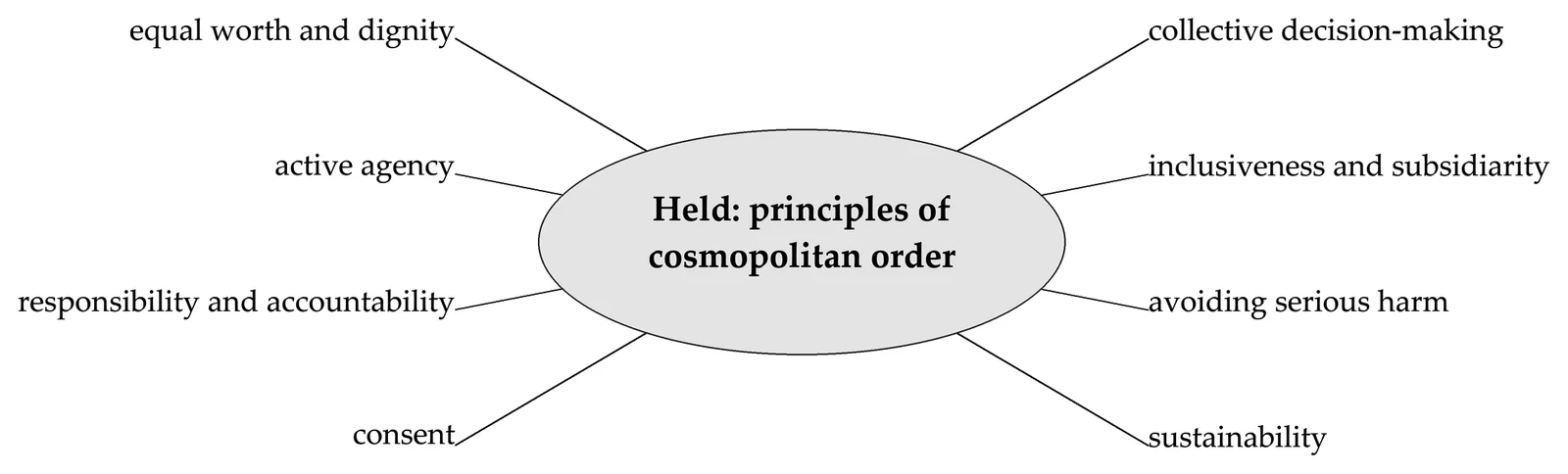
Held’s first three principles are equal worth and dignity of every person; active agency, the capacity of people to shape their lives; and personal responsibility and accountability, meaning that people must take responsibility for the effects of their actions on others.
7. Held’s Further Principles
The next principles are consent, so that collective arrangements rest on agreement; collective decision-making about public matters through voting; and inclusiveness and subsidiarity, meaning that those significantly affected by a decision should have a say, at the most appropriate level.
8. Harm and Sustainability
Held’s last two principles are the avoidance of serious harm, which gives priority to meeting urgent human needs, and sustainability, which requires that development respect the limits of the planet’s resources and the interests of future generations.
9. Held’s Institutions
Held proposes reform of the United Nations, regional parliaments, global courts of human rights, mechanisms to regulate global markets and the involvement of civil society in global governance.
10. Sypnowich on Cosmopolitanism
Christine Sypnowich distinguishes cosmopolitans, people who are open to and enjoy other cultures, from cosmopolitanism as a moral and political doctrine. She argues that cosmopolitan ideals are best grounded in concern for human flourishing, the conditions that allow people everywhere to live well.
11. Nussbaum and Appiah
Martha Nussbaum argued that our first loyalty should be to humanity, drawing circles of concern outwards. Kwame Anthony Appiah defends a rooted cosmopolitanism that combines universal concern with respect for difference and local attachments.
12. Indian Voices
Rabindranath Tagore criticised aggressive nationalism and hoped for a world not broken up into fragments by narrow domestic walls. Gandhi wanted the cultures of all lands to blow freely about his house, but refused to be blown off his feet by any.
13. Criticisms
Communitarians and nationalists argue that people find meaning in particular communities, and that global institutions would be remote and undemocratic. Realists argue that states will not give up sovereignty, and critics from the global South warn that cosmopolitanism may hide Western dominance.
14. Cosmopolitanism and Belonging
Many argue that cosmopolitanism need not reject national belonging. People can love their country while recognising duties to humanity, just as local loyalties coexist with national ones.
15. Cosmopolitan Citizenship
Cosmopolitans speak of global or cosmopolitan citizenship, in which people take part in decisions beyond their own state through international organisations, transnational social movements and global civil society. Campaigns on climate change, debt relief and landmines show citizens acting across borders. Critics reply that without a global state, such citizenship lacks the rights and institutions that make national citizenship meaningful.
16. Evaluation
Cosmopolitanism offers a powerful vision of equal human worth and global democracy, but it must respect diversity and local belonging to win wide support.
Conclusion. Thus, cosmopolitanism holds that all humans form a single moral community. From the Stoics and Kant to Held, it calls for extending democracy and justice beyond the nation-state through principles such as equal worth, consent, inclusiveness and sustainability. Sypnowich grounds it in human flourishing, and Appiah shows it can coexist with local belonging.
Short Notes
(a) State of nature
Hobbes’s picture of human life without government, a war of every man against every man in which life is solitary, poor, nasty, brutish and short.
(b) Structural violence
Johan Galtung’s term (1969) for harm caused by unjust social structures, such as poverty and discrimination, even when no direct physical violence is used.
(c) Global Resources Dividend
Thomas Pogge’s proposal for a small tax on the use of natural resources, with the proceeds used to end severe poverty across the world.
(d) Duty of assistance
John Rawls’s idea in The Law of Peoples (1999) that well-ordered peoples must help burdened societies build just institutions, in place of a global principle of redistribution.
More notes: MDSE-10 Issues in Contemporary Politics
These notes are prepared by PADHO TO AISE for study help. They are not an official University of Delhi publication.