
Semester VII MDSE-10 Issues in Contemporary Politics
Unit III · 20 min read · Updated 24 Nov 2026
As per the University of Delhi (DU) BA (Hons) Political Science syllabus
Contents
- 3.1 Human Rights and Sovereignty
- 3.2 The Humanitarian Intervention Debate
- 3.3 From Kosovo to the Responsibility to Protect
- 3.4 Important Questions
- What is humanitarian intervention? Discuss the debate between human rights and sovereignty.
- Examine the liberal case for humanitarian intervention and its critics.
- Discuss the Responsibility to Protect and its significance.
- Discuss just war theory and its application to humanitarian intervention.
- Short Notes
यदि मानवीय हस्तक्षेप संप्रभुता पर अस्वीकार्य हमला है, तो हमें रवांडा या स्रेब्रेनित्सा जैसी घटनाओं का उत्तर कैसे देना चाहिए?
If humanitarian intervention is, indeed, an unacceptable assault on sovereignty, how should we respond to a Rwanda, to a Srebrenica?
— Kofi Annan, We the Peoples: Millennium Report (2000)
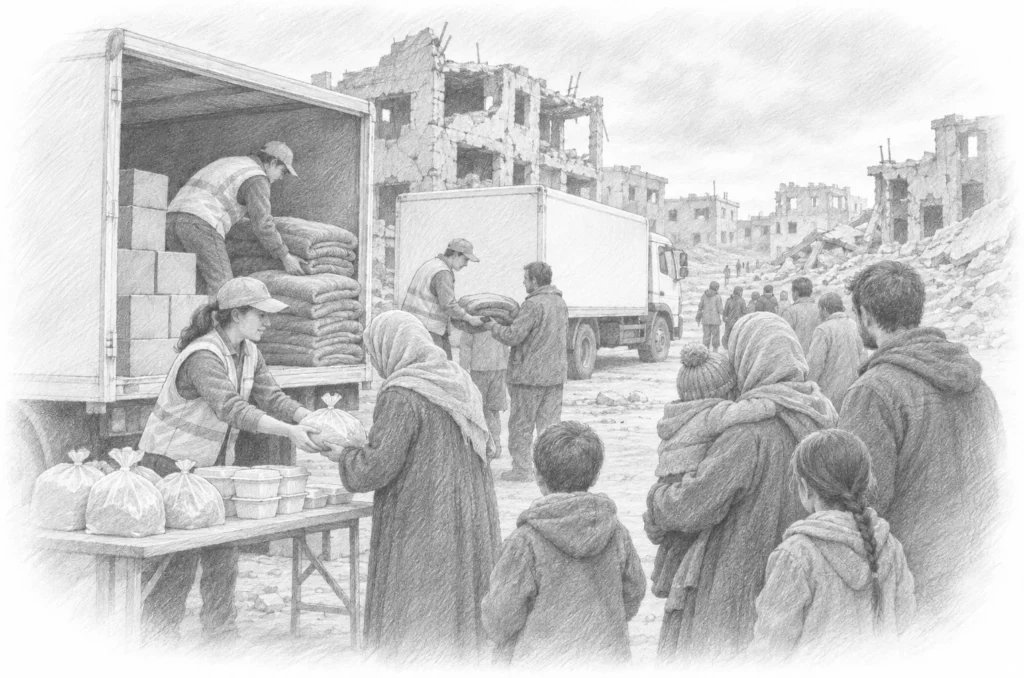
HUMANITARIAN intervention is the use of military force by outside states to stop mass atrocities inside another state. It sets two principles of world politics against each other: human rights, which belong to every person, and sovereignty, which forbids interference in a state’s internal affairs. After the failures in Rwanda and Srebrenica and the controversial NATO action in Kosovo, the world adopted the Responsibility to Protect in 2005. This chapter explains the debate, drawing on J.L. Holzgrefe, Robert Keohane, Fernando Tesón, Bhikhu Parekh, Brian Orend, C.A.J. Coady, Michael Walzer and Katherine Smits.
3.1 Human Rights and Sovereignty
Human rights are rights that belong to every person simply as a human being. Brian Orend grounds them in the vital needs of persons, such as security, subsistence, equality, freedom and recognition. Sovereignty gives each state supreme authority within its territory, and the UN Charter forbids the use of force against states except in self-defence or with Security Council authorisation. When a state commits atrocities against its own people, these two principles collide.
3.2 The Humanitarian Intervention Debate
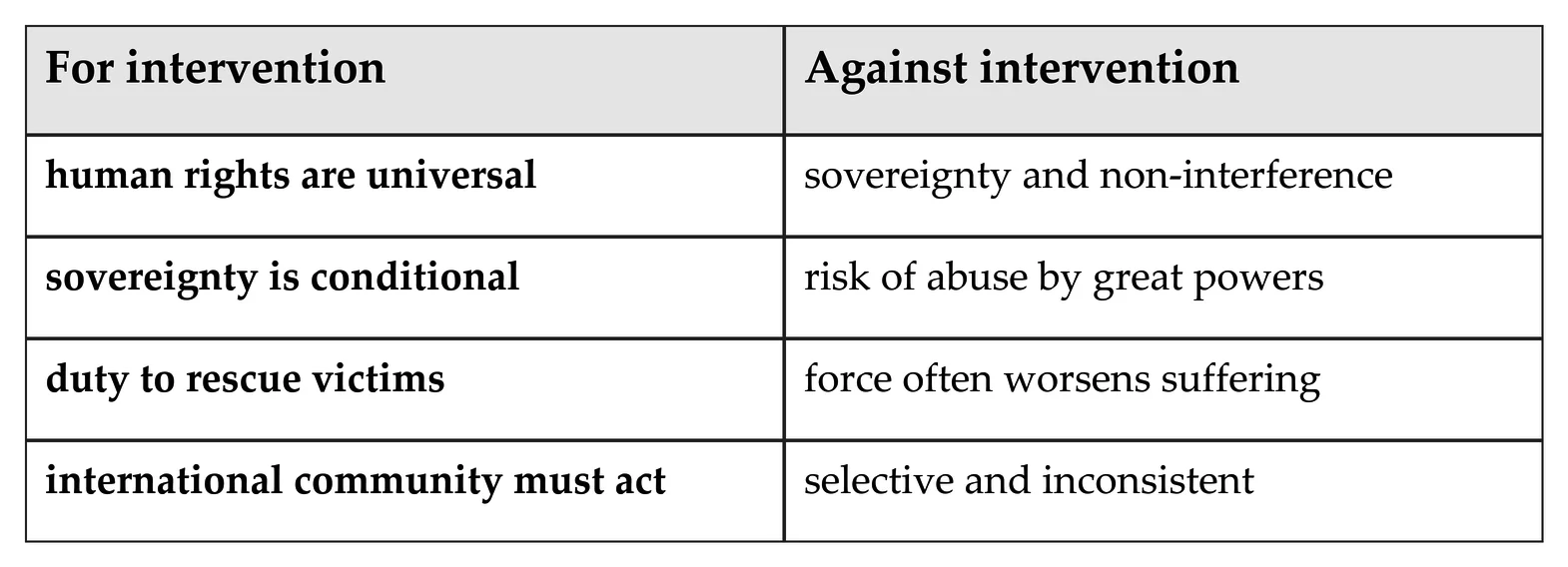
Supporters such as Tesón argue that sovereignty exists to protect human rights, so tyrants forfeit its protection. Critics argue that intervention violates international law, is often selective and self-interested, and may cause more suffering. Parekh seeks a middle path, supporting impartial, collective intervention under the United Nations, while Walzer limits it to acts that shock the moral conscience of mankind.
3.3 From Kosovo to the Responsibility to Protect
NATO bombed Serbia in 1999 to stop ethnic cleansing in Kosovo without Security Council approval, which an independent commission called illegal but legitimate. In response, the International Commission on Intervention and State Sovereignty proposed the Responsibility to Protect in 2001, and the UN endorsed it in 2005. Its use in Libya in 2011 revived fears of regime change.

3.4 Important Questions
- Question 1 What is humanitarian intervention? Discuss the debate between human rights and sovereignty.
- Question 2 Examine the liberal case for humanitarian intervention and its critics.
- Question 3 Discuss the Responsibility to Protect and its significance.
- Question 4 Discuss just war theory and its application to humanitarian intervention.
DU asks the same idea in different words. So learn one broad answer for each question below; the same answer works for every question joined by OR.
Important Question 1
What is humanitarian intervention? Discuss the debate between human rights and sovereignty.
OR
Examine the ethical, legal and political dilemmas of humanitarian intervention.
OR
Is humanitarian intervention compatible with state sovereignty? Discuss.
Model Answer
“The threat or use of force across state borders by a state (or group of states) aimed at preventing or ending widespread and grave violations of the fundamental human rights of individuals other than its own citizens, without the permission of the state within whose territory force is applied.”
— J.L. Holzgrefe, The Humanitarian Intervention Debate (2003)
Introduction. Humanitarian intervention raises one of the hardest questions in world politics: may states use force inside another state to protect people from mass atrocities? It sets the universal claims of human rights against the principle of state sovereignty and non-intervention. J.L. Holzgrefe and Robert Keohane describe the ethical, legal and political dilemmas involved.
1. Holzgrefe’s Definition
Holzgrefe defines humanitarian intervention as the threat or use of force across borders by a state or group of states to prevent or end grave violations of the human rights of people who are not its own citizens, without the permission of the target state. It excludes non-military aid and the rescue of one’s own citizens.
2. Human Rights as the Basis
Brian Orend argues that human rights protect the vital needs of every person, which he groups as personal security, material subsistence, elemental equality, personal freedom and social recognition. If these rights are universal, their mass violation concerns all humanity, not only the state where it occurs.
3. Sovereignty and Non-Intervention
Since the Peace of Westphalia in 1648, sovereignty has meant that each state has supreme authority within its territory and others must not interfere. Article 2(7) of the UN Charter protects matters within the domestic jurisdiction of states.
4. The Legal Debate
Article 2(4) of the UN Charter prohibits the use of force against any state, with exceptions only for self-defence under Article 51 and action authorised by the Security Council under Chapter VII. Restrictionists argue that unauthorised humanitarian intervention is illegal; counter-restrictionists argue that human rights norms permit it.
5. The Ethical Debate
Holzgrefe surveys ethical theories. Utilitarians judge intervention by whether it saves more lives than it costs; natural law thinkers see a duty to help the innocent; social contract theorists ask whether states have duties to outsiders; and communitarians stress the value of communities governing themselves.
6. Keohane on Dilemmas
Robert Keohane notes that humanitarian intervention involves ethical, legal and political dilemmas, as an international order built on sovereignty conflicts with a growing commitment to human rights. He suggests that sovereignty is changing and need not be treated as absolute.
7. Arguments For
Supporters argue that human rights are universal, that sovereignty is conditional on protecting citizens, that bystanders have a duty to rescue victims of genocide, and that failing to act, as in Rwanda in 1994, makes the world complicit in mass murder.
8. Arguments Against
Opponents argue that intervention violates international law, can be abused by powerful states to pursue their interests, is applied selectively, may worsen violence and undermines the self-determination of peoples.
9. Selectivity
Critics point out that intervention happens where great powers have interests, as in Libya, but not in many other crises, such as Darfur or Myanmar. This selectivity weakens the claim that intervention is purely humanitarian.
10. Views from the Global South
Many countries of the global South, including India, remember colonialism and are wary of intervention by Western powers. They stress sovereignty, non-interference and the role of the UN, while accepting that genocide must not go unchecked.
11. Rwanda and Srebrenica
The failure to stop the Rwandan genocide in 1994, when about 800,000 people were killed, and the massacre of about 8,000 Bosnian Muslim men and boys at Srebrenica in 1995 under UN protection, convinced many that non-intervention could not be absolute.
12. Annan’s Challenge
UN Secretary-General Kofi Annan asked in 2000 how, if intervention is an unacceptable assault on sovereignty, the world should respond to a Rwanda or a Srebrenica. His challenge led to the idea of the Responsibility to Protect.
13. Sovereignty as Responsibility
A new idea emerged that sovereignty is not only a right but a responsibility: states must protect their people, and when they fail, the responsibility shifts to the international community.
14. Non-Military Alternatives
Many argue that the international community should first use diplomacy, sanctions, arms embargoes, international courts and humanitarian aid, keeping military force as a last resort.
15. Evaluation
The debate shows a real conflict between two values, human rights and sovereignty, which the world has tried to reconcile through the idea of sovereignty as responsibility.
Conclusion. Thus, humanitarian intervention is the use of force across borders to stop grave human rights violations without the target state’s consent. It raises ethical, legal and political dilemmas, as Holzgrefe and Keohane show, between universal human rights and sovereignty. Failures in Rwanda and Srebrenica pushed the world towards sovereignty as responsibility.
Important Question 2
Examine the liberal case for humanitarian intervention and its critics.
OR
Discuss Tesón’s and Parekh’s views on humanitarian intervention.
OR
Can military intervention in other countries be justified on humanitarian grounds?
Model Answer
“If humanitarian intervention is, indeed, an unacceptable assault on sovereignty, how should we respond to a Rwanda, to a Srebrenica?”
— Kofi Annan, We the Peoples: Millennium Report (2000)
Introduction. The question whether military intervention can be justified on humanitarian grounds divides political theorists. Liberals such as Fernando Tesón argue strongly for intervention to protect human rights, while realists and communitarians are sceptical. Bhikhu Parekh rethinks the idea to make it less open to abuse, and Katherine Smits sets out the main arguments on each side.
1. Tesón’s Liberal Case
Fernando Tesón argues that the purpose of states is to protect the rights of individuals. A government that seriously violates the rights of its people loses its legitimacy, so its sovereignty does not protect it from intervention aimed at ending tyranny or anarchy.
2. Conditions in Tesón
Tesón accepts that intervention must meet conditions: the violations must be severe, the intervention must be proportionate, it must be welcomed by the victims, and it must aim at restoring human rights. He argues that the motive of the intervener matters less than the humanitarian result.
3. The Realist Critique
Realists argue that states act only in their national interest, so humanitarian claims often hide strategic motives. They also warn that interventions are costly and that states should not risk their soldiers for causes that do not affect their security.
4. The Communitarian Critique
Communitarians argue that political communities have a right to determine their own affairs. John Stuart Mill, in ‘A Few Words on Non-Intervention’ (1859), argued that a people must win its own freedom, since liberty given from outside is unlikely to last.
5. Parekh’s Rethinking
Bhikhu Parekh, in ‘Rethinking Humanitarian Intervention’ (1997), criticises both rigid sovereignty and Western liberal interventionism. He values the political community as the collective life of a people, but argues that it cannot shelter a state that brutalises its citizens or has collapsed into civil war.
6. Parekh’s Conditions
Parekh argues that intervention should be collective, preferably under the United Nations, impartial and guided by a sense of humanity rather than national interest. Its aim should be to help a society restore political order and resolve its conflicts, not to impose an outside model.
7. Smits on the Arguments
Katherine Smits presents the debate as one between cosmopolitans, who stress universal human rights and a duty to rescue, and those who stress sovereignty, self-determination and the risks of war. She shows that the answer depends on how we weigh these values and judge consequences.
8. Coady’s Caution
C.A.J. Coady argues that war is a terrible means, which always kills innocent people and has uncertain results. He is sceptical of armed humanitarian intervention and urges that non-violent forms of intervention be preferred wherever possible.
9. Motives and Outcomes
A key issue is whether mixed motives disqualify an intervention. Many argue that no state acts from pure humanitarianism, so what matters is whether the intervention actually protects people and is proportionate.
10. India and Bangladesh
India’s intervention in East Pakistan in 1971, after mass killings and the flight of about ten million refugees, is often cited as a case of humanitarian intervention, though India justified it mainly as self-defence. Vietnam’s intervention in Cambodia in 1978 and Tanzania’s in Uganda in 1979 are other examples.
11. Kosovo
NATO’s bombing of Serbia in 1999 to stop ethnic cleansing in Kosovo was carried out without Security Council approval. The Independent International Commission on Kosovo described it as illegal but legitimate, showing the gap between law and morality.
12. Libya
In 2011, the Security Council authorised force in Libya to protect civilians. However, the intervention ended in the overthrow of Gaddafi and years of instability, which convinced critics that humanitarian intervention can become a cover for regime change.
13. Selectivity and Double Standards
Critics note that intervention has occurred in some cases but not in others, such as Syria, where vetoes blocked action, or Gaza, raising questions of double standards and the influence of great-power interests.
14. A Balanced View
Many scholars now accept that intervention can be justified in extreme cases of genocide or mass atrocity, but only under strict conditions, collective authority and with a plan for rebuilding.
15. Somalia and Its Lessons
In 1992, the Security Council authorised a US-led force to secure food deliveries in Somalia, where civil war and famine had killed hundreds of thousands. After eighteen American soldiers died in Mogadishu in October 1993, the United States withdrew. This experience made Western governments reluctant to risk troops in humanitarian missions and contributed to the failure to act in Rwanda the following year.
16. Evaluation
The liberal case rightly stresses universal rights, but critics show that intervention is risky and open to abuse, so it must be rare, collective and carefully limited.
Conclusion. Thus, Tesón argues that tyrants forfeit sovereignty, so intervention to protect rights is justified, while realists, communitarians such as Mill and sceptics such as Coady warn of abuse and harm. Parekh calls for impartial, collective intervention under the UN, and cases such as Kosovo and Libya show the dilemmas involved.
Important Question 3
Discuss the Responsibility to Protect and its significance.
OR
Examine the evolution of the Responsibility to Protect since 2001.
OR
Has the Responsibility to Protect resolved the dilemma of humanitarian intervention?
Model Answer
“Each individual State has the responsibility to protect its populations from genocide, war crimes, ethnic cleansing and crimes against humanity.”
— UN World Summit Outcome Document (2005), paragraph 138
Introduction. The Responsibility to Protect, known as R2P, is the principle that states have a responsibility to protect their people from mass atrocities, and that the international community must act when they fail. It emerged in response to the failures of the 1990s and the controversy over Kosovo, and it was endorsed by the United Nations in 2005.
1. Background
The 1990s saw genocide in Rwanda, ethnic cleansing in Bosnia and the controversial NATO intervention in Kosovo. These events showed that the world lacked agreed rules on when to intervene, leaving it torn between inaction and unauthorised action.
2. The ICISS Report
In 2001, the International Commission on Intervention and State Sovereignty, set up by Canada and co-chaired by Gareth Evans and Mohamed Sahnoun, published The Responsibility to Protect. It shifted the debate from the right of states to intervene to the responsibility to protect people.

3. Three Responsibilities
The commission described a responsibility to prevent atrocities by addressing their causes, a responsibility to react to situations of compelling need, by force only in extreme cases, and a responsibility to rebuild after intervention.
4. Criteria for Force
The commission set criteria for military intervention: right authority, preferably the Security Council; just cause, such as large-scale loss of life or ethnic cleansing; right intention; last resort; proportional means; and reasonable prospects of success.
5. The 2005 World Summit
At the World Summit of 2005, all UN members accepted, in paragraphs 138 and 139 of the Outcome Document, that each state must protect its people from genocide, war crimes, ethnic cleansing and crimes against humanity, and that the international community may act collectively through the Security Council when states manifestly fail.
6. The Three Pillars
In 2009, Secretary-General Ban Ki-moon described R2P in three pillars: the protection responsibilities of each state; international assistance and capacity-building to help states; and timely and decisive collective response when a state manifestly fails to protect its people.
7. Sovereignty as Responsibility
R2P rests on the idea, developed by Francis Deng and others, that sovereignty is a responsibility, not a licence. A state that protects its people enjoys full sovereignty, but one that commits atrocities cannot hide behind it.
8. Libya, 2011
Security Council Resolution 1973 of March 2011 authorised all necessary measures to protect civilians in Libya. India, China, Russia, Brazil and Germany abstained. The NATO-led operation contributed to the fall of Gaddafi, leading critics to accuse the West of using R2P for regime change.
9. Responsibility while Protecting
In 2011, Brazil proposed the idea of responsibility while protecting, arguing that those who use force under R2P must be accountable, use force only as a last resort and monitor how mandates are carried out.
10. Syria and Myanmar
In Syria, Russian and Chinese vetoes blocked strong Security Council action despite mass killings, and the international response to the violence against the Rohingya in Myanmar from 2017 was weak, showing the limits of R2P.
11. Prevention
Supporters stress that R2P is mainly about prevention, through early warning, mediation, development and human rights protection, rather than military action, which should be the rare exception.
12. India’s Position
India accepts the principle that states must protect their people but stresses sovereignty, the central role of the UN and caution about the use of force. Its abstention on Libya reflected concern about the misuse of R2P.
13. Achievements
R2P has created a shared language about mass atrocities, made it harder for governments to claim that atrocities are purely internal matters, and encouraged prevention and protection of civilians in UN peacekeeping.
14. Limitations
R2P depends on the Security Council, where the veto powers can block action, so it is applied selectively. It does not resolve the conflict between law and morality when the Council is paralysed.
15. Protection of Civilians in Peacekeeping
Since 1999, many UN peacekeeping missions, such as those in the Democratic Republic of the Congo and South Sudan, have been given mandates to protect civilians, if necessary by force. This links R2P with peacekeeping. India, one of the largest contributors of peacekeepers, supports civilian protection within UN mandates while stressing the consent of host states and impartiality.
16. Evaluation
R2P has reframed the debate around protection and responsibility, but great-power politics continues to decide when and where it is applied.
Conclusion. Thus, the Responsibility to Protect, proposed by the ICISS in 2001 and endorsed by the UN in 2005, holds that states must protect their people from four mass atrocity crimes and that the international community must act when they fail. Its three pillars stress prevention, but Libya and Syria show that politics limits its use.
Important Question 4
Discuss just war theory and its application to humanitarian intervention.
OR
Examine Walzer’s view of humanitarian intervention.
OR
What principles should govern the use of force for humanitarian purposes?
Model Answer
“Humanitarian intervention is justified when it is a response (with reasonable expectations of success) to acts that shock the moral conscience of mankind.”
— Michael Walzer, Just and Unjust Wars (1977)
Introduction. Just war theory is a tradition of thought about when war may be fought and how it must be conducted. It provides a framework for judging humanitarian intervention, which is itself a form of war. Michael Walzer, Brian Orend and C.A.J. Coady have applied just war principles to intervention, reaching different conclusions.
1. The Just War Tradition
The just war tradition developed from Augustine and Thomas Aquinas to Hugo Grotius and modern international law. It stands between pacifism, which rejects all war, and realism, which sees war as a matter of interest beyond moral judgement.
2. Jus ad Bellum
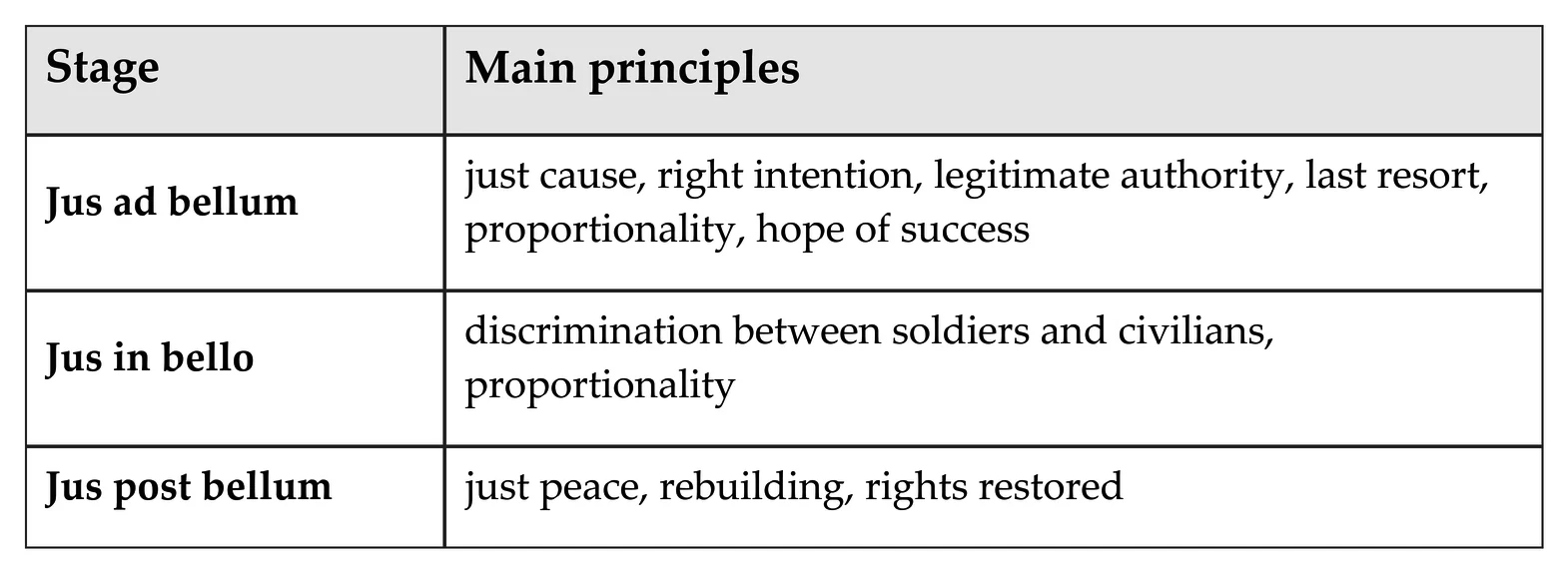
Jus ad bellum, justice in going to war, requires a just cause, right intention, legitimate authority, public declaration, last resort, proportionality between expected good and harm, and a reasonable probability of success.
3. Jus in Bello
Jus in bello, justice in the conduct of war, requires discrimination between combatants and civilians, so that civilians are not deliberately attacked, and proportionality in the use of force. These rules apply to humanitarian interventions as to other wars.
4. Jus post Bellum
Brian Orend developed jus post bellum, justice after war. A just war must end in a just peace that restores rights, punishes war criminals fairly, avoids revenge on the defeated people and helps rebuild the society.
5. Walzer’s Legalist Paradigm
Michael Walzer, in Just and Unjust Wars (1977), set out a legalist paradigm in which states have rights to territorial integrity and political independence, and aggression is the central crime. Normally, intervention in another state’s affairs is wrong.
6. Walzer’s Exceptions
Walzer allows exceptions: assisting a secessionist movement that represents a distinct community, counter-intervention to balance another power’s intervention, and humanitarian intervention in response to massacre or enslavement that shocks the moral conscience of mankind.
7. Walzer’s Communitarian Basis
Walzer’s view rests on respect for political communities’ right to determine their own affairs. Only when a government turns against its people in extreme ways, as in genocide, does the presumption of non-intervention give way.
8. Coady’s Scepticism
C.A.J. Coady applies just war principles strictly. He argues that armed intervention rarely meets the tests of last resort, proportionality and reasonable hope of success, because war kills innocents and often produces unforeseen harm.
9. Legitimate Authority
Who has authority to intervene is a key question. Many argue that only the UN Security Council has legitimate authority, while others accept regional organisations or coalitions when the Council is blocked, as in Kosovo.
10. Right Intention
Right intention requires that the main aim be to protect people, not to gain territory, resources or influence. Since states usually have mixed motives, many accept intervention if the humanitarian aim is dominant.
11. Proportionality and Success
Intervention must not cause more harm than it prevents and must have a reasonable chance of success. The heavy civilian costs and long instability after some interventions show how hard these tests are to meet.
12. Protecting Civilians
Humanitarian interventions using air power, as in Kosovo and Libya, have been criticised for civilian casualties and damage to infrastructure, raising questions about discrimination and proportionality.
13. Rebuilding
The failures after interventions, as in Libya, show the importance of jus post bellum. Intervention must include plans for restoring order, protecting rights and helping people rebuild their political institutions.
14. Just War and R2P
The ICISS criteria for the Responsibility to Protect, such as just cause, right intention, last resort, proportional means and reasonable prospects, are drawn directly from the just war tradition.
15. Last Resort
The principle of last resort requires that all reasonable peaceful means, such as diplomacy, mediation, sanctions and the threat of prosecution, be tried before force is used. Critics of the Libya intervention argued that negotiations were abandoned too quickly, while supporters replied that waiting for every peaceful option to fail can mean arriving after a massacre has already happened.
16. Evaluation
Just war theory provides a useful framework for judging humanitarian intervention, setting strict tests that few interventions fully meet.
Conclusion. Thus, just war theory judges intervention by jus ad bellum, jus in bello and jus post bellum. Walzer permits humanitarian intervention only against acts that shock the moral conscience of mankind, Orend stresses justice after war and Coady doubts that armed intervention usually meets these tests. Its principles shaped the Responsibility to Protect.
Short Notes
(a) Responsibility to Protect
The principle, proposed in 2001 and endorsed by the UN in 2005, that states must protect their people from genocide, war crimes, ethnic cleansing and crimes against humanity, and that the international community must act when they fail.
(b) Illegal but legitimate
The judgement of the Independent International Commission on Kosovo on NATO’s 1999 intervention, which lacked Security Council approval but was seen as morally justified.
(c) Jus post bellum
Justice after war, developed by Brian Orend and others: a just war must end in a just peace that restores rights and rebuilds society.
(d) Legalist paradigm
Michael Walzer’s account of international society as a society of states with rights to territorial integrity and political independence, in which aggression is the central crime and intervention is normally wrong.
More notes: MDSE-10 Issues in Contemporary Politics
These notes are prepared by PADHO TO AISE for study help. They are not an official University of Delhi publication.