
Semester VII MDSE-10 Issues in Contemporary Politics
Unit IV · 20 min read · Updated 24 Nov 2026
As per the University of Delhi (DU) BA (Hons) Political Science syllabus
Contents
- 4.1 Anthropocentrism and Ecocentrism
- 4.2 Third World Political Ecology
- 4.3 Responsibility to Future Generations
- 4.4 Important Questions
- Distinguish between anthropocentrism and ecocentrism. Discuss Eckersley’s ecocentric approach.
- What is political ecology? Discuss the politics of environment in the Third World.
- Do we have obligations to future generations? Discuss with reference to the environment.
- Discuss the idea of political responsibility in the context of climate change.
- Short Notes
प्रकृति में कुछ भी अकेला नहीं होता।
In nature nothing exists alone.
— Rachel Carson, Silent Spring (1962)
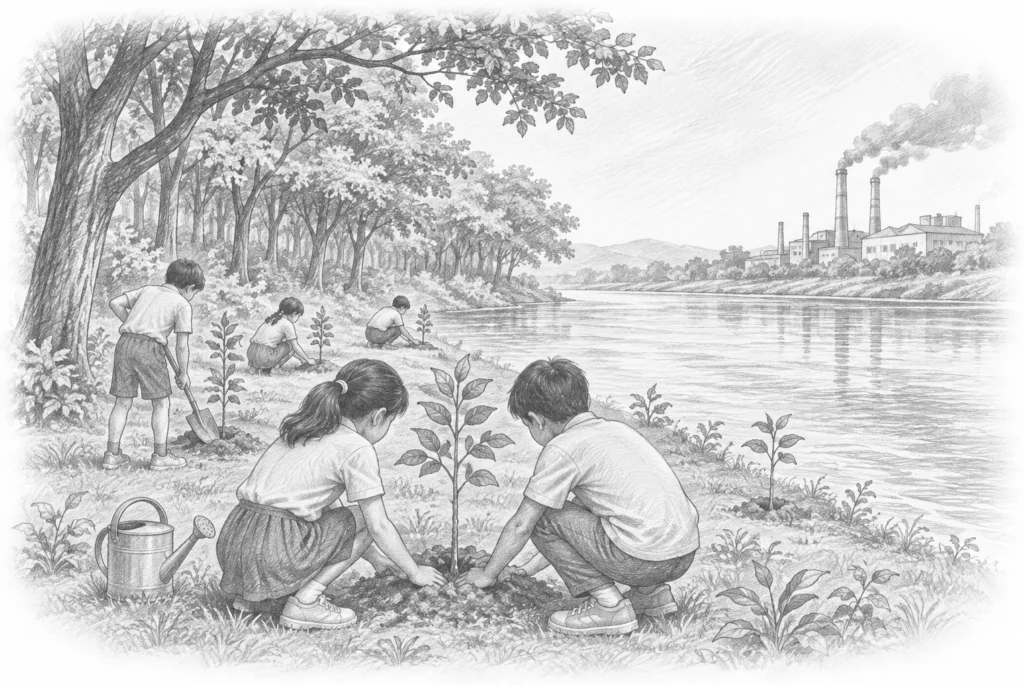
ECOLOGY studies the relations between living things and their environment, and ecological crises, from deforestation to climate change, have made these relations a political question. Who is responsible for protecting nature, and on whose behalf: present humans, future generations or nature itself? Robyn Eckersley argues for an ecocentric politics, Raymond Bryant and Sinéad Bailey show how environmental change in the Third World is shaped by unequal power, and Dale Jamieson and Katherine Smits ask what we owe to future generations. This chapter explains these debates with examples from India.
4.1 Anthropocentrism and Ecocentrism
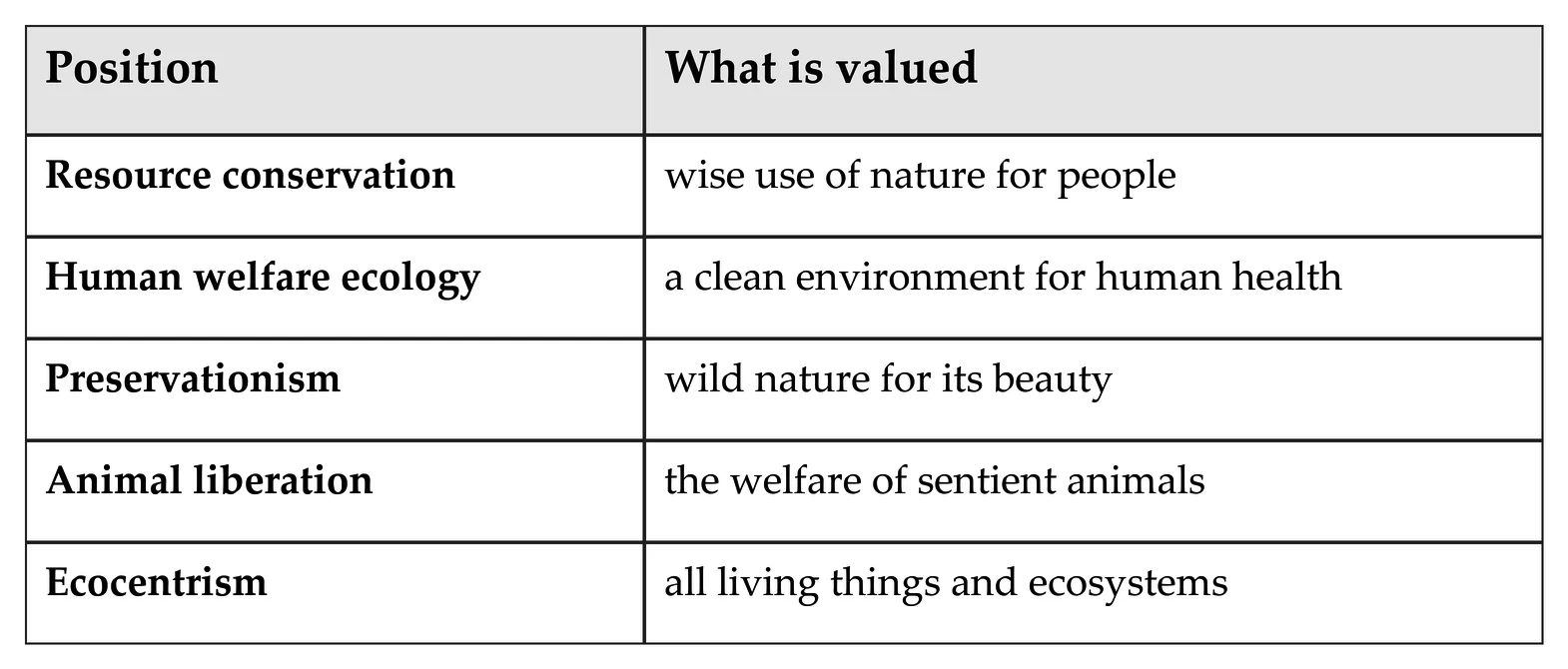
Anthropocentrism holds that only human beings have intrinsic value and that nature matters only as a resource for people. Ecocentrism holds that ecosystems, species and all living things have value in themselves. Robyn Eckersley places environmental thought on a spectrum from resource conservation to ecocentrism and argues for an ecocentric political theory that extends emancipation to the non-human world.
4.2 Third World Political Ecology
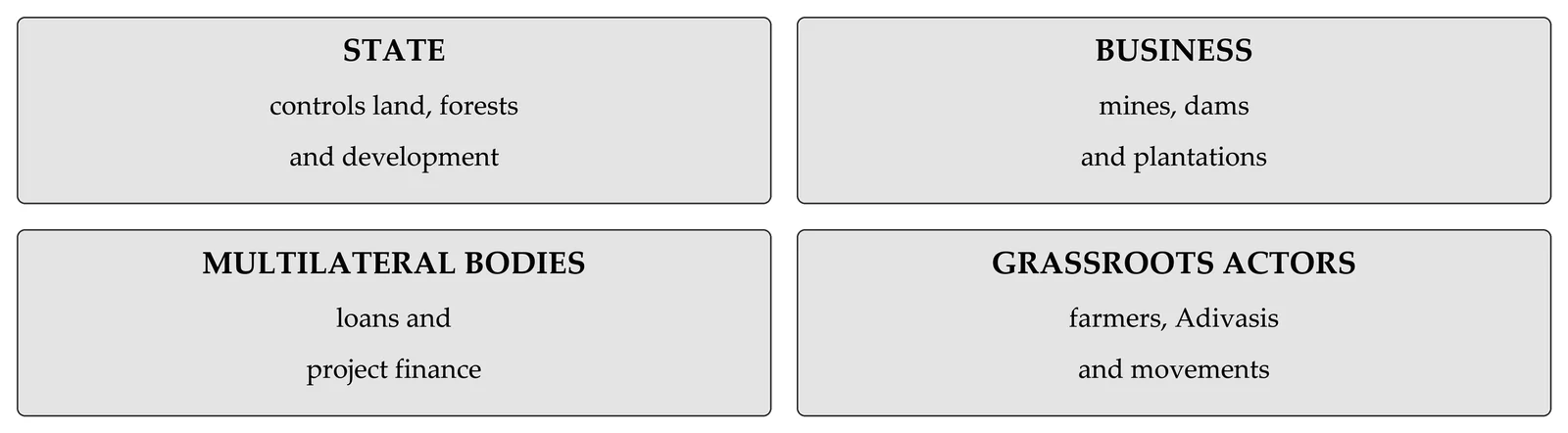
Political ecology studies how power shapes environmental change. Bryant and Bailey argue that in the Third World the costs and benefits of environmental change are shared unequally, usually reinforcing the disadvantages of the poor. The state, business, multilateral institutions, NGOs and grassroots actors struggle over land, forests and water, as movements such as Chipko and the Narmada Bachao Andolan show.
4.3 Responsibility to Future Generations
Environmental decisions affect people not yet born. The Brundtland Report (1987) defined sustainable development as meeting present needs without compromising the ability of future generations to meet theirs. Thinkers such as Hans Jonas and Katherine Smits ask what we owe the future, while climate change raises the question of how responsibility should be shared among countries and generations.

4.4 Important Questions
- Question 1 Distinguish between anthropocentrism and ecocentrism. Discuss Eckersley’s ecocentric approach.
- Question 2 What is political ecology? Discuss the politics of environment in the Third World.
- Question 3 Do we have obligations to future generations? Discuss with reference to the environment.
- Question 4 Discuss the idea of political responsibility in the context of climate change.
DU asks the same idea in different words. So learn one broad answer for each question below; the same answer works for every question joined by OR.
Important Question 1
Distinguish between anthropocentrism and ecocentrism. Discuss Eckersley’s ecocentric approach.
OR
Examine the main currents of environmental political thought.
OR
Does nature have value in itself? Discuss.
Model Answer
“A thing is right when it tends to preserve the integrity, stability, and beauty of the biotic community. It is wrong when it tends otherwise.”
— Aldo Leopold, A Sand County Almanac (1949)
Introduction. Environmental political thought asks why and how nature should be protected. The central divide is between anthropocentrism, which values nature for human purposes, and ecocentrism, which values nature for its own sake. Robyn Eckersley, in Environmentalism and Political Theory (1992), maps the range of positions and argues for an ecocentric approach to politics.
1. Anthropocentrism
Anthropocentrism places human beings at the centre of moral concern. Nature has instrumental value as a source of food, raw materials, beauty and health. Protecting the environment is justified because it serves human interests, now and in the future.
2. Ecocentrism
Ecocentrism holds that the natural world, including species, ecosystems and the earth as a whole, has intrinsic value, independent of human use. Humans are one part of a wider community of life and have no right to destroy it for their convenience.
3. Eckersley’s Spectrum
Eckersley describes a spectrum of environmental thought: resource conservation, which seeks wise use of resources; human welfare ecology, which seeks a healthy environment for people; preservationism, which protects wilderness for its beauty; animal liberation; and ecocentrism, which values all life and ecosystems.
4. Resource Conservation
Resource conservation, associated with Gifford Pinchot in the United States, aims at the efficient and sustainable use of natural resources for the greatest good of the greatest number over time. It is fully anthropocentric.
5. Animal Liberation
Peter Singer, in Animal Liberation (1975), argued that the capacity to suffer gives animals moral standing and attacked speciesism, the unjustified preference for one’s own species. Tom Regan argued that animals have rights. These views extend moral concern beyond humans but focus on individual sentient beings.
6. Leopold’s Land Ethic
Aldo Leopold, in A Sand County Almanac (1949), proposed a land ethic that enlarges the community to include soils, waters, plants and animals. An action is right when it preserves the integrity, stability and beauty of the biotic community.
7. Deep Ecology
Arne Naess, in 1973, contrasted shallow ecology, concerned with pollution and resource depletion for the health of rich countries, with deep ecology, which recognises the intrinsic value of all life. Naess and George Sessions later set out a platform calling for reduced human interference with nature.
8. Eckersley’s Ecocentric Approach
Eckersley argues that ecocentrism offers the most comprehensive environmental philosophy. She sees it as an extension of emancipatory thought: just as politics has sought to free oppressed humans, it should also respect the flourishing of non-human beings and ecosystems.
9. Eckersley on Political Forms
Eckersley rejects eco-authoritarianism, the view that only a strong state can impose ecological limits, and doubts that small self-governing communities alone can solve global problems. She favours a democratic political order that takes ecological values seriously at many levels.
10. Environmentalism and Ecologism
Michael Clark and Andrew Dobson distinguish environmentalism, a managerial approach that seeks to solve environmental problems within existing values and economies, from ecologism, a radical ideology that calls for deep changes in our relationship with nature and in patterns of production and consumption.
11. Social Ecology and Ecofeminism
Murray Bookchin’s social ecology argues that the domination of nature arises from the domination of humans by humans. Ecofeminists, such as Vandana Shiva in Staying Alive (1988), link the exploitation of nature with the oppression of women.
12. Guha’s Critique
Ramachandra Guha, in 1989, criticised deep ecology from a Third World perspective, arguing that its focus on wilderness preservation ignored the needs of the poor and had been used to displace forest dwellers from protected areas in countries like India.
13. Indian Traditions
Indian traditions such as the Bishnoi community’s protection of trees and animals, sacred groves and Gandhi’s idea of limited wants are often cited as sources of ecological respect, though practice has often differed from these ideals.
14. Criticisms of Ecocentrism
Critics argue that ecocentrism is vague about how to weigh human needs against nature, may justify harsh measures against the poor, and is hard to turn into policy. Defenders reply that it challenges the assumption that nature exists only for humans.
15. Evaluation
The debate between anthropocentrism and ecocentrism shapes how societies value nature, and Eckersley shows how ecocentric values can inform democratic politics.
Conclusion. Thus, anthropocentrism values nature for human ends, while ecocentrism sees intrinsic value in all life. Eckersley maps a spectrum from resource conservation to ecocentrism and argues for an ecocentric, emancipatory and democratic politics. Deep ecology, the land ethic and ecofeminism enrich the debate, while Guha reminds us of the needs of the poor.
Important Question 2
What is political ecology? Discuss the politics of environment in the Third World.
OR
Examine Bryant and Bailey’s approach to Third World political ecology.
OR
Discuss the environmentalism of the poor with reference to India.
Model Answer
“The earth provides enough to satisfy every man’s needs, but not every man’s greed.”
— M.K. Gandhi, as recorded by Pyarelal, Mahatma Gandhi: The Last Phase
Introduction. Environmental problems are not only technical or natural; they are shaped by power, interests and inequality. Political ecology studies these political dimensions of environmental change. Raymond Bryant and Sinéad Bailey, in Third World Political Ecology (1997), examine how different actors struggle over the environment in developing countries, where the poor depend most directly on natural resources.
1. Meaning of Political Ecology
Political ecology studies the relationship between political, economic and social factors and environmental change. It asks who controls natural resources, who benefits from their use, who bears the costs of degradation and how environmental conflicts are fought.
2. The Politicised Environment
Bryant and Bailey argue that the environment is politicised. They assume that the costs and benefits of environmental change are distributed unequally, that this reinforces or reduces existing social and economic inequalities, and that it therefore changes the balance of power among actors.
3. Actor-Based Approach
Bryant and Bailey focus on actors and their interests: the state, multilateral institutions, businesses, environmental NGOs and grassroots actors. Each has different power, resources and goals, and their interactions shape environmental outcomes.
4. The State
The state plays a contradictory role: it is both a developer, promoting dams, mines and industry for growth, and a steward, responsible for protecting the environment. In practice, development goals often override environmental protection.
5. Business and Multilateral Institutions
Businesses, including transnational companies, seek access to resources such as minerals, timber and water. Multilateral institutions such as the World Bank have financed large projects, such as dams, that caused displacement and environmental damage.
6. Grassroots Actors
Grassroots actors, such as poor farmers, fishers, pastoralists and Adivasis, depend directly on land, forests and water. They are often the main victims of environmental degradation but also resist it through movements and everyday practices.
7. Environmentalism of the Poor
Ramachandra Guha and Joan Martinez-Alier describe an environmentalism of the poor, in which struggles over nature are struggles for livelihood and survival, unlike the wilderness-focused environmentalism of rich countries.
8. Colonial Forestry
Madhav Gadgil and Ramachandra Guha showed that colonial forest laws, such as the Indian Forest Act of 1878, took forests away from local communities for commercial timber, causing both ecological damage and conflict, a legacy continued after independence.
9. Chipko
The Chipko movement began in 1973 in the Garhwal Himalaya, when villagers, including women led by figures such as Gaura Devi, hugged trees to stop commercial logging. It became a symbol of community control over forests.
10. Narmada Bachao Andolan
The Narmada Bachao Andolan, led by Medha Patkar from the late 1980s, opposed large dams on the Narmada that displaced hundreds of thousands of people. Its campaign led the World Bank to withdraw from the Sardar Sarovar project in 1993.
11. Niyamgiri and Forest Rights
In 2013, after a Supreme Court judgment, the gram sabhas of the Dongria Kondh in Niyamgiri, Odisha, rejected bauxite mining on their sacred hills. The Forest Rights Act of 2006 recognises the rights of forest-dwelling communities over land and resources.
12. North–South Dimensions
Political ecology also highlights global inequalities: rich countries consume most resources and produce most waste and emissions, while poor countries supply raw materials and suffer environmental harm.
13. Environmental NGOs
Environmental NGOs campaign, research and support local struggles, but some international NGOs have been criticised for promoting conservation models that exclude local communities.
14. Criticisms
Critics argue that political ecology may underplay ecological processes and overemphasise conflict, and that local communities are not always ecologically wise. Supporters reply that it reveals the power relations hidden behind environmental problems.
15. Water and Commons
Conflicts over water show political ecology at work. In Plachimada, Kerala, villagers and the panchayat campaigned from 2002 against a soft drinks bottling plant blamed for depleting and polluting groundwater, and the plant stopped production. Such struggles show how control over common resources such as water, grazing land and fisheries decides who prospers and who loses.
16. Evaluation
Political ecology shows that environmental problems in the Third World are inseparable from questions of power, poverty and justice.
Conclusion. Thus, political ecology studies how power shapes environmental change. Bryant and Bailey show that the environment is politicised, with costs falling on the poor and actors such as the state, business and grassroots groups struggling over resources. Chipko, Narmada and Niyamgiri show India’s environmentalism of the poor.
Important Question 3
Do we have obligations to future generations? Discuss with reference to the environment.
OR
Should the natural environment be protected for future generations?
OR
Examine the idea of sustainable development and intergenerational justice.
Model Answer
“Sustainable development is development that meets the needs of the present without compromising the ability of future generations to meet their own needs.”
— World Commission on Environment and Development, Our Common Future (1987)
Introduction. Many of today’s environmental choices, such as burning fossil fuels, cutting forests and using up groundwater, will affect people who are not yet born. This raises the question of intergenerational justice: what do we owe to future generations? Katherine Smits examines whether the environment should be protected for them, and thinkers from Burke and Rawls to Jonas and Parfit have offered different answers.
1. The Problem
Future generations cannot vote, bargain or protest against our decisions, yet they will live with the consequences. Climate change, species extinction and nuclear waste may affect people for centuries, making our responsibility to them an urgent political question.
2. Burke’s Partnership
Edmund Burke described society as a partnership not only between the living, but between those who are living, those who are dead and those who are to be born. This idea suggests that each generation holds the world in trust for the next.
3. Rawls’s Just Savings
John Rawls, in A Theory of Justice (1971), proposed a just savings principle. Behind the veil of ignorance, not knowing which generation they belong to, people would agree that each generation should pass on enough to allow just institutions to be maintained.
4. Jonas’s Imperative
Hans Jonas, in The Imperative of Responsibility, argued that modern technology gives us power over the distant future, requiring a new ethics. His imperative is to act so that the effects of our actions are compatible with the permanence of genuine human life.
5. Parfit’s Non-Identity Problem
Derek Parfit, in Reasons and Persons (1984), raised the non-identity problem. Our policies affect which people will be born, so future people cannot complain that a policy harmed them if, without it, they would never have existed. This makes the idea of harming the future puzzling.
6. Answering Parfit
Many reply that we can wrong future generations by leaving them a worse world, whoever they turn out to be. Our duty is to ensure that whoever lives in the future enjoys conditions for a decent life.
7. Smits on Protecting Nature
Katherine Smits sets out arguments for protecting the environment for future generations: duties of justice, the value of nature itself and the risks of irreversible harm. She also discusses objections, such as uncertainty about future preferences and technological change.
8. Discounting
Economists often discount future costs and benefits, giving them less weight than present ones. Critics argue that discounting the well-being of future people simply because they are distant in time is unjust.
9. Sustainable Development
The Brundtland Report of 1987 defined sustainable development as meeting present needs without compromising future generations. It linked environment with development and poverty, and influenced the Rio Earth Summit of 1992 and the Sustainable Development Goals of 2015.
10. The Precautionary Principle
The precautionary principle states that where there are threats of serious or irreversible damage, lack of full scientific certainty should not be used to postpone measures to prevent harm. It protects future generations against uncertain risks.
11. Indian Constitution
The 42nd Amendment of 1976 added Article 48A, directing the state to protect and improve the environment, and Article 51A(g), making it a duty of citizens to protect the natural environment.
12. Indian Courts
The Supreme Court has read a right to a clean environment into Article 21, adopted the precautionary and polluter pays principles in the Vellore Citizens Welfare Forum case of 1996, and recognised intergenerational equity in environmental cases.
13. Institutions
India created the National Green Tribunal in 2010 to hear environmental cases quickly. Some countries have established commissioners for future generations, such as Wales, to represent their interests in policy.
14. Criticisms
Some argue that we cannot know what future people will need, that they may be richer and more technologically advanced, and that present poverty should come first. Others reply that irreversible harms, such as extinction, cannot be undone by future wealth.
15. Rights of Nature
Some legal systems now give rights to nature itself, so that its interests can be represented on behalf of present and future generations. Ecuador’s Constitution of 2008 recognised the rights of nature, New Zealand granted legal personhood to the Whanganui River in 2017, and the Uttarakhand High Court in 2017 declared the Ganga and Yamuna living entities, though the Supreme Court stayed that order.
16. Evaluation
Despite philosophical puzzles, there are strong reasons to protect the environment for future generations, especially against irreversible harm.
Conclusion. Thus, we have obligations to future generations because our environmental choices shape their lives. Burke’s partnership, Rawls’s just savings and Jonas’s imperative support such duties, though Parfit’s non-identity problem complicates them. Sustainable development, the precautionary principle and India’s constitutional and judicial principles put intergenerational justice into practice.
Important Question 4
Discuss the idea of political responsibility in the context of climate change.
OR
Who should bear the burden of tackling climate change? Discuss.
OR
Examine the principle of common but differentiated responsibilities.
Model Answer
“Act so that the effects of your action are compatible with the permanence of genuine human life.”
— Hans Jonas, The Imperative of Responsibility (1984)
Introduction. Climate change is the greatest environmental challenge of our time. It is caused by greenhouse gas emissions from billions of people over generations, and its harms fall most heavily on the poor and on future generations. This raises difficult questions of political responsibility: who caused the problem, who should pay to solve it and how should the burden be shared among countries?
1. The Problem of Climate Change
Burning fossil fuels and cutting forests release carbon dioxide and other gases that trap heat, raising global temperatures. This causes rising seas, heatwaves, floods, droughts and crop failures, threatening lives and livelihoods across the world.
2. Jamieson on Responsibility
Dale Jamieson argues that climate change challenges our ordinary idea of moral responsibility, which assumes that an identifiable person knowingly harms another identifiable person nearby. In climate change, harms are diffuse, unintended and spread across space and time.
3. The Tragedy of the Commons
Garrett Hardin’s idea of the tragedy of the commons (1968) explains why each actor has an incentive to overuse a shared resource, such as the atmosphere, even though all suffer in the end. This makes collective action necessary.
4. A Perfect Moral Storm
Stephen Gardiner describes climate change as a perfect moral storm, combining global dispersion of causes and effects, the burden on future generations who cannot speak, and the weakness of our moral theories, all of which tempt us to pass the buck.
5. Polluter Pays
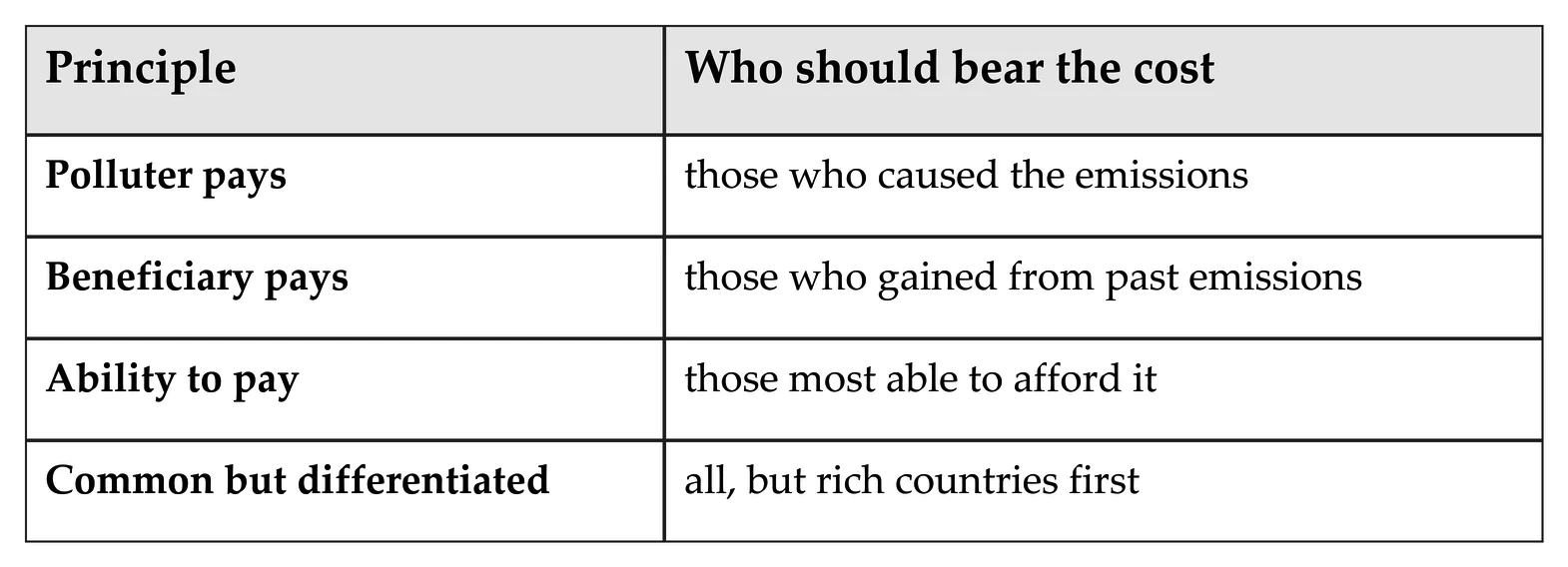
The polluter pays principle holds that those who caused the emissions should bear the cost of dealing with them. Since industrialised countries produced most historical emissions, they should bear the largest share.
6. Beneficiary Pays and Ability to Pay
The beneficiary pays principle holds that those who gained from past emissions, through industrial wealth, should pay. The ability to pay principle holds that those most able to afford it should carry the greatest burden.
7. Common but Differentiated Responsibilities
The UN Framework Convention on Climate Change of 1992 adopted the principle of common but differentiated responsibilities and respective capabilities. All countries share responsibility, but developed countries must take the lead, given their historical emissions and greater resources.
8. From Kyoto to Paris
The Kyoto Protocol of 1997 set binding targets only for developed countries. The Paris Agreement of 2015 asked all countries to set nationally determined contributions to keep warming well below 2°C, and preferably 1.5°C, with regular reviews.
9. India’s Position
India stresses equity and climate justice, pointing out that its per capita emissions are well below the world average. It has pledged to reach net zero by 2070, to obtain half its power capacity from non-fossil sources by 2030, and co-founded the International Solar Alliance in 2015.
10. Young’s Social Connection Model
Iris Marion Young distinguished a liability model of responsibility, which blames individuals for specific harms, from a social connection model, in which all who take part in structural processes that cause injustice share a forward-looking responsibility to change them. Climate change fits the second model.
11. Individual Responsibility
Some argue that individuals should reduce their own emissions through lifestyle changes. India’s Mission LiFE, Lifestyle for Environment, launched in 2022, promotes mindful consumption. Others argue that individual actions matter less than political and structural change.
12. Corporations and States
A small number of fossil fuel companies and states account for a large share of emissions. Many argue that political responsibility lies mainly with governments and corporations, which have the power to change energy systems.
13. Climate Justice
The climate justice movement stresses that the poor, small island states and future generations suffer most while contributing least. It demands finance and technology for adaptation and compensation for loss and damage, a fund for which was agreed in 2022.
14. Challenges
Challenges include free-riding by states, short-term electoral pressures, disputes over finance and fairness, and the influence of fossil fuel interests, all of which slow collective action.
15. Evaluation
Climate change requires rethinking political responsibility as shared, forward-looking and fair, with the greatest burden on those who caused the problem and can best afford to solve it.
Conclusion. Thus, climate change challenges our ideas of responsibility, as Jamieson and Gardiner show, because its harms are diffuse and stretch across space and time. Principles such as polluter pays and common but differentiated responsibilities, together with Young’s social connection model, guide a fair sharing of burdens, and India stresses equity while pledging net zero by 2070.
Short Notes
(a) Deep ecology
Arne Naess’s term (1973) for an environmental philosophy that recognises the intrinsic value of all living beings, as opposed to shallow ecology focused on human welfare.
(b) Environmentalism of the poor
Guha and Martinez-Alier’s term for environmental struggles in the South, where defending forests, water and land is a struggle for livelihood and survival.
(c) Common but differentiated responsibilities
The principle in the 1992 UN climate convention that all countries share responsibility for climate change but developed countries must take the lead.
(d) Precautionary principle
The principle that where there are threats of serious or irreversible environmental damage, lack of full scientific certainty should not delay measures to prevent it, adopted by the Supreme Court of India in 1996.
More notes: MDSE-10 Issues in Contemporary Politics
These notes are prepared by PADHO TO AISE for study help. They are not an official University of Delhi publication.