
Semester II DSC-5 Methods and Approaches in Comparative Political Analysis
Unit III · 27 min read · Updated 24 Nov 2026
As per the University of Delhi (DU) BA (Hons) Political Science syllabus
Contents
- 3.1 Meaning of Institutions
- 3.2 The Traditional Institutional Approach
- 3.3 The Rise of the New Institutionalism
- 3.4 Historical Institutionalism
- 3.5 Rational Choice Theory and Rational Choice Institutionalism
- 3.6 Sociological Institutionalism
- 3.7 Important Questions
- Distinguish between the traditional and the new institutional approaches to comparative politics.
- Discuss historical institutionalism as an approach to comparative politics.
- Examine rational choice theory and rational choice institutionalism.
- Discuss sociological institutionalism and compare the three new institutionalisms.
- Short Notes
संस्थाएँ समाज में खेल के नियम हैं, अर्थात मनुष्य द्वारा बनाई गई वे सीमाएँ जो मानवीय अंतःक्रिया को आकार देती हैं।
Institutions are the rules of the game in a society or, more formally, are the humanly devised constraints that shape human interaction.
— Douglass North, Institutions, Institutional Change and Economic Performance (1990)
WHY DO TWO DEMOCRACIES with similar societies produce very different governments? Part of the answer lies in their institutions: whether they are presidential or parliamentary, federal or unitary, whether they elect members by plurality or by proportional representation, and what unwritten rules guide their politicians. Institutions were the first subject of comparative government, which studied constitutions and formal structures. The behavioural revolution then pushed them aside in favour of behaviour and systems. From the 1980s institutions returned to the centre of the discipline, but in a new form, known as the new institutionalism. In this chapter we study the traditional institutional approach, the reasons for its decline and revival, and the three new institutionalisms identified by Peter Hall and Rosemary Taylor: historical, rational choice and sociological institutionalism.
3.1 Meaning of Institutions
In everyday language an institution is an organisation such as Parliament, the Supreme Court or the Election Commission. Political scientists use the word more broadly. For Douglass North, institutions are the rules of the game that shape human interaction, while organisations are the players. Institutions may be formal, such as constitutions, laws and electoral rules, or informal, such as conventions, norms, customs and codes of conduct. The convention that the President acts on the advice of the Council of Ministers, the practice of coalition dharma or the norm against defection are as much institutions as the written Constitution. Institutions matter because they distribute power, structure choices, create incentives and give meaning to action.
3.2 The Traditional Institutional Approach
The traditional or old institutionalism dominated political science from the late nineteenth century until the 1950s. Its classic works include Woodrow Wilson’s Congressional Government (1885), A.V. Dicey’s writings on the British constitution, James Bryce’s Modern Democracies (1921), Herman Finer’s Theory and Practice of Modern Government (1932) and Carl Friedrich’s Constitutional Government and Democracy (1937). B. Guy Peters identifies its five main features:
- Legalism: law was seen as the central element of government, so political science studied constitutions, statutes and legal powers.
- Structuralism: formal structures, such as presidential or parliamentary systems, were believed to determine political behaviour.
- Holism: whole political systems were compared, rather than particular institutions or processes.
- Historicism: institutions were explained by their historical development.
- Normative analysis: scholars were concerned with ‘good government’ and often treated Western liberal democracy as the ideal.
The approach produced rich descriptions of institutions and is still valuable for understanding constitutions. But it was criticised as descriptive rather than explanatory, formal, ignoring how institutions actually work and the informal rules behind them, parochial, confined to Western countries, and normative rather than scientific. The behavioural revolution of the 1950s therefore turned away from institutions to individual behaviour, groups and systems. Jean Blondel [ब्लॉन्डेल], in ‘Then and Now: Comparative Politics’ (1999), describes how comparative politics moved from the institutional description of the early period, through the behavioural and systems phase, to a more balanced field in which institutions again occupy a central place.
3.3 The Rise of the New Institutionalism
By the late 1970s many scholars felt that behaviouralism and systems theory had gone too far. Behaviour, they argued, does not happen in a vacuum: it is shaped by the rules within which people act. James March and Johan Olsen, in ‘The New Institutionalism: Organizational Factors in Political Life’ (1984), argued that institutions are not mere arenas for social forces but actors in their own right. Theda Skocpol [स्कॉचपोल], in ‘Bringing the State Back In’ (1985), argued that the state has its own interests and capacities and is not simply a mirror of society. Economists such as North showed that institutions explain why some economies grow and others do not.
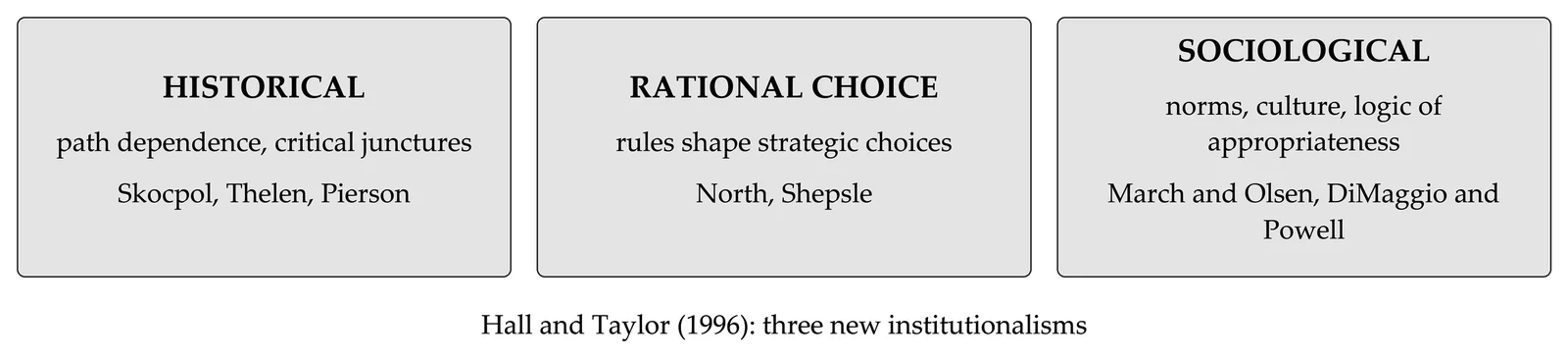
The new institutionalism differs from the old in several ways. It defines institutions broadly to include informal rules and norms; it seeks to explain rather than describe; it is theoretical and comparative; it studies how institutions shape behaviour and how behaviour in turn changes institutions; and it is empirical rather than normative. Peter Hall and Rosemary Taylor, in ‘Political Science and the Three New Institutionalisms’ (1996), showed that it is not one school but three (Figure 3.2). Each answers two questions differently: how do institutions affect behaviour, and how do institutions originate and change? Hall and Taylor distinguish a calculus approach, in which institutions affect behaviour by altering the incentives of rational actors, from a cultural approach, in which institutions shape the very identities and preferences of actors.
3.4 Historical Institutionalism
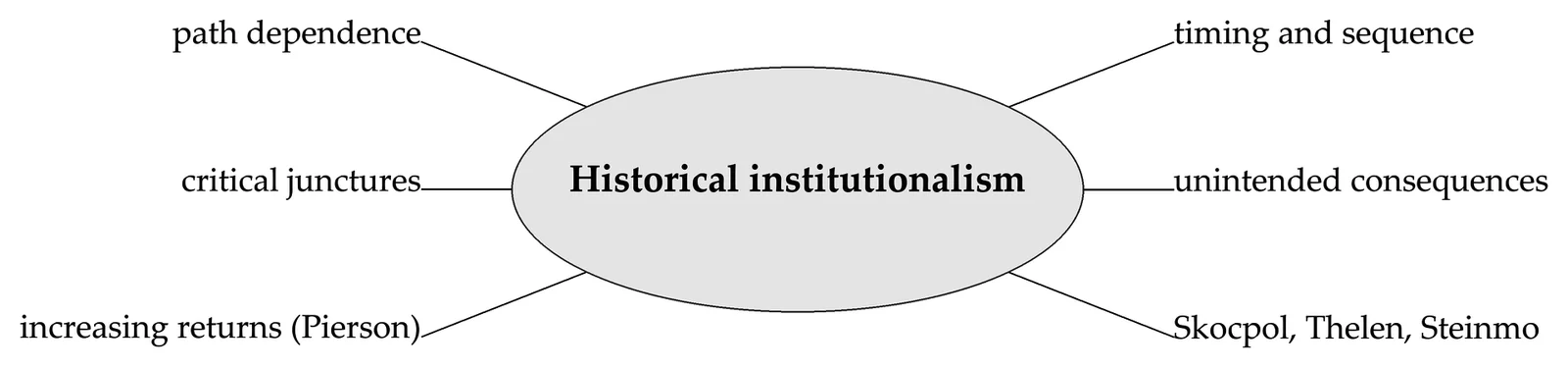
Historical institutionalism studies how institutions, created at particular moments in history, shape political outcomes over long periods. Its leading figures include Theda Skocpol, Peter Hall, Kathleen Thelen [टेलन], Sven Steinmo and Paul Pierson; Steinmo, Thelen and Longstreth’s Structuring Politics (1992) is a founding collection. Its main ideas are:
- Institutions as formal and informal rules: procedures, routines, norms and conventions embedded in the organisation of the state and the economy.
- Both calculus and culture: historical institutionalists accept that institutions shape incentives, but also that they shape preferences and identities.
- Asymmetries of power: institutions give some groups greater access to decision-making than others, so they are not neutral.
- Path dependence: once a country starts down a certain path, institutions create increasing returns, since people adapt to them, invest in them and build further rules on them, so the path becomes hard to reverse. Pierson (2000) developed this idea from economics.
- Critical junctures: moments of crisis, such as wars, revolutions or independence, when choices are open and decisions set countries on lasting paths. Ruth and David Collier’s Shaping the Political Arena (1991) studied such junctures in Latin America.
- Unintended consequences: institutions often produce results that their creators did not intend.
- Ideas matter: institutions interact with ideas and interests to produce outcomes.
A classic example is Skocpol’s States and Social Revolutions (1979), which explained the French, Russian and Chinese revolutions by the breakdown of state institutions under international pressure combined with peasant revolts, not by ideology or class alone. Gøsta Esping-Andersen’s Three Worlds of Welfare Capitalism (1990) showed how different historical coalitions produced liberal, conservative and social-democratic welfare states that continue to differ. In India, the institutional choices of the Constitution, such as a strong centre, the all-India services and reservations, created paths that have shaped politics ever since.
Criticism: historical institutionalism explains stability better than change; its picture of long periods of stability broken by sudden critical junctures (Stephen Krasner’s ‘punctuated equilibrium’) has been questioned. Thelen and Wolfgang Streeck (2005) therefore studied gradual change through processes such as layering (adding new rules to old ones), conversion (using old institutions for new purposes), drift and displacement. Critics also say its explanations are case-specific and hard to generalise.
3.5 Rational Choice Theory and Rational Choice Institutionalism
Rational choice theory applies the methods of economics to politics. It assumes that individuals are rational: they have fixed, ordered preferences and choose the action that best achieves them, given their information and the expected actions of others. Its classic works include Anthony Downs’s An Economic Theory of Democracy (1957), which explained why parties converge on the median voter, and Mancur Olson’s The Logic of Collective Action (1965), which showed that rational individuals will not contribute to a common good unless they receive selective benefits or are coerced, the free-rider problem.
Rational choice institutionalism applies these assumptions to institutions. Its main ideas are:
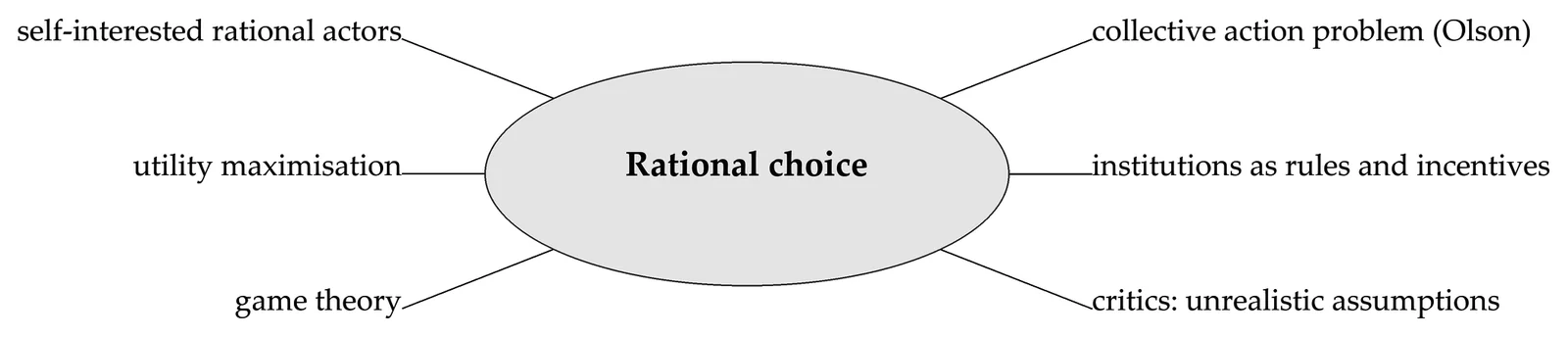
- Fixed preferences: actors have given preferences and behave instrumentally and strategically to maximise them.
- Collective action dilemmas: politics is seen as a series of situations, such as the prisoner’s dilemma or the tragedy of the commons, in which individually rational behaviour produces collectively bad results.
- Institutions as solutions: institutions reduce uncertainty, lower transaction costs, provide information and enforcement, and so allow actors to co-operate. Kenneth Shepsle [शेप्सल] showed how the committee system of the US Congress produced stable decisions, a ‘structure-induced equilibrium’ (1979).
- Strategic interaction: behaviour depends on the expectations each actor has about how others will behave, which is modelled through game theory.
- Origin of institutions: institutions are created voluntarily because they benefit the actors who create them, and they change when they no longer do so.
Elinor Ostrom’s Governing the Commons (1990) showed how communities create rules to manage shared resources without either the state or the market. Principal–agent theory explains how voters (principals) control politicians (agents), and George Tsebelis [त्सेबेलिस]’s Veto Players (2002) explains policy stability by counting the actors whose agreement is needed for change. Mark Pennington argues that rational choice and institutional analysis together give comparative politics a powerful way of explaining why democratic systems perform differently.
Criticism: its assumptions are unrealistic, since people act out of habit, emotion, duty and identity, not only calculation; it takes preferences as given rather than explaining them; it is functionalist, explaining institutions by the benefits they bring, which cannot explain inefficient institutions that persist; it neglects culture, history and power; and critics see in its ‘economic man’ a Western, individualist bias.
3.6 Sociological Institutionalism
Sociological institutionalism grew out of organisation theory in sociology. Its central claim is that many institutional forms and practices are adopted not because they are the most efficient but because they are culturally appropriate and legitimate. Its main ideas are:
- Broad definition of institutions: institutions include not only rules and procedures but also symbol systems, cognitive scripts and moral templates that provide ‘frames of meaning’ for action. The line between institutions and culture disappears.
- Logic of appropriateness: March and Olsen (1989) argued that people act not by calculating consequences (the logic of consequences) but by asking what is appropriate for someone in their role and situation.
- Institutions shape identities: institutions tell actors who they are and what they want, so preferences are not fixed but socially constructed.
- Isomorphism: Paul DiMaggio [डिमैजियो] and Walter Powell (1983) explained why organisations become similar through coercive isomorphism (pressure from powerful actors, such as aid conditions), mimetic isomorphism (copying successful models under uncertainty) and normative isomorphism (professional standards spread by education and professional networks).
- Legitimacy: John Meyer and Brian Rowan (1977) showed that organisations adopt formal structures as ‘myth and ceremony’ to gain legitimacy, even when these structures are only loosely connected to what they actually do.
This explains, for example, why countries across the world have adopted similar constitutions, human rights commissions, central banks, ministries for women or anti-corruption agencies, even where these do not fit local conditions. Criticism: it tends to see actors as passive followers of cultural scripts, neglects conflict and power, and explains similarity better than difference and change.
Comparing the three new institutionalisms
| Basis | Historical | Rational choice | Sociological |
|---|---|---|---|
| Institutions are | Formal and informal rules embedded in the state | Rules that structure incentives | Rules, norms, symbols and scripts |
| How they shape behaviour | Both incentives and identities | By altering strategic calculations | By defining what is appropriate |
| Origin and change | Critical junctures; path dependence; gradual change | Created for mutual benefit; changed when costly | Adopted for legitimacy; spread by isomorphism |
| Key thinkers | Skocpol, Thelen, Pierson | North, Shepsle, Ostrom | March and Olsen, DiMaggio and Powell |
Institutions in the developing world
Lise Rakner and Vicky Randall point out that in many developing countries formal institutions are weak and informal institutions, such as patron–client networks, neopatrimonialism (rule through personal loyalty behind a modern façade) and ethnic or caste ties, often decide how politics works. Gretchen Helmke and Steven Levitsky (2004) classified informal institutions as complementary (supporting formal rules), accommodating (altering their effects without violating them), competing (contradicting them) and substitutive (achieving what weak formal institutions fail to). Comparative analysis must therefore study both kinds of institutions, which recalls Riggs’s idea of formalism.
3.7 Important Questions
- Question 1 Distinguish between the traditional and the new institutional approaches to comparative politics.
- Question 2 Discuss historical institutionalism as an approach to comparative politics.
- Question 3 Examine rational choice theory and rational choice institutionalism.
- Question 4 Discuss sociological institutionalism and compare the three new institutionalisms.
DU asks the same idea in different words. So learn one broad answer for each question below; the same answer works for every question joined by OR.
Important Question 1
Distinguish between the traditional and the new institutional approaches to comparative politics.
OR
Critically examine the traditional institutional approach.
OR
Why did institutions return to the centre of comparative politics?
Model Answer
“The bureaucratic agency, the legislative committee, and the appellate court are arenas for contending social forces, but they are also collections of standard operating procedures and structures that define and defend interests.”
— James March and Johan Olsen, ‘The New Institutionalism’ (1984)
Introduction. Institutions, the formal and informal rules of the political game, have always been central to comparative politics. The traditional institutionalism of the early twentieth century described constitutions and formal structures; the new institutionalism that emerged in the 1980s explains how institutions, formal and informal, shape political behaviour and outcomes.
1. Meaning of Institutions
North defined institutions as the rules of the game that shape human interaction. They may be formal, such as constitutions and laws, or informal, such as conventions and norms. March and Olsen described institutions as collections of rules and routines that define appropriate action.
2. The Traditional Approach
Represented by Wilson, Dicey, Bryce, Finer and Friedrich, it studied the constitutions and formal institutions of Western states. Peters identifies its features as legalism, structuralism, holism, historicism and normative analysis. Guy Peters summarised it as legal, structural, holistic, historical and normative.
3. Criticism of the Traditional Approach
It was descriptive rather than explanatory, formal rather than realistic, confined to the West, and normative. It ignored informal politics, parties, groups and behaviour, and could not explain why similar constitutions worked differently in different countries. It ignored informal practices, parties and groups.
4. Decline and Return
The behavioural revolution shifted attention to behaviour and systems. From the late 1970s, scholars argued that behaviour is shaped by rules. March and Olsen (1984), Skocpol’s call to bring the state back in (1985) and North’s economics led to the new institutionalism. Blondel describes this movement from institutions to behaviour and back to a balanced field. March and Olsen’s article ‘The New Institutionalism’ (1984) marked the return of institutions.
5. Why Institutions Matter
Institutions shape who has power, how preferences are formed and which choices are possible; electoral rules shape party systems, and federal structures shape ethnic conflict.
6. Features of the New Institutionalism
It defines institutions broadly to include informal rules; it seeks explanation and theory; it studies the two-way relationship between institutions and behaviour; it is comparative and empirical; and it recognises that institutions distribute power and are not neutral.
7. Informal Institutions
Helmke and Levitsky (2004) showed that informal institutions, such as patronage and clientelism, can complement or undermine formal rules, which is important in countries like India.
8. Three Variants
Hall and Taylor identify historical institutionalism (path dependence, critical junctures), rational choice institutionalism (institutions as incentives that solve collective action problems) and sociological institutionalism (institutions as cultural scripts and the logic of appropriateness). Each offers a different answer to how institutions affect behaviour.
9. Discursive Institutionalism
Vivien Schmidt added discursive institutionalism, which stresses ideas and discourse in explaining institutional change.
10. Old and New Compared
The old studied formal structures; the new also studies informal rules. The old described; the new explains. The old was normative and Western; the new is empirical and comparative. The old assumed that structure determines behaviour; the new studies how each shapes the other. The new also uses comparative and quantitative methods.
11. Institutions and Development
Acemoglu and Robinson, in Why Nations Fail (2012), argued that inclusive political and economic institutions explain why some countries prosper and others do not.
12. Evaluation
The new institutionalism has become the dominant approach in comparative politics. Critics say that institutions are defined so broadly that the concept loses precision, and that the approach explains stability better than change. Yet it has shown convincingly that institutions matter. It reminds us that politics is shaped by rules as well as by interests and culture.
13. An Illustration from India
An old institutionalist studying India would describe the Articles on the President, Governor and Parliament. A new institutionalist would ask how informal rules shape their working: why Governors’ discretion has often been used politically, how the convention of collective responsibility operates in coalitions, how the informal norm against floor-crossing was turned into a formal anti-defection law in 1985, and how caste and kinship networks influence party organisation. The difference is between describing rules and explaining behaviour. A new institutionalist would also study conventions, coalition practices and the role of the courts.
Conclusion. Thus, institutionalism has moved from describing constitutions to explaining politics through rules. The new institutionalism keeps the old concern with institutions but studies them in a more realistic and theoretical way.
Important Question 2
Discuss historical institutionalism as an approach to comparative politics.
OR
Explain the concepts of path dependence and critical junctures.
OR
How does historical institutionalism explain institutional change?
Model Answer
“Once a country or region has started down a track, the costs of reversal are very high.”
— Margaret Levi (1997), quoted by Paul Pierson, ‘Increasing Returns, Path Dependence, and the Study of Politics’ (2000)
Introduction. Historical institutionalism explains political outcomes by studying how institutions created at particular moments in history shape later politics. Associated with Skocpol, Hall, Thelen, Steinmo and Pierson, it is one of the three new institutionalisms identified by Hall and Taylor (1996).
1. Meaning of Institutions
Historical institutionalists define institutions as the formal and informal procedures, routines, norms and conventions embedded in the organisation of the polity and the economy. Thelen and Steinmo set out the approach in Structuring Politics (1992).
2. Calculus and Culture
They combine the calculus approach, in which institutions shape strategies, and the cultural approach, in which institutions shape preferences and identities. This middle position distinguishes it from the other two institutionalisms.
3. Power and Institutions
Institutions distribute power unequally, giving some groups privileged access to decision-making. They are not neutral solutions to common problems. Institutions are therefore not neutral but reflect past struggles.
4. Path Dependence
Choices made early create increasing returns: people adapt to institutions and invest in them, so the costs of changing course rise over time. Pierson developed this idea to explain why institutions persist even when they are inefficient. Paul Pierson (2000) showed how increasing returns lock institutions in and make change costly.
5. Critical Junctures
At moments of crisis, such as wars, revolutions or independence, choices are relatively open, and decisions taken then set lasting paths. The Colliers studied such junctures in Latin America; India’s constitution-making after 1947 was such a juncture. Ruth and David Collier (1991) showed how the incorporation of labour in Latin America created lasting legacies.
6. Timing and Sequence
Historical institutionalists stress that when things happen matters: the sequence of industrialisation, democratisation and state-building shapes later politics.
7. Unintended Consequences and Ideas
Institutions often produce outcomes their creators did not intend, and they interact with ideas and interests. Hall showed how economic ideas such as Keynesianism were shaped by institutions.
8. Policy Feedback
Policies create constituencies that defend them, as pensions and welfare programmes do, which makes them hard to reverse.
9. Illustrations
Skocpol’s States and Social Revolutions (1979) explained revolutions through state breakdown; Esping-Andersen’s Three Worlds of Welfare Capitalism (1990) showed how different welfare regimes persist; and India’s choices of a strong centre, all-India services and reservations created lasting paths. Peter Hall’s study of economic policy in Britain and France (1986) showed how institutions shape policy.
10. Institutional Change
Early historical institutionalism saw change as sudden, at critical junctures, followed by long stability (punctuated equilibrium). Streeck and Thelen (2005) showed that institutions also change gradually through layering, conversion, drift and displacement. Mahoney and Thelen (2010) developed a theory of gradual change.
11. Strengths
It combines attention to history, power and institutions, avoiding both purely cultural and purely rational explanations.
12. The Welfare State as an Example
Esping-Andersen’s The Three Worlds of Welfare Capitalism (1990) and Pierson’s Dismantling the Welfare State? (1994) showed how welfare institutions shaped later politics and resisted cuts.
13. Agency and Structure
Critics ask whether historical institutionalism leaves enough room for human agency; newer work stresses that actors interpret and reshape institutions.
14. Criticism
It is better at explaining stability than change; its concepts can be vague; its explanations are often case-specific and hard to generalise; and it may overemphasise structure at the cost of human agency. Some say it describes rather than predicts.
15. Four Modes of Gradual Change
Streeck and Thelen identified four modes of gradual change. Layering adds new rules on top of old ones; conversion redirects existing institutions to new purposes; drift occurs when institutions are not adapted to a changing environment, so their effects change; and displacement replaces old rules with new ones. Such changes can transform institutions without any dramatic break.
16. Critical Junctures in India
Independence and Partition (1947–50) were a critical juncture that produced a secular, federal, parliamentary constitution; the Emergency (1975–77) led to the 44th Amendment, which strengthened safeguards against abuse of emergency powers; and the economic crisis of 1991 opened the path of liberalisation. Each choice shaped later politics in ways that were hard to reverse. The choice of a parliamentary system and of linguistic states shaped later Indian politics.
Conclusion. Thus, historical institutionalism shows that history matters: the paths chosen at critical moments shape the politics of countries for generations.
Important Question 3
Examine rational choice theory and rational choice institutionalism.
OR
Discuss the rational choice approach to comparative politics.
OR
How does rational choice institutionalism explain the origin of institutions?
Model Answer
“Unless the number of individuals in a group is quite small, or unless there is coercion … rational, self-interested individuals will not act to achieve their common or group interests.”
— Mancur Olson, The Logic of Collective Action (1965)
Introduction. Rational choice theory applies the assumptions of economics to politics: individuals are rational actors who pursue their preferences strategically. Rational choice institutionalism uses these assumptions to explain how institutions shape behaviour and why they are created. Its leading figures include Douglass North, Kenneth Shepsle, Barry Weingast and Elinor Ostrom.
1. Assumptions of Rational Choice
Individuals have fixed, ordered preferences; they act instrumentally to maximise them; they calculate costs and benefits; and they act strategically, taking into account what others will do. It rests on methodological individualism, explaining collective outcomes by individual choices.
2. Classic Applications
Downs (1957) explained party competition by voters and parties maximising utility; Olson (1965) explained the free-rider problem in collective action; and game theory, such as the prisoner’s dilemma, explained why co-operation fails. Olson’s The Logic of Collective Action (1965) showed why large groups find it hard to organise.
3. Collective Action Dilemmas
Politics is full of situations where individually rational behaviour produces collectively bad outcomes, such as the tragedy of the commons, arms races or tax evasion. Garrett Hardin’s ‘tragedy of the commons’ (1968) shows how shared resources are overused.
4. Institutions as Solutions
Institutions reduce uncertainty, lower transaction costs, provide information and enforce agreements, making co-operation possible. Shepsle showed how congressional committees produce stable decisions; Ostrom showed how communities create rules to manage common resources. Elinor Ostrom showed that communities can design institutions to manage common resources sustainably.
5. Strategic Interaction
Institutions affect behaviour by shaping expectations about how others will act. Principal–agent theory and veto player theory (Tsebelis) apply this logic to accountability and policy change. Game theory models these interactions.
6. Origin and Change of Institutions
Institutions are created voluntarily because they benefit those who create them, and they change when they cease to do so. North used this to explain why some economies developed secure property rights and grew. Critics argue that this functionalist account neglects power and unintended consequences.
7. Principal–Agent Theory
Principal–agent theory analyses how voters control politicians, or politicians control bureaucrats, when agents have more information than principals.
8. Veto Players
George Tsebelis showed that the number of veto players, actors whose agreement is needed for change, explains policy stability across political systems.
9. Public Choice
Public choice theory, developed by Buchanan and Tullock in The Calculus of Consent (1962), applies rational choice to government, explaining rent-seeking, budget growth and logrolling.
10. Contributions
The approach offers clear, testable models, explains strategic behaviour precisely, and has shed light on electoral systems, coalitions, legislatures and federalism. Pennington shows its value for explaining differences among democratic systems. It also explains coalition formation, as in William Riker’s theory of minimum winning coalitions (1962).
11. Rational Choice and India
Rational choice has been used to explain coalition-building, defections, vote-buying and the behaviour of bureaucrats in India.
12. Criticism
Its assumptions are unrealistic, ignoring emotion, habit, duty and identity; it takes preferences as given; it is functionalist, unable to explain inefficient institutions that persist; it neglects culture, history and power; and it reflects a Western, individualist view of human nature. Green and Shapiro’s Pathologies of Rational Choice Theory (1994) criticised its weak empirical record.
13. Game Theory Illustrations
In the prisoner’s dilemma, two suspects who cannot communicate each gain by confessing whatever the other does, so both confess and both are worse off than if both had stayed silent. In the tragedy of the commons (Garrett Hardin, 1968), each herder gains by adding animals to a shared pasture, until it is destroyed. Institutions that allow repeated interaction, communication and enforcement can make co-operation rational; Robert Axelrod (1984) showed how a ‘tit-for-tat’ strategy sustains co-operation in repeated games.
14. Rational Choice in Comparative Politics
Rational choice has explained the number of parties under different electoral systems (Gary Cox, Making Votes Count, 1997), the formation of minimum winning coalitions (William Riker, 1962), and why African governments adopted policies that harmed farmers to favour urban groups (Robert Bates, Markets and States in Tropical Africa, 1981).
Conclusion. Thus, rational choice institutionalism explains institutions as rules that help rational actors co-operate. It is precise and powerful, but it must be combined with historical and cultural explanations.
Important Question 4
Discuss sociological institutionalism and compare the three new institutionalisms.
OR
Explain Hall and Taylor’s three new institutionalisms.
OR
What is the ‘logic of appropriateness’?
Model Answer
“Sociological institutionalists define institutions to include … the symbol systems, cognitive scripts, and moral templates that provide the ‘frames of meaning’ guiding human action.”
— Peter Hall and Rosemary Taylor, ‘Political Science and the Three New Institutionalisms’ (1996)
Introduction. Sociological institutionalism argues that institutions shape behaviour by providing cultural frames of meaning, and that institutional forms spread because they are seen as legitimate. It is the third of the new institutionalisms identified by Hall and Taylor, alongside historical and rational choice institutionalism.
1. Origins
It developed from organisation theory in sociology, which noticed that organisations adopt practices not because they are efficient but because they are culturally accepted. Meyer and Rowan (1977) argued that organisations adopt formal structures as ‘myth and ceremony’ to gain legitimacy.
2. Broad Definition of Institutions
Institutions include not only rules and procedures but also symbols, cognitive scripts and moral templates; the line between institutions and culture is blurred. This blurs the line between institutions and culture.
3. The Logic of Appropriateness
March and Olsen argued that actors ask what is appropriate for someone in their role and situation (logic of appropriateness) rather than calculating consequences (logic of consequences). It is contrasted with the logic of consequences, in which actors calculate costs and benefits.
4. Institutions Shape Identities
Preferences are not fixed but are constructed by institutions, which tell actors who they are and what they should want.
5. Isomorphism and Legitimacy
DiMaggio and Powell explained why organisations become alike through coercive, mimetic and normative isomorphism. Meyer and Rowan showed that formal structures are adopted as ‘myth and ceremony’ to gain legitimacy. This explains the worldwide spread of similar constitutions, central banks and human rights commissions. Coercive isomorphism comes from pressure, mimetic from imitation under uncertainty, and normative from professional standards.
6. Diffusion of Institutions
Sociological institutionalism explains why countries copy institutions such as election commissions, human rights commissions and independent central banks: they adopt them to appear modern and legitimate.
7. Historical Institutionalism Compared
Historical institutionalism sees institutions as products of history that create path dependence; it combines calculus and culture and emphasises power. Sociological institutionalism stresses culture and legitimacy.
8. Rational Choice Institutionalism Compared
Rational choice institutionalism sees institutions as incentives created by rational actors to solve collective action problems; preferences are fixed. Sociological institutionalism sees preferences as shaped by institutions and action as guided by appropriateness.
9. The Three Compared in Brief
Rational choice sees actors as calculators, historical institutionalism as shaped by past choices and power, and sociological institutionalism as followers of cultural norms; each explains change differently.
10. Towards Synthesis
Hall and Taylor argued that each approach reveals different aspects of reality and that they should learn from one another: rational choice offers precision about strategy, sociology about culture, and history about power and time. Each answers a different question about how institutions shape behaviour.
11. Illustrations from India
India’s adoption of institutions such as the RTI Act, Lokayuktas and independent regulators partly reflects global models, while their working is shaped by Indian norms and history.
12. Criticism
Sociological institutionalism treats actors as passive followers of scripts, neglects conflict and power, and explains similarity better than difference or change. It struggles to explain why actors sometimes break institutional scripts.
13. Illustrations
Sociological institutionalism explains the worldwide spread of independent central banks, constitutional courts, women’s ministries and national human rights institutions modelled on the UN Paris Principles (1993). India’s National Human Rights Commission (1993) was created partly under such international normative pressure. Meyer and Rowan’s idea of decoupling, formal adoption with different actual practice, recalls Riggs’s formalism.
14. Link with Constructivism
The approach influenced constructivism in International Relations. Martha Finnemore’s National Interests in International Society (1996) showed how international organisations taught states new norms, such as the value of science bureaucracies, shaping their identities and interests.
15. Evaluation
Together, the three institutionalisms show that institutions matter as rules, as products of history and as cultural frames, and comparative politics is richer when they are combined.
Conclusion. Thus, sociological institutionalism shows that institutions shape not only what people do but who they are. Together, the three new institutionalisms give a rich understanding of how rules shape politics.
Short Notes
(a) Path dependence
The idea that decisions taken at an early stage create increasing returns, so that later choices are constrained and reversing the path becomes costly. Developed in politics by Paul Pierson (2000), it explains why institutions persist even when they are inefficient.
(b) Logic of appropriateness
March and Olsen’s term for action guided by the question ‘what is appropriate for a person like me in a situation like this?’ rather than by calculation of costs and benefits (the logic of consequences). It is central to sociological institutionalism.
(c) Informal institutions
Unwritten rules, such as conventions, clientelism and kinship networks, that are created and enforced outside official channels. Helmke and Levitsky classify them as complementary, accommodating, competing or substitutive, depending on how they relate to formal rules. They are especially important in developing countries.
(d) Critical juncture
A concept of historical institutionalism referring to a relatively short period of major change, such as a war, revolution or economic crisis, in which choices made by actors set institutions on a particular path that later becomes hard to reverse. Ruth and David Collier’s Shaping the Political Arena (1991) used it to explain how the incorporation of labour shaped Latin American politics.
More notes: DSC-5 Methods and Approaches in Comparative Political Analysis
These notes are prepared by PADHO TO AISE for study help. They are not an official University of Delhi publication.