
Semester II DSC-5 Methods and Approaches in Comparative Political Analysis
Unit V · 28 min read · Updated 24 Nov 2026
As per the University of Delhi (DU) BA (Hons) Political Science syllabus
Contents
- 5.1 The Political Economy Approach
- 5.2 Underdevelopment
- 5.3 Modernisation
- 5.4 Dependency
- 5.5 World Systems Theory
- 5.6 Important Questions
- Critically examine the modernisation theory of development.
- Discuss the dependency theory of underdevelopment.
- Explain Immanuel Wallerstein’s world-systems theory.
- What is underdevelopment? Examine the critique of ‘development’ with reference to Gustavo Esteva.
- Short Notes
अल्पविकास 20 जनवरी 1949 को शुरू हुआ। उस दिन दो अरब लोग अल्पविकसित हो गए।
Underdevelopment began, then, on January 20, 1949. On that day, 2 billion people became underdeveloped.
— Gustavo Esteva, ‘Development’, in The Development Dictionary (1992)
WHY ARE SOME COUNTRIES RICH and others poor? Why did Britain industrialise first, while India, once a great manufacturing country, became a supplier of raw materials? Can poor countries become rich by following the path of the West, or does the world economy itself keep them poor? These are the questions of the political economy approach, which studies how politics and economics shape each other, within countries and across the world. In this chapter we study four ideas that dominated the debate on development after the Second World War: the meaning of underdevelopment, the modernisation theory that promised that poor countries would follow the West, the dependency theory from Latin America that blamed underdevelopment on the West, and Immanuel Wallerstein’s world-systems theory, which treated the whole capitalist world economy as the unit of analysis.
5.1 The Political Economy Approach
Political economy is the study of the relationship between politics and economics: between the state and the market, power and wealth. The classical political economists, Adam Smith, David Ricardo and Karl Marx, all studied how production and distribution are shaped by political institutions and class relations. In comparative politics, the political economy approach became important in the 1960s and 1970s as a reaction to systems theory and modernisation theory, which had paid little attention to economic structures, classes and international inequality. Ronald Chilcote, in Comparative Inquiry in Politics and Political Economy, shows that its central themes are the state, class, development and underdevelopment, and imperialism.
Three broad traditions can be distinguished. The liberal tradition sees markets as efficient and expects free trade and investment to benefit all countries. The nationalist or statist tradition, going back to Friedrich List, holds that the state must protect and promote national industry. The Marxist tradition sees capitalism as a system of exploitation between classes and between countries. Modernisation theory belongs largely to the liberal tradition; dependency and world-systems theories to the Marxist and radical traditions.
5.2 Underdevelopment
A. Underdevelopment as a condition
In ordinary usage, underdevelopment describes the condition of countries with low income per head, widespread poverty, dependence on agriculture and the export of primary goods, little industry, low levels of literacy and health, high unemployment and sharp inequality. Measures such as the Human Development Index (1990) added health and education to income. But how did such countries come to be called ‘underdeveloped’, and what causes underdevelopment? Different theories give different answers.
B. Underdevelopment as a discourse: Esteva
Gustavo Esteva [एस्तेवा], in his essay ‘Development’ in The Development Dictionary (1992), edited by Wolfgang Sachs, argued that underdevelopment is not simply a fact but a way of seeing invented after the Second World War. On 20 January 1949, President Harry Truman, in his inaugural address, announced a ‘bold new program’ to make American scientific and industrial progress available for the ‘improvement and growth of underdeveloped areas’. On that day, Esteva wrote, two billion people became underdeveloped: peoples with very different histories, cultures and ways of life were redefined in terms of what they lacked compared with the industrial West. ‘Development’, a metaphor taken from biology, implied that there was only one natural path of growth, and that the West stood at its end. Esteva and other post-development thinkers, such as Arturo Escobar (Encountering Development, 1995), argued that the development project often destroyed local knowledge, community and self-reliance, and they called for people to create their own forms of good life rather than imitate the West.
C. Underdevelopment as a product of history
Radical economists offered another view: underdevelopment is not an original state but a result of the way poor countries were integrated into the world capitalist economy. Paul Baran, in The Political Economy of Growth (1957), argued that the economic surplus of poor countries was drained away by foreign capital and wasted by local elites. Andre Gunder Frank called this the development of underdevelopment, and Walter Rodney wrote How Europe Underdeveloped Africa (1972). India’s experience of de-industrialisation and the drain of wealth under colonial rule, studied in Semester I, is a classic example.
5.3 Modernisation
Modernisation theory dominated American social science in the 1950s and 1960s. It arose in a particular context: the decolonisation of Asia and Africa, the Cold War competition with the Soviet Union for influence in these new nations, and American programmes of foreign aid. Its central claim was that all societies move from a traditional to a modern stage, and that the new nations would develop by following the path already taken by the West.
A. Roots
The theory drew on evolutionary ideas of nineteenth-century sociology (Comte, Spencer, Durkheim), which saw societies moving from simple to complex forms, and on Talcott Parsons’s functionalism. Parsons’s pattern variables contrasted traditional and modern societies: traditional societies were particularistic (treating people according to relationships), ascriptive (valuing birth), diffuse and affective; modern societies were universalistic, achievement-oriented, specific and affectively neutral.
B. Main thinkers
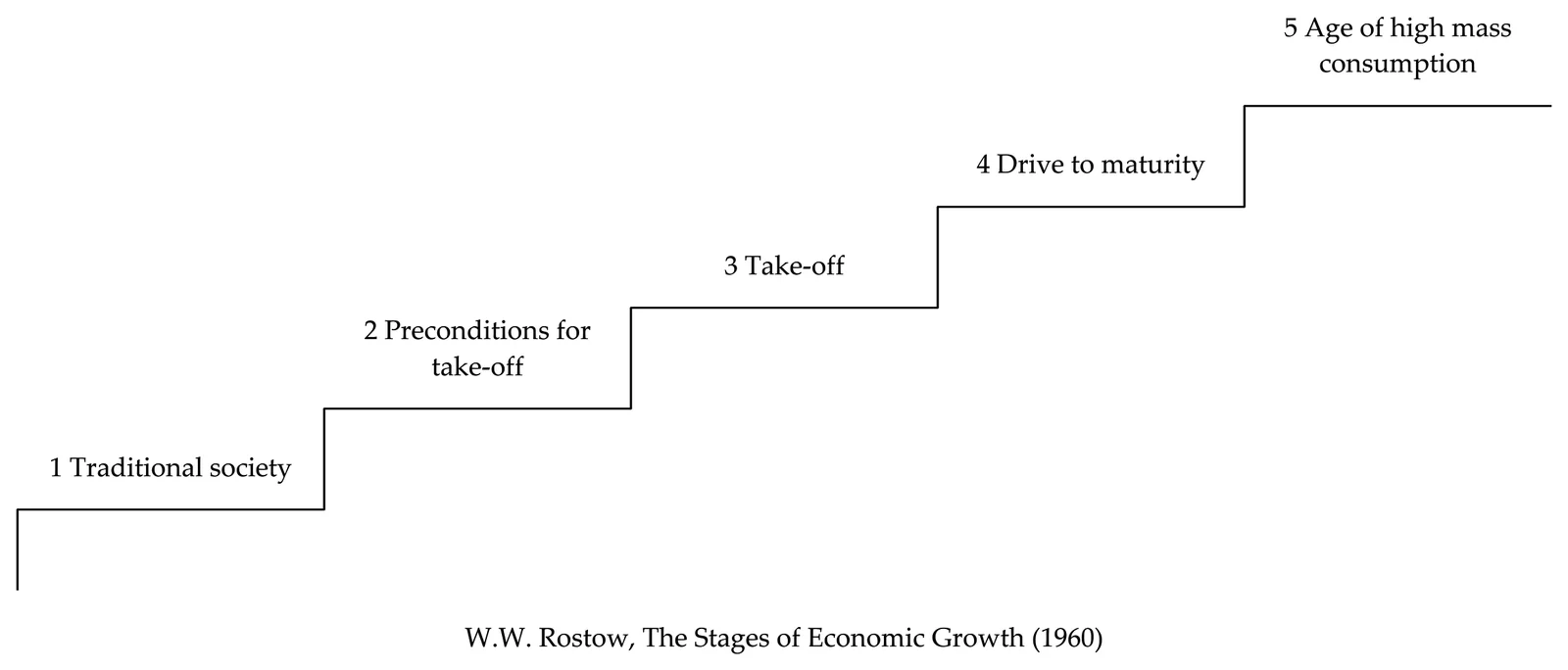
- W.W. Rostow [रॉस्टो], in The Stages of Economic Growth: A Non-Communist Manifesto (1960), said that all societies pass through five stages: the traditional society, the preconditions for take-off, the take-off, the drive to maturity and the age of high mass consumption (Figure 5.2). Foreign aid and investment could help countries reach take-off.
- Daniel Lerner, in The Passing of Traditional Society (1958), studied the Middle East and argued that urbanisation, literacy and mass media create ‘empathy’, the capacity to imagine oneself in new roles, which produces modern, participant individuals.
- Seymour Martin Lipset (1959) showed that economic development is closely associated with democracy.
- David McClelland (The Achieving Society, 1961) stressed the psychological ‘need for achievement’, and Alex Inkeles described the attitudes of the ‘modern man’: openness to new experience, independence from traditional authority, belief in science and planning.
- Political development theorists, such as Almond and Lucian Pye, described the political side of modernisation: differentiation of structures, equality and the capacity of the political system.
- Samuel Huntington, in Political Order in Changing Societies (1968), revised the theory: rapid modernisation mobilises people faster than political institutions can absorb them, producing instability and ‘political decay’. Order requires strong political institutions.
C. Assumptions
Alvin So, in Social Change and Development (1990), summarises the assumptions of classical modernisation theory: modernisation is a phased process through stages; it is homogenising, making societies alike; it means Europeanisation or Americanisation; it is irreversible and progressive; it is a lengthy process of evolution rather than revolution; and it is systemic and transformative, changing every aspect of society together. Problems of development were explained mainly by internal factors, such as traditional values and institutions.
D. Criticism
Modernisation theory was criticised as ethnocentric, treating the West as the universal model; as relying on a false dichotomy between tradition and modernity, since Lloyd and Susanne Rudolph’s The Modernity of Tradition (1967) showed how traditional institutions such as caste could adapt to modern politics; as ignoring history, especially colonialism, and the international economic structure; as unilinear, assuming one path for all; and as ideological, a Cold War doctrine that Rostow himself called a ‘non-communist manifesto’. Its predictions also failed: many developing countries became authoritarian and remained poor. So notes that new modernisation studies from the 1980s became more careful, accepting that tradition and modernity can coexist, that there are many paths, and that external factors matter.
5.4 Dependency
Dependency theory emerged in Latin America in the 1960s as a direct challenge to modernisation theory. It argued that underdevelopment is caused not by internal traditions but by the external relationship of poor countries with the rich countries of the capitalist world. Poor countries are poor because rich countries are rich.
A. Origins: ECLA and Prebisch
The Argentine economist Raúl Prebisch [प्रेबिश], head of the UN Economic Commission for Latin America (ECLA, founded 1948), divided the world into an industrial centre and an agricultural periphery. He and Hans Singer (1950) argued that the terms of trade of the periphery tend to decline: the prices of its primary exports fall relative to the prices of the manufactured goods it imports, so wealth flows to the centre. ECLA recommended import-substitution industrialisation behind tariff walls. When this strategy disappointed in the 1960s, more radical dependency theorists, influenced by Marxism and by Lenin’s theory of imperialism, went further.
B. Andre Gunder Frank
Andre Gunder Frank, in ‘The Development of Underdevelopment’ (1966) and Capitalism and Underdevelopment in Latin America (1967), argued that underdevelopment is not an original condition but was created by capitalist development. The world is a chain of metropolis–satellite relations (Figure 5.3): the metropolis extracts surplus from the satellite, from the world centre down to national capitals, regional towns and villages. Satellites, he argued, developed most when their ties with the metropolis were weakest, as in Latin America during the World Wars and the Depression, and the most backward regions were those once most closely tied to the metropolis, such as the former sugar and mining zones. Frank concluded that development required breaking with capitalism.

C. Other dependency theorists
- Theotonio dos Santos (1970) defined dependence as a situation in which the economy of certain countries is conditioned by the development and expansion of another economy, and traced its forms from colonial dependence to financial-industrial dependence and the ‘new dependence’ based on multinational corporations and technology.
- Samir Amin analysed unequal development and unequal exchange between centre and periphery and advocated delinking from the world system.
- Fernando Henrique Cardoso [कार्दोसो] and Enzo Faletto, in Dependency and Development in Latin America (1969), argued that development and dependence can coexist: through an alliance of multinational capital, local capitalists and the state, countries such as Brazil achieved associated dependent development, real industrial growth but within dependence. Peter Evans called this the ‘triple alliance’ (1979).
D. Main features
Dependency theory explains underdevelopment by external factors; sees the world economy as a structure of domination; holds that the surplus of the periphery is transferred to the centre through trade, investment, debt and profits; points to the alliance of local elites with foreign capital; and argues that integration into world capitalism produces distorted, unequal growth. Its prescriptions ranged from import substitution and regional co-operation to socialism and delinking.
E. Criticism
Dependency theory was criticised as deterministic and economistic, neglecting internal class structures, states and culture; as vague in its definition of dependence; and as empirically weak, since it could not explain the rapid industrialisation of East Asian economies such as South Korea and Taiwan, which developed through integration with the world market under strong developmental states. Its prescription of delinking proved costly. Yet it changed the debate by showing that development must be studied in a global and historical context, and later ‘dependent development’ studies became more flexible.
5.5 World Systems Theory
Immanuel Wallerstein [वॉलरस्टीन] (1930–2019), an American sociologist, developed world-systems theory in The Modern World-System (first volume 1974) and in ‘The Rise and Future Demise of the World Capitalist System: Concepts for Comparative Analysis’ (1974). He drew on dependency theory, Marxism and the French Annales historian Fernand Braudel [ब्रोदेल]’s study of long-term economic history.
A. The unit of analysis
Wallerstein argued that the nation-state is the wrong unit of analysis. Countries do not develop separately; they are parts of a single world-system, which he defined as a unit with a single division of labour and multiple cultural systems. There have been two kinds of world-systems: world-empires, with a single political centre, such as Rome or Mughal India, and world-economies, with a single division of labour but many states. The modern capitalist world-economy emerged in Europe in the ‘long sixteenth century’ (about 1450–1640) and gradually expanded to cover the whole globe.
B. Core, semi-periphery and periphery
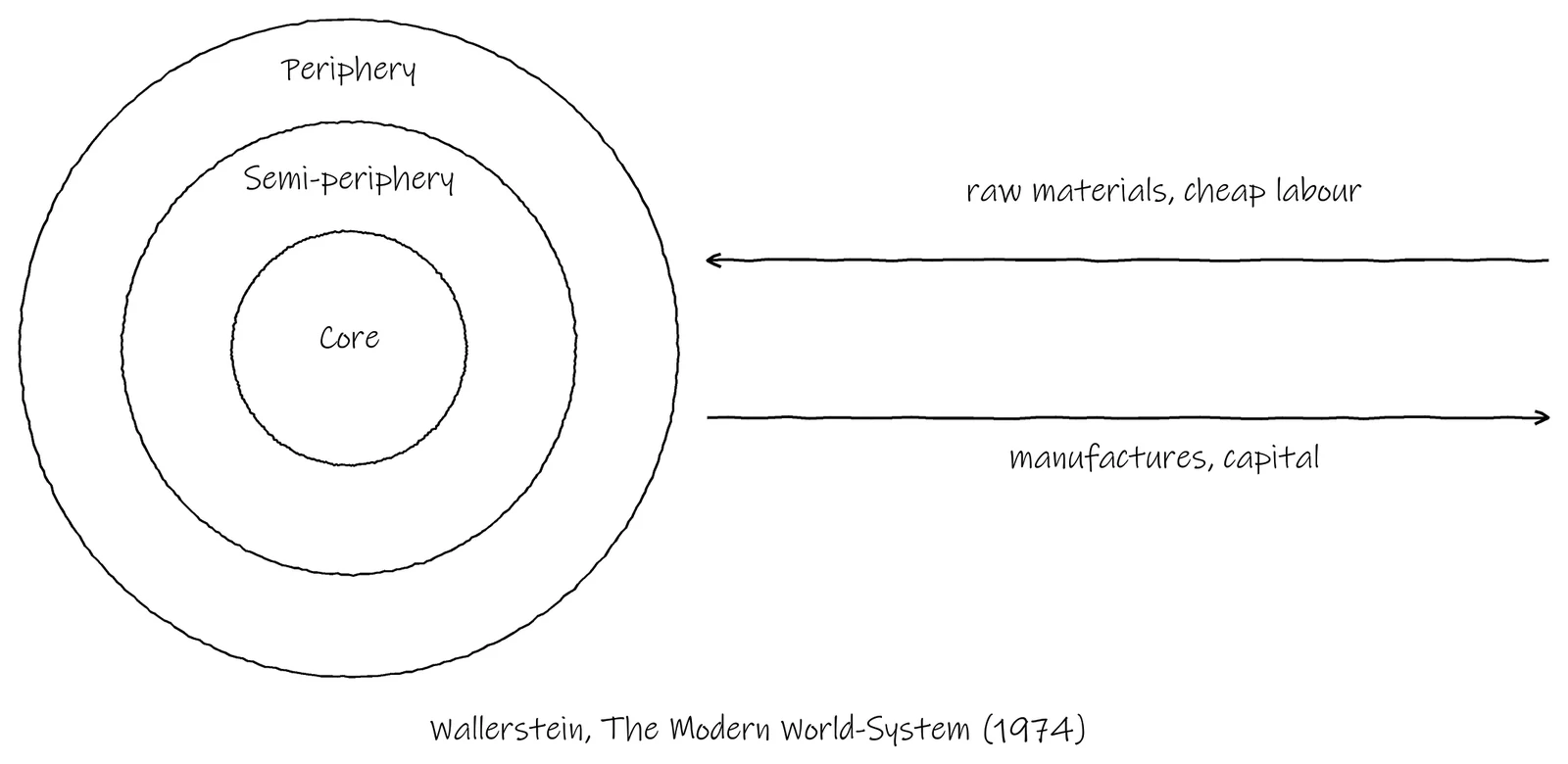
The capitalist world-economy has a trimodal structure (Figure 5.4). The core consists of states with strong governments and high-wage, high-technology, capital-intensive production. The periphery consists of areas with weak states that specialise in low-wage, labour-intensive production of raw materials and simple goods. The semi-periphery lies in between, exploiting the periphery while being exploited by the core; it also acts as a political buffer, since its existence prevents the system from being polarised into two hostile camps. Surplus flows from periphery to core through unequal exchange. Unlike Frank, Wallerstein allowed for mobility: states can rise from periphery to semi-periphery or core, as Japan and South Korea did, or fall.
C. Cycles and the future
The world-economy moves through long cycles of expansion and contraction, and through cycles of hegemony, in which one core power dominates: the Netherlands in the seventeenth century, Britain in the nineteenth and the United States in the twentieth. Wallerstein believed that the capitalist world-economy was approaching a systemic crisis and that anti-systemic movements, socialist, nationalist and new social movements, would shape what replaced it.
D. Criticism
Critics, including Theda Skocpol (1977), argued that Wallerstein reduced politics and the state to the economy; that his theory is functionalist, explaining institutions by their role in the system; that the semi-periphery is a vague category; that it neglects culture and internal class struggles; and that it is hard to test. Frank himself later argued, in ReOrient (1998), that the world economy was centred on Asia until about 1800, challenging the European starting point. Still, world-systems theory gave comparative politics a global and historical perspective that remains influential in the study of globalisation.
| Basis | Modernisation | Dependency | World-systems |
|---|---|---|---|
| Unit of analysis | Nation-state | Nation-state in the world economy | The world-system |
| Cause of underdevelopment | Internal: traditional values and institutions | External: domination by the centre | Position in the world division of labour |
| View of contact with the West | Beneficial: diffusion of capital and values | Harmful: drain of surplus | Unequal exchange; mobility possible |
| Path forward | Follow the West; aid and investment | Delink, import substitution, socialism | Rise to semi-periphery or core; anti-systemic change |
| Key thinkers | Rostow, Lerner, Lipset | Prebisch, Frank, dos Santos, Cardoso | Wallerstein |
5.6 Important Questions
- Question 1 Critically examine the modernisation theory of development.
- Question 2 Discuss the dependency theory of underdevelopment.
- Question 3 Explain Immanuel Wallerstein’s world-systems theory.
- Question 4 What is underdevelopment? Examine the critique of ‘development’ with reference to Gustavo Esteva.
DU asks the same idea in different words. So learn one broad answer for each question below; the same answer works for every question joined by OR.
Important Question 1
Critically examine the modernisation theory of development.
OR
Discuss Rostow’s stages of economic growth.
OR
Examine the assumptions and limitations of the modernisation approach.
Model Answer
“It is possible to identify all societies, in their economic dimensions, as lying within one of five categories.”
— W.W. Rostow, The Stages of Economic Growth (1960)
Introduction. Modernisation theory holds that all societies move from a traditional to a modern stage, and that the developing countries of Asia, Africa and Latin America would develop by following the path of the West. It dominated American social science in the 1950s and 1960s.
1. Context
The theory arose amid decolonisation, the Cold War competition for influence in new nations, and American foreign aid programmes. It offered a non-communist route to development. The United States promoted modernisation as an alternative to communist models of development.
2. Intellectual Roots
It drew on evolutionary sociology (Comte, Spencer, Durkheim) and Parsons’s functionalism. His pattern variables contrasted particularistic, ascriptive, diffuse traditional societies with universalistic, achievement-oriented, specific modern societies.
3. Parsons’s Pattern Variables
Talcott Parsons contrasted traditional societies, based on ascription, particularism and diffuseness, with modern societies based on achievement, universalism and specificity, which shaped modernisation theory.
4. Rostow’s Stages
Rostow identified five stages: traditional society, preconditions for take-off, take-off, drive to maturity and high mass consumption. Investment, aid and entrepreneurship would help countries reach take-off. His book was subtitled ‘A Non-Communist Manifesto’.
5. Social and Psychological Modernisation
Lerner linked urbanisation, literacy and media to empathy and participation; McClelland stressed the need for achievement; Inkeles described the attitudes of the modern man; Lipset linked development to democracy. Inkeles and Smith identified traits of ‘modern man’, such as openness to new experience and belief in science.
6. Political Development
Almond and Pye described the differentiation of structures and growth of capacity and equality. Huntington warned that rapid mobilisation without strong institutions produces political decay. Huntington (1968) argued that rapid modernisation without strong institutions leads to political decay and disorder.
7. The Modernity of Tradition
Some versions held that traditional cultures must be replaced by modern values, but Lloyd and Susanne Rudolph’s The Modernity of Tradition (1967) showed that Indian traditions such as caste could adapt to modern politics.
8. Assumptions
So identifies the assumptions: modernisation is phased, homogenising, Westernising, irreversible, progressive, lengthy, systemic and transformative, and the obstacles to it are internal.
9. Criticism
It is ethnocentric, treating the West as the model; its tradition–modernity dichotomy is false, as the Rudolphs showed in India; it ignores colonialism and the world economy; it is unilinear and ideological; and its predictions failed as many countries became authoritarian and remained poor. Dependency theorists turned its argument upside down. It ignored colonialism and the global economy as causes of underdevelopment.
10. New Modernisation Studies
Later work accepted that tradition and modernity can coexist, that there are multiple paths, and that external factors matter. Inglehart and Welzel revived the link between development, values and democracy.
11. Modernisation and Democracy
Lipset’s thesis that development produces democracy was tested by Adam Przeworski and Fernando Limongi (1997). They found that development does not necessarily cause transitions to democracy, but that democracies are far more likely to survive in richer countries; above a certain income level democracies almost never collapsed. India, a poor democracy that survived, is a striking exception.
12. Modernisation and India
Nehru’s planning, with its emphasis on heavy industry, science and big dams, reflected modernisation ideas. Gandhi’s Hind Swaraj (1909) had offered a radical critique of modern industrial civilisation, and the Rudolphs showed that Indian tradition adapted to modernity rather than disappearing before it.
13. Evaluation
Modernisation theory offered a hopeful vision of development, but its Western bias and neglect of history and power led to dependency and other critiques; revised versions remain influential.
Conclusion. Thus, modernisation theory provided an optimistic but Western-centred model of development. Its critics showed that history, power and the world economy cannot be ignored.
Important Question 2
Discuss the dependency theory of underdevelopment.
OR
Explain Andre Gunder Frank’s idea of the ‘development of underdevelopment’.
OR
Compare the modernisation and dependency approaches to development.
Model Answer
“Dependence is a situation in which the economy of certain countries is conditioned by the development and expansion of another economy to which the former is subjected.”
— Theotonio dos Santos, ‘The Structure of Dependence’ (1970)
Introduction. Dependency theory, which emerged in Latin America in the 1960s, explains underdevelopment by the subordinate position of poor countries in the world capitalist economy. It was a direct challenge to modernisation theory, which blamed underdevelopment on internal tradition.
1. Background: ECLA
Prebisch’s ECLA divided the world into centre and periphery and showed, with Singer, that the terms of trade of primary exporters decline. It recommended import-substitution industrialisation, whose limits encouraged more radical theories. Prebisch and Singer argued that the terms of trade for primary products decline over time.
2. Marxist Roots
Lenin’s theory of imperialism and Baran’s analysis of the drain of economic surplus provided the theoretical foundation.
3. Frank’s Development of Underdevelopment
Frank argued that underdevelopment was created by capitalism through a chain of metropolis–satellite relations that extracts surplus. Satellites developed most when ties were weakest, and the most backward regions were those once most integrated. His Capitalism and Underdevelopment in Latin America (1967) described chains of metropolis and satellite.
4. Dos Santos and Amin
Dos Santos traced colonial, financial-industrial and technological-industrial dependence. Samir Amin analysed unequal exchange and advocated delinking. Samir Amin spoke of unequal development and called for delinking from the world system.
5. Cardoso and Faletto
They argued that development can occur within dependence, through an alliance of foreign capital, local capital and the state, as in Brazil: associated dependent development. Cardoso later served as president of Brazil.
6. Dependency and India
Indian thinkers such as Dadabhai Naoroji, with his drain theory, anticipated dependency ideas, and India’s post-independence policy of self-reliance and import substitution reflected similar concerns.
7. Main Features
Dependency theory emphasises external causes, the transfer of surplus through trade, investment and debt, the alliance of local elites with foreign capital, and distorted, unequal growth. It also stresses the role of local elites allied with foreign capital, the comprador classes.
8. Modernisation and Dependency Compared
Modernisation blames internal tradition and sees contact with the West as beneficial; dependency blames external domination and sees contact as harmful. Modernisation recommends following the West; dependency recommends delinking or socialism. Both treat the nation-state as the unit, which world-systems theory rejected.
9. Criticism
Dependency theory is deterministic and economistic, neglects internal factors, defines dependence vaguely, and cannot explain the success of East Asian countries that developed through integration with world markets. Delinking proved costly.
10. Import Substitution and Its Limits
Latin American governments followed ECLA’s advice by protecting domestic industry and creating state enterprises. Growth was achieved for a time, but industries remained inefficient and dependent on imported machinery and foreign loans, ending in the debt crisis of 1982 and the structural adjustment programmes of the IMF and World Bank.
11. The East Asian Challenge
South Korea and Taiwan industrialised rapidly through exports to Western markets, guided by strong developmental states, as Chalmers Johnson (1982) showed for Japan and Alice Amsden (1989) for Korea. Their success contradicted the prediction that integration into world markets blocks development, though it also showed that the state can shape a country’s place in the world economy.
12. Neo-dependency
Critics of globalisation argue that debt, structural adjustment and the power of multinational corporations create new forms of dependency.
13. Relevance Today
Dependency ideas reappear in debates on global value chains, unequal exchange in commodity trade, debt burdens and the terms of new investment in Africa and Asia.
14. Evaluation
Dependency theory exposed the global inequalities ignored by modernisation theory, but its pessimism about development within capitalism was challenged by East Asia; it remains valuable as a reminder of external constraints.
Conclusion. Thus, dependency theory placed underdevelopment in a global and historical context and exposed the inequalities of the world economy, though its pessimistic predictions were not always borne out.
Important Question 3
Explain Immanuel Wallerstein’s world-systems theory.
OR
Discuss the concepts of core, periphery and semi-periphery.
OR
How does world-systems theory differ from dependency theory?
Model Answer
“The only kind of social system is a world-system, which we define quite simply as a unit with a single division of labor and multiple cultural systems.”
— Immanuel Wallerstein, ‘The Rise and Future Demise of the World Capitalist System’ (1974)
Introduction. World-systems theory, developed by Immanuel Wallerstein from 1974, argues that development and underdevelopment can be understood only by studying the capitalist world-economy as a whole. It built on dependency theory, Marxism and Braudel’s long-term history.
1. The Unit of Analysis
The nation-state is not a self-contained unit; the proper unit is the world-system, a unit with a single division of labour and multiple cultures. He set out the theory in The Modern World-System (1974).
2. World-Empires and World-Economies
World-empires have one political centre; world-economies have one division of labour but many states. The modern capitalist world-economy emerged in the long sixteenth century and expanded across the globe.
3. Core
Core states have strong governments and high-wage, capital-intensive, high-technology production, and they appropriate surplus from the rest. Western Europe, the United States and Japan are examples.
4. Periphery
Peripheral areas have weak states and specialise in low-wage, labour-intensive production of raw materials and simple goods. Much of Africa and parts of Asia and Latin America are peripheral.
5. Semi-periphery
The semi-periphery combines core and peripheral activities, exploiting the periphery while being exploited by the core, and acts as a buffer that prevents polarisation of the system. Countries such as Brazil, India and South Africa are often seen as semi-peripheral.
6. Unequal Exchange and Mobility
Surplus flows from periphery to core through unequal exchange. States can move up or down the hierarchy, as Japan and South Korea rose.
7. Cycles, Hegemony and Crisis
The system moves through cycles of expansion and contraction and of hegemony (the Netherlands, Britain, the United States). Wallerstein expected a systemic crisis and a role for anti-systemic movements. Dutch, British and American hegemonies followed one another.
8. Comparison with Dependency Theory
Dependency theory has two categories, centre and periphery, and treats nations as units; world-systems theory adds the semi-periphery, takes the world-system as the unit, and allows mobility.
9. Long Waves
Wallerstein linked the system’s rhythm to long economic waves of about fifty years, alternating expansion and stagnation.
10. Anti-systemic Movements
He argued that labour, nationalist and new social movements challenge the system, and that the capitalist world-economy faces a structural crisis.
11. Criticism
Skocpol and others criticised its economic reductionism and neglect of the state and culture, its functionalism, the vagueness of the semi-periphery, and its difficulty of testing. Frank’s ReOrient challenged its European starting point. Critics also argue that it neglects culture and the agency of states.
12. Origins of the Modern World-System
Wallerstein showed that in the long sixteenth century north-western Europe became the core, with wage labour and commercial agriculture; eastern Europe became a periphery exporting grain through a ‘second serfdom’, and the Americas a periphery of slave and coerced labour; Mediterranean Europe became a semi-periphery with sharecropping. Each zone had a different form of labour control suited to its place in the division of labour.
13. The Rise of China
China’s movement from periphery towards the core is often used to test the theory, showing both the possibility of mobility and the persistence of hierarchy.
14. World-Systems and India
India was incorporated into the capitalist world-economy between about 1750 and 1850, when colonial rule turned it into an exporter of raw materials and a market for British goods. Today India, like Brazil, is often described as semi-peripheral, and China’s rise shows the mobility that the theory allows.
15. Evaluation
World-systems theory offers a global and historical view of inequality that national studies miss, though its economic focus must be supplemented by attention to politics and culture.
Conclusion. Thus, world-systems theory offers a global, historical framework for understanding inequality among nations, and remains influential in the study of globalisation.
Important Question 4
What is underdevelopment? Examine the critique of ‘development’ with reference to Gustavo Esteva.
OR
Discuss the political economy approach to comparative politics.
OR
Examine the post-development critique of development.
Model Answer
“We must embark on a bold new program for making the benefits of our scientific advances and industrial progress available for the improvement and growth of underdeveloped areas.”
— Harry S. Truman, Inaugural Address (20 January 1949)
Introduction. Underdevelopment usually refers to the condition of poor countries with low incomes, weak industry and poor human development. But scholars disagree about its causes and even about whether the concept itself is neutral. The political economy approach studies these questions by linking politics and economics.
1. The Political Economy Approach
Political economy studies the relationship between state and market, power and wealth. It includes liberal, nationalist and Marxist traditions, and in comparative politics it challenged systems theory by focusing on classes, the state and international inequality (Chilcote). It examines how power shapes economic outcomes and how economic interests shape politics.
2. Underdevelopment as a Condition
Underdeveloped countries are marked by low income per head, poverty, dependence on agriculture and primary exports, limited industry, low literacy and health, unemployment and inequality. It is also marked by dependence on primary exports and weak institutions.
3. Explanations
Modernisation theory blames internal traditions; dependency theory blames the drain of surplus to the centre; world-systems theory blames the position of countries in the world division of labour. Institutionalists stress weak states and poor governance.
4. Underdevelopment as a Product of History
Baran, Frank and Rodney argued that underdevelopment was created by the integration of poor countries into world capitalism, as India’s de-industrialisation under colonial rule shows. Walter Rodney’s How Europe Underdeveloped Africa (1972) is a classic statement.
5. Esteva: The Invention of Underdevelopment
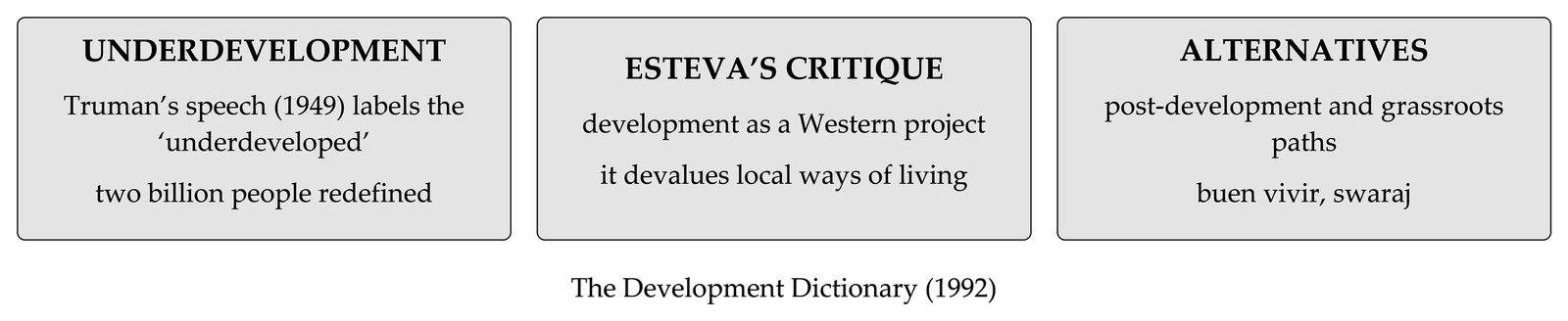
Esteva argued that underdevelopment was born as a concept with Truman’s speech of 1949: on that day two billion people were redefined by what they lacked compared with the West. With President Truman’s inaugural address of 20 January 1949, Esteva wrote, two billion people suddenly became ‘underdeveloped’.
6. The Development Dictionary
Esteva’s essay appeared in The Development Dictionary (1992), edited by Wolfgang Sachs, which criticised key words of development such as needs, poverty and progress.
7. The Critique of Development
‘Development’, a biological metaphor, implies a single natural path with the West at its end. In practice the development project often destroyed local knowledge, community and self-reliance, and created dependence on experts and aid. It reduces diverse ways of life to a single scale measured by income.
8. Post-Development Alternatives
Esteva, Sachs and Escobar called for people to define their own good life, to revive community, local knowledge and self-reliance, and to resist the homogenising model of economic growth. Arturo Escobar’s Encountering Development (1995) analysed development as a discourse of power.
9. Buen Vivir and Swaraj
Alternatives include the Andean idea of buen vivir, living well in harmony with community and nature, and Gandhian swaraj, which measure progress by well-being and self-rule rather than growth.
10. Development and Displacement in India
Large dams, mines and industrial projects displaced millions of people, many of them Adivasis, leading movements such as the Narmada Bachao Andolan to question the costs of development.
11. Evaluation
The critique exposed the Western bias and power behind development discourse. But critics argue that it romanticises tradition, ignores the real gains of development in health and education, and offers few practical alternatives for reducing poverty. Critics reply that the poor themselves often want roads, schools and hospitals.
12. Indian Debates on Development
Gandhi’s Hind Swaraj (1909) rejected industrial civilisation in favour of village self-reliance. From the late 1980s the Narmada Bachao Andolan opposed large dams that displaced tribal and rural people, questioning who pays the costs of development. Amartya Sen’s Development as Freedom (1999) offered a reformist answer, defining development as the expansion of people’s capabilities and freedoms rather than income alone.
13. Human and Sustainable Development
The UNDP’s Human Development Index (1990), designed by Mahbub ul Haq with Sen’s ideas, added health and education to income, and the Brundtland Report (1987) defined sustainable development as meeting present needs without compromising future generations, both attempts to broaden the meaning of development. The Sustainable Development Goals (2015) set seventeen goals for 2030.
14. Lessons
Post-development reminds us that development must be defined by the people it affects, not imposed from outside.
Conclusion. Thus, underdevelopment is both a material condition and a contested idea. Political economy shows its causes in power and history; the post-development critique shows how the very language of development reflects that power.
Short Notes
(a) The Prebisch–Singer thesis
The argument of Raúl Prebisch and Hans Singer (1950) that the terms of trade of countries exporting primary goods tend to decline relative to those exporting manufactures, so that wealth is transferred from the periphery to the industrial centre. It was the basis of ECLA’s import-substitution strategy.
(b) Associated dependent development
Cardoso and Faletto’s concept for industrial growth that occurs within dependence, through an alliance of multinational corporations, local capitalists and the state, as in Brazil. It modified the view that dependence always blocks development.
(c) Semi-periphery
In Wallerstein’s world-systems theory, the intermediate zone between core and periphery, with a mix of high- and low-wage production. It exploits the periphery and is exploited by the core, and stabilises the system by preventing polarisation.
(d) Developmental state
A state that actively guides economic development through planning, industrial policy, credit allocation and a capable, relatively autonomous bureaucracy, while working closely with private business. Chalmers Johnson’s MITI and the Japanese Miracle (1982) used the term for Japan, and it was later applied to South Korea and Taiwan. Peter Evans described such states as having embedded autonomy.
More notes: DSC-5 Methods and Approaches in Comparative Political Analysis
- Understanding Comparative Politics
- Approaches to Studying Comparative Politics: Political System, Structural functional analysis
- Approaches to Studying Comparative Politics: Traditional and Neo-Institutionalisms
- Approaches to Studying Comparative Politics: Political Culture
- Gendering Comparative Politics
These notes are prepared by PADHO TO AISE for study help. They are not an official University of Delhi publication.