
Semester II DSC-5 Methods and Approaches in Comparative Political Analysis
Unit II · 23 min read · Updated 24 Nov 2026
As per the University of Delhi (DU) BA (Hons) Political Science syllabus
Contents
- 2.1 The Idea of a System
- 2.2 David Easton’s Political System Approach
- 2.3 Gabriel Almond’s Structural-Functional Analysis
- 2.4 Comparing Political Systems: Using the Two Approaches
- 2.5 An Evaluation of Both Approaches
- 2.6 Important Questions
- Explain David Easton’s political system approach.
- Critically examine Gabriel Almond’s structural-functional approach.
- Evaluate the contributions and limitations of the systems and structural-functional approaches.
- Short Notes
राजनीतिक व्यवस्था वे अंतःक्रियाएँ हैं जिनके द्वारा समाज के लिए मूल्यों का आधिकारिक आवंटन होता है।
A political system can be designated as those interactions through which values are authoritatively allocated for a society.
— David Easton, A Framework for Political Analysis (1965)
AFTER THE SECOND WORLD WAR comparative politics faced a practical problem. Dozens of new states had appeared in Asia and Africa, and their politics could not be understood with the old categories of Western constitutional law. Many had no strong parliament or courts, yet they had chiefs, castes, religious leaders, parties and armies that performed political tasks. Scholars needed concepts that could be applied to every country, whatever its institutions. Two closely related answers became dominant in the 1950s and 1960s: David Easton’s political system approach, which saw politics as a system that converts inputs from society into outputs, and Gabriel Almond’s structural-functional analysis, which asked what functions every political system must perform and which structures perform them in each country. In this chapter we study both approaches, how they are used to compare political systems, and why they were later criticised.
2.1 The Idea of a System
A system is a set of interrelated parts that work together as a whole and interact with their environment, so that a change in one part affects the others. The idea came from biology, where Ludwig von Bertalanffy [बर्टालान्फ़ी] developed a general systems theory: a living organism takes in food and air from its environment, processes them and maintains itself through feedback. The sociologist Talcott Parsons applied it to society, arguing that every social system must perform certain functions to survive, and anthropologists such as Malinowski and Radcliffe-Brown studied the functions of institutions in tribal societies. Political scientists borrowed these ideas because they offered a language for studying politics in any society, Western or non-Western, with or without formal constitutions.
The systems approach has three main assumptions. First, politics is a system of interactions, not just a set of institutions. Second, the system exists in an environment with which it constantly exchanges influences. Third, a system tends to persist: it responds to pressures in ways that keep it going. These assumptions were part of the behavioural revolution, which wanted political science to be general, empirical and scientific.
2.2 David Easton’s Political System Approach
David Easton (1917–2014), a Canadian-American political scientist, was the leading theorist of the political system. In The Political System (1953) he criticised political science for lacking a general theory, and in A Framework for Political Analysis and A Systems Analysis of Political Life (both 1965) he set out his model. He defined politics as the authoritative allocation of values for a society: a political system is the set of interactions through which valued things, such as wealth, power, status and security, are distributed by decisions that people accept as binding.
A. The input–output model
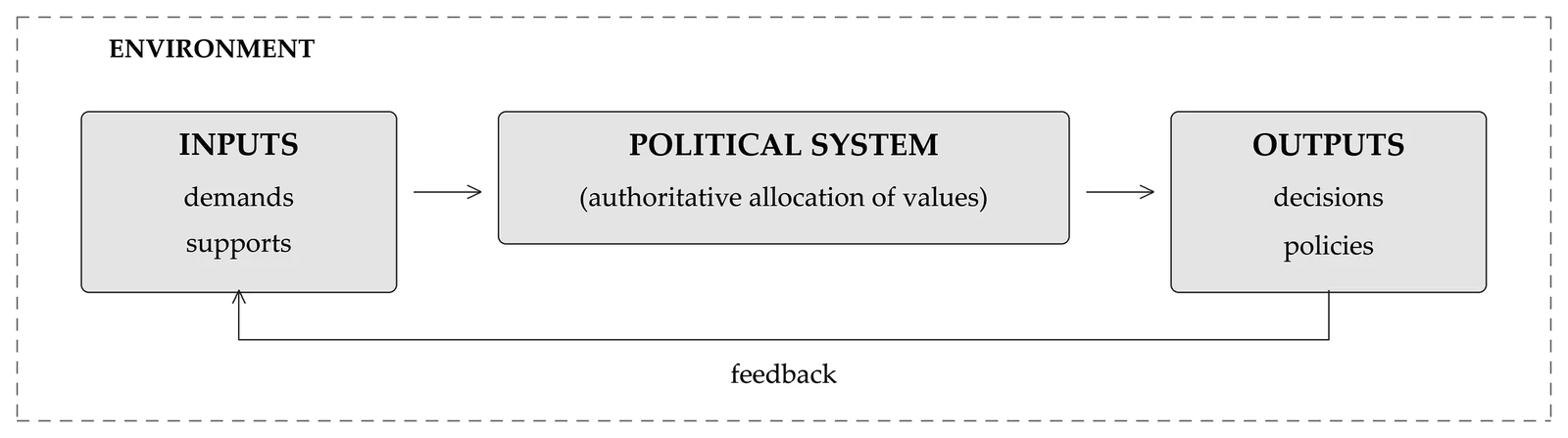
Easton described the political system as a conversion process (Figure 2.2):
- Environment: the political system is surrounded by an intra-societal environment (the economy, culture, social structure, personality) and an extra-societal environment (the international system). Disturbances in the environment create pressures on the system.
- Inputs: these pressures enter the system as demands, claims that authorities should allocate values in a certain way, such as demands for jobs, reservations or lower taxes, and supports, the attitudes and actions that keep the system going, such as paying taxes, voting, obeying laws and loyalty.
- Conversion: within the system, demands are processed by parties, legislatures, executives and bureaucracies. Easton called this the black box, since his model concentrated on inputs and outputs rather than on what happens inside.
- Outputs: the system produces binding decisions and actions, such as laws, policies, budgets and judicial decisions.
- Feedback: outputs affect the environment, which in turn generates new demands and supports. Through this feedback loop the authorities learn about the effects of their actions and can correct them.
B. Regulating demands: gatekeepers
No system can satisfy all demands. Easton showed that demands are filtered by gatekeepers, such as parties, interest groups, opinion leaders and the media, which decide which demands reach the authorities. Demands are also reduced by cultural norms, which make some demands seem illegitimate, and by combining many demands into a few. When demands are too many (volume stress) or too complex (content stress), the system faces demand stress.
C. Support and its objects
Support is directed at three objects: the political community, the group of people who agree to solve their problems together; the regime, the basic rules and structures, such as the constitution; and the authorities, the persons who hold office at a given time. Easton distinguished specific support, which depends on satisfaction with particular outputs, from diffuse support, a general attachment to the system that continues even when people are unhappy with particular decisions. A system with a reserve of diffuse support can survive bad times; one that depends only on specific support is fragile. When support falls below a critical level, the system faces support stress.
D. Persistence
Easton’s central question was how political systems persist in a world of stability and change. Systems respond to stress by meeting demands, by changing their structures, by building diffuse support through socialisation, or by repressing demands. Persistence does not mean that nothing changes; a system may transform its regime and still persist as a political community.
2.3 Gabriel Almond’s Structural-Functional Analysis
Gabriel Almond [आलमंड] (1911–2002), chairman of the SSRC Committee on Comparative Politics, combined the systems idea with the functionalism of Parsons and Robert Merton. Structural-functional analysis asks two questions: what functions must every political system perform, and what structures perform them in a particular country? A structure is a pattern of action or an institution, such as a party, a legislature, a caste association or a family; a function is the consequence of that activity for the system. Merton’s distinction between manifest (intended) and latent (unintended) functions reminded scholars that institutions may perform functions other than those formally assigned to them.
A. Four characteristics of all political systems
In his introduction to The Politics of the Developing Areas (1960), Almond stated four propositions that made comparison of all systems possible:
- All political systems, however simple, have political structures.
- The same functions are performed in all political systems, though by different structures and with different frequency.
- All political structures are multi-functional: a structure, such as a party or a family, performs several functions.
- All political systems are mixed in the cultural sense: there are no purely ‘modern’ or purely ‘traditional’ systems.
B. Input and output functions
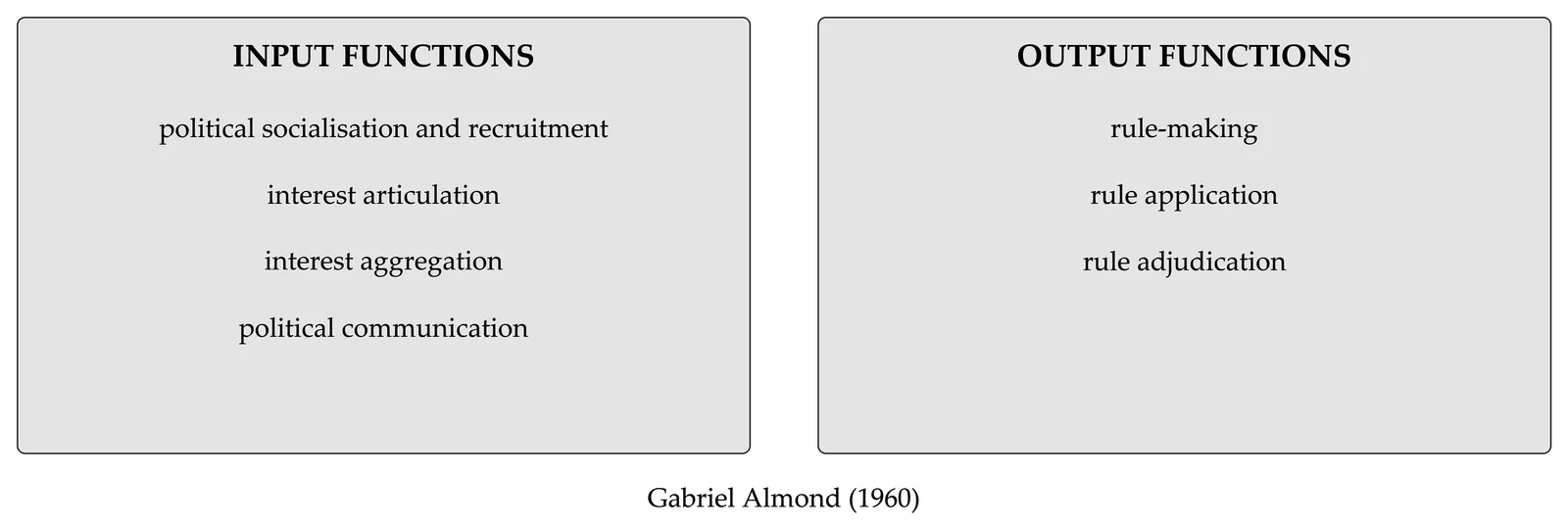
Almond identified seven functions that every political system performs (Figure 2.3). The input functions are performed mainly by non-governmental structures:
- Political socialisation and recruitment: the process by which people acquire political attitudes and values, through family, school, peer groups and media, and by which people are selected for political roles.
- Interest articulation: the expression of demands by individuals and groups, through interest groups, caste associations, trade unions, petitions, demonstrations or even riots.
- Interest aggregation: the combining of many demands into general policy alternatives, mainly by political parties, which bring together different groups behind a common programme.
- Political communication: the flow of information through the system, through the media and personal networks, which links all the other functions.
The output functions are performed mainly by governmental structures, and correspond to the old separation of powers: rule-making (legislation), rule application (execution and administration) and rule adjudication (judicial decision).
C. Almond and Powell: a developmental approach
In Comparative Politics: A Developmental Approach (1966), Almond and G. Bingham Powell reorganised the functions at three levels. At the level of capabilities, they asked how the system performs as a whole in its environment: its extractive capability (drawing resources such as taxes and manpower), regulative capability (controlling behaviour), distributive capability (allocating goods and services), symbolic capability (using symbols, ceremonies and appeals to build support) and responsive capability (responding to demands). At the level of conversion functions, they placed interest articulation, interest aggregation, rule-making, rule application, rule adjudication and communication. At the level of system maintenance and adaptation, they placed socialisation and recruitment. In later editions of Comparative Politics Today, Almond and his co-authors simplified this into system functions (socialisation, recruitment, communication), process functions (articulation, aggregation, policy-making, implementation and adjudication) and policy functions (the outputs and outcomes of extraction, regulation and distribution).
D. Political development
Almond and Powell measured political development by three criteria: structural differentiation, in which specialised structures emerge for each function; cultural secularisation, in which people become more rational, analytical and empirical in their political actions; and subsystem autonomy, the independence of parties, interest groups and media from the government. A developed system has high levels of all three and greater capabilities.
2.4 Comparing Political Systems: Using the Two Approaches
The great advantage of the two approaches is that they provide a common vocabulary for comparing very different countries. In Comparative Politics Today, Almond and his co-authors show how to compare systems by asking the same questions of each: what is its environment, domestic and international; what structures exist; which structures perform which functions; what are its policies and their outcomes; and how does it change?
The answers can differ greatly. In Britain, interest aggregation is performed mainly by two large parties; in a military regime, it may be performed by the army or the bureaucracy; and in a traditional monarchy, by the royal court. Interest articulation may take the form of organised associational groups in one country and of caste or tribal groups in another. In India, Lloyd and Susanne Rudolph (1967) showed how caste associations became modern vehicles of interest articulation, and Rajni Kothari (1964) described how the Congress system aggregated the interests of very diverse groups within a single dominant party. The approaches thus allow comparison of informal and non-Western structures that the old formal-legal approach ignored.
2.5 An Evaluation of Both Approaches
A. Contributions
- They gave comparative politics a general framework and vocabulary applicable to all countries.
- They moved attention beyond formal institutions to parties, groups, culture, communication and informal structures.
- They included the non-Western world in comparison and inspired studies of political development.
- Easton’s concepts of demands, supports, feedback and legitimacy remain useful in the study of policy and regime stability.
- Almond’s functions helped organise textbooks and research for decades.
B. Criticisms
- Status quo bias: both approaches stress equilibrium, persistence and system maintenance, and treat conflict and revolution as disturbances. Critics said they were conservative and could not explain fundamental change.
- Western bias: the functions were derived from the Anglo-American political system, and ‘development’ meant becoming like it. Manoranjan Mohanty and others saw them as part of a Cold War social science that served American interests.
- Vagueness and tautology: concepts such as function, system and equilibrium are abstract and hard to measure. To say that a structure exists because it performs a function needed for the system’s survival risks circular reasoning.
- The black box: Easton’s model says little about what happens inside the system, about power, elites and the state.
- Neglect of power and class: Marxists argue that the approaches ignore the domination of some classes over others and the role of the global capitalist system.
- Over-abstraction: Sartori and others argued that such general frameworks stretch concepts so far that they lose their meaning.
From the late 1970s, scholars turned to the state, institutions, political economy and culture, approaches that we study in the following chapters. Yet the systems and structural-functional approaches left a lasting mark: much of the vocabulary of comparative politics, from interest articulation to political socialisation, comes from them.
2.6 Important Questions
- Question 1 Explain David Easton’s political system approach.
- Question 2 Critically examine Gabriel Almond’s structural-functional approach.
- Question 3 Evaluate the contributions and limitations of the systems and structural-functional approaches.
DU asks the same idea in different words. So learn one broad answer for each question below; the same answer works for every question joined by OR.
Important Question 1
Explain David Easton’s political system approach.
OR
Critically examine Easton’s input–output model of the political system.
OR
Discuss the systems approach to the study of comparative politics.
Model Answer
“Politics is the authoritative allocation of values for a society.”
— David Easton, The Political System (1953)
Introduction. The political system approach studies politics as a system of interactions that converts demands and supports from society into authoritative decisions. It was developed by David Easton in The Political System (1953), A Framework for Political Analysis (1965) and A Systems Analysis of Political Life (1965), and it gave comparative politics one of its first general theories.
1. Background
Easton borrowed the idea of a system from Bertalanffy’s general systems theory and from Parsons’s sociology. He criticised traditional political science for lacking theory, and as a leader of the behavioural movement sought a framework applicable to all political systems. He set out the approach in The Political System (1953) and A Systems Analysis of Political Life (1965).
2. Definition of Politics and the Political System
Easton defined politics as the authoritative allocation of values for a society. The political system is the set of interactions through which such allocations are made and accepted as binding. It is distinguished from other social systems by this authoritative character.
3. Environment
The system exists within an intra-societal environment (economy, culture, social structure) and an extra-societal environment (the international system). Changes in the environment create disturbances that enter the system.
4. Inputs: Demands and Supports
Demands are claims for the allocation of values, such as jobs, welfare or security. Supports are attitudes and actions that sustain the system, such as obedience, taxes, voting and loyalty. Support is directed at the political community, the regime and the authorities, and may be specific or diffuse. Support may be specific, for particular outputs, or diffuse, a general loyalty to the system.
5. Withinputs
Easton noted that demands can also arise within the political system itself, from officials and leaders, which he called ‘withinputs’.
6. Conversion and Gatekeepers
Demands are filtered by gatekeepers, such as parties, interest groups and the media, and reduced by cultural norms. Inside the system, legislatures, executives and bureaucracies convert them into decisions; Easton left this process largely as a black box.
7. Outputs and Feedback
Outputs are binding decisions and policies. They affect the environment, generating new demands and supports, which flow back through the feedback loop and allow the authorities to adjust their actions.
8. Stress and Persistence
Systems face demand stress, when demands are too many or too complex, and support stress, when support falls. They persist by meeting demands, regulating them, changing structures or building diffuse support. Easton’s main concern was how systems persist amid change. Systems persist by adjusting outputs, changing structures or generating diffuse support.
9. Significance
The model gave a general, abstract framework for comparing all political systems, highlighted the links between politics and its environment, and introduced concepts such as feedback, legitimacy and diffuse support that remain in use. It also influenced policy analysis and systems thinking in administration.
10. Criticism
Critics argue that the model is too abstract to be tested, that it has a status quo bias favouring stability, that the black box ignores power, elites and the state, and that it neglects conflict, class and revolutionary change. Its Western, behavioural origins have also been criticised. It cannot easily explain where demands come from or why some groups are excluded.
11. Easton and Behaviouralism
Easton was a leading voice of the behavioural movement and listed its ‘intellectual foundation stones’ in 1962: regularities, verification, techniques, quantification, separation of facts and values, systematisation, pure science and integration with other social sciences. In his presidential address to the American Political Science Association in 1969, however, he announced a ‘post-behavioural revolution’ that demanded relevance and action on the urgent problems of society.
12. An Illustration from India
The reorganisation of states shows the model at work. In the 1950s demands for linguistic states were articulated by popular movements, filtered by the Congress party as gatekeeper, processed by the States Reorganisation Commission and Parliament, and converted into an output, the States Reorganisation Act, 1956. Its effects generated new demands, for Maharashtra and Gujarat in 1960 and later for other states, through feedback.
Conclusion. Thus, Easton’s political system approach offered a simple and general picture of politics as a cycle of inputs, conversion, outputs and feedback. It is a useful starting point for comparison, though it must be supplemented by the study of power, conflict and institutions.
Important Question 2
Critically examine Gabriel Almond’s structural-functional approach.
OR
Discuss the input and output functions of the political system according to Almond.
OR
Explain the capabilities of the political system according to Almond and Powell.
Model Answer
“The same functions are performed in all political systems, even though these functions may be performed with different frequencies, and by different kinds of structures.”
— Gabriel Almond, The Politics of the Developing Areas (1960)
Introduction. Structural-functional analysis studies political systems by asking what functions every system must perform and which structures perform them. Gabriel Almond introduced it to comparative politics in The Politics of the Developing Areas (1960) and developed it with G. Bingham Powell in Comparative Politics: A Developmental Approach (1966).
1. Origins
The approach came from the functionalism of anthropologists such as Malinowski and Radcliffe-Brown and of sociologists Talcott Parsons and Robert Merton, who distinguished manifest from latent functions. Almond combined it with Easton’s systems idea. Talcott Parsons and Robert Merton developed functionalism in sociology, and Merton distinguished manifest from latent functions.
2. Structures and Functions
A structure is an observable pattern of activity or institution; a function is the consequence of that activity for the system. The same structure may perform many functions and the same function may be performed by different structures in different countries.
3. Four Characteristics of Political Systems
All political systems have structures; the same functions are performed in all systems; all structures are multi-functional; and all systems are culturally mixed, combining modern and traditional elements.
4. Input Functions
Political socialisation and recruitment, interest articulation, interest aggregation and political communication are performed mainly by non-governmental structures such as families, schools, interest groups, parties and media.
5. Output Functions
Rule-making, rule application and rule adjudication are performed mainly by legislatures, executives and bureaucracies, and courts, corresponding to the separation of powers.
6. Capabilities and Levels of Functions
Almond and Powell added capabilities, extractive, regulative, distributive, symbolic and responsive, which measure the performance of the system as a whole. They distinguished conversion functions from system maintenance and adaptation functions, and later from policy functions.
7. Political Development
Development was measured by structural differentiation, cultural secularisation and subsystem autonomy. Developed systems have specialised structures, rational political cultures and autonomous groups and parties. Almond and Powell set out these criteria in Comparative Politics: A Developmental Approach (1966).
8. Almond and Verba’s Civic Culture
Almond also studied political culture with Verba in The Civic Culture (1963), linking structures and functions to citizens’ attitudes.
9. Contributions
The approach provided a universal vocabulary for comparison, looked beyond formal institutions to informal structures, and brought non-Western countries into comparative politics. It helped explain how caste associations or dominant parties perform functions in countries such as India. It encouraged the study of the new states of Asia and Africa.
10. Function and Dysfunction
Merton’s idea that structures can be dysfunctional, harming the system, helps explain political decay, as Huntington later argued.
11. Criticism
Critics argue that it is conservative, stressing stability and system maintenance; Western-centric, taking the Anglo-American system as the model of development; tautological, since functions are inferred from structures and vice versa; and vague, making empirical testing difficult. It also neglects power, class and conflict. It also struggles to explain revolutionary change.
12. Types of Interest Groups
Almond and Powell classified the structures of interest articulation into four types: anomic groups, spontaneous outbursts such as riots and demonstrations; non-associational groups, based on kinship, caste, religion or region, without formal organisation; institutional groups, formal organisations such as the army, bureaucracy or churches that also press their own interests; and associational groups, specialised organisations such as trade unions and business associations. Developed systems rely more on associational groups.
13. An Illustration from India
The Rudolphs showed how caste associations became modern vehicles of interest articulation; Kothari showed how the Congress system aggregated diverse interests; and output functions are performed by Parliament, the bureaucracy and an active judiciary that sometimes also makes rules through public interest litigation, showing the multi-functionality of structures.
Conclusion. Thus, Almond’s structural-functional approach made the comparison of all political systems possible by focusing on functions rather than formal institutions. Its value lies in its vocabulary; its weakness in its bias towards stability and the Western model.
Important Question 3
Evaluate the contributions and limitations of the systems and structural-functional approaches.
OR
Compare Easton’s systems approach with Almond’s structural-functional approach.
OR
Why were the systems approaches criticised as conservative and Eurocentric?
Model Answer
“A sudden upsurge of interest in ‘the state’ has occurred in comparative social science in the past decade.”
— Theda Skocpol, ‘Bringing the State Back In’ (1985)
Introduction. The systems approach of Easton and the structural-functional approach of Almond dominated comparative politics in the 1950s and 1960s. Both sought general frameworks for comparing all political systems. Their contributions were great, but so were their limitations, which led to new approaches from the 1970s.
1. Common Features
Both see politics as a system interacting with its environment; both are general and abstract; both belong to the behavioural revolution; and both seek to compare all countries, Western and non-Western. Both were products of the behavioural revolution and the search for a science of politics.
2. Easton and Almond Compared
Easton concentrated on the flow of inputs and outputs and on how systems persist; he left the inside of the system as a black box. Almond opened the black box by identifying the functions performed within the system and the structures that perform them. Easton was more abstract; Almond more concerned with comparison and development. Easton focused on the system as a whole, Almond on the functions performed by particular structures.
3. Contribution: A Common Vocabulary
Concepts such as demands, supports, feedback, socialisation, interest articulation and aggregation became the common language of comparative politics. This made comparison between very different countries possible.
4. Contribution: Beyond Formal Institutions
The approaches studied informal structures, parties, groups, families, castes, that the formal-legal approach ignored, and allowed meaningful comparison of non-Western countries.
5. Limitation: Status Quo Bias
Both emphasised equilibrium, persistence and system maintenance, treating conflict and revolution as dysfunctions. They could not adequately explain the upheavals of the 1960s or the breakdown of regimes. This made them ill-suited to explain revolutions, social movements and conflict.
6. Limitation: Western Bias
The functions and the idea of development were drawn from the Anglo-American experience. Mohanty argued that such approaches reflected the Cold War interests of the United States and ignored imperialism and class exploitation. Critics such as Manoranjan Mohanty saw them as tools of Cold War modernisation theory.
7. Limitation: Abstraction and Tautology
Concepts such as function and system are vague and hard to measure; explaining structures by the functions they perform risks circular reasoning. Sartori warned against concepts stretched so far that they lose meaning. Functions were often inferred from the survival of structures, which is circular.
8. Limitation: Neglect of the State and Power
The black box neglected the state, bureaucracy and elites. Theda Skocpol’s call to ‘bring the state back in’ (1985) and the new institutionalism were responses to this gap. Skocpol’s ‘Bringing the State Back In’ (1985) called for treating the state as an autonomous actor.
9. Marxist Criticism
Marxists argued that both approaches ignored class conflict and the economic basis of politics, presenting capitalist democracy as the normal and stable form of politics.
10. Use in Indian Politics
Indian scholars used these frameworks in the 1960s to study the Congress system, caste associations and political development, showing both their usefulness and their limits in a non-Western context.
11. Later Alternatives
From the 1970s, rational choice theory and the new institutionalism replaced systems approaches as the main frameworks of comparative politics.
12. Legacy
Despite their decline, the approaches remain useful for organising comparative description, and much of their vocabulary survives in textbooks such as Comparative Politics Today. Concepts such as political socialisation and interest aggregation remain in textbooks.
13. The Political Development Debate
Almond and Powell’s criteria of development were applied to new nations by scholars such as Lucian Pye, Joseph LaPalombara and Myron Weiner. Samuel Huntington (1968) argued that this optimism was misplaced: rapid social mobilisation without strong institutions produced instability and political decay, so order, not participation, should come first.
14. Continuing Uses
Systems concepts remain useful in policy analysis, which speaks of feedback and implementation, and in the study of legitimacy: Pippa Norris’s Critical Citizens (1999) used Easton’s distinction between diffuse and specific support to show that citizens may support democracy as a system while distrusting particular governments. Environmental and health policy also use systems thinking.
15. Evaluation
The systems and structural-functional approaches gave comparative politics a common language and widened its scope, but their abstraction and conservatism led to their decline. They remain useful as frameworks rather than as complete theories.
Conclusion. Thus, the systems and structural-functional approaches gave comparative politics its first general frameworks. Their bias towards stability and the West led to new approaches, but their concepts remain part of the discipline.
Short Notes
(a) Gatekeepers
In Easton’s model, gatekeepers are the structures, such as political parties, interest groups, opinion leaders and the media, that regulate the flow of demands into the political system, deciding which demands reach the authorities. They protect the system from demand overload.
(b) Capabilities of the political system
Almond and Powell’s measures of how a political system performs in its environment: extractive (drawing resources), regulative (controlling behaviour), distributive (allocating goods and services), symbolic (building support through symbols) and responsive (responding to demands).
(c) Interest articulation and interest aggregation
Interest articulation is the expression of demands by individuals and groups, for example through interest groups, caste associations or protests. Interest aggregation is the combination of many demands into general policy alternatives, usually by political parties. Articulation voices interests; aggregation unites them.
More notes: DSC-5 Methods and Approaches in Comparative Political Analysis
These notes are prepared by PADHO TO AISE for study help. They are not an official University of Delhi publication.