
Generic Electives (GE) GE-5 Governance: Issues and Challenges
Unit 5 · 24 min read · Updated 27 Nov 2026
As per the University of Delhi (DU) Generic Elective (GE) syllabus offered by the Department of Political Science
Contents
- 5.1 Public Service Delivery
- Initiatives to Improve Service Delivery
- Best Practices
- Problems
- 5.2 Electronic Governance
- Evolution in India
- Benefits
- Challenges
- 5.3 Citizens’ Charter, Right to Information and Corporate Social Responsibility
- Citizens’ Charter
- Right to Information
- Corporate Social Responsibility
- 5.4 Important Questions
- Discuss the major initiatives taken to improve public service delivery in India.
- What is e-governance? Discuss its significance and challenges in India.
- Examine the citizens’ charter and the right to information as instruments of good governance in India.
- What is corporate social responsibility? Examine the CSR framework in India and its role in governance.
- Short Notes
इस अधिनियम के उपबंधों के अधीन रहते हुए, सभी नागरिकों को सूचना का अधिकार होगा।
Subject to the provisions of this Act, all citizens shall have the right to information.
— Right to Information Act, 2005, Section 3
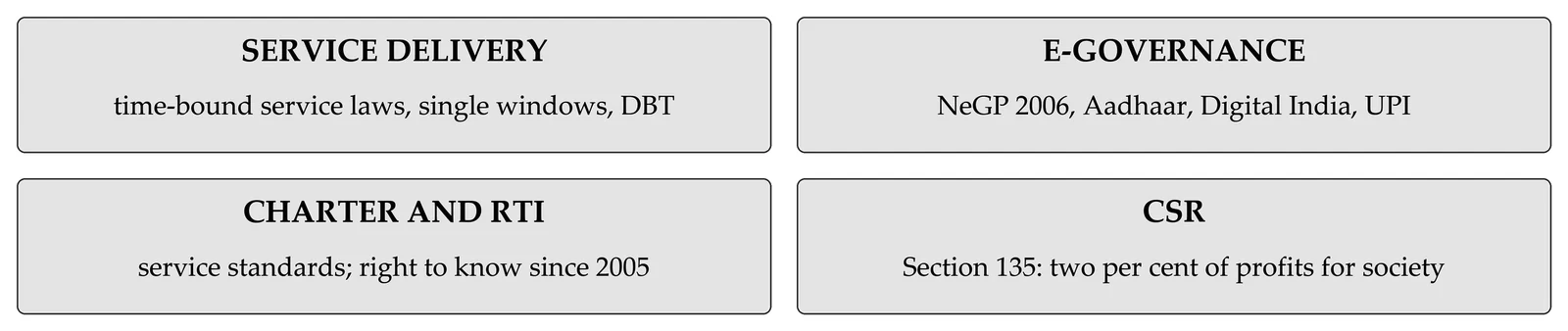
GGOOD governance becomes real for citizens when they can obtain a certificate without bribes, find out why their pension is delayed, receive welfare directly in their bank accounts and hold officials to promised standards. Since the 1990s, India has introduced many initiatives to improve governance: reforms in public service delivery, electronic governance, citizens’ charters, the Right to Information and corporate social responsibility. This chapter examines each initiative, with examples of best practices from different states, and assesses its achievements and limitations.
5.1 Public Service Delivery
Public service delivery refers to the provision of services by the government to citizens, such as certificates, licences, pensions, rations, health care, education, water and electricity. For most citizens, the quality of governance is judged by their everyday experience of these services. In India, service delivery has often suffered from delays, corruption, discretion of officials, complex procedures, poor access in rural areas and the lack of accountability when services fail.
Initiatives to Improve Service Delivery
- Right to public services laws. Beginning with Madhya Pradesh in 2010, followed by Bihar and others, these laws guarantee delivery of notified services within fixed time limits, with penalties on officials for delay. Karnataka’s Sakala (2012) is a well-known example.
- Sevottam model. Developed by the Department of Administrative Reforms and Public Grievances and endorsed by the Second ARC, it has three modules: a citizen’s charter with service standards, a grievance redressal system, and building service delivery capability.
- Single-window and citizen service centres. FRIENDS in Kerala (2000), e-Seva and later MeeSeva in Andhra Pradesh and Telangana, and Common Service Centres across India provide many services at one place.
- Direct Benefit Transfer. Subsidies and benefits are transferred directly to bank accounts, reducing leakages.
- Public distribution reforms. Computerisation, Aadhaar-based authentication and One Nation One Ration Card allow beneficiaries, including migrants, to draw rations anywhere in India.
- Grievance redressal. The Centralised Public Grievance Redress and Monitoring System (CPGRAMS) allows citizens to file complaints online, and many states have helplines such as CM helplines.
- Outcome monitoring. Programmes such as the Aspirational Districts Programme (2018) rank districts on health, education and other indicators to improve delivery.
Best Practices
Several sectoral examples show what effective delivery requires. Tamil Nadu’s universal public distribution system and midday meal scheme, Chhattisgarh’s PDS reforms in the 2000s, Kerala’s primary health care and Kudumbashree network, and social audits of MGNREGA in Andhra Pradesh are often cited as best practices. Scholars such as Reetika Khera and Jean Drèze have shown that political commitment, universal entitlements, transparency and community monitoring were common features of successful schemes.
Problems
Problems remain: the digital divide and authentication failures can exclude the poor; laws guaranteeing services are often poorly enforced; front-line staff are overburdened; and services such as health and education depend on quality, not only access. Good delivery requires adequate staff, funds and accountability, not only technology.

5.2 Electronic Governance
Electronic governance (e-governance) is the use of information and communication technology (ICT) by government to deliver services, exchange information, conduct transactions and integrate systems. It aims to make governance simple, moral, accountable, responsive and transparent, a formula often summed up as SMART government. E-governance includes four types of interaction: government to citizen (G2C), such as online certificates; government to business (G2B), such as online tax filing and procurement; government to government (G2G), such as sharing data between departments; and government to employee (G2E), such as online payroll.
Evolution in India
- Early steps. The National Informatics Centre was set up in 1976, and NICNET linked district headquarters by satellite from 1987.
- State initiatives. Bhoomi (Karnataka) computerised land records; Gyandoot (Dhar, Madhya Pradesh, 2000) set up village information kiosks; FRIENDS (Kerala) and e-Seva (Andhra Pradesh) offered integrated bill payment; Lokvani (Sitapur, Uttar Pradesh) handled grievances; Akshaya (Kerala, 2002) spread digital literacy.
- Legal framework. The Information Technology Act, 2000 gave legal recognition to electronic records and signatures.
- National e-Governance Plan (2006). It launched Mission Mode Projects in areas such as income tax, passports, land records, e-courts and municipalities, with Common Service Centres in villages.
- Aadhaar (2009). The Unique Identification Authority of India began issuing a biometric identity number, now held by most residents, given statutory backing by the Aadhaar Act, 2016.
- Digital India (2015). Launched on 1 July 2015 with three vision areas: digital infrastructure as a utility to every citizen, governance and services on demand, and digital empowerment of citizens; e-Kranti was its component for electronic delivery of services.
- Digital public infrastructure. DigiLocker (2015), UPI (2016), Government e-Marketplace (2016), UMANG (2017) and CoWIN (2021) have made India a leader in digital public infrastructure.
Benefits
E-governance reduces discretion and corruption by limiting face-to-face contact with officials, saves time and cost, improves transparency through online tracking, enables direct benefit transfers, improves data for policy and makes services available anytime and anywhere. During the Covid-19 pandemic, digital platforms supported vaccination, relief transfers and online education.
Challenges
The digital divide between urban and rural areas, men and women, and rich and poor limits access; digital literacy is low among many citizens; privacy concerns arise from large databases, which the Supreme Court recognised in declaring privacy a fundamental right in Puttaswamy (2017), leading to the Digital Personal Data Protection Act, 2023; cyber security threats are growing; biometric failures can exclude the poor from welfare; and many projects lack interoperability and local language content. E-governance must therefore be inclusive, secure and rights-respecting.

5.3 Citizens’ Charter, Right to Information and Corporate Social Responsibility
Citizens’ Charter
A citizens’ charter is a public document in which a government organisation sets out its services, the standards citizens can expect, the time limits for delivery, how to obtain services and how to complain. The idea began in the United Kingdom in 1991 under Prime Minister John Major. In India, the Conference of Chief Secretaries in 1996 and the Conference of Chief Ministers in 1997 adopted an Action Plan for Effective and Responsive Government, and the Department of Administrative Reforms and Public Grievances began coordinating charters in ministries and departments. A typical charter includes the organisation’s vision and mission, the services offered, service standards, the grievance redressal mechanism and the expectations from citizens.
Evaluations found that many charters were drafted without consulting citizens, were not widely publicised, were rarely updated and had no legal enforceability. The Second ARC recommended that charters be made meaningful through consultation, specific standards and compensation for failure. The Citizens’ Right to Grievance Redress Bill, 2011, which would have made charters enforceable, lapsed, but state public service guarantee laws have given legal force to time limits.
Right to Information
The right to information was recognised by the Supreme Court as part of the freedom of speech and expression under Article 19(1)(a), in State of U.P. v. Raj Narain (1975) and S.P. Gupta (1981). The Mazdoor Kisan Shakti Sangathan, led by Aruna Roy, Nikhil Dey and Shankar Singh, campaigned in Rajasthan in the 1990s for access to records of public works through jan sunwais. The National Campaign for People’s Right to Information (1996) took the demand national. After state laws, including Tamil Nadu and Goa in 1997, and the weak Freedom of Information Act of 2002, Parliament passed the Right to Information Act in June 2005; it came into force on 12 October 2005.
- Coverage. All public authorities, including bodies substantially financed by the government, must provide information.
- Time limits. Information must be supplied within 30 days, or within 48 hours if it concerns the life or liberty of a person.
- Proactive disclosure. Section 4 requires authorities to publish information about their functions, budgets, decisions and officials.
- Exemptions. Section 8 exempts information affecting sovereignty, security, cabinet papers before decisions and personal information, though information that cannot be denied to Parliament cannot be denied to citizens; Section 24 exempts certain intelligence and security organisations except on allegations of corruption and human rights violations.
- Information commissions. The Central and State Information Commissions hear appeals and complaints and can impose penalties of up to Rs 25,000 on officials.
- Amendments. The 2019 amendment allowed the Union government to fix the tenure and salaries of information commissioners, and the Digital Personal Data Protection Act, 2023 widened the exemption for personal information, raising concerns about the law’s strength.
The RTI has been used by millions of citizens to obtain information on rations, pensions, public works and official decisions, exposing scams and empowering the poor. However, it faces pending appeals, vacancies in information commissions, poor record-keeping and attacks on RTI activists, dozens of whom have been killed.
Corporate Social Responsibility
Corporate social responsibility (CSR) means that businesses have responsibilities to society beyond making profits. Archie Carroll’s pyramid (1991) describes four levels of responsibility: economic, legal, ethical and philanthropic. John Elkington spoke of the triple bottom line of people, planet and profit. In India, the idea echoes Gandhi’s concept of trusteeship, under which the wealthy hold property in trust for society, and the philanthropy of business houses such as the Tatas.
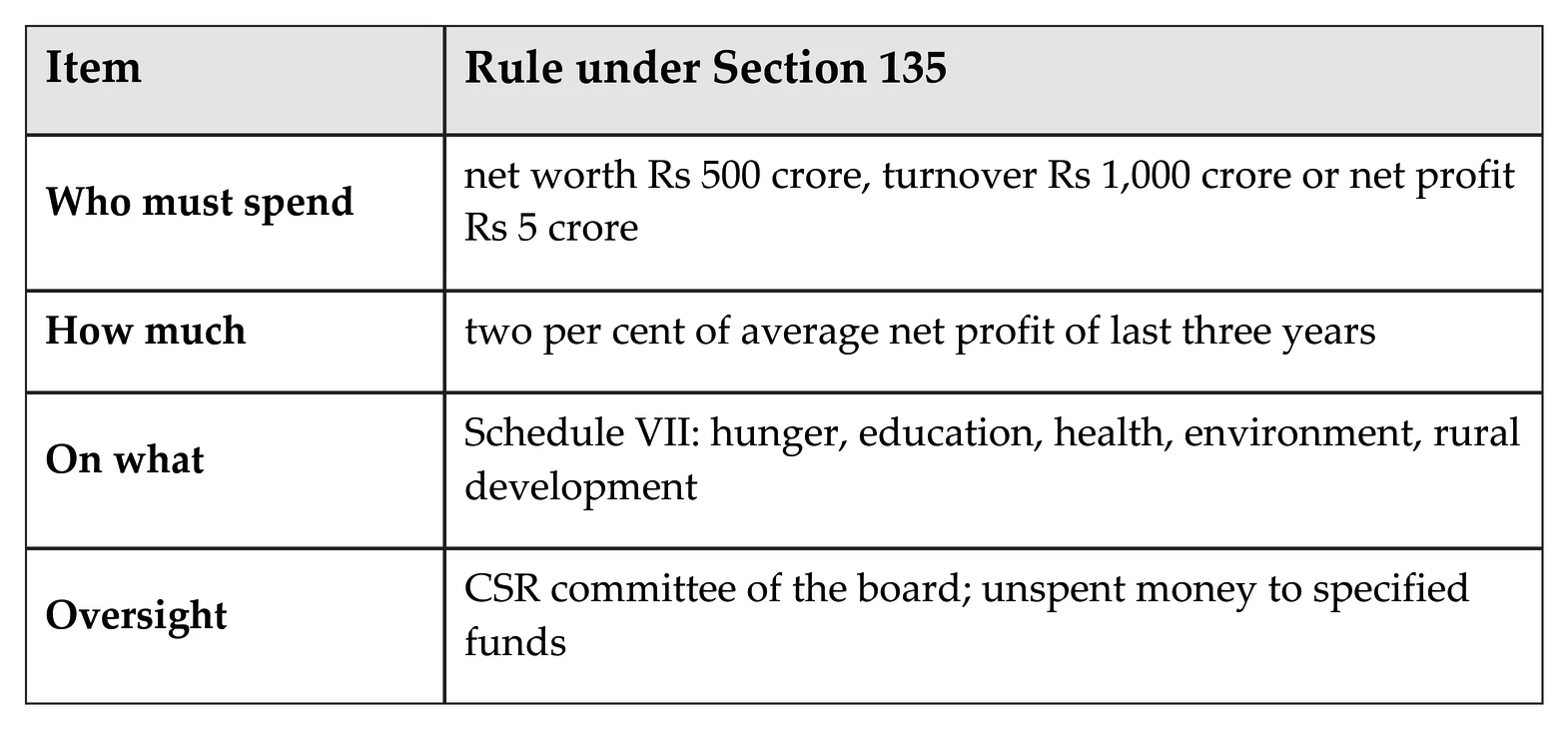
Section 135 of the Companies Act, 2013, in force from 1 April 2014, made India the first country to mandate CSR spending. Companies with a net worth of Rs 500 crore or more, a turnover of Rs 1,000 crore or more, or a net profit of Rs 5 crore or more must spend at least 2% of their average net profits of the preceding three years on activities listed in Schedule VII, such as eradicating hunger and poverty, education, health, gender equality, environmental sustainability and rural development. Amendments in 2019 required unspent amounts to be transferred to specified funds. Annual CSR spending has risen to over Rs 25,000 crore. Critics note that spending is concentrated in developed states and cities, that companies favour projects with publicity value, that monitoring of impact is weak, and that CSR may shift public responsibilities to private firms.

5.4 Important Questions
- Question 1 Discuss the major initiatives taken to improve public service delivery in India.
- Question 2 What is e-governance? Discuss its significance and challenges in India.
- Question 3 Examine the citizens’ charter and the right to information as instruments of good governance in India.
- Question 4 What is corporate social responsibility? Examine the CSR framework in India and its role in governance.
DU asks the same idea in different words. So learn one broad answer for each question below; the same answer works for every question joined by OR.
Important Question 1
Discuss the major initiatives taken to improve public service delivery in India.
OR
Examine the role of public service guarantee laws and the Sevottam model in improving service delivery.
OR
Discuss some best practices of good governance in India.
Model Answer
“Recall the face of the poorest and the weakest man whom you may have seen, and ask yourself, if the step you contemplate is going to be of any use to him.”
— M.K. Gandhi, note of 1948 (Gandhi’s talisman)
Introduction. For most citizens, governance is experienced through everyday services: certificates, pensions, rations, health care and schooling. In India, service delivery has long suffered from delays, corruption and the discretion of officials. Since the 1990s, governments have introduced many initiatives, from citizens’ charters and service guarantee laws to e-governance and direct benefit transfers, to make services timely, transparent and accountable.
1. Meaning of Public Service Delivery
Public service delivery refers to the provision of services by the government to citizens, such as documents, welfare benefits, utilities, health care and education, which form the core of the citizen’s experience of the state.
2. Problems of Delivery
Delays, corruption, discretion, complex procedures, poor access in rural areas, absenteeism of staff and lack of accountability when services fail have been common problems in India.
3. Citizens’ Charters
From 1997, citizens’ charters set out the services, standards and grievance procedures of government departments, though their lack of enforceability limited their impact.
4. The Sevottam Model
The Sevottam model combines a citizen’s charter with service standards, an effective grievance redressal system and the building of service delivery capability, providing a framework for excellence in service.
5. Public Service Guarantee Laws
Beginning with Madhya Pradesh in 2010, many states passed laws guaranteeing services within fixed time limits, with penalties for officials who delay. Karnataka’s Sakala (2012) is a prominent example.
6. Single-Window Service Centres
FRIENDS in Kerala, e-Seva and MeeSeva in Andhra Pradesh and Telangana, and Common Service Centres across India provide many services at one place, reducing visits to offices.
7. Direct Benefit Transfer
DBT, built on Jan-Dhan, Aadhaar and mobile phones, transfers benefits directly into bank accounts, reducing leakages through intermediaries in schemes such as LPG subsidies and PM-KISAN.
8. Public Distribution Reforms
Computerisation, Aadhaar-based authentication and One Nation One Ration Card have reduced leakages and allowed migrants to draw rations anywhere in the country.
9. Grievance Redressal
CPGRAMS allows citizens to lodge complaints online and track them, and state helplines provide another channel for redressing grievances.
10. Tamil Nadu and Chhattisgarh PDS
Tamil Nadu’s universal public distribution system and Chhattisgarh’s PDS reforms of the 2000s, combining political commitment with transparency, are widely cited best practices.
11. Kerala’s Social Services
Kerala’s strong primary health care, Kudumbashree network and decentralised planning show how local institutions and public action improve delivery.
12. Social Audits
Andhra Pradesh’s large-scale social audits of MGNREGA, conducted by an independent unit with community participation, exposed corruption and recovered misused funds.
13. Outcome Monitoring
The Aspirational Districts Programme of 2018 ranks districts on health, nutrition, education and other indicators, encouraging competition and improvement in backward areas.
14. Exclusion Risks
Technology-driven delivery can exclude the poor when authentication fails or connectivity is poor, so offline alternatives and grievance systems are essential.
15. Capacity and Enforcement
Service guarantee laws are often poorly enforced, and staff shortages limit the quality of health and education services, which depend on people, not only procedures.
16. Mobile Governance
Mobile phones have become the main channel for services: SMS alerts confirm transfers, apps such as UMANG offer hundreds of services in one place, and the Aadhaar-enabled payment system lets villagers withdraw money through banking correspondents. Mobile governance brings services to people who have never used a computer.
17. Evaluation
Service delivery reforms have made many services faster and more transparent, but lasting improvement requires adequate staff, funds, accountability and attention to the poorest citizens.
Conclusion. Thus, India has improved public service delivery through citizens’ charters, the Sevottam model, service guarantee laws, single-window centres, DBT, PDS reforms, grievance systems and outcome monitoring, with best practices in Tamil Nadu, Chhattisgarh, Kerala and Andhra Pradesh. Gandhi’s talisman reminds us that reforms must be judged by their benefit to the poorest.
Important Question 2
What is e-governance? Discuss its significance and challenges in India.
OR
Examine the role of Digital India in promoting good governance.
OR
Discuss some important e-governance initiatives in India.
Model Answer
“The right to privacy is protected as an intrinsic part of the right to life and personal liberty under Article 21 and as a part of the freedoms guaranteed by Part III of the Constitution.”
— Supreme Court of India, Justice K.S. Puttaswamy v. Union of India (2017)
Introduction. E-governance is the use of information and communication technology by government to deliver services, share information and conduct transactions. India has moved from early experiments in the 1990s to the National e-Governance Plan of 2006 and the Digital India programme of 2015, building digital public infrastructure used by hundreds of millions. E-governance promises efficiency and transparency, but raises concerns about exclusion and privacy.
1. Meaning
E-governance means using ICT to transform the relationship between government and citizens, businesses and other governments, making governance simple, moral, accountable, responsive and transparent.
2. Types of Interaction
E-governance includes government to citizen (G2C), government to business (G2B), government to government (G2G) and government to employee (G2E) interactions.
3. Early Initiatives
The National Informatics Centre was set up in 1976, and NICNET linked districts from 1987. States pioneered projects such as Bhoomi for land records in Karnataka and Gyandoot kiosks in Dhar, Madhya Pradesh.
4. State Best Practices
FRIENDS in Kerala and e-Seva in Andhra Pradesh offered integrated bill payment, Lokvani in Sitapur handled grievances online, and Akshaya in Kerala spread digital literacy through village centres.
5. Legal Framework
The Information Technology Act of 2000 gave legal recognition to electronic records and signatures, providing the foundation for electronic transactions with the government.
6. National e-Governance Plan
The NeGP of 2006 launched Mission Mode Projects in areas such as income tax, passports, land records, e-courts and municipalities, and set up Common Service Centres in villages.
7. Aadhaar
Aadhaar, launched in 2009, gave residents a biometric identity number, enabling authentication for services and direct benefit transfers, with statutory backing from the Aadhaar Act of 2016.
8. Digital India
Launched on 1 July 2015, Digital India aims at digital infrastructure as a utility, governance and services on demand, and digital empowerment of citizens.
9. Digital Public Infrastructure
DigiLocker, UPI, the Government e-Marketplace, UMANG and CoWIN have made India a global leader in digital public infrastructure for payments, documents, procurement and health services.
10. Benefits
E-governance reduces discretion and corruption, saves time and cost, improves transparency through online tracking, enables direct transfers and provides better data for policy.
11. E-Governance in the Pandemic
During Covid-19, digital platforms supported vaccine registration, relief transfers to Jan-Dhan accounts and online education, showing the value of digital infrastructure in crises.
12. Digital Divide
Many rural citizens, women, elderly people and the poor lack devices, connectivity and digital skills, limiting their access to online services.
13. Privacy and Data Protection
Large government databases raise privacy concerns. The Supreme Court declared privacy a fundamental right in Puttaswamy (2017), and Parliament passed the Digital Personal Data Protection Act in 2023.
14. Exclusion and Security
Biometric authentication failures have excluded some beneficiaries from rations and pensions, and growing cyber attacks threaten government systems and citizens’ data.
15. Other Challenges
Lack of interoperability between systems, limited local language content and resistance to change within the bureaucracy slow the progress of e-governance.
16. E-Governance in Courts and Procurement
The e-Courts project has computerised courts, enabled e-filing and virtual hearings, and created the National Judicial Data Grid to track pending cases. The Government e-Marketplace, launched in 2016, has made public procurement more transparent by allowing departments to buy goods and services online from registered sellers.
17. Evaluation
E-governance has transformed service delivery in India, but it must be inclusive, secure and respectful of rights to serve all citizens fairly.
Conclusion. Thus, e-governance, from Bhoomi and FRIENDS to the NeGP, Aadhaar and Digital India, has made services faster, more transparent and less corrupt. Yet the digital divide, exclusion, cyber threats and privacy concerns, recognised in Puttaswamy, show that technology must serve citizens’ rights.
Important Question 3
Examine the citizens’ charter and the right to information as instruments of good governance in India.
OR
Discuss the significance and limitations of the Right to Information Act, 2005.
OR
What is a citizens’ charter? Why has it not been very effective in India?
Model Answer
“The people of this country have a right to know every public act, everything that is done in a public way, by their public functionaries.”
— Justice K.K. Mathew, State of U.P. v. Raj Narain (1975)
Introduction. Good governance requires that citizens know what services they are entitled to, what standards to expect and how decisions are made. The citizens’ charter sets out the commitments of public organisations to citizens, while the Right to Information Act of 2005 gives citizens a legal right to obtain information from public authorities. Together, they aim to make governance transparent, responsive and accountable.
1. Meaning of the Citizens’ Charter
A citizens’ charter is a public document setting out an organisation’s services, standards, time limits, procedures and grievance mechanism, along with the expectations from citizens.
2. Origin
The citizens’ charter began in the United Kingdom in 1991 under John Major, as part of efforts to make public services responsive to citizens as users.
3. Charters in India
After the conferences of Chief Secretaries in 1996 and Chief Ministers in 1997 adopted an action plan for responsive government, the DARPG coordinated the preparation of charters in ministries and departments.
4. Limitations of Charters
Many charters were drafted without consulting citizens, poorly publicised, rarely updated and not legally enforceable, so citizens could not demand compensation when standards were not met.
5. Reforms
The Second ARC recommended consultation, specific standards and remedies, and state public service guarantee laws have given legal force to time limits for many services.
6. Constitutional Basis of the RTI
In Raj Narain (1975) and S.P. Gupta (1981), the Supreme Court held that the right to know is part of the freedom of speech and expression under Article 19(1)(a).
7. The RTI Movement
The MKSS, led by Aruna Roy, held jan sunwais in Rajasthan in the 1990s, demanding access to records of public works. The NCPRI, formed in 1996, took the campaign national.
8. The RTI Act, 2005
After state laws and the weak Freedom of Information Act of 2002, Parliament passed the RTI Act in June 2005, which came into force on 12 October 2005.
9. Main Provisions
Public authorities must supply information within 30 days, or 48 hours for matters of life and liberty, and must proactively disclose information under Section 4.
10. Exemptions
Section 8 exempts information affecting security, sovereignty, cabinet deliberations and personal privacy, while Section 24 exempts certain security agencies except for corruption and human rights violations.
11. Information Commissions
Central and State Information Commissions hear appeals and complaints and can impose penalties of up to Rs 25,000 on officials who deny information without reason.
12. Impact
Millions of RTI applications have helped citizens obtain rations and pensions, exposed scams in public works and recruitment, and made officials more careful in decision-making.
13. Challenges
Large numbers of pending appeals, vacancies in information commissions, poor record-keeping and attacks on activists, dozens of whom have been killed, weaken the RTI.
14. Amendments
The 2019 amendment allowed the Union government to fix the tenure and salaries of information commissioners, and the data protection law of 2023 widened the exemption for personal information, raising concerns.
15. Charter and RTI Together
The charter tells citizens what to expect, while the RTI enables them to find out whether those commitments are being met, so the two instruments complement each other.
16. RTI and the Courts
Courts have expanded the reach of the RTI. In CPIO, Supreme Court v. Subhash Chandra Agarwal (2019), the Supreme Court held that the office of the Chief Justice of India is a public authority under the Act, while balancing transparency with judicial independence and privacy.
17. Best Practices in RTI
Some states and departments have adopted best practices, such as online RTI portals, publishing replies proactively and holding hearings by video. Rajasthan’s Jan Soochna Portal (2019), developed with civil society, proactively displays information on rations, pensions and works, putting the Section 4 duty into practice.
18. Evaluation
The RTI has been one of India’s most powerful governance reforms, while charters have been less effective; both depend on active citizens and committed institutions.
Conclusion. Thus, the citizens’ charter sets out the standards citizens can expect from public organisations, while the RTI Act gives them a legal right to information, reflecting Justice Mathew’s view that people have a right to know every public act. The RTI has transformed transparency, though both instruments face challenges of enforcement.
Important Question 4
What is corporate social responsibility? Examine the CSR framework in India and its role in governance.
OR
Discuss the provisions of Section 135 of the Companies Act, 2013.
OR
Critically evaluate mandatory CSR in India.
Model Answer
“The Board of every company referred to in sub-section (1), shall ensure that the company spends, in every financial year, at least two per cent. of the average net profits of the company made during the three immediately preceding financial years.”
— Companies Act, 2013, Section 135(5) (abridged)
Introduction. Corporate social responsibility is the idea that businesses have obligations to society beyond making profits and obeying the law. In the language of governance, CSR represents a partnership between the market and society for development. India became the first country to make CSR spending mandatory through Section 135 of the Companies Act, 2013.
1. Meaning of CSR
CSR refers to the responsibility of companies to contribute to the well-being of society and the environment, taking into account the interests of workers, consumers, communities and future generations.
2. Carroll’s Pyramid
Archie Carroll (1991) described four levels of corporate responsibility: economic (being profitable), legal (obeying the law), ethical (doing what is right) and philanthropic (contributing to the community).
3. Triple Bottom Line
John Elkington argued that companies should measure their performance by the triple bottom line of people, planet and profit, not by profit alone.
4. Indian Tradition
CSR in India draws on Gandhi’s idea of trusteeship, under which the wealthy hold their property in trust for society, and on the philanthropy of business houses such as the Tatas and Birlas.
5. Section 135
Section 135 of the Companies Act, 2013, in force from 1 April 2014, requires companies with a net worth of Rs 500 crore, a turnover of Rs 1,000 crore or a net profit of Rs 5 crore to spend on CSR.
6. The Two Per Cent Rule
Eligible companies must spend at least two per cent of their average net profits of the preceding three years on CSR activities, through a CSR committee of the board.
7. Schedule VII Activities
Schedule VII lists activities such as eradicating hunger and poverty, promoting education, health care, gender equality, environmental sustainability, rural development and disaster relief.
8. 2019 Amendments
Amendments in 2019 required unspent CSR amounts to be transferred to specified funds or unspent CSR accounts, strengthening compliance.
9. Scale of Spending
Annual CSR spending has grown to over Rs 25,000 crore, making companies significant contributors to education, health and rural development.
10. CSR and Governance
CSR brings corporate resources, management skills and innovation into development, complementing state efforts and reflecting the partnership of state, market and society in governance.
11. Examples
Companies have funded schools, hospitals, sanitation, skill development and water conservation, often in partnership with NGOs and government programmes.
12. Regional Concentration
CSR spending is concentrated in industrially developed states such as Maharashtra, Karnataka and Gujarat, while poorer states and districts receive less.
13. Publicity and Weak Monitoring
Companies often prefer projects with publicity value, and the impact of CSR spending is rarely evaluated rigorously, raising questions about effectiveness.
14. Shifting Public Responsibility
Critics argue that mandatory CSR is a hidden tax and may shift responsibilities for public services from the state to private firms, blurring accountability.
15. Responsible Business Beyond CSR
True responsibility includes fair wages, safe working conditions, environmental compliance and ethical conduct in core business, not only spending on social projects.
16. Evaluation
Mandatory CSR has mobilised large resources for development, but its value depends on alignment with local needs, transparency and responsible conduct in all business activities.
Conclusion. Thus, CSR, rooted in Carroll’s pyramid, the triple bottom line and Gandhi’s trusteeship, was made mandatory in India by Section 135 of the Companies Act, 2013, requiring two per cent of profits for Schedule VII activities. It has mobilised large funds, though regional concentration and weak monitoring limit its contribution to governance.
Short Notes
(a) Sevottam
A service delivery model developed by the DARPG combining a citizen’s charter, grievance redressal and capacity building to achieve excellence in public services.
(b) Digital India
A programme launched on 1 July 2015 to provide digital infrastructure as a utility, governance and services on demand, and digital empowerment of citizens.
(c) Proactive disclosure
The duty of public authorities under Section 4 of the RTI Act to publish information about their functions, budgets and decisions without waiting for requests.
More notes: GE-5 Governance: Issues and Challenges
These notes are prepared by PADHO TO AISE for study help. They are not an official publication.