
Generic Electives (GE) GE-5 Governance: Issues and Challenges
Unit 1 · 24 min read · Updated 27 Nov 2026
As per the University of Delhi (DU) Generic Elective (GE) syllabus offered by the Department of Political Science
Contents
- 1.1 Government and Governance
- Definitions of Governance
- Government versus Governance
- The Rise of the Governance Concept
- Good Governance
- 1.2 Role of the State in the Era of Globalisation
- From Welfare State to Market-Friendly State
- New Public Management
- Debates on the State under Globalisation
- The Indian Experience
- 1.3 State, Market and Civil Society
- The State
- The Market
- Civil Society
- Partnership among the Three
- 1.4 Important Questions
- Distinguish between government and governance. Why has the concept of governance gained importance?
- Examine the changing role of the state in the era of globalisation.
- Discuss the relationship between the state, market and civil society in governance.
- Explain the concept of good governance. Critically examine the good governance agenda of international institutions.
- Short Notes
वह तरीका जिससे किसी देश के आर्थिक और सामाजिक संसाधनों के विकास हेतु प्रबंधन में शक्ति का प्रयोग किया जाता है।
The manner in which power is exercised in the management of a country’s economic and social resources for development.
— World Bank, Governance and Development (1992)
FFOR most of the twentieth century, the study of politics focused on government, the formal institutions of the state such as legislatures, executives and courts. Since the 1990s, the word governance has become central to political science and development policy. It refers to the wider process of governing, in which the state works with markets, civil society and international bodies. This chapter explains the difference between government and governance, the idea of good governance, the changing role of the state in the era of globalisation, and the relationship among the state, market and civil society.
1.1 Government and Governance
The word governance comes from the Greek kubernan, meaning to steer a ship. For a long time it was used as a synonym for government. Government refers to the formal institutions of the state, the legislature, executive and judiciary, which have the legal authority to make and enforce binding decisions. Governance is a broader term. It refers to the process of governing, the ways in which decisions are made and implemented, and the many actors, both governmental and non-governmental, who take part in it.
Definitions of Governance
- World Bank (1992). Governance is the manner in which power is exercised in the management of a country’s economic and social resources for development.
- UNDP (1997). Governance is the exercise of economic, political and administrative authority to manage a country’s affairs at all levels; it comprises the mechanisms, processes and institutions through which citizens and groups articulate their interests, exercise their legal rights, meet their obligations and mediate their differences.
- James Rosenau (1992). Governance is a more encompassing phenomenon than government, including informal, non-governmental mechanisms; there can be governance without government, as in international regimes.
- R.A.W. Rhodes (1996). Governance refers to self-organising, inter-organisational networks, a new process of governing in which the state steers rather than commands.
- Gerry Stoker (1998). Governance refers to a set of institutions and actors drawn from but also beyond government, involving blurred boundaries between public and private sectors.
Government versus Governance
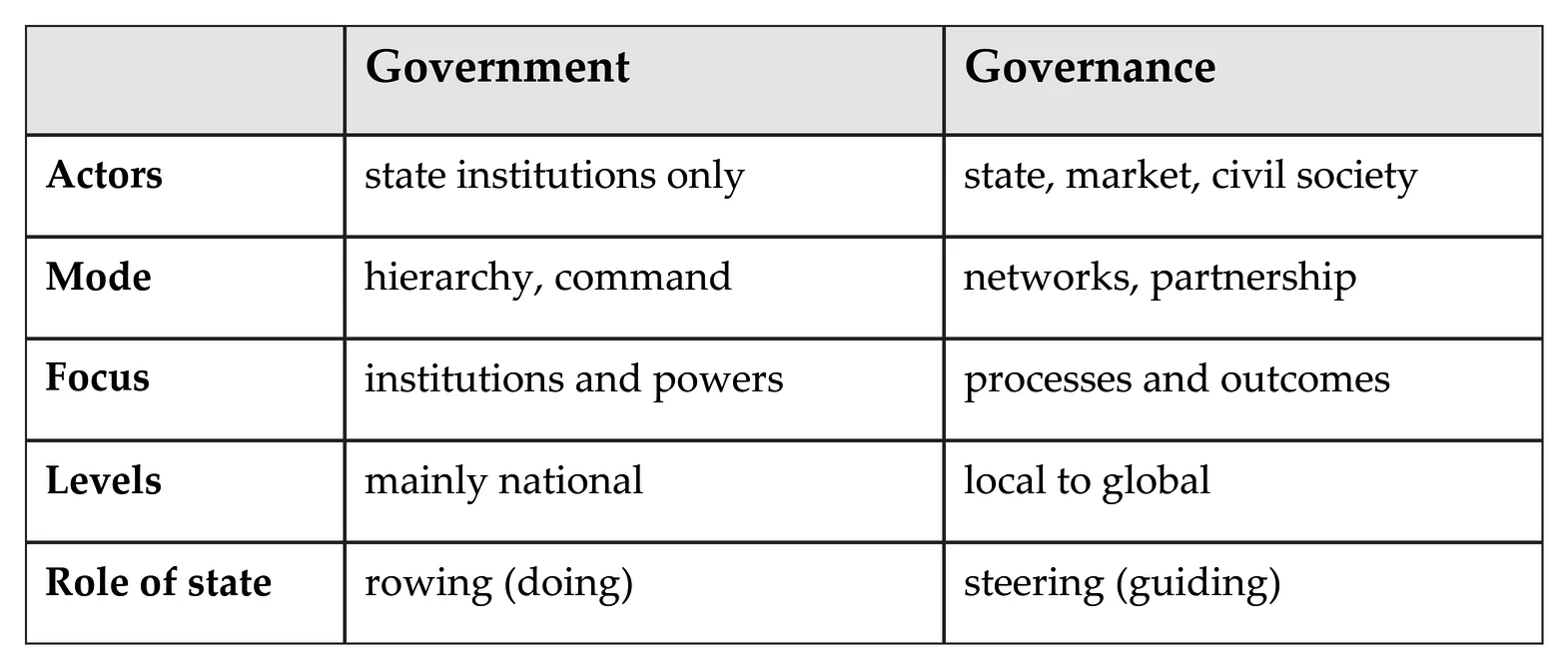
Government is state-centred, hierarchical and based on command and control, with authority flowing from the top. Governance is multi-actor, based on networks, partnerships and negotiation, and includes the market and civil society. Government focuses on institutions, governance on processes and outcomes. Government operates mainly at the national level, while governance is multi-level, from local to global. In short, government is one of the actors in governance, though still the most important one.
The Rise of the Governance Concept
The shift from government to governance was driven by several developments in the 1980s and 1990s: the fiscal crisis of the welfare state; the rise of neo-liberalism and the New Public Management, which favoured markets and private sector methods; globalisation, which reduced the autonomy of states; the growth of NGOs and civil society; and the end of the Cold War, after which donors emphasised democracy and accountability. International institutions, particularly the World Bank, popularised the term.
Good Governance
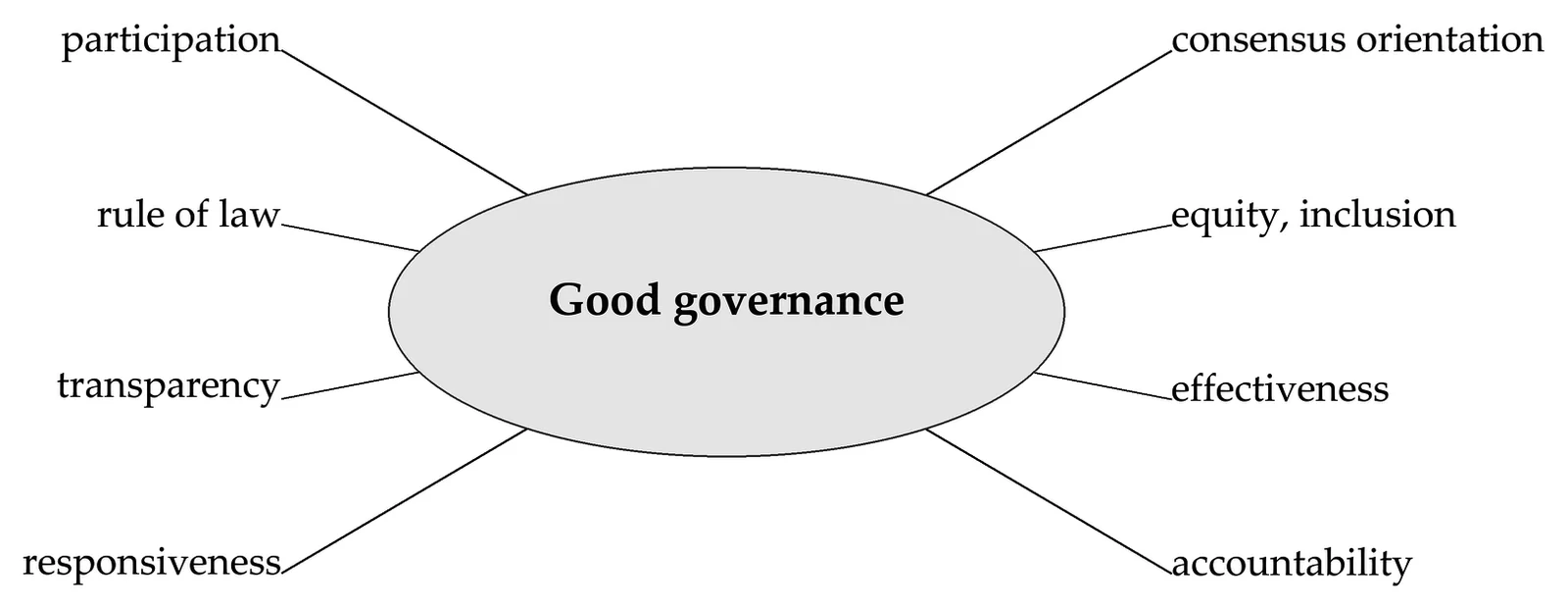
The World Bank’s 1989 report on Sub-Saharan Africa blamed the region’s problems on a crisis of governance. Good governance soon became a condition for aid. The UNDP identified its characteristics as participation, rule of law, transparency, responsiveness, consensus orientation, equity and inclusiveness, effectiveness and efficiency, accountability and strategic vision. The World Bank’s Worldwide Governance Indicators measure six dimensions: voice and accountability, political stability and absence of violence, government effectiveness, regulatory quality, rule of law and control of corruption.
Critics argue that the good governance agenda reflects Western, neo-liberal assumptions, treating governance as a technical, managerial issue and depoliticising questions of power and inequality. Carlos Santiso showed that aid conditionality based on good governance had limited success. Others argue that the agenda was used to push market reforms on developing countries. In India, the Second Administrative Reforms Commission emphasised citizen-centric governance, ethics and accountability.
1.2 Role of the State in the Era of Globalisation
Globalisation refers to the growing interconnection of the world through trade, investment, finance, technology, migration and ideas. It has changed the role of the state profoundly, though scholars disagree about whether it has weakened the state or only transformed it.
From Welfare State to Market-Friendly State
After the Second World War, most states took on large roles: the welfare state in the West, the socialist state in the East and the developmental state in newly independent countries like India, which used planning and the public sector to promote growth. From the 1980s, the neo-liberal governments of Margaret Thatcher and Ronald Reagan, and the Washington Consensus of the IMF, World Bank and US Treasury, promoted liberalisation, privatisation, deregulation and fiscal discipline. The state was to become a facilitator of markets rather than a direct producer.
New Public Management
David Osborne and Ted Gaebler, in Reinventing Government (1992), argued that governments should steer rather than row, setting policy while leaving delivery to markets and NGOs. New Public Management (NPM) introduced private sector techniques into government: performance targets, competition, contracting out, user charges and treating citizens as customers. India’s slogan of minimum government, maximum governance reflects similar ideas.
Debates on the State under Globalisation
- Retreat of the state. Hyper-globalists such as Kenichi Ohmae and Susan Strange argued that global markets and corporations had eroded state sovereignty, leading to the retreat of the state.
- Hollowing out. R.A.W. Rhodes spoke of the hollowing out of the state, as functions moved upwards to international bodies, downwards to local governments and outwards to agencies and markets.
- Transformation, not decline. Others argue that states remain central, since markets need states to make rules, enforce contracts and provide infrastructure. The East Asian developmental states showed the importance of an active state.
- Return of the state. The global financial crisis of 2008, when states rescued banks, and the Covid-19 pandemic, when states led health responses and relief, showed that the state remains indispensable.
The Indian Experience
India followed a mixed economy with a dominant public sector until 1991, when a balance of payments crisis led to liberalisation, privatisation and globalisation. The state withdrew from many industries, ended the licence raj and opened the economy to foreign investment. At the same time, it created regulatory bodies such as SEBI, TRAI and the Competition Commission, and expanded rights-based welfare, such as the RTI, MGNREGA and the right to food. The Indian state has therefore been transformed into a regulatory and welfare state, rather than simply retreating.

1.3 State, Market and Civil Society
Governance involves three main sectors: the state, which has authority and the power to make binding rules; the market, which produces goods and services through private enterprise and exchange; and civil society, the sphere of voluntary associations between the family and the state. Each has strengths and weaknesses, and good governance depends on their balance.
The State
The state provides public goods such as defence, law and order and infrastructure; makes and enforces laws; redistributes resources through taxation and welfare; and regulates markets. However, states may suffer from state failure: corruption, inefficiency, red tape and capture by powerful groups, as public choice theorists argue.
The Market
Markets allocate resources efficiently through prices and competition, encourage innovation and generate growth. But markets also suffer from market failure: they under-provide public goods, ignore externalities such as pollution, create monopolies and produce inequality. The 2008 financial crisis showed the dangers of unregulated markets.
Civil Society
The idea of civil society has a long history. Hegel saw it as the sphere of particular interests between the family and the state. Alexis de Tocqueville praised voluntary associations in America as schools of democracy. Antonio Gramsci saw civil society as the sphere where the ruling class builds hegemony through consent, but also where counter-hegemony can emerge. Robert Putnam, in Making Democracy Work (1993), argued that civic associations generate social capital, trust and networks that make governments work better. Neera Chandhoke has stressed that civil society is not free of power and inequality, and depends on a democratic state.
Civil society includes NGOs, trade unions, professional bodies, religious and caste associations, social movements, self-help groups and the media. It articulates citizens’ demands, monitors the state, delivers services and promotes participation. In India, movements and NGOs shaped the RTI Act, MGNREGA and environmental laws, while self-help groups have empowered millions of women.
Partnership among the Three
- Public-private partnerships (PPPs). The state and private companies jointly build and run infrastructure such as highways, airports and power plants.
- State-civil society partnerships. NGOs implement government programmes, as in literacy, health and watershed development.
- Corporate social responsibility. Under the Companies Act, 2013, large companies must spend on social development, linking the market with social goals.
- Co-production. Citizens and communities take part in delivering services, such as water user associations and school management committees.
- Concerns. Critics warn that partnerships may blur accountability, allow private interests to capture public resources and weaken the state’s responsibility for welfare.

1.4 Important Questions
- Question 1 Distinguish between government and governance. Why has the concept of governance gained importance?
- Question 2 Examine the changing role of the state in the era of globalisation.
- Question 3 Discuss the relationship between the state, market and civil society in governance.
- Question 4 Explain the concept of good governance. Critically examine the good governance agenda of international institutions.
DU asks the same idea in different words. So learn one broad answer for each question below; the same answer works for every question joined by OR.
Important Question 1
Distinguish between government and governance. Why has the concept of governance gained importance?
OR
What is governance? Explain the shift from government to governance.
OR
Discuss the meaning and dimensions of governance.
Model Answer
“Governance can be seen as the exercise of economic, political and administrative authority to manage a country’s affairs at all levels.”
— UNDP, Governance for Sustainable Human Development (1997)
Introduction. Government and governance are related but different ideas. Government refers to the formal institutions of the state, while governance refers to the broader process of governing in which many actors take part. Since the 1990s, governance has become a key concept in political science, public administration and development policy, reflecting changes in the way societies are governed.
1. Meaning of Government
Government refers to the formal institutions of the state, the legislature, the executive and the judiciary, which have legal authority to make and enforce binding decisions for society. It rests on sovereignty and the monopoly of legitimate force.
2. Meaning of Governance
Governance, from the Greek word for steering, refers to the process of governing: how decisions are made and implemented, and the interaction of governmental and non-governmental actors in managing public affairs.
3. Definitions
The World Bank defines governance as the manner in which power is exercised in managing a country’s resources for development. The UNDP sees it as the exercise of economic, political and administrative authority at all levels, including the mechanisms through which citizens articulate interests.
4. Rosenau and Rhodes
James Rosenau argued that governance is broader than government and can exist without government, as in international regimes. R.A.W. Rhodes described governance as governing through self-organising networks.
5. Actors
Government is state-centred, while governance includes the state, the market and civil society, as well as international organisations, all of which take part in making and implementing decisions.
6. Mode of Functioning
Government works through hierarchy, command and control. Governance works through networks, partnerships, negotiation and cooperation, in which the state steers rather than commands.
7. Levels
Government operates mainly at the national and sub-national levels. Governance is multi-level, linking local, national, regional and global institutions, as in climate governance.
8. Focus
Government focuses on formal institutions and their powers. Governance focuses on processes and outcomes, such as participation, transparency, accountability and effectiveness.
9. Fiscal Crisis and Neo-Liberalism
The fiscal crisis of the welfare state in the 1970s and the rise of neo-liberalism in the 1980s led to calls for a smaller state and greater role for markets, encouraging the shift to governance.
10. New Public Management
NPM introduced business methods into government, such as contracting out and performance targets. Osborne and Gaebler’s call to steer rather than row captured this shift.
11. Globalisation
Globalisation increased the role of international institutions, multinational companies and global civil society, so that national governments alone could not manage many issues.
12. Rise of Civil Society
The growth of NGOs, social movements and the media, and the spread of democracy after the Cold War, increased demands for participation and accountability.
13. Role of International Institutions
The World Bank and UNDP promoted governance and good governance as conditions for aid and development from 1989 onwards, spreading the concept across the developing world.
14. Governance in India
In India, reforms since 1991, the Second Administrative Reforms Commission, decentralisation through the 73rd and 74th Amendments and laws such as the RTI Act reflect the shift towards governance.
15. Criticism
Critics argue that the governance concept blurs accountability, since it is unclear who is responsible when many actors are involved, and that it can mask the retreat of the state from welfare.
16. Evaluation
Governance does not replace government but widens our understanding of how societies are governed. The state remains the central actor, coordinating the contributions of markets and civil society.
Conclusion. Thus, government refers to the formal institutions of the state acting through hierarchy and command, while governance refers to the wider process of governing through networks of state, market and civil society actors at many levels. The concept gained importance due to neo-liberalism, NPM, globalisation and the rise of civil society.
Important Question 2
Examine the changing role of the state in the era of globalisation.
OR
Has globalisation led to the retreat of the state? Discuss.
OR
Discuss the impact of globalisation on the role of the Indian state.
Model Answer
“Catalytic Government: Steering Rather Than Rowing.”
— David Osborne and Ted Gaebler, Reinventing Government (1992), chapter title
Introduction. Globalisation, the growing interconnection of economies and societies across the world, has deeply affected the role of the state. Some scholars argue that it has eroded state sovereignty and led to the retreat of the state, while others argue that the state has only been transformed, taking on new roles as regulator and facilitator. Recent crises have shown the continuing importance of the state.
1. Meaning of Globalisation
Globalisation refers to the increasing flow of goods, capital, technology, people and ideas across borders, driven by trade liberalisation, financial integration and advances in communication technology.
2. The Post-War State
After 1945, states played large roles: the welfare state in the West, the socialist state in the East and the developmental state in countries like India, which used planning and the public sector.
3. The Neo-Liberal Turn
From the 1980s, Thatcher in Britain and Reagan in the United States promoted a smaller state. The Washington Consensus encouraged liberalisation, privatisation, deregulation and fiscal discipline across the developing world.
4. From Provider to Facilitator
The state was to withdraw from production and act as a facilitator of markets, providing the legal and physical infrastructure for private enterprise and attracting investment.
5. New Public Management
NPM reforms introduced competition, contracting out and performance targets into government, treating citizens as customers, as Osborne and Gaebler urged governments to steer rather than row.
6. The Retreat of the State Thesis
Kenichi Ohmae spoke of a borderless world, and Susan Strange argued that markets and corporations had become more powerful than states, leading to the retreat of the state.
7. Hollowing Out
Rhodes argued that the state was being hollowed out, as functions moved upwards to international bodies such as the WTO, downwards to local governments and outwards to agencies and markets.
8. Constraints on Policy
Global capital markets punish governments that run large deficits or adopt policies disliked by investors, and international agreements limit policy choices in trade and finance.
9. The Regulatory State
At the same time, states created regulatory bodies to oversee privatised and liberalised sectors. In India, SEBI, TRAI, the Competition Commission and electricity regulators reflect this new role.
10. The Developmental State
The success of East Asian economies such as South Korea and Taiwan showed that an active, capable state guiding industrialisation could thrive in a global economy.
11. The 2008 Crisis
The global financial crisis of 2008 led states to rescue banks and stimulate economies, showing that markets depend on states in times of crisis.
12. The Covid-19 Pandemic
During the pandemic, states led health responses, vaccination drives and relief measures, and controlled borders, reaffirming the central role of the state.
13. The Indian State after 1991
After the 1991 crisis, India liberalised trade and investment, ended the licence raj and privatised some enterprises, while retaining a large public sector and strong regulatory role.
14. Rights-Based Welfare in India
Alongside liberalisation, India expanded rights-based welfare through the RTI, MGNREGA, the Right to Education and the National Food Security Act, showing that the state took on new social responsibilities.
15. Challenges
Globalisation has increased inequality and insecurity for many, creating pressures on states to protect workers and farmers, and leading to a backlash against globalisation in many countries.
16. Globalisation and Federalism in India
Liberalisation increased the role of state governments in India, as states began to compete for private and foreign investment through investor summits, land and tax incentives and single-window clearances. This competitive federalism has made states important economic actors, though it has also widened regional inequalities between richer and poorer states.
17. Digital Technology and the State
Digital technology has given the state new tools of governance, such as the Aadhaar identity system, online services and data-driven monitoring, strengthening its capacity to deliver welfare. At the same time, it has raised concerns about surveillance and privacy, which the Supreme Court addressed in recognising privacy as a fundamental right in Puttaswamy (2017).
18. Evaluation
Globalisation has transformed rather than eliminated the state. The state today is less a direct producer and more a regulator, facilitator and protector, but it remains indispensable.
Conclusion. Thus, globalisation has shifted the role of the state from provider to facilitator and regulator, as neo-liberalism and NPM urged it to steer rather than row. But the developmental state, the 2008 crisis, the pandemic and India’s rights-based welfare show that the state has been transformed, not retreated.
Important Question 3
Discuss the relationship between the state, market and civil society in governance.
OR
What is civil society? Examine its role in governance.
OR
Good governance requires a balance between state, market and civil society. Discuss.
Model Answer
“Governance, in other words, is a more encompassing phenomenon than government.”
— James N. Rosenau, Governance without Government (1992)
Introduction. Governance today involves three sectors: the state, with its authority to make binding rules; the market, which produces goods and services through private enterprise; and civil society, the sphere of voluntary associations. Each sector has distinct strengths and weaknesses, and good governance depends on their balance and partnership.
1. Three Sectors of Governance
The state, market and civil society are often called the first, second and third sectors. Governance involves their interaction, as Rosenau noted when he described governance as more encompassing than government.
2. Role of the State
The state provides public goods such as defence, law and order and infrastructure, makes and enforces laws, redistributes resources and regulates markets and social life.
3. State Failure
States may fail through corruption, inefficiency, red tape and capture by powerful interests. Public choice theorists argue that politicians and bureaucrats pursue their own interests rather than the public good.
4. Role of the Market
Markets allocate resources efficiently through prices and competition, encourage innovation and generate economic growth, which creates jobs and resources for public purposes.
5. Market Failure
Markets under-provide public goods, ignore externalities such as pollution, create monopolies and produce inequality. The 2008 financial crisis showed the dangers of unregulated markets.
6. Meaning of Civil Society
Civil society is the sphere of voluntary associations between the family and the state, including NGOs, trade unions, professional bodies, social movements, community groups and the media.
7. Hegel and Tocqueville
Hegel saw civil society as the sphere of particular interests between family and state. Tocqueville praised voluntary associations in America as schools of democracy that check state power.
8. Gramsci
Gramsci saw civil society as the sphere where the ruling class builds hegemony through consent, through institutions such as schools, churches and the media, but also where counter-hegemonic movements can arise.
9. Putnam and Social Capital
Robert Putnam argued in 1993 that regions of Italy with dense civic associations had more effective governments, because associations generate social capital, trust and cooperation.
10. Functions of Civil Society
Civil society articulates demands, monitors the state, defends rights, delivers services and promotes participation. In India, movements shaped the RTI Act, MGNREGA and environmental laws.
11. Limits of Civil Society
Neera Chandhoke cautions that civil society is not free of power and inequality, and that some associations are based on caste or religious exclusion. Civil society also depends on a democratic state that protects freedoms.
12. Public-Private Partnerships
PPPs bring the state and private companies together to build and run infrastructure such as highways, airports and metro rail, combining public goals with private efficiency.
13. State-Civil Society Partnerships
NGOs and self-help groups implement government programmes in health, literacy and livelihoods, and communities co-produce services through bodies such as school management committees.
14. Corporate Social Responsibility
Section 135 of the Companies Act, 2013, requires large companies to spend two per cent of their average net profits on social development, linking markets with social goals.
15. Risks of Partnership
Partnerships can blur accountability, allow private interests to capture public resources and weaken the state’s commitment to welfare, so they require strong regulation and transparency.
16. Self-Help Groups in India
Women’s self-help groups, promoted through the NABARD bank linkage programme from 1992, Kudumbashree in Kerala from 1998 and the National Rural Livelihoods Mission from 2011, show how civil society, the state and banks can work together. Crores of women have gained access to credit, savings and collective voice through these groups.
17. Civil Society and the State in Conflict
Civil society also challenges the state. Movements such as the Narmada Bachao Andolan against large dams and campaigns against corruption in 2011 shaped public debate, while governments have tightened rules on foreign funding of NGOs under the Foreign Contribution (Regulation) Act, showing tensions between the two sectors.
18. Evaluation
Good governance requires each sector to do what it does best: the state to ensure rights and justice, the market to create wealth and civil society to give voice and hold power accountable.
Conclusion. Thus, the state, market and civil society each contribute to governance and each can fail. As Rosenau suggested, governance encompasses more than government, and good governance depends on a balance and partnership among the three, under a democratic state that protects rights and regulates markets.
Important Question 4
Explain the concept of good governance. Critically examine the good governance agenda of international institutions.
OR
What are the main features of good governance?
OR
Good governance is a depoliticised, managerial concept. Discuss.
Model Answer
“Good governance is perhaps the single most important factor in eradicating poverty and promoting development.”
— Kofi Annan, Annual Report on the Work of the Organization (1998)
Introduction. Good governance became a central idea in development policy from the late 1980s, when the World Bank attributed the economic problems of many developing countries to poor governance. International institutions promoted good governance as a condition for aid. The concept has been widely adopted, but also criticised as reflecting Western and neo-liberal priorities.
1. Origins
The World Bank’s 1989 report on Sub-Saharan Africa spoke of a crisis of governance. Its 1992 report Governance and Development set out the components of good governance.
2. World Bank’s View
The World Bank focused on public sector management, accountability, a legal framework for development, and transparency and information, treating governance mainly as an issue of economic management.
3. UNDP’s View
The UNDP took a broader view, linking governance with sustainable human development and identifying characteristics such as participation, rule of law, transparency, responsiveness, consensus orientation, equity, effectiveness, accountability and strategic vision.
4. Participation and Rule of Law
Good governance requires that all citizens have a voice in decision-making, directly or through representatives, and that laws are fair, impartially enforced and protect human rights.
5. Transparency and Accountability
Decisions must be taken openly, information must be freely available, and those in power must answer for their actions to the public and to institutions such as courts and auditors.
6. Responsiveness, Equity and Effectiveness
Institutions must serve all stakeholders in reasonable time, ensure that the vulnerable are included, and produce results that meet needs while making the best use of resources.
7. Measuring Governance
The World Bank’s Worldwide Governance Indicators measure voice and accountability, political stability, government effectiveness, regulatory quality, rule of law and control of corruption.
8. Good Governance and Aid
Donors made good governance a condition for aid and loans, requiring reforms such as anti-corruption measures, civil service reform and privatisation.
9. Good Governance in India
India’s Second Administrative Reforms Commission emphasised citizen-centric governance, ethics and accountability, and laws such as the RTI Act of 2005 and the Lokpal and Lokayuktas Act of 2013 reflect good governance ideas. India observes 25 December as Good Governance Day.
10. Criticism: Western Bias
Critics argue that the agenda imposes Western liberal models of the state on societies with different histories and values, ignoring local institutions and traditions.
11. Criticism: Neo-Liberal Agenda
The agenda has been criticised as a way of pushing market reforms, privatisation and a reduced state on developing countries through aid conditionality.
12. Criticism: Depoliticisation
By treating governance as a technical, managerial matter, the agenda depoliticises questions of power, inequality and conflict, which are central to development.
13. Criticism: Effectiveness of Conditionality
Carlos Santiso found that aid conditionality based on good governance had limited success, since reforms imposed from outside lacked local ownership.
14. Too Many Goals
Merilee Grindle argued that the good governance agenda is too long and demanding, and proposed good enough governance, focusing on the reforms most essential for development in each context.
15. Positive Contribution
Despite criticism, the agenda drew attention to corruption, accountability and the quality of institutions, and helped citizens demand transparency and rights.
16. Evaluation
Good governance is a valuable ideal when understood democratically, as empowering citizens and making power accountable, rather than as a set of conditions imposed from outside.
Conclusion. Thus, good governance refers to participatory, transparent, accountable, equitable, effective and lawful governance, as promoted by the World Bank and UNDP. Though criticised as Western, neo-liberal and depoliticising, the idea, as Annan said, remains vital for eradicating poverty and promoting development when rooted in democracy.
Short Notes
(a) Governance without government
James Rosenau’s idea that order and regulation can be achieved through informal, non-governmental mechanisms and international regimes without a central government.
(b) New Public Management
A set of reforms from the 1980s that introduced private sector methods into government, such as performance targets, competition, contracting out and treating citizens as customers.
(c) Social capital
Robert Putnam’s term for the networks, norms and trust that enable citizens to cooperate for mutual benefit, generated by participation in civic associations.
More notes: GE-5 Governance: Issues and Challenges
These notes are prepared by PADHO TO AISE for study help. They are not an official publication.