

Generic Electives (GE) GE-9 Women and Politics in India: Concepts and Debates
Unit V · 23 min read · Updated 27 Nov 2026
As per the University of Delhi (DU) Generic Elective (GE) syllabus offered by the Department of Political Science
Contents
- 5.1 Forms, Causes and Extent of Violence
- Forms of Violence
- A Continuum of Violence
- Causes
- Extent and Trends
- 5.2 Law and Violence: A Review of Legislation
- The Decade of Legislation, 1980–89
- Flavia Agnes: Protecting Women
- Later Laws
- 5.3 Sexual Violence, the Body and the State’s Response
- Menon: Sexual Violence and the Law
- The Nirbhaya Moment
- Five Years Post Nirbhaya
- Feminist Debates
- 5.4 Important Questions
- Discuss the forms and causes of violence against women in India.
- Critically review the laws enacted to protect women against violence in India.
- Examine the feminist debates on sexual violence and the law, with reference to Nivedita Menon.
- Examine the response of the state and the health system to sexual violence after the Nirbhaya case.
- Short Notes
स्त्रियों के विरुद्ध हिंसा का अर्थ है लिंग-आधारित हिंसा का कोई भी कार्य जिसके परिणामस्वरूप स्त्रियों को शारीरिक, यौन या मानसिक हानि या पीड़ा होती है, या होने की संभावना है।
Violence against women means any act of gender-based violence that results in, or is likely to result in, physical, sexual or psychological harm or suffering to women.
— United Nations, Declaration on the Elimination of Violence against Women (1993), Article 1
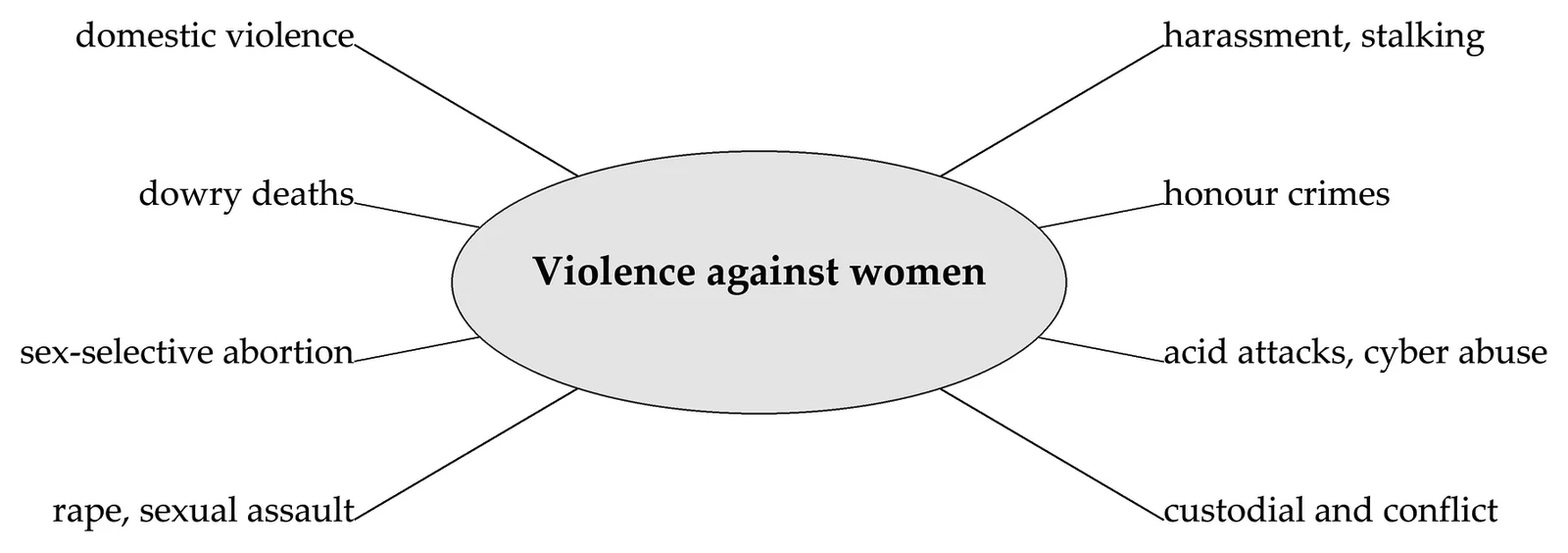
VVIOLENCE against women is one of the most widespread violations of human rights. It takes many forms, from domestic violence and dowry deaths to rape, sexual harassment, acid attacks and honour crimes, and it happens in homes, workplaces, streets and even in police custody. Feminists argue that such violence is not a matter of a few deviant individuals but is rooted in patriarchy and used to maintain women’s subordination. This chapter examines the forms, causes and extent of violence against women in India, the laws passed to address it, feminist debates on sexual violence and the law, and the state’s response after the Nirbhaya case of 2012.
5.1 Forms, Causes and Extent of Violence
The UN Declaration on the Elimination of Violence against Women (1993) defines it as any act of gender-based violence that results in, or is likely to result in, physical, sexual or psychological harm or suffering to women, including threats, coercion or arbitrary deprivation of liberty, in public or private life. It recognises violence against women as a manifestation of historically unequal power relations between men and women.
Forms of Violence
- Within the family. Domestic violence, marital rape, dowry harassment and dowry deaths, and violence against widows and daughters.
- Before birth and in childhood. Sex-selective abortion, neglect of girl children and child marriage.
- Sexual violence. Rape, sexual assault, sexual harassment at work and in public places, stalking and voyeurism.
- In the name of honour and custom. Honour crimes, witch-hunting of women in some regions, and violence by caste councils.
- Other forms. Acid attacks, trafficking, cyber harassment, custodial violence by police and security forces, and sexual violence during communal and caste conflicts.
A Continuum of Violence
The British scholar Liz Kelly described a continuum of sexual violence (1988), linking everyday harassment, threats and abuse to rape and murder. The continuum shows that extreme violence is connected to routine forms that are often treated as normal, such as street harassment, and that all of them limit women’s freedom. Susan Brownmiller, in Against Our Will (1975), argued that rape functions as a means by which men as a group keep women in a state of fear.
Causes
Feminists see violence against women as rooted in patriarchy: in beliefs that women are subordinate, that men have a right to control them, and that women’s sexuality must be policed to protect family and caste honour. Economic dependence, lack of property, social acceptance of violence, alcohol abuse, weak enforcement of laws and fear of stigma also contribute. Caste and communal hierarchies make Dalit, Adivasi and minority women especially vulnerable.
Extent and Trends
Arvind Verma, Hanif Qureshi and Jee Yearn Kim, in Exploring the Trend of Violence against Women in India (2017), analysed crime data and found that recorded crimes against women rose steadily over the years. They caution that rising numbers partly reflect greater reporting and new laws, but also show the persistence of violence. The National Crime Records Bureau recorded over four lakh cases of crimes against women in 2022, the largest category being cruelty by husband or relatives. The National Family Health Survey 2019–21 found that about three in ten ever-married women had experienced physical or sexual violence by their husbands, and that most never sought help. Official data thus capture only part of the violence women face.
5.2 Law and Violence: A Review of Legislation
The Decade of Legislation, 1980–89
Campaigns by the women’s movement in the late 1970s and 1980s led to a series of laws. The Criminal Law (Amendment) Act, 1983 addressed custodial rape and shifted the burden of proof in certain cases; Section 498A (1983) made cruelty by husband or relatives a crime; the Dowry Prohibition Act was amended in 1984 and 1986; Section 304B (1986) created the offence of dowry death; the Indecent Representation of Women Act (1986) and the Commission of Sati (Prevention) Act (1987) followed; and the Family Courts Act (1984) set up family courts.
Flavia Agnes: Protecting Women
Flavia Agnes, in Protecting Women Against Violence? Review of a Decade of Legislation 1980–89 (1992), reviewed these laws critically. She argued that many were passed hastily, as symbolic responses to public pressure, without adequate consultation or provisions for implementation. Some laws reflected protectionist and patriarchal assumptions, treating women as victims needing protection rather than as rights-bearing citizens. Implementation by police and courts remained poor, conviction rates were low, and women continued to face hostility when they sought justice. Agnes concluded that the state had co-opted the movement’s demands into laws while failing to change the institutions that enforce them, so the laws offered limited protection in practice.
Later Laws
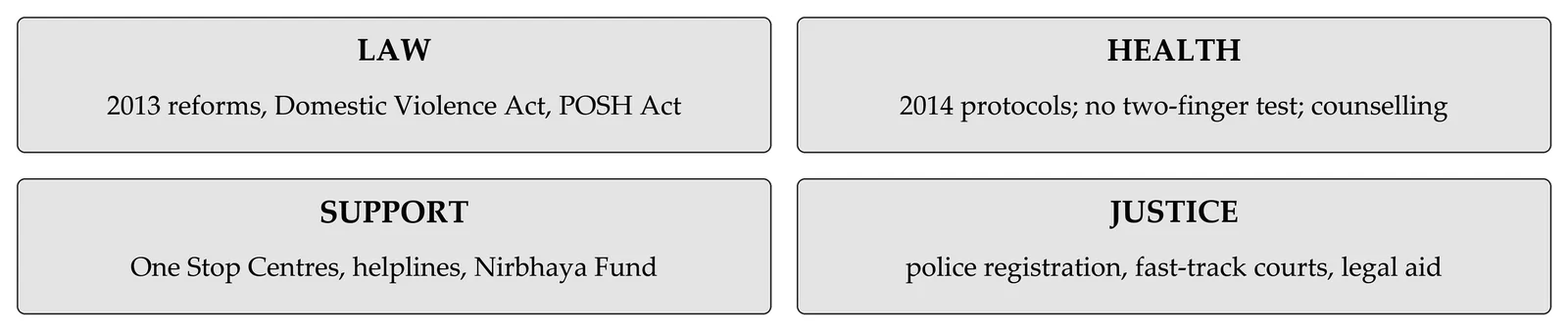
- Protection of Women from Domestic Violence Act, 2005. It provides a civil remedy against physical, sexual, verbal, emotional and economic abuse, including the right to reside in the shared household and protection orders, with protection officers to assist women.
- Sexual Harassment of Women at Workplace Act, 2013. It requires employers to set up internal committees, building on the Vishaka guidelines of 1997.
- Criminal Law (Amendment) Act, 2013. It widened the definition of rape and created offences of stalking, voyeurism, acid attack and sexual harassment.
- Criminal Law (Amendment) Act, 2018. It introduced the death penalty for the rape of girls below twelve, a step opposed by many feminists.
- Bharatiya Nyaya Sanhita, 2023. It replaced the Penal Code from 2024, retaining most offences against women, including the marital rape exception.

5.3 Sexual Violence, the Body and the State’s Response
Menon: Sexual Violence and the Law
Nivedita Menon, in Sexual Violence: Escaping the Body, a chapter of Recovering Subversion (2004), examines feminist debates on reforming the law on sexual violence. She shows how traditional rape law was organised around the honour and chastity of the woman and her family and around the act of penetration, so that a woman’s past sexual history, her resistance and her character became central in trials. Feminists sought to redefine rape as a violation of bodily integrity and consent rather than of honour. Menon discusses proposals, such as those of the Law Commission’s 172nd Report (2000), for a broader, graded offence of sexual assault, and the debate over whether such laws should be gender-neutral. She argues that feminist politics must avoid reinforcing the idea that sexual violence destroys a woman’s honour or life, and must instead affirm women’s agency, so that women can, in a sense, escape the meanings imposed on their bodies by patriarchal law.
The Nirbhaya Moment
The gang rape and murder of a young woman in a bus in Delhi in December 2012 led to unprecedented protests. The government set up the Justice J.S. Verma Committee, which reported within a month, recommending wide reforms based on consent, autonomy and accountability of the police and state, including criminalising marital rape and reviewing the Armed Forces (Special Powers) Act. Parliament passed the Criminal Law (Amendment) Act, 2013, though it did not accept all recommendations. The government created the Nirbhaya Fund (2013) and One Stop Centres (Sakhi, 2015) to provide medical, legal and counselling support.
Five Years Post Nirbhaya
Sunita Bandewar, Amita Pitre and Lakshmi Lingam, in Five Years Post Nirbhaya (2018), examined the response to sexual assault, especially by the health system. They noted progress, such as the Health Ministry’s guidelines and protocols of 2014 for medico-legal care, which rejected the degrading two-finger test and stressed informed consent, treatment and psychological support. But they found that implementation was uneven: many hospitals lacked trained staff, survivors still faced insensitive treatment, coordination between health, police and legal services was weak, and the Nirbhaya Fund was under-used. They concluded that laws and guidelines must be matched by resources, training and accountability.
Feminist Debates
- Death penalty. Many feminists opposed the death penalty for rape, arguing that it may discourage reporting, especially when perpetrators are relatives, and does not address root causes.
- Carceral feminism. Some warn that relying on harsher punishments strengthens state power without changing patriarchal attitudes.
- Consent. Courts’ treatment of consent, as in debates over whether a feeble no is enough, shows the continuing difficulty of centring women’s agency.
- Marital rape. The continued exception for marital rape is seen as the clearest sign that the law still treats wives as lacking full bodily autonomy.
- Survivor-centred approach. Feminists call for support services, fast and sensitive trials, and attention to the survivor’s wishes rather than only punishment.
5.4 Important Questions
- Question 1 Discuss the forms and causes of violence against women in India.
- Question 2 Critically review the laws enacted to protect women against violence in India.
- Question 3 Examine the feminist debates on sexual violence and the law, with reference to Nivedita Menon.
- Question 4 Examine the response of the state and the health system to sexual violence after the Nirbhaya case.
DU asks the same idea in different words. So learn one broad answer for each question below; the same answer works for every question joined by OR.
Important Question 1
Discuss the forms and causes of violence against women in India.
OR
Violence against women is rooted in patriarchy. Discuss.
OR
Examine the trends of violence against women in India.
Model Answer
“It is nothing more or less than a conscious process of intimidation by which all men keep all women in a state of fear.”
— Susan Brownmiller, Against Our Will (1975), on rape
Introduction. Violence against women is pervasive in India and across the world, taking forms from domestic abuse to sexual assault and honour crimes. Feminists argue that it is not the result of individual deviance alone but of patriarchal power relations that it helps maintain. Understanding its forms and causes is essential to addressing it.
1. Definition
The UN Declaration of 1993 defines violence against women as any act of gender-based violence causing physical, sexual or psychological harm, in public or private life.
2. Domestic Violence
Violence by husbands and relatives, including physical, sexual, emotional and economic abuse, is the most common form, often hidden as a private family matter.
3. Dowry Violence
Harassment and murder of women for dowry, including bride-burning, persist despite the Dowry Prohibition Act of 1961 and Section 304B on dowry death.
4. Violence before Birth
Sex-selective abortion and neglect of girls have produced an adverse sex ratio, reflecting son preference rooted in patriliny.
5. Sexual Violence
Rape, sexual assault, harassment, stalking and voyeurism occur in homes, workplaces and public places, limiting women’s freedom of movement.
6. Honour Crimes and Witch-Hunting
Women are attacked for marrying across caste or religion, and in some regions women are branded as witches and assaulted, often to seize their land.
7. Acid Attacks and Cyber Violence
Acid attacks, often by rejected suitors, and online harassment show new and brutal forms of violence against women.
8. Custodial and Conflict Violence
Custodial rape, as in the Mathura case, and sexual violence during communal and caste conflicts show the role of state agents and political violence.
9. The Continuum of Violence
Liz Kelly’s continuum links everyday harassment to rape and murder, showing that extreme violence is connected to routine forms treated as normal.
10. Patriarchy as Root Cause
Feminists argue that violence is rooted in beliefs that men have a right to control women and that women’s sexuality must be policed for family honour.
11. Brownmiller’s Argument
Brownmiller argued that rape is a process of intimidation by which men as a group keep women in fear, so violence maintains male dominance.
12. Economic Dependence
Women’s lack of property and income makes it difficult for them to leave violent relationships, and economic abuse is itself a form of violence.
13. Caste and Community
Caste and communal hierarchies make Dalit, Adivasi and minority women especially vulnerable to violence used to assert dominance.
14. Trends
Verma, Qureshi and Kim found that recorded crimes against women have risen, partly due to greater reporting, and NCRB recorded over four lakh cases in 2022.
15. Hidden Violence
NFHS-5 found that about three in ten ever-married women had experienced spousal violence, yet most never sought help, showing the limits of official data.
16. Violence and Social Norms
Surveys show that a significant share of both women and men in India say that a husband is justified in beating his wife for reasons such as neglecting the house or children. Such acceptance of violence, learnt through socialisation, shows that changing attitudes is as important as changing laws.
17. Consequences of Violence
Violence harms women’s physical and mental health, reduces their ability to work and study, and limits their participation in public life. It also affects children who witness it, so violence against women imposes heavy costs on families, the economy and society.
18. Evaluation
Violence against women is a structural problem rooted in patriarchy, caste and economic dependence, requiring social as well as legal change.
Conclusion. Thus, violence against women in India takes forms from domestic and dowry violence to sexual assault, honour crimes and custodial violence, forming a continuum. As Brownmiller argued, such violence keeps women in fear and maintains male dominance, so addressing it requires challenging patriarchy itself.
Important Question 2
Critically review the laws enacted to protect women against violence in India.
OR
Examine Flavia Agnes’s review of the legislation of the 1980s.
OR
Discuss the Protection of Women from Domestic Violence Act, 2005.
Model Answer
“An Act to provide for more effective protection of the rights of women guaranteed under the Constitution who are victims of violence of any kind occurring within the family.”
— Protection of Women from Domestic Violence Act, 2005, long title (abridged)
Introduction. Since the late 1970s, campaigns by the women’s movement have led to many laws against violence against women. These laws mark important gains, but feminist scholars such as Flavia Agnes argue that they have often been symbolic, protectionist and poorly implemented. A critical review shows both achievements and limitations.
1. The Movement and the Law
The autonomous women’s movement of the late 1970s campaigned against custodial rape and dowry deaths, demanding legal reform.
2. Laws of the 1980s
The 1980s saw the Criminal Law Amendment of 1983, Section 498A, amendments to the Dowry Prohibition Act, Section 304B on dowry death, and laws on indecent representation and sati.
3. Agnes’s Review
Flavia Agnes reviewed the decade of legislation from 1980 to 1989 and questioned whether it actually protected women.
4. Hasty and Symbolic Laws
Agnes argued that many laws were passed hastily as symbolic responses to public pressure, without adequate consultation or provisions for implementation.
5. Protectionist Assumptions
Some laws treated women as victims needing protection rather than as rights-bearing citizens, reflecting patriarchal assumptions.
6. Poor Implementation
Police and courts remained hostile, conviction rates were low, and women continued to face disbelief and delay when seeking justice.
7. Co-option by the State
Agnes concluded that the state co-opted the movement’s demands into laws without changing the institutions that enforce them.
8. Section 498A Debate
Section 498A has helped many women, but claims of misuse led the Supreme Court in Rajesh Sharma (2017) to order safeguards, later modified, showing contested implementation.
9. The Domestic Violence Act
The PWDVA of 2005 provides civil remedies against physical, sexual, verbal, emotional and economic abuse, including protection orders and the right to residence.
10. Strengths of the PWDVA
It recognised the many forms of domestic abuse and gave women a right to stay in the shared household, a major step beyond criminal law.
11. Weaknesses of the PWDVA
Protection officers are few and overburdened, and courts often push women towards reconciliation, limiting the Act’s effectiveness.
12. Workplace Harassment
The Vishaka guidelines of 1997 and the POSH Act of 2013 require internal committees, but many workplaces, especially in the informal sector, do not comply.
13. Post-2012 Reforms
The Criminal Law Amendment of 2013 widened the definition of rape and created new offences after the Verma Committee’s recommendations.
14. Death Penalty Debate
The 2018 amendment introduced the death penalty for the rape of girls under twelve, which many feminists opposed as ineffective and harmful to reporting.
15. Beyond Law
Feminists argue that laws must be accompanied by shelters, support services, police reform and social change to address violence effectively.
16. Indecent Representation and Sati Laws
The Indecent Representation of Women Act (1986) and the Commission of Sati (Prevention) Act (1987) were also products of campaigns, but Agnes and others noted that the sati law punished the widow for attempting sati and that obscenity laws can be used to police women’s own expression.
17. Courts and Matrimonial Remedies
Women facing violence often turn to maintenance and divorce proceedings, but long delays and costs make these remedies hard to use. Legal aid under the Legal Services Authorities Act, 1987, which entitles women to free legal services, is meant to help, though awareness and quality vary widely.
18. Evaluation
Laws against violence are important achievements of the women’s movement, but their effectiveness depends on implementation and changes in social attitudes.
Conclusion. Thus, laws from Section 498A and Section 304B to the PWDVA of 2005, the POSH Act and the 2013 reforms mark real gains. Yet as Flavia Agnes showed, laws passed as symbolic responses, with protectionist assumptions and poor implementation, offer limited protection unless institutions change.
Important Question 3
Examine the feminist debates on sexual violence and the law, with reference to Nivedita Menon.
OR
How has the legal understanding of rape changed in India?
OR
Discuss the significance of the Justice Verma Committee report.
Model Answer
“Rape is not merely a physical assault; it is often destructive of the whole personality of the victim.”
— Supreme Court of India, State of Punjab v. Gurmit Singh (1996)
Introduction. Sexual violence has been a central concern of the Indian women’s movement. Feminists have sought to change the law’s understanding of rape from a violation of honour to a violation of bodily integrity and consent. Nivedita Menon examines these debates, while the Nirbhaya case of 2012 and the Verma Committee transformed the legal framework.
1. Traditional Rape Law
Traditional rape law focused on penetration and on the honour and chastity of the woman and her family, rather than on her consent and autonomy.
2. Character and Resistance
Trials often focused on the woman’s past sexual history, her resistance and her character, humiliating survivors and discouraging reporting.

3. The Mathura Case
The acquittal of policemen in the Mathura case of 1979 sparked the first national campaign for reform, leading to the 1983 amendment on custodial rape.
4. Menon’s Analysis
Menon examines how rape law was organised around honour and penetration, and how feminists sought to redefine it as a violation of bodily integrity.
5. The 172nd Law Commission Report
The Law Commission’s 172nd Report (2000) proposed a broader offence of sexual assault, raising debates on gender-neutrality and on grading sexual violence.
6. Gender-Neutrality Debate
Feminists debated whether rape law should be gender-neutral, fearing that neutrality regarding perpetrators could be misused against women while recognising other survivors.
7. Escaping the Body
Menon argues that feminism must avoid reinforcing the idea that sexual violence destroys a woman’s honour or life, and must affirm women’s agency beyond patriarchal meanings of the body.
8. Gurmit Singh
In Gurmit Singh (1996), the Supreme Court recognised the deep harm of rape and directed courts to treat survivors’ testimony with sensitivity, rejecting the need for corroboration.
9. The Nirbhaya Case
The gang rape and murder of a young woman in Delhi in December 2012 led to unprecedented protests demanding justice and reform.
10. The Verma Committee
The Justice Verma Committee reported within a month, recommending reforms based on consent and autonomy, including criminalising marital rape and police accountability.
11. The 2013 Amendment
The Criminal Law (Amendment) Act, 2013 widened the definition of rape and created new offences, but did not criminalise marital rape.
12. Consent
Debates on consent continue, as courts have sometimes treated hesitation or a feeble no as ambiguous, showing the difficulty of centring women’s agency.
13. Two-Finger Test
The Supreme Court held in Lillu (2013) that the two-finger test violates dignity, and in 2022 directed that it should not be conducted.
14. Death Penalty
Many feminists opposed the death penalty introduced in 2018 for rape of young girls, arguing it could deter reporting and does not address root causes.
15. Marital Rape
The marital rape exception, retained in the Bharatiya Nyaya Sanhita, remains the clearest gap in the law’s recognition of women’s autonomy.
16. Sexual Violence in Conflict
Sexual violence by security forces in conflict areas, as alleged in Kunan Poshpora in Kashmir in 1991 and in Manipur, where women protested naked before an army headquarters in 2004 after the killing of Thangjam Manorama, shows how special laws can shield perpetrators.
17. Survivors’ Voices
Feminists stress listening to survivors, who may want safety, acknowledgement or compensation as much as punishment. Survivor-led groups and support networks help women rebuild their lives and challenge the stigma attached to sexual violence.
18. Evaluation
The law on sexual violence has moved from honour towards consent and autonomy, but feminist debates show that further change is needed in law and practice.
Conclusion. Thus, feminists have sought to redefine rape from a violation of honour to a violation of bodily integrity and consent, as Menon’s analysis shows. The Supreme Court in Gurmit Singh recognised rape as destructive of the whole personality, and the Nirbhaya protests and Verma Committee transformed the law, though marital rape remains excluded.
Important Question 4
Examine the response of the state and the health system to sexual violence after the Nirbhaya case.
OR
Discuss the institutional response to violence against women in India.
OR
Write a note on One Stop Centres and the Nirbhaya Fund.
Model Answer
“Eliminate all forms of violence against all women and girls in the public and private spheres, including trafficking and sexual and other types of exploitation.”
— UN Sustainable Development Goals (2015), Target 5.2
Introduction. The Nirbhaya case of December 2012 marked a turning point in India’s response to sexual violence. Beyond legal reform, the state introduced new funds, institutions and protocols for supporting survivors. Studies such as that of Bandewar, Pitre and Lingam assess how far these measures have improved the response, especially in the health system.
1. The Nirbhaya Moment
The gang rape and murder in Delhi in December 2012 led to mass protests and demands for safety, justice and accountability.
2. The Verma Committee
The Verma Committee recommended reforms in criminal law, police, health and education systems, stressing the state’s responsibility to protect women.
3. Legal Reforms
The Criminal Law (Amendment) Act, 2013 widened the definition of rape and created offences of stalking, voyeurism and acid attack.
4. The Nirbhaya Fund
The Nirbhaya Fund, created in 2013, finances projects for women’s safety, such as emergency response systems and support centres, though much of it has remained unspent.
5. One Stop Centres
One Stop Centres, called Sakhi, launched in 2015, provide medical, legal, police and counselling support to women facing violence in one place.
6. Helplines and Emergency Response
Women’s helplines such as 181 and the Emergency Response Support System (112) aim to provide quick assistance to women in distress.
7. Health Ministry Guidelines
The Health Ministry’s guidelines and protocols of 2014 set standards for medico-legal care of survivors, stressing informed consent, treatment and psychological support.
8. Ending the Two-Finger Test
The guidelines rejected the degrading two-finger test, and the Supreme Court later directed that it must not be conducted.
9. Bandewar, Pitre and Lingam
Their study of five years after Nirbhaya found progress in guidelines but uneven implementation across states and hospitals.
10. Gaps in Health Response
Many hospitals lacked trained staff and facilities, and survivors still faced insensitive treatment and long waits.
11. Weak Coordination
Coordination between health, police, legal aid and support services remained weak, forcing survivors to navigate several institutions.
12. Fast-Track Courts
Fast-track special courts were set up for rape and POCSO cases from 2019, but delays and low conviction rates continue.
13. Police Response
Refusal to register complaints, victim-blaming and pressure to compromise remain common, despite rules requiring registration of FIRs.
14. Trends after Nirbhaya
Reported cases of sexual violence rose after 2012, reflecting greater willingness to report as well as continuing violence.
15. Global Commitments
India has committed to SDG target 5.2 on eliminating violence against women, linking domestic policy to international goals.
16. Safety in Public Spaces
Programmes such as Safe City projects under the Nirbhaya Fund in several cities, with better lighting, CCTV and women’s police patrols, aim to make public spaces safer, though critics warn that surveillance cannot replace changing attitudes and improving public transport.
17. Data and Accountability
Reliable data are essential for accountability. Feminists have called for better collection of data on violence, including surveys of unreported violence, and for public audits of the use of the Nirbhaya Fund and the functioning of One Stop Centres.
18. Evaluation
The response after Nirbhaya created important laws and institutions, but resources, training and accountability are needed to make them work for survivors.
Conclusion. Thus, after Nirbhaya the state reformed laws and created the Nirbhaya Fund, One Stop Centres, helplines and health protocols. Bandewar, Pitre and Lingam show that implementation has been uneven, and meeting the goal of eliminating all violence against women requires sustained resources and accountability.
Short Notes
(a) Continuum of violence
Liz Kelly’s idea (1988) that everyday harassment, threats and abuse are connected to rape and murder, forming a continuum that limits women’s freedom.
(b) One Stop Centre
A centre, called Sakhi, launched in 2015 to provide medical, legal, police and counselling support to women affected by violence in one place.
(c) Section 498A
A provision added to the Indian Penal Code in 1983 that made cruelty by a husband or his relatives towards a married woman a criminal offence.
(d) Nirbhaya Fund
A dedicated fund created by the Union government in 2013, after the Delhi gang rape, to finance projects for the safety and security of women, such as emergency response systems, One Stop Centres and safe city projects.
More notes: GE-9 Women and Politics in India: Concepts and Debates
These notes are prepared by PADHO TO AISE for study help. They are not an official publication.