
Generic Electives (GE) GE-9 Women and Politics in India: Concepts and Debates
Unit II · 23 min read · Updated 27 Nov 2026
As per the University of Delhi (DU) Generic Elective (GE) syllabus offered by the Department of Political Science
Contents
- 2.1 The Family, Household and Patriliny
- Patriliny and Patrilocality
- Palriwala: Consumption and Authority in the Household
- Bargaining within the Family
- 2.2 Gendering Caste: Marriage and Community
- Ambedkar on Caste and Women
- Chakravarti: Gendering Caste
- Marriage, Choice and Honour
- Law and Marriage Choice
- 2.3 Dalit Feminist Standpoint and Multiple Patriarchies
- Rege: A Dalit Feminist Standpoint
- Sangari: Multiple Patriarchies
- Debates on Personal Laws
- 2.4 Important Questions
- The family is a site of power. Discuss with reference to patriliny and the household.
- Examine the relationship between caste and gender in India.
- Discuss the role of community in controlling women’s marriage choices in India.
- Discuss the Dalit feminist standpoint and the idea of multiple patriarchies.
- Short Notes
बहिर्विवाह के ऊपर अंतर्विवाह का आरोपण ही जाति का निर्माण है।
The superposition of endogamy on exogamy means the creation of caste.
— B.R. Ambedkar, Castes in India (1916)
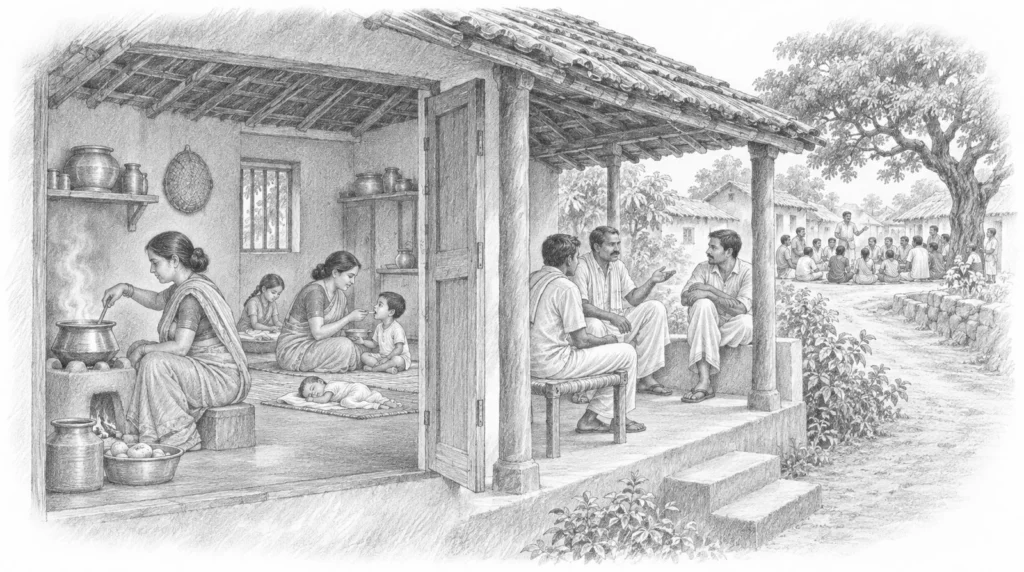
FFAMILY and community are the first places where most Indian women experience both care and control. The family decides who eats first, who inherits property, who studies and whom a daughter may marry. Communities of caste and religion enforce rules about marriage, dress and conduct, often in the name of honour. Feminists have shown that the family is not simply a unit of love and shared interest but a site of power, and that caste and community are maintained through control over women. This chapter examines the household and patriliny, the gendering of caste, marriage and community, the Dalit feminist standpoint and multiple patriarchies.

2.1 The Family, Household and Patriliny
The family is often seen as a natural institution based on love, care and shared interests. Feminists argue that it is also a social and political institution in which power, labour and resources are unequally distributed. Friedrich Engels, in The Origin of the Family, Private Property and the State (1884), linked the subordination of women to the rise of private property and the monogamous family, in which men sought to pass property to their own children; he called the overthrow of mother-right the world historical defeat of the female sex. Though his history has been questioned, his insight that the family is linked to property and power remains influential.
Patriliny and Patrilocality
- Patriliny. Descent, family name and property pass through the male line, from father to son, so sons are seen as permanent members and heirs of the family.
- Patrilocality. After marriage, a woman usually moves to her husband’s home, where she is an outsider and subordinate, especially to her mother-in-law and husband.
- Son preference. Since sons inherit, support parents and perform rituals, families prefer sons, which has produced India’s adverse child sex ratio and sex-selective abortion.
- Dowry. Dowry, the transfer of wealth to the groom’s family at marriage, is linked to women’s exclusion from inheritance and their treatment as a burden.
- Inheritance. Women traditionally had weak rights to land and property; the Hindu Succession (Amendment) Act, 2005 made daughters coparceners, and the Supreme Court confirmed this in Vineeta Sharma (2020), though in practice daughters often give up their share.
Palriwala: Consumption and Authority in the Household
Rajni Palriwala, in Economics and Patriliny: Consumption and Authority within the Household (2008), shows that the household is not a unit with shared interests in which resources are equally distributed. Patriliny shapes who controls resources and who makes decisions. Senior men usually hold authority over property and major decisions, while women’s access to food, health care, education and money depends on their position as daughter, wife, mother or widow. Women often eat last and least, and their work in the fields and home is treated as part of their duty rather than as a contribution that earns rights. Palriwala argues that understanding women’s position requires looking inside the household at relations of consumption and authority.
Bargaining within the Family
Amartya Sen described the household as a site of cooperative conflict, where members cooperate but also have conflicting interests, and their bargaining power depends on their outside options and perceived contributions. Bina Agarwal, in A Field of One’s Own (1994), argued that independent land rights for women would strengthen their bargaining position, reduce poverty and improve their welfare. Women’s earnings, property and education thus shape their power within the family.
2.2 Gendering Caste: Marriage and Community
Ambedkar on Caste and Women
B.R. Ambedkar, in Castes in India (1916), argued that endogamy, marriage within the group, is the essential feature of caste, and that the superposition of endogamy on exogamy creates caste. To maintain endogamy, a caste must prevent its members from marrying outside it and manage the problem of surplus men and women. Ambedkar argued that practices such as sati, enforced widowhood and child marriage arose as means of controlling women to preserve endogamy. Caste is thus maintained through the control of women’s sexuality and marriage.
Chakravarti: Gendering Caste
Uma Chakravarti, in Gendering Caste through a Feminist Lens (2003), develops this argument. She shows that caste and gender are inseparable: upper-caste women are closely controlled to preserve the purity of caste lineage, since women are seen as the gateway through which caste purity could be lost, while lower-caste women face both caste oppression and sexual exploitation by upper-caste men. She describes this as brahmanical patriarchy, a set of rules and institutions in which caste and gender are linked, and shows how it was reinforced by texts, customs and the state. Women themselves are drawn into enforcing caste norms, especially as mothers and mothers-in-law.
Marriage, Choice and Honour
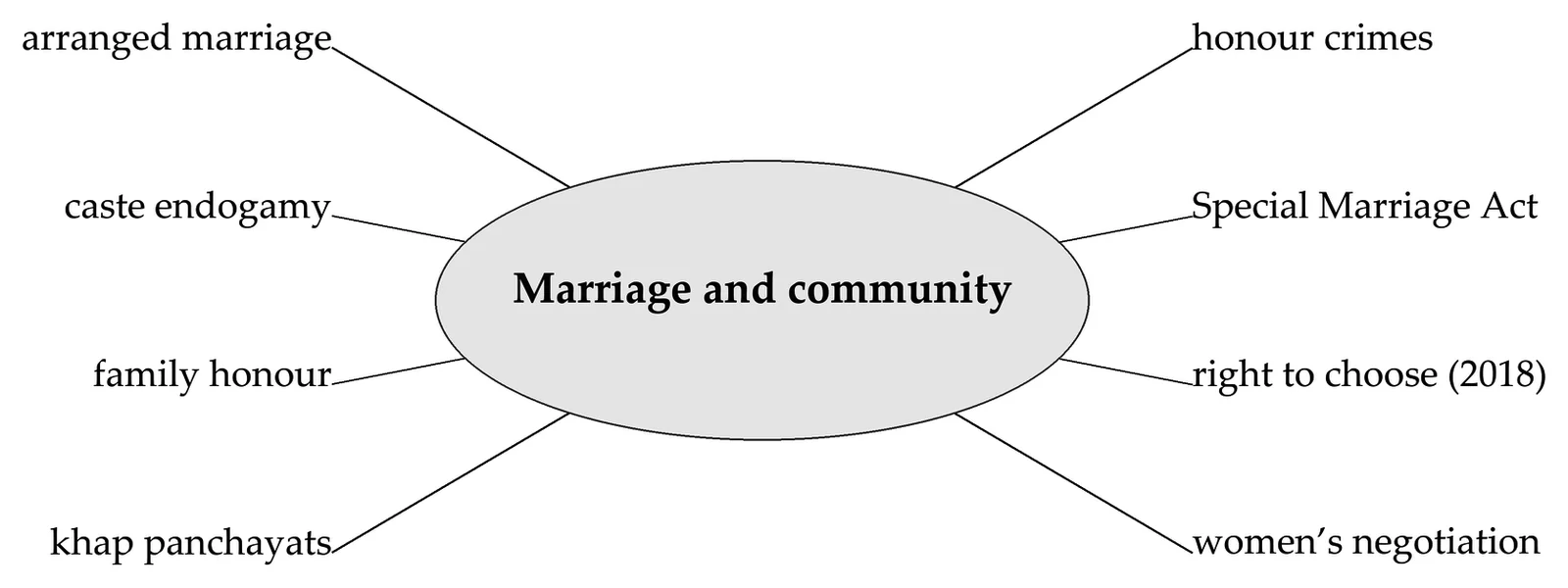
The Saheli Women’s Centre, in Talking Marriage, Caste and Community: Women’s Voices from Within (2007), recorded the experiences of women about marriage choices. They show that families and communities strongly control whom women marry, and that women who choose partners across caste or religion often face threats, violence, false cases and even murder in the name of honour. Caste panchayats such as khap panchayats in Haryana have issued decrees against such marriages. At the same time, women’s narratives reveal negotiation, resistance and the desire for autonomy.
Law and Marriage Choice
- Special Marriage Act, 1954. It allows marriage across religions without conversion, though its requirement of a thirty-day public notice has exposed couples to harassment.
- Right to choose a partner. In Shafin Jahan v. Asokan (2018), the Hadiya case, the Supreme Court held that the right to marry a person of one’s choice is integral to Article 21.
- Honour crimes. In Shakti Vahini v. Union of India (2018), the Supreme Court condemned honour killings and khap interference and directed measures to protect couples.
- Inter-caste marriage. Ambedkar saw inter-caste marriage as the real remedy for caste, and some states give incentives for such marriages.

2.3 Dalit Feminist Standpoint and Multiple Patriarchies
Rege: A Dalit Feminist Standpoint
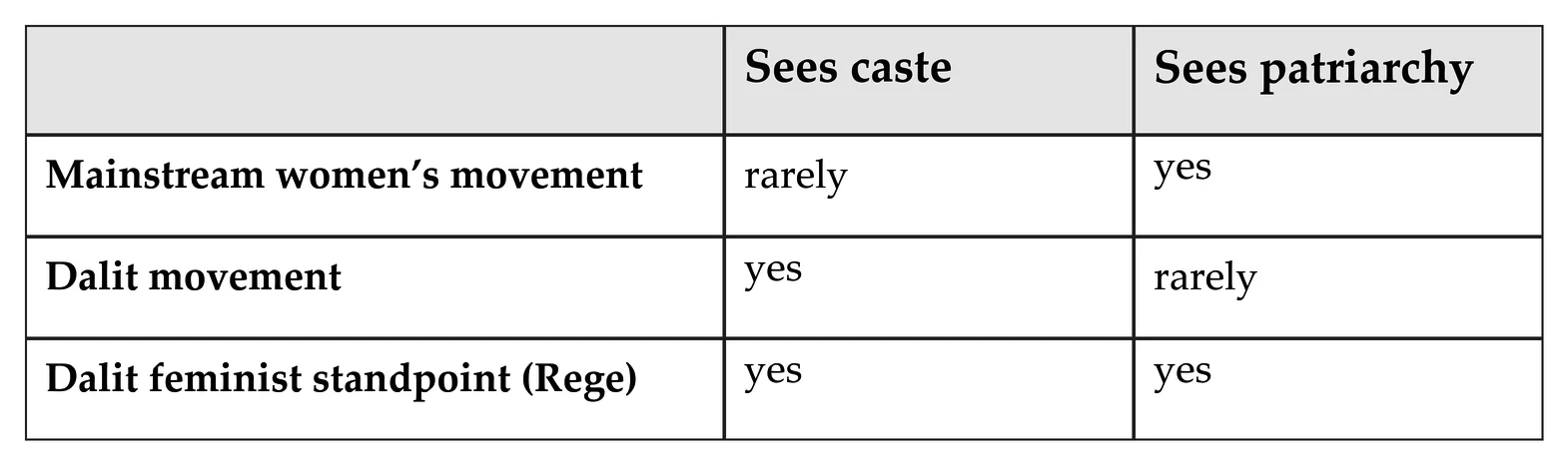
Sharmila Rege, in A Dalit Feminist Standpoint (1998, reprinted 2005), argued that the Indian women’s movement of the 1970s and 1980s was dominated by upper-caste, middle-class women who spoke of a universal sisterhood but ignored caste, while the Dalit movement spoke of caste but ignored patriarchy within Dalit communities. Dalit women, facing both caste and gender oppression, were marginalised in both. Drawing on standpoint theory, which holds that knowledge is shaped by social position and that the oppressed can see aspects of power hidden from the privileged, Rege argued for a Dalit feminist standpoint. This is not simply the experience of Dalit women but a political position, open to all who commit to it, that places the experiences of Dalit women at the centre of feminist analysis and challenges both brahmanism and patriarchy.
Rege drew on the legacy of Savitribai and Jotirao Phule, Ambedkar and the women of the Ambedkarite movement, who linked the struggle against caste with women’s emancipation. The founding of the National Federation of Dalit Women in 1995 reflected the assertion of Dalit women’s autonomous voice.
Sangari: Multiple Patriarchies
Kumkum Sangari, in Politics of Diversity: Religious Communities and Multiple Patriarchies (1995), examined how different religious communities in India maintain their own personal laws on marriage, divorce, inheritance and guardianship, which often discriminate against women. She argued that these are not separate, self-contained patriarchies but overlapping ones that share common features and reinforce each other, forming a broad patriarchal agreement across communities. Defending community autonomy in the name of diversity can therefore entrench women’s subordination, while the state has often used communities’ claims to avoid reform. Sangari called for securing women’s rights without either surrendering to community patriarchies or imposing a majoritarian uniformity.
Debates on Personal Laws
Debates on personal laws illustrate these tensions. The Shah Bano case (1985) and the Muslim Women Act (1986) pitted women’s rights against community claims; the Supreme Court in Shayara Bano (2017) declared instant triple talaq unconstitutional, and Parliament criminalised it in 2019. Proposals for a Uniform Civil Code, mentioned in Article 44, and Uttarakhand’s Uniform Civil Code of 2024, have been welcomed by some as advancing gender equality and criticised by others as threatening minority identity. Many feminists favour reforms that expand women’s rights within and across communities, guided by women’s own voices.
2.4 Important Questions
- Question 1 The family is a site of power. Discuss with reference to patriliny and the household.
- Question 2 Examine the relationship between caste and gender in India.
- Question 3 Discuss the role of community in controlling women’s marriage choices in India.
- Question 4 Discuss the Dalit feminist standpoint and the idea of multiple patriarchies.
DU asks the same idea in different words. So learn one broad answer for each question below; the same answer works for every question joined by OR.
Important Question 1
The family is a site of power. Discuss with reference to patriliny and the household.
OR
Examine the relationship between patriliny, consumption and authority within the household.
OR
Discuss women’s position in the Indian family.
Model Answer
“The overthrow of mother-right was the world historical defeat of the female sex.”
— Friedrich Engels, The Origin of the Family, Private Property and the State (1884)
Introduction. The family is commonly idealised as a haven of love and shared interests. Feminist scholars argue that it is also a site of power, where labour, resources and authority are distributed unequally between men and women and between generations. In India, patriliny and patrilocality shape women’s position in the household, as Rajni Palriwala’s work shows.
1. The Idealised Family
The family is seen as natural, private and based on love, with members sharing resources and interests, an image that hides inequality.
2. Engels on the Family
Engels linked women’s subordination to private property and the monogamous family, calling the overthrow of mother-right the world historical defeat of the female sex.
3. Patriliny
In patrilineal families, descent and property pass through the male line, so sons are permanent members and heirs, while daughters are expected to leave.
4. Patrilocality
After marriage, women move to their husband’s home, where they are outsiders under the authority of the husband and his family, weakening their position.
5. Son Preference
Patriliny produces son preference, reflected in India’s adverse child sex ratio and sex-selective abortion, despite the PCPNDT Act of 1994.
6. Dowry
Dowry is linked to women’s exclusion from inheritance and their treatment as a burden, and dowry violence persists despite the Dowry Prohibition Act of 1961.
7. Palriwala’s Argument
Palriwala shows that the household is not a unit of shared interests; patriliny shapes who controls resources and makes decisions.
8. Consumption
Women’s access to food, health care, education and money depends on their position in the family; women often eat last and least.
9. Authority
Senior men usually hold authority over property and major decisions, while women’s work is treated as duty rather than as a contribution earning rights.
10. Cooperative Conflict
Sen described the household as a site of cooperative conflict, where members cooperate but have conflicting interests and unequal bargaining power.
11. Land Rights
Bina Agarwal argued that independent land rights for women would strengthen their bargaining position and welfare within the family.
12. Legal Reforms
The Hindu Succession (Amendment) Act, 2005 made daughters coparceners, confirmed in Vineeta Sharma (2020), though many daughters still give up their share.
13. Domestic Violence
The family can be a site of violence; the Protection of Women from Domestic Violence Act, 2005 recognised women’s right to live free from violence at home.
14. Changing Families
Urbanisation, education and women’s employment are changing families, though patriarchal norms often adapt rather than disappear.
15. The Family as Support
Feminists also recognise that families provide care and support, and seek to make them more equal rather than to abolish them.
16. Matrilineal Communities
Not all Indian communities are patrilineal. Among the Khasi and Garo of Meghalaya and, historically, the Nairs of Kerala, descent and property passed through women. Yet even in these communities, men often held political authority, showing that matriliny does not simply mean female power.
17. Women’s Unpaid Work in the Family
Time-use surveys in India show that women spend several times more hours than men on unpaid domestic and care work. This work sustains the family and economy but gives women no income or property, reinforcing their dependence within the household.
18. Evaluation
Seeing the family as a site of power is essential to understanding women’s subordination and to designing laws and policies for equality.
Conclusion. Thus, the family is a site of power shaped by patriliny and patrilocality, producing son preference, dowry and weak inheritance for women. Palriwala shows how consumption and authority within the household are unequal, and legal reforms and women’s bargaining power seek to make families more equal.
Important Question 2
Examine the relationship between caste and gender in India.
OR
Discuss Uma Chakravarti’s analysis of gendering caste.
OR
How is caste maintained through the control of women?
Model Answer
“I measure the progress of a community by the degree of progress which women have achieved.”
— B.R. Ambedkar, speech at the Depressed Classes Women’s Conference, Nagpur (1942)
Introduction. Caste and gender are deeply intertwined in India. Caste is maintained through rules on marriage and sexuality that control women, while women’s experience of patriarchy differs by caste. B.R. Ambedkar and Uma Chakravarti have shown that the subordination of women and the reproduction of caste are two sides of the same system.
1. Caste and Endogamy
Ambedkar argued in Castes in India (1916) that endogamy, marriage within the group, is the essence of caste, and its superposition on exogamy creates caste.
2. Controlling Surplus Women
Ambedkar argued that sati, enforced widowhood and child marriage arose to control surplus women and preserve endogamy, showing that caste depends on controlling women.
3. Chakravarti’s Argument
Uma Chakravarti argues that caste and gender are inseparable and must be analysed together through a feminist lens.
4. Purity and Sexuality
Upper-caste women are closely controlled because their sexuality is seen as the gateway through which caste purity could be lost.
5. Brahmanical Patriarchy
Chakravarti describes brahmanical patriarchy as a set of rules and institutions linking caste and gender, reinforced by religious texts, customs and the state.
6. Lower-Caste Women
Dalit and lower-caste women face both caste oppression and sexual exploitation by upper-caste men, as well as hard labour outside the home.
7. Women as Enforcers
Women themselves are drawn into enforcing caste norms, especially as mothers and mothers-in-law, showing how patriarchy secures consent.
8. Reformers against Caste and Patriarchy
The Phules opened schools for girls and lower castes from 1848 and opposed both caste and the oppression of widows, linking the two struggles.
9. Ambedkar and Women
Ambedkar championed women’s rights through the Hindu Code Bill and resigned from the cabinet in 1951 when it was stalled, seeing women’s progress as a measure of a community’s progress.
10. Honour and Violence
Inter-caste marriages often provoke violence and honour killings, since they threaten caste boundaries maintained through women.
11. Caste Violence against Women
Sexual violence against Dalit women, as in the Khairlanji massacre of 2006 and the Hathras case of 2020, shows how caste power operates through women’s bodies.
12. Rege’s Critique
Sharmila Rege criticised the women’s movement for ignoring caste and the Dalit movement for ignoring patriarchy, calling for a Dalit feminist standpoint.
13. Legal Protections
The Scheduled Castes and Scheduled Tribes (Prevention of Atrocities) Act, 1989, amended in 2015, recognises sexual violence against Dalit women as an atrocity.
14. Changing Patterns
Education, urbanisation and inter-caste marriages are slowly weakening caste control, but caste-based marriage remains the norm in most families.
15. Implications for Feminism
A feminism that ignores caste cannot address the realities of most Indian women, so caste must be central to feminist politics.
16. Devadasi and Caste Exploitation
The devadasi system, in which girls from lower castes were dedicated to temples and sexually exploited, shows how caste and gender oppression combined. Laws in Madras (1947), Karnataka (1982) and other states prohibited the practice, though it persisted in some areas.
17. Dalit Women’s Testimonies
Autobiographies by Dalit women, such as Baby Kamble’s The Prisons We Broke and Urmila Pawar’s The Weave of My Life, describe both caste humiliation and patriarchy within their own communities, providing the experiential basis for a Dalit feminist standpoint.
18. Caste, Labour and Women’s Work
Caste shapes women’s work: upper-caste women were often secluded as a sign of status, while Dalit women laboured in fields, as manual scavengers and as domestic workers. The prohibition of manual scavenging by laws of 1993 and 2013 affects mainly Dalit women, showing how caste assigns degrading labour along gender lines.
19. Evaluation
Analysing caste and gender together reveals how both are maintained and shows that ending one requires challenging the other.
Conclusion. Thus, caste is maintained through endogamy and the control of women’s sexuality, as Ambedkar showed, and Chakravarti’s concept of brahmanical patriarchy shows how caste and gender are inseparable. Ambedkar’s measure of progress by women’s progress reminds us that the struggles against caste and patriarchy are linked.
Important Question 3
Discuss the role of community in controlling women’s marriage choices in India.
OR
Examine the issues of honour crimes and the right to choose a partner.
OR
Discuss women’s voices on marriage, caste and community.
Model Answer
“The right to marry a person of one’s choice is integral to Article 21 of the Constitution.”
— Supreme Court of India, Shafin Jahan v. Asokan K.M. (2018)
Introduction. In India, marriage is seen not as a private choice of two individuals but as an alliance between families and communities. Families and communities of caste and religion closely control whom women marry, often in the name of honour. Women who choose their own partners face resistance and violence, while courts and women’s groups have defended the right to choose.
1. Marriage as Alliance
Arranged marriages within caste and religion are the norm, as marriage is seen as an alliance that preserves family status, property and community boundaries.
2. Saheli’s Study
The Saheli Women’s Centre’s Talking Marriage, Caste and Community (2007) recorded women’s own experiences of marriage, choice and community control.
3. Control over Choice
Women’s narratives show that families decide whom they marry, and women who resist face emotional pressure, confinement and threats.
4. Honour
Women are seen as bearers of family and community honour, so their choices in marriage and sexuality are policed by men and elders.
5. Honour Crimes
Couples who marry across caste or religion have been attacked and murdered in honour killings, especially in parts of north and south India.
6. Khap Panchayats
Caste councils such as khap panchayats in Haryana have issued decrees against inter-caste and same-gotra marriages and sanctioned violence against couples.
7. Negotiation and Resistance
Saheli’s study also reveals that women negotiate, resist and sometimes succeed in making their own choices, showing their agency.
8. Special Marriage Act
The Special Marriage Act of 1954 allows marriage across religions without conversion, but its thirty-day public notice has exposed couples to harassment.
9. The Hadiya Case
In Shafin Jahan (2018), the Supreme Court held that the right to marry a person of one’s choice is integral to Article 21, restoring an adult woman’s choice.
10. Shakti Vahini
In Shakti Vahini (2018), the Court condemned honour killings and khap interference and directed police to protect couples.
11. Laws on Conversion
Laws in several states restricting religious conversion for marriage have been criticised for policing interfaith relationships and women’s choices.
12. Community and Personal Law
Personal laws of different communities govern marriage, divorce and inheritance, often discriminating against women, as Sangari shows.
13. Dowry and Marriage
Dowry continues to shape marriage negotiations, linked to women’s exclusion from inheritance and their treatment as a burden.
14. Changing Practices
Education, urban life, employment and online platforms have increased self-chosen marriages, though within limits set by family and community.
15. Feminist Response
Women’s groups provide shelter, legal aid and counselling to couples, and campaign for laws against honour crimes and for reform of the Special Marriage Act.
16. Love Jihad Discourse
In recent years, campaigns alleging a conspiracy behind interfaith marriages, described as love jihad, have been used to justify laws restricting conversion for marriage. Feminists argue that such campaigns deny adult women’s agency and treat them as property of their community.
17. Age of Marriage
The Prohibition of Child Marriage Act, 2006 sets the minimum age at 18 for women and 21 for men. Child marriage has declined but persists, and debates continue on raising the age for women to 21, with feminists stressing education and livelihoods rather than criminalisation alone.
18. Evaluation
Control over marriage is central to the reproduction of caste and community, and women’s right to choose is a key test of gender justice.
Conclusion. Thus, families and communities control women’s marriage choices in the name of honour, as Saheli’s study shows, leading to honour crimes and khap decrees. The Supreme Court has affirmed that the right to marry a person of one’s choice is integral to Article 21, though social control remains strong.
Important Question 4
Discuss the Dalit feminist standpoint and the idea of multiple patriarchies.
OR
Examine Sharmila Rege’s argument for a Dalit feminist standpoint.
OR
Discuss Kumkum Sangari’s analysis of religious communities and multiple patriarchies.
Model Answer
“We are actively committed to struggling against racial, sexual, heterosexual, and class oppression.”
— Combahee River Collective Statement (1977)
Introduction. Indian feminism has had to confront the fact that women are divided by caste, class and religion. Sharmila Rege argued for a Dalit feminist standpoint that places the experiences of Dalit women at the centre, while Kumkum Sangari analysed how religious communities maintain multiple, overlapping patriarchies. Both challenge the idea of a single, universal women’s experience.
1. Universal Sisterhood
The women’s movement of the 1970s and 1980s often spoke of a universal sisterhood, assuming that all women shared the same oppression.
2. Rege’s Critique
Rege argued that this movement was dominated by upper-caste, middle-class women who ignored caste, while the Dalit movement ignored patriarchy.
3. Double Marginalisation
Dalit women, facing both caste and gender oppression, were marginalised within both the women’s movement and the Dalit movement.
4. Standpoint Theory
Standpoint theory holds that knowledge is shaped by social position and that the oppressed can see aspects of power hidden from the privileged.
5. The Dalit Feminist Standpoint
Rege argued that the Dalit feminist standpoint is a political position, open to all who commit to it, that places Dalit women’s experiences at the centre of feminist analysis.
6. Phule and Ambedkar Legacy
Rege drew on the Phules, Ambedkar and Ambedkarite women, who linked the struggle against caste with women’s emancipation.
7. Dalit Women’s Organisation
The National Federation of Dalit Women, founded in 1995, asserted Dalit women’s autonomous voice in national and international forums.
8. Intersectionality
The Combahee River Collective and Kimberlé Crenshaw showed how race, gender and class interlock, ideas that resonate with Dalit feminist thought.
9. Sangari’s Argument
Sangari examined how religious communities maintain personal laws on marriage, divorce, inheritance and guardianship that often discriminate against women.
10. Overlapping Patriarchies
She argued that these patriarchies are not separate but overlapping, sharing common features and forming a broad patriarchal agreement across communities.
11. Diversity and Women’s Rights
Sangari warned that defending community autonomy in the name of diversity can entrench women’s subordination, while the state uses community claims to avoid reform.
12. Shah Bano
The Shah Bano case (1985) and the Muslim Women Act (1986) showed how community claims and electoral politics can override women’s rights.
13. Triple Talaq
In Shayara Bano (2017), the Supreme Court declared instant triple talaq unconstitutional, and Parliament criminalised it in 2019, a step debated among feminists.
14. Uniform Civil Code
Article 44 directs the state to endeavour to secure a Uniform Civil Code; Uttarakhand adopted one in 2024, welcomed by some and criticised by others.
15. A Feminist Path
Many feminists favour reforms that expand women’s rights within and across communities, guided by women’s own voices, rather than majoritarian uniformity.
16. Tribal Women and Customary Law
Adivasi women often face customary laws that deny them inheritance of land, as debated in Madhu Kishwar v. State of Bihar (1996). This shows that multiple patriarchies also exist in tribal communities, and that customary autonomy can conflict with women’s rights.
17. Muslim Women’s Voices
Organisations such as the Bharatiya Muslim Mahila Andolan, founded in 2007, have campaigned for reform of Muslim personal law from within the community, showing that women can challenge patriarchy without abandoning their religious identity.
18. Evaluation
The Dalit feminist standpoint and the idea of multiple patriarchies have made Indian feminism more attentive to caste, community and difference.
Conclusion. Thus, Rege’s Dalit feminist standpoint places the experiences of Dalit women at the centre of feminism, and Sangari shows how religious communities maintain overlapping patriarchies. Like the Combahee River Collective, both insist that the struggle against patriarchy must also challenge caste, class and other oppressions.
Short Notes
(a) Patriliny
A system in which descent, family name and property pass through the male line, making sons the heirs and weakening women’s position in the family.
(b) Dalit feminist standpoint
Sharmila Rege’s political position that places the experiences of Dalit women at the centre of feminist analysis to challenge both caste and patriarchy.
(c) Multiple patriarchies
Kumkum Sangari’s idea that different religious communities and castes maintain overlapping forms of patriarchy that reinforce one another.
(d) Honour crime
Violence, including murder, committed by family or community members against women or couples seen as bringing dishonour, often for marrying across caste or religion; the Supreme Court condemned such crimes in Shakti Vahini (2018).
More notes: GE-9 Women and Politics in India: Concepts and Debates
These notes are prepared by PADHO TO AISE for study help. They are not an official publication.