
Generic Electives (GE) GE-10 Digital Social Sciences
Unit VII · 21 min read · Updated 27 Nov 2026
As per the University of Delhi (DU) Generic Elective (GE) syllabus offered by the Department of Political Science
Contents
- 7.1 What AI and Algorithms Are
- A Short History
- Types of AI
- AI in India
- Ethics of AI
- 7.2 AI, Work and Inequality
- Frey: The Technology Trap
- AI and Work in India
- 7.3 Algorithms, Power and Accountability
- Eubanks: Automating Inequality
- Cheney-Lippold: We Are Data
- Pasquale: The Black Box Society
- Bias, Accountability and Regulation
- 7.4 Important Questions
- What is artificial intelligence? Discuss its development and types.
- How will artificial intelligence affect work and inequality? Discuss with reference to Carl Benedikt Frey.
- How do automated systems profile, police and punish the poor? Discuss with reference to Virginia Eubanks.
- Discuss the problem of the black box and algorithmic identity. How can algorithms be made accountable?
- Short Notes
कृत्रिम बुद्धिमत्ता कंप्यूटरों से वैसे काम करवाने का प्रयास करती है जो मन कर सकते हैं।
Artificial intelligence (AI) seeks to make computers do the sorts of things that minds can do.
— Margaret A. Boden, Artificial Intelligence: A Very Short Introduction (2018)
AALGORITHMS decide which posts appear in our feeds, which job applicants are shortlisted, who gets a loan and, in some countries, who is flagged as a risk to commit a crime or abuse a child. Artificial intelligence (AI), especially machine learning and generative AI, has spread rapidly into work, governance and everyday life. This chapter explains what AI and algorithms are, how AI may transform work and inequality, how automated systems can profile and punish the poor, and why the hidden workings of algorithms, the black box, pose challenges for accountability and democracy.

7.1 What AI and Algorithms Are
An algorithm is a set of step-by-step instructions for solving a problem or performing a task, like a recipe. Computers run on algorithms, and today algorithms process vast amounts of data to sort, rank, predict and decide. Artificial intelligence, as Margaret Boden explains in Artificial Intelligence: A Very Short Introduction (2018), seeks to make computers do the sorts of things that minds can do, such as perceiving, reasoning, learning, using language and making decisions.
A Short History
Alan Turing, in Computing Machinery and Intelligence (1950), asked whether machines can think and proposed the Turing test, in which a machine passes if a human cannot tell it apart from a person in conversation. The term artificial intelligence was coined by John McCarthy and colleagues for the Dartmouth workshop of 1956. Early AI, called symbolic AI or good old-fashioned AI, used rules and logic. Periods of optimism alternated with AI winters when progress stalled. From the 2010s, machine learning, especially deep learning with neural networks trained on huge datasets, produced breakthroughs in image recognition, translation and games; DeepMind’s AlphaGo defeated a world champion at Go in 2016. The release of ChatGPT in November 2022 brought generative AI, which creates text, images and code, to hundreds of millions of users.
Types of AI
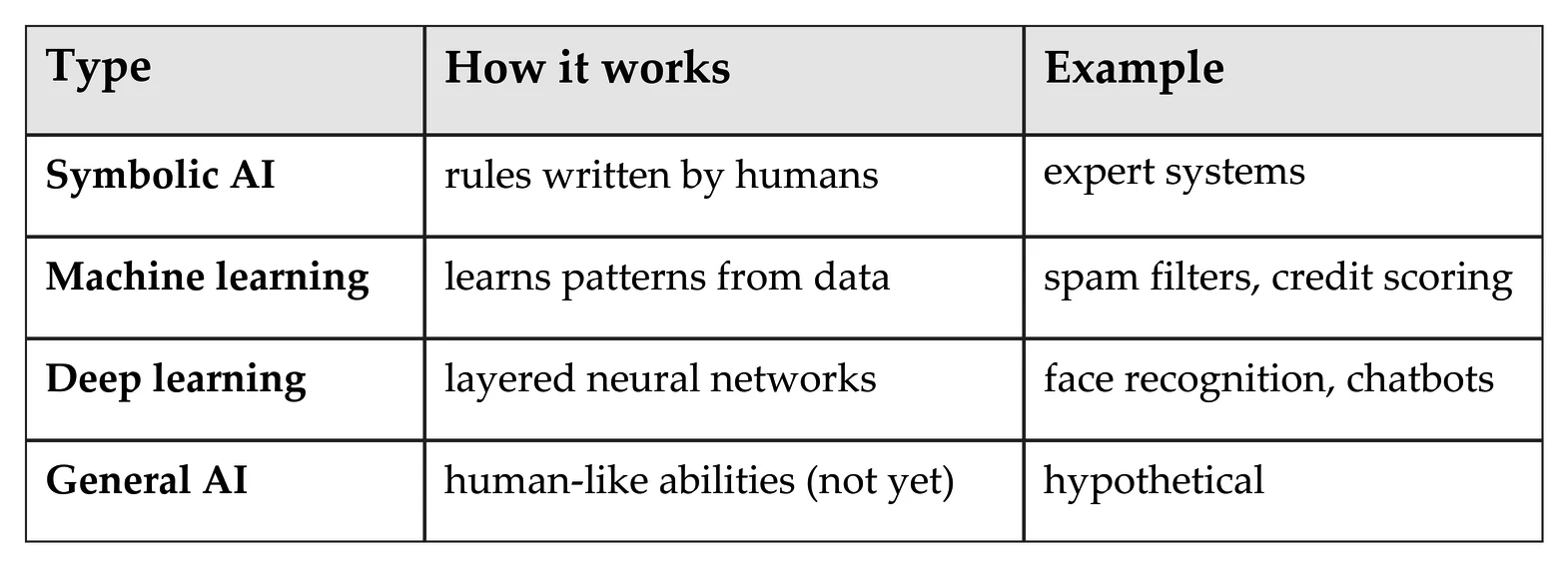
- Symbolic AI. Programs follow explicit rules written by humans, such as expert systems.
- Machine learning. Programs learn patterns from data rather than following fixed rules; they improve as they see more examples.
- Deep learning and neural networks. Inspired loosely by the brain, layered networks learn complex patterns, powering face recognition, speech recognition and large language models.
- Narrow AI. Systems designed for specific tasks, such as recommending videos or detecting fraud; all current AI is narrow.
- Artificial general intelligence. Hypothetical AI with human-like general abilities across tasks; Boden is sceptical about its near arrival and stresses how much of human intelligence AI still lacks.
AI in India
NITI Aayog’s National Strategy for Artificial Intelligence (2018), under the slogan AI for All, identified health care, agriculture, education, smart cities and mobility as priority sectors. The IndiaAI Mission, approved in 2024, aims to build computing capacity, datasets and AI applications. AI is used in crop advisories, disease screening, language translation through Bhashini, fraud detection and policing, including facial recognition, raising questions about accuracy, bias and rights.
Ethics of AI
Ethical principles for AI, adopted by bodies such as UNESCO in its Recommendation on the Ethics of Artificial Intelligence (2021), stress human rights, fairness, transparency, accountability, privacy and environmental sustainability. NITI Aayog’s principles for responsible AI (2021) apply similar ideas to India. Turning such principles into practice remains a major challenge.
7.2 AI, Work and Inequality
Frey: The Technology Trap
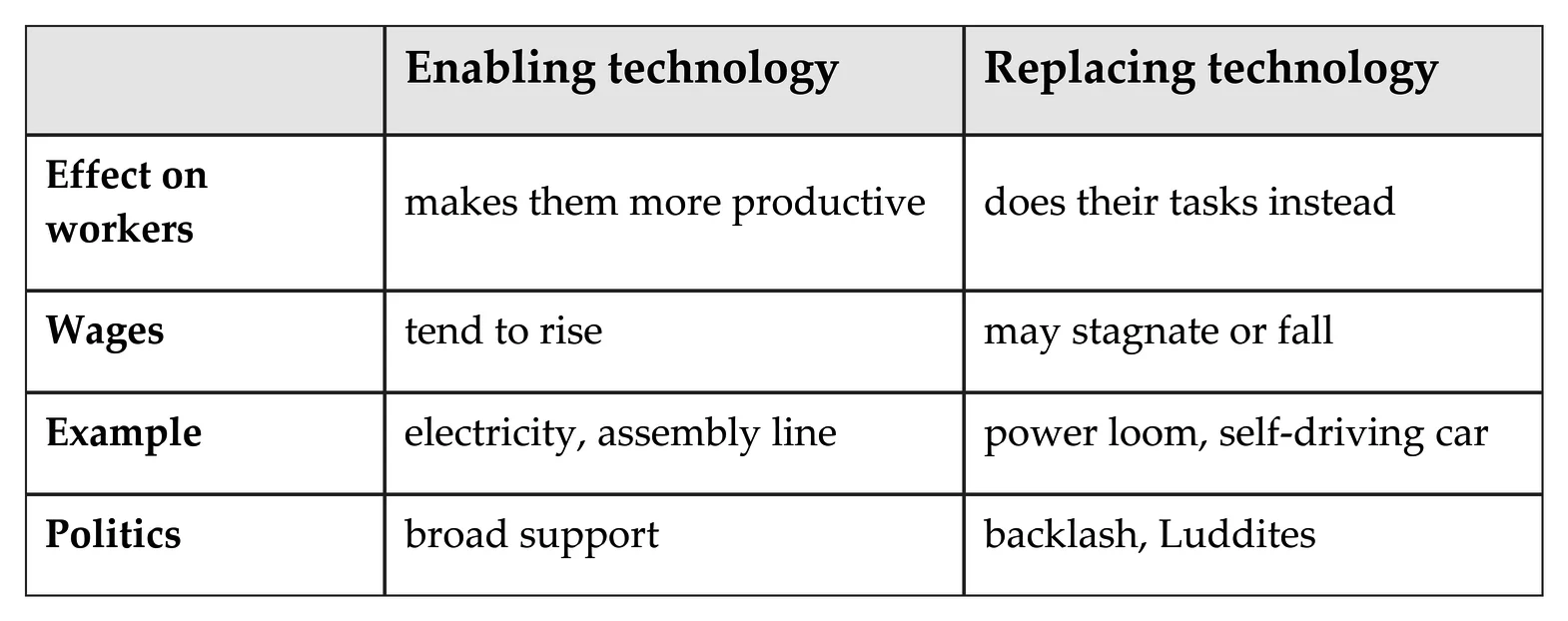
Carl Benedikt Frey, in The Technology Trap: Capital, Labor, and Power in the Age of Automation (2019), places AI in the long history of technological change. He distinguishes enabling technologies, which make workers more productive and raise their wages, from replacing technologies, which substitute for workers and can lower their wages. During the Industrial Revolution, machines replaced skilled artisans, provoking the Luddite protests, and ordinary workers’ wages stagnated for decades even as output grew, a period known as Engels’ pause. In the twentieth century, technologies such as electricity and the assembly line were largely enabling, creating many middle-class jobs.
In his chapter on artificial intelligence, Frey argues that AI is extending automation from routine manual tasks to many cognitive tasks, such as driving, translation, diagnosis and clerical work. With Michael Osborne, he had estimated in 2013 that a large share of American jobs were at high risk of automation. Frey warns that if AI acts mainly as a replacing technology, it may cause job losses, wage stagnation and rising inequality, as in the early Industrial Revolution, provoking a political backlash against technology. He argues that the outcome is not determined by technology alone but by policy: education and retraining, support for displaced workers, and institutions that share the gains of productivity.
AI and Work in India
- IT and services. AI tools can automate coding, testing, customer support and back-office work, threatening routine jobs in India’s IT and BPO industries while creating demand for AI skills.
- Hidden AI labour. Indian workers label data and moderate content to train AI systems, often on low pay, part of the ghost work behind AI.
- Agriculture and informal work. Most Indian workers are in agriculture and informal sectors, where AI’s effects are slower but may come through platforms and precision farming.
- Skills. Programmes for AI skilling aim to prepare workers, but access is unequal across regions, gender and class.
7.3 Algorithms, Power and Accountability
Eubanks: Automating Inequality
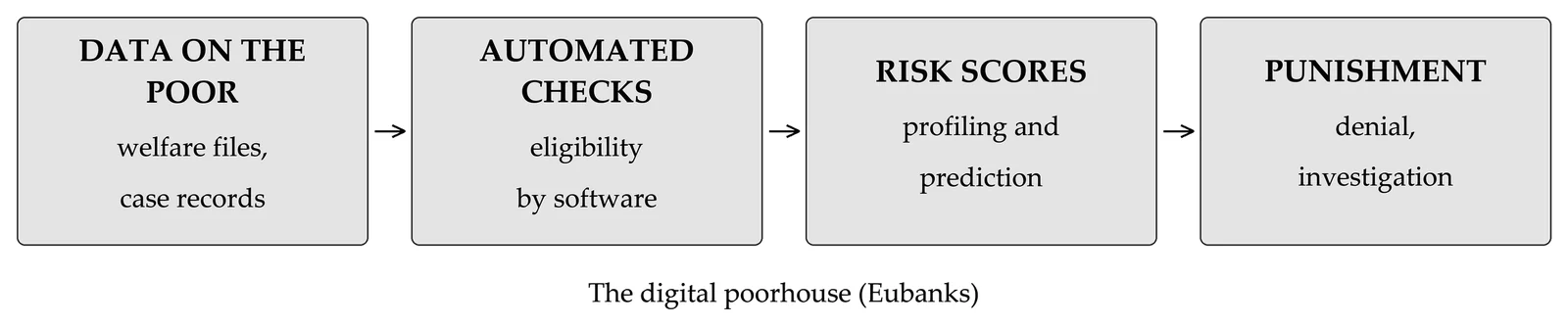
Virginia Eubanks, in Automating Inequality: How High-Tech Tools Profile, Police, and Punish the Poor (2018), examines automated systems used in American welfare and social services. In her introduction, Red Flags, she describes how such systems subject poor and working-class people to intense data collection, profiling and surveillance, while the better-off are rarely scrutinised. She studied an automated welfare eligibility system in Indiana that wrongly denied benefits to many people; a coordinated entry system ranking homeless people in Los Angeles; and a predictive model in Allegheny County, Pennsylvania, that scores the risk of child abuse, often treating poverty itself as a risk factor. Eubanks argues that these tools create a digital poorhouse, continuing older traditions of controlling and punishing the poor, now hidden behind the apparent neutrality of technology.
Cheney-Lippold: We Are Data
John Cheney-Lippold, in We Are Data: Algorithms and the Making of Our Digital Selves (2017), argues that algorithms constantly classify us into categories, such as gender, age, interests or citizenship, based on our data, not on who we are or say we are. These measurable types are statistical constructions that change as our data changes; an algorithm may decide that a user is a woman or a foreigner based on browsing patterns. Our algorithmic identities shape the advertisements, prices, news and even surveillance we encounter, yet we rarely know how we have been categorised. Cheney-Lippold argues that this gives those who control algorithms a new form of power over identity.
Pasquale: The Black Box Society
Frank Pasquale, in The Black Box Society: The Secret Algorithms That Control Money and Information (2015), argues that powerful companies in search, finance and reputation use secret algorithms to make decisions that affect people’s lives, such as credit scores, search rankings and risk assessments. These algorithms are black boxes: their inputs and workings are hidden by trade secrecy and technical complexity. Meanwhile, these companies know more and more about us, creating a one-way mirror. Pasquale calls for transparency, auditing and regulation to create an intelligible society in which important decisions can be understood and challenged.
Bias, Accountability and Regulation
Studies have exposed algorithmic bias: ProPublica’s investigation (2016) found that a criminal risk-assessment tool in the United States wrongly flagged Black defendants as high-risk more often than white defendants; Amazon abandoned a hiring tool in 2018 that penalised women; and Joy Buolamwini’s Gender Shades study (2018) showed that facial recognition was least accurate for darker-skinned women. Responses include the European Union’s AI Act (2024), which classifies AI by risk and bans some uses, and Article 22 of the GDPR on automated decisions. India has relied mainly on advisories and guidelines, with debates on labelling AI-generated content and deepfakes, while welfare algorithms, such as those used to identify ineligible beneficiaries, have been criticised for wrongful exclusions.

7.4 Important Questions
- Question 1 What is artificial intelligence? Discuss its development and types.
- Question 2 How will artificial intelligence affect work and inequality? Discuss with reference to Carl Benedikt Frey.
- Question 3 How do automated systems profile, police and punish the poor? Discuss with reference to Virginia Eubanks.
- Question 4 Discuss the problem of the black box and algorithmic identity. How can algorithms be made accountable?
DU asks the same idea in different words. So learn one broad answer for each question below; the same answer works for every question joined by OR.
Important Question 1
What is artificial intelligence? Discuss its development and types.
OR
Examine Margaret Boden’s understanding of AI.
OR
Distinguish between narrow AI and artificial general intelligence.
Model Answer
“I propose to consider the question, ‘Can machines think?’”
— Alan M. Turing, Computing Machinery and Intelligence (1950)
Introduction. Artificial intelligence is one of the most transformative technologies of our time. It has moved from philosophical speculation and early experiments to systems that recognise faces, translate languages and generate text. Margaret Boden explains what AI is, how it has developed and what it can and cannot do.
1. Algorithms
An algorithm is a set of step-by-step instructions for solving a problem; computers use algorithms to process data, sort, rank, predict and decide.
2. Boden’s Definition
Boden defines AI as seeking to make computers do the sorts of things that minds can do, such as perceiving, reasoning, learning and using language.
3. Turing’s Question
In 1950, Alan Turing asked whether machines can think and proposed a test in which a machine passes if it cannot be distinguished from a human in conversation.
4. Dartmouth, 1956
The term artificial intelligence was coined by John McCarthy and colleagues for the Dartmouth workshop of 1956, which launched AI as a field.
5. Symbolic AI
Early AI used explicit rules and logic written by humans, as in expert systems, an approach called good old-fashioned AI.
6. AI Winters
Periods of optimism were followed by AI winters, when progress stalled and funding fell because early promises were not met.
7. Machine Learning
Machine learning allows programs to learn patterns from data rather than follow fixed rules, improving with more examples.
8. Deep Learning
Deep learning uses layered neural networks trained on huge datasets, producing breakthroughs in image and speech recognition from the 2010s.
9. Landmarks
IBM’s Deep Blue defeated chess champion Garry Kasparov in 1997, and DeepMind’s AlphaGo defeated a world champion at Go in 2016.
10. Generative AI
Generative AI, which creates text, images and code, reached hundreds of millions of users after the release of ChatGPT in November 2022.
11. Narrow AI
All current AI is narrow, designed for specific tasks such as recommendation, translation or fraud detection, without general understanding.
12. Artificial General Intelligence
Artificial general intelligence would have human-like abilities across tasks; Boden is sceptical about its near arrival, stressing what AI still lacks.
13. Limits of AI
Boden notes that AI lacks common sense, genuine understanding and emotions, and can fail in unexpected ways outside its training data.
14. AI in India
NITI Aayog’s 2018 strategy, AI for All, and the IndiaAI Mission of 2024 promote AI in health, agriculture, education and governance.
15. Social Questions
AI raises questions about jobs, bias, privacy, misinformation and accountability, which social scientists must examine.
16. Large Language Models
Large language models, such as those behind ChatGPT, are trained on vast amounts of text to predict the next word in a sequence. They can write fluent answers, but they can also produce confident falsehoods, known as hallucinations, and reproduce biases in their training data.
17. AI in Indian Languages
Building AI for India requires data and models in many Indian languages. Projects such as Bhashini and open-source Indian language models aim to make AI tools usable by people who do not read English, which is essential for inclusive digital services.
18. Evaluation
AI is powerful but limited, and its social effects depend on how it is designed, deployed and governed.
Conclusion. Thus, AI, which Boden defines as making computers do what minds can do, has developed from Turing’s question and symbolic AI to machine learning, deep learning and generative AI. All current AI is narrow, and its benefits and harms depend on social choices about its use.
Important Question 2
How will artificial intelligence affect work and inequality? Discuss with reference to Carl Benedikt Frey.
OR
Distinguish between enabling and replacing technologies.
OR
Discuss the impact of automation and AI on employment in India.
Model Answer
“Technological unemployment… means unemployment due to our discovery of means of economising the use of labour outrunning the pace at which we can find new uses for labour.”
— John Maynard Keynes, Economic Possibilities for our Grandchildren (1930)
Introduction. Every major technological change has raised fears of job loss. Artificial intelligence extends automation from manual to cognitive tasks, raising new concerns about employment and inequality. Carl Benedikt Frey’s The Technology Trap places AI in historical perspective, showing that the effects of technology depend on whether it enables or replaces workers, and on policy.
1. Fears of Technological Unemployment
Keynes warned in 1930 of technological unemployment, when labour-saving technology outpaces the creation of new jobs.
2. Frey’s Framework
Frey distinguishes enabling technologies, which make workers more productive, from replacing technologies, which substitute for workers.
3. The Industrial Revolution
During the Industrial Revolution, machines replaced skilled artisans, provoking Luddite protests against the destruction of their livelihoods.
4. Engels’ Pause
Ordinary workers’ wages stagnated for decades while output grew, a period called Engels’ pause, showing that gains from technology can be unequal.
5. Twentieth-Century Technologies
Electricity and assembly lines were largely enabling, creating many middle-class jobs and rising wages, which made technology popular.
6. AI and Cognitive Tasks
Frey argues that AI extends automation to cognitive tasks such as driving, translation, diagnosis and clerical work, threatening many jobs.
7. Frey and Osborne’s Estimate
Frey and Osborne estimated in 2013 that a large share of American jobs were at high risk of automation, sparking global debate.
8. Rising Inequality
If AI acts mainly as a replacing technology, gains may go to capital owners and highly skilled workers, widening inequality.
9. Political Backlash
Frey warns that people who lose from automation may turn against technology and globalisation, fuelling populist politics.
10. Policy Choices
Frey argues that outcomes depend on policy: education, retraining, support for displaced workers and sharing productivity gains.
11. New Jobs
AI also creates new jobs in developing, maintaining and supervising AI systems, and in services that complement automation.
12. India’s IT Industry
AI can automate coding, testing and customer support, threatening routine IT and BPO jobs while increasing demand for AI skills.
13. Hidden AI Labour
Indian workers label data and moderate content to train AI systems, often on low pay, part of the hidden labour behind AI.
14. India’s Workforce
Most Indian workers are in agriculture and informal work, where AI’s direct effects are slower, but platforms and precision tools may change these sectors.
15. Skilling
AI skilling programmes aim to prepare workers, but unequal access by region, gender and class may widen divides.
16. Generative AI and White-Collar Work
Generative AI can draft documents, write code and answer customer queries, affecting white-collar jobs that were once thought safe from automation. Some studies find it helps less-experienced workers most, while others warn of reduced hiring for entry-level jobs.
17. Global Inequality
The benefits of AI may concentrate in countries and companies that own the most data, computing power and talent, widening the gap between the Global North and South unless developing countries build their own capacity.
18. Evaluation
AI’s effect on work is not predetermined; it depends on whether societies use it to enable workers and share its gains.
Conclusion. Thus, Frey shows that technologies can enable or replace workers, and that AI may replace cognitive tasks, risking an Engels’ pause of stagnant wages and rising inequality. Keynes’s fear of technological unemployment can be avoided only through policies that share AI’s gains.
Important Question 3
How do automated systems profile, police and punish the poor? Discuss with reference to Virginia Eubanks.
OR
What is the digital poorhouse? Discuss.
OR
Examine algorithmic bias and its consequences.
Model Answer
“Models are opinions embedded in mathematics.”
— Cathy O’Neil, Weapons of Math Destruction (2016)
Introduction. Governments increasingly use automated systems to decide who receives welfare, who is investigated and who is a risk. These systems are presented as neutral and efficient. Virginia Eubanks argues that they often profile, police and punish the poor, creating a digital poorhouse hidden behind the apparent objectivity of technology.
1. Automated Decision-Making
Automated systems use data and algorithms to decide on welfare eligibility, risk scores and resource allocation, often with little human review.
2. Eubanks’s Argument
Eubanks argues in Automating Inequality (2018) that these systems subject the poor to intense data collection, profiling and surveillance.
3. Red Flags
In her introduction, Red Flags, Eubanks describes how the poor are flagged by automated systems for suspicion, while the better-off are rarely scrutinised.
4. Indiana
An automated welfare eligibility system in Indiana wrongly denied benefits to many people, treating errors in paperwork as failure to cooperate.
5. Los Angeles
A coordinated entry system ranked homeless people for scarce housing, collecting sensitive data that could be shared with police.
6. Allegheny County
A predictive model in Allegheny County scored the risk of child abuse, often treating poverty and use of public services as risk factors.
7. The Digital Poorhouse
Eubanks argues that these tools create a digital poorhouse, continuing older traditions of controlling and punishing the poor through technology.
8. Neutrality as Myth
As Cathy O’Neil says, models are opinions embedded in mathematics: they reflect choices about data and goals, not neutral truth.
9. Criminal Justice Bias
ProPublica found in 2016 that a risk-assessment tool wrongly flagged Black defendants as high-risk more often than white defendants.
10. Hiring and Facial Recognition
Amazon abandoned a hiring tool in 2018 that penalised women, and Buolamwini’s Gender Shades study showed facial recognition was least accurate for darker-skinned women.
11. Indian Welfare Algorithms
Algorithms used in India to identify ineligible welfare beneficiaries, such as in Telangana, have been criticised for wrongly excluding eligible poor families.
12. Predictive Policing
Predictive policing tools and facial recognition risk targeting poor and marginalised communities already over-policed.
13. Lack of Recourse
People affected by automated decisions often do not know how they were made and have no effective way to challenge them.
14. Eubanks’s Remedies
Eubanks calls for designing systems with the poor rather than for them, ensuring human judgement, transparency and an ethic of dignity.
15. Rights-Based Safeguards
Safeguards include impact assessments, audits, explanation of decisions and the right to human review.
16. Data Quality and Errors
Automated welfare systems depend on databases that often contain errors, such as wrong names, outdated addresses or mismatched records. When decisions are automated, such errors can cut off benefits without anyone noticing, falling hardest on those least able to correct them.
17. Human in the Loop
Scholars argue that automated systems should support rather than replace human judgement, with caseworkers able to override algorithmic scores and listen to affected people, so that technology does not remove empathy and discretion from welfare.
18. Eubanks on Middle-Class Blindness
Eubanks argues that the middle class often fails to notice automated systems because they are tested first on the poor. She warns that tools of surveillance and sorting developed for welfare recipients may later be extended to everyone, so their effects are a concern for all citizens.
19. Evaluation
Automated systems can reproduce and deepen inequality unless designed and governed with attention to justice and the rights of the poor.
Conclusion. Thus, Eubanks shows that automated systems in welfare and social services profile, police and punish the poor, creating a digital poorhouse. As O’Neil notes, models are opinions embedded in mathematics, so algorithmic decisions must be transparent, accountable and just.
Important Question 4
Discuss the problem of the black box and algorithmic identity. How can algorithms be made accountable?
OR
Examine Frank Pasquale’s idea of the black box society.
OR
We are data. Discuss with reference to Cheney-Lippold.
Model Answer
“The data subject shall have the right not to be subject to a decision based solely on automated processing, including profiling, which produces legal effects concerning him or her or similarly significantly affects him or her.”
— EU General Data Protection Regulation (2016), Article 22(1)
Introduction. Algorithms now shape what we see, how we are categorised and what opportunities we get, yet their workings are often hidden. Frank Pasquale describes a black box society ruled by secret algorithms, and John Cheney-Lippold shows how algorithms construct our digital identities. Making algorithms accountable is a central challenge for democracy.
1. Algorithms and Power
Algorithms decide credit, search rankings, prices, news feeds and risk assessments, giving those who control them great power over people’s lives.
2. Pasquale’s Black Box
Pasquale argues that companies in search, finance and reputation use secret algorithms whose inputs and workings are hidden, like a black box.
3. Sources of Secrecy
Algorithms are hidden by trade secrecy, technical complexity and deliberate obscurity, making them hard for outsiders and even regulators to understand.
4. The One-Way Mirror
Pasquale describes a one-way mirror: companies know more and more about us, while we know little about them or their decisions.
5. Reputation and Finance
Credit scores and financial algorithms can determine access to loans and jobs, and errors or biases can harm people without explanation.
6. Search and Information
Search algorithms shape what information people find, giving search companies influence over knowledge and public debate.
7. An Intelligible Society
Pasquale calls for transparency, auditing and regulation to create an intelligible society where important decisions can be understood and challenged.
8. Cheney-Lippold’s We Are Data
Cheney-Lippold argues that algorithms classify us into categories based on our data, not on who we are or say we are.
9. Measurable Types
These measurable types, such as algorithmic gender or age, are statistical constructions that change as our data changes.
10. Consequences of Algorithmic Identity
Algorithmic identities shape the advertisements, prices, news and surveillance we encounter, often without our knowledge.
11. Power over Identity
Cheney-Lippold argues that those who control algorithms gain a new form of power to define who we are.
12. Right to Explanation
Article 22 of the GDPR gives people the right not to be subject to solely automated decisions with significant effects, and to human intervention.
13. The EU AI Act
The European Union’s AI Act of 2024 classifies AI by risk, bans some uses and requires transparency and oversight for high-risk systems.
14. India’s Approach
India has relied mainly on advisories and guidelines, with debates on labelling AI-generated content, deepfakes and accountability of platforms.
15. Tools of Accountability
Algorithmic impact assessments, independent audits, transparency reports, explanation of decisions and human review can make algorithms accountable.
16. Explainable AI
Researchers are developing explainable AI, methods that show which factors influenced an algorithm’s decision, so that people can understand and contest outcomes. However, the most powerful deep learning models remain difficult to explain fully.
17. Algorithmic Accountability in Government
Some governments publish registers of the algorithms they use in public services, so that citizens can know where automated decisions affect them. Such transparency could help Indian welfare and policing algorithms become more accountable.
18. Evaluation
Opening the black box is essential for democracy, since decisions affecting rights must be understandable and contestable.
Conclusion. Thus, Pasquale shows that secret algorithms create a black box society and a one-way mirror, while Cheney-Lippold shows that algorithms construct our identities as measurable types. Rights such as Article 22 of the GDPR, the EU AI Act and audits point towards making algorithms accountable.
Short Notes
(a) Turing test
A test proposed by Alan Turing in 1950, in which a machine is considered intelligent if a human cannot distinguish it from a person in conversation.
(b) Digital poorhouse
Virginia Eubanks’s term for automated systems that profile, police and punish poor people, continuing older traditions of controlling the poor.
(c) Black box
Frank Pasquale’s term for algorithms whose inputs and workings are hidden by secrecy and complexity, making their decisions hard to understand or challenge.
More notes: GE-10 Digital Social Sciences
These notes are prepared by PADHO TO AISE for study help. They are not an official publication.