
Generic Electives (GE) GE-10 Digital Social Sciences
Unit VI · 22 min read · Updated 27 Nov 2026
As per the University of Delhi (DU) Generic Elective (GE) syllabus offered by the Department of Political Science
Contents
- 6.1 The Electronic Silk Road and Digital Work
- India on the Electronic Silk Road
- Regulating the Electronic Silk Road
- Inequalities in Digital Work
- The Platform Economy in Numbers
- 6.2 The Gig Economy and Platform Labour
- Dolber and Others: Workers in the Gig Economy
- Features of Platform Labour
- The Gig Economy in India
- 6.3 Ride-Hailing in India, Workers’ Rights and Regulation
- Verma, Ilavarasan and Kar: Inequalities in Ride-Hailing
- Workers Organise
- Law and Policy
- The Future of Work
- Technology and Workers’ Voice
- 6.4 Important Questions
- Discuss Anupam Chander’s idea of the electronic silk road and its significance for India.
- What is the gig economy? Discuss the nature of platform labour.
- Examine the inequalities in ride-hailing platforms in India.
- Discuss the challenges of securing rights and social protection for workers in the digital economy.
- Short Notes
प्रत्येक व्यक्ति को काम करने, रोज़गार के स्वतंत्र चुनाव, काम की न्यायसंगत और अनुकूल परिस्थितियों और बेरोज़गारी से सुरक्षा का अधिकार है।
Everyone has the right to work, to free choice of employment, to just and favourable conditions of work and to protection against unemployment.
— United Nations, Universal Declaration of Human Rights (1948), Article 23(1)
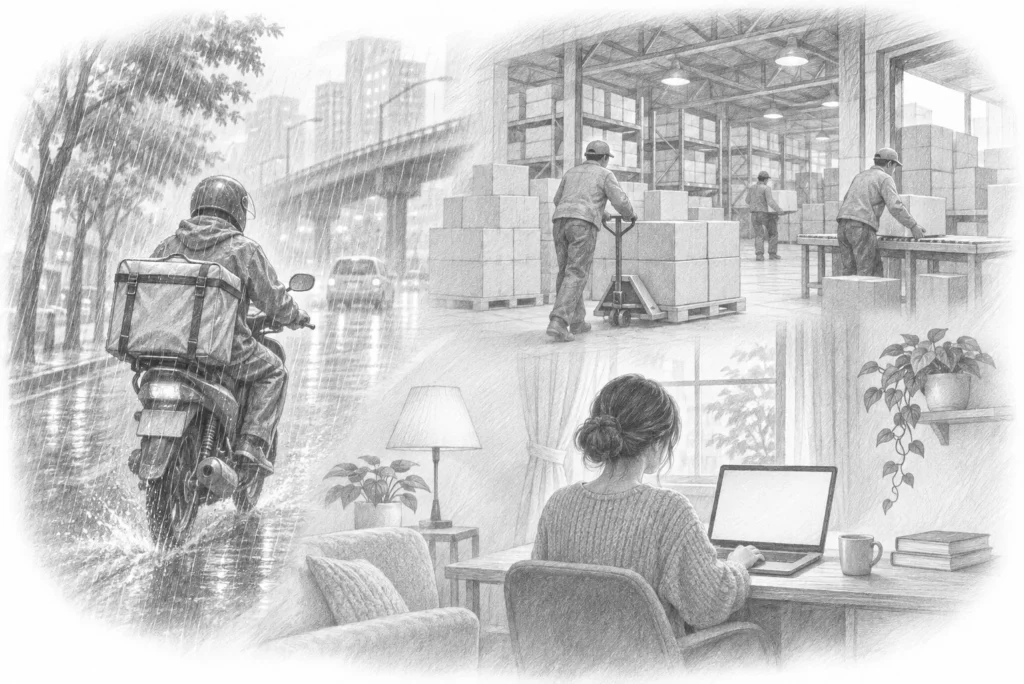
TTHE digital economy has created new kinds of work. Indian engineers write software for clients across the world; call centre workers answer customers in distant countries; and millions of young people deliver food, drive taxis and offer home services through apps. These jobs bring income and flexibility, but often without contracts, minimum wages or social security, and under the control of algorithms. This chapter examines the electronic silk road of cross-border digital work, the gig and platform economy, inequalities in ride-hailing platforms in India, and the efforts of workers and governments to secure rights and protection.
6.1 The Electronic Silk Road and Digital Work
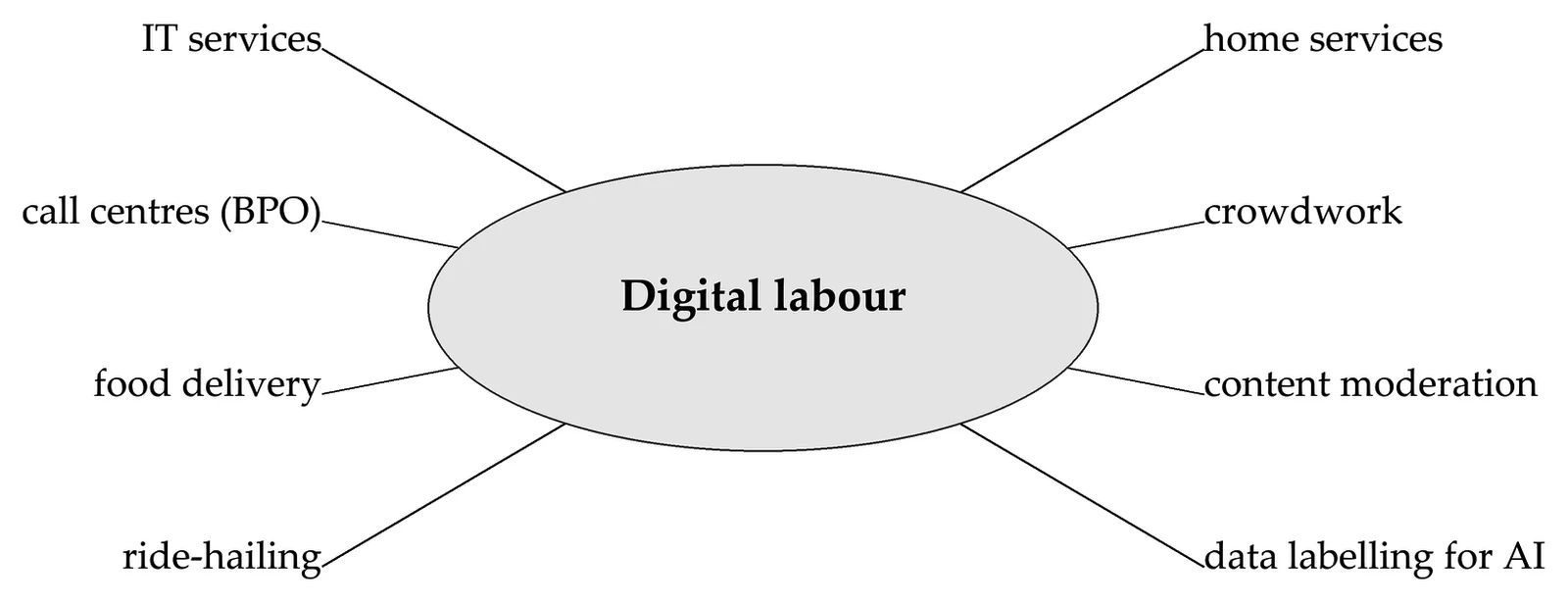
The ancient Silk Road carried goods between Asia and Europe. Anupam Chander, in The Electronic Silk Road: How the Web Binds the World Together in Commerce (2013), argues that the internet has created a new silk road carrying services across borders. A radiologist in India can read scans for a hospital in the United States; a programmer in Bengaluru can maintain software for a bank in London; a call centre in Gurugram can serve customers in Australia. Chander calls this cross-border trade in services net-work, work carried out over the network.
India on the Electronic Silk Road
India has been one of the greatest beneficiaries of the electronic silk road. From the 1990s, its information technology (IT) and business process outsourcing (BPO) industries grew rapidly, helped by English-speaking graduates, lower wages, time-zone differences that allowed round-the-clock work, and liberalisation. Companies such as Infosys, TCS and Wipro became global firms, and the industry employs millions and earns a large share of India’s export income. The Y2K problem around 2000 and the growth of the internet boosted demand for Indian software services.
Regulating the Electronic Silk Road
Chander notes that cross-border net-work raises legal questions: whose law applies to a service supplied from one country to another, how to protect consumers and privacy across borders, and how to prevent a race to the bottom in regulation. He argues for a balance between free trade in services and legitimate national regulation, through harmonisation of rules, recognition of each other’s standards and what he calls glocalisation, adapting global services to local legal requirements. Debates on data localisation, cross-border data flows and digital trade rules continue today.
Inequalities in Digital Work
The benefits of digital work have been uneven. High-skilled IT professionals earn well, while BPO workers often face night shifts, stress and limited career growth. Much digital work is invisible: content moderators who screen violent and disturbing material, data labellers who train artificial intelligence and crowdworkers on platforms such as Amazon Mechanical Turk, many in the Global South, are paid little for repetitive tasks. Mary Gray and Siddharth Suri call this ghost work, the hidden human labour behind seemingly automated services.
The Platform Economy in Numbers
India’s digital economy has grown rapidly, driven by cheap smartphones and data, digital payments and a large young workforce. Food delivery, ride-hailing, e-commerce and online services employ millions, while the IT and business services industry remains one of the country’s largest sources of export earnings and formal jobs for graduates.
6.2 The Gig Economy and Platform Labour
The gig economy refers to work organised as short-term tasks or gigs, often through digital platforms that connect workers with customers. Nick Srnicek, in Platform Capitalism (2016), describes platforms as digital infrastructures that enable two or more groups to interact, positioning themselves as intermediaries that extract data and fees. Lean platforms such as Uber own few assets, relying on workers who provide their own vehicles and phones.
Dolber and Others: Workers in the Gig Economy
Brian Dolber, Chenjerai Kumanyika, Michelle Rodino-Colocino and Todd Wolfson, editors of The Gig Economy: Workers and Media in the Age of Convergence (2021), argue that the gig economy is not simply a new technology but a new way of organising and controlling labour, extending precarity that had long affected media and creative workers to many sectors. Platforms present workers as independent entrepreneurs or partners, but in practice control their work through apps. The editors stress that gig workers, from drivers to journalists and content creators, are organising to demand rights, and that media and communication are central both to how platforms control workers and how workers resist.
Features of Platform Labour
- Misclassification. Platforms treat workers as independent contractors rather than employees, avoiding obligations such as minimum wages, social security and the right to unionise.
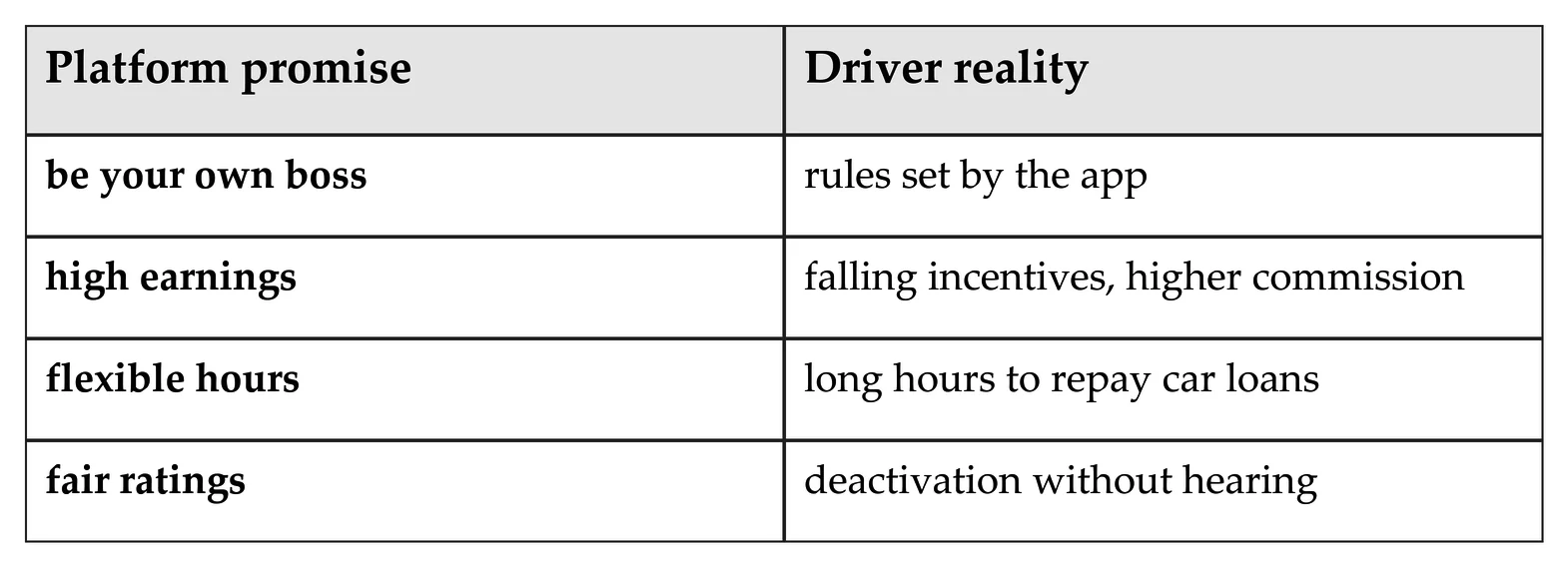
- Algorithmic management. Apps assign tasks, set prices, monitor performance through ratings and GPS, and can deactivate workers without explanation, a system Alex Rosenblat describes in Uberland (2018).
- Flexibility and insecurity. Workers can choose when to log in, but earnings are unpredictable and depend on incentives that platforms change unilaterally.
- Costs borne by workers. Workers pay for vehicles, fuel, phones and data, and bear the risks of accidents and illness.
- Information asymmetry. Platforms know far more than workers about demand, pricing and the rules of the algorithm.
- Fragmentation. Workers are dispersed and isolated, which makes collective organisation harder, though they increasingly organise through WhatsApp groups and unions.
The Gig Economy in India
NITI Aayog’s report India’s Booming Gig and Platform Economy (2022) estimated 77 lakh gig workers in 2020–21 and projected a rapid increase by 2029–30. Gig work is concentrated in delivery (Swiggy, Zomato, Zepto), ride-hailing (Ola, Uber, Rapido), e-commerce logistics and home services (Urban Company). For many young men from small towns and lower-middle-class families, it offers quick entry into work, but often as a stopgap without a career path. Women are a small share of gig workers, concentrated in beauty and care services.

6.3 Ride-Hailing in India, Workers’ Rights and Regulation
Verma, Ilavarasan and Kar: Inequalities in Ride-Hailing
Ravinder Kumar Verma, P. Vigneswara Ilavarasan and Arpan Kumar Kar, in Inequalities in Ride-Hailing Platforms (2020), studied drivers of Ola and Uber in India. When the platforms entered, they offered high incentives that attracted many drivers, some of whom took loans to buy cars. As more drivers joined and the platforms reduced incentives and raised commissions, earnings fell, leaving many drivers in debt and working longer hours. The study identifies several inequalities: between the platform and drivers, since the platform sets fares, commissions and rules; among drivers, between those who own cars and those who rent them from fleet owners; and in information, as drivers cannot see how the algorithm allocates rides or calculates incentives. Ratings by customers can lead to deactivation, giving drivers little power to contest decisions. The authors conclude that platforms reproduce and sometimes deepen inequality, despite promises of entrepreneurship.
Workers Organise
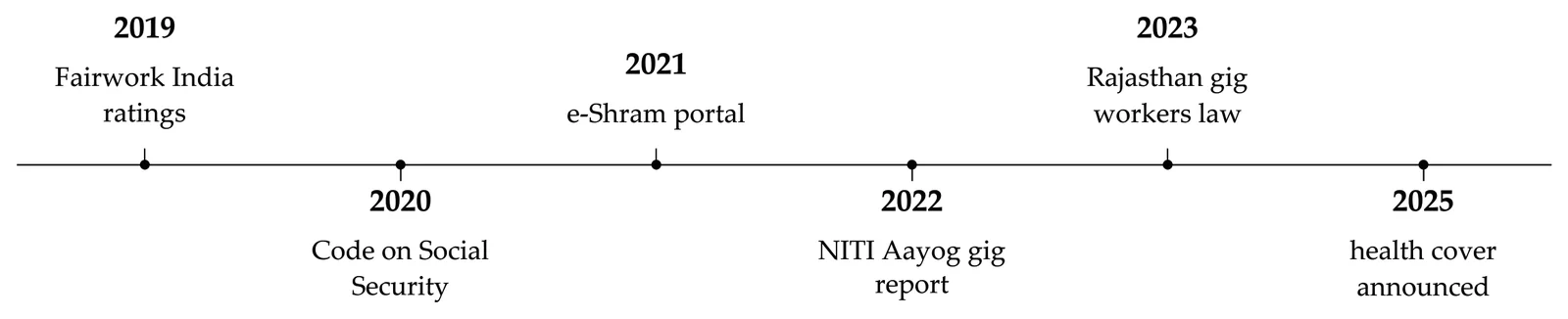
Gig workers in India have organised protests and strikes against falling pay, arbitrary deactivation and lack of safety. Ride-hailing drivers in Delhi, Mumbai and Bengaluru held strikes from 2017 onwards; food delivery workers protested changes in pay structures; and women working for home-service platforms protested new rules in 2021. Unions such as the Indian Federation of App-based Transport Workers (2019) and the Telangana Gig and Platform Workers Union have emerged. The Fairwork India project, run by researchers since 2019, rates platforms on fair pay, conditions, contracts, management and representation.
Law and Policy
- Code on Social Security, 2020. It defined gig workers and platform workers for the first time and provided for social security schemes funded partly by aggregators’ contributions, though the code took time to come into force.
- e-Shram (2021). A national portal to register unorganised workers, including gig workers, for access to welfare schemes.
- State laws. Rajasthan’s Platform-Based Gig Workers (Registration and Welfare) Act, 2023 was the first state law, creating a welfare board and a welfare fee on platforms; other states, such as Karnataka, have followed.
- Health cover. The Union Budget of 2025 announced registration of gig workers on e-Shram and health cover under Ayushman Bharat.
- International debates. Courts in Britain held in Uber v. Aslam (2021) that Uber drivers are workers entitled to minimum wages and holiday pay, and the European Union adopted a Platform Work Directive in 2024.
The Future of Work
The growth of platform work raises broader questions about the future of employment: whether secure jobs will give way to precarious gigs, how social security can cover workers without employers, and how workers can bargain collectively with algorithms. Scholars argue that technology does not determine these outcomes; laws, collective action and public policy will shape whether the digital economy provides decent work.
Technology and Workers’ Voice
Workers also use technology to organise. WhatsApp groups allow delivery riders to share information about pay changes and coordinate strikes, and some unions have built apps to collect data on earnings and working hours. Such worker data can counter the information advantage of platforms and support collective bargaining.
6.4 Important Questions
- Question 1 Discuss Anupam Chander’s idea of the electronic silk road and its significance for India.
- Question 2 What is the gig economy? Discuss the nature of platform labour.
- Question 3 Examine the inequalities in ride-hailing platforms in India.
- Question 4 Discuss the challenges of securing rights and social protection for workers in the digital economy.
DU asks the same idea in different words. So learn one broad answer for each question below; the same answer works for every question joined by OR.
Important Question 1
Discuss Anupam Chander’s idea of the electronic silk road and its significance for India.
OR
Examine cross-border trade in services in the digital economy.
OR
Discuss the growth of India’s IT and BPO industries and its implications for labour.
Model Answer
“From the territory of one Member into the territory of any other Member.”
— General Agreement on Trade in Services (1994), Article I:2(a), defining cross-border supply
Introduction. The internet has made it possible to deliver services across borders as easily as goods, creating new forms of work and trade. Anupam Chander describes this as the electronic silk road. India, with its large pool of English-speaking graduates, became one of its main beneficiaries through the IT and BPO industries, though the gains have been unequal.
1. The Old and New Silk Roads
The ancient Silk Road carried goods between Asia and Europe; Chander argues that the internet has created a new silk road carrying services across borders.
2. Net-Work
Chander calls cross-border work carried out over the internet net-work, such as software development, data processing and remote medical services.

3. Cross-Border Supply
The WTO’s GATS recognises cross-border supply of services from one country into another as a mode of trade, which digital technology has greatly expanded.
4. India’s IT Industry
From the 1990s, India’s IT industry grew rapidly, with companies such as Infosys, TCS and Wipro serving global clients and employing millions.
5. Business Process Outsourcing
BPO firms in cities such as Gurugram, Bengaluru and Hyderabad handle customer service, accounting and data processing for foreign companies.
6. Reasons for India’s Success
English-speaking graduates, lower wages, time-zone differences allowing round-the-clock work, and liberalisation helped India grow on the electronic silk road.
7. Economic Benefits
IT and services exports became a major source of foreign exchange and created a new urban middle class, boosting cities such as Bengaluru and Hyderabad.
8. Legal Questions
Chander notes that net-work raises questions about whose law applies, how to protect consumers and privacy across borders, and how to prevent a regulatory race to the bottom.
9. Harmonisation and Glocalisation
He argues for harmonising rules, recognising each other’s standards and glocalisation, adapting global services to local legal requirements.
10. Data Flows
Debates on data localisation and cross-border data flows affect India’s IT industry, which depends on handling foreign clients’ data.
11. Unequal Benefits
High-skilled professionals earn well, while BPO workers often face night shifts, stress, surveillance and limited career growth.
12. Ghost Work
Gray and Suri describe ghost work, the hidden labour of content moderators, data labellers and crowdworkers, many in the Global South, who are poorly paid.
13. Protectionist Backlash
Outsourcing has faced backlash in rich countries, with restrictions on work visas and political criticism of jobs moving abroad.
14. Automation Threat
Artificial intelligence threatens some routine IT and BPO jobs, forcing the industry to move towards higher-value services.
15. Regional Concentration
Digital work is concentrated in a few cities, contributing to regional inequality within India.
16. Remote Work after the Pandemic
The Covid-19 pandemic normalised remote work, allowing more professionals to work for distant employers and clients from small towns. Global capability centres set up by multinational companies in India have expanded, showing the continuing growth of the electronic silk road.
17. Freelancing Platforms
Online freelancing platforms connect Indian writers, designers and programmers directly with clients abroad. India has one of the largest numbers of online freelancers in the world, though freelancers face competition that pushes down rates and have little social protection.
18. Digital Trade Agreements
New trade agreements increasingly include chapters on digital trade, covering cross-border data flows, electronic signatures and customs duties on electronic transmissions. India has been cautious, seeking policy space to regulate data and develop its own digital industries.
19. Evaluation
The electronic silk road has brought great opportunities to India, but its benefits are unequal and depend on regulation and skills.
Conclusion. Thus, Chander’s electronic silk road describes how the internet carries services across borders, the cross-border supply recognised by GATS. India’s IT and BPO industries have benefited greatly, but legal challenges, ghost work, automation and unequal gains show that net-work requires fair regulation.
Important Question 2
What is the gig economy? Discuss the nature of platform labour.
OR
Examine the features and problems of gig work.
OR
Discuss algorithmic management in the platform economy.
Model Answer
“Labour is not a commodity.”
— ILO, Declaration of Philadelphia (1944)
Introduction. The gig economy organises work as short-term tasks mediated by digital platforms. It has created millions of jobs worldwide, including in India, offering flexibility and easy entry. But scholars such as Dolber and his colleagues argue that it represents a new way of controlling labour, extending precarity and weakening workers’ rights.
1. Meaning of the Gig Economy
The gig economy refers to work organised as short-term tasks or gigs, often obtained through apps that connect workers with customers.
2. Platforms
Srnicek describes platforms as digital infrastructures enabling groups to interact, acting as intermediaries that extract data and fees.
3. Lean Platforms
Lean platforms such as Uber own few assets, relying on workers who provide their own vehicles, phones and labour.
4. Dolber and Colleagues
Dolber and his co-editors argue that the gig economy is a new way of organising and controlling labour, extending precarity across sectors.
5. Misclassification
Platforms treat workers as independent contractors or partners, avoiding obligations of minimum wages, social security and collective bargaining.
6. Algorithmic Management
Apps assign tasks, set prices, track performance through ratings and GPS and can deactivate workers, as Rosenblat describes in Uberland.
7. Flexibility
Workers can choose when to log in, which attracts students, part-time workers and those needing quick income.
8. Insecurity
Earnings are unpredictable, depend on incentives changed unilaterally by platforms, and lack benefits such as sick leave and pensions.
9. Costs and Risks
Workers bear the costs of vehicles, fuel, phones and data, and the risks of accidents, illness and income loss.
10. Information Asymmetry
Platforms know far more than workers about demand, pricing and algorithmic rules, giving them great power over workers.
11. Gig Work in India
NITI Aayog estimated 77 lakh gig workers in 2020–21, concentrated in delivery, ride-hailing, logistics and home services.
12. Who Does Gig Work
Many are young men from small towns seeking quick entry into work, often as a stopgap; women are a small share, concentrated in beauty and care services.
13. Media and Creative Workers
Dolber and colleagues show that precarity long faced by media and creative workers has spread to other sectors through platforms.
14. Worker Resistance
Gig workers organise strikes, form unions and use WhatsApp groups to share information and coordinate action.
15. Labour Is Not a Commodity
The ILO’s principle that labour is not a commodity reminds us that work involves human dignity, which platform models must respect.
16. Social Media Creators
Content creators on video and social media platforms are also gig workers, dependent on platform algorithms for visibility and income. Changes in algorithms or monetisation rules can suddenly reduce their earnings, showing platform control over creative labour.
17. Gig Work and Caste
Studies of delivery and home-service work in Indian cities find that platform jobs often draw workers from marginalised castes and migrant communities, and that customers sometimes discriminate by caste or religion, showing that old hierarchies persist in new forms of work.
18. Dark Stores and Quick Commerce
Quick commerce companies promise delivery in ten minutes from small warehouses called dark stores. Workers face intense time pressure, and concerns about road safety led to criticism of such promises, illustrating how platform business models shape working conditions.
19. Evaluation
The gig economy offers opportunities but often at the cost of security and rights, so regulation and collective action are needed to ensure decent work.
Conclusion. Thus, the gig economy organises work through platforms that classify workers as contractors and manage them through algorithms, creating flexibility but also insecurity. As the ILO declared, labour is not a commodity, and platform work must be made consistent with decent work and workers’ rights.
Important Question 3
Examine the inequalities in ride-hailing platforms in India.
OR
Discuss the condition of Ola and Uber drivers in India.
OR
Do platforms create entrepreneurs or precarious workers? Discuss.
Model Answer
“Gig worker means a person who performs work or participates in a work arrangement and earns from such activities outside of traditional employer-employee relationship.”
— Code on Social Security, 2020, Section 2(35)
Introduction. Ride-hailing platforms such as Ola and Uber transformed urban transport in India, offering convenience to passengers and income to drivers. But research by Verma, Ilavarasan and Kar shows that the platforms have produced significant inequalities, as drivers’ earnings fell, debts rose and control rested with algorithms.
1. Entry of Platforms
Ola, founded in 2010, and Uber, which entered India in 2013, rapidly expanded ride-hailing in Indian cities.
2. Early Incentives
At first, platforms offered high incentives and bonuses that attracted large numbers of drivers with the promise of good earnings.
3. Loans for Cars
Many drivers took loans to buy cars, sometimes through schemes promoted by the platforms, expecting incentives to continue.
4. Falling Earnings
As more drivers joined and platforms cut incentives and raised commissions, earnings fell, leaving many drivers in debt.
5. Longer Hours
Drivers worked longer hours to maintain income, affecting their health, safety and family life.
6. Platform and Driver
The study identifies inequality between the platform, which sets fares, commissions and rules, and drivers who have little say.
7. Owners and Renters
Drivers who own cars and those who rent from fleet owners face different conditions, with renters earning less after paying rent.
8. Information Asymmetry
Drivers cannot see how the algorithm allocates rides or calculates incentives, while the platform has full information.
9. Ratings and Deactivation
Customer ratings affect drivers’ access to rides, and low ratings or complaints can lead to deactivation without a fair hearing.
10. Myth of Entrepreneurship
Platforms call drivers partners and entrepreneurs, but in practice drivers have little control over prices, customers or working conditions.
11. Legal Recognition
The Code on Social Security, 2020 recognised gig workers as those working outside traditional employer-employee relationships, providing for social security schemes.
12. Strikes and Protests
Ride-hailing drivers in Delhi, Mumbai and Bengaluru have held strikes since 2017 against falling earnings and high commissions.
13. Unions
Unions such as the Indian Federation of App-based Transport Workers, formed in 2019, represent drivers and demand regulation.
14. State Regulation
Some states have issued aggregator guidelines on fares and commissions, and Rajasthan’s 2023 Act created a welfare board for gig workers.
15. Global Comparison
In Uber v. Aslam (2021), the UK Supreme Court held that Uber drivers are workers entitled to minimum wages, a precedent watched by Indian unions.
16. Safety of Passengers and Drivers
Ride-hailing raised concerns about the safety of passengers, especially women, after incidents such as a rape in a cab in Delhi in 2014, leading to background checks and panic buttons. Drivers also face violence, robbery and road accidents with little insurance cover.
17. Two-Wheeler Taxis and Auto-Rickshaws
Platforms have expanded into bike taxis and auto-rickshaws, drawing in workers who already worked informally. Some states have restricted bike taxis, showing conflicts between platforms, traditional transport workers and regulators.
18. Evaluation
Ride-hailing platforms have created work but also new inequalities, showing that platform labour needs regulation and collective bargaining.
Conclusion. Thus, Verma, Ilavarasan and Kar show that ride-hailing platforms produced inequality between platform and drivers, among drivers and in information, as early incentives gave way to falling earnings and debt. The Code on Social Security, 2020 recognises gig workers, but their rights remain weak.
Important Question 4
Discuss the challenges of securing rights and social protection for workers in the digital economy.
OR
Examine the legal framework for gig and platform workers in India.
OR
How are digital workers organising for their rights? Discuss.
Model Answer
“At the most general level, platforms are digital infrastructures that enable two or more groups to interact.”
— Nick Srnicek, Platform Capitalism (2016)
Introduction. Labour law was built around the employer-employee relationship of the industrial age. Platform work, in which workers are treated as independent contractors managed by algorithms, falls outside this framework. Securing rights and social protection for digital workers requires new laws, institutions and forms of collective action.
1. The Challenge
Platforms, which Srnicek describes as infrastructures connecting groups, deny being employers, so workers fall outside traditional labour protections.
2. Misclassification Debate
Workers and unions argue that platforms control work like employers and should be held responsible, while platforms defend the contractor model.
3. Code on Social Security, 2020
The Code defined gig and platform workers and provided for social security schemes funded partly by aggregators’ contributions.
4. e-Shram
The e-Shram portal, launched in 2021, registers unorganised workers, including gig workers, to give them access to welfare schemes.
5. Rajasthan’s Act
Rajasthan’s Platform-Based Gig Workers (Registration and Welfare) Act, 2023, the first state law, created a welfare board and a welfare fee on platforms.
6. Other States
Other states, such as Karnataka, have followed with laws or proposals on social security and grievance redressal for gig workers.
7. Health Cover
The Union Budget of 2025 announced registration of gig workers on e-Shram and health cover under Ayushman Bharat.
8. Algorithmic Transparency
Workers demand transparency about how algorithms allocate work, set pay and deactivate accounts, and the right to appeal decisions.
9. Minimum Earnings
Unions demand minimum earnings per hour, including waiting time, and limits on platform commissions.
10. Safety
Delivery and ride-hailing workers face road accidents and pressure from delivery-time targets, leading to demands for insurance and safer practices.
11. Fairwork India
Researchers in the Fairwork India project, from 2019, rate platforms on fair pay, conditions, contracts, management and representation, pressing them to improve.
12. Worker Organising
Gig workers have formed unions, held strikes and used WhatsApp groups to coordinate, though dispersed and changing workforces make organising difficult.
13. Women Workers
Women working for home-service platforms protested new rules in 2021, showing that women gig workers also organise for their rights.
14. International Developments
Britain’s Supreme Court held Uber drivers to be workers in 2021, and the European Union adopted a Platform Work Directive in 2024, shaping global debates.
15. Decent Work
The ILO’s idea of decent work, including fair income, security, rights and voice, provides a standard for evaluating platform work.
16. Portable Benefits
Since gig workers often work for several platforms, scholars propose portable benefits that follow the worker, funded by small contributions from each platform on every transaction, as the Rajasthan law attempts through its welfare fee.
17. Data Rights for Workers
Workers increasingly demand access to the data platforms collect about them, such as ratings, earnings and deactivation records, so that they can contest decisions and bargain collectively, a demand recognised in the European Union’s Platform Work Directive.
18. Evaluation
Securing rights for digital workers requires combining new laws, social security, algorithmic transparency and collective organisation.
Conclusion. Thus, platforms, which Srnicek defines as infrastructures connecting groups, place workers outside traditional labour law. India’s Code on Social Security, e-Shram and Rajasthan’s 2023 Act are first steps, while workers’ unions and Fairwork ratings push for decent work in the digital economy.
Short Notes
(a) Algorithmic management
The use of software and algorithms by platforms to assign tasks, set pay, monitor performance and discipline workers, often without human supervisors.
(b) Ghost work
Mary Gray and Siddharth Suri’s term for the hidden human labour, such as data labelling and content moderation, behind seemingly automated digital services.
(c) Platform worker
Under the Code on Social Security, 2020, a worker who uses an online platform to access organisations or individuals and provide services for payment.
More notes: GE-10 Digital Social Sciences
These notes are prepared by PADHO TO AISE for study help. They are not an official publication.