
Generic Electives (GE) GE-1 Ideas in Indian Political Thought
Unit V · 25 min read · Updated 27 Nov 2026
As per the University of Delhi (DU) Generic Elective (GE) syllabus offered by the Department of Political Science
Contents
- 5.1 Ambedkar: Life, Struggles and Works
- Struggles and Public Life
- Major Works
- 5.2 Nyaya: Ambedkar’s Idea of Justice and Critique of Caste
- Liberty, Equality and Fraternity
- Features of Ambedkar’s Idea of Justice
- Ambedkar’s Analysis of Caste
- Annihilation of Caste
- 5.3 Instruments of Justice: Democracy, Socialism, Safeguards and Buddhism
- Constitutional Democracy and Social Democracy
- State Socialism
- Safeguards and Constitutional Provisions
- Conversion to Buddhism
- Legacy and Debates
- 5.4 Important Questions
- Discuss Ambedkar’s idea of nyaya (justice).
- Examine Ambedkar’s critique of the caste system in Annihilation of Caste.
- Discuss Ambedkar’s views on democracy, constitutional morality and social democracy.
- Compare the views of Gandhi and Ambedkar on caste and untouchability.
- Short Notes
मेरा सामाजिक दर्शन तीन शब्दों में निहित कहा जा सकता है: स्वतंत्रता, समानता और बंधुत्व।
My social philosophy may be said to be enshrined in three words: liberty, equality and fraternity.
— B.R. Ambedkar, Radio talk, All India Radio (1954)
BBHIMRAO RAMJI AMBEDKAR (1891–1956) rose from the humiliation of untouchability to become a scholar, a leader of the oppressed, the chairman of the Drafting Committee of the Constitution and independent India’s first Law Minister. His life’s work was a struggle for nyaya, i.e. justice, understood not only as fair laws but as the real end of caste oppression, economic exploitation and the subordination of women. This chapter studies his life and context, his conception of justice built on liberty, equality and fraternity, his critique of caste in Annihilation of Caste, and the instruments he proposed for justice: constitutional democracy, state socialism, safeguards for the oppressed and, finally, Buddhism.

5.1 Ambedkar: Life, Struggles and Works
Ambedkar was born on 14 April 1891 at Mhow in a Mahar family, a caste treated as untouchable. As a child he faced humiliating discrimination, such as being made to sit apart in school and denied water. With the support of the Maharaja of Baroda, he studied at Columbia University in New York, where he was influenced by the philosopher John Dewey, and at the London School of Economics, becoming one of the most highly educated Indians of his generation. He returned to fight for the rights of the untouchables, whom he called the depressed classes.
Struggles and Public Life
- Organisation. He founded the Bahishkrit Hitakarini Sabha (1924) and journals such as Mooknayak (1920) and Bahishkrit Bharat (1927) to awaken the depressed classes.
- Mahad Satyagraha (1927). He led untouchables to drink water from the public Chavdar tank at Mahad, and on 25 December 1927 publicly burnt the Manusmriti as a symbol of caste oppression.
- Kalaram Temple Satyagraha (1930). He led a campaign at Nashik for the right of untouchables to enter temples.
- Round Table Conferences and the Poona Pact. He represented the depressed classes in London (1930–32) and won separate electorates in the Communal Award, which he gave up in the Poona Pact of 1932 after Gandhi’s fast, accepting reserved seats in joint electorates.
- Political parties. He founded the Independent Labour Party (1936) and the Scheduled Castes Federation (1942), and served as Labour Member of the Viceroy’s Executive Council (1942–46).
- Constitution maker. As chairman of the Drafting Committee from 1947, he piloted the Constitution through the Constituent Assembly, and as Law Minister he introduced the Hindu Code Bill, resigning in 1951 when it was stalled.
- Buddhism. On 14 October 1956, he converted to Buddhism at Nagpur with lakhs of followers, and died on 6 December 1956.
Major Works
Ambedkar’s many writings include Castes in India (1916), Annihilation of Caste (1936), What Congress and Gandhi Have Done to the Untouchables (1945), Who Were the Shudras (1946), States and Minorities (1947), The Untouchables (1948) and The Buddha and His Dhamma (published 1957). Together they form a sustained inquiry into caste, democracy and justice.
5.2 Nyaya: Ambedkar’s Idea of Justice and Critique of Caste
The Sanskrit word nyaya means justice. Amartya Sen, in The Idea of Justice (2009), distinguished niti, organisational propriety and correct rules, from nyaya, realised justice in people’s actual lives. Ambedkar’s idea of justice was close to nyaya in this sense: he cared not only about just laws but about whether the untouchables, women and the poor could actually live with dignity.
Liberty, Equality and Fraternity
Ambedkar summed up his social philosophy in three words: liberty, equality and fraternity. He said in 1954 that he had derived them not from the French Revolution but from the teachings of the Buddha. For him, the three were inseparable: liberty without equality would produce the supremacy of the few, equality without liberty would kill individual initiative, and without fraternity, i.e. a sense of common brotherhood, neither could survive. Fraternity was the hardest to achieve in a society divided into castes.
Features of Ambedkar’s Idea of Justice
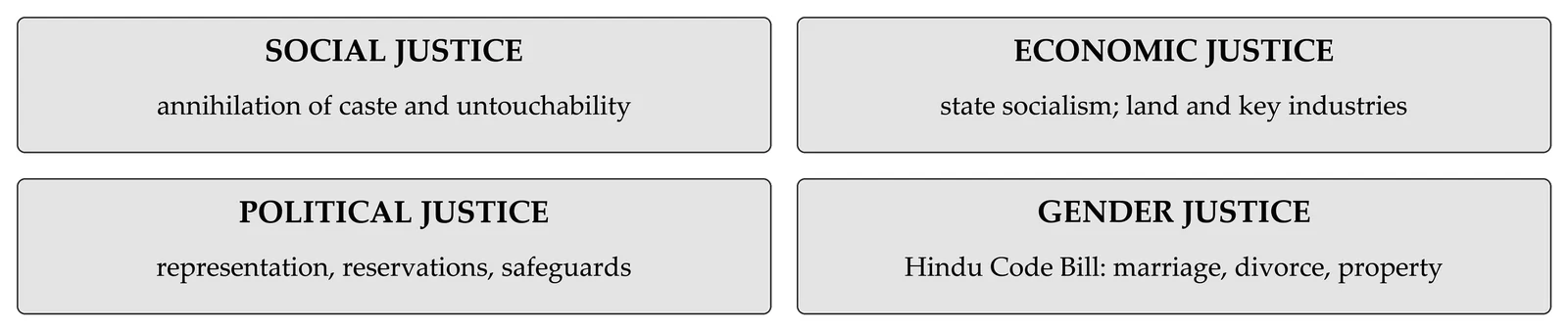
- Social justice. The end of caste hierarchy and untouchability, which he saw as the greatest injustice in Indian society.
- Economic justice. An end to exploitation of landless labourers and workers, through state ownership of key industries and land.
- Political justice. Equal political rights, representation and safeguards for the oppressed within constitutional democracy.
- Gender justice. Equal rights for women in marriage, divorce and inheritance, which he sought through the Hindu Code Bill.
- Dignity. Justice meant self-respect for the oppressed, who must educate, agitate and organise to claim their rights.
- Rational and moral. Justice must rest on reason and morality, not on religious scriptures that sanctify inequality.
Ambedkar’s Analysis of Caste
- Endogamy. In Castes in India (1916), he argued that the essence of caste is endogamy, marriage within the group, enforced through practices such as sati, enforced widowhood and child marriage, so caste and the subordination of women are linked.
- Division of labourers. In Annihilation of Caste, he argued that caste is not merely a division of labour but a division of labourers, fixed by birth rather than choice and graded one above the other.
- Graded inequality. Caste creates a hierarchy in which each caste looks down on those below and up to those above, so the oppressed cannot easily unite against oppression.
- Religious sanction. Caste is sanctified by the shastras, especially the Manusmriti, so it cannot be ended without rejecting their authority.
- Anti-social spirit. Caste destroys public spirit, public opinion and charity, making a nation impossible, since each caste cares only for itself.
- Origin of untouchability. In The Untouchables (1948), he suggested that untouchability arose from the contempt of Brahmins for Broken Men who remained Buddhists and ate beef.
Annihilation of Caste
In 1936, the Jat-Pat Todak Mandal of Lahore, a Hindu reform group, invited Ambedkar to preside over its conference. When it saw his speech, which attacked the Hindu scriptures, it cancelled the conference, and Ambedkar published the speech as Annihilation of Caste. He argued that social reform must come before political reform, that inter-dining was not enough and that the real remedy was inter-caste marriage, but that caste could not be destroyed without destroying the religious authority of the shastras. Gandhi replied in Harijan, defending varna while condemning untouchability, and Ambedkar answered him in a reply published with later editions.
5.3 Instruments of Justice: Democracy, Socialism, Safeguards and Buddhism
Constitutional Democracy and Social Democracy
Ambedkar defined democracy as a form and method of government whereby revolutionary changes in the economic and social life of the people are brought about without bloodshed. He believed that political democracy, i.e. one person one vote, must be supported by social democracy, a way of life recognising liberty, equality and fraternity. In his speech of 25 November 1949, he warned that in politics India would have equality while in social and economic life it would have inequality, a life of contradictions that must be resolved soon or those who suffered from inequality would blow up the structure of political democracy. He also stressed constitutional morality, i.e. respect for constitutional methods, which he said is not a natural sentiment but must be cultivated.
State Socialism
In States and Minorities (1947), a memorandum for the Constituent Assembly, Ambedkar proposed state socialism written into the Constitution: key industries and insurance would be owned by the state, agricultural land would be state-owned and cultivated collectively by villagers, and the state would supply capital and inputs. He believed that economic exploitation could not be ended by private enterprise and that political democracy needed an economic foundation. The Assembly did not adopt this scheme, but its spirit is reflected in the Directive Principles.
Safeguards and Constitutional Provisions
- Abolition of untouchability. Article 17 abolished untouchability and made its practice an offence.
- Equality and non-discrimination. Articles 14, 15 and 16 guarantee equality and permit special provisions for the backward classes.
- Reservations. Seats are reserved for Scheduled Castes and Scheduled Tribes in legislatures (Articles 330 and 332), and reservations are permitted in public employment and education.
- Protection from exploitation. Article 23 prohibits forced labour and Article 46 directs the state to promote the interests of weaker sections.
- Remedies. Article 32, which Ambedkar called the heart and soul of the Constitution, guarantees the right to approach the Supreme Court.
Conversion to Buddhism
At Yeola in 1935, Ambedkar declared that though he was born a Hindu, he would not die a Hindu. After studying many religions, he chose Buddhism and converted at Nagpur on 14 October 1956 with lakhs of followers. In The Buddha and His Dhamma, he presented a rational, ethical and socially engaged Buddhism, often called Navayana, which rejected caste, emphasised equality and compassion and saw religion as a source of morality and fraternity rather than ritual. Conversion was, for him, the final step in the search for justice and dignity.
Legacy and Debates
Ambedkar’s ideas have shaped Indian democracy, the Dalit movement and the politics of social justice, from the Republican Party of India to the Dalit Panthers (1972) and the Bahujan Samaj Party (1984). Scholars such as Eleanor Zelliot, Gail Omvedt in Dalits and the Democratic Revolution (1994), Christophe Jaffrelot in Dr Ambedkar and Untouchability (2005) and Aishwary Kumar in Radical Equality (2015) have studied his thought. Some critics argue that reservations alone cannot end caste and that his rejection of Hinduism limited his appeal, while admirers see him as the most original thinker of social justice in modern India.
5.4 Important Questions
- Question 1 Discuss Ambedkar’s idea of nyaya (justice).
- Question 2 Examine Ambedkar’s critique of the caste system in Annihilation of Caste.
- Question 3 Discuss Ambedkar’s views on democracy, constitutional morality and social democracy.
- Question 4 Compare the views of Gandhi and Ambedkar on caste and untouchability.
DU asks the same idea in different words. So learn one broad answer for each question below; the same answer works for every question joined by OR.
Important Question 1
Discuss Ambedkar’s idea of nyaya (justice).
OR
Examine Ambedkar’s conception of social justice.
OR
‘Liberty, equality and fraternity’ formed the core of Ambedkar’s social philosophy. Discuss.
Model Answer
“Political democracy cannot last unless there lies at the base of it social democracy.”
— B.R. Ambedkar, Constituent Assembly (25 November 1949)
Introduction. Nyaya, or justice, was the central concern of B.R. Ambedkar’s thought and life. Having experienced untouchability himself, he understood justice not merely as fair laws but as the real end of caste oppression, economic exploitation and gender inequality. His idea of justice rested on liberty, equality and fraternity, and he sought to realise it through constitutional democracy, state socialism, safeguards for the oppressed and a rational religion.
1. Meaning of Nyaya
Nyaya means justice. Amartya Sen distinguished niti, i.e. correct rules and institutions, from nyaya, i.e. justice as it is actually realised in people’s lives. Ambedkar’s concern was nyaya in this sense: whether the oppressed could actually live with equal dignity and opportunity, not merely whether laws were formally fair.
2. Experience of Injustice
Ambedkar’s idea of justice grew from his experience as a Mahar who faced humiliation in school, at work and in public places. This experience taught him that the deepest injustice in India was social, built into caste, and that political freedom from Britain would mean little if caste oppression continued.
3. Liberty, Equality and Fraternity
Ambedkar said that his social philosophy was enshrined in liberty, equality and fraternity, which he derived from the Buddha. He argued that the three must go together: liberty without equality produces domination by the few, equality without liberty kills initiative, and fraternity is needed to make both real.
4. Fraternity as the Key
Ambedkar gave special importance to fraternity, a sense of common brotherhood among all Indians. Caste destroyed fraternity by dividing society into closed, graded groups. Without fraternity, he warned, liberty and equality would be no deeper than coats of paint.
5. Social Justice
Social justice meant the annihilation of caste and untouchability. Ambedkar argued that caste is a division of labourers, not only of labour, based on birth and graded inequality, and sanctified by the shastras, so justice required rejecting their authority and promoting inter-caste marriage.
6. Economic Justice
Ambedkar believed that landless labourers and workers suffered both caste and class exploitation. In States and Minorities (1947), he proposed state socialism: state ownership of key industries, insurance and agricultural land, with collective farming, to prevent exploitation and give democracy an economic foundation.
7. Political Justice
Political justice meant equal political rights and effective representation for the oppressed. Ambedkar fought for separate electorates, accepted reserved seats in the Poona Pact of 1932 and ensured reservations in the Constitution, believing that the oppressed must share political power.
8. Gender Justice
Ambedkar linked caste with the control of women through endogamy and sought equal rights for women in marriage, divorce, maintenance and inheritance through the Hindu Code Bill. He resigned as Law Minister in 1951 when the bill was stalled, showing his commitment to gender justice.
9. Social Democracy
He argued that political democracy cannot last unless it rests on social democracy, a way of life based on liberty, equality and fraternity. India in 1950 was entering a life of contradictions, equal in politics but unequal in society and economy.
10. Constitutional Morality
Ambedkar believed that justice must be pursued through constitutional methods, not violence or civil disobedience after independence. Constitutional morality, respect for the Constitution’s values and procedures, must be cultivated in a society that was still essentially undemocratic.
11. Rights and Remedies
For Ambedkar, rights needed remedies, which is why he called Article 32 the heart and soul of the Constitution. Justice required institutions that the oppressed could actually use to claim their rights.
12. Religion and Justice
Ambedkar held that religion should be based on morality and reason, not on scriptures that sanctify inequality. His conversion to Buddhism in 1956 expressed his search for a religion of equality, compassion and fraternity.
13. Criticisms
Critics argue that state socialism was not adopted, that reservations benefited mainly a small section of Dalits and that his sharp critique of Hinduism limited his appeal among Hindus. Others note tensions between his liberal constitutionalism and his radical goals.
14. Evaluation
Ambedkar’s idea of nyaya was one of the most comprehensive theories of justice in modern India, combining social, economic, political and gender justice and insisting that justice be realised in the lives of the most oppressed.
Conclusion. Thus, Ambedkar’s nyaya rested on liberty, equality and fraternity and demanded social justice through the annihilation of caste, economic justice through state socialism, political justice through representation and safeguards, and gender justice through the Hindu Code Bill. Insisting that political democracy must rest on social democracy, he made justice the central aim of the Indian Constitution.
Important Question 2
Examine Ambedkar’s critique of the caste system in Annihilation of Caste.
OR
Why did Ambedkar call for the annihilation of caste? Discuss.
OR
Discuss Ambedkar’s analysis of the origin and nature of caste.
Model Answer
“Caste is not just a division of labour. It is also a division of labourers.”
— B.R. Ambedkar, Annihilation of Caste (1936)
Introduction. Annihilation of Caste (1936) is Ambedkar’s most famous critique of the caste system. Written as an address for the Jat-Pat Todak Mandal of Lahore, which cancelled the conference after reading it, the text argues that caste is an unjust, anti-social system sanctioned by Hindu scriptures, and that it cannot be reformed but must be destroyed. Together with his earlier work Castes in India (1916), it provides a powerful analysis of caste.
1. The Context
The Jat-Pat Todak Mandal, a Hindu reform organisation in Lahore, invited Ambedkar to preside over its annual conference in 1936. When the organisers saw that his speech attacked the Hindu scriptures, they asked him to delete parts. He refused, the conference was cancelled, and he published the speech himself.
2. Social Reform before Political Reform
Ambedkar criticised Indian nationalists for giving priority to political independence while neglecting social reform. He argued that political freedom would be meaningless for the untouchables if society remained divided into castes, and that social reform must come first.
3. Caste and Endogamy
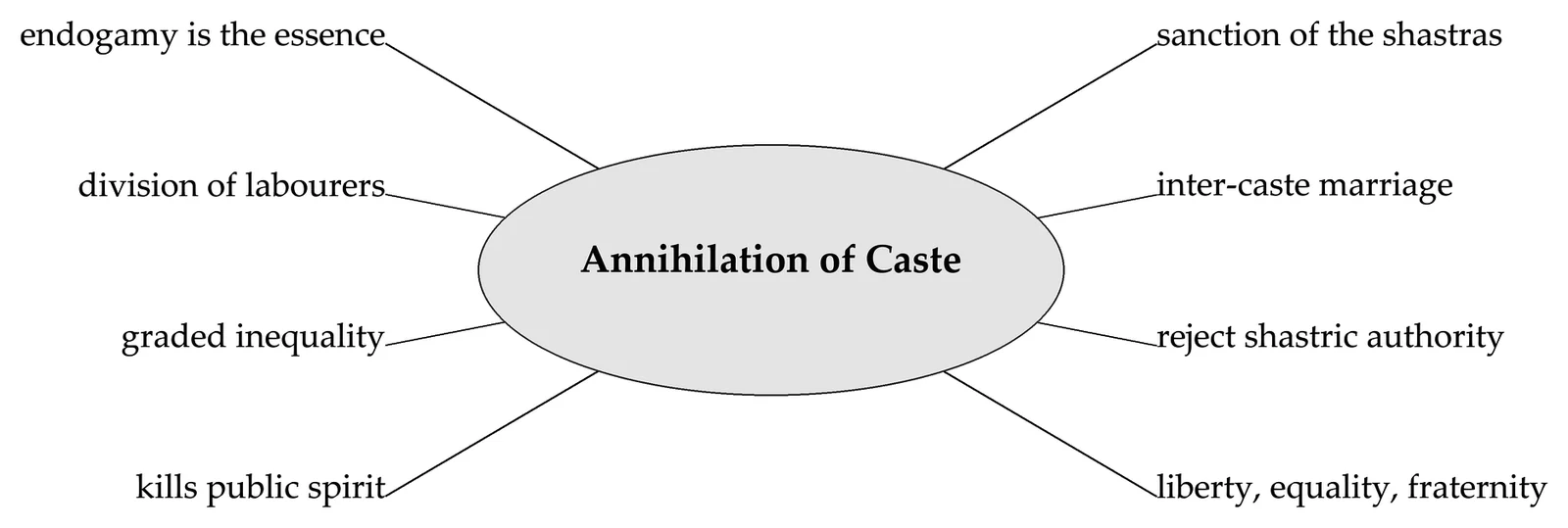
In Castes in India (1916), presented at Columbia University, Ambedkar argued that the essence of caste is endogamy, marriage within the group. To maintain endogamy, society imposed sati, enforced widowhood and child marriage, showing that caste depends on the control of women.
4. A Division of Labourers
Ambedkar rejected the defence of caste as a division of labour. Caste, he said, is a division of labourers, fixed by birth rather than choice or ability, and graded one above the other. It is therefore neither efficient nor just.
5. Graded Inequality
Caste creates graded inequality: each caste is superior to some and inferior to others, so each has something to protect. This prevents the oppressed castes from uniting against the system and makes caste very difficult to overthrow.
6. Caste and Hindu Society
Ambedkar argued that Hindu society is not a society but a collection of castes, each concerned only with itself. Caste destroyed public spirit, public opinion and charity, making it impossible to build a nation or a sense of common good.
7. Caste and Morality
Caste, Ambedkar said, has killed public spirit and made morality caste-bound: virtue and duty extend only to one’s own caste. A Hindu’s loyalty is to his caste, not to society or humanity.
8. Religious Sanction
Ambedkar argued that caste is sanctified by the shastras, especially the Manusmriti, and that Hindus observe caste because they believe it is religiously ordained. Therefore caste cannot be destroyed without destroying belief in the authority of the shastras.
9. The Remedy: Inter-Caste Marriage
Ambedkar argued that inter-dining was not enough; the real remedy was inter-caste marriage, since only the fusion of blood could create a feeling of kinship. But people would not inter-marry while they believed caste was sacred.
10. Rejecting the Shastras
He called on Hindus to reject the authority of the shastras and adopt a religion of principles based on liberty, equality and fraternity rather than a religion of rules that sanctified inequality.
11. Gandhi’s Response
Gandhi replied in Harijan in 1936, defending varna as a division of duties while condemning untouchability, and arguing that the shastras should be interpreted in the light of conscience. Ambedkar replied that Gandhi’s defence of varna kept the essence of caste intact.
12. Influence
Annihilation of Caste has become a foundational text of the Dalit movement and of anti-caste thought. It has been republished many times, including an annotated edition in 2014 with an introduction by Arundhati Roy, which provoked debate.
13. Criticisms
Critics argue that Ambedkar underestimated the possibility of reform within Hinduism and that his demand to reject the shastras was unrealistic for most Hindus. Others argue that caste has economic and political roots as well as religious ones.
14. Evaluation
Annihilation of Caste remains one of the most powerful critiques of social hierarchy ever written, showing that caste is not a harmless division of labour but a system of graded inequality that destroys fraternity and justice.
Conclusion. Thus, in Annihilation of Caste Ambedkar argued that caste, based on endogamy and graded inequality, is a division of labourers that destroys public spirit and morality. Since it is sanctified by the shastras, it can be ended only through inter-caste marriage and the rejection of their authority, a call that made the text a foundation of anti-caste thought.
Important Question 3
Discuss Ambedkar’s views on democracy, constitutional morality and social democracy.
OR
‘Political democracy cannot last unless there lies at the base of it social democracy.’ Discuss.
OR
Examine Ambedkar’s idea of constitutional morality.
Model Answer
“Constitutional morality is not a natural sentiment. It has to be cultivated.”
— B.R. Ambedkar, Constituent Assembly (4 November 1948)
Introduction. Ambedkar was a firm believer in democracy, but he understood it as much more than elections and majority rule. He saw democracy as a way of life based on liberty, equality and fraternity, a means of bringing about social and economic revolution without bloodshed. He warned that political democracy in India would not survive unless it was supported by social democracy and a culture of constitutional morality.
1. Definition of Democracy
Ambedkar defined democracy as a form and method of government whereby revolutionary changes in the economic and social life of the people are brought about without bloodshed. For him, the test of democracy was its ability to transform an unequal society peacefully.
2. Influence of John Dewey
At Columbia University, Ambedkar studied under John Dewey, who saw democracy as a mode of associated living and shared experience. This influenced Ambedkar’s view of democracy as a social way of life, not just a political system.
3. Political Democracy
Political democracy means equal political rights, universal adult franchise and responsible government. Ambedkar strongly supported universal adult franchise for India, rejecting arguments that the illiterate masses were not ready to vote.
4. Social Democracy
Social democracy is a way of life which recognises liberty, equality and fraternity as principles of life. Ambedkar argued that India lacked social democracy because caste denied equality and fraternity, and that political democracy without it would remain fragile.
5. A Life of Contradictions
In his speech of 25 November 1949, Ambedkar warned that on 26 January 1950, India would enter a life of contradictions: equality in politics but inequality in social and economic life. If this contradiction was not removed, those who suffered from inequality would blow up the structure of political democracy.
6. Economic Democracy
Ambedkar also stressed economic democracy, arguing that political rights mean little to those who are economically dependent. His proposal of state socialism and the Directive Principles reflect his concern for economic justice.
7. Constitutional Morality
Borrowing from the historian George Grote, Ambedkar described constitutional morality as paramount reverence for the forms of the Constitution, combined with freedom of criticism. He warned that it is not a natural sentiment but must be cultivated, since democracy in India was only a top-dressing on an undemocratic soil.
8. Holding Fast to Constitutional Methods
Ambedkar urged Indians to abandon methods such as civil disobedience, non-cooperation and satyagraha after independence, calling them the grammar of anarchy, since constitutional methods were now available for achieving social and economic objectives.
9. Against Hero-Worship
He warned against bhakti or hero-worship in politics, which he said is a sure road to degradation and eventual dictatorship. Citizens should not lay their liberties at the feet of even a great man.
10. Majority Rule and Minorities
Ambedkar feared that in India the majority was a communal majority, permanently fixed by birth, rather than a political majority formed by opinion. He therefore insisted on safeguards for minorities and the depressed classes.
11. Conditions for Successful Democracy
In a speech of 1952, Ambedkar listed conditions for democracy: no glaring inequalities, the presence of an opposition, equality before law, observance of constitutional morality, no tyranny of the majority, a functioning moral order and a public conscience.
12. Judicial Use of Constitutional Morality
The Supreme Court has used Ambedkar’s idea of constitutional morality in recent judgments, such as Navtej Singh Johar (2018) and the Sabarimala case (2018), contrasting it with popular or social morality.
13. Criticisms
Critics argue that constitutional morality can give judges too much discretion and that Ambedkar’s rejection of mass agitation after independence underestimated the role of protest in democracy. Others say his warnings remain unheeded in a society still marked by caste.
14. Evaluation
Ambedkar’s view of democracy as social democracy grounded in constitutional morality was deeply insightful, and his warnings about contradictions, hero-worship and majoritarianism remain relevant to Indian democracy today.
Conclusion. Thus, Ambedkar saw democracy as a way of bringing revolutionary change without bloodshed, resting on social democracy, i.e. liberty, equality and fraternity, and on constitutional morality that must be cultivated. His warnings about the life of contradictions, hero-worship and communal majorities make his ideas central to understanding the challenges of Indian democracy.
Important Question 4
Compare the views of Gandhi and Ambedkar on caste and untouchability.
OR
Discuss the Gandhi–Ambedkar debate on caste.
OR
Examine the Poona Pact and the differences between Gandhi and Ambedkar.
Model Answer
“Though I was born a Hindu, I solemnly assure you that I will not die as a Hindu.”
— B.R. Ambedkar, Yeola Conference (13 October 1935)
Introduction. Gandhi and Ambedkar were the two most important leaders who addressed caste and untouchability in modern India, but they approached the question very differently. Gandhi sought to reform Hinduism from within, removing untouchability while defending varna, while Ambedkar argued that caste was inherent in Hindu religion and must be annihilated. Their debate shaped Indian politics and the Constitution.
1. Shared Concern
Both condemned untouchability. Gandhi called it a sin and a blot on Hinduism and campaigned against it, while Ambedkar experienced it directly and devoted his life to ending it. Their disagreement was about its causes and remedies.
2. Gandhi on Varna
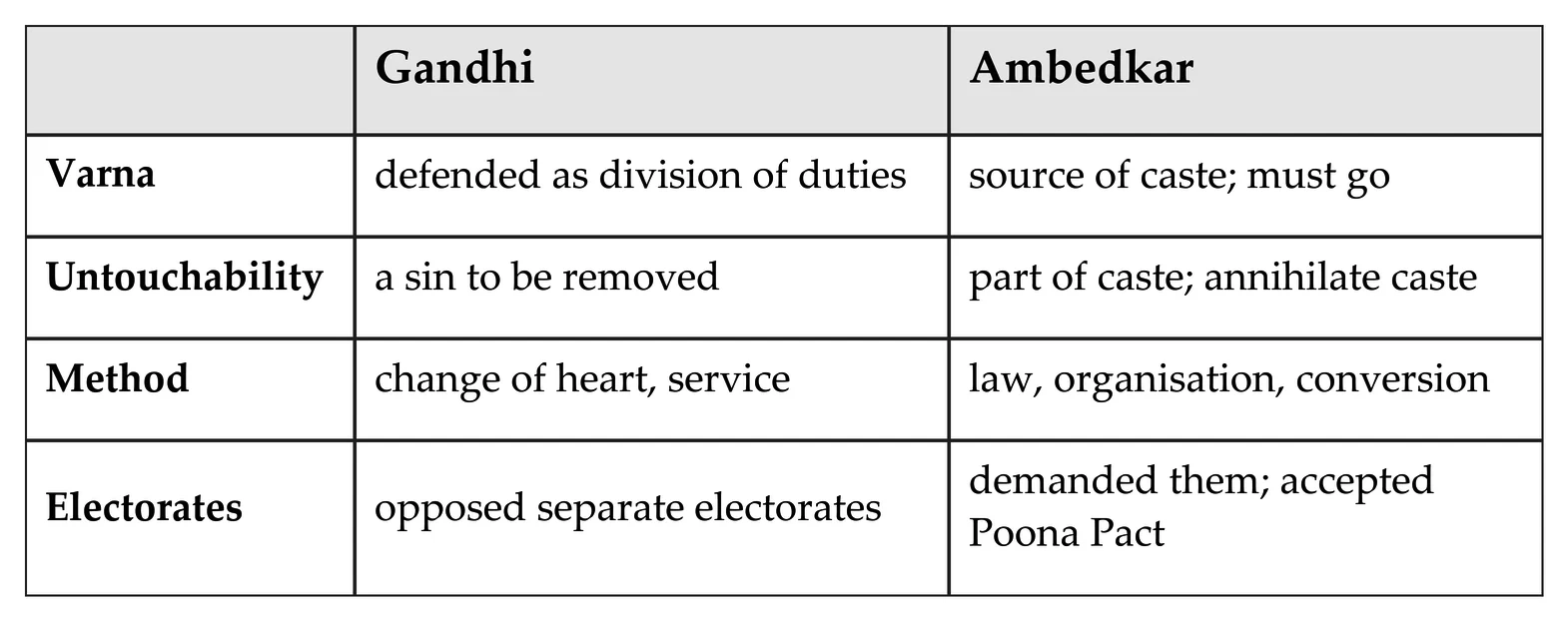
Gandhi distinguished varna from caste. He defended varna as a natural division of duties based on hereditary occupation, without superiority or inferiority, and believed that removing untouchability would purify Hinduism.
3. Ambedkar on Varna and Caste
Ambedkar argued that varna and caste were inseparable, that varna was the source of caste and that untouchability could not be removed without destroying caste itself. He rejected the idea of hereditary occupation as inconsistent with liberty.
4. Reform from Within or Rejection
Gandhi wanted Hindus to change their hearts through moral persuasion, temple entry and service. Ambedkar believed that caste was sanctified by the shastras and that Hindus would not give it up while they believed in their authority, so he called for rejecting the shastras.
5. Harijan and Depressed Classes
Gandhi called the untouchables Harijans, children of God, and founded the Harijan Sevak Sangh in 1932. Ambedkar rejected the term as patronising and preferred the oppressed to organise themselves rather than depend on upper-caste charity.
6. Separate Electorates
At the Round Table Conferences, Ambedkar demanded separate electorates for the depressed classes, which the Communal Award of 1932 granted. Gandhi opposed this, believing it would divide Hindu society, and began a fast unto death in Yerawada jail.
7. The Poona Pact (1932)
Under pressure from Gandhi’s fast, Ambedkar signed the Poona Pact in September 1932, giving up separate electorates in return for a larger number of reserved seats in joint electorates. Ambedkar later regarded the pact as coercion that deprived the depressed classes of independent representatives.
8. Annihilation of Caste Debate
In 1936, Gandhi replied to Annihilation of Caste in Harijan, defending varna and the shastras interpreted by conscience. Ambedkar replied that Gandhi’s position left the basis of caste untouched and that a reformed caste system was still a caste system.
9. Village and Individual
Gandhi idealised the village as the basis of swaraj, while Ambedkar saw it as a den of localism and caste oppression and insisted that the individual should be the unit of the Constitution.
10. Religion
Gandhi remained a devout Hindu who believed in reforming Hinduism. Ambedkar declared in 1935 that he would not die a Hindu, and converted to Buddhism in 1956, seeking a religion of equality.
11. Ambedkar’s Criticism of Congress
In What Congress and Gandhi Have Done to the Untouchables (1945), Ambedkar argued that the Congress and Gandhi had not genuinely represented the untouchables and that their reforms were limited and paternalistic.
12. Convergence in the Constitution
Despite their differences, the Constitution reflects both: it abolished untouchability (Article 17), provided reservations and safeguards demanded by Ambedkar, and placed village panchayats in the Directive Principles in deference to Gandhian ideals.
13. Later Interpretations
Scholars such as Eleanor Zelliot and Christophe Jaffrelot stress the depth of their disagreement, while others, such as Bhikhu Parekh, note that both sought a just and moral society by different routes.
14. Evaluation
The Gandhi–Ambedkar debate was between moral reform from within and radical structural change. Ambedkar’s analysis proved more penetrating about the roots of caste, while Gandhi’s campaigns helped change upper-caste attitudes.
Conclusion. Thus, Gandhi and Ambedkar both condemned untouchability but differed fundamentally: Gandhi defended varna and sought reform within Hinduism through moral persuasion, while Ambedkar saw caste as inseparable from the shastras and called for its annihilation. Their clash over separate electorates, the Poona Pact and religion shaped the politics of caste and the Constitution.
Short Notes
(a) Poona Pact (1932)
The agreement between Gandhi and Ambedkar, signed after Gandhi’s fast in Yerawada jail, that replaced separate electorates for the depressed classes with reserved seats in joint electorates.
(b) Graded inequality
Ambedkar’s term for the caste hierarchy in which each caste is superior to some and inferior to others, which prevents the oppressed castes from uniting.
(c) Navayana
The term often used for Ambedkar’s rational, ethical and socially engaged interpretation of Buddhism, set out in The Buddha and His Dhamma.
More notes: GE-1 Ideas in Indian Political Thought
These notes are prepared by PADHO TO AISE for study help. They are not an official publication.