
Generic Electives (GE) GE-10 Digital Social Sciences
Unit IV · 22 min read · Updated 27 Nov 2026
As per the University of Delhi (DU) Generic Elective (GE) syllabus offered by the Department of Political Science
Contents
- 4.1 The Mobile Revolution in India
- Jeffrey and Doron: Cell Phone Nation
- The Data Revolution
- Infrastructure and Policy
- 4.2 The Smartphone, Social Media and Everyday Life
- Agrawal: India Connected
- Narayanan and Narayan: Mapping New Media
- Venkatraman: Social Media and Education in South India
- Changing Everyday Life
- 4.3 The Digital Divide and Access as a Right
- Levels of the Digital Divide
- Dimensions of the Divide in India
- The Pandemic and the Divide
- Internet Access as a Right
- 4.4 Important Questions
- Discuss the mobile phone revolution in India and its impact on business, politics and everyday life.
- How is the smartphone transforming Indian democracy and society? Discuss with reference to Ravi Agrawal.
- What is the digital divide? Discuss its dimensions in India.
- Is access to the internet a right? Discuss with reference to internet shutdowns in India.
- Short Notes
इंटरनेट के माध्यम से वाक् और अभिव्यक्ति की स्वतंत्रता तथा कोई भी पेशा या व्यापार करने की स्वतंत्रता को अनुच्छेद 19(1)(क) और 19(1)(छ) के अंतर्गत संवैधानिक संरक्षण प्राप्त है।
The freedom of speech and expression and the freedom to practise any profession or carry on any trade, business or occupation over the medium of internet enjoys constitutional protection under Article 19(1)(a) and Article 19(1)(g).
— Supreme Court of India, Anuradha Bhasin v. Union of India (2020)
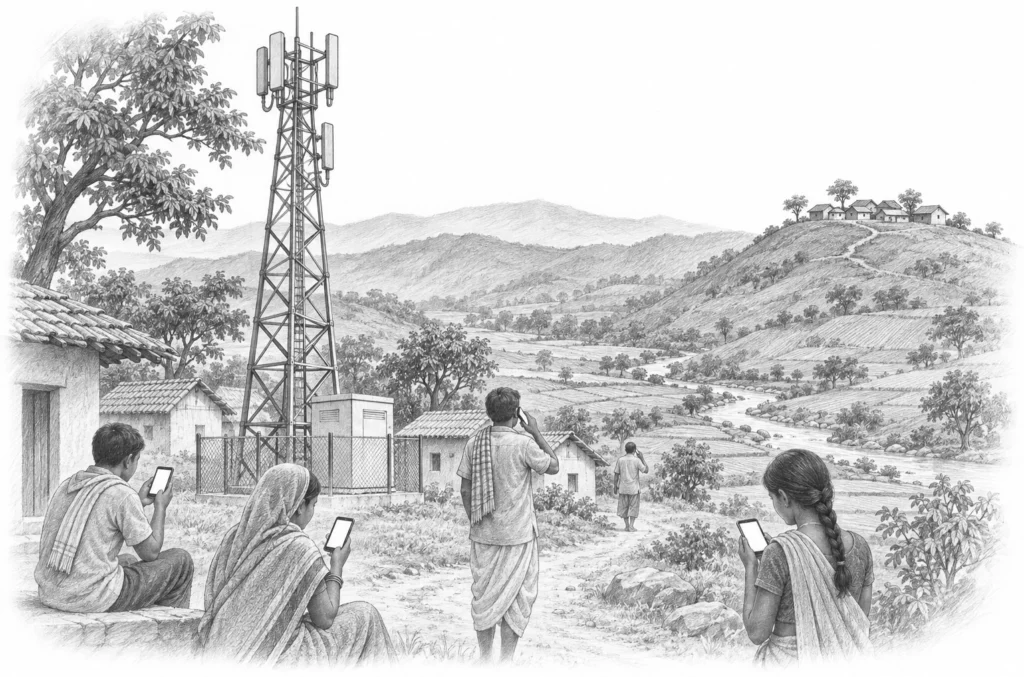
IIN the space of two decades, India went from a country where a telephone connection required years of waiting to one with hundreds of millions of smartphone users and some of the cheapest mobile data in the world. The mobile phone, and later the smartphone, changed business, politics, education, family life and love. Yet access remains deeply unequal, by region, class, caste, gender, language and age. This chapter examines the mobile revolution, how the smartphone is transforming Indian democracy and everyday life, the digital divide, and the debate on internet access as a right.

4.1 The Mobile Revolution in India
Until the 1990s, telephones in India were scarce, controlled by the state and available mainly to the urban elite. Liberalisation changed this. The National Telecom Policy of 1994 opened telecom to private companies; the first mobile phone call was made in Kolkata on 31 July 1995; and the Telecom Regulatory Authority of India (TRAI) was set up in 1997. Competition drove prices down, and from the mid-2000s cheap handsets and prepaid connections spread mobile phones to villages, workers and the poor. India became one of the largest mobile markets in the world.
Jeffrey and Doron: Cell Phone Nation
Robin Jeffrey and Assa Doron, in Cell Phone Nation (2013), describe how the mobile phone revolutionised business, politics and ordinary life in India. For business, phones allowed small traders, farmers, fishermen and artisans to find buyers and prices; the economist Robert Jensen (2007) showed that mobile phones reduced price variation for fishermen in Kerala. In politics, parties and movements used phones to mobilise supporters, send messages and organise, while governments used them to monitor. In ordinary life, phones changed relationships, allowing young people to communicate privately and women to keep in touch with natal families. At the same time, Jeffrey and Doron show that phones also became sites of control, as some caste councils tried to ban unmarried girls from using them, and that access was shaped by caste, class and gender.
The Data Revolution
The second phase of the revolution came with smartphones and cheap mobile data. The entry of Reliance Jio in September 2016 with free and then very cheap data forced competitors to cut prices, and India’s mobile data consumption rose to among the highest in the world. By 2024, TRAI reported over 90 crore internet subscribers, the vast majority accessing the internet through mobile phones. For most Indians, the smartphone, not the computer, is the gateway to the internet.
Infrastructure and Policy
- BharatNet. Begun as the National Optical Fibre Network in 2011, it aims to connect all gram panchayats with broadband.
- Digital India (2015) set goals of digital infrastructure as a utility, services on demand and digital empowerment.
- PM-WANI (2020) promotes public Wi-Fi through local providers.
- Common Service Centres provide digital services in villages through local entrepreneurs.
- Digital public infrastructure such as UPI made smartphones tools of payment for small vendors and households.
4.2 The Smartphone, Social Media and Everyday Life
Agrawal: India Connected
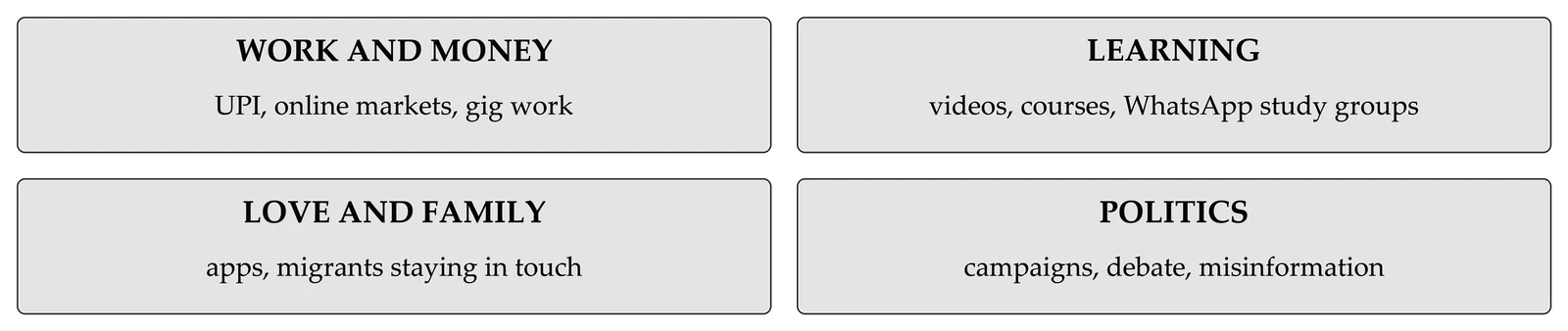
Ravi Agrawal, in India Connected: How the Smartphone is Transforming the World’s Largest Democracy (2018), argues that the smartphone is transforming almost every aspect of Indian life. It is changing how people work and earn, through digital payments, gig platforms and online marketplaces; how they learn, through videos and online courses; how they find love and marriage, through dating and matrimonial apps that challenge caste and family control; how they consume entertainment and news; and how they engage in politics, as parties use social media and messaging apps to reach voters. Agrawal also stresses the dark side: misinformation, online harassment of women, addiction and the concentration of power in platforms. For many, especially women and the rural poor, the smartphone is both a tool of empowerment and a site of new controls.
Narayanan and Narayan: Mapping New Media
Shalini Narayanan and Sunetra Sen Narayan, in India Connected: Mapping the Impact of New Media (2016), bring together studies of how new media are affecting Indian society, from political communication and activism to journalism, governance and culture. They show that new media do not simply replace old media, but interact with television, newspapers and face-to-face networks, and that their impact differs across social groups and regions.
Venkatraman: Social Media and Education in South India
Shriram Venkatraman, in Social Media in South India (2017), part of the global Why We Post project led by Daniel Miller, studied a semi-rural town in Tamil Nadu near the IT corridor of Chennai. In the chapter on education and the knowledge economy, he shows how families saw social media in contradictory ways: as a distraction that threatened students’ studies and morals, and as a gateway to the knowledge economy and IT jobs. Students used WhatsApp groups and YouTube to share notes, solve problems and learn English and computer skills, while parents and teachers tried to regulate their use. His ethnography shows that the meaning of social media is shaped by local aspirations, family structures, caste and class.
Changing Everyday Life
Across India, smartphones have changed how families stay in touch with migrant members, how farmers check weather and prices, how small vendors accept payments through UPI, how students learn and how citizens access government services. But they have also brought new concerns: screen addiction, exposure to fraud and misinformation, and online violence. The impact of technology thus depends on social context, skills and power.
4.3 The Digital Divide and Access as a Right
Levels of the Digital Divide
The digital divide refers to inequalities in access to and use of digital technologies. Scholars distinguish three levels. The first-level divide is about access: who has devices and connectivity. The second-level divide, highlighted by Eszter Hargittai (2002), is about skills and uses: even among those with access, people differ in what they can do online. The third-level divide is about outcomes: who actually benefits from internet use in terms of income, education, health and participation.
Dimensions of the Divide in India
- Rural and urban. Internet use and broadband are far higher in cities than in villages, and many remote areas lack reliable connectivity.
- Gender. According to the National Family Health Survey 2019–21, only about one-third of women aged 15–49 had ever used the internet, compared with more than half of men; women are also less likely to own a phone.
- Class and caste. Poorer households, and many Dalit and Adivasi households, have less access to devices, data and digital skills.
- Language. Much online content is in English, disadvantaging those who use Indian languages.
- Age and disability. Older people and persons with disabilities face barriers in using digital services.
- Region. States in the north-east and parts of central India have weaker connectivity than southern and western states.
The Pandemic and the Divide
The Covid-19 pandemic exposed the divide sharply. When schools closed, millions of children without smartphones or data could not attend online classes, and surveys such as ASER found large learning losses. Registration for vaccines through the CoWIN portal initially disadvantaged those without smartphones or digital skills, until walk-in registration was allowed. Welfare and services moving online can exclude those on the wrong side of the divide.
Internet Access as a Right
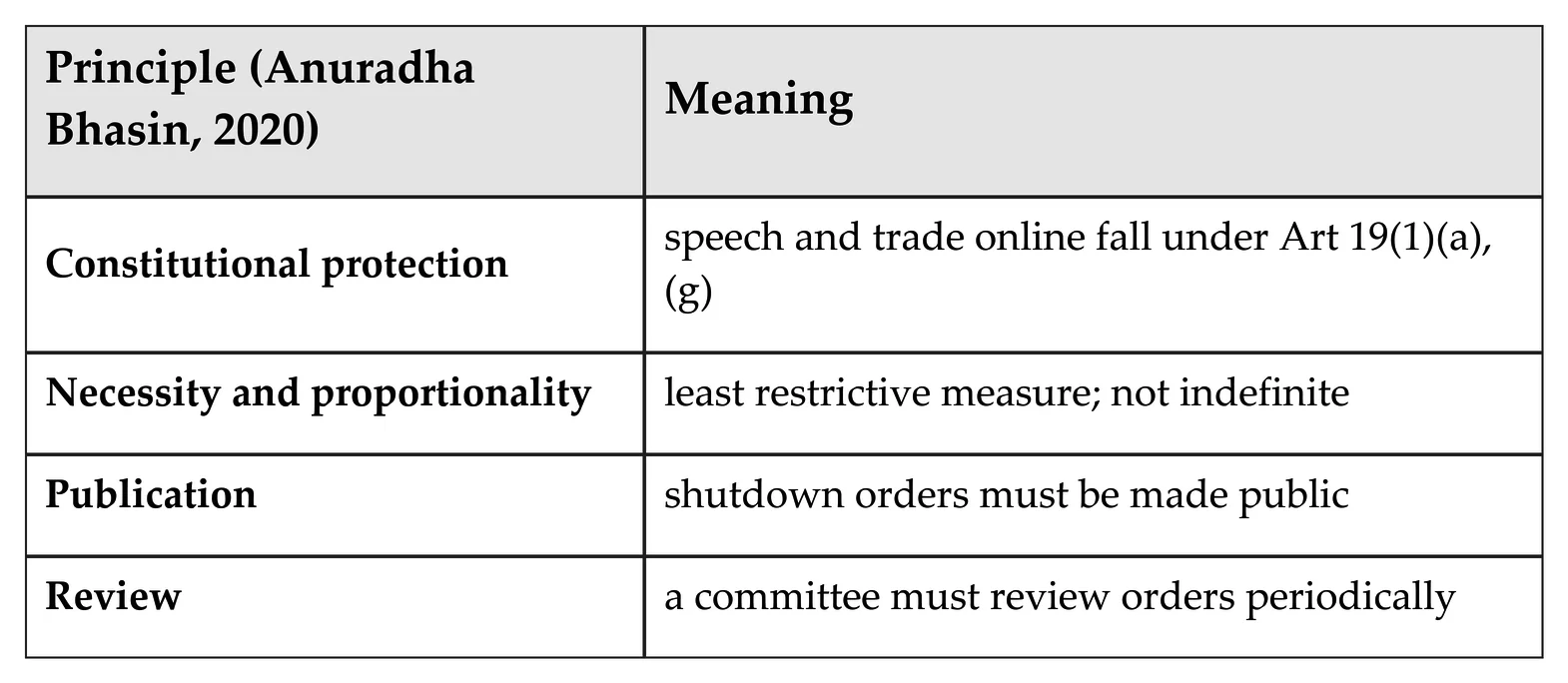
Courts have increasingly recognised the importance of internet access. In Faheema Shirin v. State of Kerala (2019), the Kerala High Court held that the right to access the internet is part of the right to education and the right to privacy under Article 21. In Anuradha Bhasin v. Union of India (2020), concerning the shutdown in Jammu and Kashmir after August 2019, the Supreme Court held that freedom of speech and the freedom to carry on trade over the internet are protected under Articles 19(1)(a) and 19(1)(g), and that internet shutdowns must be necessary, proportionate, temporary and subject to review, with orders published. The UN Human Rights Council has affirmed that the same rights people have offline must also be protected online. Yet India has recorded more internet shutdowns than any other country in several years, according to digital rights groups. Kerala launched the K-FON project to provide free internet to poor households, treating access as a basic right.

4.4 Important Questions
- Question 1 Discuss the mobile phone revolution in India and its impact on business, politics and everyday life.
- Question 2 How is the smartphone transforming Indian democracy and society? Discuss with reference to Ravi Agrawal.
- Question 3 What is the digital divide? Discuss its dimensions in India.
- Question 4 Is access to the internet a right? Discuss with reference to internet shutdowns in India.
DU asks the same idea in different words. So learn one broad answer for each question below; the same answer works for every question joined by OR.
Important Question 1
Discuss the mobile phone revolution in India and its impact on business, politics and everyday life.
OR
Examine Jeffrey and Doron’s analysis in Cell Phone Nation.
OR
How has the mobile phone transformed Indian society? Discuss.
Model Answer
“The new electronic interdependence recreates the world in the image of a global village.”
— Marshall McLuhan, The Gutenberg Galaxy (1962)
Introduction. The mobile phone is perhaps the most rapidly adopted technology in Indian history. From a scarce, state-controlled service, telephony became, within two decades, a part of the lives of hundreds of millions. Robin Jeffrey and Assa Doron show how the cell phone revolutionised business, politics and ordinary life, while also becoming a site of new controls.
1. Before the Revolution
Until the 1990s, telephones were scarce in India, controlled by the state, and connections often required years of waiting, limiting them to the urban elite.
2. Liberalisation of Telecom
The National Telecom Policy of 1994 opened telecom to private companies, the first mobile call was made in Kolkata in 1995, and TRAI was set up in 1997.
3. Spread to the Poor
Competition, cheap handsets and prepaid connections spread mobile phones to villages, workers and the poor from the mid-2000s.
4. Cell Phone Nation
Jeffrey and Doron show in Cell Phone Nation (2013) how the mobile phone transformed business, politics and everyday life across India.
5. Business and Markets
Phones allowed small traders, farmers and artisans to find buyers and prices, reducing the power of middlemen and improving market efficiency.
6. The Kerala Fishermen
Robert Jensen’s study (2007) showed that mobile phones helped Kerala fishermen choose markets, reducing price variation and waste and raising welfare.
7. Politics
Parties and movements used phones to mobilise supporters, send messages and organise, while governments used them to communicate and monitor.
8. Ordinary Life
Phones changed relationships, allowing young people private communication, migrants to stay in touch with families and women to keep links with natal homes.
9. Control and Resistance
Some caste councils tried to ban unmarried girls from using phones, showing that the phone threatened traditional control and was also policed.
10. Caste, Class and Gender
Jeffrey and Doron show that access and use were shaped by caste, class and gender, so the revolution did not benefit everyone equally.
11. The Data Revolution
Smartphones and cheap data, especially after Jio’s entry in 2016, made the internet accessible to hundreds of millions through their phones.
12. Digital Payments
UPI, launched in 2016, turned phones into tools of payment for vendors and households, making India a world leader in digital transactions.
13. Services and Welfare
Phones became gateways to government services, banking and welfare, as SMS alerts and apps linked citizens with the state.
14. A Global Village
McLuhan’s idea of a global village captures how phones connect people across distances, linking villages to cities and the world.
15. New Problems
Mobile phones also brought fraud, misinformation, harassment and surveillance, showing that technology’s effects are mixed.
16. Mobile Phones and Migrants
For India’s millions of internal migrants, mobile phones made it possible to stay in daily contact with families, send money home through mobile banking and find work through contacts, changing the experience of migration.
17. Mobile Phones and Women
For many women, a mobile phone offered a private channel of communication and a measure of independence, but families often controlled who could own a phone and how it was used, showing that technology enters existing gender relations.
18. Evaluation
The mobile revolution transformed Indian society in profound ways, but its benefits depend on access, skills and social context.
Conclusion. Thus, the mobile phone, spreading after telecom liberalisation, transformed business, politics and everyday life in India, as Jeffrey and Doron show, creating something like McLuhan’s global village. Yet caste, class and gender shaped who benefited, and new forms of control and harm accompanied the revolution.
Important Question 2
How is the smartphone transforming Indian democracy and society? Discuss with reference to Ravi Agrawal.
OR
Discuss the role of social media in education and aspirations in India with reference to Venkatraman.
OR
Examine the impact of new media on Indian society.
Model Answer
“Every once in a while, a revolutionary product comes along that changes everything.”
— Steve Jobs, introducing the iPhone (2007)
Introduction. The smartphone has become the main gateway to the internet for most Indians. Ravi Agrawal argues that it is transforming work, learning, love, entertainment and politics in the world’s largest democracy. Studies by Narayanan and Narayan and by Shriram Venkatraman show how its impact depends on local contexts, aspirations and social structures.
1. The Smartphone as Gateway
For most Indians, the smartphone, not the computer, is the gateway to the internet, made affordable by cheap handsets and mobile data.
2. Agrawal’s Argument
In India Connected (2018), Agrawal argues that the smartphone is transforming almost every aspect of Indian life and democracy.
3. Work and Money
Smartphones enable digital payments, online marketplaces and gig work, changing how people earn, buy and sell.
4. Learning
Videos, online courses and messaging groups allow people to learn new skills, from English and coding to farming techniques.
5. Love and Marriage
Dating and matrimonial apps give young people new ways to meet partners, sometimes challenging caste and family control over marriage.
6. Entertainment and News
Streaming, short videos and social media have changed how Indians consume entertainment and news, often in Indian languages.
7. Politics
Parties use social media and messaging apps to reach voters, and citizens use them to express views, organise and criticise power.
8. The Dark Side
Agrawal stresses misinformation, online harassment of women, addiction and the concentration of power in a few platforms.
9. Mapping New Media
Narayanan and Narayan show that new media interact with older media and face-to-face networks, and their impact differs across groups and regions.
10. Venkatraman’s Study
Venkatraman studied social media use in a semi-rural Tamil Nadu town near Chennai’s IT corridor, as part of the Why We Post project.
11. Distraction or Opportunity
Families saw social media both as a distraction that threatened studies and morals and as a gateway to the knowledge economy and IT jobs.
12. Learning through WhatsApp
Students used WhatsApp groups and YouTube to share notes, solve problems and learn English and computer skills.
13. Regulation by Families
Parents and teachers tried to regulate students’ use of social media, showing how technology is shaped by family structures and values.
14. Local Meanings
Venkatraman’s ethnography shows that the meaning of social media depends on local aspirations, caste, class and gender, not on technology alone.
15. Democracy
The smartphone has widened participation in public debate but has also made democracy vulnerable to manipulation and polarisation.
16. Regional Language Internet
Most new Indian internet users prefer content in Indian languages, and platforms offering video and voice in regional languages have grown rapidly, making the internet more accessible to those not literate in English.
17. Smartphones and Gig Work
Smartphones made possible the gig economy of ride-hailing, delivery and home services, giving millions of young people work, though often on insecure terms, as discussed in the chapter on labour in the digital economy.
18. Evaluation
The smartphone is a powerful force for change in India, but its effects are mixed and shaped by social context and inequality.
Conclusion. Thus, Agrawal shows that the smartphone is transforming work, learning, love, entertainment and politics in India, a revolutionary product that changes everything. Narayanan and Narayan and Venkatraman show that its impact depends on local contexts, as families see it as both distraction and opportunity.
Important Question 3
What is the digital divide? Discuss its dimensions in India.
OR
Distinguish between first-level, second-level and third-level digital divides.
OR
Examine the gender digital divide in India.
Model Answer
“The right to have access to Internet becomes the part of right to education as well as right to privacy under Article 21 of the Constitution of India.”
— Kerala High Court, Faheema Shirin R.K. v. State of Kerala (2019)
Introduction. Although internet access has spread rapidly in India, it remains deeply unequal. The digital divide, the gap between those who can access and benefit from digital technologies and those who cannot, follows lines of region, gender, class, caste, language, age and disability. As services move online, the divide can deepen existing inequalities.
1. Meaning
The digital divide refers to inequalities in access to, use of and benefits from digital technologies such as computers, smartphones and the internet.
2. First-Level Divide
The first-level divide concerns access: who has devices, connectivity and affordable data, and who does not.
3. Second-Level Divide
Eszter Hargittai highlighted the second-level divide in skills and uses, since people with access differ in what they can do online.
4. Third-Level Divide
The third-level divide concerns outcomes: who actually benefits from internet use in terms of income, education, health and participation.
5. Rural and Urban
Internet use and broadband are far higher in cities than in villages, and many remote areas lack reliable connectivity.
6. Gender
NFHS-5 (2019–21) found that only about one-third of women aged 15–49 had ever used the internet, compared with more than half of men.
7. Causes of the Gender Gap
Women are less likely to own phones, face family restrictions on use, have less time and fear harassment online.
8. Class and Caste
Poorer households and many Dalit and Adivasi households have less access to devices, data and digital skills.
9. Language
Much online content is in English, disadvantaging speakers of Indian languages, though content in Indian languages is growing rapidly.
10. Age and Disability
Older people and persons with disabilities face barriers in using digital services, especially when interfaces are not accessible.
11. The Pandemic
During Covid-19, millions of children without devices or data could not attend online classes, and surveys found large learning losses.
12. Exclusion from Services
As welfare, banking and government services move online, those on the wrong side of the divide risk exclusion, as early CoWIN registration showed.
13. Policy Responses
BharatNet, Digital India, PM-WANI, Common Service Centres and PMGDISHA aim to widen access and skills, with mixed results.
14. Access as a Right
The Kerala High Court held in Faheema Shirin (2019) that internet access is part of the rights to education and privacy under Article 21.
15. Kerala’s K-FON
Kerala’s K-FON project aims to provide free internet to poor households, treating connectivity as a basic right.
16. Device Sharing
In many poor households a single phone is shared among family members, with men and boys usually having priority. Studies of device sharing show that access figures can overstate women’s and girls’ real ability to use the internet.
17. Affordability
Although data prices fell sharply after 2016, the cost of smartphones and data packs remains a significant share of income for the poorest households, so affordability is still a barrier to meaningful access.
18. Evaluation
Bridging the digital divide requires not only connectivity but also skills, affordable devices, content in Indian languages and attention to gender and social inequality.
Conclusion. Thus, the digital divide in India operates at the levels of access, skills and outcomes, and along lines of region, gender, class, caste, language and age. As the Kerala High Court recognised, internet access is now part of the right to education and privacy, so bridging the divide is a matter of rights and justice.
Important Question 4
Is access to the internet a right? Discuss with reference to internet shutdowns in India.
OR
Examine the Supreme Court’s judgment in Anuradha Bhasin v. Union of India.
OR
Discuss the impact of internet shutdowns on rights and livelihoods.
Model Answer
“The same rights that people have offline must also be protected online, in particular freedom of expression.”
— UN Human Rights Council, Resolution 32/13 (2016)
Introduction. As life moves online, access to the internet has become essential for expression, education, livelihoods and access to services. Courts and international bodies have increasingly recognised its importance. At the same time, India has frequently shut down the internet in particular regions, raising questions about the balance between security and rights.
1. The Internet and Rights
The internet is now a primary medium for speech, information, education, work and access to government services, making access closely linked to basic rights.
2. International Recognition
The UN Human Rights Council affirmed in 2016 that the same rights people have offline must also be protected online, in particular freedom of expression.
3. Faheema Shirin
The Kerala High Court held in 2019 that a student’s right to access the internet in a hostel was part of her rights to education and privacy under Article 21.
4. Internet Shutdowns
Governments shut down mobile or all internet services in regions during protests, exams or conflicts, citing public order and security.
5. Frequency in India
Digital rights groups report that India recorded more internet shutdowns than any other country in several recent years.
6. Jammu and Kashmir
After the change in the status of Jammu and Kashmir in August 2019, internet services were suspended for months, one of the longest shutdowns in a democracy.
7. Anuradha Bhasin
In Anuradha Bhasin (2020), the Supreme Court held that speech and trade over the internet are protected under Articles 19(1)(a) and 19(1)(g).
8. Proportionality
The Court held that shutdowns must be necessary and proportionate, using the least restrictive measure, and cannot be indefinite.
9. Publication and Review
It required shutdown orders to be published and periodically reviewed by a committee, so that they can be challenged.
10. Legal Framework
Shutdowns are ordered under the Telecom Suspension Rules of 2017, and now the Telecommunications Act, 2023, which allows suspension in emergencies and for public safety.
11. Impact on Livelihoods
Shutdowns disrupt businesses, digital payments, education and health services, causing large economic losses, especially for small enterprises.
12. Impact on Expression
Shutdowns prevent journalists from reporting and citizens from communicating, which critics argue harms democracy precisely when information is most needed.
13. The Security Argument
Governments argue that shutdowns prevent the spread of rumours and violence during unrest, protecting public order and lives.
14. Alternatives
Critics suggest targeted measures, such as action against specific harmful content, rather than blanket shutdowns that affect everyone.
15. A Positive Right
Some argue that access should be a positive right, requiring the state to provide affordable connectivity, as Kerala’s K-FON project attempts.
16. Shutdowns and Examinations
Several states have suspended mobile internet during recruitment and school examinations to prevent cheating, affecting millions of people. Critics argue that such blanket shutdowns are disproportionate when narrower measures are available.
17. Net Neutrality
In 2016, TRAI prohibited discriminatory tariffs for data services, rejecting zero-rating plans such as Facebook’s Free Basics, and in 2018 India adopted strong net neutrality rules, protecting equal access to all online content.
18. Evaluation
Internet access is increasingly recognised as essential to the exercise of rights, so restrictions must be necessary, proportionate and accountable.
Conclusion. Thus, courts in Faheema Shirin and Anuradha Bhasin have recognised that rights exercised through the internet enjoy constitutional protection, and the UN affirms that rights offline must be protected online. Frequent shutdowns in India show the need to ensure that restrictions are necessary, proportionate and reviewed.
Short Notes
(a) Second-level digital divide
Eszter Hargittai’s term for differences in skills and uses of the internet among people who already have access to it.
(b) BharatNet
A project begun in 2011 as the National Optical Fibre Network to provide broadband connectivity to all gram panchayats in India.
(c) Anuradha Bhasin case
The Supreme Court’s 2020 judgment holding that speech and trade over the internet are constitutionally protected and that shutdowns must be necessary, proportionate and reviewed.
(d) Net neutrality
The principle that internet service providers must treat all online content equally, without blocking, slowing or charging differently for particular websites or services; India adopted strong net neutrality rules in 2018 after rejecting zero-rating plans in 2016.
More notes: GE-10 Digital Social Sciences
These notes are prepared by PADHO TO AISE for study help. They are not an official publication.