
Generic Electives (GE) GE-1 Ideas in Indian Political Thought
Unit III · 25 min read · Updated 27 Nov 2026
As per the University of Delhi (DU) Generic Elective (GE) syllabus offered by the Department of Political Science
Contents
- 3.1 Vivekananda: Life and Context
- The Context of His Thought
- Influences on Vivekananda
- 3.2 Culture: Practical Vedanta, Religion and Society
- Practical Vedanta
- Features of Vivekananda’s Cultural Thought
- Critique of Caste and Untouchability
- East and West
- Vivekananda on Women
- 3.3 Nationalism: The Spiritual Nation and the Masses
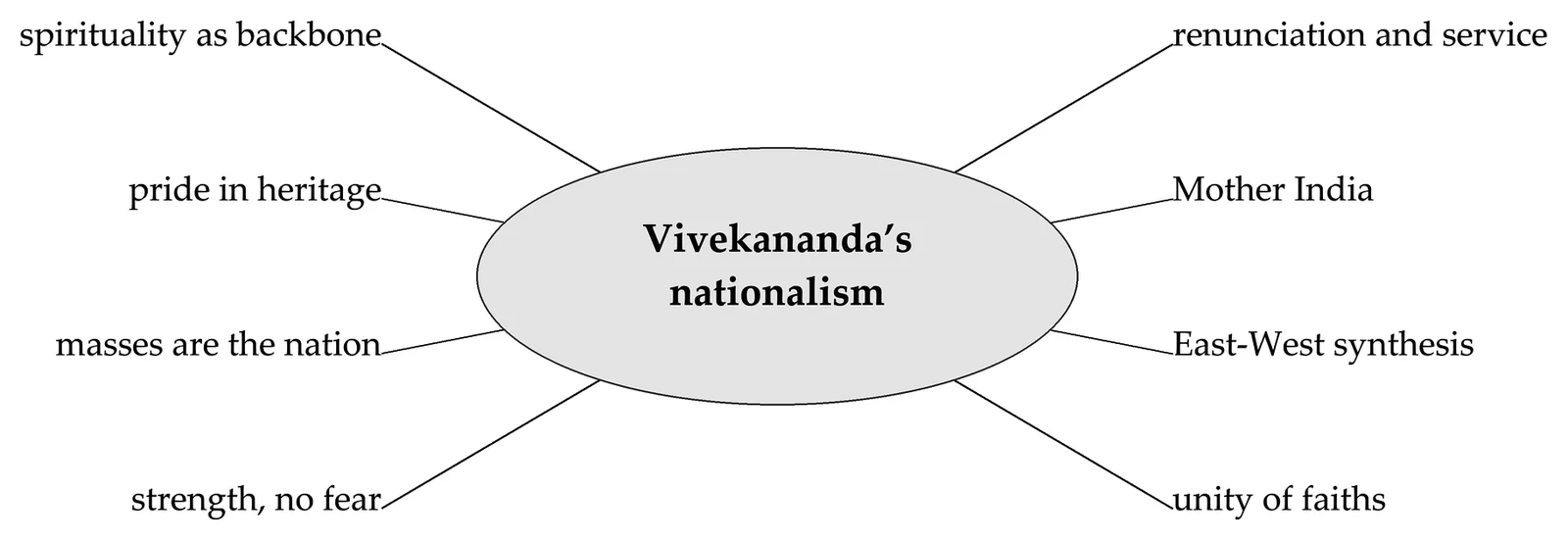
- Features of Vivekananda’s Nationalism
- Influence on the National Movement
- Debates on Vivekananda’s Nationalism
- Vivekananda’s Idea of History
- 3.4 Important Questions
- Discuss Vivekananda’s ideas on culture and nationalism.
- Discuss Vivekananda’s Practical Vedanta and its social message.
- Examine Vivekananda’s views on caste, the masses and social reform.
- Assess Vivekananda’s contribution to Indian nationalism.
- Short Notes
उठो, जागो और तब तक मत रुको जब तक लक्ष्य प्राप्त न हो जाए।
Arise, awake, and stop not till the goal is reached.
— Swami Vivekananda, Lectures of the 1890s, drawing on the Katha Upanishad
SSWAMI VIVEKANANDA (1863–1902) was a monk, a teacher of Vedanta and one of the most powerful voices of India’s cultural awakening in the nineteenth century. He was not a politician and never joined the Congress, yet his call to Indians to recover their self-confidence, serve the poor and build national strength inspired generations of nationalists. This chapter studies his life and context, his ideas on culture, especially Practical Vedanta, religion and the relationship between East and West, and his idea of nationalism, which grounded the nation in spiritual culture and in the uplift of the masses.

3.1 Vivekananda: Life and Context
Narendranath Datta was born into an educated Calcutta family and studied Western philosophy at the Scottish Church College. He was drawn to the Brahmo Samaj but searched for direct religious experience, and in 1881 he met the mystic Ramakrishna Paramahamsa, who became his guru. After Ramakrishna’s death in 1886, Narendranath and his fellow disciples formed a monastic order. From 1888 to 1893 he travelled across India as a wandering monk, seeing at first hand the poverty and degradation of the masses; at Kanyakumari in December 1892, he resolved to work for their uplift.
In 1893 he went to the United States and spoke at the World’s Parliament of Religions in Chicago, beginning with the words Sisters and Brothers of America and presenting Hinduism as a universal, tolerant religion. He lectured in America and England, returned to India in 1897 to a hero’s welcome and delivered the lectures later published as Lectures from Colombo to Almora. He founded the Ramakrishna Mission in 1897, combining spiritual practice with social service, and the Belur Math near Calcutta in 1898. He died on 4 July 1902, aged thirty-nine.
The Context of His Thought
- Colonial contempt. British officials and missionaries described Indian civilisation as backward and Hinduism as superstitious, which damaged Indians’ self-respect.
- Reform and revival. The Brahmo Samaj, the Arya Samaj and the Theosophical Society were offering different responses to Western criticism.
- Mass poverty. Famines, deindustrialisation and caste oppression left the majority of Indians in deep poverty and ignorance.
- The rise of nationalism. The Indian National Congress (1885) was an organisation of the educated elite, with little contact with the masses.
Vivekananda responded to this context by combining pride in India’s spiritual heritage with a sharp criticism of its social evils and an urgent call to serve the poor.
Influences on Vivekananda
- Ramakrishna Paramahamsa. His guru taught that all religions are true paths to God and that God should be served in human beings, the basis of Practical Vedanta.
- Western philosophy. At college he read Herbert Spencer, John Stuart Mill and other Western thinkers, which gave him a rational approach to religion.
- The Brahmo Samaj. His early link with the Brahmo Samaj exposed him to religious reform and monotheism.
- Advaita Vedanta. Shankaracharya’s non-dualism provided the philosophical foundation of his thought.
- His travels. His wanderings across India from 1888 to 1893 showed him the poverty of the masses and shaped his social concern.
3.2 Culture: Practical Vedanta, Religion and Society
Practical Vedanta
Vivekananda’s thought rested on Advaita Vedanta, the philosophy of non-dualism, which holds that the ultimate reality, Brahman, is present in every being. He turned this into a Practical Vedanta, arguing that if God is present in every person, then serving human beings, especially the poor, the sick and the ignorant, is the highest form of worship. He spoke of Daridra Narayana, God in the form of the poor, and taught that the service of man is the service of God (jiva is Shiva).
Features of Vivekananda’s Cultural Thought
- Divinity of the individual. Every person is potentially divine, so the aim of life is to manifest this divinity through work, worship, knowledge or psychic control, the paths described in his Karma Yoga and Raja Yoga (1896).
- Universal religion. All religions are paths to the same truth; at Chicago he spoke of a religion of tolerance and universal acceptance.
- Strength and fearlessness. He told Indians that weakness was the cause of their misery, that strength is life and weakness is death, and that they must build strong bodies and minds.
- Education. He defined education as the manifestation of the perfection already in man, and called for education that builds character, self-reliance and practical skills, reaching the masses and women.
- Critique of priestcraft and superstition. He attacked empty rituals, priestly domination and the reduction of religion to rules of touch and food.
- Women’s uplift. He said a nation that does not respect its women cannot progress, and inspired Sister Nivedita (Margaret Noble) to start a school for girls in Calcutta in 1898.
- Synthesis of East and West. India should keep its spiritual heritage while learning science, organisation and practical energy from the West.

Critique of Caste and Untouchability
Vivekananda was one of the strongest critics of untouchability among religious leaders of his time. He mocked the religion of don’t-touchism, saying that Indian religion had been reduced to the kitchen and the cooking pot. He held that the original idea of varna was based on qualities and that caste as a hereditary system of privilege had degenerated into oppression. He looked forward to a time when the Shudras, the labouring masses, would rise, and called on the upper castes to raise the lower castes through education rather than pull anyone down. Critics note that he did not reject varna completely, but his condemnation of untouchability and his call to serve the poor were radical in his time.
East and West
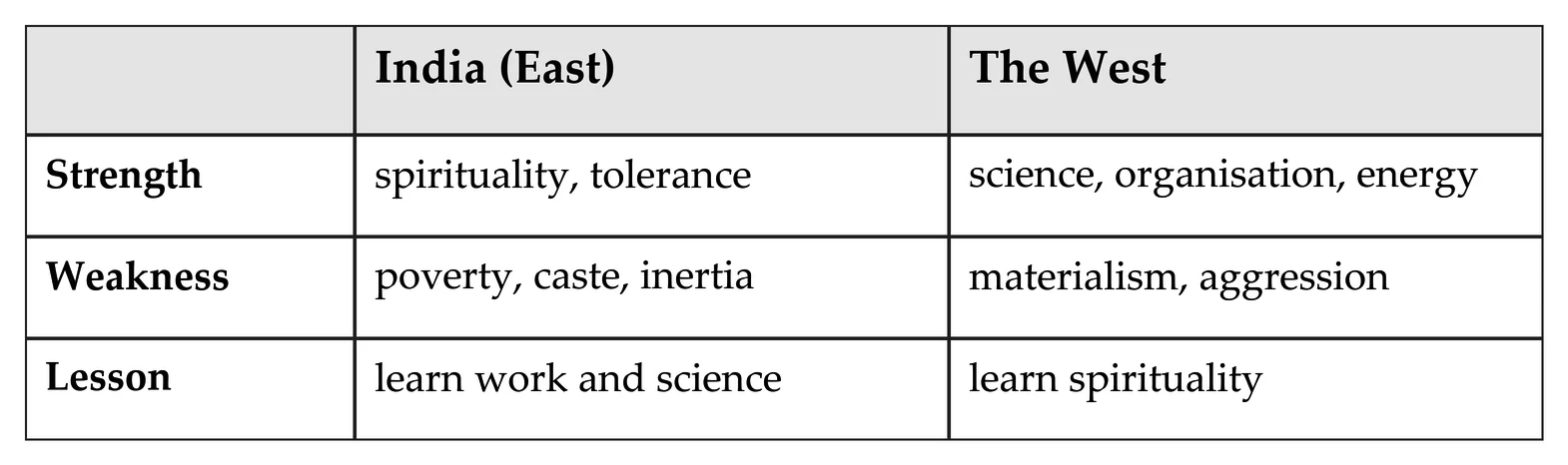
In essays such as The East and the West (1900) and lectures in the West, Vivekananda contrasted India’s spiritual strength with the West’s material and organisational power. He admired Western energy, science, discipline and the freedom of women, but criticised its materialism and aggression. India, he argued, needed to learn from the West how to organise, work hard and use science, while the West needed India’s spirituality. Tapan Raychaudhuri, in Europe Reconsidered (1988), shows how this view helped educated Bengalis regain self-respect in the face of colonial claims of superiority.
Vivekananda on Women
Vivekananda held that a nation which does not respect its women cannot become great, and that women must be educated and allowed to solve their own problems in their own way. He admired the freedom and education of women he met in America, while also praising Indian ideals of womanhood such as Sita. He wanted women’s education to combine modern knowledge with Indian spiritual values, a combination that his disciple Sister Nivedita tried to realise in her school.
3.3 Nationalism: The Spiritual Nation and the Masses
Vivekananda never wrote a systematic theory of the nation, but his speeches and letters contain a powerful vision of nationalism.
Features of Vivekananda’s Nationalism
- Spiritual basis. Every nation, he said, has a central theme; India’s is religion, i.e. spirituality, which forms the backbone of its national life, so national regeneration must begin with spiritual regeneration.
- Cultural pride. He told Indians that their civilisation had given the world great spiritual truths, restoring confidence crushed by colonial contempt.
- The masses as the nation. He insisted that the real nation lives in the cottages of the poor, and that neglect of the masses was India’s great national sin.
- Service and renunciation. He described renunciation and service as the national ideals of India, calling young people to dedicate themselves to the nation.
- Mother India. In his Madras lecture of 1897, he urged Indians to make Mother India their only god for the next fifty years.
- Inclusive vision. He spoke of a future India built on a Vedantic brain and an Islamic body, expressing a hope for unity between Hindus and Muslims in a letter of 1898.
- No narrow politics. He kept away from party politics, believing that political freedom would follow from the social and spiritual awakening of the people.
Influence on the National Movement
Vivekananda’s influence on Indian nationalism was immense. Extremist leaders such as Bal Gangadhar Tilak, Bipin Chandra Pal and Aurobindo Ghosh drew inspiration from his call for strength and self-confidence, and revolutionaries in Bengal read his works. Subhas Chandra Bose described him as the maker of modern India, and Gandhi, visiting Belur Math in 1921, said that reading Vivekananda had increased his love for his country a thousandfold. Rabindranath Tagore advised those who wished to know India to study Vivekananda. Sister Nivedita linked his ideas with the Swadeshi movement of 1905.
Debates on Vivekananda’s Nationalism
Scholars disagree about the nature of his nationalism. Some see it as an inclusive, humanist nationalism grounded in universal religion and service of the poor. Others, such as Jyotirmaya Sharma in A Restatement of Religion (2013), argue that his emphasis on Hinduism as the essence of India helped shape later Hindu nationalism. Historians such as Sumit Sarkar note that his message appealed mainly to the educated middle class. A balanced view recognises that Vivekananda combined Hindu cultural pride with universalism and a strong commitment to social equality, and that different groups have emphasised different parts of his legacy.
Vivekananda’s Idea of History
In his Bengali essay Bartaman Bharat (Modern India, 1899), Vivekananda offered a theory of Indian history as a succession of dominant classes: first the priests (Brahmins), then the warriors (Kshatriyas), then the traders (Vaishyas), and finally, he predicted, the labourers (Shudras), who would rise to power. Each class had made a contribution but also exploited those below. He welcomed the coming age of the Shudras, while hoping that they would combine their rise with the cultural achievements of earlier classes. This analysis shows his concern for the masses and his belief that history moves towards greater equality.
3.4 Important Questions
- Question 1 Discuss Vivekananda’s ideas on culture and nationalism.
- Question 2 Discuss Vivekananda’s Practical Vedanta and its social message.
- Question 3 Examine Vivekananda’s views on caste, the masses and social reform.
- Question 4 Assess Vivekananda’s contribution to Indian nationalism.
DU asks the same idea in different words. So learn one broad answer for each question below; the same answer works for every question joined by OR.
Important Question 1
Discuss Vivekananda’s ideas on culture and nationalism.
OR
Examine Vivekananda’s concept of spiritual nationalism.
OR
What was Vivekananda’s idea of the Indian nation?
Model Answer
“For the next fifty years this alone shall be our keynote — this, our great Mother India.”
— Swami Vivekananda, The Future of India, Madras (1897)
Introduction. Swami Vivekananda was a monk and teacher of Vedanta who became one of the main inspirers of Indian nationalism. He believed that India’s culture, especially its spiritual heritage, was the foundation of its national life, and that the nation could be regenerated only by awakening this culture and uplifting the masses. His idea of nationalism was cultural and spiritual rather than narrowly political.
1. Context
Vivekananda wrote at a time of colonial contempt for Indian civilisation, mass poverty and an elite-led Congress. He sought to restore Indians’ self-confidence and to direct educated youth towards service of the people.
2. Culture as the Basis of the Nation
He argued that every nation has a central theme, and that India’s is spirituality. National regeneration must therefore begin with the revival of India’s spiritual culture, not with imitation of the West.
3. Practical Vedanta
Vivekananda turned Advaita Vedanta into a practical philosophy: since God is present in every being, serving people, especially the poor, is worship. This gave his nationalism a social and humanitarian content.
4. Pride in Heritage
At Chicago in 1893 and in later lectures, he presented Indian religion as tolerant and universal, giving Indians pride in their civilisation and challenging colonial claims of Western superiority.
5. The Masses as the Nation
He insisted that the real India lives in its villages and cottages and that neglect of the masses was the great national sin. Any national movement must begin with their education and uplift.
6. Strength and Fearlessness
He told Indians that weakness was the cause of their degradation and urged them to build physical and moral strength, a message that inspired the assertive nationalism of the Extremists.
7. Renunciation and Service
He described renunciation and service as India’s national ideals, calling young people to dedicate their lives to the nation, and founded the Ramakrishna Mission in 1897 to organise service.
8. Mother India
In Madras in 1897, he urged Indians to make Mother India their only god for the next fifty years, a striking call to patriotic devotion.
9. Synthesis of East and West
He wanted India to keep its spirituality while learning science, organisation and energy from the West, so his nationalism was not a rejection of modernity but a selective synthesis.
10. Inclusive Hopes
He spoke of a future India combining a Vedantic brain and an Islamic body, expressing hope for Hindu–Muslim unity, and preached universal religion and tolerance.
11. Influence
Tilak, Aurobindo, Bipin Chandra Pal, Subhas Bose and Gandhi acknowledged his influence, and Sister Nivedita connected his ideas with the Swadeshi movement.
12. Criticisms
Critics argue that his identification of India with Hindu spirituality could exclude minorities and later fed Hindu nationalism, and that his message reached mainly the educated middle class.
13. Cultural and Political Nationalism
Vivekananda’s nationalism was cultural rather than political: he believed political freedom would follow social and spiritual awakening, unlike the Congress’s focus on constitutional demands.
14. Religion as the Backbone
Vivekananda argued in his lectures of 1897 that each nation has a main current of life; for India, it is religion. Just as political life is the backbone of some Western nations, spirituality is India’s, so any attempt to build the nation by abandoning religion would break its backbone. This did not mean rituals, but the realisation of the divine in all beings.
15. Nationalism and Humanism
Vivekananda’s nationalism was linked to humanism. He wanted India to regain strength not to dominate others but to give the world its spiritual message of tolerance and universal acceptance. National regeneration was thus a step towards serving humanity as a whole.
16. Education for the Nation
He called for a system of education that would build character, strength of mind and self-reliance, and would be given in the people’s own languages. He wanted young people to go to the villages as teachers, linking national awakening with mass education.
17. Evaluation
Vivekananda gave Indian nationalism its spiritual and cultural confidence and its concern for the masses, though his emphasis on Hindu spirituality has been interpreted in different ways.
Conclusion. Thus, Vivekananda grounded Indian nationalism in culture, arguing that India’s spirituality was the backbone of its national life and that regeneration required strength, service and the uplift of the masses. His call to make Mother India the focus of devotion inspired generations of nationalists, though his legacy remains debated.
Important Question 2
Discuss Vivekananda’s Practical Vedanta and its social message.
OR
‘Service to man is service to God.’ Discuss with reference to Vivekananda.
OR
Explain Vivekananda’s idea of Daridra Narayana.
Model Answer
“So long as the millions live in hunger and ignorance, I hold every man a traitor who, having been educated at their expense, pays not the least heed to them.”
— Swami Vivekananda, letter to his Madras disciples (1894)
Introduction. Practical Vedanta is Vivekananda’s reinterpretation of Advaita Vedanta as a philosophy of action and social service. Traditional Vedanta emphasised renunciation and individual liberation; Vivekananda argued that the presence of the divine in every being makes service to humanity the highest religion. This gave Indian spirituality a strong social conscience.
1. Advaita Vedanta
Advaita Vedanta, associated with Shankaracharya, holds that the ultimate reality, Brahman, is one and that the individual soul is identical with it. The world of differences is ultimately an appearance.
2. From Philosophy to Practice
Vivekananda argued that if Brahman is present in every person, then every person deserves reverence and service. Vedanta must not remain a forest philosophy but enter everyday life.
3. Daridra Narayana
Vivekananda popularised the idea of Daridra Narayana, God in the form of the poor. Serving the poor, hungry and sick is the true worship of God, more valuable than temple rituals.
4. Jiva Is Shiva
Following Ramakrishna, he taught that every living being is Shiva, so service should be offered not as charity from above but as worship of the divine in others.
5. The Four Yogas
He presented karma yoga (selfless work), bhakti yoga (devotion), jnana yoga (knowledge) and raja yoga (meditation) as paths to realisation, giving special importance to karma yoga in his Karma Yoga and Raja Yoga (1896).
6. Service to the Masses
He told educated Indians that they had a duty to serve the millions who had paid for their education, calling those who ignored the poor traitors.
7. Education for All
He defined education as the manifestation of the perfection already in man and called for education reaching the masses through teachers who went to the villages, building character and self-reliance.
8. Women’s Uplift
He held that women must be educated and allowed to solve their own problems, and inspired Sister Nivedita’s school for girls in Calcutta (1898).
9. The Ramakrishna Mission
He founded the Ramakrishna Mission in 1897 to organise relief work in famines, plagues and floods, and to run schools and hospitals, putting Practical Vedanta into action.
10. Critique of Ritualism
He criticised religion reduced to rituals and rules of touch, saying that a religion which does not wipe the widow’s tears or feed the hungry is not worth the name.
11. Strength and Self-Reliance
Practical Vedanta also meant strength: realising one’s divinity gives fearlessness and self-confidence, which Indians needed to overcome their degradation.
12. Influence
His idea of service influenced Gandhi’s concern for Daridranarayan and constructive work, and later social service movements in India.
13. Criticisms
Critics argue that service without structural change cannot remove poverty, and that a religious framework of service may overlook economic and political causes of inequality.
14. Vedanta and Equality
Since Vedanta teaches that the same divine self is present in all, Vivekananda argued that it is the strongest basis for equality. Privilege based on birth, caste or wealth contradicts the Vedantic truth that every person is equally divine, so Practical Vedanta implied social equality.
15. Work as Worship
In Karma Yoga, Vivekananda taught that work done without attachment to results, for the good of others, purifies the mind and leads to freedom. Ordinary work, done in the right spirit, could thus become a spiritual discipline, joining action with renunciation.
16. Service without Pity
He warned that service should not be done with an attitude of pity or superiority. The server should be grateful for the chance to worship God in the person served, so service becomes an act of reverence rather than charity from above.
17. Evaluation
Practical Vedanta gave Indian spirituality a social dimension, turning religion towards service, education and the uplift of the poor, and influenced the moral foundations of Indian nationalism.
Conclusion. Thus, Vivekananda’s Practical Vedanta turned the non-dualist philosophy of Vedanta into a call for service, teaching that God is present in every being and especially in the poor, Daridra Narayana. Through education, relief work and the Ramakrishna Mission, he made service to humanity the highest worship.
Important Question 3
Examine Vivekananda’s views on caste, the masses and social reform.
OR
Discuss Vivekananda as a social reformer.
OR
How did Vivekananda criticise untouchability and the condition of the masses?
Model Answer
“Our religion is in the kitchen. Our God is the cooking-pot, and our religion is, Don’t touch me, I am holy.”
— Swami Vivekananda, Lectures from Colombo to Almora (1897)
Introduction. Vivekananda was not only a teacher of spirituality but also a fierce critic of the social evils of Indian society. He condemned untouchability, priestly domination and the neglect of the masses, and called for the uplift of the poor, the lower castes and women through education and service. His views on social reform, however, differed from those of the liberal reformers of his time.
1. The Condition of the Masses
During his travels from 1888 to 1893, Vivekananda saw the poverty, ignorance and degradation of the Indian masses, which convinced him that their uplift was India’s most urgent task.
2. Neglect of the Masses as National Sin
He declared that the neglect of the masses was the great national sin and the cause of India’s downfall, and that no national revival was possible without raising them.
3. Critique of Untouchability
He ridiculed untouchability as don’t-touchism, saying that Indian religion had been reduced to the kitchen and the cooking pot. He saw it as a betrayal of Vedanta, which teaches that the same divine spirit is in all.
4. Views on Caste
He held that varna originally reflected qualities and functions, but that hereditary caste had become a system of privilege and oppression. He condemned the arrogance of the upper castes and their exploitation of the lower castes.
5. The Rise of the Shudras
In his essay Modern India (1899), he predicted that power would pass from priests and warriors to traders and finally to the Shudras, the labouring masses, whose rise he welcomed.
6. Levelling Up
His remedy was to raise the lower castes to the level of the higher through education and culture, not to pull anyone down, giving everyone access to knowledge once monopolised by Brahmins.
7. Critique of Priestcraft
He attacked priests who exploited the people through rituals and superstitions, and urged a religion of service and strength in place of empty ceremony.
8. Women
He criticised the neglect of women and argued that women, once educated, should be left to solve their own problems, supporting women’s education and Sister Nivedita’s work.
9. Differences with Liberal Reformers
Unlike liberal reformers who imitated the West and relied on colonial legislation, Vivekananda wanted reform to grow from within Indian culture, through education and spiritual awakening, rather than condemnation of Hindu tradition.
10. Education as the Remedy
He believed that education was the key to social change, proposing teachers who would go to the villages and teach the poor in their own languages.
11. Service through the Mission
The Ramakrishna Mission’s relief work, schools and hospitals put his social ideas into practice, serving people regardless of caste or religion.
12. Criticisms
Critics argue that he did not reject varna completely, that his reform remained within a Hindu framework and that his idea of raising the lower castes was paternalistic compared with anti-caste thinkers such as Phule and Ambedkar.
13. Influence
His condemnation of untouchability and call to serve the poor influenced later reformers and nationalists, including Gandhi’s campaign against untouchability.
14. Sister Nivedita and Social Work
Vivekananda’s disciple Sister Nivedita (Margaret Noble) put his social ideas into practice, starting a girls’ school in Calcutta in 1898 and serving during the plague of 1899, showing how his ideals of education and service could be translated into action.
15. Vivekananda and the Dignity of Labour
Vivekananda praised the labouring classes, the farmers, artisans and workers, as the real builders of the nation, whose labour supported the privileged. He urged educated Indians to respect manual work and the people who did it, a view that later shaped Gandhi’s ideas of bread labour.
16. Evaluation
Vivekananda was a powerful social critic within a religious framework, whose condemnation of untouchability and concern for the masses gave Indian nationalism a social conscience, though he did not develop a full programme of social equality.
Conclusion. Thus, Vivekananda condemned untouchability as don’t-touchism, called neglect of the masses India’s national sin, welcomed the rise of the Shudras and sought to raise the lower castes and women through education and service. His reform from within tradition differed from both liberal reformers and radical anti-caste thinkers.
Important Question 4
Assess Vivekananda’s contribution to Indian nationalism.
OR
Discuss Vivekananda’s views on East and West.
OR
Was Vivekananda a Hindu nationalist? Discuss.
Model Answer
“After having gone through them, the love that I had for my country became a thousandfold.”
— Mahatma Gandhi, at Belur Math (1921), on reading Vivekananda’s works
Introduction. Although Vivekananda never took part in politics, he is regarded as one of the makers of Indian nationalism. He restored Indians’ self-confidence, gave nationalism a cultural and spiritual foundation, turned attention to the masses and inspired many leaders of the freedom struggle. His views on East and West and on Hinduism have been interpreted in different ways, making his legacy a subject of debate.
1. Restoring Self-Confidence
At a time of colonial contempt, Vivekananda’s success at Chicago in 1893 and his message of India’s spiritual greatness gave Indians pride and self-confidence, the psychological basis of nationalism.
2. A Cultural Foundation
He grounded the nation in culture, arguing that spirituality was the backbone of India’s national life, giving nationalism an emotional and cultural depth beyond political demands.
3. East and West
He contrasted India’s spirituality with the West’s material strength and organisation, arguing that India should keep its spiritual heritage while learning science, discipline and practical energy from the West.
4. Neither Imitation nor Rejection
Unlike those who imitated the West or rejected it entirely, Vivekananda sought a synthesis, which helped Indians engage with modernity without losing their identity.
5. Focus on the Masses
By insisting that the real nation lived in its villages, he shifted attention from the elite to the masses, anticipating Gandhi’s mass politics.
6. Inspiration for the Extremists
Tilak, Bipin Chandra Pal and Aurobindo Ghosh drew on his call for strength and self-reliance, and his ideas influenced the Swadeshi movement through Sister Nivedita.
7. Inspiration for Revolutionaries and Bose
Revolutionaries in Bengal read his works, and Subhas Chandra Bose described him as the maker of modern India who inspired his own commitment.
8. Gandhi and Tagore
Gandhi said in 1921 that reading Vivekananda had increased his love for India a thousandfold, and Tagore advised those who wished to know India to study Vivekananda.
9. Service and Nation-Building
His ideal of service and the Ramakrishna Mission’s work provided a model of constructive nation-building, later developed in Gandhi’s constructive programme.
10. Universal Religion
His message of tolerance and universal acceptance gave Indian nationalism a universalist dimension, and he hoped for unity between Hindus and Muslims.
11. The Hindu Nationalist Interpretation
Some scholars, such as Jyotirmaya Sharma, argue that by identifying India’s essence with Hindu spirituality, Vivekananda contributed to the later rise of Hindu nationalism, and Hindu nationalist organisations claim him as an inspiration.
12. The Inclusive Interpretation
Others stress his universalism, his respect for all religions, his condemnation of untouchability and his concern for the poor, arguing that his nationalism was humanist rather than exclusive.
13. Limitations
His influence was strongest among the educated middle class, and his cultural nationalism did not offer a programme for political independence or economic change.
14. Vivekananda and Youth
Vivekananda addressed young Indians as the hope of the nation, asking them to build strong bodies and minds and to dedicate themselves to service. Since 1985, his birthday on 12 January has been observed as National Youth Day, reflecting his enduring appeal to the young.
15. Cultural Nationalism and the Freedom Struggle
Vivekananda did not join the Congress or propose a programme of political action, but his cultural nationalism prepared the ground for the political nationalism of the Swadeshi movement and later for Gandhi’s mass movements by creating self-confidence and a spirit of sacrifice.
16. Evaluation
Vivekananda was a cultural architect of Indian nationalism, whose message of self-confidence, strength and service shaped the national movement, though his legacy is claimed by different traditions.
Conclusion. Thus, Vivekananda contributed to Indian nationalism by restoring self-confidence, grounding the nation in spiritual culture, synthesising East and West and turning attention to the masses. He inspired Tilak, Aurobindo, Bose and Gandhi, though scholars still debate whether his nationalism was universal and humanist or a forerunner of Hindu nationalism.
Short Notes
(a) Practical Vedanta
Vivekananda’s reinterpretation of Advaita Vedanta as a philosophy of action, teaching that because the divine is present in every being, service of humanity is the highest worship.
(b) Daridra Narayana
The idea, popularised by Vivekananda, that God is present in the poor, so serving the poor is serving God.
(c) Ramakrishna Mission
The organisation founded by Vivekananda on 1 May 1897 to combine spiritual practice with social service, including education, health care and disaster relief.
More notes: GE-1 Ideas in Indian Political Thought
These notes are prepared by PADHO TO AISE for study help. They are not an official publication.